
1 Peter 2:16

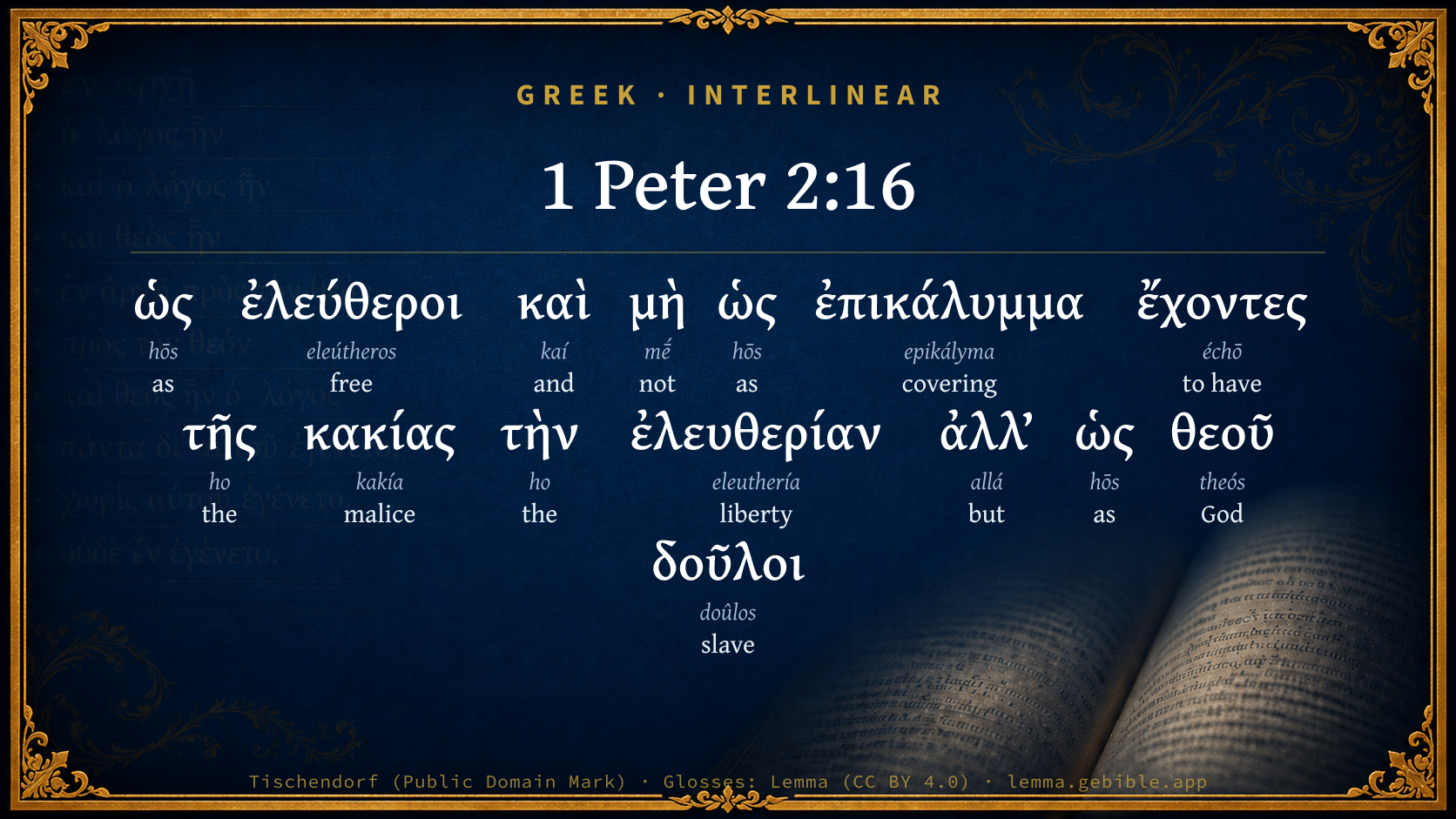
Greek (Tischendorf 8th ed.) 1 Peter 2:16 appears in the Greek New Testament. The text above is from the Tischendorf 8th edition. Each word links to its Strong’s number and a concise gloss. Click any word for its full Thayer’s Greek Lexicon entry.
Download image
Cite this verse

1 Peter 2:16 (World English Bible). Public Domain. Lemma interlinear Bible study tool, https://lemma.gebible.app/v/1-peter/2/16.

Show BibTeX & RIS
BibTeX
RIS
English Translation
as free, and not using your freedom for a cloak of wickedness, but as bondservants of God.
World English Bible · Public Domain
Highlights
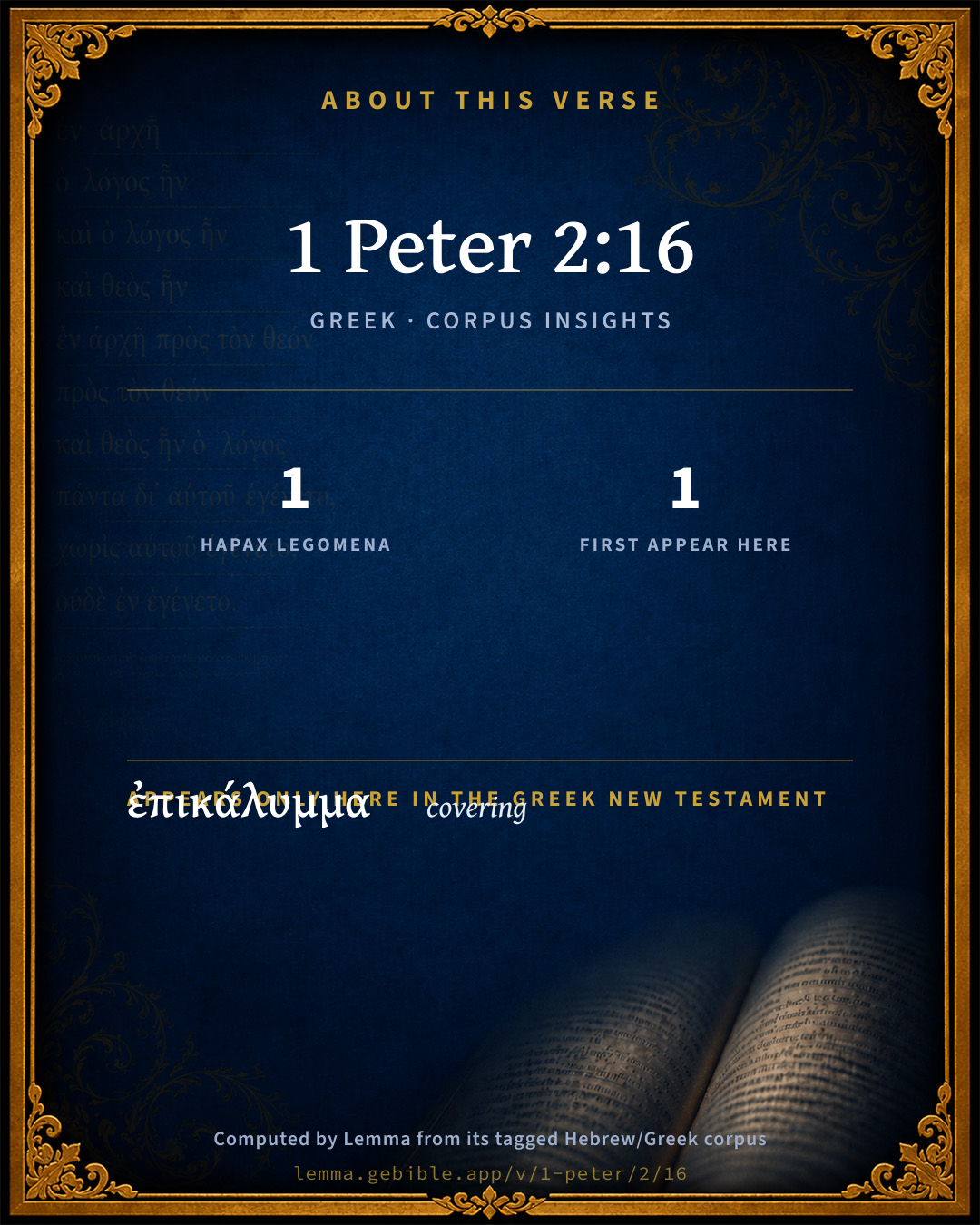
  • 1 hapax legomenon — only here in the Greek New Testament
  • 1 first appearance in the Greek New Testament
Full analysis ↓
Download a study sheet

One document with this verse’s original text, its word-by-word gloss line, the meaning frame, cross-references with their text, attributed commentary, and full source and license credits — printable, and it pastes into notes with its structure intact.

This verse Autodidact and up

Study sheet (.html) Plain text (.txt)

A passage Seminary Student

Up to 50 verses in one chapter. A passage sheet keeps up to 6 commentary sources and 12 cross-references per verse, in the order this page ranks them, and says so on the sheet whenever that leaves anything out. Ask for a single verse and you get the Autodidact verse sheet above.

Everything on this page stays free to read, with no account — the sheet is a download of what is already on screen, not access to it.

Want to remove ads? Support Godless Engineer
Compare translations 3

The same verse in 3 English versions, stacked beneath the original-language interlinear above. Click any original word for its lexicon entry.

Each is an independent rendering of the whole verse — the interlinear is not word-aligned to these translations.

Highlighted words mark where these versions differ — a whole-verse word diff, not a word-by-word alignment.

  • World English Bible Public Domain
    as free, and not using your freedom for a cloak of wickedness, but as bondservants of God.
  • King James Version Public Domain
    As free, and not using your liberty for a cloke of maliciousness, but as the servants of God.
  • unfoldingWord Literal Text CC BY-SA 4.0
    as free and not having freedom as a covering of evil, but as servants of God.

unfoldingWord Literal Text — © unfoldingWord, licensed CC BY-SA 4.0. Word-aligned USFM3 via Door43 (git.door43.org/unfoldingWord/en_ult).

Versions to compare (up to 4)

3 of 4 selected

Show all 19 translations

Every available English version of this verse, each an independent rendering of the whole verse.

  • World English Bible Public Domain
    as free, and not using your freedom for a cloak of wickedness, but as bondservants of God.
  • Berean Standard Bible Public Domain
    Live in freedom, but do not use your freedom as a cover-up for evil; live as servants of God.
  • Majority Standard Bible Public Domain
    Live in freedom, but do not use your freedom as a cover-up for evil; live as servants of God.
  • King James Version Public Domain
    As free, and not using your liberty for a cloke of maliciousness, but as the servants of God.
  • American Standard Version (1901) Public Domain
    as free, and not using your freedom for a cloak of wickedness, but as bondservants of God.
  • Revised Version (1885) Public Domain
    as free, and not using your freedom for a cloke of wickedness, but as bondservants of God.
  • Geneva Bible (1599) Public Domain
    As free, and not as hauing the libertie for a cloke of maliciousnesse, but as the seruauntes of God.
  • Douay-Rheims (1899) Public Domain
    As free, and not as making liberty a cloak for malice, but as the servants of God.
  • Young's Literal Translation Public Domain
    as free, and not having the freedom as the cloak of the evil, but as servants of God;
  • Literal Standard Version CC BY-SA 4.0
    as free, and not having freedom as the cloak of evil, but as servants of God;
  • Unlocked Literal Bible CC BY-SA 4.0
    As free people, do not use your freedom as a covering for wickedness, but be like servants of God.
  • unfoldingWord Literal Text CC BY-SA 4.0
    as free and not having freedom as a covering of evil, but as servants of God.
  • Darby Bible Public Domain
    as free, and not as having liberty as a cloak of malice, but as God's bondmen.
  • World Messianic Bible Public Domain
    Live as free people, yet not using your freedom for a cloak of wickedness, but as bondservants of God.
  • Webster's Bible Public Domain
    As free, and not using your liberty for a cloke of maliciousness, but as the servants of God.
  • Free Bible Version CC BY-SA 4.0
    Yes, you are free people! So don't use your freedom as a cover-up for evil, but live as God's servants.
  • Bible in Basic English Public Domain
    As those who are free, not using your free position as a cover for wrongdoing, but living as the servants of God;
  • Text-Critical English NT CC BY 4.0
    Live as free people, but do not use your freedom as an excuse to do evil; live as servants of God.
  • Tyndale New Testament (1534) Public Domain
    as fre and not as havinge the libertie for a cloke of maliciousnes but even as the servautes of god.

Literal Standard Version (2020), Covenant Press — licensed CC BY-SA 4.0. Text via the HelloAO Bible API (eBible.org). Unlocked Literal Bible (unfoldingWord) — licensed CC BY-SA 4.0. Text via the HelloAO Bible API (eBible.org). unfoldingWord Literal Text — © unfoldingWord, licensed CC BY-SA 4.0. Word-aligned USFM3 via Door43 (git.door43.org/unfoldingWord/en_ult). Free Bible Version, Dr. Jonathan Gallagher — licensed CC BY-SA 4.0. Text via the HelloAO Bible API (eBible.org).

Word by word

More ways to search: Search by grammar → Find every occurrence → Compare this word →

Practice this passage: Drill this verse → Learn its vocabulary →

About this verse

These counts appear in no published source. They are computed here, from the morphology-tagged text and Lemma’s own curated glosses. What Lemma adds →

15
words
12
distinct lemmas
General Epistles
section

Notable vocabulary

1 hapax legomenon — a word that appears only here in the entire Greek New Testament:

  • ἐπικάλυμμα covering G1942

First appearance in Scripture

This word makes its first canonical appearance in the Greek New Testament here:

  • ἐπικάλυμμα covering G1942

Shared distinctive vocabulary

κακίας malice G2549 occurs in 11 verses of the Greek New Testament. Also found in:
Repetition

Words recur within this verse:

Cross-references

15

Topical passages linked to 1 Peter 2:16 in the Treasury of Scripture Knowledge — connected by theme and wording, ordered by reader-vote popularity; previews shown in the World English Bible.

  • Galatians 5:13 For you, brothers, were called for freedom. Only don't use your freedom for gain to the flesh, but through love be servants to one another.
  • Romans 6:22 But now, being made free from sin, and having become servants of God, you have your fruit of sanctification, and the result of eternal life.
  • Romans 6:18 Being made free from sin, you became bondservants of righteousness.
  • 1 Corinthians 7:22 For he who was called in the Lord being a bondservant is the Lord's free man. Likewise he who was called being free is Christ's bondservant.
  • Galatians 5:1 Stand firm therefore in the liberty by which Christ has made us free, and don't be entangled again with a yoke of bondage.
  • James 1:25 But he who looks into the perfect law, the law of freedom, and continues, not being a hearer who forgets but a doer of the work, this man will be blessed in what he does.
  • Ephesians 6:6 not in the way of service only when eyes are on you, as men-pleasers; but as servants of Christ, doing the will of God from the heart;
  • James 2:12 So speak, and so do, as men who are to be judged by a law of freedom.
  • John 8:32–36 You will know the truth, and the truth will make you free."
  • Matthew 23:13 "Woe to you, scribes and Pharisees, hypocrites! For you devour widows' houses, and as a pretense you make long prayers. Therefore you will receive greater condemnation.
  • 2 Peter 2:19 promising them liberty, while they themselves are bondservants of corruption; for by whom a man is overcome, by the same is he also brought into bondage.
  • John 15:22 If I had not come and spoken to them, they would not have had sin; but now they have no excuse for their sin.
  • Colossians 3:24 knowing that from the Lord you will receive the reward of the inheritance; for you serve the Lord Christ.
  • 1 Thessalonians 2:5 For neither were we at any time found using words of flattery, as you know, nor a cloak of covetousness (God is witness),
  • Jude 1:4 For there are certain men who crept in secretly, even those who were long ago written about for this condemnation: ungodly men, turning the grace of our God into lasciviousness, and denying our only Master, God, and Lord, Jesus Christ.

Cross-references courtesy of OpenBible.info (CC BY 4.0).

Commentary

Notes on 1 Peter 2:16 from classic Christian and Jewish commentators (each source and its license shown beneath its notes). The classic Christian expositions comment on the surrounding passage and are grouped to its opening verse, so a note may address several verses; the Jewish commentaries on the Tanakh (Rashi and others) are per-verse, so they appear only where the commentator wrote on this verse.

Lemma curates 59 commentaries, every one of them public domain or Creative Commons licensed, each selected and text-cleaned for this edition rather than reprinted as found. About our sources →

Joseph Benson's Commentary

1Pe 2:16-17. As free — In the noblest sense, in consequence of your relation to Christ, and your interest in the merit of his death; (see on Joh 8:32; 1Co 7:22; Gal 5:1; Gal 5:13;) as sons and daughters of the Lord Almighty, and therefore heirs of God; and not using your liberty as a cloak of maliciousness — Κακιας, of wickedness. Though you are indeed made free from the dominion of sin and Satan, the world and the flesh, yet not from subjection to magistrates; therefore use not your liberty so as, under pretence thereof, to be guilty of disobedience to governors, or any other wickedness: but act in all things as the servants of God — Observing all his laws, and performing all the duties he requires. Honour all men — As being made in the image of God, intelligent, free, and immortal beings; bought by the blood of his Son, and designed for his eternal kingdom. Love the brotherhood — All true Christians. Fear, reverence, and obey, God. Honour the king — Whom God has set over you. Pay him all that regard, both in affection and action, which the laws of God and man require. Perhaps no finer and stronger instances of the laconic style are to be found anywhere than in this passage. It is remarkable that the apostle requires Christians to honour the Roman emperor, though a great persecutor, and of a most abandoned character.

Joseph Benson's Commentary on the Old and New Testaments (1811–1818) — public domain. Text from a community e-Sword module.

Bengel's Gnomon

Johann Albrecht Bengel

1Pe 2:16. Ὡς ἐλεύθεροι, as free) without maliciousness. This depends on 1Pe 2:13. Concerning liberty, comp. 1Pe 2:9.—κακίας) maliciousness, the vice of a slave.

Bengel's Gnomon of the New Testament — English translation (T&T Clark, Edinburgh, 1860) — public domain. Text from a community e-Sword module.

Meyer's Critical & Exegetical Commentary

Heinrich August Wilhelm Meyer

1Pe_2:16. ὡς ἐλεύθεροι] is not, as Lachm., Jachmann, Steiger, Fronmüller think, to be joined with what follows (1Pe_2:17),[141] but with a preceding thought; either with ἀγαθοποιοῦντας (Beda, Luther, Calvin, Wiesinger, Hofm.), or with ὑποτάγητε (Chrys., Oecum., Gerhard, Bengel, de Wette, Schott, etc.). The latter of these connections deserves the preference, not because in the former a change of construction would take place, but because the special point to be brought out here was, that the freedom of the Christians was to be manifested in submission to (heathen) authorities. What follows shows this, inasmuch as those Christians who had not attained unto true freedom, might easily be led to justify their opposition to those in power on the ground of the liberty which belonged to them in Christ. ὡς ἐλεύθεροι states the position which the Christians are to take up inwardly towards the authorities; their subjection is not that of δοῦλοι, since they recognise them as a divine ordinance for the attainment of moral ends.[142]

καὶ μὴ ὡς ἐπικάλυμμα ἔχοντες τῆς κακίας τὴν ἐλευθερίαν] καί is epexegetical: and that, since what follows defines the idea ἐλεύθεροι first negatively and then positively.

ὡς belongs not to ἐπικάλυμμα, but to ἔχοντες: and that not as those who have.

ἐπικάλυμμα is the more remote, τὴν ἐλευθερίαν the proximate, object of ἔχοντες: who have the ἐλευθερία as the ἐπικάλυμμα τ. κακ.

ἐπικάλυμμα, ἅπ. λεγ.; for its original meaning, cf. Exo_26:14, LXX.; here used metaphorically (cf. Kypke in loc.). The sense is: not as those to whom their freedom serves as a covering for their κακία (cf. 2Pe_2:19; Gal_5:13), i.e. who seek to conceal their wickedness by boasting of their Christian freedom. This is the exact reverse of the Pharisaism of those who seek to conceal the wickedness of the heart by an outward conformity to the law.

ἀλλʼ ὡς δοῦλοι Θεοῦ] expresses positively the nature of the truly free. True liberty consists in the δουλεία Θεοῦ (Rom_6:16 ff.); it refers back to the τὸ θέλημα τοῦ Θεοῦ, and further still to διὰ κύριον.

[141] Hofmann justly says: We cannot think of joining ver. 16 with ver. 17, for its contents would not suit πάντας τιμήσατεeven should it be connected with this only (Fronmüller), which is quite impossiblenot to speak of τὴν ἀδελφοτητα or τὸν Θεὸν φοβεῖσθε.

[142] It is not probable that Peter here refers, as Weiss (p. 349) thinks, to the words of Christ, Mat_17:27, since they apply to circumstances altogether different from those mentioned here; see Meyer in loc.

Meyer — Critical and Exegetical Commentary on the New Testament — English translation by Peter Christie, edited by Frederick Crombie (T&T Clark, 1880) — public domain. Text from a community e-Sword module.

Expositor's Greek Testament

ed. W. Robertson Nicoll

1Pe 2:16 . ὡς ἐλεύθεροι , the contrast with τῆς κακίας supports the connection of ἐ , in thought with ἀγαθοποιοῦντας , which explains the nature of the self-subjection required. Christians are free (Mat 17:26 f. q.v. ; Joh 8:36 ; Gal 2:4 ) and therefore must submit to authority. Peter generalises summarily St. Paul’s argument in Gal 5:13 , which refers to internal relations. καὶ μὴ … ἐλευθερίαν , and not having your freedom as a cloak of your malice . For ἐπ . cf. Menander (apud Stobaeum Florileg.) πλοῦτος δὲ πολλῶν ἐπικάλυμμʼ ἐστιν κακῶν . The verb is used in Ps. cited Rom 4:7 = כפר ; and this sense may perhaps be contemplated here; early Christians regarded their freedom as constituting a propitiation for future as for past sins.

The Expositor's Greek Testament, edited by W. Robertson Nicoll (1897–1910) — public domain. Text from a community e-Sword module.

Jamieson, Fausset & Brown

Robert Jamieson, A. R. Fausset & David Brown

As free--as "the Lord's freemen," connected with Pe1 2:15, doing well as being free. "Well-doing" (Pe1 2:15) is the natural fruit of being freemen of Christ, made free by "the truth" from the bondage of sin. Duty is enforced on us to guard against licentiousness, but the way in which it is to be fulfilled, is by love and the holy instincts of Christian liberty. We are given principles, not details.

not using--Greek, "not as having your liberty for a veil (cloak) of badness, but as the servants of God," and therefore bound to submit to every ordinance of man (Pe1 2:13) which is of God's appointment.

Jamieson, Fausset & Brown — Commentary Critical and Explanatory on the Whole Bible (1871) — public domain (CC PDM 1.0). Text via the HelloAO Bible API.

Adam Clarke's Commentary

Verse 16. As free] The Jews pretended that they were a free people, and owed allegiance to God alone; hence they were continually rebelling against the Roman government, to which God had subjected them because of their rebellion against him: thus they used their liberty for a cloak of maliciousness-for a pretext of rebellion, and by it endeavoured to vindicate their seditious and rebellious conduct.

But as the servants of God.] These were free from sin and Satan, but they were the servants of God-bound to obey him; and, as he had made it their duty to obey the civil magistrate, they served God by submitting to every ordinance of man for the Lord's sake.

Adam Clarke's Commentary on the Bible (1810–1826) — public domain. Text from a community e-Sword/MySword module.

John Calvin's Commentaries

16 As free This is said by way of anticipation, that he might obviate those things which are usually objected to with regard to the liberty of God’s children. For as men are naturally ingenious in laying hold on what may be for their advantage, many, at the commencement of the Gospel, thought themselves free to live only for themselves. This doting opinion, then, is what Peter corrects; and he briefly shews how much the liberty of Christians differed from unbridled licentiousness. And, in the first place, he denies that there is any veil or pretext for wickedness, by which he intimates, that there is no liberty given us to hurt our neighbors, or to do any harm to others. True liberty, then, is that which harms or injures no one. To confirm this, he declares that those are free who serve God. It is obvious, hence, to conclude, that we obtain liberty, in order that we may more promptly and more readily render obedience to God; for it is no other than a freedom from sin; and dominion is taken away from sin, that men may become obedient to righteousness.

In short, it is a free servitude, and a serving freedom. For as we ought to be the servants of God, that we may enjoy this benefit, so moderation is required in the use of it. In this way, indeed, our consciences become free; but this prevents us not to serve God, who requires us also to be subject to men.

John Calvin's Commentaries (1540-1563) — public domain. Text from the Calvin Translation Society English edition (1840s-50s) via the Christian Classics Ethereal Library (ccel.org). Calvin's coverage is partial (roughly two-thirds of the Bible); uncommented books and verses are honest gaps, never fabricated. The 19th-century editor's footnotes and remarks are omitted so the notes are faithfully Calvin's own voice.

Ellicott's Commentary for English Readers

(16) As free.—This points at once to what was the gist of the accusation. The Christian took up a position of complete independence within, and professed himself in a certain sense to be above the laws, by virtue of being a member of Christ’s kingdom. This position of independence the heathen state resented, and looked upon the Christian Church as a dangerous organisation. Here, therefore, St. Peter both insists upon, and defines that independent position. “This the Apostle adds,” says Leighton, “lest any should so far mistake the nature of their Christian liberty as to dream of an exemption from obedience either to God or to man for His sake, and according to His appointment. Their freedom he grants, but would have them understand aright what it is.”

And not using.—The word “as” in the Greek attaches better to the participle instead of to the word “cloke,” so that the sentence will run, As free (i.e., as men who are really free), and not as using freedom for a curtain of vice. In this way the true and the false freedom are more forcibly contrasted.

For a cloke of maliciousness.—The uncommon word here used means any kind of covering, but not in the sense of a garment, so that we must not insist on the metaphor of the word “cloke.” The same Greek word is used in Exo_26:14 to express the second covering of the tabernacle there mentioned, i.e., the uppermost, outermost covering. Grimm quotes a fragment of the comic poet Menander, “Wealth is a covering of many a bad thing;” this helps us to see that what St. Peter means is not ordinary hypocrisy. The man does not profess to be better than he is, but loudly asserts that he is not a slave. Men admire such freedom of speech, and excuse his vices just because of their openness.

But as the servants of God.—Such freedom as has been mentioned is no freedom. It is moral slavery. The only true freedom lies in being “servants” (or rather slaves) “of God,” whose will it is that you should be good subjects (1Pe_2:13; 1Pe_2:15). For a slightly different turn of thought, see Gal_5:13.

A Bible Commentary for English Readers, edited by Charles John Ellicott (1878–1897) — public domain. Text from a community e-Sword module.

The Cambridge Bible for Schools and Colleges

gen. ed. J. J. S. Perowne

16. as free, and not using your liberty for a cloke] The English text gives the impression that the word “free” is closely connected with the preceding verse. In the Greek, however, the adjective is in the nominative and cannot be in apposition with the preceding participle for “well-doing” which is in the accusative case. We are led therefore to connect it with what follows. “As being free … honour all men …” The fact that men had been made free with the freedom which Christ had given (comp. Joh_8:32; Joh_8:36, Gal_5:1) brought with it an obligation to use the freedom rightly. If under the pretence that they were asserting their Christian freedom, they were rude, over-bearing, insolent, regardless of the conventional courtesies of life, what was this but to make their liberty a cloke (the word is the same as that used in the LXX. of Exo_26:14 for the “covering” of the Tabernacle) for baseness? The word just given answers better to the comprehensive meaning of the Greek word than the more specific “maliciousness.” In Gal_5:13, 2Pe_2:19 we find indications that the warning was but too much needed.

“License they mean when they cry liberty”

was as true in the Apostolic age as it has been in later times.

as the servants of God] St Peter, like St Paul, brings together the two contrasts as expressing one of the paradoxes of the spiritual life. There is a service even in slavery, which is not only compatible with freedom, but is absolutely its condition. Comp. Rom_6:16-18, 1Co_7:22-23.

The Cambridge Bible for Schools and Colleges (gen. ed. J. J. S. Perowne; Cambridge University Press, 1878–1918) — public domain. Text from a community e-Sword module.

John Gill's Exposition

Honour all men,.... To whom honour is due, according to the place, station, and circumstances in which they are, the gifts of providence and grace bestowed on them, and the usefulness they are of, whether they be Jews or Gentiles, rich or poor, believers or unbelievers: it is a saying of Ben Zoma (e),

"who is to be honoured, or is worthy of honour , "he that honoureth creatures";

meaning men in general, or the Gentiles particularly, who were sometimes so called by the Jews; See Gill on Mar 16:15, and may be meant by "all men" here:

love the brotherhood; or "your brethren", as the Syriac version renders it: the whole company of the brethren in Christ, who are born of God, are members of Christ, and of the same body, and have the same spirit, belong to the same family, and are of the household of faith, let them be of whatsoever nation, or in whatsoever circumstances of life. The Jews had not that good opinion of, nor that affection for the Gentiles, but were ready to treat them with indifference, neglect, and contempt; and not only those that knew not God, but even believing Gentiles themselves; and which is the reason of these exhortations, that they should despise no man, but honour all; and especially should express their love, both by words and deeds, to those that were in the same spiritual relation with them, and that without any difference, on account of their being of another nation:

fear God; not with a servile, but a filial fear, the new covenant grace of fear; which springs from the goodness of God, has that for its object, and is increased by the fresh instances and discoveries of it; and which shows itself in a reverential affection for God, a strict regard to his worship and ordinances, and a carefulness of offending him. This is placed between what goes before, and follows after, to show the influence it has on each of them; for where the fear of God is, there will be due respect shown to all men, more or less, and an hearty and affectionate love to all the saints, as brethren, and a proper regard to those that are set in high places of dignity and power:

honour the king; Caesar, the Roman emperor, though a wicked, persecuting Nero, and so any other king or governor; who, so far as he acts the part of a civil magistrate, preserves the peace, the property, and liberty of his subjects, is a terror to evil works, and an encourager of good ones, and rules according to the laws of God, and civil society, is deserving of great honour and esteem from men; and which is to be shown by speaking well of him; by a cheerful subjection to him; by an observance of the laws, and by payment of tribute, and doing everything to make him easy, and honourable in his government: advice much like this is given by Isocrates (f),

"fear God, honour parents, revere friends, and obey the laws.

(e) Pirke Abot, c. 4. sect. 1. (f) Paraen. ad Demos Orat. 1.

John Gill's Exposition of the Whole Bible (1746–1763) — public domain (CC PDM 1.0). Text via the HelloAO Bible API.

Trapp's Complete Commentary

John Trapp

16 As free, and not using your liberty for a cloke of maliciousness, but as the servants of God.

Ver. 16. As free] {See Trapp on "Gal 5:13"}

As free, and not using, &c.] Free in respect of our consciences, exempted from human powers, and yet, as servants of God, bouud in conscience to obey him in obeying them, so far forth as he doth command us to obey them. (Downame.)

For a cloak] Or cover. This were to put light not under a bushel, but under a dunghill. Beza thinks the apostle here alludes to that old custom at Rome, that those that were manumitted or set free should go with their heads covered, who before used to go bareheaded. Religion is an ill cloak of maliciousness; and will surely serve hypocritical libertines as the disguise Ahab put on and perished.

John Trapp, A Commentary or Exposition upon All the Books of the Old and New Testament (1647–1656) — public domain. Text from a community e-Sword module.

Albert Barnes' Notes on the Bible

As free - That is, they were to consider themselves as freemen, as having a right to liberty. The Jews boasted much of their freedom, and regarded it as a birthright privilege that they were free, Joh 8:33. They never willingly acknowledged their subjection to any other power, but claimed it as an elementary idea of their civil constitution that God only was their Sovereign. They were indeed conquered by the Romans, and paid tribute, but they did it because they were compelled to do it, and it was even a question much debated among them whether they should do it or not Mat 22:17. Josephus has often referred to the fact that the Jews rebelled against the Romans under the plea that they were a free people, and that they were subject only to God. This idea of essential freedom the Jews had when they became Christians, and everything in Christianity tended to inspire them with the love of liberty.

They who were converted to the Christian faith, whether from among the Jews or the Gentiles, were made to feel that they were the children of God; that his law was the supreme rule of their lives; that in the ultimate resort they were subject to him alone; that they were redeemed, and that, therefore, the yoke of bondage could not be properly imposed on them; that God “had made of one blood all nations of men, for to dwell on all the face of the earth,” Act 17:26; and that, therefore, they were on a level before him. The meaning here is, that they were not to consider themselves as slaves, or to act as slaves. In their subjection to civil authority they were not to forget that they were freemen in the highest sense, and that liberty was an invaluable blessing. They had been made free by the Son of God, Joh 8:32, Joh 8:36. They were free from sin and condemnation. They acknowledged Christ as their supreme Head, and the whole spirit and tendency of his religion prompted to the exercise of freedom.

They were not to submit to the chains of slavery; not to allow their consciences to be bound, or their essential liberty to be interfered with; nor in their subjection to the civil magistrate were they ever to regard themselves otherwise than as freemen. As a matter of fact, Christianity has always been the friend and promoter of liberty. Its influence emancipated the slaves throughout the Roman Empire; and all the civil freedom which we enjoy, and which there is in the world, can be traced to the influence of the Christian religion. To spread the gospel in its purity everywhere would be to break every yoke of oppression and bondage, and to make people everywhere free. It is the essential right of every man who is a Christian to be a freeman - to be free to worship God; to read the Bible; to enjoy the avails of his own labor; to train up his children in the way in which he shall deem best; to form his own plans of life, and to pursue his own ends, provided only that he does not interfere with the equal rights of others - and every system which prevents this, whether it be that of civil government, of ecclesiastical law, or of domestic slavery, is contrary to the religion of the Saviour.

And not using your liberty for a cloke of maliciousness - Margin, as in Greek, “having.” Not making your freedom a mere pretext under which to practice all kinds of evil. The word rendered “maliciousness” - κακία kakia - means more than our word maliciousness does; for it denotes evil of any kind, or all kinds. The word maliciousness refers rather to enmity of heart, ill-will, an intention to injure. The apostle has reference to an abuse of freedom, which has often occurred. The pretence of these who have acted in this manner has been, that the freedom of the gospel implied deliverance from all kinds of restraint; that they were under no yoke, and bound by no laws; that, being the children of God, they had a right to all kinds of enjoyment and indulgence; that even the moral law ceased to bind them, and that they had a right to make the most of liberty in all respects. Hence, they have given themselves up to all sorts of sensual indulgence, claiming exemption from the restraints of morality as well as of civil law, and sinking into the deepest abyss of vice. Not a few have done this who have professed to be Christians; and, occasionally, a fanatical sect now appears who make the freedom which they say Christianity confers, a pretext for indulgence in the most base and degrading vices. The apostles saw this tendency in human nature, and in nothing are they more careful than to guard against this abuse.

But as the servants of God - Not free from all restraint; not at liberty to indulge in all things, but bound to serve God in the faithful obedience of his laws. Thus bound to obey and serve him, they could not be at liberty to indulge in those things which would be in violation of his laws, and which would dishonor him. See this sentiment explained in the notes at 1Co 7:22; 1Co 9:21.

Albert Barnes' Notes on the Bible (1834–1885) — public domain. Text from a community e-Sword/MySword module.

Haydock's Catholic Bible Commentary

As free; to wit, from the slavery of sin, but take care not to make this Christian freedom and liberty a cloak for malice, as they do, who pretend that this makes subjects free from their obedience to temporal princes and magistrates; or servants free from the obedience due to their masters, even when they are froward,[6] ill-humoured, or cross to them. (Witham) --- There were some heretics in the days of St. Peter, as there are at present, who under pretext of evangelical liberty seek to be free from all even lawful subjection, and thus set themselves above the ordinances of both civil and ecclesiastical power.

===============================

[BIBLIOGRAPHY]

Dyscolis, Greek: skoliois, pravis, curvis, &c.

George Leo Haydock (1774–1849), Haydock's Catholic Family Bible and Commentary, 1859 edition — public domain. Excludes Psalms (Douay-Rheims chapter numbering differs from Protestant) and Deuterocanonical books (Catholic canon only).

Matthew Poole's English Annotations

As free; he prevents an objection; they might pretend they were a free people, as Jews, and therefore were not to obey strangers, Deu 17:15; Joh 8:33; and made free by Christ. He answers: That they were free indeed, but it was from sin, and not from righteousness, not from obedience to God’s law, which requires subjection to magistrates, for they were still the servants of God.

And not using your liberty for a cloak of maliciousness; not using your liberty to cover or palliate your wickedness, excusing yourselves from obedience to your superiors by a pretence of Christian liberty, when, though ye be free from sin, yet ye are not from duty.

But as the servants of God; and so still bound to obey him, and your rulers in him.

Matthew Poole's English Annotations on the Holy Bible (1683–1685) — public domain. Text from a community e-Sword/MySword module.

Whedon's Commentary on the Bible

Daniel D. Whedon

16. As free—Compare St. Paul in Gal_5:13. Free, as being of the royal priesthood, the holy nation, and God’s own people, (1Pe_2:9,) with the consciousness of superiority to a mere earthly life. But they might not therefore infer a freedom from obligation to obey earthly laws. The Jews were thus misled, claiming to owe allegiance only to God as their King, and stirring up rebellion against the authority of Rome. By a perversion of the true doctrine, this Christian freedom might become a pretext for sedition, and a cloak to cover gross wickedness. The Anabaptists in Germany, and the Fifth-monarchy men in England, in Cromwell’s time, furnish notable illustrations.

Servants of God—Free, yet servants; bound to obey God, and therefore to obey those to whom he commands us to submit ourselves.

Daniel D. Whedon (gen. ed.), Commentary on the Old and New Testaments (1874–1909) — public domain. Text from a community e-Sword module.

The Pulpit Commentary

As free. This verse is not to be taken with what follows, for it does not well cohere with the contents of ver. 17; but either with ver. 14 (Ver. 15 being regarded as parenthetical) or with ver. 15, notwithstanding the change of case in the original, which presents no real difficulty; the meaning being that Christian freedom must show itself, not in license, but in willing obedience to constituted authorities: "Not only for wrath, but for conscience" sake". (Rom_13:5) Those whom the truth makes free are free indeed, but true freedom implies submission to legitimate authority. And not using your liberty for a cloak of maliciousness; literally, not having your liberty as a cloak. The word rendered "cloak" (ejpikalumma) is used in the Septuagint (Exo_26:14) for the covering of the tabernacle. The pretence of Christian liberty must not be made a covering, a concealment, of wickedness. But as the servants of God. The truest liberty is that of the servants of God; his service is perfect freedom. (comp. Rom_6:16-23)

True freedom.

The change was great which even an enlightened and pious Jew passed through when he received Jesus as the Messiah. Finding in Christian doctrine and privilege the substance of which he had so long been conversant with the shadow, his mind expanded and his best feelings were touched with a brightness of joy and hope. The moral horizon widened around him. Human life must have seemed a grander and more glorious thing. Much more must this have been the case with a heathen, who, if sincere, had been encompassed with the chains of a ceremonial religion. Both to the Jewish and the Gentile convert the predominant experience in Christian faith and fellowship must have been an experience of liberty. It was a justly founded delight which they thus came to share. Yet it was not without its dangers, as the Apostle Peter well knew. Hence his admonition to his readers to take and practically to adopt a fair and balanced view of the new liberty upon which they had entered.

I THE CHRISTIAN"S SPIRITUAL FREEDOM.

1. He enjoys freedom in relation to God. Apart from the great redemption, man is, as sinful, exposed to the Divine displeasure and righteous condemnation. From this he is delivered, i.e. set free; and that by an act of God"s own clemency and interposition.

2. He is emancipated from the slavery to which sin formerly subjected him. The Scriptures everywhere represent the service of sin as serfdom, not as honorable and worthy of such a being as man. And experience shows that this view is just, that the servant of sin is the slave of sin. Now, from this bondage Christ liberates his people. Sin has not dominion over them. No created power could effect this great enfranchisement; it is the work of the Divine Savior clothed with the omnipotence of Heaven.

3. He is also freed from subjection to the authority of man. As the soul recognizes the right of Deity, the power claimed by humanity recedes and diminishes. Another and a higher standard than human authority claims profoundest reverence; and, where there is a conflict, the Christian spirit realizes freedom from the created yoke.

II THE CHRISTIAN"S RENUNCIATION OF THE COUNTERFEIT OF LIBERTY.

No doubt many, under the guise of Christianity, have adopted antinomian principles; it was so in apostolic days; it is so now. Against this error Peter faithfully warns those lately emancipated from bondage to sin and death. We are warned in this language:

(1) that it is possible for men nominally Christian to be in bondage in respects in which they ought to be free; and

(2) to be exercising freedom where they ought to submit to restraint. The history of Christendom assures us that there is a tendency, on the part of those who realize their new and sacred privileges, to despise the safe way of scrupulous and watchful obedience. And on the other hand, it is found that traditional chains are retained and cherished which should be cast off with indignation and hatred.

III THE CHRISTIAN"S SPIRITUAL BONDAGE.

All the while that he is free, the Christian is the true servant and bondman of the Lord Christ. Of this service it may be said that it is:

1. Voluntary, because adopted and accepted deliberately, upon a consideration of the claims of Christ, and the true duty and interest of his emancipated ones.

2. Practical, being the service not only of the heart, but of the bodily nature and outward life.

3. Honorable. In the slavery of sin is disgrace; but to serve Christ is higher honor than for a minister of state to serve a good and mighty king, than for a pupil to serve a master of power and genius.

4. Happy and advantageous. The Christian does not serve for the sake of the reward; but he does not serve without a reward. Christ has it in his power to recompense, and he exercises this power for the benefit of his faithful adherents and friends. There is no joy like that of serving Christ, and no recompense such as that which he does and will confer. In a word, it is the experience of the Christian that true service and true liberty are united in his life, and in his life alone. J.R.T.

The Pulpit Commentary (1880–1919), ed. H.D.M. Spence-Jones & Joseph S. Exell — public domain. Text from a community e-Sword module.

John Wesley's Explanatory Notes

As free - Yet obeying governors, for God's sake.

John Wesley, Explanatory Notes Upon the Whole Bible (1754–1765) — public domain. Text via the GEBible commentary corpus.

Burkitt's Expository Notes on the New Testament

William Burkitt

Here our apostle answers an objection, which he foresaw the Christian Jews ready to make against this duty of subjection, namely, "that they were a free people, as Jews, and ought to preserve their liberty, and own no governors that were not of their own nation: and as Christians they looked upon themselves as Christ’s freemen:" whereas Christian liberty exempts no man from the duty of civil subjection: the liberty Christ has purchased for believers is a freedom from sin and Satan, from sinful servitude: Christ makes all his subjects free, but it is with a freedom from spirtual bondage, and not from civil subjection; consequently, to plead our Christian liberty in bar to that obedience which we owe our superiors and governors, either civil or ecclesiastical, is to use our liberty for a cloak of maliciousness, and as a covering for that disobedience which is hateful to God, and injurious to mankind, as being destructive of order and government, which is the beauty and the bond of human society.

William Burkitt's Expository Notes on the New Testament (1700–1703) — public domain. Text from a community e-Sword module.

The People's New Testament

B. W. Johnson

16. As free. Christians, freed from the bondage of sin and of the law, and having the free spirit of children, must not use their liberty as a cloke, an excuse, for wickedness. Servants. They are God's servants.

B. W. Johnson's The People's New Testament with Notes (1889–1891) — public domain. Electronic text from the Christian Classics Ethereal Library (CCEL) ThML edition.

Cambridge Greek Testament for Schools and Colleges

16. ὡς ἐλεύθεροι. The nominative connects the verse with 1Pe 2:13. In submitting yourselves to the institutions of human society you will not be reverting to the old bondage of your heathen life from which you have been ransomed. The service of God is “perfect freedom” (cui servire est regnare), the freedom to do what you ought rather than what you like. Old institutions must be submitted to not as a bondage to men but as ordinances of God.

ἐπικάλυμμα κακίας. Christian liberty affords no pretext for churlish, scornful, contempt towards heathenism and its institutions, rather it requires you to “honour all men.”

ὡς θεοῦ δοῦλοι, cf. Rom 6:22 and 1Co 7:22.

Cambridge Greek Testament for Schools and Colleges (Cambridge University Press, 1896; 21 vols, various authors incl. Carr, Maclear, Plummer, Farrar, Lumby, Moule, M. R. James, Simcox) — public domain. Text from a community e-Sword module.

Alford’s Greek Testament

Henry Alford

16.] The connexion is somewhat doubtful. Chrys. (in Cramer’s Catena), Œc., Bengel, Gerh., De Wette, join ὡς ἐλεύθεροι with ὑποτάγητε above, ver. 13: Bede, Luther, Calv., Hammond, Wiesinger, with ἀγαθοποιοῦντας, ver. 15: Steiger, Huther, with the following, ver. 17. This latter seems quite untenable, as carrying no application on from ver. 16 to ver. 17. No one would think of pleading his freedom as an excuse for not honouring all, or for not loving the brethren, or for not fearing God: or indeed for not, in some sense, honouring the King. But in a matter of subjection, such ἐλευθερία might be and often is made a cloak for disobedience. Connecting then ὡς ἐλεύθ. with what has preceded, which of the other connexions are we to take? That with ὑποτάγητε seems too distant: it may certainly be said that ver. 17 brings in again the general duty in its most simple form: but even thus we can hardly account for the parenthetical ver. 15, so unparenthetical in its aspect and construction. Whereas if we join ὡς ἐλεύθ. to ver. 15, we obtain, as Wiesinger well argues, an epexegesis which that verse seems to need,—for it is almost a truism that we are to accomplish the φιμοῦν by ἀγαθοποιεῖν, unless some explanation be given of the particular circumstances under which this is to take place. I regard then ver. 16 as an epexegesis of ver. 15, not carrying on the construction with an accus. but with a nom. as already in ver. 12, and indeed even more naturally here, because not the act consequent on ἀγαθοποιεῖν, as there on ἀπέχεσθαι, is specified, but the antecedent state and Christian mode of ἀγαθοποιεῖν. As free (children of God, His family and people, His kingly priesthood: not merely free from the law, or free from sin, or free from earthly subjection, but generally and abstractedly free—Christ’s freed men), and not as (ὡς belongs to ἔχοντες, not to ἐπικάλυμμα) having (cf. above, ver. 12) your freedom (for) a veil (reff.) of your evil intent (the τῆς, hypothetical: of the evil intent which using your freedom as a veil would necessarily presuppose), but as God’s (emphatic) servants (and therefore bound to submit yourselves to that which God ordains).

Henry Alford, The Greek Testament (1849–1861) — public domain. Text from a community e-Sword module.

Vincent's Word Studies in the New Testament

Marvin R. Vincent

Using [εχοντες] . Lit., having or holding.

Cloke [επικαλυμμα] . Only here in New Testament. Lit., a veil. The idea is that of using Christian freedom as a mask for ungodly license. Paul uses the kindred verb (Rom 4:7) of the covering of sins. On the sentiment, compare Gal 5:13.

Marvin R. Vincent, Word Studies in the New Testament (1887–1900) — public domain. Text from a community e-Sword/MySword module.

Lesson kit

Teaching starters — assembled from the data on this page, not authored interpretation. Every prompt links to the verse data it draws on. Edit before teaching.

1 Peter, in the General Epistles, opens this verse with 15 words (12 distinct Greek lemmas). Its most distinctive word is epikályma (“covering”). A historical commentator’s framing appears above. Read the whole chapter for the surrounding context.

Discussion questions

  1. What does “covering” (epikályma) contribute to the verse as a whole?
  2. This verse holds 1 word here found nowhere else in the Greek New Testament. What might the rare word draw attention to?
  3. The word “covering” first appears here in Scripture. What is being introduced at this debut?
  4. Matthew 6:34 shares the word «malice» with this verse. How do the two illuminate each other?
  5. “as” occurs 3× in this one verse. What is the effect of the repetition?
  6. These translations render this verse differently. What is at stake in choosing one wording over another?
  7. Reading how Joseph Benson's Commentary and Bengel's Gnomon read this verse, where do the two commentators agree and where do they part?

Things to notice

  • 1 word in this verse appears nowhere else in the Greek New Testament.
  • 1 word makes its first canonical appearance in Scripture here.
  • These translations choose different wording for 12 words in this verse.
  • “as” occurs 3× in this single verse.
  • 12 distinct Greek lemmas span 15 words in this verse.

Reading settings

Reading text

Shown beneath each verse's original-language words.

Old Testament
Old Testament edition

Read the OT as the Masoretic Hebrew (MT) or the Greek Septuagint (LXX).

English shown for the Greek Septuagint (in the Hebrew ↔ Greek comparison).

Comparing translations? Open the Compare panel on any verse page to stack up to four side by side.