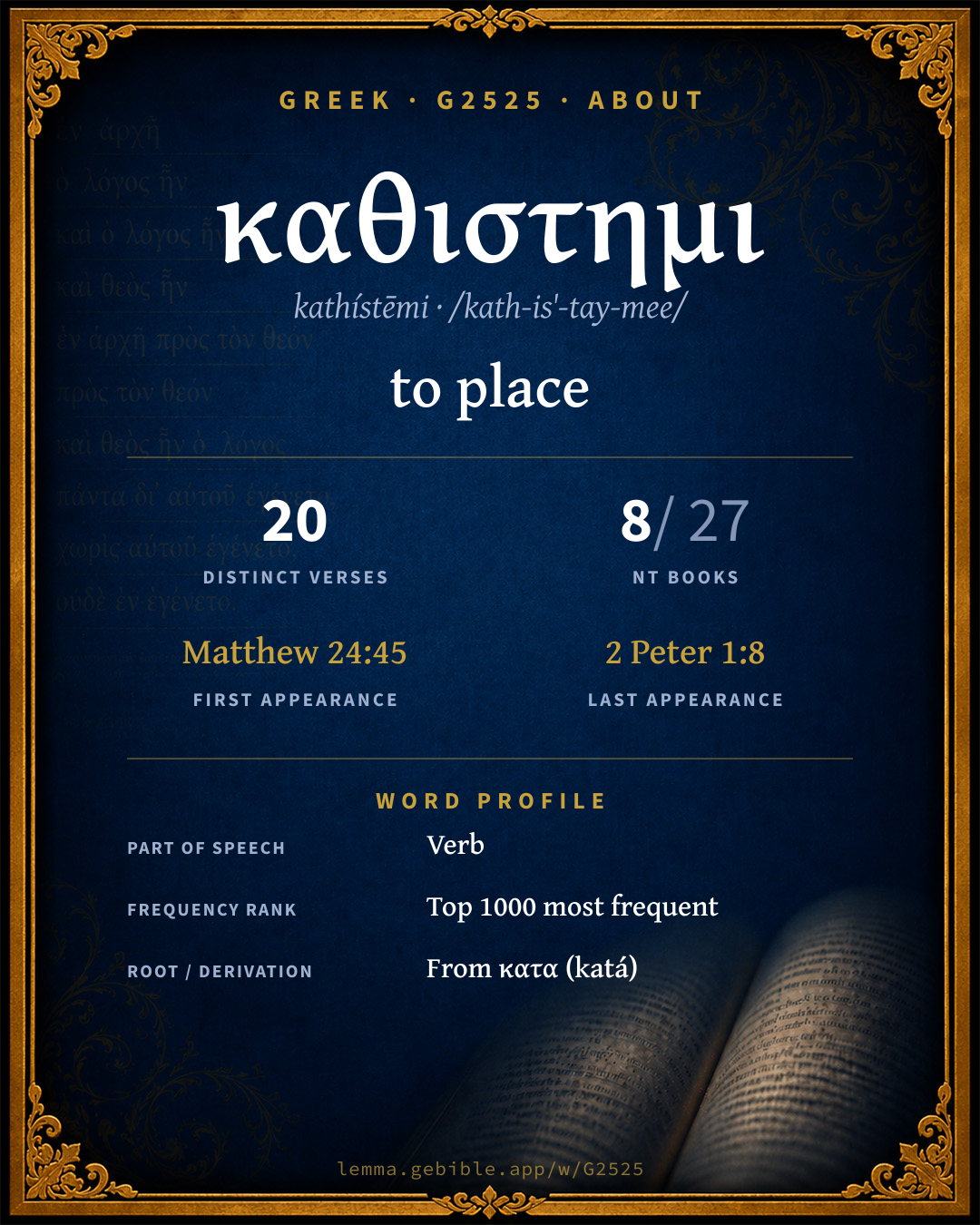
καθίστημι
to place
‘to place’ is one of 6 main senses fuller range ↓
Full lexicon entry — Thayer's Greek Lexicon
From Thayer's Greek Lexicon
Where this word appears
See every Future-tense verb in the Greek New Testament →
Grammar key — what these labels mean
Part of speech
- Verb
- An action or state-of-being word.
Tense
- Aorist
- Action viewed as a simple whole, without regard to duration — often past (perfective aspect).
- Present
- Ongoing or general action in present time (imperfective aspect).
- Future
- Action expected in future time.
Voice
- Active
- The subject performs the action.
- Passive
- The subject receives the action.
Mood
- Indicative
- States a fact or asks a factual question (the mood of reality).
- Subjunctive
- Expresses probability, purpose, or possibility (the mood of contingency).
- Participle
- A verbal adjective (“writing,” “having written”).
Case
- Nominative
- The case of the subject (and the predicate nominative).
Person
- 3rd person
- The one spoken about (“he / she / it / they”).
- 1st person
- The speaker (“I / we”).
- 2nd person
- The one addressed (“you”).
Gender
- Masculine
- Grammatically masculine.
Number
- Singular
- One.
- Plural
- More than one.
1 verse where G2525 appears in the Aorist tense in the Book of Matthew. Filtered view — show all forms. Click any verse to open its interlinear word-by-word view. Verse text shown in the World English Bible for context — . Each verse’s Greek form is shown with its reference; the English is not keyword-highlighted, since the data carries no word-level English alignment. Use “Compare translations” on any verse to read it across multiple English versions. This concordance covers the Greek New Testament; Septuagint (Greek Old Testament) occurrences of this word are not indexed here.
Matthew
About this entry
At a glance — auto-summarized from this page’s data, not written by a person. Every figure links to its source below. This summary describes the numbers; it doesn’t interpret them.
At its core, καθιστημι (kathístēmi) means “to place.” Catalogued under 6 senses, its meaning is not single-sense. With 20 verses in 8 books, it is an uncommon word in the Greek New Testament. Its uses concentrate in Acts (25% of all occurrences). First canonically at Matthew 24:45, it enters the text early. Dig into 20-verse concordance and the renderings breakdown below.
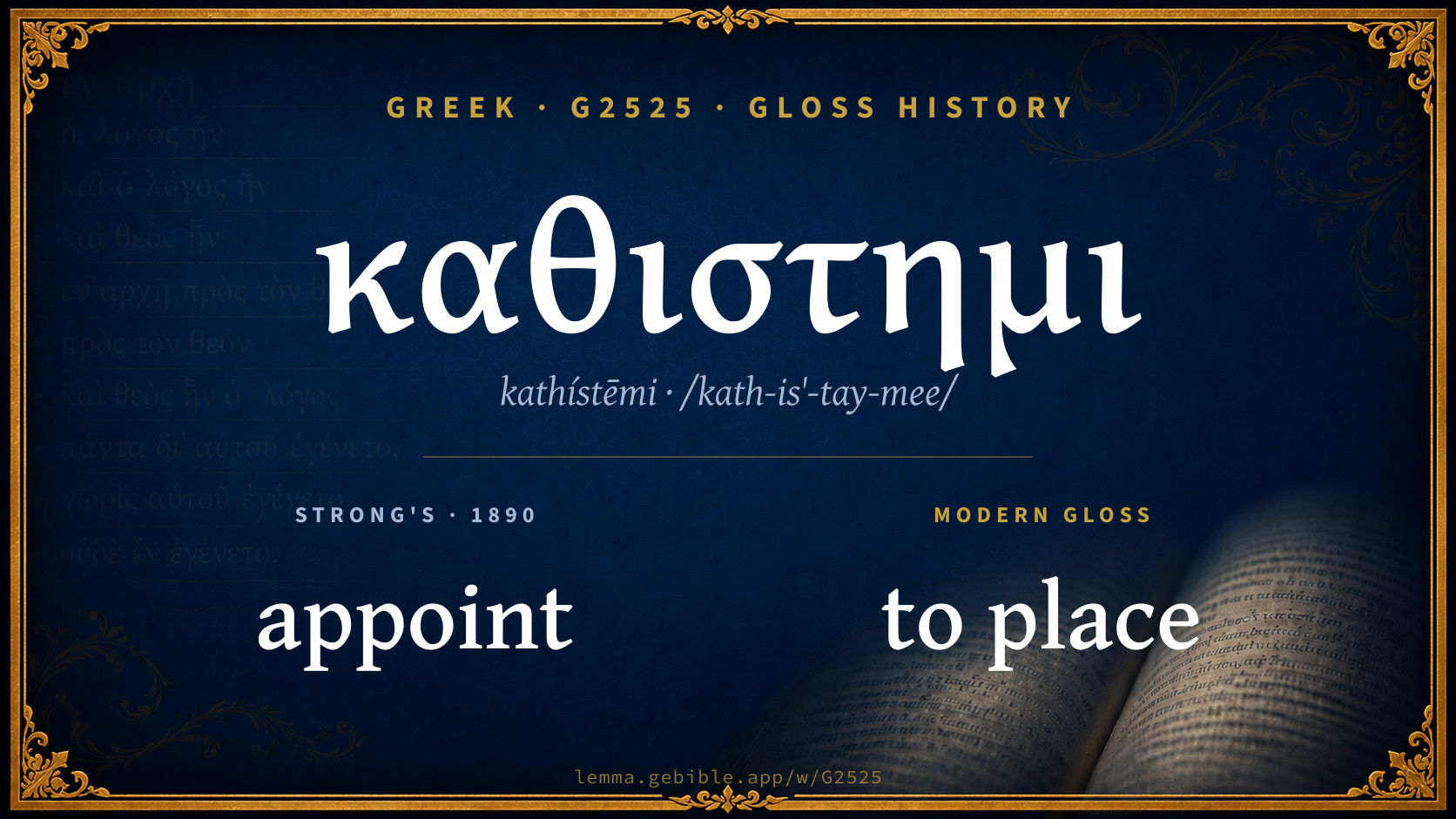
Gloss history
Strong's 1890 vs modern scholarship
About this word
Strong's G2525 catalogs a Greek word from the Greek New Testament.
These counts are not copied from any lexicon or concordance. They are computed here, from the morphology-tagged Greek New Testament. What Lemma adds →
- 20
- distinct verses
- The word appears in 20 distinct verses.
- 8 / 27
- NT books
- The word appears in 8 of 27 New Testament books.
- #607
- by frequency
- Top 1000 most frequent Greek words (rank 607 of 5,347 Greek words by occurrence).
View all 20 occurrences in the concordance →
By section of the New Testament
By traditional corpus
Conventional, traditional groupings — biblical authorship is debated, so this is a traditional corpus grouping, not an authorship claim. Some books belong to more than one corpus (Luke is in both the Gospels and the Lukan corpus, and so on), so these shares overlap and need not total 100%. Each figure is a share of the word’s 20 distinct verses.
- Lukan (Luke–Acts) 8 verses · 40%
- Gospels 7 verses · 35%
- Hebrews 3 verses · 15%
- General (Catholic) Epistles 3 verses · 15%
- Pauline corpus 2 verses · 10%
How translations render this word
Counts come from each version’s own published word-to-Strong’s tagging or interlinear alignment — an approximate guide to how each version renders this word, not a word-level alignment the data otherwise carries. Because each total is that version’s own tagged count, the per-version totals vary from one another and need not match the appearance or distinct-verse counts above. These counts may also differ from a printed concordance because Lemma counts each distinctly tagged rendering and does not collapse phrase taggings into a single head-word total. This is a fixed set of word-tagged versions (KJV, ASV, BSB, ULT) and does not change with the reading translation you choose elsewhere. Each version’s license is shown beside its name below (and on Sources).
- King James Version: Ruler 4×, Made 3×, I will make 2×
- American Standard Version: Made 3×, I will set 2×, Is appointed 2×
- Berean Standard Bible: Appointed 2×, He will put him in charge 2×, I will put 2×
- unfoldingWord Literal Text: Appointed 3×, He will appoint 2×, I will appoint 2×
King James Version Public Domain
Renders G2525 across 26 tagged occurrences — most commonly:
Plus 13 renderings that appear only once — usually multi-word phrases or single function words the recovered tagging swept in, not distinct renderings.
American Standard Version Public Domain
Renders G2525 across 26 tagged occurrences — most commonly:
Plus 19 renderings that appear only once — usually multi-word phrases or single function words the recovered tagging swept in, not distinct renderings.
Berean Standard Bible Public Domain
Renders G2525 across 20 tagged occurrences — most commonly:
Plus 10 renderings that appear only once — usually multi-word phrases or single function words the recovered tagging swept in, not distinct renderings.
unfoldingWord Literal Text CC BY-SA 4.0
Renders G2525 across 22 tagged occurrences — most commonly:
Plus 13 renderings that appear only once — usually multi-word phrases or single function words the recovered tagging swept in, not distinct renderings.
Senses in Thayer's
The 6 senses Thayer's distinguishes for this word, in lexicon order (not ranked by frequency or importance). The full entry — with sub-senses — is in the Lexicon Entry tab.
- to set one over a thing (in charge of it)
- to appoint one to administer an office
- to set down as, constitute, to declare, show to be
- to constitute, to render, make, cause to be
- to conduct or bring to a certain place
- to show or exhibit one's self
Word origin
Derived from κατα (katá) (G2596) — down.
Forms in the corpus
The 10 distinct written forms G2525 takes in the Greek New Testament, most frequent first — each parse links to that tense’s occurrences in the concordance.
| Form | Parsing | Example | Uses |
|---|---|---|---|
| κατέστησεν katéstēsen | Verb, Aorist, Active, Indicative, 3rd person, Singular | Matthew 24:45 | 5 |
| καθίσταται kathístatai | Verb, Present, Passive, Indicative, 3rd person, Singular | Hebrews 5:1 | 4 |
| καταστήσει katastḗsei | Verb, Future, Active, Indicative, 3rd person, Singular | Matthew 24:47 | 3 |
| καθίστησιν kathístēsin | Verb, Present, Active, Indicative, 3rd person, Singular | Hebrews 7:28 | 2 |
| καταστήσω katastḗsō | Verb, Future, Active, Indicative, 1st person, Singular | Matthew 25:21 | 2 |
| καθιστάνοντες kathistánontes | Verb, Present, Active, Participle, Nominative, Plural, Masculine | Acts 17:15 | 1 |
| καταστήσομεν katastḗsomen | Verb, Future, Active, Indicative, 1st person, Plural | Acts 6:3 | 1 |
| καταστήσῃς katastḗsēs | Verb, Aorist, Active, Subjunctive, 2nd person, Singular | Titus 1:5 | 1 |
| κατασταθήσονται katastathḗsontai | Verb, Future, Passive, Indicative, 3rd person, Plural | Romans 5:19 | 1 |
| κατεστάθησαν katestáthēsan | Verb, Aorist, Passive, Indicative, 3rd person, Plural | Romans 5:19 | 1 |
Same root — word family
Other Thayer's entries built from the same root as G2525, grouped by Strong’s listed origin. These share a root / origin per the lexicon — not necessarily a shared meaning. Each links to that word’s own entry.
Derives from
Shares the same root
- καθα kathá G2505 according as
- καθαιρεω kathairéō G2507 to tear down
- καθαπτω katháptō G2510 to fasten down
- καθεδρα kathédra G2515 seat
- καθεζομαι kathézomai G2516 to sit down
- καθεξης kathexēs G2517 in order
- καθευδω katheúdō G2518 to fall asleep
- καθηγητης kathēgētḗs G2519 guide
- καθηκω kathḗkō G2520 to come down
- καθημαι káthēmai G2521 to sit down
- καθημερινος kathēmerinós G2522 daily
- καθιημι kathíēmi G2524 to send down
- καθο kathó G2526 according to what
- καθολου kathólou G2527 wholly
- καθοπλιζω kathoplízō G2528 to arm
- καθοραω kathoráō G2529 to see clearly
- καθοτι kathóti G2530 according to what
- καθως kathṓs G2531 according as
- καμμυω kammýō G2576 to close eyes
- καταβαινω katabaínō G2597 to descend
- καταβαλλω katabállō G2598 to cast down
- καταβαρεω katabaréō G2599 to weigh down
- καταβιβαζω katabibázō G2601 to bring down
- καταβραβευω katabrabeúō G2603 to defraud
+103 more words share this root (not shown).
Derived from this word
Compare all same-root words → Showing 4 of 130 — not the complete family. They share a root, not necessarily a meaning.
Septuagint usage
The same Greek word καθιστημι appears 171 times in the Greek Old Testament (Septuagint), across 164 verses in 24 books.
- 171
- LXX occurrences
- Tagged occurrences of this Greek word in the Septuagint.
- 164
- verses
- Distinct Septuagint verses containing this word.
- 24 / 39
- OT books
- The word appears in 24 of the 39 Old Testament books.
Sample Septuagint occurrences
- Genesis 23:16 καταἵστημι
- Exodus 2:14 καταἵστημι
- Leviticus 13:16 καταἵστημι
- Numbers 3:10 καταἵστημι
- Deuteronomy 1:13 καταἵστημι
- Joshua 5:7 καταἵστημι
- 1 Samuel 1:9 καταἵστημι
- 2 Samuel 3:39 καταἵστημι
- 1 Kings 2:35 καταἵστημι
- 2 Kings 7:17 καταἵστημι
- 1 Chronicles 6:16 καταἵστημι
- 2 Chronicles 11:15 καταἵστημι
Septuagint occurrences (same lexeme)
Every verse where the same Strong’s number (G2525) appears in the Greek Septuagint — showing the first 50 of 164. Verse text shown in the World English Bible for context; the Greek form is the matched word — the English is not keyword-highlighted.
- Genesis 23:16 καταἵστημι Abraham listened to Ephron. Abraham weighed to Ephron the silver which he had named in the audience of the children of Heth, four hundred shekels of silver, according to the current merchants' standard.
- Genesis 29:3 καταἵστημι There all the flocks were gathered. They rolled the stone from the well's mouth, and watered the sheep, and put the stone again on the well's mouth in its place.
- Genesis 39:4 καταἵστημι Joseph found favor in his sight. He ministered to him, and he made him overseer over his house, and all that he had he put into his hand.
- Genesis 39:5 καταἵστημι It happened from the time that he made him overseer in his house, and over all that he had, that Yahweh blessed the Egyptian's house for Joseph's sake; and the blessing of Yahweh was on all that he had, in the house and in the field.
- Genesis 40:13 καταἵστημι Within three more days, Pharaoh will lift up your head, and restore you to your office. You will give Pharaoh's cup into his hand, the way you did when you were his cupbearer.
- Genesis 40:21 καταἵστημι He restored the chief cupbearer to his position again, and he gave the cup into Pharaoh's hand;
- Genesis 41:13 καταἵστημι It happened, as he interpreted to us, so it was: he restored me to my office, and he hanged him."
- Genesis 41:33 καταἵστημι Now therefore let Pharaoh look for a discreet and wise man, and set him over the land of Egypt.
- Genesis 41:34 καταἵστημι Let Pharaoh do this, and let him appoint overseers over the land, and take up the fifth part of the land of Egypt's produce in the seven plenteous years.
- Genesis 41:41 καταἵστημι Pharaoh said to Joseph, "Behold, I have set you over all the land of Egypt."
- Genesis 41:43 καταἵστημι and he made him to ride in the second chariot which he had. They cried before him, "Bow the knee!" He set him over all the land of Egypt.
- Genesis 47:5 καταἵστημι Pharaoh spoke to Joseph, saying, "Your father and your brothers have come to you.
- Exodus 2:14 καταἵστημι He said, "Who made you a prince and a judge over us? Do you plan to kill me, as you killed the Egyptian?" Moses was afraid, and said, "Surely this thing is known."
- Exodus 4:7 καταἵστημι He said, "Put your hand inside your cloak again." He put his hand inside his cloak again, and when he took it out of his cloak, behold, it had turned again as his other flesh.
- Exodus 5:14 καταἵστημι The officers of the children of Israel, whom Pharaoh's taskmasters had set over them, were beaten, and demanded, "Why haven't you fulfilled your quota both yesterday and today, in making brick as before?"
- Exodus 14:26 καταἵστημι Yahweh said to Moses, "Stretch out your hand over the sea, that the waters may come again on the Egyptians, on their chariots, and on their horsemen."
- Exodus 14:27 καταἵστημι Moses stretched out his hand over the sea, and the sea returned to its strength when the morning appeared; and the Egyptians fled against it. Yahweh overthrew the Egyptians in the midst of the sea.
- Exodus 18:21 καταἵστημι Moreover you shall provide out of all the people able men, such as fear God: men of truth, hating unjust gain; and place such over them, to be rulers of thousands, rulers of hundreds, rulers of fifties, and rulers of tens.
- Leviticus 13:16 καταἵστημι Or if the raw flesh turns again, and is changed to white, then he shall come to the priest;
- Numbers 3:10 καταἵστημι You shall appoint Aaron and his sons, and they shall keep their priesthood. The stranger who comes near shall be put to death."
- Numbers 3:32 καταἵστημι Eleazar the son of Aaron the priest shall be prince of the princes of the Levites, with the oversight of those who keep the charge of the sanctuary.
- Numbers 4:19 καταἵστημι but thus do to them, that they may live, and not die, when they approach to the most holy things: Aaron and his sons shall go in, and appoint them everyone to his service and to his burden;
- Numbers 21:15 καταἵστημι The slope of the valleys That inclines toward the dwelling of Ar, Leans on the border of Moab.
- Numbers 31:48 καταἵστημι The officers who were over the thousands of the host, the captains of thousands, and the captains of hundreds, came near to Moses;
- Numbers 35:25 καταἵστημι and the congregation shall deliver the manslayer out of the hand of the avenger of blood, and the congregation shall restore him to his city of refuge, where he was fled: and he shall dwell therein until the death of the high priest, who was anointed with the holy oil.
- Deuteronomy 1:13 καταἵστημι Take wise men of understanding and well known according to your tribes, and I will make them heads over you.
- Deuteronomy 1:15 καταἵστημι So I took the heads of your tribes, wise men, and known, and made them heads over you, captains of thousands, and captains of hundreds, and captains of fifties, and captains of tens, and officers, according to your tribes.
- Deuteronomy 16:18 καταἵστημι Judges and officers shall you make you in all your gates, which Yahweh your God gives you, according to your tribes; and they shall judge the people with righteous judgment.
- Deuteronomy 17:14 καταἵστημι When you are come to the land which Yahweh your God gives you, and shall possess it, and shall dwell therein, and shall say, I will set a king over me, like all the nations that are round about me;
- Deuteronomy 17:15 καταἵστημι you shall surely set him king over you, whom Yahweh your God shall choose: one from among your brothers shall you set king over you; you may not put a foreigner over you, who is not your brother.
- Deuteronomy 19:16 καταἵστημι If an unrighteous witness rise up against any man to testify against him of wrong-doing,
- Deuteronomy 20:9 καταἵστημι It shall be, when the officers have made an end of speaking to the people, that they shall appoint captains of hosts at the head of the people.
- Deuteronomy 25:6 καταἵστημι It shall be, that the firstborn whom she bears shall succeed in the name of his brother who is dead, that his name not be blotted out of Israel.
- Deuteronomy 28:13 καταἵστημι Yahweh will make you the head, and not the tail; and you shall be above only, and you shall not be beneath; if you shall listen to the commandments of Yahweh your God, which I command you this day, to observe and to do [them],
- Deuteronomy 28:36 καταἵστημι Yahweh will bring you, and your king whom you shall set over you, to a nation that you have not known, you nor your fathers; and there shall you serve other gods, wood and stone.
- Deuteronomy 31:21 καταἵστημι It shall happen, when many evils and troubles are come on them, that this song shall testify before them as a witness; for it shall not be forgotten out of the mouths of their seed: for I know their imagination which they frame this day, before I have brought them into the land which I swore.
- Deuteronomy 32:25 καταἵστημι Outside shall the sword bereave, In the chambers terror; [It shall destroy] both young man and virgin, The suckling with the man of gray hairs.
- Joshua 5:7 καταἵστημι Their children, whom he raised up in their place, them did Joshua circumcise: for they were uncircumcised, because they had not circumcised them by the way.
- Joshua 6:23 καταἵστημι The young men the spies went in, and brought out Rahab, and her father, and her mother, and her brothers, and all that she had; all her relatives also they brought out; and they set them outside of the camp of Israel.
- Joshua 8:2 καταἵστημι You shall do to Ai and her king as you did to Jericho and her king: only the spoil of it, and the cattle of it, shall you take for a prey to yourselves: set you an ambush for the city behind it.
- Joshua 9:27 καταἵστημι That day Joshua made those wood cutters and drawers of water for the congregation, and for the altar of Yahweh, to this day, in the place which he should choose.
- Joshua 10:18 καταἵστημι Joshua said, Roll great stones to the mouth of the cave, and set men by it to keep them:
- Joshua 20:3 καταἵστημι that the manslayer who kills any person unwittingly [and] unawares may flee there: and they shall be to you for a refuge from the avenger of blood.
- Joshua 20:6 καταἵστημι He shall dwell in that city, until he stand before the congregation for judgment, until the death of the high priest that shall be in those days: then shall the manslayer return, and come to his own city, and to his own house, to the city from whence he fled.
- 1 Samuel 1:9 καταἵστημι So Hannah rose up after they had eaten in Shiloh, and after they had drunk. Now Eli the priest was sitting on his seat by the door-post of the temple of Yahweh.
- 1 Samuel 1:26 καταἵστημι She said, Oh, my lord, as your soul lives, my lord, I am the woman who stood by you here, praying to Yahweh.
- 1 Samuel 3:10 καταἵστημι Yahweh came, and stood, and called as at other times, Samuel, Samuel. Then Samuel said, Speak; for your servant hears.
- 1 Samuel 5:3 καταἵστημι When they of Ashdod arose early on the next day, behold, Dagon was fallen on his face to the ground before the ark of Yahweh. They took Dagon, and set him in his place again.
- 1 Samuel 8:1 καταἵστημι It happened, when Samuel was old, that he made his sons judges over Israel.
- 1 Samuel 8:5 καταἵστημι and they said to him, Behold, you are old, and your sons don't walk in your ways: now make us a king to judge us like all the nations.
These are occurrences of the same Greek lexeme (G2525) in the Septuagint — not a translation of any one Hebrew word. The store carries no word-level Hebrew↔Greek alignment, so no Hebrew original is asserted here. Counts come from the recovered LXX Strong's tagging — high-frequency vocabulary is well covered, while rare or late forms may be untagged — so they reflect tagged occurrences and may slightly undercount.