
1 Chronicles 9:20

Hebrew (Westminster Leningrad Codex) 1 Chronicles 9:20 appears in the Hebrew Old Testament. The text above is from the Westminster Leningrad Codex. Each word links to its Strong’s number, a concise gloss, and parsing drawn from the Open Scriptures Hebrew Bible morphology. Click any word for its full Brown-Driver-Briggs (BDB) entry.
Download image
Cite this verse

1 Chronicles 9:20 (World English Bible). Public Domain. Lemma interlinear Bible study tool, https://lemma.gebible.app/v/1-chronicles/9/20.

Show BibTeX & RIS
BibTeX
RIS
English Translation
Phinehas the son of Eleazar was ruler over them in time past, [and] Yahweh was with him.
World English Bible · Public Domain
Download a study sheet

One document with this verse’s original text, its word-by-word gloss line, the meaning frame, cross-references with their text, attributed commentary, and full source and license credits — printable, and it pastes into notes with its structure intact.

This verse Autodidact and up

Study sheet (.html) Plain text (.txt)

A passage Seminary Student

Up to 50 verses in one chapter. A passage sheet keeps up to 6 commentary sources and 12 cross-references per verse, in the order this page ranks them, and says so on the sheet whenever that leaves anything out. Ask for a single verse and you get the Autodidact verse sheet above.

Everything on this page stays free to read, with no account — the sheet is a download of what is already on screen, not access to it.

Want to remove ads? Support Godless Engineer
Compare translations 3

The same verse in 3 English versions, stacked beneath the original-language interlinear above. Click any original word for its lexicon entry.

Each is an independent rendering of the whole verse — the interlinear is not word-aligned to these translations.

Highlighted words mark where these versions differ — a whole-verse word diff, not a word-by-word alignment.

  • World English Bible Public Domain
    Phinehas the son of Eleazar was ruler over them in time past, [and] Yahweh was with him.
  • King James Version Public Domain
    And Phinehas the son of Eleazar was the ruler over them in time past, and the LORD was with him.
  • unfoldingWord Literal Text CC BY-SA 4.0
    And Phinehas, the son of Eleazar was leader over them to their faces; Yahweh with him.

unfoldingWord Literal Text — © unfoldingWord, licensed CC BY-SA 4.0. Word-aligned USFM3 via Door43 (git.door43.org/unfoldingWord/en_ult).

Versions to compare (up to 4)

3 of 4 selected

Show all 18 translations

Every available English version of this verse, each an independent rendering of the whole verse.

  • World English Bible Public Domain
    Phinehas the son of Eleazar was ruler over them in time past, [and] Yahweh was with him.
  • Berean Standard Bible Public Domain
    In earlier times Phinehas son of Eleazar had been in charge of the gatekeepers, and the LORD was with him.
  • Majority Standard Bible Public Domain
    In earlier times Phinehas son of Eleazar had been in charge of the gatekeepers, and the LORD was with him.
  • King James Version Public Domain
    And Phinehas the son of Eleazar was the ruler over them in time past, and the LORD was with him.
  • American Standard Version (1901) Public Domain
    And Phinehas the son of Eleazar was ruler over them in time past, `and' Jehovah was with him.
  • Revised Version (1885) Public Domain
    And Phinehas the son of Eleazar was ruler over them in time past, and the LORD was with him.
  • Geneva Bible (1599) Public Domain
    And Phinehas ye sonne of Eleazar was their guide, and the Lord was with him.
  • Douay-Rheims (1899) Public Domain
    And Phinees the son of Eleazar, was their prince before the Lord,
  • Young's Literal Translation Public Domain
    and Phinehas son of Eleazar hath been leader over them formerly; Jehovah `is' with him.
  • Literal Standard Version CC BY-SA 4.0
    and Phinehas son of Eleazar has been leader over them formerly; YHWH [is] with him.
  • Unlocked Literal Bible CC BY-SA 4.0
    Phinehas son of Eleazar had been in charge of them in the past, and Yahweh had been with him.
  • unfoldingWord Literal Text CC BY-SA 4.0
    And Phinehas, the son of Eleazar was leader over them to their faces; Yahweh with him.
  • Darby Bible Public Domain
    And Phinehas the son of Eleazar was the ruler over them formerly; Jehovah was with him.
  • World Messianic Bible Public Domain
    Phinehas the son of Eleazar was ruler over them in time past, and the LORD was with him.
  • Webster's Bible Public Domain
    And Phinehas the son of Eleazar was the ruler over them in time past, and the LORD was with him.
  • Free Bible Version CC BY-SA 4.0
    Previously Phinehas son of Eleazar had been the leader of the gatekeepers. The Lord was with him.
  • Bible in Basic English Public Domain
    In the past Phinehas, the son of Eleazar, had been ruler over them; may the Lord be with him!
  • JPS Tanakh (1917) Public Domain
    and Phinehas the son of Eleazar was ruler over them in time past, the LORD being with him.

Literal Standard Version (2020), Covenant Press — licensed CC BY-SA 4.0. Text via the HelloAO Bible API (eBible.org). Unlocked Literal Bible (unfoldingWord) — licensed CC BY-SA 4.0. Text via the HelloAO Bible API (eBible.org). unfoldingWord Literal Text — © unfoldingWord, licensed CC BY-SA 4.0. Word-aligned USFM3 via Door43 (git.door43.org/unfoldingWord/en_ult). Free Bible Version, Dr. Jonathan Gallagher — licensed CC BY-SA 4.0. Text via the HelloAO Bible API (eBible.org).

Word by word

More ways to search: Search by grammar → Find every occurrence → Compare this word →

Practice this passage: Drill this verse → Learn its vocabulary →

וּפִֽינְחָ֣ס
Pîynᵉchâç
H6372
“and · Phinehas”
Conjunction + Noun, Proper
Part of Speech
Conjunction + Noun
Type
Proper
Full BDB Definition

Origin: apparently from H6310 and a variation of H5175

TWOT: None

Phinehas = "mouth of brass" - son of Eleazar and grandson of Aaron; his zealousness for the Lord averted a plague on Israel and gained him the promise of the Lord of an everlasting priesthood in his family - a priest and the son of the priest Eli - the father of a helper of Ezra
  1. בֶּן bên H1121 “son of” Noun, Common, Masculine, Singular, Construct
  2. אֶלְעָזָ֗ר ʼElʻâzâr H499 “Eleazar” Noun, Proper
  3. נָגִ֨יד nâgîyd H5057 “ruler” Noun, Common, Masculine, Singular, Absolute
  4. הָיָ֧ה hâyâh H1961 “to be” Verb, Qal, Perfect, 3rd Person, Masculine, Singular
  5. עֲלֵיהֶ֛ם ʻal H5921 “upon · them” Preposition + Suffix, Personal, 3rd Person, Masculine, Plural
  6. לְפָנִ֖ים pânîym H6440 “to/for · face(s)” Preposition + Noun, Common, Both, Plural, Absolute
  7. יְהוָ֥ה Yᵉhôvâh H3068 “LORD” Noun, Proper
  8. עִמּֽוֹ ʻim H5973 “with · him” Preposition + Suffix, Personal, 3rd Person, Masculine, Singular

About this verse

These counts appear in no published source. They are computed here, from the morphology-tagged text and Lemma’s own curated glosses. What Lemma adds →

9
words
9
distinct lemmas
Historical
section

Notable vocabulary

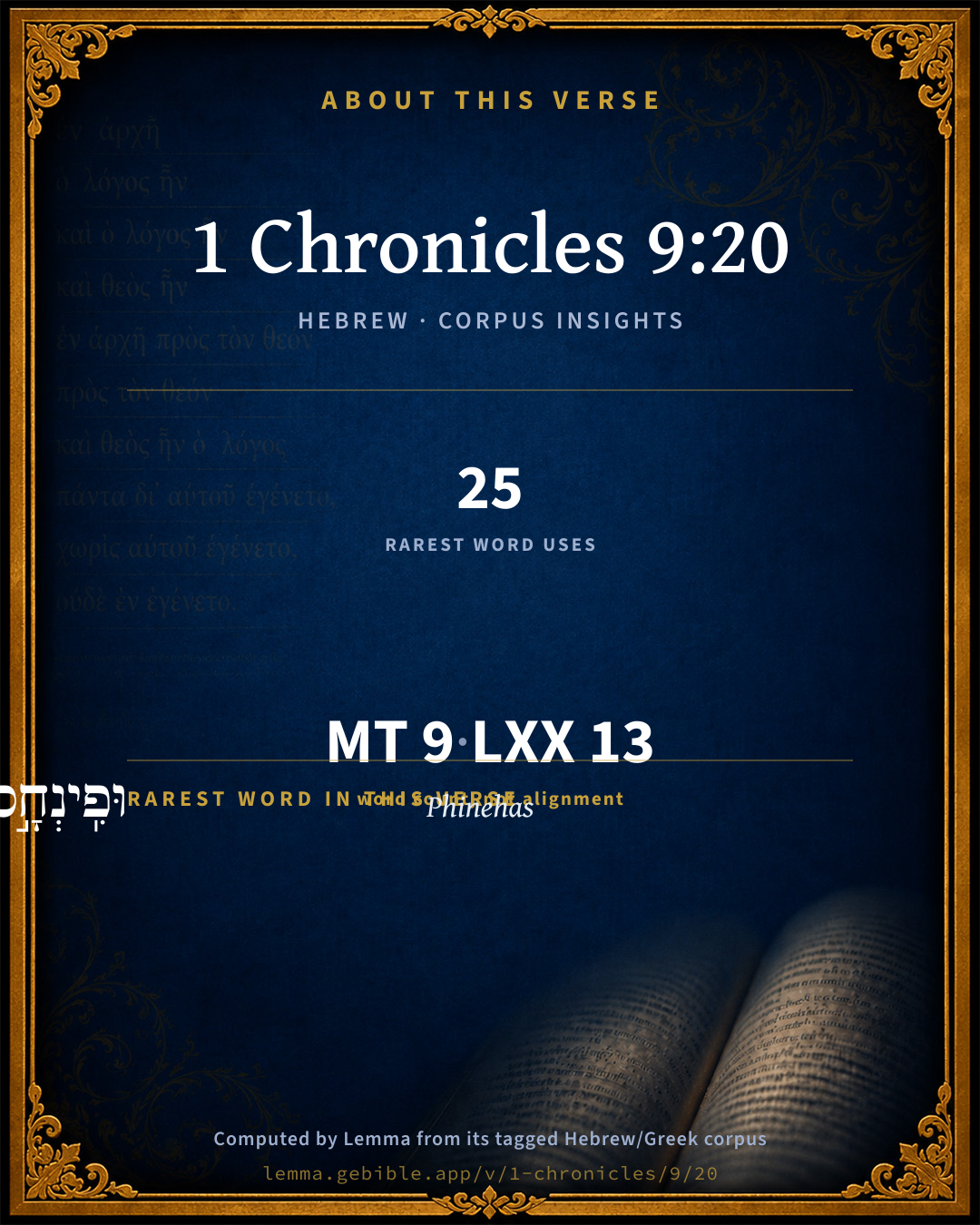
The rarest word here is וּפִֽינְחָ֣ס Phinehas H6372 — appearing just 25 times in the whole Hebrew Bible.

Shared distinctive vocabulary

וּפִֽינְחָ֣ס Phinehas H6372 occurs in 24 verses of the Hebrew Bible. Also found in:

Grammatical profile

  • 1 verb
  • 6 nouns
  • 2 prepositions

Verb forms

  • הָיָ֧ה Qal · Perfect

Hebrew & Septuagint length

In English translation the verse runs 17 words from the Hebrew and 17 from the Septuagint (LXX English) — the same length.

A rough comparison of the two English renderings, which tokenize alike — not a word-level alignment.

Word counts can differ between the Hebrew and the Greek without any difference in meaning — e.g. the Hebrew direct-object marker אֵת has no separate Greek word, and Greek often adds the article ὁ.

In the original languages it is 9 Hebrew tokens and 13 Greek tokens — but the two are counted differently (Hebrew bundles its prefixes and suffixes into one token; the Greek is in lemma form), so that isn’t a like-for-like length.

Cross-references

8

Topical passages linked to 1 Chronicles 9:20 in the Treasury of Scripture Knowledge — connected by theme and wording, ordered by reader-vote popularity; previews shown in the World English Bible.

  • Numbers 25:7–13 When Phinehas, the son of Eleazar, the son of Aaron the priest, saw it, he rose up from the midst of the congregation, and took a spear in his hand;
  • Numbers 3:32 Eleazar the son of Aaron the priest shall be prince of the princes of the Levites, with the oversight of those who keep the charge of the sanctuary.
  • Numbers 4:16 "The charge of Eleazar the son of Aaron the priest shall be the oil for the light, the sweet incense, the continual meal offering, and the anointing oil, the charge of all the tabernacle, and of all that is in it, the sanctuary, and its furnishings."
  • Numbers 4:28 This is the service of the families of the sons of the Gershonites in the Tent of Meeting: and their charge shall be under the hand of Ithamar the son of Aaron the priest.
  • Numbers 4:33 This is the service of the families of the sons of Merari, according to all their service, in the Tent of Meeting, under the hand of Ithamar the son of Aaron the priest."
  • Numbers 31:6 Moses sent them, one thousand of every tribe, to the war, them and Phinehas the son of Eleazar the priest, to the war, with the vessels of the sanctuary and the trumpets for the alarm in his hand.
  • 1 Samuel 16:18 Then answered one of the young men, and said, Behold, I have seen a son of Jesse the Bethlehemite, who is skillful in playing, and a mighty man of valor, and a man of war, and prudent in speech, and a comely person; and Yahweh is with him.
  • Acts 7:9–10 "The patriarchs, moved with jealousy against Joseph, sold him into Egypt. God was with him,

Cross-references courtesy of OpenBible.info (CC BY 4.0).

Hebrew and Greek witnesses Masoretic Hebrew ↔ Greek Septuagint

The same verse in the two great witnesses to the Old Testament, shown verse-for-verse.

These are two independent witnesses, not word-aligned to each other, and the Septuagint is shown in lemma (dictionary) form.

Hebrew 1 Chronicles 9:20 Masoretic · Westminster Leningrad Codex

וּפִֽינְחָ֣ס בֶּן אֶלְעָזָ֗ר נָגִ֨יד הָיָ֧ה עֲלֵיהֶ֛ם לְפָנִ֖ים יְהוָ֥ה עִמּֽוֹ

Phinehas the son of Eleazar was ruler over them in time past, [and] Yahweh was with him.

World English Bible · Public Domain

Greek LXX 1 Chronicles 9:20 Septuagint · lemma form

καί φινεες υἱός ελεαζαρ ἡγέομαι εἰμί ἐπί αὐτός ἔμπροσθεν καί οὗτος μετά αὐτός

And Phinees son of Eleazar was head over them before the Lord, and these were with him.

LXX2012 (modern English Septuagint) · Public Domain

Hebrew: Westminster Leningrad Codex (CC BY 4.0). Greek: Septuagint (public domain); English from LXX2012 (modern English Septuagint) (Public Domain). How the Septuagint differs from the Hebrew →

Commentary

Notes on 1 Chronicles 9:20 from classic Christian and Jewish commentators (each source and its license shown beneath its notes). The classic Christian expositions comment on the surrounding passage and are grouped to its opening verse, so a note may address several verses; the Jewish commentaries on the Tanakh (Rashi and others) are per-verse, so they appear only where the commentator wrote on this verse.

Lemma curates 59 commentaries, every one of them public domain or Creative Commons licensed, each selected and text-cleaned for this edition rather than reprinted as found. About our sources →

Trapp's Complete Commentary

John Trapp

1Ch 9:20 And Phinehas the son of Eleazar was the ruler over them in time past, [and] the LORD [was] with him.

Ver. 20. And the Lord was with him.] To assist and accept him in his generous actions.

John Trapp, A Commentary or Exposition upon All the Books of the Old and New Testament (1647–1656) — public domain. Text from a community e-Sword module.

Joseph Benson's Commentary

1Ch 9:20. Phinehas was ruler over them — That is, over all the porters, and other Levites and priests before mentioned. The Lord was with him to direct, and assist, and bless him in the discharge of his office, which seems to be here observed to encourage his successor, and consequently all the priests and Levites of this time, to go on courageously and resolutely in their work, not doubting but God would stand by them as he had stood by their fathers.

Joseph Benson's Commentary on the Old and New Testaments (1811–1818) — public domain. Text from a community e-Sword module.

Adam Clarke's Commentary

Verse 20. And Phinehas] The Targum says, "And Phinehas, the son of Eleazar, was ruler over them from ancient times, from the day in which the tabernacle was set up in the wilderness; and the WORD of the Lord was his assistant."

Adam Clarke's Commentary on the Bible (1810–1826) — public domain. Text from a community e-Sword/MySword module.

Ellicott's Commentary for English Readers

(20) And Phinehas the son of Eleazar was the ruler over them in time past.—Or, of yore. Phinehas may have held this office of president (nagîd, 1Ch_9:11) of the warders before he became high priest, just as Eleazar had held a similar position during the lifetime of Aaron (Num_3:32). Nothing is said of it elsewhere.

And the Lord was with him.—Rather, The Lord be with him! a pious ejaculation, such as the Jews of later times were wont to use in speaking of a departed worthy; and of interest to us as indicating a belief in continued existence after death. (Comp. 1Ch_22:11; 1Ch_22:16.)

A Bible Commentary for English Readers, edited by Charles John Ellicott (1878–1897) — public domain. Text from a community e-Sword module.

John Gill's Exposition

All those that were chosen to be porters in the gates were two hundred and twelve,.... As fixed in the days of David, and might not be fewer:

these were reckoned by their genealogies in their villages; where they dwelt:

whom David and Samuel the seer did ordain in their set office; the scheme was first drawn by Samuel the prophet, and communicated to David, who put it into execution, to be constantly and perpetually observed.

John Gill's Exposition of the Whole Bible (1746–1763) — public domain (CC PDM 1.0). Text via the HelloAO Bible API.

Haydock's Catholic Bible Commentary

Before. Hebrew, "the Lord with him," an usual form of blessing, (Calmet) or of wishing well (Haydock) to the deceased. (Calemt) --- This Phinees lived after the captivity, (Menochius) and possessed the same power as Eleazar and Joiada, chap. xii. 27., and Numbers iii. 32. It is not necessary to refute the fables of the Rabbins, who pretend that the famous Phinees was an angel, who appeared at different times, and particularly at the return from Babylon. (Calmet) --- Hebrew may refer to the ancient Phinees: "And Phinees....was ruler over them formerly, and the Lord was with him." (Du Hamel)

George Leo Haydock (1774–1849), Haydock's Catholic Family Bible and Commentary, 1859 edition — public domain. Excludes Psalms (Douay-Rheims chapter numbering differs from Protestant) and Deuterocanonical books (Catholic canon only).

Matthew Poole's English Annotations

Over them, i.e. over all the porters, and other Levites and priests before mentioned.

The Lord was with him, to direct, and assist, and bless him in the discharge of his place; which seems here related to encourage his successor, and consequently all the priests and Levites of this time, to go on courageously and resolutely in their work, not doubting but God will stand by them as he had done by their fathers.

Matthew Poole's English Annotations on the Holy Bible (1683–1685) — public domain. Text from a community e-Sword/MySword module.

The Pulpit Commentary

God with us.

Lord was with him." These words frequently occur in the sacred Scriptures. Of many of the worthies of ancient time is God"s favouring presence stated of Abraham, (Gen_26:24) of Jacob, (Gen_28:15) of Joseph, (Gen_39:2) of Samuel, (1Sa_3:19) of, (1Sa_18:14) etc. There is evidently something more in the words than

I THE OBVIOUS SENSE IN WINCH GOD IS CONSTANTLY PRESENT WITH EVERY ONE. The omnipresent One cannot be separated, in space, from any of his creatures. "He is not far from every one of us: for in him we live, and move, and have our being". (Act_17:27, Act_17:28)

Awake, asleep, at home, abroad, We are surrounded still with God. (See Ps 139)

We shall fail to find in the text its chief significance if we do not see

II THE DEEPER SENSE IN WHICH GOD IS WILLING TO BE NEAR US ALL. He is ready to be with us:

1. With his favouring presence; as a loving friend is, in sweet fellowship with his friend.

2. With his sympathizing presence; as the patient mother is with her sick or suffering child, taking his hand to assure him of her closeness to him and tender care for him.

3. With his encouraging presence; as a teacher is with his pupil, animating him to do his best in the trial-hour.

4. With his guiding and guardian presence; as the father leads his child on in the darkness, at once showing the way and defending from the unknown perils in the path. If we yield ourselves to God in the time of our youth, and determine to walk with Christ along the path of life, then his gracious presence will attend us at every step, he will be with us to our journey"s end, and will finally take us to be with him in the eternal home. C.

The Pulpit Commentary (1880–1919), ed. H.D.M. Spence-Jones & Joseph S. Exell — public domain. Text from a community e-Sword module.

Keil & Delitzsch

C. F. Keil & F. Delitzsch

All those that were chosen to be porters in the gates were two hundred and twelve,.... As fixed in the days of David, and might not be fewer:

these were reckoned by their genealogies in their villages; where they dwelt:

whom David and Samuel the seer did ordain in their set office; the scheme was first drawn by Samuel the prophet, and communicated to David, who put it into execution, to be constantly and perpetually observed.

Keil & Delitzsch — Biblical Commentary on the Old Testament (1861–1891) — public domain (CC PDM 1.0). Text via the HelloAO Bible API. (Old Testament only.)

unfoldingWord translationNotes

Door43 World Missions Community

General Information:

All of the names here (except Yahweh) are the names of men. (See: How to Translate Names)

in charge of them

"in charge of the Korahites" (See: 1 Chronicles 9:19)

translationWords

Phinehas

Zechariah (OT)

tent of meeting

unfoldingWord translationNotes — © Distant Shores Media and the Door43 World Missions Community, licensed CC BY-SA 4.0. Source: git.door43.org/Door43/en_tn.

Rashi

Rabbi Shlomo Yitzchaki (Rashi)

And Phinehas the son of Eleazar was the ruler over them in time past, the Lord being with him [This means] that he prophesied in time past, and our Sages said that this is Phinehas the priest, and because he did not annul Jephthah’s vow, the Shechinah left him.

Rashi on the Tanakh — English translations: “The Judaica Press complete Tanach with Rashi, translated by A. J. Rosenberg” (CC BY 4.0); “Pentateuch with Rashi's commentary by M. Rosenbaum and A.M. Silbermann, 1929-1934” (public domain); “The Metsudah Tanach series, Lakewood, N.J” (CC BY 4.0); and “The Book of Joshua, Metsudah Publications, 1997” (CC BY 4.0). Text via Sefaria.

Lesson kit

Teaching starters — assembled from the data on this page, not authored interpretation. Every prompt links to the verse data it draws on. Edit before teaching.

1 Chronicles, in the Historical, opens this verse with 9 words (9 distinct Hebrew lemmas). Its most distinctive word is Pîynᵉchâç (“Phinehas”). A historical commentator’s framing appears above. Read the whole chapter for the surrounding context.

Discussion questions

  1. The word Pîynᵉchâç carries the sense “Phinehas.” How does it shape the verse?
  2. Exodus 6:25 shares the word «Phinehas» with this verse. How do the two illuminate each other?
  3. These translations render this verse differently; the difference is in the English rendering, not the original. What questions does that raise?
  4. The verb «הָיָ֧ה» is Qal Perfect. How does its form color the action?
  5. Reading how Trapp's Complete Commentary and Joseph Benson's Commentary read this verse, where do the two commentators agree and where do they part?

Things to notice

Reading settings

Reading text

Shown beneath each verse's original-language words.

Old Testament
Old Testament edition

Read the OT as the Masoretic Hebrew (MT) or the Greek Septuagint (LXX).

English shown for the Greek Septuagint (in the Hebrew ↔ Greek comparison).

Comparing translations? Open the Compare panel on any verse page to stack up to four side by side.