

Philippians 3:8
Greek (Tischendorf 8th ed.) Philippians 3:8 appears in the Greek New Testament. The text above is from the Tischendorf 8th edition. Each word links to its Strong’s number and a concise gloss. Click any word for its full Thayer’s Greek Lexicon entry.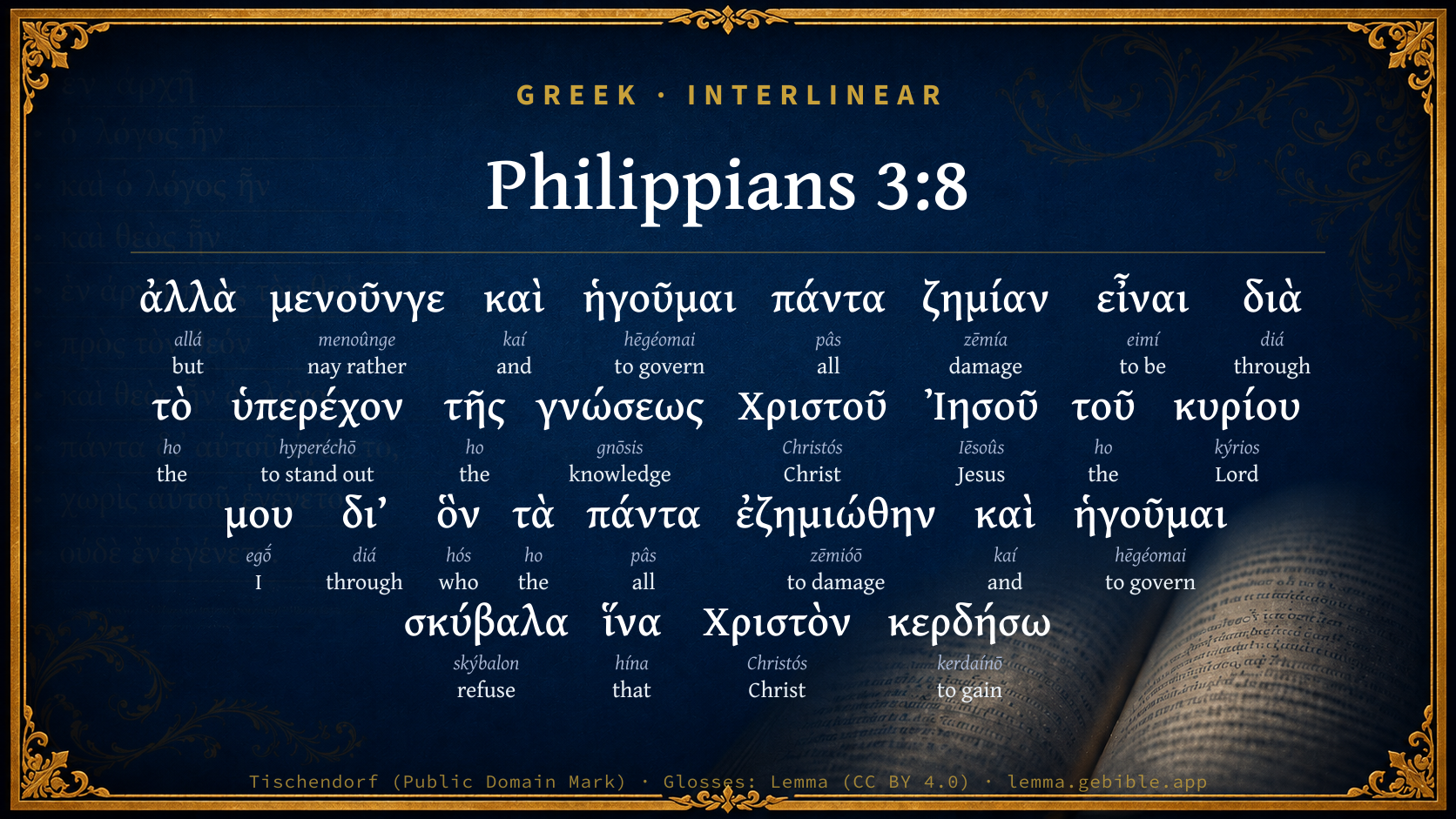
Yes most assuredly, and I count all things to be loss for the excellency of the knowledge of Christ Jesus, my Lord, for whom I suffered the loss of all things, and count them nothing but refuse, that I may gain Christ
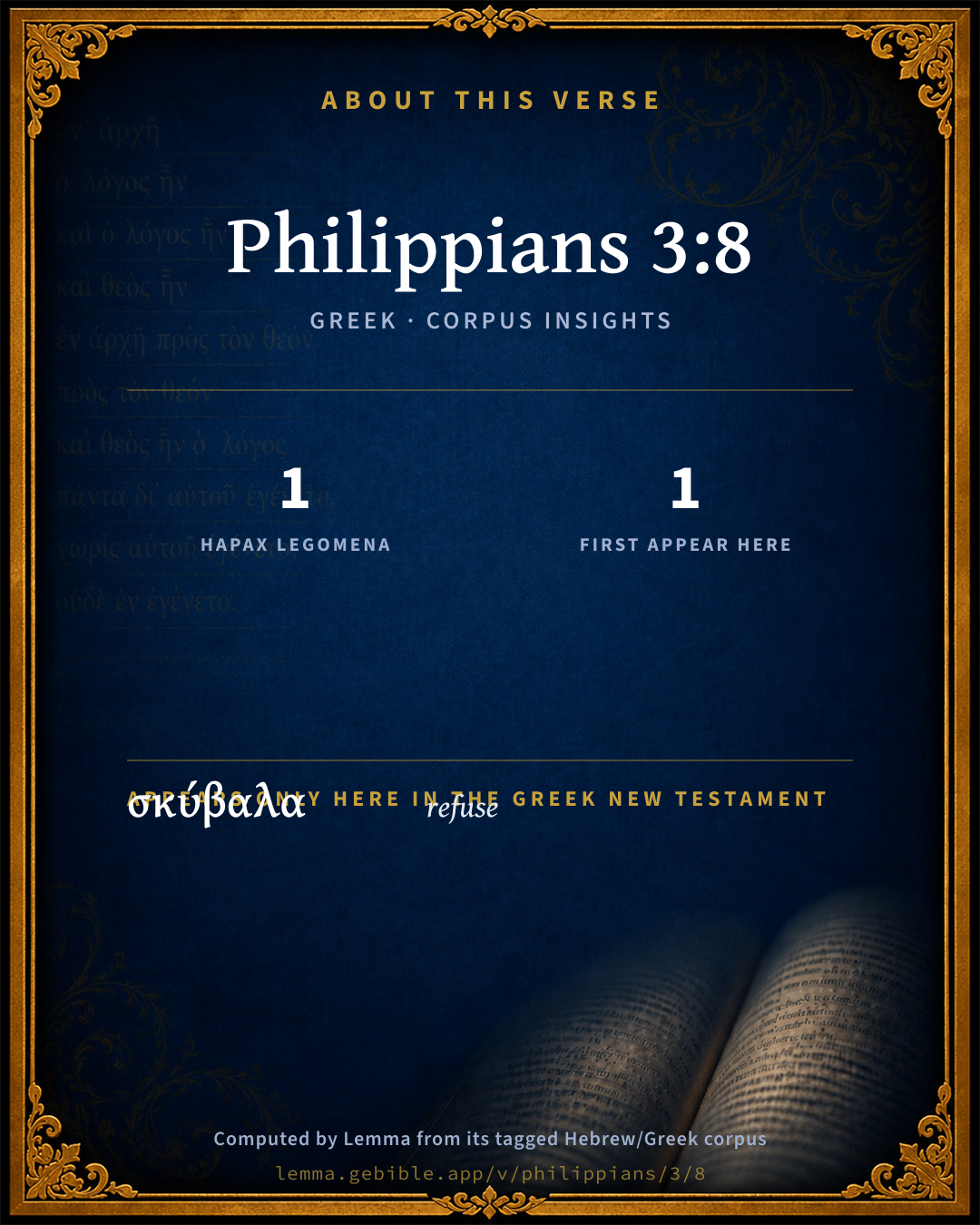
- 1 hapax legomenon — only here in the Greek New Testament
- 1 first appearance in the Greek New Testament
Download a study sheet
One document with this verse’s original text, its word-by-word gloss line, the meaning frame, cross-references with their text, attributed commentary, and full source and license credits — printable, and it pastes into notes with its structure intact.
This verse Autodidact and up
A passage Seminary Student
Up to 50 verses in one chapter. A passage sheet keeps up to 6 commentary sources and 12 cross-references per verse, in the order this page ranks them, and says so on the sheet whenever that leaves anything out. Ask for a single verse and you get the Autodidact verse sheet above.
Everything on this page stays free to read, with no account — the sheet is a download of what is already on screen, not access to it.
Compare translations 3
The same verse in 3 English versions, stacked beneath the original-language interlinear above. Click any original word for its lexicon entry.
Each is an independent rendering of the whole verse — the interlinear is not word-aligned to these translations.
Highlighted words mark where these versions differ — a whole-verse word diff, not a word-by-word alignment.
-
World English Bible Public Domain
Yes most assuredly, and I count all things to be loss for the excellency of the knowledge of Christ Jesus, my Lord, for whom I suffered the loss of all things, and count them nothing but refuse, that I may gain Christ
-
King James Version Public Domain
Yea doubtless, and I count all things but loss for the excellency of the knowledge of Christ Jesus my Lord: for whom I have suffered the loss of all things, and do count them but dung, that I may win Christ,
-
unfoldingWord Literal Text CC BY-SA 4.0
But on the contrary, I consider even all things to be loss because of the surpassing value of the knowledge of Christ Jesus my Lord, because of whom I have suffered the loss of all things—and I consider dung—so that I might gain Christ
unfoldingWord Literal Text — © unfoldingWord, licensed CC BY-SA 4.0. Word-aligned USFM3 via Door43 (git.door43.org/unfoldingWord/en_ult).
Show all 19 translations
Every available English version of this verse, each an independent rendering of the whole verse.
-
World English Bible Public Domain
Yes most assuredly, and I count all things to be loss for the excellency of the knowledge of Christ Jesus, my Lord, for whom I suffered the loss of all things, and count them nothing but refuse, that I may gain Christ
-
Berean Standard Bible Public Domain
More than that, I count all things as loss compared to the surpassing excellence of knowing Christ Jesus my Lord, for whom I have lost all things. I consider them rubbish, that I may gain Christ
-
Majority Standard Bible Public Domain
More than that, I count all things as loss compared to the surpassing excellence of knowing Christ Jesus my Lord, for whom I have lost all things. I consider them rubbish, that I may gain Christ
-
King James Version Public Domain
Yea doubtless, and I count all things but loss for the excellency of the knowledge of Christ Jesus my Lord: for whom I have suffered the loss of all things, and do count them but dung, that I may win Christ,
-
American Standard Version (1901) Public Domain
Yea verily, and I count all things to be loss for the excellency of the knowledge of Christ Jesus my Lord: for whom I suffered the loss of all things, and do count them but refuse, that I may gain Christ,
-
Revised Version (1885) Public Domain
Yea verily, and I count all things to be loss for the excellency of the knowledge of Christ Jesus my Lord: for whom I suffered the loss of all things, and do count them but dung, that I may gain Christ,
-
Geneva Bible (1599) Public Domain
Yea, doubtlesse I thinke all thinges but losse for the excellent knowledge sake of Christ Iesus my Lord, for whome I haue counted all things losse, and doe iudge them to bee dongue, that I might winne Christ,
-
Douay-Rheims (1899) Public Domain
Furthermore I count all things to be but loss for the excellent knowledge of Jesus Christ my Lord; for whom I have suffered the loss of all things, and count them but as dung, that I may gain Christ:
-
Young's Literal Translation Public Domain
yes, indeed, and I count all things to be loss, because of the excellency of the knowledge of Christ Jesus my Lord, because of whom of the all things I suffered loss, and do count them to be refuse, that Christ I may gain, and be found in him,
-
Literal Standard Version CC BY-SA 4.0
yes, indeed, and I count all things to be loss, because of the excellence of the knowledge of Christ Jesus my Lord, because of whom I suffered loss of all things, and count them to be refuse, that I may gain Christ, and be found in Him,
-
Unlocked Literal Bible CC BY-SA 4.0
In fact, now I count all things to be loss because of the surpassing value of the knowledge of Christ Jesus my Lord. For him I have given up all things—and I consider them rubbish—so that I may gain Christ
-
unfoldingWord Literal Text CC BY-SA 4.0
But on the contrary, I consider even all things to be loss because of the surpassing value of the knowledge of Christ Jesus my Lord, because of whom I have suffered the loss of all things—and I consider dung—so that I might gain Christ
-
Darby Bible Public Domain
But surely I count also all things to be loss on account of the excellency of the knowledge of Christ Jesus my Lord, on account of whom I have suffered the loss of all, and count them to be filth, that I may gain Christ;
-
World Messianic Bible Public Domain
Yes most certainly, and I count all things to be a loss for the excellency of the knowledge of Messiah Yeshua, my Lord, for whom I suffered the loss of all things, and count them nothing but refuse, that I may gain Messiah
-
Webster's Bible Public Domain
Yes doubtless, and I count all things to be loss for the excellence of the knowledge of Christ Jesus my Lord: for whom I have suffered the loss of all things, and do count them to be dung, that I may win Christ,
-
Free Bible Version CC BY-SA 4.0
Truly, I count everything as loss in exchange for the incredible benefit I've gained through knowing Christ Jesus my Lord. I've thrown away all these things for him, and consider them trash, so that I might gain Christ.
-
Bible in Basic English Public Domain
Yes truly, and I am ready to give up all things for the knowledge of Christ Jesus my Lord, which is more than all: for whom I have undergone the loss of all things, and to me they are less than nothing, so that I may have Christ as my reward,
-
Text-Critical English NT CC BY 4.0
More than that, I count all things as loss because of the surpassing value of knowing Christ Jesus my Lord. For his sake I have suffered the loss of all things and count them as rubbish so that I may gain Christ
-
Tyndale New Testament (1534) Public Domain
Ye I thinke all thynges but losse for that excellet knowledges sake of Christ Iesu my lorde. For whom I have counted all thynge losse and do iudge them but donge that I myght wynne Christ
Literal Standard Version (2020), Covenant Press — licensed CC BY-SA 4.0. Text via the HelloAO Bible API (eBible.org). Unlocked Literal Bible (unfoldingWord) — licensed CC BY-SA 4.0. Text via the HelloAO Bible API (eBible.org). unfoldingWord Literal Text — © unfoldingWord, licensed CC BY-SA 4.0. Word-aligned USFM3 via Door43 (git.door43.org/unfoldingWord/en_ult). Free Bible Version, Dr. Jonathan Gallagher — licensed CC BY-SA 4.0. Text via the HelloAO Bible API (eBible.org).
Word by word
More ways to search: Search by grammar → Find every occurrence → Compare this word →
Practice this passage: Drill this verse → Learn its vocabulary →
- Appears 1× in the Greek New Testament
- First appears here
- Part of Speech
- Noun
- Case
- Accusative
- Number
- Plural
- Gender
- Neuter
Full Thayer's Definition
- ἀλλὰ allá G235 “but” Conjunction
- μενοῦνγε menoûnge G3304 “nay rather” Particle
- καὶ kaí G2532 “and” Conjunction
- ἡγοῦμαι hēgéomai G2233 “to govern” Verb, Present, Middle or Passive deponent, Indicative, 1st person, Singular
- πάντα pâs G3956 “all” Adjective, Accusative, Plural, Neuter
- ζημίαν zēmía G2209 “damage” Noun, Accusative, Singular, Feminine
- εἶναι eimí G1510 “to be” Verb, Present, Active, Infinitive
- διὰ diá G1223 “through” Preposition
- τὸ ho G3588 “the” Article, Accusative, Singular, Neuter
- ὑπερέχον hyperéchō G5242 “to stand out” Verb, Present, Active, Participle, Accusative, Singular, Neuter
- τῆς ho G3588 “the” Article, Genitive, Singular, Feminine
- γνώσεως gnōsis G1108 “knowledge” Noun, Genitive, Singular, Feminine
- Χριστοῦ Christós G5547 “Christ” Noun, Genitive, Singular, Masculine
- Ἰησοῦ Iēsoûs G2424 “Jesus” Noun, Genitive, Singular, Masculine
- τοῦ ho G3588 “the” Article, Genitive, Singular, Masculine
- κυρίου kýrios G2962 “Lord” Noun, Genitive, Singular, Masculine
- μου egṓ G1473 “I” Personal pronoun, 1st person, Genitive, Singular
- δι’ diá G1223 “through” Preposition
- ὃν hós G3739 “who” Relative pronoun, Accusative, Singular, Masculine
- τὰ ho G3588 “the” Article, Accusative, Plural, Neuter
- πάντα pâs G3956 “all” Adjective, Accusative, Plural, Neuter
- ἐζημιώθην zēmióō G2210 “to damage” Verb, Aorist, Passive, Indicative, 1st person, Singular
- καὶ kaí G2532 “and” Conjunction
- ἡγοῦμαι hēgéomai G2233 “to govern” Verb, Present, Middle or Passive deponent, Indicative, 1st person, Singular
- σκύβαλα skýbalon G4657 “refuse” Noun, Accusative, Plural, Neuter
- ἵνα hína G2443 “that” Conjunction
- Χριστὸν Christós G5547 “Christ” Noun, Accusative, Singular, Masculine
- κερδήσω kerdaínō G2770 “to gain” Verb, Aorist, Active, Subjunctive, 1st person, Singular
About this verse
These counts appear in no published source. They are computed here, from the morphology-tagged text and Lemma’s own curated glosses. What Lemma adds →
- 28
- words
- 20
- distinct lemmas
- Pauline Epistles
- section
Notable vocabulary
1 hapax legomenon — a word that appears only here in the entire Greek New Testament:
- σκύβαλα refuse G4657
First appearance in Scripture
This word makes its first canonical appearance in the Greek New Testament here:
- σκύβαλα refuse G4657
Shared distinctive vocabulary
μενοῦνγε nay rather G3304 occurs in 4 verses of the Greek New Testament. Also found in:
Cross-references
47Topical passages linked to Philippians 3:8 in the Treasury of Scripture Knowledge — connected by theme and wording, ordered by reader-vote popularity; previews shown in the World English Bible.
- Jeremiah 9:23–24 Thus says Yahweh, Don't let the wise man glory in his wisdom, neither let the mighty man glory in his might, don't let the rich man glory in his riches;
- Romans 8:18 For I consider that the sufferings of this present time are not worthy to be compared with the glory which will be revealed toward us.
- Acts 20:24 But these things don't count; nor do I hold my life dear to myself, so that I may finish my race with joy, and the ministry which I received from the Lord Jesus, to fully testify to the Gospel of the grace of God.
- Philippians 3:7 However, what things were gain to me, these have I counted loss for Christ.
- John 17:3 This is eternal life, that they should know you, the only true God, and him whom you sent, Jesus Christ.
- Philippians 3:10 that I may know him, and the power of his resurrection, and the fellowship of his sufferings, becoming conformed to his death;
- 2 Peter 1:3 seeing that his divine power has granted to us all things that pertain to life and godliness, through the knowledge of him who called us by his own glory and virtue;
- Matthew 19:27–29 Then Peter answered, "Behold, we have left everything, and followed you. What then will we have?"
- 1 Corinthians 2:2 For I determined not to know anything among you, except Jesus Christ, and him crucified.
- Colossians 2:2–3 that their hearts may be comforted, they being knit together in love, and gaining all riches of the full assurance of understanding, that they may know the mystery of God, both of the Father and of Christ,
- 1 John 5:20 We know that the Son of God has come, and has given us an understanding, that we know him who is true, and we are in him who is true, in his Son Jesus Christ. This is the true God, and eternal life.
- John 17:8 for the words which you have given me I have given to them, and they received them, and knew for sure that I came forth from you, and they have believed that you sent me.
- Ephesians 3:8–9 To me, the very least of all saints, was this grace given, to preach to the Gentiles the unsearchable riches of Christ,
- Isaiah 53:11 He shall see of the travail of his soul, [and] shall be satisfied: by the knowledge of himself shall my righteous servant justify many; and he shall bear their iniquities.
- John 14:20 In that day you will know that I am in my Father, and you in me, and I in you.
- Ephesians 1:17–18 that the God of our Lord Jesus Christ, the Father of glory, may give to you a spirit of wisdom and revelation in the knowledge of him;
- Hebrews 3:14 For we have become partakers of Christ, if we hold fast the beginning of our confidence firm to the end:
- Matthew 13:44–46 "Again, the Kingdom of Heaven is like a treasure hidden in the field, which a man found, and hid. In his joy, he goes and sells all that he has, and buys that field.
- Luke 10:21–22 In that same hour Jesus rejoiced in the Holy Spirit, and said, "I thank you, O Father, Lord of heaven and earth, that you have hidden these things from the wise and understanding, and revealed them to little children. Yes, Father, for so it was well-pleasing in your sight."
- 1 Corinthians 4:9–13 For, I think that God has displayed us, the apostles, last of all, like men sentenced to death. For we are made a spectacle to the world, both to angels and men.
- 2 Corinthians 4:6 seeing it is God who said, "Light will shine out of darkness," who has shone in our hearts, to give the light of the knowledge of the glory of God in the face of Jesus Christ.
- Ephesians 3:18–19 may be strengthened to comprehend with all the saints what is the breadth and length and height and depth,
- Ephesians 4:13 until we all attain to the unity of the faith, and of the knowledge of the Son of God, to a full grown man, to the measure of the stature of the fullness of Christ;
- 2 Peter 3:18 But grow in the grace and knowledge of our Lord and Savior Jesus Christ. To him be the glory both now and forever. Amen.
- Matthew 11:25–27 At that time, Jesus answered, "I thank you, Father, Lord of heaven and earth, that you hid these things from the wise and understanding, and revealed them to infants.
- Matthew 16:16–17 Simon Peter answered, "You are the Christ, the Son of the living God."
- 2 Corinthians 11:23–27 Are they servants of Christ? (I speak as one beside himself) I am more so; in labors more abundantly, in prisons more abundantly, in stripes above measure, in deaths often.
- 1 John 1:3 that which we have seen and heard we declare to you, that you also may have fellowship with us. Yes, and our fellowship is with the Father, and with his Son, Jesus Christ.
- Psalms 126:6 He who goes out weeping, carrying seed for sowing, Will assuredly come again with joy, carrying his sheaves.
- Luke 20:42–44 David himself says in the book of Psalms, 'The Lord said to my Lord, "Sit at my right hand,
- John 14:7 If you had known me, you would have known my Father also. From now on, you know him, and have seen him."
- John 16:3 They will do these things because they have not known the Father, nor me.
- John 20:28 Thomas answered him, "My Lord and my God!"
- 2 Timothy 4:6 For I am already being offered, and the time of my departure has come.
- 1 John 2:19 They went out from us, but they didn't belong to us; for if they had belonged to us, they would have continued with us. But they left, that they might be revealed that none of them belong to us.
- 2 Corinthians 4:4 in whom the god of this world has blinded the minds of the unbelieving, that the light of the Gospel of the glory of Christ, who is the image of God, should not dawn on them.
- 1 Peter 2:7 For you therefore who believe is the honor, but for such as are disobedient, "The stone which the builders rejected, Has become the chief cornerstone,"
- Numbers 14:30 surely you shall not come into the land, concerning which I swore that I would make you dwell therein, save Caleb the son of Jephunneh, and Joshua the son of Nun.
- 2 Kings 9:37 and the body of Jezebel shall be as dung on the face of the field in the portion of Jezreel, so that they shall not say, This is Jezebel.
- Luke 11:20 But if I by the finger of God cast out demons, then the Kingdom of God has come to you.
- John 20:13 They told her, "Woman, why are you weeping?" She said to them, "Because they have taken away my Lord, and I don't know where they have laid him."
- 1 Corinthians 9:10 or does he say it assuredly for our sake? Yes, it was written for our sake, because he who plows ought to plow in hope, and he who threshes in hope should partake of his hope.
- Luke 1:43 Why am I so favored, that the mother of my Lord should come to me?
- Galatians 1:16 to reveal his Son in me, that I might preach him among the Gentiles, I didn't immediately confer with flesh and blood,
- 1 Kings 14:10 therefore, behold, I will bring evil on the house of Jeroboam, and will cut off from Jeroboam every man-child, him who is shut up and him who is left at large in Israel, and will utterly sweep away the house of Jeroboam, as a man sweeps away dung, until it be all gone.
- Job 20:7 Yet he shall perish forever like his own dung, Those who have seen him shall say, 'Where is he?'
- Malachi 2:3 Behold, I will rebuke your seed, and will spread dung on your faces, even the dung of your feasts; and you will be taken away with it.
Cross-references courtesy of OpenBible.info (CC BY 4.0).
Lesson kit
Teaching starters — assembled from the data on this page, not authored interpretation. Every prompt links to the verse data it draws on. Edit before teaching.
Philippians, in the Pauline Epistles, opens this verse with 28 words (20 distinct Greek lemmas). Its most distinctive word is skýbalon (“refuse”). A historical commentator’s framing appears above. Read the whole chapter for the surrounding context.
Discussion questions
- How does “refuse” (skýbalon) shape what this verse is saying?
- This verse holds 1 word here found nowhere else in the Greek New Testament. What might the rare word draw attention to?
- The word “refuse” first appears here in Scripture. What is being introduced at this debut?
- Luke 11:28 shares the word «nay rather» with this verse. How do the two illuminate each other?
- “to govern” occurs 2× in this one verse. What is the effect of the repetition?
- These translations render this verse differently; the difference is in the English rendering, not the original. What questions does that raise?
- Reading how The Biblical Illustrator and Joseph Benson's Commentary read this verse, where do the two commentators agree and where do they part?
Things to notice
- 1 word in this verse appears nowhere else in the Greek New Testament.
- 1 word makes its first canonical appearance in Scripture here.
- These translations choose different wording for 24 words in this verse.
- “to govern” occurs 2× in this single verse.
- 20 distinct Greek lemmas span 28 words in this verse.
Commentary
Notes on Philippians 3:8 from classic Christian and Jewish commentators (each source and its license shown beneath its notes). The classic Christian expositions comment on the surrounding passage and are grouped to its opening verse, so a note may address several verses; the Jewish commentaries on the Tanakh (Rashi and others) are per-verse, so they appear only where the commentator wrote on this verse.
Lemma curates 59 commentaries, every one of them public domain or Creative Commons licensed, each selected and text-cleaned for this edition rather than reprinted as found. About our sources →
The Biblical Illustrator
Joseph S. Exell
The Biblical Illustrator, edited by Joseph S. Exell (c. 1880s–1900s) — public domain. Text from a community e-Sword module.
Joseph Benson's Commentary
Joseph Benson's Commentary on the Old and New Testaments (1811–1818) — public domain. Text from a community e-Sword module.
MacLaren's Expositions of Holy Scripture
Alexander MacLaren
Alexander MacLaren, Expositions of Holy Scripture (1904–1910) — public domain. Text from a community e-Sword module.
The Expositor's Bible
William Robertson Nicoll, ed., The Expositor's Bible (London: Hodder & Stoughton, 1887–1910) — public domain. 65 of 66 books (1 Corinthians is not separately keyed, as that volume carries no machine-parseable verse references); section-level commentary keyed to the opening verse. Introductory and overview sections not keyed to a specific passage are excluded.
Bengel's Gnomon
Johann Albrecht Bengel
Bengel's Gnomon of the New Testament — English translation (T&T Clark, Edinburgh, 1860) — public domain. Text from a community e-Sword module.
Meyer's Critical & Exegetical Commentary
Heinrich August Wilhelm Meyer
Meyer — Critical and Exegetical Commentary on the New Testament — English translation by Peter Christie, edited by Frederick Crombie (T&T Clark, 1880) — public domain. Text from a community e-Sword module.
Expositor's Greek Testament
ed. W. Robertson Nicoll
The Expositor's Greek Testament, edited by W. Robertson Nicoll (1897–1910) — public domain. Text from a community e-Sword module.
Geneva Bible (1599)
Geneva Bible translators
Geneva Bible (1599) marginal notes — public domain. Text via Bolls.life.
Jamieson, Fausset & Brown
Robert Jamieson, A. R. Fausset & David Brown
Jamieson, Fausset & Brown — Commentary Critical and Explanatory on the Whole Bible (1871) — public domain (CC PDM 1.0). Text via the HelloAO Bible API.
Adam Clarke's Commentary
Adam Clarke's Commentary on the Bible (1810–1826) — public domain. Text from a community e-Sword/MySword module.
John Calvin's Commentaries
John Calvin's Commentaries (1540-1563) — public domain. Text from the Calvin Translation Society English edition (1840s-50s) via the Christian Classics Ethereal Library (ccel.org). Calvin's coverage is partial (roughly two-thirds of the Bible); uncommented books and verses are honest gaps, never fabricated. The 19th-century editor's footnotes and remarks are omitted so the notes are faithfully Calvin's own voice.
Ellicott's Commentary for English Readers
A Bible Commentary for English Readers, edited by Charles John Ellicott (1878–1897) — public domain. Text from a community e-Sword module.
The Cambridge Bible for Schools and Colleges
gen. ed. J. J. S. Perowne
The Cambridge Bible for Schools and Colleges (gen. ed. J. J. S. Perowne; Cambridge University Press, 1878–1918) — public domain. Text from a community e-Sword module.
John Gill's Exposition
John Gill's Exposition of the Whole Bible (1746–1763) — public domain (CC PDM 1.0). Text via the HelloAO Bible API.
Trapp's Complete Commentary
John Trapp
John Trapp, A Commentary or Exposition upon All the Books of the Old and New Testament (1647–1656) — public domain. Text from a community e-Sword module.
Albert Barnes' Notes on the Bible
Albert Barnes' Notes on the Bible (1834–1885) — public domain. Text from a community e-Sword/MySword module.
Matthew Poole's English Annotations
Matthew Poole's English Annotations on the Holy Bible (1683–1685) — public domain. Text from a community e-Sword/MySword module.
Whedon's Commentary on the Bible
Daniel D. Whedon
Daniel D. Whedon (gen. ed.), Commentary on the Old and New Testaments (1874–1909) — public domain. Text from a community e-Sword module.
The Pulpit Commentary
The Pulpit Commentary (1880–1919), ed. H.D.M. Spence-Jones & Joseph S. Exell — public domain. Text from a community e-Sword module.
John Wesley's Explanatory Notes
John Wesley, Explanatory Notes Upon the Whole Bible (1754–1765) — public domain. Text via the GEBible commentary corpus.
Godbey's Commentary on the New Testament
William B. Godbey
William B. Godbey, Commentary on the New Testament (1896–1900) — public domain. Text from a community e-Sword module.
The People's New Testament
B. W. Johnson
B. W. Johnson's The People's New Testament with Notes (1889–1891) — public domain. Electronic text from the Christian Classics Ethereal Library (CCEL) ThML edition.
unfoldingWord translationNotes
Door43 World Missions Community
unfoldingWord translationNotes — © Distant Shores Media and the Door43 World Missions Community, licensed CC BY-SA 4.0. Source: git.door43.org/Door43/en_tn.
Cambridge Greek Testament for Schools and Colleges
Cambridge Greek Testament for Schools and Colleges (Cambridge University Press, 1896; 21 vols, various authors incl. Carr, Maclear, Plummer, Farrar, Lumby, Moule, M. R. James, Simcox) — public domain. Text from a community e-Sword module.
Alford’s Greek Testament
Henry Alford
Henry Alford, The Greek Testament (1849–1861) — public domain. Text from a community e-Sword module.
International Critical Commentary
International Critical Commentary — older volumes (1896–1929), various authors — public domain. Text from a community e-Sword module.
Vincent's Word Studies in the New Testament
Marvin R. Vincent
Marvin R. Vincent, Word Studies in the New Testament (1887–1900) — public domain. Text from a community e-Sword/MySword module.