
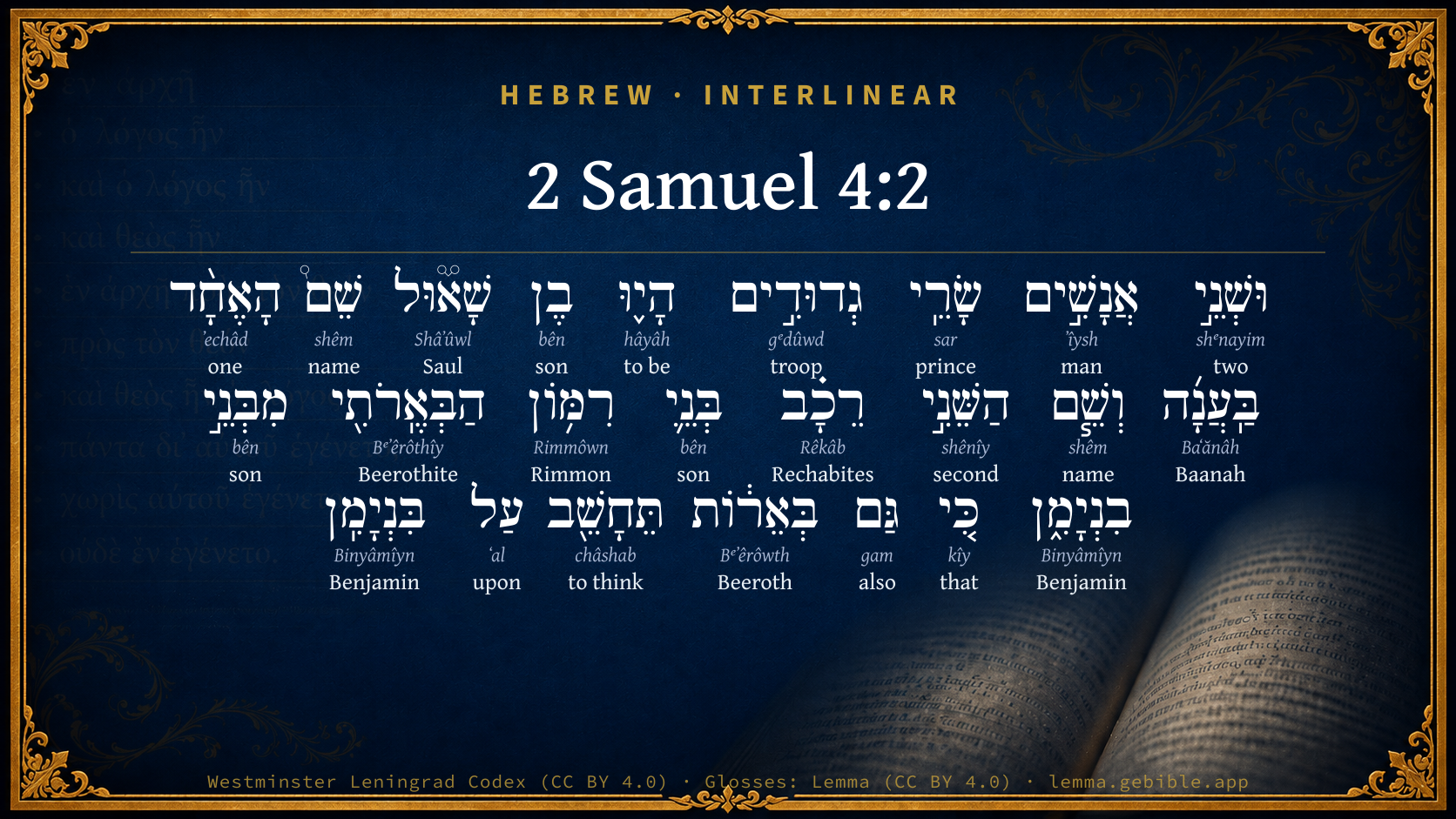
2 Samuel 4:2

Hebrew (Westminster Leningrad Codex) 2 Samuel 4:2 appears in the Hebrew Old Testament. The text above is from the Westminster Leningrad Codex. Each word links to its Strong’s number, a concise gloss, and parsing drawn from the Open Scriptures Hebrew Bible morphology. Click any word for its full Brown-Driver-Briggs (BDB) entry.
Download image
Cite this verse

2 Samuel 4:2 (World English Bible). Public Domain. Lemma interlinear Bible study tool, https://lemma.gebible.app/v/2-samuel/4/2.

Show BibTeX & RIS
BibTeX
RIS
English Translation
[Ish-bosheth], Saul's son, [had] two men who were captains of bands: the name of the one was Baanah, and the name of the other Rechab, the sons of Rimmon the Beerothite, of the children of Benjamin (for Beeroth also is reckoned to Benjamin:
World English Bible · Public Domain
Highlights
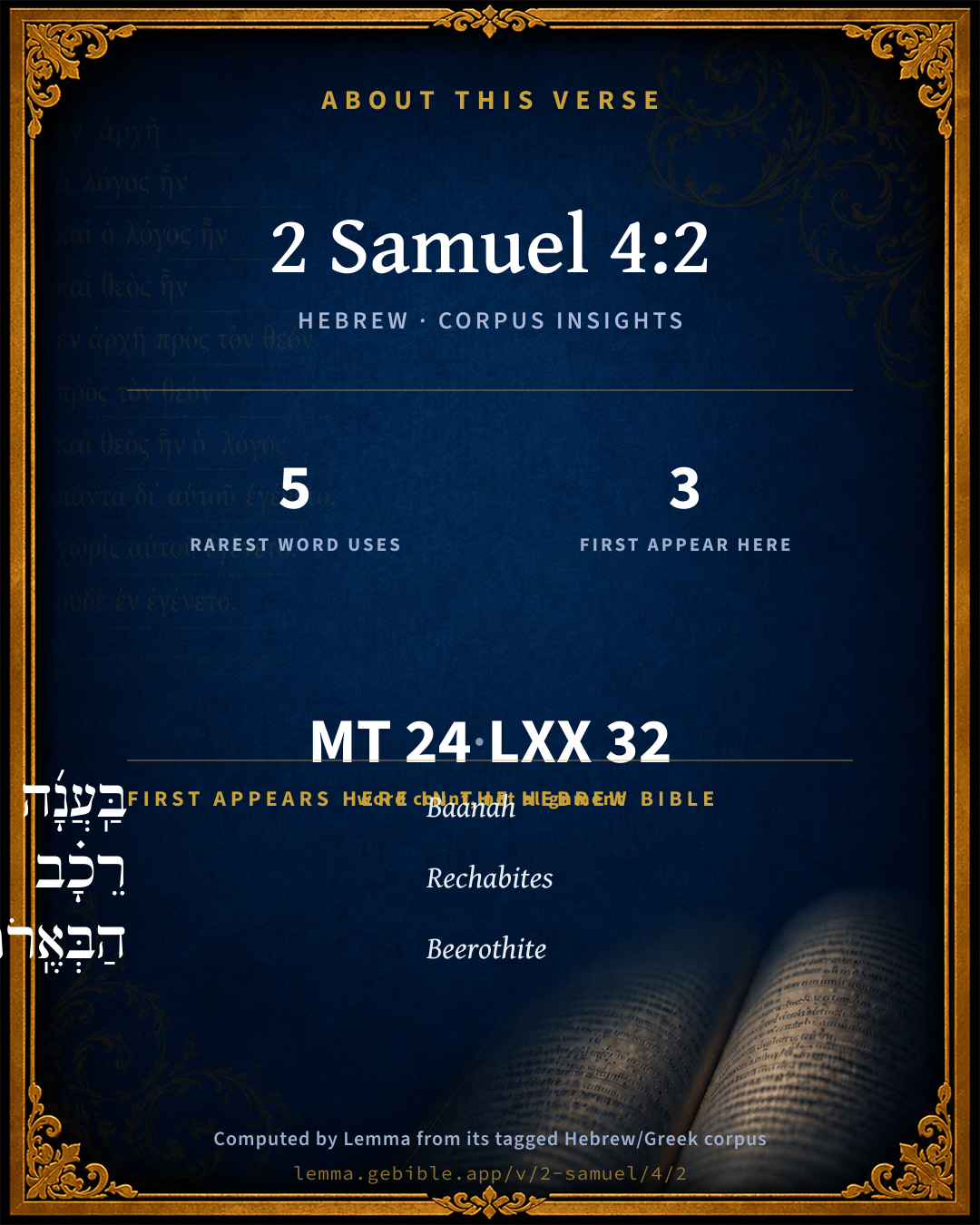
  • 3 first appearances in the Hebrew Bible
Full analysis ↓
Download a study sheet

One document with this verse’s original text, its word-by-word gloss line, the meaning frame, cross-references with their text, attributed commentary, and full source and license credits — printable, and it pastes into notes with its structure intact.

This verse Autodidact and up

Study sheet (.html) Plain text (.txt)

A passage Seminary Student

Up to 50 verses in one chapter. A passage sheet keeps up to 6 commentary sources and 12 cross-references per verse, in the order this page ranks them, and says so on the sheet whenever that leaves anything out. Ask for a single verse and you get the Autodidact verse sheet above.

Everything on this page stays free to read, with no account — the sheet is a download of what is already on screen, not access to it.

Want to remove ads? Support Godless Engineer
Compare translations 3

The same verse in 3 English versions, stacked beneath the original-language interlinear above. Click any original word for its lexicon entry.

Each is an independent rendering of the whole verse — the interlinear is not word-aligned to these translations.

Highlighted words mark where these versions differ — a whole-verse word diff, not a word-by-word alignment.

  • World English Bible Public Domain
    [Ish-bosheth], Saul's son, [had] two men who were captains of bands: the name of the one was Baanah, and the name of the other Rechab, the sons of Rimmon the Beerothite, of the children of Benjamin (for Beeroth also is reckoned to Benjamin:
  • King James Version Public Domain
    And Saul's son had two men that were captains of bands: the name of the one was Baanah, and the name of the other Rechab, the sons of Rimmon a Beerothite, of the children of Benjamin: (for Beeroth also was reckoned to Benjamin.
  • unfoldingWord Literal Text CC BY-SA 4.0
    Now two men, commanders of troops, were the son of Saul. The name of the one Baanah, and the name of the second Rechab, sons of Rimmon the Beerothite, from the sons of Benjamin, for Beeroth is also reckoned to Benjamin.

unfoldingWord Literal Text — © unfoldingWord, licensed CC BY-SA 4.0. Word-aligned USFM3 via Door43 (git.door43.org/unfoldingWord/en_ult).

Versions to compare (up to 4)

3 of 4 selected

Show all 18 translations

Every available English version of this verse, each an independent rendering of the whole verse.

  • World English Bible Public Domain
    [Ish-bosheth], Saul's son, [had] two men who were captains of bands: the name of the one was Baanah, and the name of the other Rechab, the sons of Rimmon the Beerothite, of the children of Benjamin (for Beeroth also is reckoned to Benjamin:
  • Berean Standard Bible Public Domain
    Saul’s son had two men who were leaders of raiding parties. One was named Baanah and the other Rechab; they were sons of Rimmon the Beerothite of the tribe of Benjamin—Beeroth is considered part of Benjamin,
  • Majority Standard Bible Public Domain
    Saul’s son had two men who were leaders of raiding parties. One was named Baanah and the other Rechab; they were sons of Rimmon the Beerothite of the tribe of Benjamin—Beeroth is considered part of Benjamin,
  • King James Version Public Domain
    And Saul's son had two men that were captains of bands: the name of the one was Baanah, and the name of the other Rechab, the sons of Rimmon a Beerothite, of the children of Benjamin: (for Beeroth also was reckoned to Benjamin.
  • American Standard Version (1901) Public Domain
    And `Ish-bosheth', Saul's son, `had' two men that were captains of bands: the name of the one was Baanah, and the name of the other Rechab, the sons of Rimmon the Beerothite, of the children of Benjamin (for Beeroth also is reckoned to Benjamin:
  • Revised Version (1885) Public Domain
    And Ish-bosheth, Saul’s son, had two men that were captains of bands: the name of the one was Baanah, and the name of the other Rechab, the sons of Rimmon the Beerothite, of the children of Benjamin: (for Beeroth also is reckoned to Benjamin:
  • Geneva Bible (1599) Public Domain
    And Sauls sonne had two men that were captaines of bandes: the one called Baanah, and the other called Rechab, the sonnes of Rimmon a Beerothite of the children of Beniamin. (for Beeroth was reckened to Beniamin,
  • Douay-Rheims (1899) Public Domain
    Now the son of Saul had two men captains of his bands, the name of the one was Baana, and the name of the other Rechab, the sons of Remmon a Berothite of the children of Benjamin: for Beroth also was reckoned in Benjamin.
  • Young's Literal Translation Public Domain
    And two men, heads of troops, have been `to' the son of Saul, the name of the one `is' Baanah, and the name of the second Rechab, sons of Rimmon the Beerothite, of the sons of Benjamin, for also Beeroth is reckoned to Benjamin,
  • Literal Standard Version CC BY-SA 4.0
    And two men, heads of troops, have been [to] the son of Saul, the name of the first [is] Baanah, and the name of the second Rechab, sons of Rimmon the Beerothite, of the sons of Benjamin, for Beeroth is also reckoned to Benjamin,
  • Unlocked Literal Bible CC BY-SA 4.0
    Now Saul's son had two men who were captains of groups of soldiers. The name of one was Baanah and the other Recab, sons of Rimmon the Beerothite of the people of Benjamin (for Beeroth is also considered part of Benjamin,
  • unfoldingWord Literal Text CC BY-SA 4.0
    Now two men, commanders of troops, were the son of Saul. The name of the one Baanah, and the name of the second Rechab, sons of Rimmon the Beerothite, from the sons of Benjamin, for Beeroth is also reckoned to Benjamin.
  • Darby Bible Public Domain
    And Saul's son had two men, captains of bands: the name of the one was Baanah, and the name of the other Rechab, the sons of Rimmon the Beerothite, of the children of Benjamin; for Beeroth also was reckoned to Benjamin.
  • World Messianic Bible Public Domain
    Saul’s son had two men who were captains of raiding bands. The name of one was Baanah and the name of the other Rechab, the sons of Rimmon the Beerothite, of the children of Benjamin (for Beeroth also is considered a part of Benjamin;
  • Webster's Bible Public Domain
    And Saul's son had two men that were captains of bands: the name of the one was Baanah, and the name of the other Rechab, the sons of Rimmon a Beerothite, of the children of Benjamin: (For Beeroth also was reckoned to Benjamin:
  • Free Bible Version CC BY-SA 4.0
    Ishbosheth had two commanders of his raiding bands, brothers by the name of Baanah and Rechab. They were the sons of Rimmon of the tribe of Benjamin from the town of Beeroth. Beeroth is considered part of the territory of Benjamin,
  • Bible in Basic English Public Domain
    And Saul's son had two men, captains of bands, one named Baanah and the other Rechab, sons of Rimmon the Beerothite, of the tribe of Benjamin; (for Beeroth was at one time taken to be part of Benjamin:
  • JPS Tanakh (1917) Public Domain
    And Saul's son had two men that were captains of bands; the name of the one was Baanah, and the name of the other Rechab, the sons of Rimmon the Beerothite, of the children of Benjamin; for Beeroth also is reckoned to Benjamin;

Literal Standard Version (2020), Covenant Press — licensed CC BY-SA 4.0. Text via the HelloAO Bible API (eBible.org). Unlocked Literal Bible (unfoldingWord) — licensed CC BY-SA 4.0. Text via the HelloAO Bible API (eBible.org). unfoldingWord Literal Text — © unfoldingWord, licensed CC BY-SA 4.0. Word-aligned USFM3 via Door43 (git.door43.org/unfoldingWord/en_ult). Free Bible Version, Dr. Jonathan Gallagher — licensed CC BY-SA 4.0. Text via the HelloAO Bible API (eBible.org).

Word by word

More ways to search: Search by grammar → Find every occurrence → Compare this word →

Practice this passage: Drill this verse → Learn its vocabulary →

הַבְּאֶֽרֹתִ֖י
Bᵉʼêrôthîy
H886
“the · Beerothite”
Particle, Definite Article + Noun, Gentilic, Masculine, Singular, Absolute
Part of Speech
Particle + Noun
Type
Gentilic
Gender
Masculine
Number
Singular
State
Absolute
Full BDB Definition

Origin: patrial from H881

TWOT: None

an inhabitant of Beeroth (in Benjamin)
  1. וּשְׁנֵ֣י shᵉnayim H8147 “and · two” Conjunction + Adjective, Cardinal number, Masculine, Dual, Construct
  2. אֲנָשִׁ֣ים ʼîysh H376 “men” Noun, Common, Masculine, Plural, Absolute
  3. שָׂרֵֽי sar H8269 “princes of” Noun, Common, Masculine, Plural, Construct
  4. גְדוּדִ֣ים gᵉdûwd H1416 “troops” Noun, Common, Masculine, Plural, Absolute
  5. הָי֪וּ hâyâh H1961 “to be” Verb, Qal, Perfect, 3rd Person, Common, Plural
  6. בֶן bên H1121 “son of” Noun, Common, Masculine, Singular, Construct
  7. שָׁא֟וּל Shâʼûwl H7586 “Saul” Noun, Proper
  8. שֵׁם֩ shêm H8034 “name of” Noun, Common, Masculine, Singular, Construct
  9. הָאֶחָ֨ד ʼechâd H259 “the · one” Particle, Definite Article + Adjective, Cardinal number, Masculine, Singular, Absolute
  10. בַּֽעֲנָ֜ה Baʻănâh H1196 “Baanah” Noun, Proper
  11. וְשֵׁ֧ם shêm H8034 “and · name of” Conjunction + Noun, Common, Masculine, Singular, Construct
  12. הַשֵּׁנִ֣י shênîy H8145 “the · second” Particle, Definite Article + Adjective, Ordinal number, Masculine, Singular, Absolute
  13. רֵכָ֗ב Rêkâb H7394 “Rechabites” Noun, Proper
  14. בְּנֵ֛י bên H1121 “sons of” Noun, Common, Masculine, Plural, Construct
  15. רִמּ֥וֹן Rimmôwn H7417 “Rimmon” Noun, Proper
  16. מִבְּנֵ֣י bên H1121 “from · sons of” Preposition + Noun, Common, Masculine, Plural, Construct
  17. בִנְיָמִ֑ן Binyâmîyn H1144 “Benjamin” Noun, Proper
  18. כִּ֚י kîy H3588 “that” Conjunction
  19. גַּם gam H1571 “also” Particle, Accusative
  20. בְּאֵר֔וֹת Bᵉʼêrôwth H881 “Beeroth” Noun, Proper
  21. תֵּחָשֵׁ֖ב châshab H2803 “to think” Verb, Niphal, Imperfect, 3rd Person, Feminine, Singular
  22. עַל ʻal H5921 “upon” Preposition
  23. בִּנְיָמִֽן Binyâmîyn H1144 “Benjamin” Noun, Proper

About this verse

These counts appear in no published source. They are computed here, from the morphology-tagged text and Lemma’s own curated glosses. What Lemma adds →

24
words
20
distinct lemmas
Historical
section

Notable vocabulary

The rarest word here is הַבְּאֶֽרֹתִ֖י Beerothite H886 — appearing just 5 times in the whole Hebrew Bible.

First appearance in Scripture

These words make their first canonical appearance in the Hebrew Bible here:

  • בַּֽעֲנָ֜ה Baanah H1196
  • רֵכָ֗ב Rechabites H7394
  • הַבְּאֶֽרֹתִ֖י Beerothite H886

Shared distinctive vocabulary

הַבְּאֶֽרֹתִ֖י Beerothite H886 occurs in 5 verses of the Hebrew Bible. Also found in:

Grammatical profile

  • 2 verbs
  • 16 nouns
  • 3 adjectives
  • 1 preposition
  • 1 conjunction
  • 1 particle

Verb forms

  • הָי֪וּ Qal · Perfect
  • תֵּחָשֵׁ֖ב Niphal · Imperfect

Repetition

Words recur within this verse — often emphatic in Hebrew:

  • בֶן son H1121 ×3
  • שֵׁם֩ name H8034 ×2
  • בִנְיָמִ֑ן Benjamin H1144 ×2

Hebrew & Septuagint length

In English translation the verse runs 43 words from the Hebrew and 47 from the Septuagint (LXX English) — closely comparable.

A rough comparison of the two English renderings, which tokenize alike — not a word-level alignment.

Word counts can differ between the Hebrew and the Greek without any difference in meaning — e.g. the Hebrew direct-object marker אֵת has no separate Greek word, and Greek often adds the article ὁ.

In the original languages it is 24 Hebrew tokens and 32 Greek tokens — but the two are counted differently (Hebrew bundles its prefixes and suffixes into one token; the Greek is in lemma form), so that isn’t a like-for-like length.

Cross-references

5

Topical passages linked to 2 Samuel 4:2 in the Treasury of Scripture Knowledge — connected by theme and wording, ordered by reader-vote popularity; previews shown in the World English Bible.

  • Joshua 18:25 Gibeon, and Ramah, and Beeroth,
  • Joshua 9:17 The children of Israel traveled, and came to their cities on the third day. Now their cities were Gibeon, and Chephirah, and Beeroth, and Kiriath Jearim.
  • 2 Samuel 3:22 Behold, the servants of David and Joab came from a foray, and brought in a great spoil with them: but Abner was not with David in Hebron; for he had sent him away, and he was gone in peace.
  • 2 Kings 5:2 The Syrians had gone out in bands, and had brought away captive out of the land of Israel a little maiden; and she waited on Naaman's wife.
  • 2 Kings 6:23 He prepared great provision for them; and when they had eaten and drunk, he sent them away, and they went to their master. The bands of Syria came no more into the land of Israel.

Cross-references courtesy of OpenBible.info (CC BY 4.0).

Hebrew and Greek witnesses Masoretic Hebrew ↔ Greek Septuagint

The same verse in the two great witnesses to the Old Testament, shown verse-for-verse.

These are two independent witnesses, not word-aligned to each other, and the Septuagint is shown in lemma (dictionary) form.

Hebrew 2 Samuel 4:2 Masoretic · Westminster Leningrad Codex

וּשְׁנֵ֣י אֲנָשִׁ֣ים שָׂרֵֽי גְדוּדִ֣ים הָי֪וּ בֶן שָׁא֟וּל שֵׁם֩ הָאֶחָ֨ד בַּֽעֲנָ֜ה וְשֵׁ֧ם הַשֵּׁנִ֣י רֵכָ֗ב בְּנֵ֛י רִמּ֥וֹן הַבְּאֶֽרֹתִ֖י מִבְּנֵ֣י בִנְיָמִ֑ן כִּ֚י גַּם בְּאֵר֔וֹת תֵּחָשֵׁ֖ב עַל בִּנְיָמִֽן

[Ish-bosheth], Saul's son, [had] two men who were captains of bands: the name of the one was Baanah, and the name of the other Rechab, the sons of Rimmon the Beerothite, of the children of Benjamin (for Beeroth also is reckoned to Benjamin:

World English Bible · Public Domain

Greek LXX 2 Samuel 4:2 Septuagint · lemma form

καί δύο ἀνήρ ἡγέομαι σύστρεμμα ὁ μεμφιβοσθε υἱός σαούλ ὄνομα ὁ εἷς βαανα καί ὄνομα ὁ δεύτερος ρηχαβ υἱός ρεμμων ὁ βηρωθαίου ἐκ ὁ υἱός βενιαμίν ὅτι βηρωθ λογίζομαι ὁ υἱός βενιαμίν

And Jebosthe the son of Saul had two men that were captains of bands: the name of the one was Baana, and the name of the other Rechab, sons of Remmon the Berothite of the children of Benjamin; for Beroth was reckoned to the children of Benjamin.

LXX2012 (modern English Septuagint) · Public Domain

Hebrew: Westminster Leningrad Codex (CC BY 4.0). Greek: Septuagint (public domain); English from LXX2012 (modern English Septuagint) (Public Domain). How the Septuagint differs from the Hebrew →

Targum (Aramaic paraphrase)

1

The Targum is the ancient Jewish Aramaic paraphrase of the Hebrew Scriptures — an interpretive translation, not the Hebrew text itself. Onkelos (literal) and Pseudo-Jonathan (expansive) render the Torah, and Jonathan the Prophets. Coverage is partial: where no permissively-licensed English translation exists for a verse, only the Aramaic is shown. This is verse-level text, not a word-by-word alignment to the Hebrew.

  1. Targum Jonathan Prophets (Joshua–Malachi)
    וּתְרֵין גַבְרִין רַבָּנֵי רֵישֵׁי מַשִׁרְיָן הֲווֹ עִם בַּר שָׁאוּל שׁוּם חַד בַּעֲנָא וְשׁוּם תִּנְיָנָא רֶכֶב בְּנֵי רִמוֹן דְמִבְּאֵרוֹת בְּנֵי בִנְיָמִין אֲרֵי אַף בְּאֵרוֹת מִתְחַשְׁבָא עַל דְבֵית בִּנְיָמִין:

    (no public-domain English translation for this verse)

    Targum Jonathan — Aramaic: “Mikraot Gedolot” (public domain). English: “Sefaria Community Translation” (CC0 1.0 (public-domain dedication)); “London "Chaldee Paraphrase," 1871” (public domain). Text via Sefaria.

Commentary

Notes on 2 Samuel 4:2 from classic Christian and Jewish commentators (each source and its license shown beneath its notes). The classic Christian expositions comment on the surrounding passage and are grouped to its opening verse, so a note may address several verses; the Jewish commentaries on the Tanakh (Rashi and others) are per-verse, so they appear only where the commentator wrote on this verse.

Lemma curates 59 commentaries, every one of them public domain or Creative Commons licensed, each selected and text-cleaned for this edition rather than reprinted as found. About our sources →

Trapp's Complete Commentary

John Trapp

2Sa 4:2 And Saul’s son had two men [that were] captains of bands: the name of the one [was] Baanah, and the name of the other Rechab, the sons of Rimmon a Beerothite, of the children of Benjamin: (for Beeroth also was reckoned to Benjamin:

Ver. 2. And Saul’s son,] i.e., Jonathan; as the Rabbis and some others, who make these two to have been captains under him; and further say, that after Jonathan’s death, they stood for Mephibosheth, their master’s son, whom they would have made king, and have slain Ishbosheth. But Mephibosheth revealed all to Ishbosheth, whereupon these traitors fled, and afterwards hearing ef Abner’s death, returned secretly and slew Ishbosheth. Thus R. Solomon, Rabanus, Cajetan, &c. But who told them all this? and what footing have they for it in Scripture? By Saul’s son here, we may better understand Ishbosheth, as 2Sa 3:14; 2Sa 3:1.

Captains of bands.] Or, Of rovers, robbers, Latronum (so the Vulgate), raiders, tories.

John Trapp, A Commentary or Exposition upon All the Books of the Old and New Testament (1647–1656) — public domain. Text from a community e-Sword module.

Joseph Benson's Commentary

2Sa 4:2. Captains of bands — Whether of regular forces, or some flying parties, whose business was spoil and prey, is not certain. Perhaps they were captains of two companies of guards about the king.

Joseph Benson's Commentary on the Old and New Testaments (1811–1818) — public domain. Text from a community e-Sword module.

Tyndale Open Study Notes

Tyndale Open Resources

4:2-3 Beeroth was located in Benjamin near Gibeon. Probably because of Saul’s persecution of the non-Israelite residents in that region (see 21:1-9), the citizens of Beeroth had fled to Gittaim, the location of which is unknown.

Tyndale Open Study Notes — © Tyndale Open Resources, licensed CC BY-SA 4.0. Text via the HelloAO Bible API.

Geneva Bible (1599)

Geneva Bible translators

This city Beeroth was in the tribe of Benjamin, Josh. 18:25.

Geneva Bible (1599) marginal notes — public domain. Text via Bolls.life.

Adam Clarke's Commentary

Verse 2. Captains of bands] Principes latronum, captains of banditti, says the Vulgate; the Syriac is the same. Whether Ish-bosheth kept bands of marauders, whose business it was to make sudden incursions into the country places, and carry off grain, provisions, cattle, c., we know not but such persons would be well qualified for the bloody work in which these two men were afterwards employed.

Adam Clarke's Commentary on the Bible (1810–1826) — public domain. Text from a community e-Sword/MySword module.

Ellicott's Commentary for English Readers

(2) A Beerothite.—Beeroth was one of the four cities of the Gibeonites (Jos_9:17), and was allotted with the others to the tribe of Benjamin (Jos_18:25). It is identified with the modern El-Bireh, nine miles north of Jerusalem. It is mentioned here, in the past tense, that Beeroth “was reckoned to Benjamin,” because in the time of the writer it was no longer inhabited. The fact that the murderers of Ish-bosheth were of his own tribe is made prominent.

A Bible Commentary for English Readers, edited by Charles John Ellicott (1878–1897) — public domain. Text from a community e-Sword module.

The Cambridge Bible for Schools and Colleges

gen. ed. J. J. S. Perowne

2. captains of bands] Leaders of predatory troops. See note on ch. 2Sa_3:22.

of the children of Benjamin] The historian calls special attention to the fact that Ish-bosheth’s murderers belonged to his own tribe.

for Beeroth also, &c.] The object of this parenthesis is to explain how these Beerothites came to be Benjamites. Beeroth was one of the four Gibeonite cities, retained by their original Canaanite inhabitants in virtue of the treaty made with Joshua (Jos_9:17). It was however reckoned to belong to the tribe of Benjamin (Jos_18:25), and had been occupied by Benjamites when its original inhabitants deserted it. When and why they did so is unknown, but it has been plausibly conjectured that they fled from Saul’s massacre of the Gibeonites (2Sa_21:1-2).

The site of Beeroth (=wells) is probably marked by the modern village of El-Bireh (=the well), about 9 miles N. of Jerusalem. “It is remarkable as the first halting-place of caravans on the northern road from Jerusalem, and therefore not improbably the scene of the event to which its monastic tradition lays claim—the place where the parents of Jesus sought him among their kinsfolk and acquaintance, and when they found him not, turned back again to Jerusalem.” Stanley, Sinai and Pal. p. 213.

The Cambridge Bible for Schools and Colleges (gen. ed. J. J. S. Perowne; Cambridge University Press, 1878–1918) — public domain. Text from a community e-Sword module.

John Gill's Exposition

And Saul's son had two men that were captains of bands,.... Of troops in the army, or of guards about the person of Ishbosheth son of Saul:

the name of the one was Baanah, and the name of the other Rechab, the sons of Rimmon a Beerothite, of the children of Benjamin; so that these men were brethren in nature, as well as in iniquity; they had the same father, who is described by his name and city, and their names are expressly mentioned and recorded to their infamy; and they were not only the servants of Ishbosheth, who had commissions under him, but were of the same tribe with him; all which is observed as an aggravation of their crime:

for Beeroth also was reckoned to Benjamin; the place from whom Rimmon their father is denominated, and where he dwelt, as well as Gittaim, where they had sojourned, as in Sa2 4:3. This place, Beeroth, originally belonged to the Gibeonites, and fell to the lot of Benjamin at the division of the land, see Jos 9:17.

John Gill's Exposition of the Whole Bible (1746–1763) — public domain (CC PDM 1.0). Text via the HelloAO Bible API.

Albert Barnes' Notes on the Bible

Beeroth - See the marginal reference. From Jos 9:17, it might have been expected that the population of Beeroth would be Canaanite. But from some unknown cause the Canaanite inhabitants of Beeroth had fled to Gittaim - perhaps the same as Gath - and continued there as sojourners. If this flight of the Beerothites took place at the time of Saul’s cruel attack upon the Gibeonites 2Sa 21:1-2, Baanah and Reehab may have been native Beerothites, and have been instigated to murder the son of Saul by a desire to avenge the blood of their countrymen. The fact of their being reckoned as Benjamites is quite compatible with their being Canaanites by blood.

Albert Barnes' Notes on the Bible (1834–1885) — public domain. Text from a community e-Sword/MySword module.

Haydock's Catholic Bible Commentary

Bands, (Latronum.) Literally, "robbers," or people who live on plunder, like the posterity of Ismael, and of Esau, Genesis xxvii. 40. The life-guards of princes are often styled latrones, (Calmet) from their being stationed at their "sides," as if Laterones. (Menochius) -----Fixumque latronis,

Impavidus frangit telum. (Virgil, Æneid xii. 7.)

See Servius. (Judges xi. 3.) --- Beroth was one of the towns of the Gabaonites. It is not certain that the inhabitants retired, in consequence of the persecution of Saul; but they went to the territory of Geth, or to another town of Benjamin, 2 Esdras xi. 33. (Calmet)

George Leo Haydock (1774–1849), Haydock's Catholic Family Bible and Commentary, 1859 edition — public domain. Excludes Psalms (Douay-Rheims chapter numbering differs from Protestant) and Deuterocanonical books (Catholic canon only).

Matthew Poole's English Annotations

Of the children of Benjamin; of Ish-bosheth’s own tribe, whom therefore he trusted the more; and this gave them opportunity to execute their wicked design.

Beeroth also, was reckoned to Benjamin: this is added as the reason why he called them Beerothites, because though Beeroth was now in the hands and possession of the Philistines, 1Sa 31:7, yet of right it belonged to the Benjamites, Jos 18:25.

Matthew Poole's English Annotations on the Holy Bible (1683–1685) — public domain. Text from a community e-Sword/MySword module.

Whedon's Commentary on the Bible

Daniel D. Whedon

2. Captains of bands — Leaders of military companies. Compare Act_10:1.

Of Benjamin — The unhappy king falls by the hands of men of his own tribe.

Beeroth — The modern Bireh, eight miles north of Jerusalem. See on Jos_9:17; Jos_18:25.

Daniel D. Whedon (gen. ed.), Commentary on the Old and New Testaments (1874–1909) — public domain. Text from a community e-Sword module.

The Pulpit Commentary

Saul"s son had two men captains of bands. The bands mentioned were light-armed troops, used in forays, such as that mentioned 2Sa_3:22. Their captains would be men of importance with Ishbosheth, who is here described somewhat contemptuously, not as king, nor by his own name, but as "Saul"s son." Beeroth. This place, literally the Wells, was one of the four towns reserved for the Gibeonites, (Jos_9:17) though nominally belonging to Benjamin. (Jos_18:25) The note, that it was reckoned to Benjamin, suggests that it had until quite lately been occupied by the Canaanites, whose flight to Gittaim had no doubt been caused by Saul"s cruel attack upon them referred to in 2Sa_21:1, 2Sa_21:2. It was thus remarkable that the destruction of Saul"s dynasty was the work of the Gibeonites of Beeroth. As we find another of these Beerothites, Naharai, holding the office of armour bearer to Joab, (1Ch_11:39) it seems probable that many of them saved themselves from expulsion by becoming soldiers. But among David"s worthies a large number were strangers, and some even men of foreign extraction. Beeroth, however, was probably seized in Saul"s reign by the Benjamites, by force, and occupied by them, as its citizens returned in large numbers from the exile, (Ezr_2:25) and are counted as genuine Israelites. Moreover, by thus dispossessing the natives, Saul was able to give his tribesmen "fields and vineyards", (1Sa_22:7) which otherwise would have been in violation of the Mosaic Law.

The Pulpit Commentary (1880–1919), ed. H.D.M. Spence-Jones & Joseph S. Exell — public domain. Text from a community e-Sword module.

Rashi

Rabbi Shlomo Yitzchaki (Rashi)

Were for the son of Shaul Were for the son of Shaul similar to (Shmuel I, 13, 8) "until the time of Shmuel" of Shmuel.

Rashi on the Tanakh — English translations: “The Judaica Press complete Tanach with Rashi, translated by A. J. Rosenberg” (CC BY 4.0); “Pentateuch with Rashi's commentary by M. Rosenbaum and A.M. Silbermann, 1929-1934” (public domain); “The Metsudah Tanach series, Lakewood, N.J” (CC BY 4.0); and “The Book of Joshua, Metsudah Publications, 1997” (CC BY 4.0). Text via Sefaria.

Lesson kit

Teaching starters — assembled from the data on this page, not authored interpretation. Every prompt links to the verse data it draws on. Edit before teaching.

2 Samuel, in the Historical, opens this verse with 24 words (20 distinct Hebrew lemmas). Its most distinctive word is Bᵉʼêrôthîy (“Beerothite”). A historical commentator’s framing appears above. Read the whole chapter for the surrounding context.

Discussion questions

  1. How does “Beerothite” (Bᵉʼêrôthîy) shape what this verse is saying?
  2. 3 words make their first appearance in Scripture here. What does this debut establish?
  3. How does 2 Samuel 4:3, which shares the word «Beerothite», read alongside this verse?
  4. What does the repetition of “son” (3× in this one verse) do in this verse?
  5. The translations on this page render this verse differently — a whole-verse word diff, not a word-by-word alignment. What might account for the different wordings?
  6. «הָי֪וּ» is a Qal Perfect verb. How does that grammatical form shape the action described?
  7. Compare how Trapp's Complete Commentary and Joseph Benson's Commentary read this verse. Where do they agree or differ?

Things to notice

Reading settings

Reading text

Shown beneath each verse's original-language words.

Old Testament
Old Testament edition

Read the OT as the Masoretic Hebrew (MT) or the Greek Septuagint (LXX).

English shown for the Greek Septuagint (in the Hebrew ↔ Greek comparison).

Comparing translations? Open the Compare panel on any verse page to stack up to four side by side.