1 Chronicles 9:11

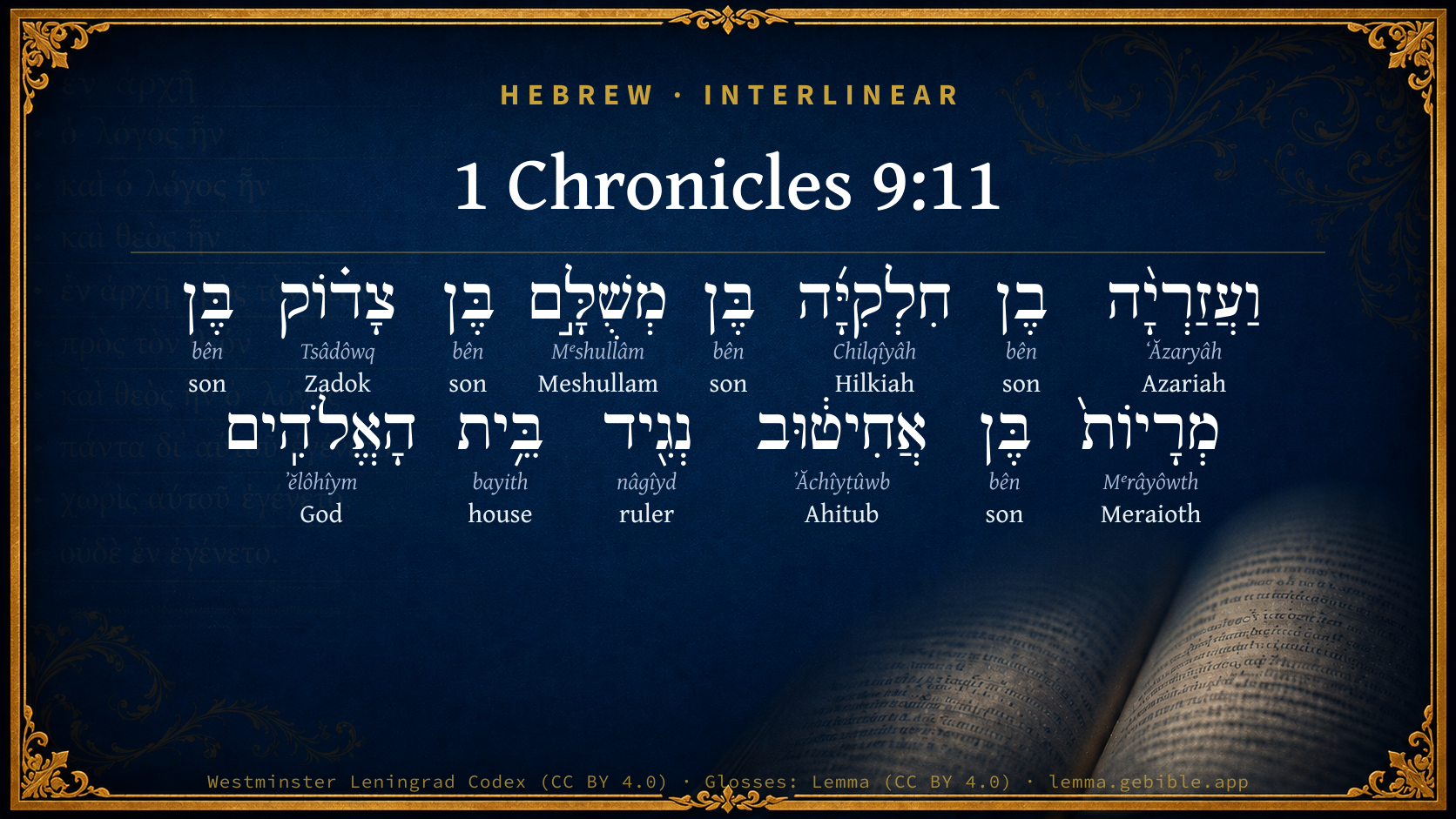
Hebrew (Westminster Leningrad Codex) 1 Chronicles 9:11 appears in the Hebrew Old Testament. The text above is from the Westminster Leningrad Codex. Each word links to its Strong’s number, a concise gloss, and parsing drawn from the Open Scriptures Hebrew Bible morphology. Click any word for its full Brown-Driver-Briggs (BDB) entry.
Download image
Cite this verse

1 Chronicles 9:11 (World English Bible). Public Domain. Lemma interlinear Bible study tool, https://lemma.gebible.app/v/1-chronicles/9/11.

Show BibTeX & RIS
BibTeX
RIS
English Translation
and Azariah the son of Hilkiah, the son of Meshullam, the son of Zadok, the son of Meraioth, the son of Ahitub, the ruler of the house of God;
World English Bible · Public Domain
Download a study sheet

One document with this verse’s original text, its word-by-word gloss line, the meaning frame, cross-references with their text, attributed commentary, and full source and license credits — printable, and it pastes into notes with its structure intact.

This verse Autodidact and up

Study sheet (.html) Plain text (.txt)

A passage Seminary Student

Up to 50 verses in one chapter. A passage sheet keeps up to 6 commentary sources and 12 cross-references per verse, in the order this page ranks them, and says so on the sheet whenever that leaves anything out. Ask for a single verse and you get the Autodidact verse sheet above.

Everything on this page stays free to read, with no account — the sheet is a download of what is already on screen, not access to it.

Want to remove ads? Support Godless Engineer
Compare translations 3

The same verse in 3 English versions, stacked beneath the original-language interlinear above. Click any original word for its lexicon entry.

Each is an independent rendering of the whole verse — the interlinear is not word-aligned to these translations.

Highlighted words mark where these versions differ — a whole-verse word diff, not a word-by-word alignment.

  • World English Bible Public Domain
    and Azariah the son of Hilkiah, the son of Meshullam, the son of Zadok, the son of Meraioth, the son of Ahitub, the ruler of the house of God;
  • King James Version Public Domain
    And Azariah the son of Hilkiah, the son of Meshullam, the son of Zadok, the son of Meraioth, the son of Ahitub, the ruler of the house of God;
  • unfoldingWord Literal Text CC BY-SA 4.0
    and Azariah, the son of Hilkiah, the son of Meshullam, the son of Zadok, the son of Meraioth, the son of Ahitub, the leader of the house of God,

unfoldingWord Literal Text — © unfoldingWord, licensed CC BY-SA 4.0. Word-aligned USFM3 via Door43 (git.door43.org/unfoldingWord/en_ult).

Versions to compare (up to 4)

3 of 4 selected

Show all 18 translations

Every available English version of this verse, each an independent rendering of the whole verse.

  • World English Bible Public Domain
    and Azariah the son of Hilkiah, the son of Meshullam, the son of Zadok, the son of Meraioth, the son of Ahitub, the ruler of the house of God;
  • Berean Standard Bible Public Domain
    Azariah son of Hilkiah, the son of Meshullam, the son of Zadok, the son of Meraioth, the son of Ahitub, the chief official of God’s temple;
  • Majority Standard Bible Public Domain
    Azariah son of Hilkiah, the son of Meshullam, the son of Zadok, the son of Meraioth, the son of Ahitub, the chief official of God’s temple;
  • King James Version Public Domain
    And Azariah the son of Hilkiah, the son of Meshullam, the son of Zadok, the son of Meraioth, the son of Ahitub, the ruler of the house of God;
  • American Standard Version (1901) Public Domain
    and Azariah the son of Hilkiah, the son of Meshullam, the son of Zadok, the son of Meraioth, the son of Ahitub, the ruler of the house of God;
  • Revised Version (1885) Public Domain
    and Azariah the son of Hilkiah, the son of Meshullam; the son of Zadok, the son of Meraioth, the son of Ahitub, the ruler of the house of God;
  • Geneva Bible (1599) Public Domain
    And Azariah the sonne of Hilkiah, ye sonne of Meshullam, the sonne of Zadok, the sonne of Meraioth, the sonne of Ahitub the chiefe of the house of God,
  • Douay-Rheims (1899) Public Domain
    And Azarias the son of Helcias, the son of Mosollam, the son of Sadoc, the son of Maraioth, the son of Achitob, high priest of the house of God.
  • Young's Literal Translation Public Domain
    and Azariah son of Hilkiah, son of Meshullam, son of Zadok, son of Meraioth, son of Ahitub, leader in the house of God;
  • Literal Standard Version CC BY-SA 4.0
    and Azariah son of Hilkiah, son of Meshullam, son of Zadok, son of Meraioth, son of Ahitub, leader in the house of God;
  • Unlocked Literal Bible CC BY-SA 4.0
    There was also Azariah son of Hilkiah son of Meshullam son of Zadok son of Meraioth son of Ahitub, the one in charge of the house of God.
  • unfoldingWord Literal Text CC BY-SA 4.0
    and Azariah, the son of Hilkiah, the son of Meshullam, the son of Zadok, the son of Meraioth, the son of Ahitub, the leader of the house of God,
  • Darby Bible Public Domain
    and Azariah the son of Hilkijah, the son of Meshullam, the son of Zadok, the son of Meraioth, the son of Ahitub, the ruler of the house of God;
  • World Messianic Bible Public Domain
    and Azariah the son of Hilkiah, the son of Meshullam, the son of Zadok, the son of Meraioth, the son of Ahitub, the ruler of God’s house;
  • Webster's Bible Public Domain
    And Azariah the son of Hilkiah, the son of Meshullam, the son of Zadok, the son of Meraioth, the son of Ahitub, the ruler of the house of God;
  • Free Bible Version CC BY-SA 4.0
    Azariah son of Hilkiah, son of Meshullam, son of Zadok, son of Meraioth, son of Ahitub. (Azariah was the head official in charge of the house of God.)
  • Bible in Basic English Public Domain
    And Azariah, the son of Hilkiah, the son of Meshullam, the son of Zadok, the son of Meraioth, the son of Ahitub, the ruler of the house of God;
  • JPS Tanakh (1917) Public Domain
    and Azariah the son of Hilkiah, the son of Meshullam, the son of Zadok, the son of Meraioth, the son of Ahitub, the ruler of the house of God;

Literal Standard Version (2020), Covenant Press — licensed CC BY-SA 4.0. Text via the HelloAO Bible API (eBible.org). Unlocked Literal Bible (unfoldingWord) — licensed CC BY-SA 4.0. Text via the HelloAO Bible API (eBible.org). unfoldingWord Literal Text — © unfoldingWord, licensed CC BY-SA 4.0. Word-aligned USFM3 via Door43 (git.door43.org/unfoldingWord/en_ult). Free Bible Version, Dr. Jonathan Gallagher — licensed CC BY-SA 4.0. Text via the HelloAO Bible API (eBible.org).

Word by word

More ways to search: Search by grammar → Find every occurrence → Compare this word →

Practice this passage: Drill this verse → Learn its vocabulary →

מְרָיוֹת֙
Mᵉrâyôwth
H4812
“Meraioth”
Noun, Proper
Part of Speech
Noun
Type
Proper
Full BDB Definition

Origin: from H4811

TWOT: None

Meraioth = "rebellious" - grandfather of Ahitub, descendant of Eleazar the son of Aaron, and the head of a priestly house - son of Ahitub, father of Zadok, descendant of Eleazar the son of Aaron, and the head of a priestly house - head of a family of priests represented by Helkai in the time of Joiakim, the son of Jeshua
  1. וַעֲזַרְיָ֨ה ʻĂzaryâh H5838 “and · Azariah” Conjunction + Noun, Proper
  2. בֶן bên H1121 “son of” Noun, Common, Masculine, Singular, Construct
  3. חִלְקִיָּ֜ה Chilqîyâh H2518 “Hilkiah” Noun, Proper
  4. בֶּן bên H1121 “son of” Noun, Common, Masculine, Singular, Construct
  5. מְשֻׁלָּ֣ם Mᵉshullâm H4918 “Meshullam” Noun, Proper
  6. בֶּן bên H1121 “son of” Noun, Common, Masculine, Singular, Construct
  7. צָד֗וֹק Tsâdôwq H6659 “Zadok” Noun, Proper
  8. בֶּן bên H1121 “son of” Noun, Common, Masculine, Singular, Construct
  9. בֶּן bên H1121 “son of” Noun, Common, Masculine, Singular, Construct
  10. אֲחִיט֔וּב ʼĂchîyṭûwb H285 “Ahitub” Noun, Proper
  11. נְגִ֖יד nâgîyd H5057 “ruler of” Noun, Common, Masculine, Singular, Construct
  12. בֵּ֥ית bayith H1004 “house of” Noun, Common, Masculine, Singular, Construct
  13. הָאֱלֹהִֽים ʼĕlôhîym H430 “the · God(s)” Particle, Definite Article + Noun, Common, Masculine, Plural, Absolute

About this verse

These counts appear in no published source. They are computed here, from the morphology-tagged text and Lemma’s own curated glosses. What Lemma adds →

14
words
10
distinct lemmas
Historical
section

Notable vocabulary

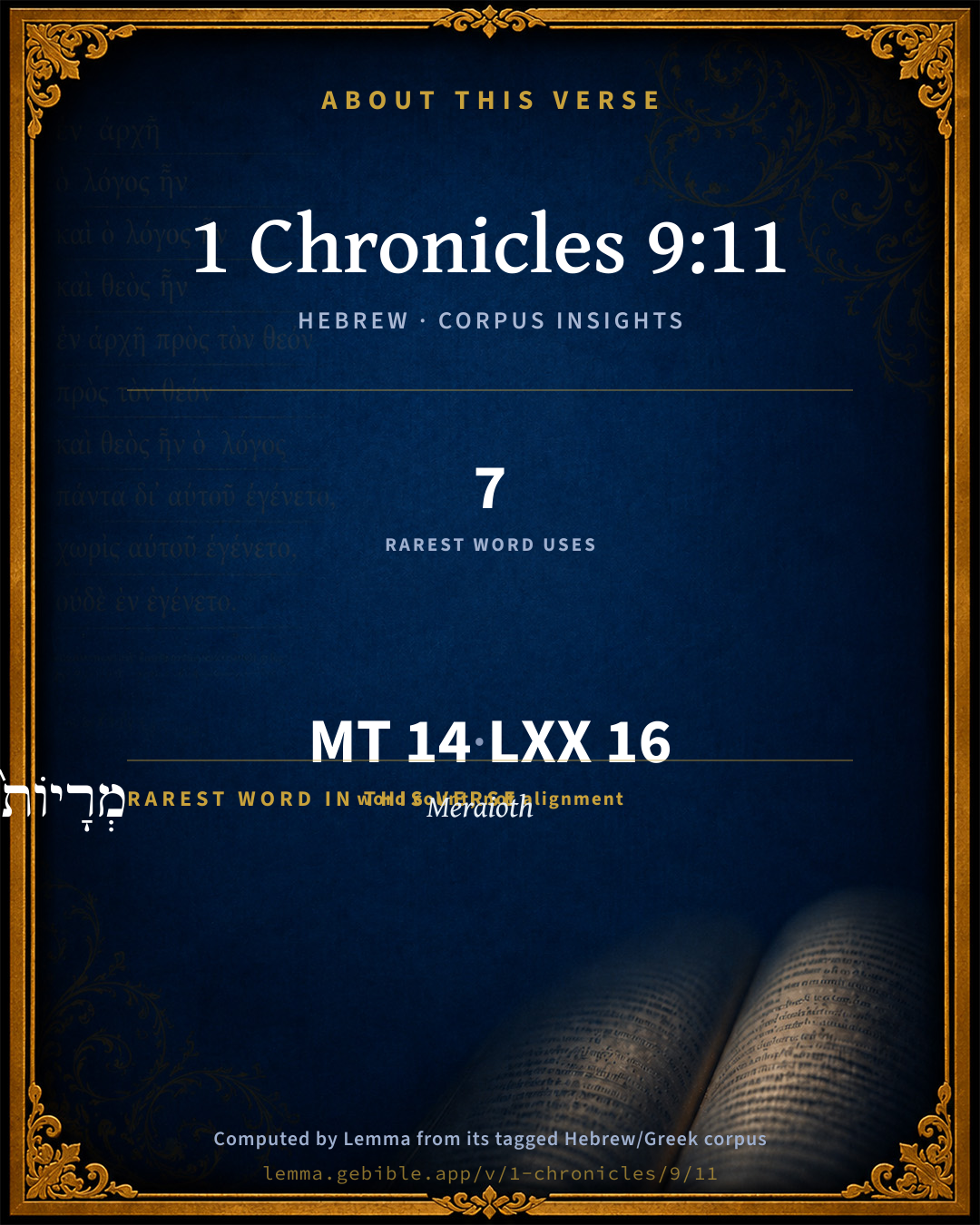
The rarest word here is מְרָיוֹת֙ Meraioth H4812 — appearing just 7 times in the whole Hebrew Bible.

Shared distinctive vocabulary

מְרָיוֹת֙ Meraioth H4812 occurs in 7 verses of the Hebrew Bible. Also found in:

Grammatical profile

  • 14 nouns

Repetition

A word recurs within this verse — often emphatic in Hebrew:

Hebrew & Septuagint length

In English translation the verse runs 29 words from the Hebrew and 29 from the Septuagint (LXX English) — the same length.

A rough comparison of the two English renderings, which tokenize alike — not a word-level alignment.

Word counts can differ between the Hebrew and the Greek without any difference in meaning — e.g. the Hebrew direct-object marker אֵת has no separate Greek word, and Greek often adds the article ὁ.

In the original languages it is 14 Hebrew tokens and 16 Greek tokens — but the two are counted differently (Hebrew bundles its prefixes and suffixes into one token; the Greek is in lemma form), so that isn’t a like-for-like length.

Cross-references

12

Topical passages linked to 1 Chronicles 9:11 in the Treasury of Scripture Knowledge — connected by theme and wording, ordered by reader-vote popularity; previews shown in the World English Bible.

  • Nehemiah 11:11 Seraiah the son of Hilkiah, the son of Meshullam, the son of Zadok, the son of Meraioth, the son of Ahitub, the ruler of the house of God,
  • Numbers 4:15–16 "When Aaron and his sons have finished covering the sanctuary, and all the furniture of the sanctuary, as the camp moves forward; after that, the sons of Kohath shall come to carry it: but they shall not touch the sanctuary, lest they die. These things are the burden of the sons of Kohath in the Tent of Meeting.
  • Numbers 4:28 This is the service of the families of the sons of the Gershonites in the Tent of Meeting: and their charge shall be under the hand of Ithamar the son of Aaron the priest.
  • Numbers 4:33 This is the service of the families of the sons of Merari, according to all their service, in the Tent of Meeting, under the hand of Ithamar the son of Aaron the priest."
  • 2 Kings 23:4 The king commanded Hilkiah the high priest, and the priests of the second order, and the keepers of the threshold, to bring forth out of the temple of Yahweh all the vessels that were made for Baal, and for the Asherah, and for all the host of the sky, and he burned them outside of Jerusalem in the fields of the Kidron, and carried the ashes of them to Bethel.
  • 2 Kings 25:18 The captain of the guard took Seraiah the chief priest, and Zephaniah the second priest, and the three keepers of the threshold:
  • 1 Chronicles 6:8–15 and Ahitub became the father of Zadok, and Zadok became the father of Ahimaaz,
  • 1 Chronicles 24:5 Thus were they divided impartially by drawing lots; for there were princes of the sanctuary, and princes of God, both of the sons of Eleazar, and of the sons of Ithamar.
  • Nehemiah 10:2 Seraiah, Azariah, Jeremiah,
  • Jeremiah 20:1 Now Pashhur, the son of Immer the priest, who was chief officer in the house of Yahweh, heard Jeremiah prophesying these things.
  • Acts 5:24 Now when the high priest, the captain of the temple, and the chief priests heard these words, they were very perplexed about them and what might become of this.
  • Acts 5:26 Then the captain went with the officers, and brought them without violence, for they were afraid that the people might stone them.

Cross-references courtesy of OpenBible.info (CC BY 4.0).

Hebrew and Greek witnesses Masoretic Hebrew ↔ Greek Septuagint

The same verse in the two great witnesses to the Old Testament, shown verse-for-verse.

These are two independent witnesses, not word-aligned to each other, and the Septuagint is shown in lemma (dictionary) form.

Hebrew 1 Chronicles 9:11 Masoretic · Westminster Leningrad Codex

וַעֲזַרְיָ֨ה בֶן חִלְקִיָּ֜ה בֶּן מְשֻׁלָּ֣ם בֶּן צָד֗וֹק בֶּן מְרָיוֹת֙ בֶּן אֲחִיט֔וּב נְגִ֖יד בֵּ֥ית הָאֱלֹהִֽים

and Azariah the son of Hilkiah, the son of Meshullam, the son of Zadok, the son of Meraioth, the son of Ahitub, the ruler of the house of God;

World English Bible · Public Domain

Greek LXX 1 Chronicles 9:11 Septuagint · lemma form

καί αζαρια υἱός χελκια υἱός μοσολλαμ υἱός σαδωκ υἱός μαραιωθ υἱός αχιτωβ ἡγέομαι οἶκος ὁ θεός

and Azaria the son of Chelcias, the son of Mosollam, the son of Sadoc, the son of Maraioth, the son of Achitob, the ruler of the house of God;

LXX2012 (modern English Septuagint) · Public Domain

On this verse, Haydock's Catholic Bible Commentary discusses the Septuagint’s reading. Read the note in Commentary ↓

Hebrew: Westminster Leningrad Codex (CC BY 4.0). Greek: Septuagint (public domain); English from LXX2012 (modern English Septuagint) (Public Domain). How the Septuagint differs from the Hebrew →

Commentary

Notes on 1 Chronicles 9:11 from classic Christian and Jewish commentators (each source and its license shown beneath its notes). The classic Christian expositions comment on the surrounding passage and are grouped to its opening verse, so a note may address several verses; the Jewish commentaries on the Tanakh (Rashi and others) are per-verse, so they appear only where the commentator wrote on this verse.

Lemma curates 59 commentaries, every one of them public domain or Creative Commons licensed, each selected and text-cleaned for this edition rather than reprinted as found. About our sources →

Trapp's Complete Commentary

John Trapp

1Ch 9:11 And Azariah the son of Hilkiah, the son of Meshullam, the son of Zadok, the son of Meraioth, the son of Ahitub, the ruler of the house of God;

Ver. 11. The son of Hilkiah.] Who found the book of the law, which was presented to Josiah. {2Ki 22:8-10}

The ruler of the house of God.] Next to the high priest.

John Trapp, A Commentary or Exposition upon All the Books of the Old and New Testament (1647–1656) — public domain. Text from a community e-Sword module.

Joseph Benson's Commentary

1Ch 9:11. The ruler — Or rather, a ruler in the house of God — Not the high-priest, who was Ezra, (Ezr 3:8,) but a chief ruler under him.

Joseph Benson's Commentary on the Old and New Testaments (1811–1818) — public domain. Text from a community e-Sword module.

Geneva Bible (1599)

Geneva Bible translators

That is, he was the high Priest.

Geneva Bible (1599) marginal notes — public domain. Text via Bolls.life.

Adam Clarke's Commentary

Verse 11. The ruler of the house of God.] The high priest at this time was Jeshua the son of Jozadak, (Ezr 3:8,) and Seraiah, (Ne 11:11,) called here Azariah, was the ruler of the house; the person next in authority to the high priest, and who probably had the guard of the temple and command of the priests, Levites, c. It is likely that the person here was the same as is called the second priest, 1Chr 9:2 1Chr 25:18, who was the sagan or high priest's deputy. 2Kg 25:18.

Adam Clarke's Commentary on the Bible (1810–1826) — public domain. Text from a community e-Sword/MySword module.

Ellicott's Commentary for English Readers

(11) And Azariah the son of Hilkiah, the son of Meshullam.—See 1Ch_6:12-13. The names coincide so far as Zadok; but either Meraioth and Ahitub have been transposed (see 1Ch_6:7), or perhaps Meraioth has been omitted in 1Ch_6:12. Instead of Azariah, the parallel in Neh_11:11 has Seraiah, the rest of the verse being verbatim the same as here. A list of priests who went up with Zerubbabel and Joshua begins with Seraiah (Neh_12:1), and in Neh_10:2 Seraiah and Azariah are priests who sealed the covenant with Nehemiah the Tirshatha, about seventy years later. Neh_12:12 shows that Seraiah was the name of a priestly clan. Perhaps the name Seraiah should be read in the present passage before, or instead of, Azariah. (Comp. 1Ch_6:13-14.) If, however, the name is official, not personal, like the names in the preceding verse, this supposition is hardly necessary. Either Azariah or Seraiah might equally represent the priestly house intended.

A Bible Commentary for English Readers, edited by Charles John Ellicott (1878–1897) — public domain. Text from a community e-Sword module.

The Cambridge Bible for Schools and Colleges

gen. ed. J. J. S. Perowne

11. Azariah] In Neh_11:11, Seraiah.

the ruler of the house of God] This title could perhaps be borne by the highpriest (2Ch_31:10; 2Ch_31:13), but in any case it was not confined to him (ib. 2Ch_35:8, where several such “rulers” are mentioned).

The Cambridge Bible for Schools and Colleges (gen. ed. J. J. S. Perowne; Cambridge University Press, 1878–1918) — public domain. Text from a community e-Sword module.

John Gill's Exposition

And their brethren, heads of the house of their fathers, one thousand and seven hundred and threescore. These, with other priests, made up this number, which was greater than those of Judah and Benjamin, that dwelt in Jerusalem, put together:

very able men for the work of the service of the house of God: men that had not only strength of body, which some part of the work of the priests required; but had courage and fortitude of mind to set about the service of God with cheerfulness, and to preserve it from corruption.

John Gill's Exposition of the Whole Bible (1746–1763) — public domain (CC PDM 1.0). Text via the HelloAO Bible API.

Haydock's Catholic Bible Commentary

Azarias, or Saraias, ibid. 11.[2 Esdras xi. 11.?] --- Mosollam, or Sellum, chap. vi. 12. (Calmet) --- High is not expressed in Pontifex; and this Azarias was only (Haydock) one of the principal families; (Menochius; Du Hamel) perhaps the second in dignity; (4 Kings xxv. 18.) while Jesus was the successor of Aaron, 1 Esdras iii. 8. (Calmet) --- Hebrew and Septuagint, "the ruler," (Haydock) or "captain of the guard of the house." (Calmet) --- They were styled pontiffs, or princes of the priests. (Tirinus)

George Leo Haydock (1774–1849), Haydock's Catholic Family Bible and Commentary, 1859 edition — public domain. Excludes Psalms (Douay-Rheims chapter numbering differs from Protestant) and Deuterocanonical books (Catholic canon only).

Matthew Poole's English Annotations

Azariah; the same called Seraiah, Neh 11:11.

Hilkiah; either of him in Josiah’s time, 2Ki 22:8, or rather another of the same name.

The ruler of the house of God; or, a ruler in the house of God; not the high priest, who was Ezra, Ezr 3:8, but a chief ruler under him; either the second priest, as such are called, Num 3:32; or the head of one of the twenty-four families or courses of the priests.

Matthew Poole's English Annotations on the Holy Bible (1683–1685) — public domain. Text from a community e-Sword/MySword module.

Whedon's Commentary on the Bible

Daniel D. Whedon

11. Ruler of the house of God — A designation of the high priest, as by virtue of his office intrusted with the chief authority and control over the temple. The title seems also to have been given to some who were not high priests, (Jer_20:1,) but held a secondary rank, and had charge of the temple-police and guards. “The Rabbies,” says Hervey, “speak very frequently of one second in dignity to the high priest, whom they call the sagan, and who often acted in the high priest’s room. He is the same who is called “the second priest.” 2Ki_23:4; 2Ki_25:18. They say Moses was sag-an to Aaron. Thus, too, it is explained of Annas and Caiaphas, (Luk_3:2,) that Annas was sagan. In like manner they say Zadok and Abiathar were high priest and sagan in the time of David. The sagan is also very frequently called memunneh, or prefect of the temple, and upon him chiefly lay the care and charge of the temple services. If the high priest was incapacitated from officiating by any accidental uncleanness, the sagan took his place.”

Daniel D. Whedon (gen. ed.), Commentary on the Old and New Testaments (1874–1909) — public domain. Text from a community e-Sword module.

The Pulpit Commentary

Vers. 11-13. This list resembles much more closely that of Neh_11:11-14. The one thousand and seven hundred and three score of this passage is not reached by five hundred and sixty-eight, when the numbers of, Neh_11:12-14 are all added together. The name Azariah (in Nehemiah appearing, probably simply by copyist"s error, as Seraiah) here described as ruler of the house of God, probably points to the high priest Eliashib, who held that office in the time of Nehemiah, and was descended from Seraiah. (1Ch_6:14) The ins and outs of the lists of these verses confirm the supposition that the way in which differences in the other lists occur are easily to be accounted for, in one compiler having selected some of the names of the whole line of genealogy, and another others, though in each several case according to reasons often unknown by us. Thus, between Jeroham and Pashur the table of Nehemiah supplies three additional links in the names Pelaliah, Amzi, Zechariah; while in our very next verse, for the three between Maasiai (Amashai) and Meshillemith, Nehemiah has only two names, and neither of those two (Azareel, Ahasai) the same as found here.

HOMILIES BY J.R. THOMSON Ver. 11.

The ruler of the house of God.

Whether this Azariah was the high priest or the" second priest" does not seem certain. But the office here ascribed to him is evidently one of great importance, and is suggestive of memorable truths with regard to God"s spiritual temple and kingdom.

I THE TRUE "HOUSE OF GOD" IS SPIRITUAL. The temple at Jerusalem was the emblem of the spiritual house which no man has built the Church of the Divine Redeemer and Lord. This is composed of faithful and holy natures, as of "lively stones.

II THIS "HOUSE OF GOD" IS ORDERED AND GOVERNED ACCORDING TO DIVINE WISDOM. This is suggested by the word ruler. " "Order is Heaven"s first law," and this law is certainly not violated in his most precious and beloved work. God"s own wisdom is displayed in his own temple.

III GOD"S OWN SON IS THE RULER IN HIS OWN HOUSE. No earthly sovereign or ecclesiastical pontiff is the head of the spiritual society in which God"s Spirit ever dwells. Christ is the King, the Lord, the Priest; "the Head over all things to his Church.

IV ALL HUMAN RULERS ARE SUBJECT AND SUBORDINATE TO THE DIVINE LORD. Bishops are overseers, and presbyters are pastors; but they are not lords over God"s heritage. They have only authority to declare his will, and to execute his commands; and this trust they fulfil, not for their own honour, but for the order and prosperity of God"s house.

T.

Vers. 11-13.

Authority and ability in the service of God.

Azariah was "the ruler of the house of God" (ver. 11); concerning a thousand seven hundred and sixty it is said that were "very able men for the work of the service of the house of God" (ver. 13). Here we have high authority and eminent ability in the service of the Lord.

I AUTHORITY IN SACRED SERVICE. Our Saviour did not establish a hierarchy in the Christian Church. The apostolate was obviously a temporary institution. We read of "elders that rule well", (1Ti_5:17) and the Hebrew Christians were charged to "obey them that had the rule over them". (Heb_13:17) There was, as there is now, a place in the Church for authority on the one hand and for loyalty on the other. There are, as there ever will be, those who direct, control, organize, appoint, remove. On the part of such there should be:

1. A sense of deep responsibility; for on their decision and direction greatthings depend.

2. A constant appeal for Divine guidance. In the affairs of his kingdomsurely the Divine Sovereign should be continually con-suited by those who speak in his Name.

3. Great carefulness to act in harmony with his revealed will, so that theymay not, while professing to work for God, be simply imposing their own fallible judgment on other minds.

4. The cultivation of humility, lest they should aspire to "have dominionover the faith" of men, instead of walking humbly with God, and serving in love like that Son of man who "came not to be ministered unto, but to minister.

II ABILITY IN SACRED SERVICE. (Ver. 13.) The ability which these priests displayed in the service of the sanctuary was of a somewhat different order from that which is now required in the service of man in the Church of Christ. But it was inspired by the same Divine Being, and it aimed at the same end the spiritual well-being of the nation. We remark concerning ability in sacred service:

1. That it is, in large part, the gift of God. "Veryable men" are "what they are by the grace of God." Their conspicuous ability is his endowment. From the Author of their being come the faculties (memory, imagination, judgment, reason, enthusiasm, strength, will, etc.) which distinguish them from their fellows. They owe their eminence to the supreme hand that raises and levels all things. Therefore

(1) let those who possess remarkable ability wear their honours meekly, remembering whence they came; and therefore

(2) let not those who lack it be envious of those who enjoy it, for then their "eye would be evil" because God is good.

2. That it is, in large part, the product of human effort. The greatest"abilities" will come to no ripeness and bear no fruit without human industry, patience, effort. Many who have it in them to do great things go to the grave having lived useless, wasted lives. Therefore

(1) let those who are gifted of God see to it that they train, mature, and use the capacities they have of him; and

(2) let those who receive the benefit of such ability honour the human while they bless the Divine Author of 2:3. That it is a gift for the use of which its possessors should feel a large measure of responsibility. Who shall measure the vastness of the influence for good or evil which one man of great ability may exert, if we take into account not only the direct but all the indirect results of his action?

3. That the approval and award of the Master depend, not on ability, buton faithfulness. They who have served God with special powers will have the gratification of seeing peculiarly large results; but whether our talents be few or many, if we be faithful at our post, we shall all share the "Well done" of the righteous Judge. C.

The Pulpit Commentary (1880–1919), ed. H.D.M. Spence-Jones & Joseph S. Exell — public domain. Text from a community e-Sword module.

John Wesley's Explanatory Notes

The ruler - Or, a ruler in the house of God: not the high-priest, who was Ezra, Ezra iii, 8, but a chief ruler under him.

John Wesley, Explanatory Notes Upon the Whole Bible (1754–1765) — public domain. Text via the GEBible commentary corpus.

Keil & Delitzsch

C. F. Keil & F. Delitzsch

And their brethren, heads of the house of their fathers, one thousand and seven hundred and threescore. These, with other priests, made up this number, which was greater than those of Judah and Benjamin, that dwelt in Jerusalem, put together:

very able men for the work of the service of the house of God: men that had not only strength of body, which some part of the work of the priests required; but had courage and fortitude of mind to set about the service of God with cheerfulness, and to preserve it from corruption.

Keil & Delitzsch — Biblical Commentary on the Old Testament (1861–1891) — public domain (CC PDM 1.0). Text via the HelloAO Bible API. (Old Testament only.)

Lesson kit

Teaching starters — assembled from the data on this page, not authored interpretation. Every prompt links to the verse data it draws on. Edit before teaching.

1 Chronicles, in the Historical, opens this verse with 14 words (10 distinct Hebrew lemmas). Its most distinctive word is Mᵉrâyôwth (“Meraioth”). A historical commentator’s framing appears above. Read the whole chapter for the surrounding context.

Discussion questions

  1. How does “Meraioth” (Mᵉrâyôwth) shape what this verse is saying?
  2. 1 Chronicles 6:6 shares the word «Meraioth» with this verse. How do the two illuminate each other?
  3. “son” occurs 5× in this one verse. What is the effect of the repetition?
  4. These translations render this verse differently; the difference is in the English rendering, not the original. What questions does that raise?
  5. Reading how Trapp's Complete Commentary and Joseph Benson's Commentary read this verse, where do the two commentators agree and where do they part?

Things to notice

Reading settings

Reading text

Shown beneath each verse's original-language words.

Old Testament
Old Testament edition

Read the OT as the Masoretic Hebrew (MT) or the Greek Septuagint (LXX).

English shown for the Greek Septuagint (in the Hebrew ↔ Greek comparison).

Comparing translations? Open the Compare panel on any verse page to stack up to four side by side.