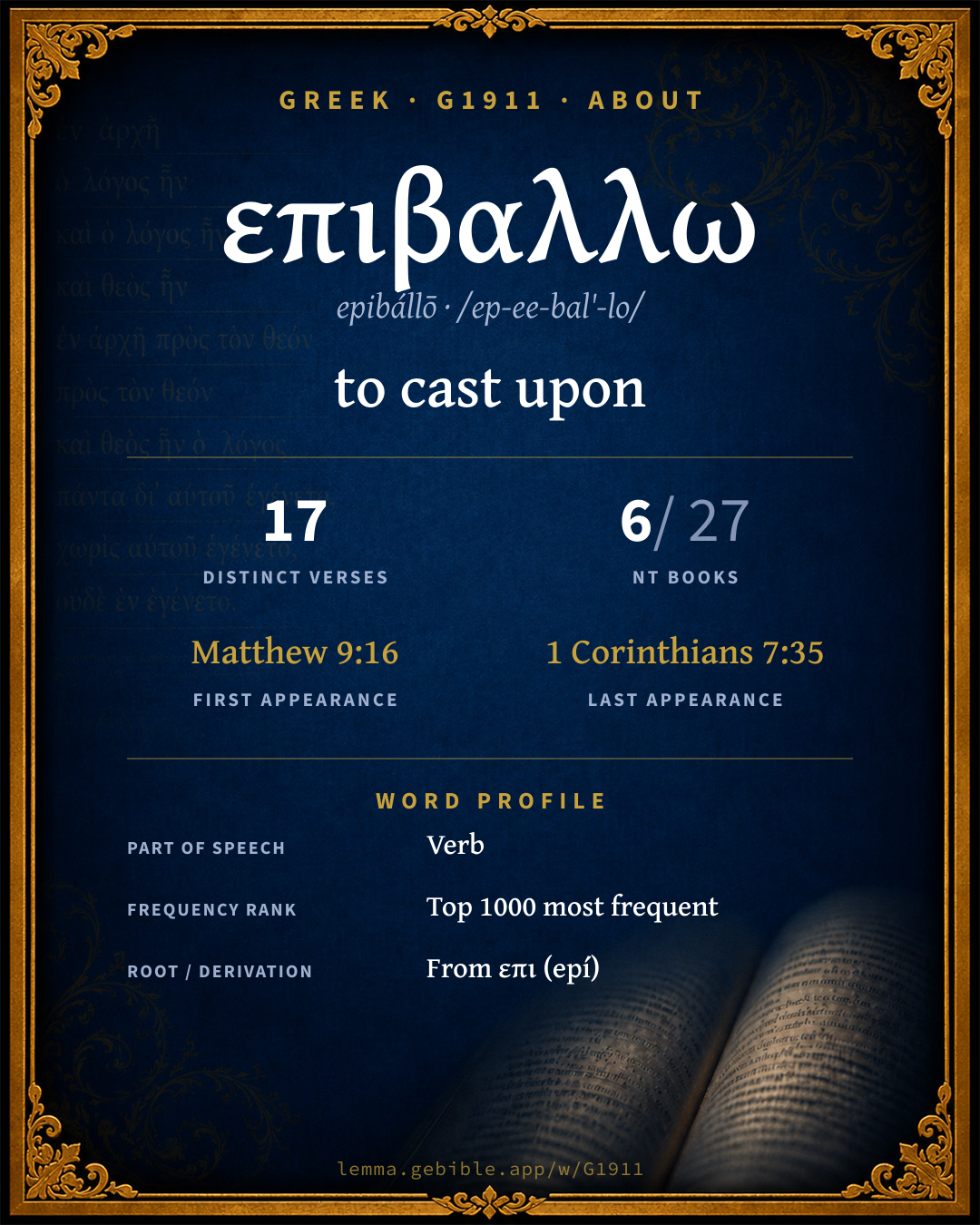
ἐπιβάλλω
to cast upon
‘to cast upon’ is one of 3 main senses fuller range ↓
Full lexicon entry — Thayer's Greek Lexicon
From Thayer's Greek Lexicon
Where this word appears
See every Aorist-tense verb in the Greek New Testament →
Grammar key — what these labels mean
Part of speech
- Verb
- An action or state-of-being word.
Tense
- Aorist
- Action viewed as a simple whole, without regard to duration — often past (perfective aspect).
- Present
- Ongoing or general action in present time (imperfective aspect).
- Future
- Action expected in future time.
- Imperfect
- Continuous or repeated action in past time (“was writing”).
Voice
- Active
- The subject performs the action.
Mood
- Indicative
- States a fact or asks a factual question (the mood of reality).
- Participle
- A verbal adjective (“writing,” “having written”).
- Infinitive
- A verbal noun (“to write”), unmarked for person or number.
- Subjunctive
- Expresses probability, purpose, or possibility (the mood of contingency).
Case
- Nominative
- The case of the subject (and the predicate nominative).
- Accusative
- The case of the direct object and of extent.
Person
- 3rd person
- The one spoken about (“he / she / it / they”).
- 1st person
- The speaker (“I / we”).
Gender
- Masculine
- Grammatically masculine.
- Neuter
- Grammatically neuter.
Number
- Plural
- More than one.
- Singular
- One.
Grammatical forms 10 distinct
- Verb, Aorist, Active, Indicative, 3rd person, Plural 5 times (29%)
- Verb, Aorist, Active, Indicative, 3rd person, Singular 2 times (12%)
- Verb, Aorist, Active, Participle, Nominative, Singular, Masculine 2 times (12%)
- Verb, Present, Active, Indicative, 3rd person, Singular 2 times (12%)
- Verb, Aorist, Active, Infinitive 1 time (6%)
- Verb, Aorist, Active, Subjunctive, 1st person, Singular 1 time (6%)
- Verb, Future, Active, Indicative, 3rd person, Plural 1 time (6%)
- Verb, Imperfect, Active, Indicative, 3rd person, Singular 1 time (6%)
+2 more forms (2 occurrences)
Parsed forms decoded from the imported morphology (Robinson–Tischendorf, public domain), counted across 17 parsed occurrences — not distinct verses.
Every verse where G1911 appears — 17 distinct verses across 6 books. Click any verse to open its interlinear word-by-word view. Verse text shown in the World English Bible for context — . Each verse’s Greek form is shown with its reference; the English is not keyword-highlighted, since the data carries no word-level English alignment. Use “Compare translations” on any verse to read it across multiple English versions. This concordance covers the Greek New Testament; Septuagint (Greek Old Testament) occurrences of this word are not indexed here.
Matthew 2 verses
- Matthew 9:16 ἐπιβάλλει pres act ind 3sg No one puts a piece of unshrunk cloth on an old garment; for the patch would tear away from the garment, and a worse hole is made.
- Matthew 26:50 ἐπέβαλον aor act ind 3pl Jesus said to him, "Friend, why are you here?" Then they came and laid hands on Jesus, and took him.
Mark 4 verses
- Mark 4:37 ἐπέβαλλεν impf act ind 3sg There arose a great wind storm, and the waves beat into the boat, so much that the boat was already filled.
- Mark 11:7 ἐπιβάλλουσιν pres act ind 3pl They brought the young donkey to Jesus, and threw their garments on it, and Jesus sat on it.
- Mark 14:46 ἐπέβαλον aor act ind 3pl They laid their hands on him, and seized him.
- Mark 14:72 ἐπιβαλὼν aor act ptcp nom sg masc The rooster crowed the second time. Peter remembered the word, how that Jesus said to him, "Before the rooster crows twice, you will deny me three times." When he thought about that, he wept.
Luke 5 verses
- Luke 5:36 ἐπιβάλλει pres act ind 3sg He also told a parable to them. "No one puts a piece from a new garment on an old garment, or else he will tear the new, and also the piece from the new will not match the old.
- Luke 9:62 ἐπιβαλὼν aor act ptcp nom sg masc But Jesus said to him, "No one, having put his hand to the plow, and looking back, is fit for the Kingdom of God."
- Luke 15:12 ἐπιβάλλον pres act ptcp acc sg neut The younger of them said to his father, 'Father, give me my share of your property.' He divided his livelihood between them.
- Luke 20:19 ἐπιβαλεῖν aor act inf The chief priests and the scribes sought to lay hands on Him that very hour, but they feared the people--for they knew He had spoken this parable against them.
- Luke 21:12 ἐπιβαλοῦσιν fut act ind 3pl But before all these things, they will lay their hands on you and will persecute you, delivering you up to synagogues and prisons, bringing you before kings and governors for my name's sake.
John 1 verse
Acts 4 verses
- Acts 4:3 ἐπέβαλον aor act ind 3pl They laid hands on them, and put them in custody until the next day, for it was now evening.
- Acts 5:18 ἐπέβαλον aor act ind 3pl and laid hands on the apostles, and put them in public custody.
- Acts 12:1 ἐπέβαλεν aor act ind 3sg Now about that time, Herod the king stretched out his hands to oppress some of the assembly.
- Acts 21:27 ἐπέβαλον aor act ind 3pl When the seven days were almost completed, the Jews from Asia, when they saw him in the temple, stirred up all the multitude and laid hands on him,
1 Corinthians 1 verse
About this entry
At a glance — auto-summarized from this page’s data, not written by a person. Every figure links to its source below. This summary describes the numbers; it doesn’t interpret them.
επιβαλλω — transliterated epibállō — is a Greek verb carrying the sense “to cast upon.” It first appears in Matthew 9:16. The Greek New Testament uses it across 17 verses — uncommon. More than a quarter of its appearances fall in Luke. Its lexical range runs to 3 senses. Each statement above links to its evidence; the full detail follows below.
Gloss history
Strong's 1890 vs modern scholarship

About this word
Strong's G1911 catalogs a Greek word from the Greek New Testament.
These counts are not copied from any lexicon or concordance. They are computed here, from the morphology-tagged Greek New Testament. What Lemma adds →
- 17
- distinct verses
- The word appears in 17 distinct verses.
- 6 / 27
- NT books
- The word appears in 6 of 27 New Testament books.
- #697
- by frequency
- Top 1000 most frequent Greek words (rank 697 of 5,347 Greek words by occurrence).
View all 17 occurrences in the concordance →
By section of the New Testament
By traditional corpus
Conventional, traditional groupings — biblical authorship is debated, so this is a traditional corpus grouping, not an authorship claim. Some books belong to more than one corpus (Luke is in both the Gospels and the Lukan corpus, and so on), so these shares overlap and need not total 100%. Each figure is a share of the word’s 17 distinct verses.
- Gospels 12 verses · 71%
- Lukan (Luke–Acts) 9 verses · 53%
- Johannine 1 verse · 6%
- Pauline corpus 1 verse · 6%
How translations render this word
Counts come from each version’s own published word-to-Strong’s tagging or interlinear alignment — an approximate guide to how each version renders this word, not a word-level alignment the data otherwise carries. Because each total is that version’s own tagged count, the per-version totals vary from one another and need not match the appearance or distinct-verse counts above. These counts may also differ from a printed concordance because Lemma counts each distinctly tagged rendering and does not collapse phrase taggings into a single head-word total. This is a fixed set of word-tagged versions (KJV, ASV, BSB, ULT) and does not change with the reading translation you choose elsewhere. Each version’s license is shown beside its name below (and on Sources).
- King James Version: Laid 5×, Putteth 2×, They laid 2×
- American Standard Version: Laid 3×, They laid 2×
- Berean Standard Bible: Seized 3×, Laid 2×, Sews 2×
- unfoldingWord Literal Text: They laid 4×, Laid 3×
King James Version Public Domain
Renders G1911 across 19 tagged occurrences — most commonly:
Plus 10 renderings that appear only once — usually multi-word phrases or single function words the recovered tagging swept in, not distinct renderings.
American Standard Version Public Domain
Renders G1911 across 17 tagged occurrences — most commonly:
Plus 12 renderings that appear only once — usually multi-word phrases or single function words the recovered tagging swept in, not distinct renderings.
Berean Standard Bible Public Domain
Renders G1911 across 18 tagged occurrences — most commonly:
Plus 11 renderings that appear only once — usually multi-word phrases or single function words the recovered tagging swept in, not distinct renderings.
unfoldingWord Literal Text CC BY-SA 4.0
Renders G1911 across 22 tagged occurrences — most commonly:
Plus 15 renderings that appear only once — usually multi-word phrases or single function words the recovered tagging swept in, not distinct renderings.
Senses in Thayer's
The 3 senses Thayer's distinguishes for this word, in lexicon order (not ranked by frequency or importance). The full entry — with sub-senses — is in the Lexicon Entry tab.
- to cast upon, to lay upon
- to throw one's self upon, rush in
- it belongs to me, falls to my share
Word origin
Derived from επι (epí) (G1909) — upon.
From G1909 and G906 ; to throw upon (literally or figuratively transitively or reflexively; usually with more or less force); specifically (with G1438 implied) to reflect ; impersonally to belong to : - beat into cast (up-) on fall lay (on) put (unto) stretch forth think on.
— Strong’s Exhaustive Concordance (1890), public domain.
Forms in the corpus
The 10 distinct written forms G1911 takes in the Greek New Testament, most frequent first — each parse links to that tense’s occurrences in the concordance.
| Form | Parsing | Example | Uses |
|---|---|---|---|
| ἐπέβαλον epébalon | Verb, Aorist, Active, Indicative, 3rd person, Plural | Matthew 26:50 | 5 |
| ἐπέβαλεν epébalen | Verb, Aorist, Active, Indicative, 3rd person, Singular | John 7:30 | 2 |
| ἐπιβάλλει epibállei | Verb, Present, Active, Indicative, 3rd person, Singular | Matthew 9:16 | 2 |
| ἐπιβαλὼν epibalṑn | Verb, Aorist, Active, Participle, Nominative, Singular, Masculine | Mark 14:72 | 2 |
| ἐπέβαλλεν epéballen | Verb, Imperfect, Active, Indicative, 3rd person, Singular | Mark 4:37 | 1 |
| ἐπιβάλλον epibállon | Verb, Present, Active, Participle, Accusative, Singular, Neuter | Luke 15:12 | 1 |
| ἐπιβάλλουσιν epibállousin | Verb, Present, Active, Indicative, 3rd person, Plural | Mark 11:7 | 1 |
| ἐπιβάλω epibálō | Verb, Aorist, Active, Subjunctive, 1st person, Singular | 1 Corinthians 7:35 | 1 |
| ἐπιβαλεῖν epibaleîn | Verb, Aorist, Active, Infinitive | Luke 20:19 | 1 |
| ἐπιβαλοῦσιν epibaloûsin | Verb, Future, Active, Indicative, 3rd person, Plural | Luke 21:12 | 1 |
Same root — word family
Other Thayer's entries built from the same root as G1911, grouped by Strong’s listed origin. These share a root / origin per the lexicon — not necessarily a shared meaning. Each links to that word’s own entry.
Derives from
Shares the same root
- επαγγελλω epangéllō G1861 to announce
- επαγω epágō G1863 to bring upon
- επαγωνιζομαι epagōnízomai G1864 to contend
- επαθροιζω epathroízō G1865 to gather together
- επαινεω epainéō G1867 to approve
- επαινος épainos G1868 approval
- επαιρω epaírō G1869 to lift up
- επαισχυνομαι epaischýnomai G1870 to be ashamed
- επαιτεω epaitéō G1871 to ask repeatedly
- επακουω epakoúō G1873 to give ear to
- επακροαομαι epakroáomai G1874 to listen to
- επαν epán G1875 after
- επαναγκες epánankes G1876 necessarily
- επαναγω epanágō G1877 to lead back
- επαναμιμνησκω epanamimnḗskō G1878 to remind
- επαναπαυομαι epanapaúomai G1879 to rest upon
- επανερχομαι epanérchomai G1880 to return
- επανισταμαι epanístamai G1881 to raise up against
- επανορθωσις epanórthōsis G1882 correction
- επανω epánō G1883 above
- επαρκεω eparkéō G1884 to avail
- επαρχια eparchía G1885 office of governor
- επαυλις épaulis G1886 farm
- επαυριον epaúrion G1887 the next day
+110 more words share this root (not shown).
Derived from this word
Proper names from this root
People and places named from this root — a name, not an additional meaning of the word.
Compare all same-root words → Showing 4 of 138 — not the complete family. 1 of the same-root words is a proper name (a person or place). They share a root, not necessarily a meaning.
Septuagint usage
The same Greek word επιβαλλω appears 53 times in the Greek Old Testament (Septuagint), across 52 verses in 15 books.
- 53
- LXX occurrences
- Tagged occurrences of this Greek word in the Septuagint.
- 52
- verses
- Distinct Septuagint verses containing this word.
- 15 / 39
- OT books
- The word appears in 15 of the 39 Old Testament books.
Sample Septuagint occurrences
- Genesis 2:21 ἐπιβάλλω
- Exodus 5:8 ἐπιβάλλω
- Leviticus 10:1 ἐπιβάλλω
- Numbers 4:6 ἐπιβάλλω
- Deuteronomy 12:7 ἐπιβάλλω
- Joshua 7:6 ἐπιβάλλω
- 2 Samuel 18:12 ἐπιβάλλω
- 1 Kings 21:6 ἐπιβάλλω
- 2 Chronicles 36:3 ἐπιβάλλω
- Esther 6:2 ἐπιβάλλω
- Job 27:12 ἐπιβάλλω
- Psalms 80:15 ἐπιβάλλω
Septuagint occurrences (same lexeme)
Every verse where the same Strong’s number (G1911) appears in the Greek Septuagint — showing the first 50 of 52. Verse text shown in the World English Bible for context; the Greek form is the matched word — the English is not keyword-highlighted.
- Genesis 2:21 ἐπιβάλλω Yahweh God caused a deep sleep to fall on the man, and he slept; and he took one of his ribs, and closed up the flesh in its place.
- Genesis 22:12 ἐπιβάλλω He said, "Don't lay your hand on the boy, neither do anything to him. For now I know that you fear God, seeing you have not withheld your son, your only son, from me."
- Genesis 39:7 ἐπιβάλλω It happened after these things, that his master's wife cast her eyes on Joseph; and she said, "Lie with me."
- Genesis 46:4 ἐπιβάλλω I will go down with you into Egypt. I will also surely bring you up again. Joseph will close your eyes."
- Genesis 48:14 ἐπιβάλλω Israel stretched out his right hand, and laid it on Ephraim's head, who was the younger, and his left hand on Manasseh's head, guiding his hands knowingly, for Manasseh was the firstborn.
- Genesis 48:17 ἐπιβάλλω When Joseph saw that his father laid his right hand on the head of Ephraim, it displeased him. He held up his father's hand, to remove it from Ephraim's head to Manasseh's head.
- Exodus 5:8 ἐπιβάλλω The number of the bricks, which they made before, you require from them. You shall not diminish anything of it, for they are idle; therefore they cry, saying, 'Let us go and sacrifice to our God.'
- Exodus 7:4 ἐπιβάλλω But Pharaoh will not listen to you, and I will lay my hand on Egypt, and bring forth my hosts, my people the children of Israel, out of the land of Egypt by great judgments.
- Exodus 20:25 ἐπιβάλλω If you make me an altar of stone, you shall not build it of hewn stones; for if you lift up your tool on it, you have polluted it.
- Exodus 21:22 ἐπιβάλλω "If men fight and hurt a pregnant woman so that she gives birth prematurely, and yet no harm follows, he shall be surely fined as much as the woman's husband demands and the judges allow.
- Exodus 21:30 ἐπιβάλλω If a ransom is laid on him, then he shall give for the redemption of his life whatever is laid on him.
- Leviticus 10:1 ἐπιβάλλω Nadab and Abihu, the sons of Aaron, each took his censer, and put fire in it, and laid incense on it, and offered strange fire before Yahweh, which he had not commanded them.
- Leviticus 19:19 ἐπιβάλλω "'You shall keep my statutes. "'You shall not crossbreed different kinds of animals. "'you shall not sow your field with two kinds of seed; "'neither shall there come upon on you a garment made of two kinds of material.
- Numbers 4:6 ἐπιβάλλω and shall put a covering of sealskin on it, and shall spread over it a cloth all of blue, and shall put in its poles.
- Numbers 4:7 ἐπιβάλλω On the table of show bread they shall spread a blue cloth, and put on it the dishes, the spoons, the bowls, and the cups with which to pour out; and the continual bread shall be on it.
- Numbers 4:8 ἐπιβάλλω They shall spread on them a scarlet cloth, and cover the same with a covering of sealskin, and shall put in its poles.
- Numbers 4:14 ἐπιβάλλω They shall put on it all its vessels, with which they minister about it, the fire pans, the flesh hooks, the shovels, and the basins; all the vessels of the altar; and they shall spread on it a covering of sealskin, and put in its poles.
- Numbers 11:31 ἐπιβάλλω There went forth a wind from Yahweh, and brought quails from the sea, and let them fall by the camp, about a day's journey on this side, and a day's journey on the other side, round about the camp, and about two cubits above the surface of the earth.
- Numbers 16:18 ἐπιβάλλω They took every man his censer, and put fire in them, and laid incense thereon, and stood at the door of the tent of meeting with Moses and Aaron.
- Numbers 17:11 ἐπιβάλλω Thus did Moses: as Yahweh commanded him, so did he.
- Numbers 17:12 ἐπιβάλλω The children of Israel spoke to Moses, saying, Behold, we perish, we are undone, we are all undone.
- Numbers 19:2 ἐπιβάλλω This is the statute of the law which Yahweh has commanded, saying, Speak to the children of Israel, that they bring you a red heifer without spot, in which is no blemish, [and] on which never came yoke.
- Deuteronomy 12:7 ἐπιβάλλω and there you shall eat before Yahweh your God, and you shall rejoice in all that you put your hand to, you and your households, in which Yahweh your God has blessed you.
- Deuteronomy 12:18 ἐπιβάλλω but you shall eat them before Yahweh your God in the place which Yahweh your God shall choose, you, and your son, and your daughter, and your man-servant, and your maid-servant, and the Levite who is within your gates: and you shall rejoice before Yahweh your God in all that you put your hand to.
- Deuteronomy 15:10 ἐπιβάλλω You shall surely give him, and your heart shall not be grieved when you give to him; because that for this thing Yahweh your God will bless you in all your work, and in all that you put your hand to.
- Deuteronomy 20:19 ἐπιβάλλω When you shall besiege a city a long time, in making war against it to take it, you shall not destroy the trees of it by wielding an axe against them; for you may eat of them, and you shall not cut them down; for is the tree of the field man, that it should be besieged of you?
- Deuteronomy 23:25 ἐπιβάλλω When you come into your neighbor's standing grain, then you may pluck the ears with your hand; but you shall not move a sickle to your neighbor's standing grain.
- Deuteronomy 24:5 ἐπιβάλλω When a man takes a new wife, he shall not go out in the host, neither shall he be charged with any business: he shall be free at home one year, and shall cheer his wife whom he has taken.
- Deuteronomy 27:5 ἐπιβάλλω There shall you build an altar to Yahweh your God, an altar of stones: you shall lift up no iron [tool] on them.
- Deuteronomy 28:8 ἐπιβάλλω Yahweh will command the blessing on you in your barns, and in all that you put your hand to; and he will bless you in the land which Yahweh your God gives you.
- Deuteronomy 28:20 ἐπιβάλλω Yahweh will send on you cursing, confusion, and rebuke, in all that you put your hand to do, until you are destroyed, and until you perish quickly; because of the evil of your doings, by which you have forsaken me.
- Joshua 7:6 ἐπιβάλλω Joshua tore his clothes, and fell to the earth on his face before the ark of Yahweh until the evening, he and the elders of Israel; and they put dust on their heads.
- Joshua 9:2 ἐπιβάλλω that they gathered themselves together, to fight with Joshua and with Israel, with one accord.
- 2 Samuel 18:12 ἐπιβάλλω The man said to Joab, Though I should receive a thousand [pieces of] silver in my hand, I still wouldn't put forth my hand against the king's son; for in our hearing the king charged you and Abishai and Ittai, saying, Beware that none touch the young man Absalom.
- 1 Kings 21:6 ἐπιβάλλω He said to her, Because I spoke to Naboth the Jezreelite, and said to him, Give me your vineyard for money; or else, if it please you, I will give you [another] vineyard for it: and he answered, I will not give you my vineyard.
- 2 Chronicles 36:3 ἐπιβάλλω The king of Egypt deposed him at Jerusalem, and fined the land one hundred talents of silver and a talent of gold.
- Esther 6:2 ἐπιβάλλω It was found written that Mordecai had told of Bigthana and Teresh, two of the king's chamberlains, of those who kept the threshold, who had sought to lay hands on the king Ahasuerus.
- Job 27:12 ἐπιβάλλω Behold, all of you have seen it yourselves; Why then have you become altogether vain?
- Psalms 80:15 ἐπιβάλλω The stock which your right hand planted, The branch that you made strong for yourself.
- Proverbs 18:17 ἐπιβάλλω He who pleads his cause first seems right; Until another comes and questions him.
- Proverbs 20:17 ἐπιβάλλω Fraudulent food is sweet to a man, But afterwards his mouth is filled with gravel.
- Proverbs 23:2 ἐπιβάλλω Put a knife to your throat, If you are a man given to appetite.
- Isaiah 5:25 ἐπιβάλλω Therefore Yahweh's anger burns against his people, And he has stretched out his hand against them, and has struck them. The mountains tremble, And their dead bodies are as refuse in the midst of the streets. For all this, his anger is not turned away, But his hand is still stretched out.
- Isaiah 11:8 ἐπιβάλλω The sucking child shall play on the hole of the asp, and the weaned child shall put his hand on the adder's den.
- Isaiah 11:14 ἐπιβάλλω They shall fly down on the shoulder of the Philistines on the west; together shall they despoil the children of the east: they shall put forth their hand on Edom and Moab; and the children of Ammon shall obey them.
- Isaiah 11:15 ἐπιβάλλω Yahweh will utterly destroy the tongue of the Egyptian sea; and with his scorching wind will he wave his hand over the River, and will strike it into seven streams, and cause men to march over in sandals.
- Isaiah 19:16 ἐπιβάλλω In that day shall the Egyptians be like women; and they shall tremble and fear because of the shaking of the hand of Yahweh of Hosts, which he shakes over them.
- Isaiah 25:11 ἐπιβάλλω He shall spread forth his hands in the midst of it, as he who swims spreads forth [his hands] to swim; but [Yahweh] will lay low his pride together with the craft of his hands.
- Isaiah 34:11 ἐπιβάλλω But the pelican and the porcupine shall possess it; and the owl and the raven shall dwell therein: and he will stretch over it the line of confusion, and the plummet of emptiness.
- Isaiah 34:17 ἐπιβάλλω He has cast the lot for them, and his hand has divided it to them by line: they shall possess it forever; from generation to generation shall they dwell therein.
These are occurrences of the same Greek lexeme (G1911) in the Septuagint — not a translation of any one Hebrew word. The store carries no word-level Hebrew↔Greek alignment, so no Hebrew original is asserted here. Counts come from the recovered LXX Strong's tagging — high-frequency vocabulary is well covered, while rare or late forms may be untagged — so they reflect tagged occurrences and may slightly undercount.