Isaiah 11:8

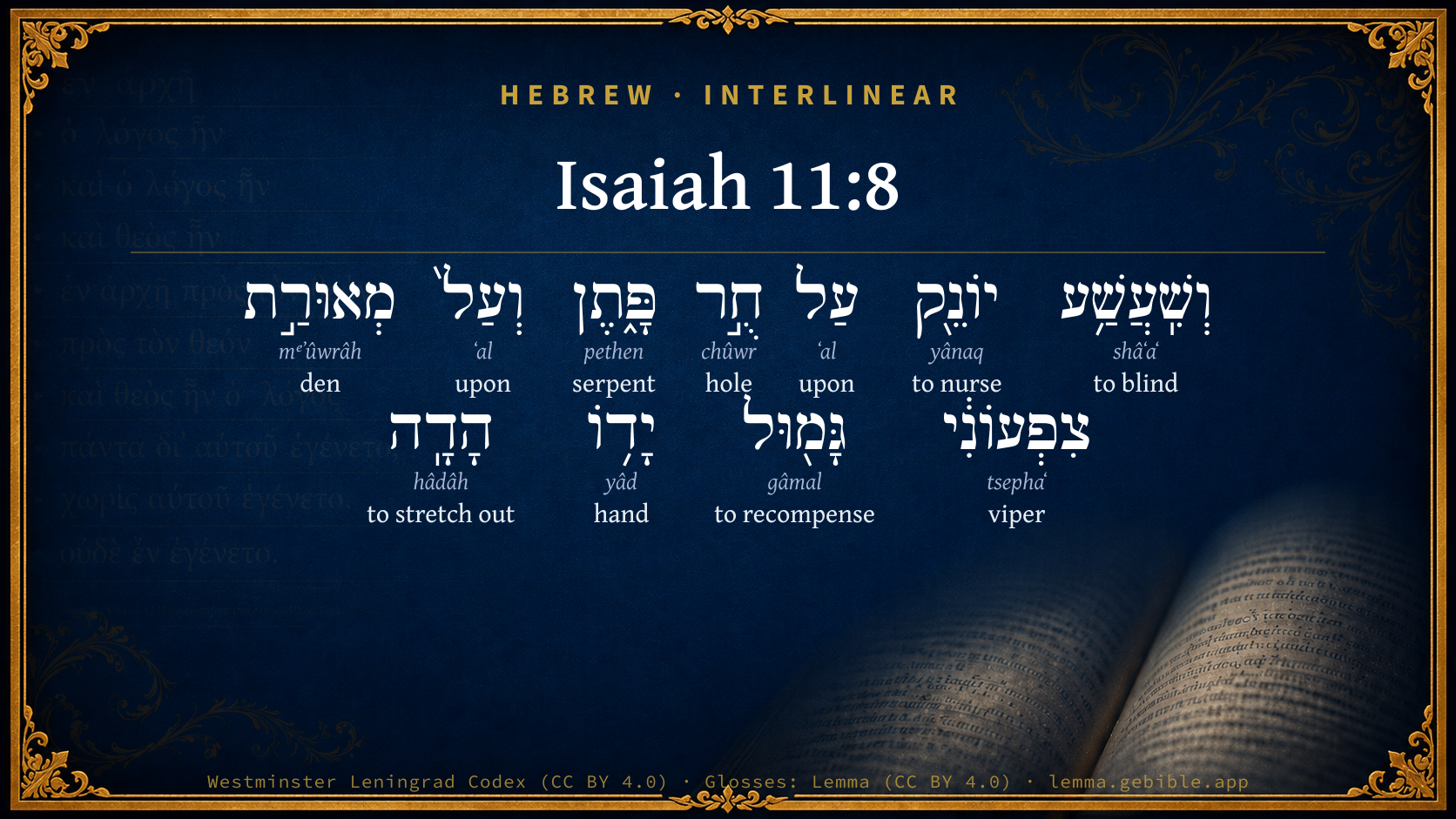
Hebrew (Westminster Leningrad Codex) Isaiah 11:8 appears in the Hebrew Old Testament. The text above is from the Westminster Leningrad Codex. Each word links to its Strong’s number, a concise gloss, and parsing drawn from the Open Scriptures Hebrew Bible morphology. Click any word for its full Brown-Driver-Briggs (BDB) entry.
Download image
Cite this verse

Isaiah 11:8 (World English Bible). Public Domain. Lemma interlinear Bible study tool, https://lemma.gebible.app/v/isaiah/11/8.

Show BibTeX & RIS
BibTeX
RIS
English Translation
The sucking child shall play on the hole of the asp, and the weaned child shall put his hand on the adder's den.
World English Bible · Public Domain
Highlights
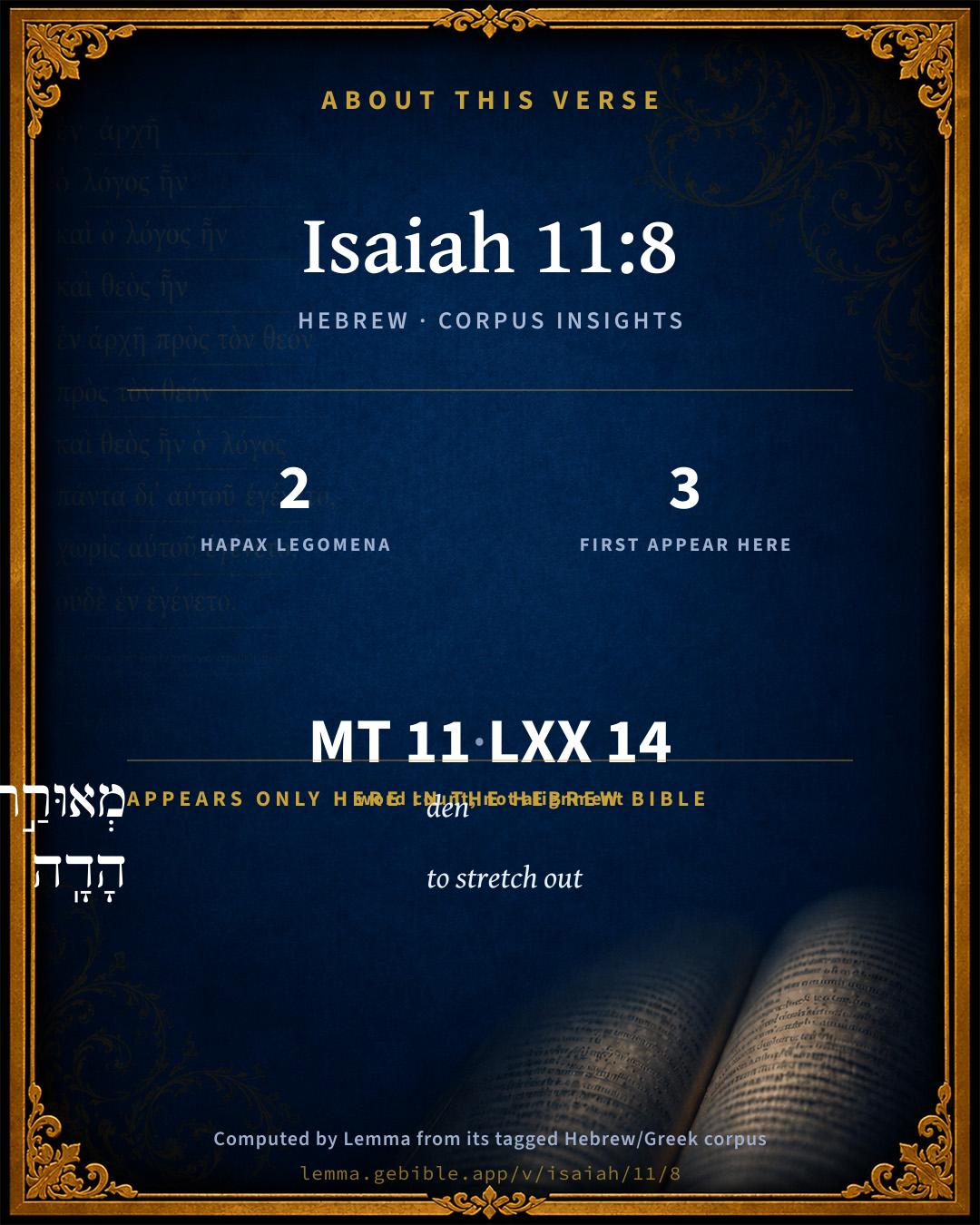
  • 2 hapax legomena — only here in the Hebrew Bible
  • 3 first appearances in the Hebrew Bible
Full analysis ↓
Download a study sheet

One document with this verse’s original text, its word-by-word gloss line, the meaning frame, cross-references with their text, attributed commentary, and full source and license credits — printable, and it pastes into notes with its structure intact.

This verse Autodidact and up

Study sheet (.html) Plain text (.txt)

A passage Seminary Student

Up to 50 verses in one chapter. A passage sheet keeps up to 6 commentary sources and 12 cross-references per verse, in the order this page ranks them, and says so on the sheet whenever that leaves anything out. Ask for a single verse and you get the Autodidact verse sheet above.

Everything on this page stays free to read, with no account — the sheet is a download of what is already on screen, not access to it.

Want to remove ads? Support Godless Engineer
Compare translations 3

The same verse in 3 English versions, stacked beneath the original-language interlinear above. Click any original word for its lexicon entry.

Each is an independent rendering of the whole verse — the interlinear is not word-aligned to these translations.

Highlighted words mark where these versions differ — a whole-verse word diff, not a word-by-word alignment.

  • World English Bible Public Domain
    The sucking child shall play on the hole of the asp, and the weaned child shall put his hand on the adder's den.
  • King James Version Public Domain
    And the sucking child shall play on the hole of the asp, and the weaned child shall put his hand on the cockatrice' den.
  • unfoldingWord Literal Text CC BY-SA 4.0
    And the nursing will play over the hole of the adder, and the weaned will stretch out his hand over the den of the viper.

unfoldingWord Literal Text — © unfoldingWord, licensed CC BY-SA 4.0. Word-aligned USFM3 via Door43 (git.door43.org/unfoldingWord/en_ult).

Versions to compare (up to 4)

3 of 4 selected

Show all 18 translations

Every available English version of this verse, each an independent rendering of the whole verse.

  • World English Bible Public Domain
    The sucking child shall play on the hole of the asp, and the weaned child shall put his hand on the adder's den.
  • Berean Standard Bible Public Domain
    The infant will play by the cobra’s den, and the toddler will reach into the viper’s nest.
  • Majority Standard Bible Public Domain
    The infant will play by the cobra’s den, and the toddler will reach into the viper’s nest.
  • King James Version Public Domain
    And the sucking child shall play on the hole of the asp, and the weaned child shall put his hand on the cockatrice' den.
  • American Standard Version (1901) Public Domain
    And the sucking child shall play on the hole of the asp, and the weaned child shall put his hand on the adder's den.
  • Revised Version (1885) Public Domain
    And the sucking child shall play on the hole of the asp, and the weaned child shall put his hand on the basilisk’s den.
  • Geneva Bible (1599) Public Domain
    And the sucking childe shall play vpon the hole of the aspe, and the wained childe shall put his hand vpon the cockatrice hole.
  • Douay-Rheims (1899) Public Domain
    And the sucking child shall play on the hole of the asp: and the weaned child shall thrust his hand into the den of the basilisk.
  • Young's Literal Translation Public Domain
    And played hath a suckling by the hole of an asp, And on the den of a cockatrice Hath the weaned one put his hand.
  • Literal Standard Version CC BY-SA 4.0
    And a suckling has played by the hole of a cobra, || And on the den of a viper || The weaned one has put his hand.
  • Unlocked Literal Bible CC BY-SA 4.0
    A baby will play over the hole of the snake, and the weaned child will put his hand on the serpent's den.
  • unfoldingWord Literal Text CC BY-SA 4.0
    And the nursing will play over the hole of the adder, and the weaned will stretch out his hand over the den of the viper.
  • Darby Bible Public Domain
    And the sucking child shall play on the hole of the adder, and the weaned child shall put forth its hand to the viper's den.
  • World Messianic Bible Public Domain
    The nursing child will play near a cobra’s hole, and the weaned child will put his hand on the viper’s den.
  • Webster's Bible Public Domain
    And the suckling child shall play on the hole of the asp, and the weaned child shall put his hand on the den of the basilisk.
  • Free Bible Version CC BY-SA 4.0
    Babies will be able to play safely near snake holes, little children will be able to put their hands into a vipers' den.
  • Bible in Basic English Public Domain
    And the child at the breast will be playing by the hole of the snake, and the older child will put his hand on the bright eye of the poison-snake.
  • JPS Tanakh (1917) Public Domain
    And the sucking child shall play on the hole of the asp, and the weaned child shall put his hand on the basilisk's den.

Literal Standard Version (2020), Covenant Press — licensed CC BY-SA 4.0. Text via the HelloAO Bible API (eBible.org). Unlocked Literal Bible (unfoldingWord) — licensed CC BY-SA 4.0. Text via the HelloAO Bible API (eBible.org). unfoldingWord Literal Text — © unfoldingWord, licensed CC BY-SA 4.0. Word-aligned USFM3 via Door43 (git.door43.org/unfoldingWord/en_ult). Free Bible Version, Dr. Jonathan Gallagher — licensed CC BY-SA 4.0. Text via the HelloAO Bible API (eBible.org).

Word by word

More ways to search: Search by grammar → Find every occurrence → Compare this word →

Practice this passage: Drill this verse → Learn its vocabulary →

מְאוּרַ֣ת
mᵉʼûwrâh
H3975
“den of”
Noun, Common, Feminine, Singular, Construct
Part of Speech
Noun
Type
Common
Gender
Feminine
Number
Singular
State
Construct
Full BDB Definition

Origin: pass. participle of H215

TWOT: 52g

light hole, den
  1. וְשִֽׁעֲשַׁ֥ע shâʻaʻ H8173 “and · to blind” Conjunction + Verb, Pilpel, Sequential Perfect, 3rd Person, Masculine, Singular
  2. יוֹנֵ֖ק yânaq H3243 “nursing” Verb, Qal, Participle Active, Masculine, Singular, Absolute
  3. עַל ʻal H5921 “upon” Preposition
  4. חֻ֣ר chûwr H2352 “hole of” Noun, Common, Masculine, Singular, Construct
  5. פָּ֑תֶן pethen H6620 “serpent” Noun, Common, Masculine, Singular, Absolute
  6. וְעַל֙ ʻal H5921 “and · upon” Conjunction + Preposition
  7. צִפְעוֹנִ֔י tsephaʻ H6848 “viper” Noun, Common, Masculine, Singular, Absolute
  8. גָּמ֖וּל gâmal H1580 “recompensed” Verb, Qal, Participle Passive, Masculine, Singular, Absolute
  9. יָד֥וֹ yâd H3027 “hand · his” Noun, Common, Both, Singular, Construct + Suffix, Personal, 3rd Person, Masculine, Singular
  10. הָדָֽה hâdâh H1911 “to stretch out” Verb, Qal, Perfect, 3rd Person, Masculine, Singular

About this verse

These counts appear in no published source. They are computed here, from the morphology-tagged text and Lemma’s own curated glosses. What Lemma adds →

11
words
10
distinct lemmas
Prophets
section

Notable vocabulary

2 hapax legomena — words that appear only here in the entire Hebrew Bible:

  • מְאוּרַ֣ת den H3975
  • הָדָֽה to stretch out H1911

First appearance in Scripture

These words make their first canonical appearance in the Hebrew Bible here:

  • חֻ֣ר hole H2352
  • מְאוּרַ֣ת den H3975
  • הָדָֽה to stretch out H1911

Shared distinctive vocabulary

חֻ֣ר hole H2352 occurs in 2 verses of the Hebrew Bible. Also found in:

Grammatical profile

  • 4 verbs
  • 5 nouns
  • 2 prepositions

Verb forms

  • וְשִֽׁעֲשַׁ֥ע Pilpel · Sequential Perfect
  • יוֹנֵ֖ק Qal · Participle Active
  • גָּמ֖וּל Qal · Participle Passive
  • הָדָֽה Qal · Perfect

Repetition

A word recurs within this verse — often emphatic in Hebrew:

Hebrew & Septuagint length

In English translation the verse runs 23 words from the Hebrew and 19 from the Septuagint (LXX English) — closely comparable.

A rough comparison of the two English renderings, which tokenize alike — not a word-level alignment.

Word counts can differ between the Hebrew and the Greek without any difference in meaning — e.g. the Hebrew direct-object marker אֵת has no separate Greek word, and Greek often adds the article ὁ.

In the original languages it is 11 Hebrew tokens and 14 Greek tokens — but the two are counted differently (Hebrew bundles its prefixes and suffixes into one token; the Greek is in lemma form), so that isn’t a like-for-like length.

Cross-references

2

Topical passages linked to Isaiah 11:8 in the Treasury of Scripture Knowledge — connected by theme and wording, ordered by reader-vote popularity; previews shown in the World English Bible.

  • Psalms 140:3 They have sharpened their tongues like a serpent. Viper's poison is under their lips. Selah.
  • Isaiah 59:5 They hatch adders' eggs, and weave the spider's web: he who eats of their eggs dies; and that which is crushed breaks out into a viper.

Cross-references courtesy of OpenBible.info (CC BY 4.0).

Hebrew and Greek witnesses Masoretic Hebrew ↔ Greek Septuagint

The same verse in the two great witnesses to the Old Testament, shown verse-for-verse.

These are two independent witnesses, not word-aligned to each other, and the Septuagint is shown in lemma (dictionary) form.

Hebrew Isaiah 11:8 Masoretic · Westminster Leningrad Codex

וְשִֽׁעֲשַׁ֥ע יוֹנֵ֖ק עַל חֻ֣ר פָּ֑תֶן וְעַל֙ מְאוּרַ֣ת צִפְעוֹנִ֔י גָּמ֖וּל יָד֥וֹ הָדָֽה

The sucking child shall play on the hole of the asp, and the weaned child shall put his hand on the adder's den.

World English Bible · Public Domain

Greek LXX Isaiah 11:8 Septuagint · lemma form

καί παιδίον νήπιος ἐπί τρώγλη ἀσπίς καί ἐπί κοίτη ἔκγονος ἀσπίς ὁ χείρ ἐπιβάλλω

And an infant shall put his hand on the holes of asps, and on the nest of young asps.

LXX2012 (modern English Septuagint) · Public Domain

Hebrew: Westminster Leningrad Codex (CC BY 4.0). Greek: Septuagint (public domain); English from LXX2012 (modern English Septuagint) (Public Domain). How the Septuagint differs from the Hebrew →

Targum (Aramaic paraphrase)

1

The Targum is the ancient Jewish Aramaic paraphrase of the Hebrew Scriptures — an interpretive translation, not the Hebrew text itself. Onkelos (literal) and Pseudo-Jonathan (expansive) render the Torah, and Jonathan the Prophets. Coverage is partial: where no permissively-licensed English translation exists for a verse, only the Aramaic is shown. This is verse-level text, not a word-by-word alignment to the Hebrew.

  1. Targum Jonathan Prophets (Joshua–Malachi)
    וִיחַיִךְ יַנְקָא עַל חוֹר חִוֵי פֶתֶן וְעַל חֵיזוּ גִלְגְלֵי עֵינַי חִוֵי חוּרְמָן חֲסִילָא יְדוֹהִי יוֹשִׁיט:

    And the sucking child shall play on the hole of the asp, and the weaned child shall put forth his hand on the sight of the pupil of the eyes of the cockatrice.

    Targum Jonathan — Aramaic: “Mikraot Gedolot” (public domain). English: “Sefaria Community Translation” (CC0 1.0 (public-domain dedication)); “London "Chaldee Paraphrase," 1871” (public domain). Text via Sefaria.

Commentary

Notes on Isaiah 11:8 from classic Christian and Jewish commentators (each source and its license shown beneath its notes). The classic Christian expositions comment on the surrounding passage and are grouped to its opening verse, so a note may address several verses; the Jewish commentaries on the Tanakh (Rashi and others) are per-verse, so they appear only where the commentator wrote on this verse.

Lemma curates 59 commentaries, every one of them public domain or Creative Commons licensed, each selected and text-cleaned for this edition rather than reprinted as found. About our sources →

Trapp's Complete Commentary

John Trapp

Isa 11:8 And the sucking child shall play on the hole of the asp, and the weaned child shall put his hand on the cockatrice’ den.

Ver. 8. And the sucking child shall play upon the hole of the asp, &c.] There shall be no danger from calumniators and cruel crafties, asps and basilisks, {a} quorum in labris venenum sessitat {Psa 140:4} These homines damnosissimi most damnable men shall have a new nature transfused into them; their malignities and mischievous qualities shall cease when once truly converted.

{a} A fabulous reptile, also called a cockatrice, alleged to be hatched by a serpent from a cock’s egg; ancient authors stated that its hissing drove away all other serpents, and that its breath, and even its look, was fatal.

John Trapp, A Commentary or Exposition upon All the Books of the Old and New Testament (1647–1656) — public domain. Text from a community e-Sword module.

Albert Barnes' Notes on the Bible

And the sucking child - An emblem here of harmlessness and innocence. The change in the world, under the Messiah, shall be as great as if a sucking infant should be able to play unharmed with a venomous serpent.

Shall play - Shall delight himself (שׁעשׁע shı̂‛ăsha‛) as children usually engage in their sports; compare Pro 8:30-31; Psa 119:24.

On the hole of the asp - Over, or around the cavern, hole, or place of retreat of the asp. He shall play over that place as safely as if the nature of the asp was changed, and it had become innocuous. The Hebrew word rendered here “asp” (פתן pethen) denotes the serpent usually called the asp, whose poison is of such rapid operation that it kills almost instantly: see Job 20:14, Job 20:16; Psa 58:4; Psa 91:13; Deu 32:33. The word occurs in no other places in the Old Testament. This serpent is small. It is found particularly in Egypt, though also in other places; see the note at Job 20:14. It is used here as the emblem of the more sudden, malignant, and violent passions; and the idea is, that under the Messiah a change would be performed in people of malignant and deadly passions as signal “as if” the asp or adder were to lose his venom, and become innocuous to a child.

And the weaned child - But still, a young and helpless child. The image is varied, but the same idea is retained.

Shall put his hand - That is, he shall do it safely, or uninjured.

On the cockatrice’ den - Margin, ‘Adder’s.’ The word rendered here “cockatrice” (צפעוני tsı̂p‛ônı̂y) occurs only in the fellowing places: Isa 14:29; Isa 11:8; Isa 59:5; Pro 23:32; Jer 8:17. In all these places, it is rendered cockatrice, except in Pro 23:32. The “cockatrice” was a fabulous kind of serpent, supposed to be hatched from the egg of a cock. The serpent here designated is, doubtless, a species of the “adder,” more venomous, perhaps, than the פתן pethen, but still belonging to the same species. Bochart (“Hieroz.” P. ii. lib. iii. ch. ix.) supposes that the “basilisk” is intended - a species of serpent that, he says, was supposed to poison even with its breath. The general idea is the same here as above. It is in vain to attempt to spiritualize these expressions, and to show that they refer to certain individuals, or that the animals here designated refer to particular classes of the enemies of the gospel. It is a mere poetic description, denoting great peace and security; and all the changes in the mad, malignant, and envenomed passions of people, that may be necessary to produce and perpetuate that peace. Pope has versified this description in the following beautiful manner:

The lambs with wolves shall graze the verdant mead,

And boys, in flowery bands, the tigers lead.

The steer and lion at one crib shall meet,

And harmless serpents lick the pilgrim’s feet.

The smiling infant in his hand shall take

The crested basilisk, and speckled snake;

Pleased, the green luster of the scales survey,

And, with their forked tongue, shall innocently play.

Messiah.

Albert Barnes' Notes on the Bible (1834–1885) — public domain. Text from a community e-Sword/MySword module.

Jamieson, Fausset & Brown

Robert Jamieson, A. R. Fausset & David Brown

play--literally, "delight" himself in sport.

cockatrice--a fabulous serpent supposed to be hatched from the egg of a cock. The Hebrew means a kind of adder, more venomous than the asp; BOCHART supposes the basilisk to be meant, which was thought to poison even with its breath.

Jamieson, Fausset & Brown — Commentary Critical and Explanatory on the Whole Bible (1871) — public domain (CC PDM 1.0). Text via the HelloAO Bible API.

Adam Clarke's Commentary

Verse 8. The cockatrice' den.] This is supposed, both by the Targum and by Kimchi, to mean the pupil of this serpent's eye. "When," says Kimchi, "he is in the mouth of his den, in an obscure place, then his eyes sparkle exceedingly: the child, seeing this, and supposing it to be a piece of crystal, or precious stone, puts forth his hand to take it. What would be very dangerous at another time, shall be safe in the days of the Messiah; for the serpent will not hurt the child."

Adam Clarke's Commentary on the Bible (1810–1826) — public domain. Text from a community e-Sword/MySword module.

Ellicott's Commentary for English Readers

(8) And the sucking child shall play on the hole of the asp . . .—The description culminates in the transformation of the brute forms which were most identified with evil. As it is, the sight of a child near the hole of the asp (the cobra) or cockatrice (better, perhaps, basilisk, the great viper), would make its mother scream with terror. There was still “enmity between the seed of the woman and the seed of the serpent” (Gen_3:15), but in the far-off reign of the Christ even that enmity should disappear, and the very symbols of evil, subtle, malignant, venomous, should be reconciled to humanity. Some critics translate the last clause, “shall stretch out his hand to the eye-ball of the basilisk” as if alluding to the power of fascination commonly assigned to it.

A Bible Commentary for English Readers, edited by Charles John Ellicott (1878–1897) — public domain. Text from a community e-Sword module.

The Cambridge Bible for Schools and Colleges

gen. ed. J. J. S. Perowne

8. The most startling contrast of all,—the innocent babe playing with the deadly serpent.

asp] Heb. pethen, rendered “adder” in Psa_58:4; Psa_91:13, elsewhere as here. The species has not been identified. The cockatrice (çiph ‘ônî, rendered “adder” in Pro_23:32) is usually identified with the basilisk (or King-serpent) of North Africa, but that reptile is not found in Palestine.

The word den (only here) is doubtful. The most natural view is that it is fem. of the word for “luminary” and denotes the glittering eye of the serpent, which attracts the child like a jewel.

The verb rendered put means strictly “lead”; comp. ducere manum.

The Cambridge Bible for Schools and Colleges (gen. ed. J. J. S. Perowne; Cambridge University Press, 1878–1918) — public domain. Text from a community e-Sword module.

John Gill's Exposition

And the sucking child shall play on the hole of the asp,.... Without fear or danger:

and the weaned child shall put his hand on the cockatrice's den; and suffer no damage: the meaning is explained in the next words, and to be understood of regenerate persons, both of new born babes, or just born, and all such who are weaned from their own righteousness, and live by faith on Christ, who shall not be hurt by the poison of false teachers, nor by the force of violent persecutors, now no more,

See Gill (Editor's note) on "Isa 11:6".

John Gill's Exposition of the Whole Bible (1746–1763) — public domain (CC PDM 1.0). Text via the HelloAO Bible API.

Haydock's Catholic Bible Commentary

Basilisk. Psalm ix. 13. The apostles subdued kings and philosophers, without any human advantages.

George Leo Haydock (1774–1849), Haydock's Catholic Family Bible and Commentary, 1859 edition — public domain. Excludes Psalms (Douay-Rheims chapter numbering differs from Protestant) and Deuterocanonical books (Catholic canon only).

Matthew Poole's English Annotations

The asp; a most fierce and poisonous serpent, Deu 32:33; Job 20:14,16, which also will not be charmed by any art of man, Psa 58:5.

The cockatrice; a serpent of more than ordinary cunning and cruelty, Pro 23:32. The meaning is, They shall not fear to be either deceived or destroyed by those who formerly watched all opportunities to do it.

Matthew Poole's English Annotations on the Holy Bible (1683–1685) — public domain. Text from a community e-Sword/MySword module.

Whedon's Commentary on the Bible

Daniel D. Whedon

8. To express the doctrine still more strongly, venomous serpents are represented as innoxious.

The asp — “This is thought to be the cobra.” — TRISTRAM’S Natural History of the Bible. Precise discrimination of the serpent species is, however, of no importance to exegesis here.

Cockatrice — The viper Daboia. (Tristram.)

Sucking… weaned child — The point is, quite the most helpless are safe among most deadly reptiles.

Stronger figures could scarcely be used, though drawn from the entire field of nature, to express the wonderful effects of the coming great moral changes under the true Davidic-Messianic rule.

Daniel D. Whedon (gen. ed.), Commentary on the Old and New Testaments (1874–1909) — public domain. Text from a community e-Sword module.

The Pulpit Commentary

The sucking child shall play on the hole of the asp; rather, by the hole near it. The "asp" is probably the Coluber Naje of Egypt, whose bite is very deadly. The cockatrice den. The "cockatrice" is another deadly serpent, perhaps the Daboia xanthina (Tristram, "Natural Hist. of the Bible").

The Pulpit Commentary (1880–1919), ed. H.D.M. Spence-Jones & Joseph S. Exell — public domain. Text from a community e-Sword module.

J. A. Alexander on Isaiah

Joseph Addison Alexander

To express the idea still more strongly, venomous serpents are represented as innoxious, not to other beasts, but to the human species, and to the most helpless and unthinking of that species. “And the sucking child shall play on (or over) the hole of the asp, and on the den of the basilisk (or cerastes) shall the weaned child stretch (or place) its hand.” The precise discrimination of the species of serpents here referred to, is of no importance to the exegesis. All that is necessary to a correct understanding of the verse is that both words denote extremely venomous and deadly reptiles. The weaned child means of course a child just weaned. This verse is a mere continuation of the metaphor begun in v. 7, and expresses, by an additional figure, the change to be effected in society by the prevalence of true religion, destroying noxious influences and rendering it possible to live in safety.

Joseph Addison Alexander, The Prophecies of Isaiah (1846–1847; New York: Scribner, 1870–1878) — public domain. Text from a community e-Sword module.

unfoldingWord translationNotes

Door43 World Missions Community

General Information:

Isaiah continues to describe the complete peace in the world when the king rules.

A baby will play over the hole of the snake

It can be stated clearly that the baby will be safe because the snake will not bite it. AT: "Babies will play safely over the hole of the snake" (See: Assumed Knowledge and Implicit Information)

the snake ... the serpent's den

These phrases refer to poisonous snakes in general. AT: "snakes ... serpents' dens" (See: Generic Noun Phrases)

the weaned child

a child who no longer drinks its mother's milk

on all my holy mountain

The "holy mountain" is Mount Zion, in Jerusalem. AT: "on all of Yahweh's holy mountain"

the earth will be full of knowledge of Yahweh

The phrase "knowledge of Yahweh" represents people who know Yahweh. AT: "the earth will be full of those who know Yahweh" or "those who know Yahweh will cover the earth" (See: Metonymy)

as the waters cover the sea

This phrase is used to show how full the earth will be of people who know Yahweh. It may be clearer that it does this if its words are similar to the words in the previous phrase. AT: "as the seas are full of water" (See: Simile)

translationWords

serpent

holy

Yahweh

water

unfoldingWord translationNotes — © Distant Shores Media and the Door43 World Missions Community, licensed CC BY-SA 4.0. Source: git.door43.org/Door43/en_tn.

Rashi

Rabbi Shlomo Yitzchaki (Rashi)

shall play Heb. וְשִׁעֲשַׁע, shall play.

over the hole of an old snake over a hole in the ground in which the snake makes its nest [krot in O.F.], a cave. an old snake פֶּתֶן. A snake, when it ages, becomes deaf and is called פֶּתֶן. From then on, it cannot be charmed; as it is said (Psalms 58:6): “Who will not hearken to the voice of charmers.”

and over the eyeball of a venomous snake Jonathan renders: the eyeballs of venomous snakes [מְאוּרַת from אוֹר, light]. Menahem (Machbereth Menachem p. 32) interpreted it as an expression of a hole, namely holes in the ground. Comp. (Gen. 11:28) “The valley of the Chaldees (אוּר)”; (infra 24:15) “In the valleys (בָּאוּרִים) honor the Lord.”

a weaned child a child weaned from his mother’s breasts.

shall stretch forth his hand Heb. הָדָה. Jonathan renders: shall stretch forth his hands (sic). Comp. (Ezekiel 7:7) “The joyful call (הֵד) of the mountains, also (infra 16: 9) “The cry (הֵידָד),” which is an expression of raising the voice. This, too, is an expression of raising, and the final [letter] ‘heh’ appears in it as a radical which sometimes falls out, like עָשָׂה (made), בָּנָה (built), קָנָה (acquired).

Rashi on the Tanakh — English translations: “The Judaica Press complete Tanach with Rashi, translated by A. J. Rosenberg” (CC BY 4.0); “Pentateuch with Rashi's commentary by M. Rosenbaum and A.M. Silbermann, 1929-1934” (public domain); “The Metsudah Tanach series, Lakewood, N.J” (CC BY 4.0); and “The Book of Joshua, Metsudah Publications, 1997” (CC BY 4.0). Text via Sefaria.

Ibn Ezra

Rabbi Abraham ibn Ezra

ושעשע And shall play. In this sense the word has always the reduplication.

חור The aperture of the nose or mouth.

מאורת The eye, which receives the light.

הדה He stretches forth; ה perhaps for י. Comp. יְרוּ stretch forth (Jer. 1. 14); or it is hapax legomenon.

Ibn Ezra on the Tanakh — English translations: “Sefaria Community Translation” (CC0 1.0 (public-domain dedication)); “Yalkut, Sifsei Chachomim Chumash, Metsudah Publications, 2009” (CC BY 4.0); and “Commentary of Ibn Ezra on Isaiah - trans. by M. Friedlander, 1873” (public domain). Text via Sefaria.

Lesson kit

Teaching starters — assembled from the data on this page, not authored interpretation. Every prompt links to the verse data it draws on. Edit before teaching.

Isaiah, in the Prophets, opens this verse with 11 words (10 distinct Hebrew lemmas). Its most distinctive word is mᵉʼûwrâh (“den”). A historical commentator’s framing appears above. Read the whole chapter for the surrounding context.

Discussion questions

  1. How does “den” (mᵉʼûwrâh) shape what this verse is saying?
  2. 2 words here appear nowhere else in the Hebrew Bible. Why might the author reach for such rare wording?
  3. 3 words make their first appearance in Scripture here. What does this debut establish?
  4. How does Isaiah 42:22, which shares the word «hole», read alongside this verse?
  5. What does the repetition of “upon” (2× in this one verse) do in this verse?
  6. These translations render this verse differently; the difference is in the English rendering, not the original. What questions does that raise?
  7. «וְשִֽׁעֲשַׁ֥ע» is a Pilpel Sequential Perfect verb. How does that grammatical form shape the action described?
  8. Compare how Trapp's Complete Commentary and Albert Barnes' Notes on the Bible read this verse. Where do they agree or differ?

Things to notice

  • 2 words in this verse appear nowhere else in the Hebrew Bible.
  • 3 words make their first canonical appearance in Scripture here.
  • This verse counts 11 Hebrew ↔ 14 Greek words.
  • These translations choose different wording for 14 words in this verse.
  • “upon” occurs 2× in this single verse.

Reading settings

Reading text

Shown beneath each verse's original-language words.

Old Testament
Old Testament edition

Read the OT as the Masoretic Hebrew (MT) or the Greek Septuagint (LXX).

English shown for the Greek Septuagint (in the Hebrew ↔ Greek comparison).

Comparing translations? Open the Compare panel on any verse page to stack up to four side by side.