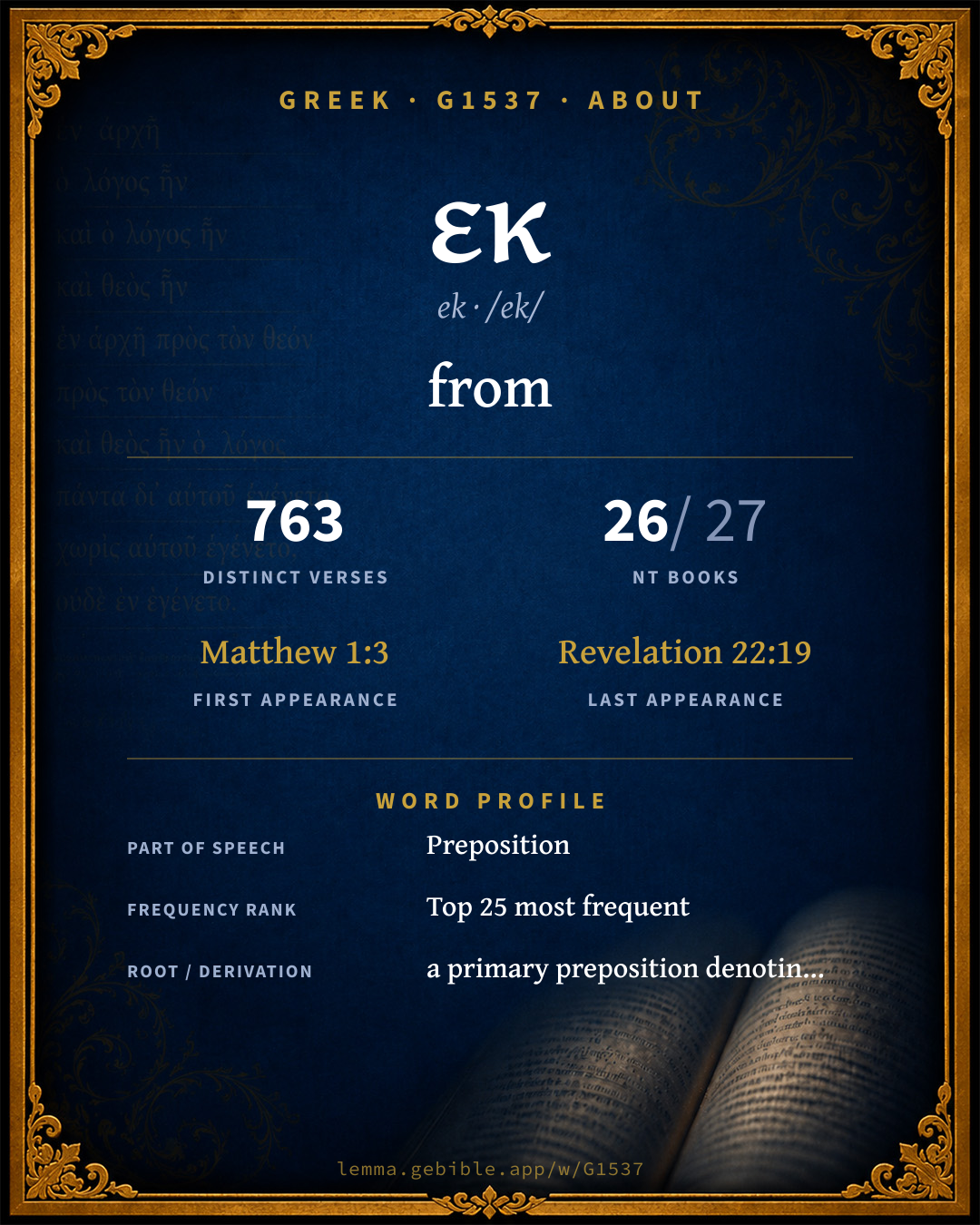
εκ
from
Full lexicon entry — Thayer's Greek Lexicon
From Thayer's Greek Lexicon
Where this word appears
Grammar key — what these labels mean
Part of speech
- Preposition
- A relational word governing a noun in a particular case.
Every verse where G1537 appears in the Book of Philippians — 8 distinct verses. Click any verse to open its interlinear word-by-word view. Verse text shown in the World English Bible for context — . Each verse’s Greek form is shown with its reference; the English is not keyword-highlighted, since the data carries no word-level English alignment. Use “Compare translations” on any verse to read it across multiple English versions. This concordance covers the Greek New Testament; Septuagint (Greek Old Testament) occurrences of this word are not indexed here.
Philippians
- Philippians 1:16 ἐξ prep The former insincerly preach Christ from selfish ambition, thinking that they add affliction to my chains;
- Philippians 1:17 ἐξ prep but the latter out of love, knowing that I am appointed for the defense of the Gospel.
- Philippians 1:23 ἐκ prep But I am in a dilemma between the two, having the desire to depart and be with Christ, which is far better.
- Philippians 3:5 ἐκ ἐξ prep prep circumcised the eighth day, of the stock of Israel, of the tribe of Benjamin, a Hebrew of Hebrews; concerning the law, a Pharisee;
- Philippians 3:9 ἐκ ἐκ prep prep and be found in him, not having a righteousness of my own, that which is of the law, but that which is through faith in Christ, the righteousness which is from God by faith;
- Philippians 3:11 ἐκ prep if by any means I may attain to the resurrection from the dead.
- Philippians 3:20 ἐξ prep For our citizenship is in heaven, from where we also wait for a Savior, the Lord Jesus Christ;
- Philippians 4:22 ἐκ prep All the saints greet you, especially those who are of Caesar's household.
About this entry
At a glance — auto-summarized from this page’s data, not written by a person. Every figure links to its source below. This summary describes the numbers; it doesn’t interpret them.
εκ — transliterated ek — is a Greek preposition carrying the sense “from.” It first appears in Matthew 1:3. The Greek New Testament uses it across 763 verses — among the most common. Related forms include εκβαλλω, εκβασις and εκγαμιζω. Each statement above links to its evidence; the full detail follows below.
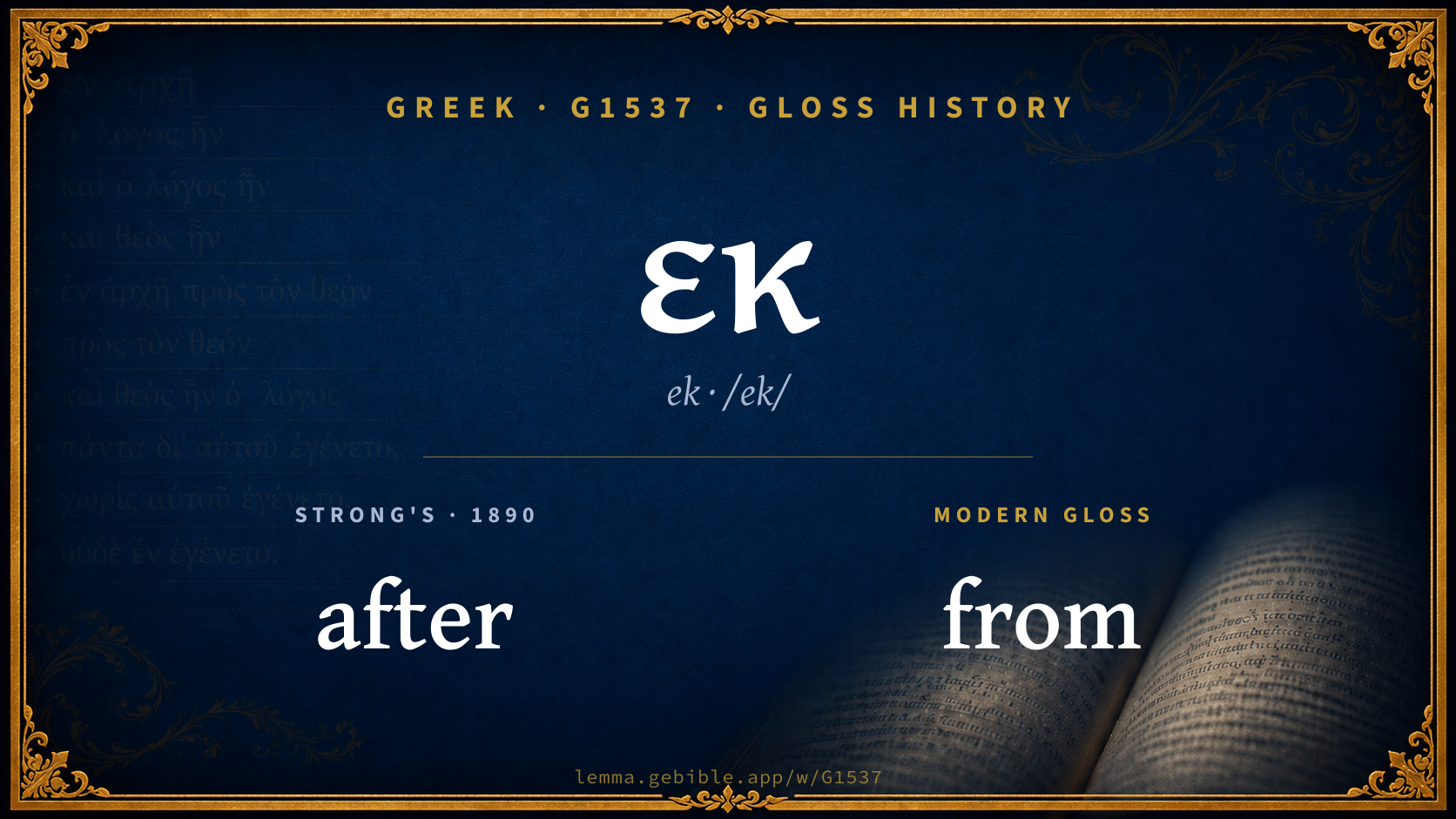
Gloss history
Strong's 1890 vs modern scholarship
About this word
Strong's G1537 catalogs a Greek word from the Greek New Testament.
These counts are not copied from any lexicon or concordance. They are computed here, from the morphology-tagged Greek New Testament. What Lemma adds →
- 763
- distinct verses
- The word appears in 763 distinct verses.
- 26 / 27
- NT books
- The word appears in 26 of 27 New Testament books.
- #20
- by frequency
- Top 25 most frequent Greek words (rank 20 of 5,347 Greek words by occurrence).
View all 763 occurrences in the concordance →
Most concentrated in
- John 136 verses 18%
- Revelation 106 verses 14%
- Acts 81 verses 11%
By section of the New Testament
By traditional corpus
Conventional, traditional groupings — biblical authorship is debated, so this is a traditional corpus grouping, not an authorship claim. Some books belong to more than one corpus (Luke is in both the Gospels and the Lukan corpus, and so on), so these shares overlap and need not total 100%. Each figure is a share of the word’s 763 distinct verses.
- Gospels 336 verses · 44%
- Johannine 267 verses · 35%
- Pauline corpus 169 verses · 22%
- Lukan (Luke–Acts) 154 verses · 20%
- Revelation 106 verses · 14%
- General (Catholic) Epistles 51 verses · 7%
- Hebrews 20 verses · 3%
How translations render this word
Counts come from each version’s own published word-to-Strong’s tagging or interlinear alignment — an approximate guide to how each version renders this word, not a word-level alignment the data otherwise carries. Because each total is that version’s own tagged count, the per-version totals vary from one another and need not match the appearance or distinct-verse counts above. These counts may also differ from a printed concordance because Lemma counts each distinctly tagged rendering and does not collapse phrase taggings into a single head-word total. This is a fixed set of word-tagged versions (KJV, ASV, BSB, ULT) and does not change with the reading translation you choose elsewhere. Each version’s license is shown beside its name below (and on Sources).
- King James Version: Of 489×, From 184×, By 51×
- American Standard Version: Of 457×, From 183×, By 50×
- Berean Standard Bible: From 345×, Of 245×, By 61×
- unfoldingWord Literal Text: From 632×, Of 111×, By 54×
King James Version Public Domain
Renders G1537 across 904 tagged occurrences — most commonly:
Plus other, less common renderings. Plus 42 renderings that appear only once — usually multi-word phrases or single function words the recovered tagging swept in, not distinct renderings. Not rendered by a distinct English word in 16 further occurrences.
American Standard Version Public Domain
Renders G1537 across 902 tagged occurrences — most commonly:
Plus other, less common renderings. Plus 63 renderings that appear only once — usually multi-word phrases or single function words the recovered tagging swept in, not distinct renderings. Not rendered by a distinct English word in 1 further occurrence.
Berean Standard Bible Public Domain
Renders G1537 across 791 tagged occurrences — most commonly:
Plus other, less common renderings. Plus 24 renderings that appear only once — usually multi-word phrases or single function words the recovered tagging swept in, not distinct renderings. Not rendered by a distinct English word in 103 further occurrences.
unfoldingWord Literal Text CC BY-SA 4.0
Renders G1537 across 918 tagged occurrences — most commonly:
Plus other, less common renderings. Plus 18 renderings that appear only once — usually multi-word phrases or single function words the recovered tagging swept in, not distinct renderings.
Senses in Thayer's
The 1 sense Thayer's distinguishes for this word, in lexicon order (not ranked by frequency or importance). The full entry — with sub-senses — is in the Lexicon Entry tab.
- out of, from, by, away from
Word origin
Origin: a primary preposition denoting origin (the point whence action or motion proceeds), from, out (of place, time, or cause
A primary preposition denoting origin (the point whence motion or action proceeds) from out (of place time or cause; literally or figuratively; direct or remote)i : - after among X are at betwixt (-yond) by (the means of) exceedingly (+ abundantly above) for (-th) from (among forth up) + grudgingly + heartily X heavenly X hereby + very highly in... ly (because by reason) of off (from) on out among (from of) over since X thenceforth through X unto X vehemently with (-out). Often used in composition with the same general import; often of completion .
— Strong’s Exhaustive Concordance (1890), public domain.
Forms in the corpus
The 3 distinct written forms G1537 takes in the Greek New Testament, most frequent first — each parse links to that case’s occurrences in the concordance.
| Form | Parsing | Example | Uses |
|---|---|---|---|
| ἐκ ek | Preposition | Matthew 1:3 | 677 |
| ἐξ ex | Preposition | Matthew 1:16 | 235 |
| Ἐκ Ek | Preposition | John 4:39 | 3 |
Same root — word family
Other Thayer's entries built from the same root as G1537, grouped by Strong’s listed origin. These share a root / origin per the lexicon — not necessarily a shared meaning. Each links to that word’s own entry.
Derived from this word
- εκβαλλω ekbállō G1544 to cast out
- εκβασις ékbasis G1545 exit
- εκγαμιζω ekgamízō G1547 to give in marriage
- εκγαμισκω ekgamískō G1548 to give in marriage
- εκγονον ékgonon G1549 offspring
- εκδαπαναω ekdapanáō G1550 to spend
- εκδεχομαι ekdéchomai G1551 to receive
- εκδηλος ékdēlos G1552 evident
- εκδημεω ekdēméō G1553 to depart
- εκδιδωμι ekdídōmi G1554 to give out
- εκδιηγεομαι ekdiēgéomai G1555 to relate
- εκδικος ékdikos G1558 without justice
- εκδιωκω ekdiṓkō G1559 to banish
- εκδοτος ékdotos G1560 delivered up
- εκδυω ekdýō G1562 to put off
- εκζητεω ekzētéō G1567 to seek out
- εκθαμβος ékthambos G1569 astonished
- εκθετος ékthetos G1570 exposed
- εκκαθαιρω ekkathaírō G1571 to cleanse
- εκκαιω ekkaíō G1572 to burn
- εκκακεω ekkakéō G1573 to be exhausted
- εκκεντεω ekkentéō G1574 to pierce
- εκκλαω ekkláō G1575 to cut off
- εκκλειω ekkleíō G1576 to shut out
+89 more words derive from G1537 (not shown).
Compare all same-root words → Showing 4 of 114 — not the complete family. They share a root, not necessarily a meaning.
Septuagint usage
The same Greek word εκ appears 3,304 times in the Greek Old Testament (Septuagint), across 2,749 verses in 37 books.
- 3,304
- LXX occurrences
- Tagged occurrences of this Greek word in the Septuagint.
- 2,749
- verses
- Distinct Septuagint verses containing this word.
- 37 / 39
- OT books
- The word appears in 37 of the 39 Old Testament books.
Sample Septuagint occurrences
- Genesis 2:6 ἐκ
- Exodus 1:5 ἐκ
- Leviticus 1:1 ἐκ
- Numbers 1:1 ἐκ
- Deuteronomy 1:15 ἐκ
- Joshua 1:8 ἐκ
- Judges 1:10 ἐκ
- Ruth 1:2 ἐκ
- 1 Samuel 1:1 ἐκ
- 2 Samuel 1:2 ἐκ
- 1 Kings 1:3 ἐκ
- 2 Kings 1:2 ἐκ
Septuagint occurrences (same lexeme)
Every verse where the same Strong’s number (G1537) appears in the Greek Septuagint — showing the first 50 of 2,749. Verse text shown in the World English Bible for context; the Greek form is the matched word — the English is not keyword-highlighted.
- Genesis 2:6 ἐκ but a mist went up from the earth, and watered the whole surface of the ground.
- Genesis 2:9 ἐκ Out of the ground Yahweh God made every tree to grow that is pleasant to the sight, and good for food; the tree of life also in the midst of the garden, and the tree of the knowledge of good and evil.
- Genesis 2:10 ἐκ A river went out of Eden to water the garden; and from there it was parted, and became four heads.
- Genesis 2:19 ἐκ Out of the ground Yahweh God formed every animal of the field, and every bird of the sky, and brought them to the man to see what he would call them. Whatever the man called every living creature, that was its name.
- Genesis 2:23 ἐκ The man said, "This is now bone of my bones, and flesh of my flesh. She will be called Woman, because she was taken out of Man."
- Genesis 3:19 ἐκ By the sweat of your face will you eat bread until you return to the ground, for out of it you were taken. For you are dust, and to dust you shall return."
- Genesis 3:22 ἐκ Yahweh God said, "Behold, the man has become like one of us, knowing good and evil. Now, lest he put forth his hand, and also take of the tree of life, and eat, and live forever..."
- Genesis 3:23 ἐκ Therefore Yahweh God sent him forth from the garden of Eden, to till the ground from whence he was taken.
- Genesis 4:10 ἐκ Yahweh said, "What have you done? The voice of your brother's blood cries to me from the ground.
- Genesis 4:11 ἐκ Now you are cursed because of the ground, which has opened its mouth to receive your brother's blood from your hand.
- Genesis 4:24 ἐκ If Cain will be avenged seven times, Truly Lamech seventy-seven times."
- Genesis 4:25 ἐκ Adam knew his wife again. She gave birth to a son, and named him Seth. For, she said, "God has appointed me another child instead of Abel, for Cain killed him."
- Genesis 6:14 ἐκ Make an ark of gopher wood. You shall make rooms in the ark, and shall seal it inside and outside with pitch.
- Genesis 6:16 ἐκ You shall make a roof in the ark, and to a cubit shall you finish it upward. You shall set the door of the ark in the side of it. You shall make it with lower, second, and third levels.
- Genesis 8:10 ἐκ He stayed yet another seven days; and again he sent forth the dove out of the ark.
- Genesis 8:12 ἐκ He stayed yet another seven days, and sent forth the dove; and she didn't return to him any more.
- Genesis 8:16 ἐκ "Go forth from the ark, you, and your wife, and your sons, and your sons' wives with you.
- Genesis 8:19 ἐκ Every animal, every creeping thing, and every bird, whatever moves on the earth, after their families, went forth out of the ark.
- Genesis 8:21 ἐκ Yahweh smelled the sweet savor. Yahweh said in his heart, "I will not again curse the ground any more for man's sake, because the imagination of man's heart is evil from his youth; neither will I ever again strike everything living, as I have done.
- Genesis 9:5 ἐκ I will surely require your blood of your lives. At the hand of every animal I will require it. At the hand of man, even at the hand of every man's brother, I will require the life of man.
- Genesis 9:10 ἐκ and with every living creature that is with you: the birds, the cattle, and every animal of the earth with you. Of all that go out of the ark, even every animal of the earth.
- Genesis 9:18 ἐκ The sons of Noah who went forth from the ark were Shem, Ham, and Japheth. Ham is the father of Canaan.
- Genesis 9:21 ἐκ He drank of the wine, and got drunk. He was uncovered within his tent.
- Genesis 10:5 ἐκ Of these were the isles of the nations divided in their lands, everyone after his language, after their families, in their nations.
- Genesis 10:11 ἐκ Out of that land he went forth into Assyria, and built Nineveh, Rehoboth Ir, Calah,
- Genesis 11:6 ἐκ Yahweh said, "Behold, they are one people, and they have all one language; and this is what they begin to do. Now nothing will be withheld from them, which they intend to do.
- Genesis 11:31 ἐκ Terah took Abram his son, Lot the son of Haran, his son's son, and Sarai his daughter-in-law, his son Abram's wife. They went forth from Ur of the Chaldees, to go into the land of Canaan. They came to Haran, and lived there.
- Genesis 12:1 ἐκ Now Yahweh said to Abram, "Get out of your country, and from your relatives, and from your father's house, to the land that I will show you.
- Genesis 12:4 ἐκ So Abram went, as Yahweh had spoken to him. Lot went with him. Abram was seventy-five years old when he departed out of Haran.
- Genesis 13:1 ἐκ Abram went up out of Egypt: he, his wife, all that he had, and Lot with him, into the South.
- Genesis 15:4 ἐκ Behold, the word of Yahweh came to him, saying, "This man will not be your heir, but he who will come forth out of your own body will be your heir."
- Genesis 15:7 ἐκ He said to him, "I am Yahweh who brought you out of Ur of the Chaldees, to give you this land to inherit it."
- Genesis 16:2 ἐκ Sarai said to Abram," See now, Yahweh has restrained me from bearing. Please go in to my handmaid. It may be that I will obtain children by her." Abram listened to the voice of Sarai.
- Genesis 16:5 ἐκ Sarai said to Abram, "This wrong is your fault. I gave my handmaid into your bosom, and when she saw that she had conceived, I was despised in her eyes. Yahweh judge between me and you."
- Genesis 17:6 ἐκ I will make you exceeding fruitful, and I will make nations of you. Kings will come out of you.
- Genesis 17:12 ἐκ He who is eight days old will be circumcised among you, every male throughout your generations, he who is born in the house, or bought with money of any foreigner who is not of your seed.
- Genesis 17:14 ἐκ The uncircumcised male who is not circumcised in the flesh of his foreskin, that soul shall be cut off from his people. He has broken my covenant."
- Genesis 17:16 ἐκ I will bless her, and moreover I will give you a son by her. Yes, I will bless her, and she will be a mother of nations. Kings of peoples will come from her."
- Genesis 17:27 ἐκ All the men of his house, those born in the house, and those bought with money of a foreigner, were circumcised with him.
- Genesis 18:16 ἐκ The men rose up from there, and looked toward Sodom. Abraham went with them to see them on their way.
- Genesis 19:1 ἐκ The two angels came to Sodom at evening. Lot sat in the gate of Sodom. Lot saw them, and rose up to meet them. He bowed himself with his face to the earth,
- Genesis 19:12 ἐκ The men said to Lot, "Do you have anybody else here? Sons-in-law, your sons, your daughters, and whoever you have in the city, bring them out of the place:
- Genesis 19:14 ἐκ Lot went out, and spoke to his sons-in-law, who were pledged to marry his daughters, and said, "Get up! Get out of this place, for Yahweh will destroy the city." But he seemed to his sons-in-law to be joking.
- Genesis 19:24 ἐκ Then Yahweh rained on Sodom and on Gomorrah sulfur and fire from Yahweh out of the sky.
- Genesis 19:25 ἐκ He overthrew those cities, all the plain, all the inhabitants of the cities, and that which grew on the ground.
- Genesis 19:29 ἐκ It happened, when God destroyed the cities of the plain, that God remembered Abraham, and sent Lot out of the midst of the overthrow, when he overthrew the cities in which Lot lived.
- Genesis 19:30 ἐκ Lot went up out of Zoar, and lived in the mountain, and his two daughters with him; for he was afraid to live in Zoar. He lived in a cave with his two daughters.
- Genesis 19:32 ἐκ Come, let's make our father drink wine, and we will lie with him, that we may preserve our father's seed."
- Genesis 19:34 ἐκ It came to pass on the next day, that the firstborn said to the younger, "Behold, I lay last night with my father. Let us make him drink wine again, tonight. You go in, and lie with him, that we may preserve our father's seed."
- Genesis 19:36 ἐκ Thus both of Lot's daughters were with child by their father.
These are occurrences of the same Greek lexeme (G1537) in the Septuagint — not a translation of any one Hebrew word. The store carries no word-level Hebrew↔Greek alignment, so no Hebrew original is asserted here. Counts come from the recovered LXX Strong's tagging — high-frequency vocabulary is well covered, while rare or late forms may be untagged — so they reflect tagged occurrences and may slightly undercount.