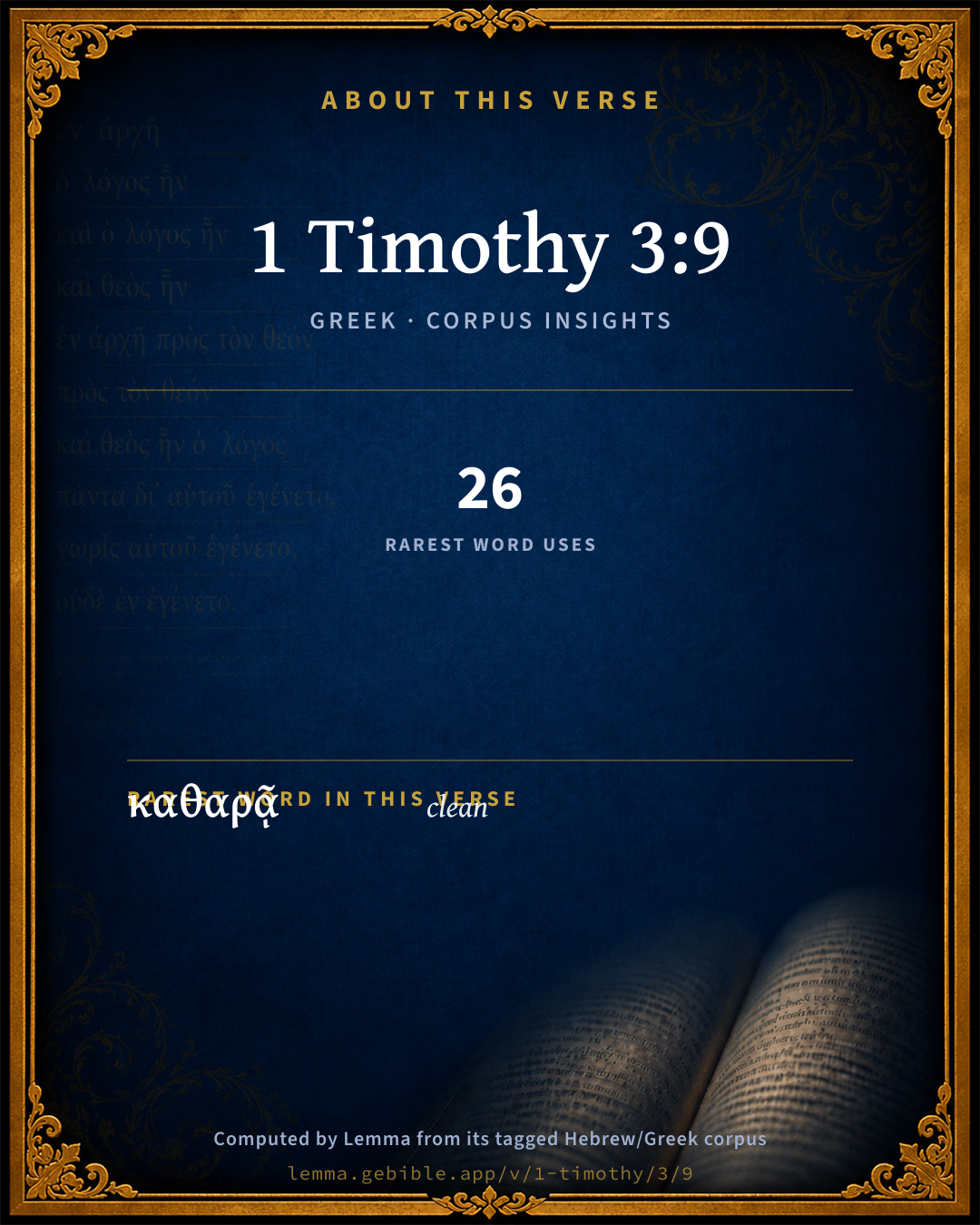
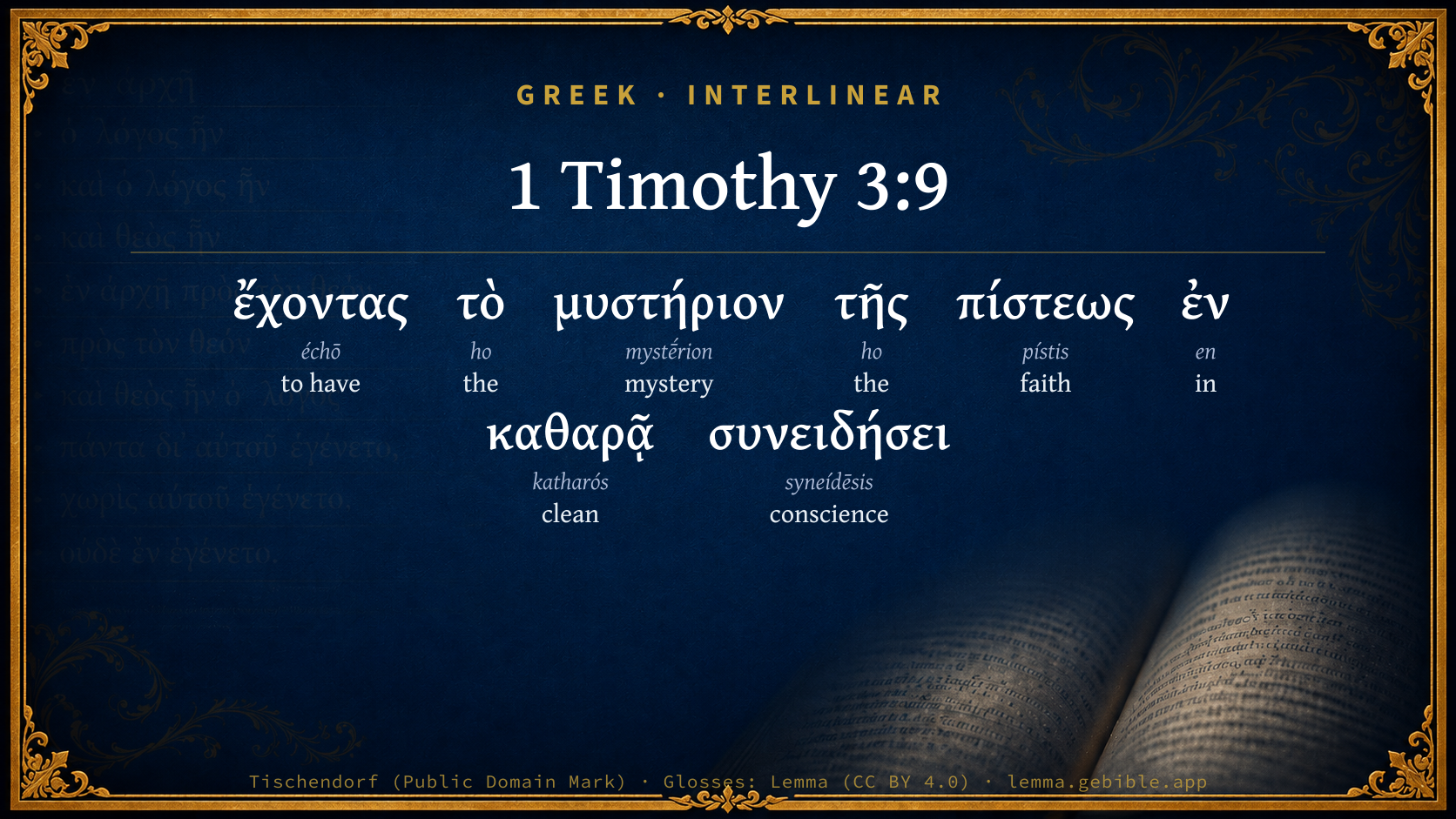
1 Timothy 3:9

Greek (Tischendorf 8th ed.) 1 Timothy 3:9 appears in the Greek New Testament. The text above is from the Tischendorf 8th edition. Each word links to its Strong’s number and a concise gloss. Click any word for its full Thayer’s Greek Lexicon entry.
Download image
Cite this verse

1 Timothy 3:9 (World English Bible). Public Domain. Lemma interlinear Bible study tool, https://lemma.gebible.app/v/1-timothy/3/9.

Show BibTeX & RIS
BibTeX
RIS
English Translation
holding the mystery of the faith in a pure conscience.
World English Bible · Public Domain
Download a study sheet

One document with this verse’s original text, its word-by-word gloss line, the meaning frame, cross-references with their text, attributed commentary, and full source and license credits — printable, and it pastes into notes with its structure intact.

This verse Autodidact and up

Study sheet (.html) Plain text (.txt)

A passage Seminary Student

Up to 50 verses in one chapter. A passage sheet keeps up to 6 commentary sources and 12 cross-references per verse, in the order this page ranks them, and says so on the sheet whenever that leaves anything out. Ask for a single verse and you get the Autodidact verse sheet above.

Everything on this page stays free to read, with no account — the sheet is a download of what is already on screen, not access to it.

Want to remove ads? Support Godless Engineer
Compare translations 3

The same verse in 3 English versions, stacked beneath the original-language interlinear above. Click any original word for its lexicon entry.

Each is an independent rendering of the whole verse — the interlinear is not word-aligned to these translations.

Highlighted words mark where these versions differ — a whole-verse word diff, not a word-by-word alignment.

  • World English Bible Public Domain
    holding the mystery of the faith in a pure conscience.
  • King James Version Public Domain
    Holding the mystery of the faith in a pure conscience.
  • unfoldingWord Literal Text CC BY-SA 4.0
    having the mystery of the faith with a pure conscience.

unfoldingWord Literal Text — © unfoldingWord, licensed CC BY-SA 4.0. Word-aligned USFM3 via Door43 (git.door43.org/unfoldingWord/en_ult).

Versions to compare (up to 4)

3 of 4 selected

Show all 19 translations

Every available English version of this verse, each an independent rendering of the whole verse.

  • World English Bible Public Domain
    holding the mystery of the faith in a pure conscience.
  • Berean Standard Bible Public Domain
    They must hold to the mystery of the faith with a clear conscience.
  • Majority Standard Bible Public Domain
    They must hold to the mystery of the faith with a clear conscience.
  • King James Version Public Domain
    Holding the mystery of the faith in a pure conscience.
  • American Standard Version (1901) Public Domain
    holding the mystery of the faith in a pure conscience.
  • Revised Version (1885) Public Domain
    holding the mystery of the faith in a pure conscience.
  • Geneva Bible (1599) Public Domain
    Hauing the mysterie of the faith in pure conscience.
  • Douay-Rheims (1899) Public Domain
    Holding the mystery of faith in a pure conscience.
  • Young's Literal Translation Public Domain
    having the secret of the faith in a pure conscience,
  • Literal Standard Version CC BY-SA 4.0
    having the secret of the faith in a pure conscience,
  • Unlocked Literal Bible CC BY-SA 4.0
    They should keep the revealed truth of the faith with a clean conscience.
  • unfoldingWord Literal Text CC BY-SA 4.0
    having the mystery of the faith with a pure conscience.
  • Darby Bible Public Domain
    holding the mystery of the faith in a pure conscience.
  • World Messianic Bible Public Domain
    holding the mystery of the faith in a pure conscience.
  • Webster's Bible Public Domain
    Holding the mystery of the faith in a pure conscience.
  • Free Bible Version CC BY-SA 4.0
    They must stick to the revealed truth about God, trusting in him with a pure conscience.
  • Bible in Basic English Public Domain
    Keeping the secret of the faith in a heart free from sin.
  • Text-Critical English NT CC BY 4.0
    They must hold the mystery of the faith with a clear conscience.
  • Tyndale New Testament (1534) Public Domain
    but havynge the mistery of the fayth in pure conscience.

Literal Standard Version (2020), Covenant Press — licensed CC BY-SA 4.0. Text via the HelloAO Bible API (eBible.org). Unlocked Literal Bible (unfoldingWord) — licensed CC BY-SA 4.0. Text via the HelloAO Bible API (eBible.org). unfoldingWord Literal Text — © unfoldingWord, licensed CC BY-SA 4.0. Word-aligned USFM3 via Door43 (git.door43.org/unfoldingWord/en_ult). Free Bible Version, Dr. Jonathan Gallagher — licensed CC BY-SA 4.0. Text via the HelloAO Bible API (eBible.org).

Word by word

More ways to search: Search by grammar → Find every occurrence → Compare this word →

Practice this passage: Drill this verse → Learn its vocabulary →

καθαρᾷ
katharós
G2513
“clean”
Adjective, Dative, Singular, Feminine
Part of Speech
Adjective
Case
Dative
Number
Singular
Gender
Feminine
Full Thayer's Definition

Origin: of uncertain affinity

TDNT: 09:53,4

1. clean, pure a. physically 1. purified by fire 2. in a similitude, like a vine cleansed by pruning and so fitted to bear fruit b. in a levitical sense 1. clean, the use of which is not forbidden, imparts no uncleanness c. ethically 1. free from corrupt desire, from sin and guilt 2. free from every admixture of what is false, sincere genuine 3. blameless, innocent 4. unstained with the guilt of anything
  1. ἔχοντας échō G2192 “to have” Verb, Present, Active, Participle, Accusative, Plural, Masculine
  2. τὸ ho G3588 “the” Article, Accusative, Singular, Neuter
  3. μυστήριον mystḗrion G3466 “mystery” Noun, Accusative, Singular, Neuter
  4. τῆς ho G3588 “the” Article, Genitive, Singular, Feminine
  5. πίστεως pístis G4102 “faith” Noun, Genitive, Singular, Feminine
  6. ἐν en G1722 “in” Preposition
  7. συνειδήσει syneídēsis G4893 “conscience” Noun, Dative, Singular, Feminine

About this verse

These counts appear in no published source. They are computed here, from the morphology-tagged text and Lemma’s own curated glosses. What Lemma adds →

8
words
7
distinct lemmas
Pauline Epistles
section

Shared distinctive vocabulary

καθαρᾷ clean G2513 occurs in 22 verses of the Greek New Testament. Also found in:

Repetition

A word recurs within this verse:

Cross-references

4

Topical passages linked to 1 Timothy 3:9 in the Treasury of Scripture Knowledge — connected by theme and wording, ordered by reader-vote popularity; previews shown in the World English Bible.

  • 1 Timothy 1:19 holding faith and a good conscience; which some having thrust away made a shipwreck concerning the faith;
  • 2 John 1:9–10 Whoever transgresses and doesn't remain in the teaching of Christ, doesn't have God. He who remains in the teaching, the same has both the Father and the Son.
  • 1 Timothy 1:5 but the end of the charge is love, out of a pure heart and a good conscience and unfeigned faith;
  • 1 Timothy 3:16 Without controversy, the mystery of godliness is great: God was revealed in the flesh, Justified in the spirit, Seen by angels, Preached among the nations, Believed on in the world, And received up in glory.

Cross-references courtesy of OpenBible.info (CC BY 4.0).

Commentary

Notes on 1 Timothy 3:9 from classic Christian and Jewish commentators (each source and its license shown beneath its notes). The classic Christian expositions comment on the surrounding passage and are grouped to its opening verse, so a note may address several verses; the Jewish commentaries on the Tanakh (Rashi and others) are per-verse, so they appear only where the commentator wrote on this verse.

Lemma curates 59 commentaries, every one of them public domain or Creative Commons licensed, each selected and text-cleaned for this edition rather than reprinted as found. About our sources →

The Cambridge Bible for Schools and Colleges

gen. ed. J. J. S. Perowne

9. the mystery of the faith] Apparently repeated again 1Ti_3:16 as ‘the mystery of godliness.’ The word ‘mystery’ is significant. Coming from the Greek, ‘to close the mouth,’ and so ‘to initiate,’ it was originally used of the secret rites of Eleusis in Attica, into which each year the youth of Athens were initiated at the annual celebrations. Thence by the process so loved by St Paul of consecrating old words to higher use it becomes the pregnant expression of the truth, ‘latet in vetere novum testamentum, vetus in novo patet.’ It is a truth once hidden but now revealed, a truth which may be apprehended though not comprehended. So the Atonement is a mystery, 1Co_2:1-2; 1Co_2:7, the Catholicity of the Church is a mystery, Eph_3:3-4; Eph_3:9; the Incarnation is a mystery, 1Ti_3:16. In St Paul’s final thought of revelation in this chapter the ‘secret now told’ embraces the whole of God’s saving love, in one or other of its aspects, here as the ‘creed of creeds,’ in 1Ti_3:16 as the ‘work of works,’ here the life of Christ, there ‘the life in Christ’ We are familiar with a somewhat similar use of ‘mystery’ in the ‘mystery plays’; and compare the word ‘mystery’ in the Prayer-Book Communion Office as the equivalent of ‘Sacrament,’—the union of the outward and visible sign and the inward and spiritual grace, the living spirit through the lifeless matter—‘the dignity of that holy mystery’; ‘He hath instituted and ordained holy mysteries’; ‘have duly received these holy mysteries.’ See further, Appendix, G.

The Cambridge Bible for Schools and Colleges (gen. ed. J. J. S. Perowne; Cambridge University Press, 1878–1918) — public domain. Text from a community e-Sword module.

Bengel's Gnomon

Johann Albrecht Bengel

1Ti 3:9. Τῆς πίστεως, of the faith) The deacons were often speaking of the Christian faith, as opportunity offered, in the discharge of their duty; and even though they should not speak, still they were bound to attend to the duties of their office, and go to the church with a holy mind, and with the desire to show a good example.

Bengel's Gnomon of the New Testament — English translation (T&T Clark, Edinburgh, 1860) — public domain. Text from a community e-Sword module.

Meyer's Critical & Exegetical Commentary

Heinrich August Wilhelm Meyer

1Ti_3:9. Ἔχοντας τὸ μυστήριον τῆς πίστεως ἐν καθαρᾷ συνειδήσει] The emphasis is not on ἔχοντας, as if it meant holding fast, but on ἐν καθαρᾷ συνειδήσει (Wiesinger).

τὸ μυστήριον τῆς πίστεως] This collocation occurs nowhere else. Πίστις is not the doctrine of faith (Heumann), but subjective faith (de Wette). Μυστήριον is the subject-matter of faith, i.e. the divine truth, which is a secret not only in so far as it was hidden from the world until it was revealed at the appointed time (Rom_16:25) and remains hidden to every man till the knowledge of it is wrought in him by the Spirit of God (1Co_2:7-10; 1Co_2:14), but also in so far as it is even to the believer ὑπερβαλλοῦσα τῆς γνώσεως (Wiesinger). The expression is synonymous with that in 1Ti_3:16 : τὸ τῆς εὐσεβείας μυστήριον.

ἐν καθαρᾷ συνειδήσει] Comp. 1Ti_1:5; 1Ti_1:19. The clause is to be joined closely with ἔχοντας, and is to be understood neither specially of occupying the office, nor quite generally of the virtuous life, or the moral disposition (Hofmann), but of purity and uprightness in regard to the mystery of the faith. It stands in contrast with the impurity of the heretics, who had their conscience stained by the mingling of truth with errors; comp. 1Ti_4:2.

Meyer — Critical and Exegetical Commentary on the New Testament — English translation by Peter Christie, edited by Frederick Crombie (T&T Clark, 1880) — public domain. Text from a community e-Sword module.

Expositor's Greek Testament

ed. W. Robertson Nicoll

1Ti 3:9 . τὸ μυστήριον τῆς πίστεως : the faith as revealed , is the same as τὸ τῆς εὐσεβείας μυστήριον , 1Ti 3:16 . In the earlier epistles of St. Paul τὸ μυστήριον is a revealed secret , in particular, the purpose of God that Jew and Gentile should unite in one Church. The notion of a secret is still prominent, because the revelation of it was recent; but just as revelation passes from a phase of usage in which the wonderful fact and manner of the disclosure is prominent to a stage in which the content or substance of what has been revealed is alone thought of, so it was with μυστήριον ; in the Pastorals it means the revelation given in Christ, the Christian creed in fact. See Dean Armitage Robinson, Ephesians , p. 234 sqq ., and Lightfoot on Col 1:26 . It was not the function of a deacon to teach or preach; it was sufficient if he were a firm believer. ἐν . καθ . συνειδ . is connected with ἔχοντας . Hort ( Christian Ecclesia , p. 201) approves of the expl. given by Weiss of τὸ μυστ . τ . πίστ ., “the secret constituted by their own inner faith”. This seems unnatural.

The Expositor's Greek Testament, edited by W. Robertson Nicoll (1897–1910) — public domain. Text from a community e-Sword module.

Vincent's Word Studies in the New Testament

Marvin R. Vincent

The mystery of the faith [το μυστηριον της πιστεως] . The phrase N. T. '. In the Gospels only, mystery or mysteries of the kingdom of God or of heaven. In Paul, mystery or mysteries of God, of his will, of Christ, of the gospel, of iniquity, the mystery kept secret or hidden away. Several times without qualification, the mystery or mysteries. See on 2Th 2:7. The mystery of the faith is the subject - matter of the faith; the truth which is its basis, which was kept hidden from the world until revealed at the appointed time, and which is a secret to ordinary eyes, but is made known by divine revelation. Comp. Rom 16:25; Eph 3:9; Col 1:26; 1Co 2:7. For the faith see on Gal 1:23, and comp. Introduction to these Epistles, 6

In a pure conscience [εν καθαρα συνειδησει] . Comp. 2Ti 1:3, 5, 19. Const. with holding. The emphasis of the passage is on these words. They express conscientious purity and sincerity in contrast with those who are described as branded in their own conscience, and thus causing their followers to fall away from the faith (ch. 4 1, 2). The passage illustrates the peculiar treatment of "faith" in these Epistles, in emphasising its ethical aspect and its ethical environment. This is not contrary to Paul 's teaching, nor does it go to the extent of substituting morals for faith as the condition of salvation and eternal life. See 2Ti 1:9; 2Ti 2:1; Tit 3:5. Nonetheless, there is a strong and habitual emphasis on good works (see 1Ti 2:10; 1Ti 5:10; 1Ti 6:18; 2Ti 2:21; 2Ti 3:17; Tit 1:16; Tit 2:7, 14; Tit 3:1, 8, 14), and faith is placed in a series of practical duties (see 1Ti 1:5, 14; 1Ti 2:15; 1Ti 4:12; 2Ti 1:13; 1Ti 1:19; 1Ti 2:7; 1Ti 3:9; 1Ti 6:11; 2Ti 2:22; 2Ti 3:10). "Holding the mystery of the faith in a pure conscience" is a significant association of faith with ethics. As Weiss puts it : "It is as if the pure conscience were the vessel in which the mystery of the faith is preserved." The idea is sound and valuable. A merely intellectual attitude toward the mystery which, in every age, attaches to the faith, will result in doubt, questioning, and wordy strife (see 1Ti 6:4; 2Ti 2:23; Tit 3:9), sometimes in moral laxity, sometimes in despair. Loyalty and duty to God are compatible with more or less ignorance concerning the mystery. An intellect, however powerful and active, joined with an impure conscience, cannot solve but only aggravates the mystery; whereas a pure and loyal conscience, and a frank acceptance of imposed duty along with mystery, puts one in the best attitude for attaining whatever solution is possible. See Joh 7:17.

Marvin R. Vincent, Word Studies in the New Testament (1887–1900) — public domain. Text from a community e-Sword/MySword module.

Geneva Bible (1599)

Geneva Bible translators

The doctrine of the Gospel, which is a mystery indeed: for flesh and blood do not reveal it.

Geneva Bible (1599) marginal notes — public domain. Text via Bolls.life.

Jamieson, Fausset & Brown

Robert Jamieson, A. R. Fausset & David Brown

the mystery of the faith--holding the faith, which to the natural man remains a mystery, but which has been revealed by the Spirit to them (Rom 16:25; Co1 2:7-10), in a pure conscience (Ti1 1:5, Ti1 1:19). ("Pure," that is, in which nothing base or foreign is intermixed [TITTMANN]). Though deacons were not ordinarily called on to preach (Stephen and Philip are not exceptions to this, since it was as evangelists, rather than as deacons, they preached), yet as being office-bearers in the Church, and having much intercourse with all the members, they especially needed to have this characteristic, which every Christian ought to have.

Jamieson, Fausset & Brown — Commentary Critical and Explanatory on the Whole Bible (1871) — public domain (CC PDM 1.0). Text via the HelloAO Bible API.

Adam Clarke's Commentary

Verse 9. Holding the mystery of the faith] Instead of της πιστεως, the faith, one MS. (the readings of which are found in the margin of a copy of Mill's Greek text in the Bodleian library, and which is marked 61 in Griesbach) reads αναστασεως, of the resurrection. This reading, like many others in this MS., is found nowhere else; and is worthy of little regard, but as expressing what appeared to the writer to be the apostle's meaning. One of the greatest mysteries of the faith was undoubtedly the resurrection of the dead; and this was held in a pure conscience when the person so exercised himself as to have a conscience void of offence towards God and towards men. See Ac 24:16. What has been since called Antinomianism, that is, making void the moral law, by a pretended faith in the righteousness of Christ, is that which the apostle has here particularly in view.

Adam Clarke's Commentary on the Bible (1810–1826) — public domain. Text from a community e-Sword/MySword module.

John Calvin's Commentaries

9 Holding the mystery of faith As if he had said, “Holding the pure doctrine of religion, and that from the heart, with a sincere fear of God;” or, “Being well instructed in the faith, so as not to be ignorant of anything which it is necessary for Christians to know.” He gives to the sum of Christian doctrine the honorable appellation of a mystery; as indeed God, through the gospel, reveals to men on earth a wisdom which angels in heaven behold with admiration, and, therefore, we need not wonder if it exceed human capacity.

Let us therefore remember that it ought to be embraced with the deepest reverence; and because we could never, by our own strength, ascend to such a height, let us humbly entreat God to impart it to us by the Spirit of revelation. On the other hand, when we see wicked men either ridicule those doctrines or have no relish for them, let us acknowledge that it is owing to the grace of God that those things which have been hidden from others are in our hearts, and before our eyes, as Moses says, (Deuteronomy 30:11.)

Thus he wishes that deacons should be well instructed in “the mystery of faith;” because, although they do not hold the office of teaching, yet it would be exceedingly absurd to hold a public office in the Church, while they were ill informed in the Christian faith, more especially since they must frequently be laid under the necessity of administering advice and consolation, if they do not choose to neglect their duties. It is added, in a pure conscience, which extends to the whole life, but chiefly that they may know how to obey God.

John Calvin's Commentaries (1540-1563) — public domain. Text from the Calvin Translation Society English edition (1840s-50s) via the Christian Classics Ethereal Library (ccel.org). Calvin's coverage is partial (roughly two-thirds of the Bible); uncommented books and verses are honest gaps, never fabricated. The 19th-century editor's footnotes and remarks are omitted so the notes are faithfully Calvin's own voice.

Ellicott's Commentary for English Readers

(9) Holding the mystery of the faith in a pure conscience.—The thought again comes to the surface—mere orthodoxy without the Christ-life was an empty, useless characteristic feature in any one; but here the man of God, writing to his dear son these solemn warnings respecting fit and proper persons to be chosen for their Master’s work, has besides in these words another end in view. He had been dwelling with great earnestness on the outward characteristics which a deacon of the Church should possess—the high and stainless name—the generous respect which his old way of living had won for him among unbelievers as well as with believers; but, in addition to these things, it was absolutely necessary for one occupying such a post to know something of the deeper spiritual life—he must hold the mystery of the faith. Now what does St. Paul mean by the mystery? He speaks of it as “a treasure” which must be held in the casket of a pure conscience. This mystery was what was sometimes hidden, but which was now revealed by the advent of St. Paul’s Master, and comprehended the truths of the redemption, the atonement, and mighty cleansing powers of the precious blood of Christ. These—the master truths of Christianity—must the appointed teacher firmly grasp; and the true deacon, whose office it was rather to administer than to preach to the people, must also be especially careful to show that he lived the life he professed to teach; or, in St. Paul’s own simile, must preserve the casket in which the precious mystery was shrined, holy and undefiled before men—he must hold the mystery of the faith in a pure conscience.

A Bible Commentary for English Readers, edited by Charles John Ellicott (1878–1897) — public domain. Text from a community e-Sword module.

John Gill's Exposition

Holding the mystery of the faith,.... The doctrine of the Gospel, called the "faith", because it contains things to be believed; proposes Christ the object of faith; is the means by which faith comes, and is unprofitable without it: it is called "the mystery", because it is of divine revelation, and could have never been discovered by human reason; and now it is revealed, the modus of many things contained in it remains a mystery; several of the doctrines of it are mysterious ones, particularly the doctrine of the Trinity; and which the ancient Jews call by this very name, (a) , "the mystery of faith"; the incarnation of the Son of God, the union of the saints to Christ, and their communion with him, and the resurrection of the dead, with others. Now this mysterious doctrine of faith is to be held by deacons; they are to profess it, and to hold fast the profession of it and that

in a pure conscience; with a conscience sprinkled by the blood of Christ; with a conscience void of offence both towards God and man; with a suitable life and conversation; a conversation becoming the Gospel of Christ, and by which it is adorned: and this part of their character is necessary, that such may be able to instruct and establish those who are weak in the faith, and oppose and refute the erroneous, and also recommend the Gospel by their own example; otherwise should their principles or practices be bad, their influence on others might be very pernicious and fatal.

(a) Zohar in Gen. fol. 12. 4. & 13. 1, 2. & in Exod. fol. 66. 3.

John Gill's Exposition of the Whole Bible (1746–1763) — public domain (CC PDM 1.0). Text via the HelloAO Bible API.

Trapp's Complete Commentary

John Trapp

9 Holding the mystery of the faith in a pure conscience.

Ver. 9. Holding the mystery] {See Trapp on "1Ti 1:19"}

John Trapp, A Commentary or Exposition upon All the Books of the Old and New Testament (1647–1656) — public domain. Text from a community e-Sword module.

Albert Barnes' Notes on the Bible

Holding the mystery of the faith - On the word “mystery,” see notes on 1Co 2:7. It means that which had been concealed, or hidden, but which was now revealed. The word “faith” here, is synonymous with “the gospel;” and the sense is, that he should hold firmly the great doctrines of the Christian religion which had been so long concealed from people, but which were now revealed. The reason is obvious. Though not a preacher, yet his influence and example would be great, and a man who held material error ought not to be in office.

In a pure conscience - A mere orthodox faith was not all that was necessary, for it was possible that a man might be professedly firm in the belief of the truths of revelation, and yet be corrupt at heart.

Albert Barnes' Notes on the Bible (1834–1885) — public domain. Text from a community e-Sword/MySword module.

Matthew Poole's English Annotations

Not ignorant or inconstant persons, but such as were acquainted with the mysteries of the gospel, and believed them, and held to them; and men of a holy life.

Matthew Poole's English Annotations on the Holy Bible (1683–1685) — public domain. Text from a community e-Sword/MySword module.

Whedon's Commentary on the Bible

Daniel D. Whedon

9. Mystery—See note on 1Ti_3:16.

Faith—In regard to doctrine.

Conscience—In regard to moral character and conduct.

Daniel D. Whedon (gen. ed.), Commentary on the Old and New Testaments (1874–1909) — public domain. Text from a community e-Sword module.

The Pulpit Commentary

Holding the mystery of the faith in a pure conscience. Musthrion, a mystery, is that which, having been long hidden, is at length disclosed, either to men generally or to elect disciples. It is derived from muew, to initiate, of which the passive mueomai, to be instructed or initiated, is found in Php_4:12, and is common in classical Greek, being itself derived from mu "to close the lips as in pronouncing the syllable mu," whence also taurus. The idea is of something secret, which might not be spoken of. In the New Testament we have "the mysteries of the kingdom of heaven" (Mat_13:11; Luk_8:10; Mar_4:11) and St. Paul brings out the full force of the word when he speaks (Rom_16:25) of "the mystery which was kept secret (sesighmenou) since the world began... but is now made known to all nations for the obedience of faith" (see too Eph_3:3-6; Col_2:2-6, etc.) "The faith" is equivalent to "the gospel," or "the kingdom of heaven," or the "godliness" of ver. 16 (where see note); and "the mystery of the faith" might be paraphrased by "the revealed truth of Christianity". What is added, "in a pure conscience," teaches us that orthodoxy without personal holiness is little worth. Holding "the truth in unrighteousness" is severely condemned by St. Paul. (Rom_1:18) He says of himself, (Act_23:1) "I have lived in all good conscience before God until this day". (comp. Act_24:16; 2Co_1:12; 1Ti_1:5, 1Ti_1:19, etc.) It is much to be observed how St. Paul, the great teacher of the doctrine of grace, lays constant stress upon the functions of the conscience, and the necessity of having a pure conscience.

The Pulpit Commentary (1880–1919), ed. H.D.M. Spence-Jones & Joseph S. Exell — public domain. Text from a community e-Sword module.

John Wesley's Explanatory Notes

Holding fast the faith in a pure conscience - Steadfast in faith, holy in heart and life.

John Wesley, Explanatory Notes Upon the Whole Bible (1754–1765) — public domain. Text via the GEBible commentary corpus.

Scofield Reference Notes

C. I. Scofield

mystery

1Ti 3:16 (See Scofield "Mat 13:11")

The Scofield Reference Bible (1917 edition), notes by C. I. Scofield — public domain. Text from a community e-Sword module.

Burkitt's Expository Notes on the New Testament

William Burkitt

That is, they must be sound believers, and of an upright life, maintaining truth of doctrine and soundness of faith, by sincerity of heart and integrity of life.

William Burkitt's Expository Notes on the New Testament (1700–1703) — public domain. Text from a community e-Sword module.

The People's New Testament

B. W. Johnson

9. Holding the mystery of the faith. The gospel, God's revealed mystery to all believers.

B. W. Johnson's The People's New Testament with Notes (1889–1891) — public domain. Electronic text from the Christian Classics Ethereal Library (CCEL) ThML edition.

Cambridge Greek Testament for Schools and Colleges

9. ἔχοντας. Holding, as contrasted with teaching, which did not come within the province of the διάκονος.

τὸ μυστήριον τῆς πίστεως. The genitive might be either (a) appositional, descriptive of the substance of the μυστήριον, the Mystery of the Faith, or (b) subjective, ‘the mystery on which faith rests and which it has embraced.’ Either would give good sense, but the analogy of τὸ μυστήριον τῆς εὐσεβείας in 1Ti 3:16 and of τὸ μυστήριον τῆς ἀνομίας in 2Th 2:7 suggest that the subjective sense is preferable here. The other meaning would be, however, quite admissible and is favoured by the presence of the definite article. See note on 1Ti 1:19.

μυστήριον is a secret, concealed from the mass of mankind, but revealed to the initiated; and the Christian μυστήριον is thus (Mat 13:11; Eph 1:9; Rom 16:25) the secret of salvation in Christ revealed to the faithful through the Divine Spirit. Cp. 1Ti 3:16.

ἐν καθαρᾷ συνειδήσει. Cp. 1Ti 1:5; 1Ti 1:19 and the notes thereon, and note the close connexion all through this Epistle between a good conscience and a sound faith; it is hard to divorce creed from life.

It will be observed that the qualification given in this verse is one which is required of all Christians, and not only of διάκονοι. As in the case of ἐπίσκοποι (see note on 1Ti 3:2), the writer is not giving a complete list of the specific duties and qualities of the deacons, but suggesting certain conditions to which it was indispensable that candidates for the diaconate should conform. And it is instructive that this spiritual qualification of faith and a good conscience is explicitly mentioned in the case of the lower rather than the higher order of the ministry of service.

Cambridge Greek Testament for Schools and Colleges (Cambridge University Press, 1896; 21 vols, various authors incl. Carr, Maclear, Plummer, Farrar, Lumby, Moule, M. R. James, Simcox) — public domain. Text from a community e-Sword module.

International Critical Commentary

9. τὸ μυστήριον τῆς π.] perhaps “the secret truths of the Christian faith”; cf. 16, lay,ng stress on doctrinal correctness, but more probably, as there is no duty of teaching implied, holding their own faith, the secret of their allegiance to Christ, secure under the protection of a good conscience, “a true inward religion and a true inward morality” (Hort., u.s.). The stress is on ἐν καθ. συνειδήσει, the casket in which the jewel is to be kept; cf. 1:9 note.

International Critical Commentary — older volumes (1896–1929), various authors — public domain. Text from a community e-Sword module.

Lesson kit

Teaching starters — assembled from the data on this page, not authored interpretation. Every prompt links to the verse data it draws on. Edit before teaching.

1 Timothy, in the Pauline Epistles, opens this verse with 8 words (7 distinct Greek lemmas). Its most distinctive word is katharós (“clean”). A historical commentator’s framing appears above. Read the whole chapter for the surrounding context.

Discussion questions

  1. The word katharós carries the sense “clean.” How does it shape the verse?
  2. How does Matthew 5:8, which shares the word «clean», read alongside this verse?
  3. What does the repetition of “the” (2× in this one verse) do in this verse?
  4. These translations render this verse differently; the difference is in the English rendering, not the original. What questions does that raise?
  5. Compare how The Cambridge Bible for Schools and Colleges and Bengel's Gnomon read this verse. Where do they agree or differ?

Things to notice

  • These translations choose different wording for 2 words in this verse.
  • “the” occurs 2× in this single verse.
  • 7 distinct Greek lemmas span 8 words in this verse.

Reading settings

Reading text

Shown beneath each verse's original-language words.

Old Testament
Old Testament edition

Read the OT as the Masoretic Hebrew (MT) or the Greek Septuagint (LXX).

English shown for the Greek Septuagint (in the Hebrew ↔ Greek comparison).

Comparing translations? Open the Compare panel on any verse page to stack up to four side by side.