Revelation 17:5

Greek (Tischendorf 8th ed.) Revelation 17:5 appears in the Greek New Testament. The text above is from the Tischendorf 8th edition. Each word links to its Strong’s number and a concise gloss. Click any word for its full Thayer’s Greek Lexicon entry.
Download image
Cite this verse

Revelation 17:5 (World English Bible). Public Domain. Lemma interlinear Bible study tool, https://lemma.gebible.app/v/revelation/17/5.

Show BibTeX & RIS
BibTeX
RIS
English Translation
And on her forehead a name was written, "MYSTERY, BABYLON THE GREAT, THE MOTHER OF THE PROSTITUTES AND OF THE ABOMINATIONS OF THE EARTH."
World English Bible · Public Domain
Download a study sheet

One document with this verse’s original text, its word-by-word gloss line, the meaning frame, cross-references with their text, attributed commentary, and full source and license credits — printable, and it pastes into notes with its structure intact.

This verse Autodidact and up

Study sheet (.html) Plain text (.txt)

A passage Seminary Student

Up to 50 verses in one chapter. A passage sheet keeps up to 6 commentary sources and 12 cross-references per verse, in the order this page ranks them, and says so on the sheet whenever that leaves anything out. Ask for a single verse and you get the Autodidact verse sheet above.

Everything on this page stays free to read, with no account — the sheet is a download of what is already on screen, not access to it.

Want to remove ads? Support Godless Engineer
Compare translations 3

The same verse in 3 English versions, stacked beneath the original-language interlinear above. Click any original word for its lexicon entry.

Each is an independent rendering of the whole verse — the interlinear is not word-aligned to these translations.

Highlighted words mark where these versions differ — a whole-verse word diff, not a word-by-word alignment.

  • World English Bible Public Domain
    And on her forehead a name was written, "MYSTERY, BABYLON THE GREAT, THE MOTHER OF THE PROSTITUTES AND OF THE ABOMINATIONS OF THE EARTH."
  • King James Version Public Domain
    And upon her forehead was a name written, MYSTERY, BABYLON THE GREAT, THE MOTHER OF HARLOTS AND ABOMINATIONS OF THE EARTH.
  • unfoldingWord Literal Text CC BY-SA 4.0
    and on her forehead had been written a name, a mystery: Babylon the Great, the Mother of Prostitutes and of the Abominations of the Earth.

unfoldingWord Literal Text — © unfoldingWord, licensed CC BY-SA 4.0. Word-aligned USFM3 via Door43 (git.door43.org/unfoldingWord/en_ult).

Versions to compare (up to 4)

3 of 4 selected

Show all 19 translations

Every available English version of this verse, each an independent rendering of the whole verse.

  • World English Bible Public Domain
    And on her forehead a name was written, "MYSTERY, BABYLON THE GREAT, THE MOTHER OF THE PROSTITUTES AND OF THE ABOMINATIONS OF THE EARTH."
  • Berean Standard Bible Public Domain
    And on her forehead a mysterious name was written: BABYLON THE GREAT, THE MOTHER OF PROSTITUTES AND OF THE ABOMINATIONS OF THE EARTH.
  • Majority Standard Bible Public Domain
    And on her forehead a mysterious name was written: BABYLON THE GREAT, THE MOTHER OF PROSTITUTES AND OF THE ABOMINATIONS OF THE EARTH.
  • King James Version Public Domain
    And upon her forehead was a name written, MYSTERY, BABYLON THE GREAT, THE MOTHER OF HARLOTS AND ABOMINATIONS OF THE EARTH.
  • American Standard Version (1901) Public Domain
    and upon her forehead a name written, MYSTERY, BABYLON THE GREAT, THE MOTHER OF THE HARLOTS AND OF THE ABOMINATIONS OF THE EARTH.
  • Revised Version (1885) Public Domain
    and upon her forehead a name written, MYSTERY, BABYLON THE GREAT, THE MOTHER OF THE HARLOTS AND OF THE ABOMINATIONS OF THE EARTH.
  • Geneva Bible (1599) Public Domain
    And in her forehead was a name written, A mysterie, that great Babylon, that mother of whoredomes, and abominations of the earth.
  • Douay-Rheims (1899) Public Domain
    And on her forehead a name was written: A mystery; Babylon the great, the mother of the fornications, and the abominations of the earth.
  • Young's Literal Translation Public Domain
    and upon her forehead was a name written: `Secret, Babylon the Great, the Mother of the Whores, and the Abominations of the earth.'
  • Literal Standard Version CC BY-SA 4.0
    and on her forehead was a name written: “SECRET, BABYLON THE GREAT, THE MOTHER OF THE WHORES, AND THE ABOMINATIONS OF THE EARTH.”
  • Unlocked Literal Bible CC BY-SA 4.0
    On her forehead was written a name having a secret meaning: “Babylon the great, the mother of prostitutes and of the detestable things of the earth.”
  • unfoldingWord Literal Text CC BY-SA 4.0
    and on her forehead had been written a name, a mystery: Babylon the Great, the Mother of Prostitutes and of the Abominations of the Earth.
  • Darby Bible Public Domain
    and upon her forehead a name written, Mystery, great Babylon, the mother of the harlots, and of the abominations of the earth.
  • World Messianic Bible Public Domain
    And on her forehead a name was written, “MYSTERY, BABYLON THE GREAT, THE MOTHER OF THE PROSTITUTES AND OF THE ABOMINATIONS OF THE EARTH.”
  • Webster's Bible Public Domain
    And upon her forehead was a name written, MYSTERY, BABYLON THE GREAT, THE MOTHER OF HARLOTS, AND ABOMINATIONS OF THE EARTH.
  • Free Bible Version CC BY-SA 4.0
    A name of mystery was written on her forehead: Babylon the Great, the Mother of Prostitutes and of the World's Obscene Things.
  • Bible in Basic English Public Domain
    And on her brow was a name, SECRET, BABYLON THE GREAT, THE MOTHER OF THE EVIL WOMEN AND OF THE UNCLEAN THINGS OF THE EARTH.
  • Text-Critical English NT CC BY 4.0
    A mysterious name was written on her forehead: “Babylon the great, the mother of prostitutes and of the abominations of the earth.”
  • Tyndale New Testament (1534) Public Domain
    And in her forhed was a name wrytten a mistery gret Babylon the mother of whordome and abominacions of the erth.

Literal Standard Version (2020), Covenant Press — licensed CC BY-SA 4.0. Text via the HelloAO Bible API (eBible.org). Unlocked Literal Bible (unfoldingWord) — licensed CC BY-SA 4.0. Text via the HelloAO Bible API (eBible.org). unfoldingWord Literal Text — © unfoldingWord, licensed CC BY-SA 4.0. Word-aligned USFM3 via Door43 (git.door43.org/unfoldingWord/en_ult). Free Bible Version, Dr. Jonathan Gallagher — licensed CC BY-SA 4.0. Text via the HelloAO Bible API (eBible.org).

Word by word

More ways to search: Search by grammar → Find every occurrence → Compare this word →

Practice this passage: Drill this verse → Learn its vocabulary →

βδελυγμάτων
bdélygma
G946
“abomination”
Noun, Genitive, Plural, Neuter
Part of Speech
Noun
Case
Genitive
Number
Plural
Gender
Neuter
Full Thayer's Definition

Origin: from G948

TDNT: 10:58,1

1. a foul thing, a detestable thing a. of idols and things pertaining to idolatry
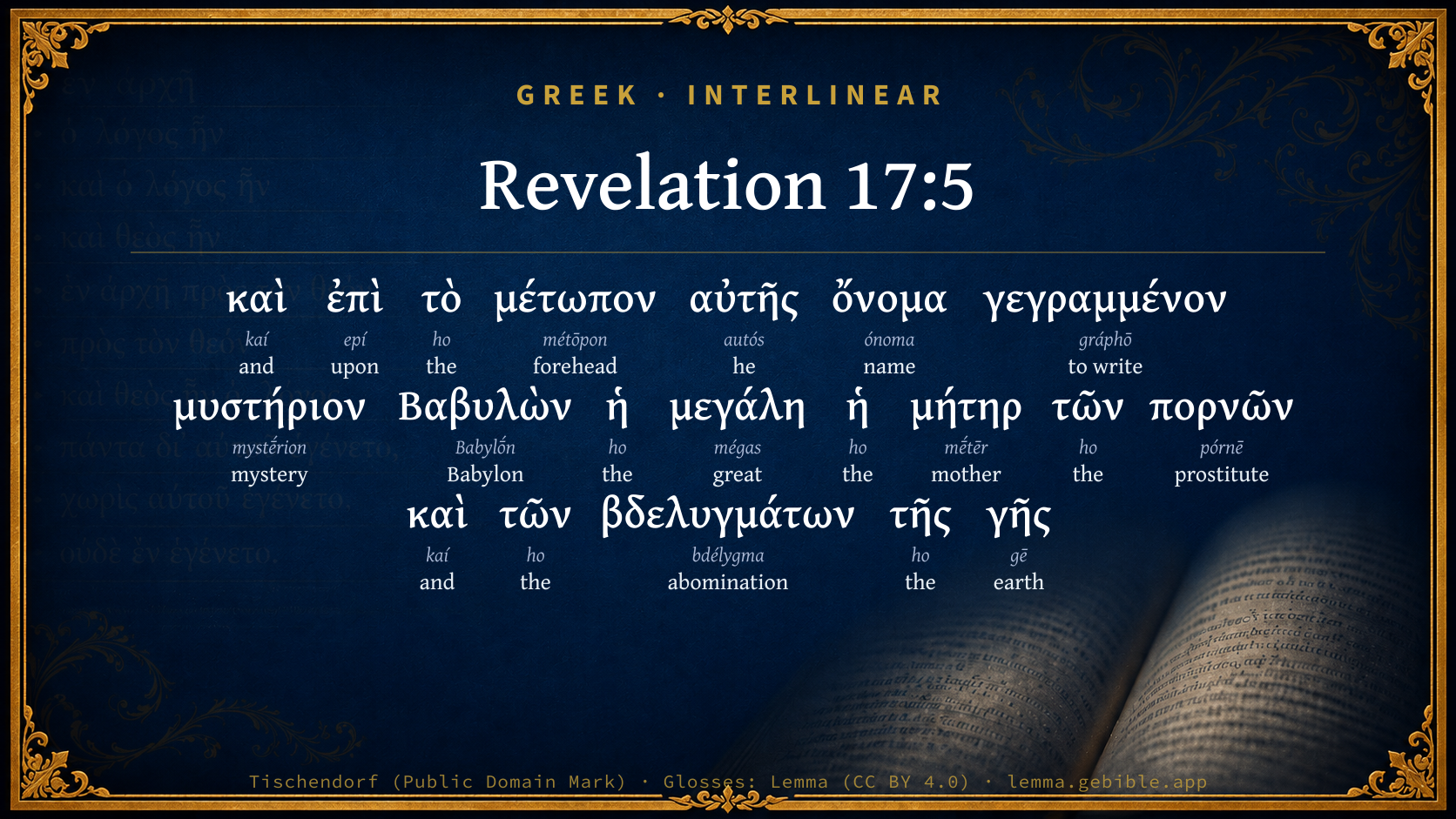
  1. καὶ kaí G2532 “and” Conjunction
  2. ἐπὶ epí G1909 “upon” Preposition
  3. τὸ ho G3588 “the” Article, Accusative, Singular, Neuter
  4. μέτωπον métōpon G3359 “forehead” Noun, Accusative, Singular, Neuter
  5. αὐτῆς autós G846 “he” Personal pronoun, Genitive, Singular, Feminine
  6. ὄνομα ónoma G3686 “name” Noun, Nominative, Singular, Neuter
  7. γεγραμμένον gráphō G1125 “to write” Verb, Perfect, Passive, Participle, Nominative, Singular, Neuter
  8. μυστήριον mystḗrion G3466 “mystery” Noun, Nominative, Singular, Neuter
  9. Βαβυλὼν Babylṓn G897 “Babylon” Noun, Nominative, Singular, Feminine
  10. ἡ ho G3588 “the” Article, Nominative, Singular, Feminine
  11. μεγάλη mégas G3173 “great” Adjective, Nominative, Singular, Feminine
  12. ἡ ho G3588 “the” Article, Nominative, Singular, Feminine
  13. μήτηρ mḗtēr G3384 “mother” Noun, Nominative, Singular, Feminine
  14. τῶν ho G3588 “the” Article, Genitive, Plural, Feminine
  15. πορνῶν pórnē G4204 “prostitute” Noun, Genitive, Plural, Feminine
  16. καὶ kaí G2532 “and” Conjunction
  17. τῶν ho G3588 “the” Article, Genitive, Plural, Neuter
  18. τῆς ho G3588 “the” Article, Genitive, Singular, Feminine
  19. γῆς gē G1093 “earth” Noun, Genitive, Singular, Feminine

About this verse

These counts appear in no published source. They are computed here, from the morphology-tagged text and Lemma’s own curated glosses. What Lemma adds →

20
words
14
distinct lemmas
Revelation
section

Notable vocabulary

The rarest word here is βδελυγμάτων abomination G946 — appearing just 6 times in the whole Greek New Testament.

Shared distinctive vocabulary

βδελυγμάτων abomination G946 occurs in 6 verses of the Greek New Testament. Also found in:

Repetition

Words recur within this verse:

Cross-references

14

Topical passages linked to Revelation 17:5 in the Treasury of Scripture Knowledge — connected by theme and wording, ordered by reader-vote popularity; previews shown in the World English Bible.

  • Revelation 14:8 Another, a second angel, followed, saying, "Babylon the great has fallen, which has made all the nations to drink of the wine of the wrath of her sexual immorality."
  • Revelation 18:2 He cried with a mighty voice, saying, "Fallen, fallen is Babylon the great, and she has become a habitation of demons, a prison of every unclean spirit, and a prison of every unclean and hateful bird!
  • Revelation 16:19 The great city was divided into three parts, and the cities of the nations fell. Babylon the great was remembered in the sight of God, to give to her the cup of the wine of the fierceness of his wrath.
  • Revelation 17:7 The angel said to me, "Why do you wonder? I will tell you the mystery of the woman, and of the beast that carries her, which has the seven heads and the ten horns.
  • Isaiah 3:9 The look of their faces testify against them. They parade their sin like Sodom. They don't hide it. Woe to their soul! For they have brought disaster upon themselves.
  • 2 Thessalonians 2:7 For the mystery of lawlessness already works. Only there is one who restrains now, until he is taken out of the way.
  • 2 Timothy 3:1–5 But know this, that in the last days, grievous times will come.
  • Revelation 19:2 for true and righteous are his judgments. For he has judged the great prostitute, who corrupted the earth with her sexual immorality, and he has avenged the blood of his servants at her hand."
  • Jeremiah 51:47–48 Therefore, behold, the days come, that I will execute judgment on the engraved images of Babylon; and her whole land shall be confounded; and all her slain shall fall in the midst of her.
  • Revelation 18:9–10 The kings of the earth, who committed sexual immorality and lived wantonly with her, will weep and wail over her, when they look at the smoke of her burning,
  • Revelation 18:21 A mighty angel took up a stone like a great millstone and cast it into the sea, saying, "Thus with violence will Babylon, the great city, be thrown down, and will be found no more at all.
  • Philippians 3:19 whose end is destruction, whose god is the belly, and whose glory is in their shame, who think about earthly things.
  • Revelation 11:8 Their dead bodies will be in the street of the great city, which spiritually is called Sodom and Egypt, where also their Lord was crucified.
  • Revelation 7:3 saying, "Don't harm the earth, neither the sea, nor the trees, until we have sealed the bondservants of our God on their foreheads!"

Cross-references courtesy of OpenBible.info (CC BY 4.0).

Commentary

Notes on Revelation 17:5 from classic Christian and Jewish commentators (each source and its license shown beneath its notes). The classic Christian expositions comment on the surrounding passage and are grouped to its opening verse, so a note may address several verses; the Jewish commentaries on the Tanakh (Rashi and others) are per-verse, so they appear only where the commentator wrote on this verse.

Lemma curates 59 commentaries, every one of them public domain or Creative Commons licensed, each selected and text-cleaned for this edition rather than reprinted as found. About our sources →

The Pulpit Commentary

And upon her forehead was a name written. Omit "was." Onoma , "name," is dependent upon ecousa , "having," in ver. 4. This practice was customary with harlots (Juv., "Sat.," 6:123; Seneca, "Controv.," 1:2). In Rev_14:1 and Rev_7:3 the faithful members of God"s Church have his Name in their foreheads; here the faithless ones, represented by the harlot, exhibit a spurious imitation. As God"s Name marked the former as his, so the name Babylon, etc., marks the latter as belonging to the world. (see on Rev_16:19 Rev_17:5 Rev_18:2) The name consists of the words following, to the end of the verse.

MYSTERY, BABYLON THE GREAT, THE MOTHER OF HARLOTS AND ABOMINATIONS OF THE EARTH. The word "MYSTERY" may be

(1) part of the name, standing coordinately with "BABYLON" (Alford, Bleek, Hengstenberg, Vitringa, Wordsworth);

(2) a description of the following title, being thus in apposition with onoma , "name" (Auberlin, De Wette, Dusterdieck, Ebrard);

(3) an adverb used in the same sense as in the last case (Stuart). Whichever view be taken, there can be no doubt that the purpose is to draw attention to the fact which is contained in the following words a fact which might otherwise be exceedingly difficult to receive. For the rest of the verso asserts that the harlot is Babylon; that is, that the worldly portion of the Church, though nominally Christian, is in reality identical with the world, which is openly antagonistic to God. Indeed, the latter portion of the verse goes even further than this. This faithless (though outwardly Christian) portion of Christ"s Church is the mother, that is, the cause of the existence of unfaithfulness to God. So true is it that the professing Christian who is worldly minded does more to cause in others disobedience and unfaithfulness to God, than he who openly declares himself in opposition to God, and even persecutes the faithful; cf. the words to the Church in Laodicea, "I would thou went cold or hot". (Rev_3:15) (On "ABOMINATIONS OF THE EARTH," see on ver. 4)

The Pulpit Commentary (1880–1919), ed. H.D.M. Spence-Jones & Joseph S. Exell — public domain. Text from a community e-Sword module.

Tyndale Open Study Notes

Tyndale Open Resources

17:5 Using code language, John was probably referring to Rome (see 17:9) as Babylon the Great, Mother of All Prostitutes. Babylon was a symbol of the idolatries and demonic obscenities of the world. As Mother, she had produced offspring who copied her character. Rome, like Babylon, prostituted herself to false gods and led other nations into adultery and idolatry.

Tyndale Open Study Notes — © Tyndale Open Resources, licensed CC BY-SA 4.0. Text via the HelloAO Bible API.

Bengel's Gnomon

Johann Albrecht Bengel

Rev 17:5. Ἡ μεγάλη, ἡ μήτηρ, κ.τ.λ., the great, the mother, etc.) Benedict XIII., above others, magnificently embellished the boastful name of Rome, in his Indiction for a universal jubilee, A. 1725. “To this holy city, illustrious with the memory of so many holy martyrs, and especially instructed in the doctrine of the blessed apostles, the princes of the Church, and hallowed with their glorious blood, flock together with religious eagerness of mind. Hasten to the place which the Lord hath chosen; ascend to this New Jerusalem, whence from the very beginning of the infant Church the law of the Lord and the light of evangelical truth has flowed forth to all nations. [Hasten to] a city honoured with so many and so great benefits, loaded with so many gifts, that it is most deservedly called the city of priests and kings, built for the pride of ages, the city of the Lord, the Sion of the Holy One of Israel. Here in truth make confession unto God in the great assembly, praise Him among much people. Inasmuch as this very Catholic and Apostolic Roman Church, constituted the head of the world by the sacred seat of the blessed Peter, is the mother of all believers, the faithful interpreter of the Divinity, and the mistress of all churches. Here the unsullied deposit of the faith, here the fountain of sacerdotal unity, here the keys of the kingdom of heaven, and the supreme power of binding and loosing, here, finally, that inexhaustible treasure of the sacred indulgences of the Church, of which the Roman Pontiff is the dispenser, is guarded.” But John, in accordance with truth, παραφράζει and explains this boastful title: Babylon, etc.

Bengel's Gnomon of the New Testament — English translation (T&T Clark, Edinburgh, 1860) — public domain. Text from a community e-Sword module.

Expositor's Greek Testament

ed. W. Robertson Nicoll

Rev 17:5 . Roman filles de joie wore a label with their names thus (Juv. vi. 123). μυστήριον (which hardly belongs to the title itself) indicates that the name is to be taken πνευματικῶς (Rev 11:8 ), not literally; “a name written which is a symbol,” or a mysteriously significant title. μήτηρ κ . τ . λ ., Rome, the natural focus of Oriental cults in general, is charged with fostering all the superstitious and vicious practices of her subjects. βδελ . (partly justified by a perusal of Petronius and Apuleius) is an apt rebuke if it comes from the prophet of a religion which one Roman historian classed among the atrocia aut pudenda which disgraced the capital (Tacit. Ann. xv. 44).

The Expositor's Greek Testament, edited by W. Robertson Nicoll (1897–1910) — public domain. Text from a community e-Sword module.

Geneva Bible (1599)

Geneva Bible translators

Deceiving with the title of religion, and public inscription of mystery: which the beast in times past did not bear.

An exposition: in which S. John declareth what manner of woman this is.

Geneva Bible (1599) marginal notes — public domain. Text via Bolls.life.

Jamieson, Fausset & Brown

Robert Jamieson, A. R. Fausset & David Brown

upon . . . forehead . . . name--as harlots usually had. What a contrast to "HOLINESS TO THE LORD," inscribed on the miter on the high priest's forehead!

mystery--implying a spiritual fact heretofore hidden, and incapable of discovery by mere reason, but now revealed. As the union of Christ and the Church is a "great mystery" (a spiritual truth of momentous interest, once hidden, now revealed, Eph 5:31-32), so the Church conforming to the world and thereby becoming a harlot is a counter "mystery" (or spiritual truth, symbolically now revealed). As iniquity in the harlot is a leaven working in "mystery," and therefore called "the mystery of iniquity," so when she is destroyed, the iniquity heretofore working (comparatively) latently in her, shall be revealed in the man of iniquity, the open embodiment of all previous evil. Contrast the "mystery of God" and "godliness," Rev 10:7; Ti1 3:16. It was Rome that crucified Christ; that destroyed Jerusalem and scattered the Jews; that persecuted the early Christians in pagan times, and Protestant Christians in papal times; and probably shall be again restored to its pristine grandeur, such as it had under the Cæsars, just before the burning of the harlot and of itself with her. So HIPPOLYTUS [On Antichrist] (who lived in the second century), thought. Popery cannot be at one and the same time the "mystery of iniquity," and the manifested or revealed Antichrist. Probably it will compromise for political power (Rev 17:3) the portion of Christianity still in its creed, and thus shall prepare the way for Antichrist's manifestation. The name Babylon, which in the image, Dan 2:32, Dan 2:38, is given to the head, is here given to the harlot, which marks her as being connected with the fourth kingdom, Rome, the last part of the image. Benedict XIII, in his indiction for a jubilee, A.D. 1725, called Rome "the mother of all believers, and the mistress of all churches" (harlots like herself). The correspondence of syllables and accents in Greek is striking; "He porne kai to therion; He numphe kai to arnion." "The whore and the beast; the Bride and the Lamb."

of harlots--Greek, "of the harlots and of the abominations." Not merely Rome, but Christendom as a whole, even as formerly Israel as a whole, has become a harlot. The invisible Church of true believers is hidden and dispersed in the visible Church. The boundary lines which separate harlot and woman are not denominational nor drawn externally, but can only be spiritually discerned. If Rome were the only seat of Babylon, much of the spiritual profit of Revelation would be lost to us; but the harlot "sitteth upon many waters" (Rev 17:1), and "ALL nations have drunk of the wine of her fornication" (Rev 17:2; Rev 18:3; "the earth," Rev 19:2). External extensiveness over the whole world and internal conformity to the world--worldliness in extent and contents--is symbolized by the name of the world city, "Babylon." As the sun shines on all the earth, thus the woman clothed with the sun is to let her light penetrate to the uttermost parts of the earth. But she, in externally Christianizing the world, permits herself to be seduced by the world; thus her universality or catholicity is not that of the Jerusalem which we look for ("the MOTHER of us all," Rev 21:2; Isa 2:2-4; Gal 4:26), but that of Babylon, the world-wide but harlot city! (As Babylon was destroyed, and the Jews restored to Jerusalem by Cyrus, so our Cyrus--a Persian name meaning the sun--the Sun of righteousness, shall bring Israel, literal and spiritual, to the holy Jerusalem at His coming. Babylon and Jerusalem are the two opposite poles of the spiritual world). Still, the Romish Church is not only accidentally and as a matter of fact, but in virtue of its very PRINCIPLE, a harlot, the metropolis of whoredom, "the mother of harlots"; whereas the evangelical Protestant Church is, according to her principle and fundamental creed, a chaste woman; the Reformation was a protest of the woman against the harlot. The spirit of the heathen world kingdom Rome had, before the Reformation, changed the Church in the West into a Church-State, Rome; and in the East, into a State-Church, fettered by the world power, having its center in Byzantium; the Roman and Greek churches have thus fallen from the invisible spiritual essence of the Gospel into the elements of the world [AUBERLEN]. Compare with the "woman" called "Babylon" here, the woman named "wickedness," or "lawlessness," "iniquity" (Zac 5:7-8, Zac 5:11), carried to Babylon: compare "the mystery of iniquity" and "the man of sin," "that wicked one," literally, "the lawless one" (Th2 2:7-8; also Mat 24:12).

Jamieson, Fausset & Brown — Commentary Critical and Explanatory on the Whole Bible (1871) — public domain (CC PDM 1.0). Text via the HelloAO Bible API.

Adam Clarke's Commentary

Verse 5. And upon her forehead was a name written, Mystery, Babylon the Great, the Mother of Harlots, and Abominations of the Earth.] This inscription being written upon her forehead is intended to show that she is not ashamed of her doctrines, but publicly professes and glories in them before the nations: she has indeed a whore's forehead, she has refused to be ashamed. The inscription upon her forehead is exactly the portraiture of the Latin Church. This Church is, as Bishop Newton well expresses it, A MYSTERY of iniquity. This woman is also called Babylon the Great; she is the exact antitype of the ancient Babylon in her idolatry and cruelty, but the ancient city called Babylon is only a drawing of her in miniature. This is indeed Babylon THE GREAT. "She affects the style and title of our HOLY MOTHER, the CHURCH; but she is, in truth, the mother of harlots and abominations of the earth."

Adam Clarke's Commentary on the Bible (1810–1826) — public domain. Text from a community e-Sword/MySword module.

Ellicott's Commentary for English Readers

(5) And upon her forehead . . .—It was usual with harlots to wear their name on the forehead; but the name here is more than a name. Like the name impressed upon the foreheads of the saints, it is “the expression of her nature”—

“MYSTERY, BABYLON THE GREAT, THE MOTHER OF THE HARLOTS AND OF THE ABOMINATIONS OF THE EARTH.”

The word “mystery” is, perhaps, part of the name; it is, at any rate, a prefix which tells us that the name is not literal, but symbolical. Something lies behind, which will be made manifest in due time. (Comp. 2Th_2:7.) She is mother of harlots. Others, in smaller spheres, will follow her example; but she is the origin and type of all.

(6) And I saw the woman drunken with the blood of the saints.—It is said later (Rev_18:24) that in her was found the blood of prophets, and saints, and of all that have been slain upon the earth. The cruel spirit of persecution marked old Pagan Rome. She was drunk with their blood. It is not literally true that “all the blood shed on the earth” would be found in Rome, either Pagan or Papal; but it is spiritually true. Just as all the blood from righteous Abel to Zacharias was required of Jerusalem, so also of Babylon; for the spirit is the same spirit of hatred of holiness and love of worldliness. To slay one is to slay all, as to be guilty in one point of the Law is to be guilty of all; for it is not to mere acts, but also to the spirit and drift of men’s conduct, that the Scriptures look. It is the Babylon spirit, whether dominant in Rome or in London, that kills the good. Wherever the spirit of worldliness (in its widest sense) is to be found, there is the spirit at enmity with God and good, and there is the Babylon which has slain the saints.

And when I saw her, I wondered . . .—Rather, And I wondered when I saw her with great wonder (not “admiration” in our modern sense). Why did St. John wonder? Was it at the splendour or the blasphemous names? Hardly these; for he was familiar with the former in descriptions of Babylon given by the prophets, and with the latter from his own vision in Revelation 13. The wonder probably rose from the strange alliance of the woman with the wild beast. It was not wonderful to see the vision of a wild beast or monster dealing out death and slaughter, but to see a woman allied with the monster and drunken with the blood of the holy provoked astonishment. The woman, too, was a harlot. The prophets had spoken of Israel and Judah as harlots, where they had allied themselves with the world and its dark idolatries (comp. Isa_1:21; Jer_2:20; Eze_16:15; Hos_2:5). Did he read in the form of the vision the hint that in the lapse of years the Church of Christ, like Israel of old, might fall from her high calling and become the ally of the world-power? The hint of it slumbered in the vision.

(7) And the angel said unto me, Wherefore didst thou marvel?—Better, Wherefore didst thou wonder? The angel explains the mystery or hidden meaning. In doing so he identifies the wild beast which carries the woman with the wild beast of Revelation 13. In that chapter the wild beast was seen wounded to death; the same thought is expressed in this chapter. The wild beast was and is not It has received its death wound: the dying and risen Lord has given the death-blow to the world-power, as He has cast down Satan (Rev_12:9), put limits to his power (Rev_20:2), and destroyed him that had the power of death (Heb_2:14). In the victory of Christ the wild beast that was (i.e., that had in successive ages been seen in the great world-powers) is slain, or, as the angel expresses it, is not. But though he is not, though he is to be reckoned as doomed, yet he will show signs of vitality: he will rise into temporary power. He shall come up out of the abyss. But the march of his power is only a march to the grave. He goes to destruction. Yet this transient revival and apparent recovery from its death-wound will be viewed (as was said in Rev_13:3 : “all the earth wondered after the wild beast”) as a marvel by those whose [??] are not heaven-taught, and whose minds are set upon earthly things. They that dwell upon the earth shall wonder, whose name is not written on the book of life from the foundation of the world, seeing the wild beast that he was, and is not, and shall be present (i.e., shall come again).

A Bible Commentary for English Readers, edited by Charles John Ellicott (1878–1897) — public domain. Text from a community e-Sword module.

The Cambridge Bible for Schools and Colleges

gen. ed. J. J. S. Perowne

5. upon her forehead was a name written] Probably not branded on the flesh, but tied on as a label, as Roman harlots actually did Wear their names.

Mystery] Interpreters compare “the mystery of lawlessness” in 2Th_2:7. The use of the word in Rev_1:20 may illustrate its meaning here: it indicates that “Babylon the Great” is to be understood in a mystical sense.

of harlots] Rather, of the harlots. She is the chief of these, and the cause of the rest being what they are. Therefore, though the fornications of Babylon are to be understood spiritually, yet her guilt includes the actual licentiousness of the Rome of Nero and Domitian, and in a wider sense “the sin of great cities” generally.

The Cambridge Bible for Schools and Colleges (gen. ed. J. J. S. Perowne; Cambridge University Press, 1878–1918) — public domain. Text from a community e-Sword module.

John Gill's Exposition

And upon her forehead was a name written,.... As the high priest had on his mitre upon his forehead written, holiness to the Lord, Exo 28:36 only a different inscription from that; the allusion is thought to be to harlots, who not only used to put their names over their doors, but some of them upon their foreheads, that all might know who they were; of which Mr. Daubuz has given proofs out of Seneca, Martial, Juvenal, and Petronius; and such might be said to have an whore's forehead indeed: and this is expressive of the openness and impudence of the church of Rome, in her idolatrous worship; she openly declares it, and pleads for it, and invites and ensnares persons to join with her in it: the name follows,

mystery, Babylon the great, the mother of harlots and abominations of the earth; her name is "mystery"; not the mystery of godliness, that she dislikes and opposes, but the mystery of iniquity; which is the name antichrist went by in the Apostle Paul's time, when he was but in embryo, Th2 2:7. Some reference may be had to the mystery of the Mass, in which the Papists pretend are the very body and blood of Christ; to their seven sacraments, for wherever almost they find the word mystery, they make a sacrament of that to which it is applied; and to their unwritten traditions, and the sense of the Scriptures, which are locked up in the pope's breast: and it is very remarkable what has been observed by some, that the word "mystery" was formerly upon the frontlet of the pope's mitre, and was removed by Pope Julius the Third, when it was observed that the Protestants made use of this passage of Scripture, and applied it to the Romish antichrist. Joseph Scaliger (l) affirms, that he saw mitres at Rome with this inscription on them. Though others think that this is not any part of the name, but only signifies that this woman was, in a mysterious or mystical sense, called Babylon, &c. just as the great city is spiritually called Sodom and Egypt, Rev 11:8 but to me it seems to be a part of the name, as well as what follows, "Babylon the great"; that is, the great city, Rev 14:8 by which name the church of Rome may well be called, because of the signification of it, confusion, Gen 11:9 its doctrine and worship being a confused mixture of Paganism, Judaism, and Christianity; and because of the pride and haughtiness of it, its tyranny and cruelty, and its sorceries and idolatry; see Isa 14:12.

And the mother of harlots, of all antichristian states and kingdoms; and is different from the heavenly Jerusalem, the Gospel church, which is the mother of true believers, Gal 4:26 or the "mother of fornications": as some copies read, and the Vulgate Latin and eastern versions render it; that is, the author and encourager of them, as the church of Rome has been; of corporeal fornication, by commanding celibacy, and forbidding marriage to priests, and setting up of brothel houses; and of spiritual fornication or idolatry, everywhere required and encouraged by it: and of "the abominations of the earth"; of abominable doctrines and practices; all manner of wickedness that is to be found in the earth, as murder, adultery, sodomy, perjury, &c. these, with everything that is vile and wicked, are practised and connived at by her.

(l) In Scaligeran.

John Gill's Exposition of the Whole Bible (1746–1763) — public domain (CC PDM 1.0). Text via the HelloAO Bible API.

Trapp's Complete Commentary

John Trapp

5 And upon her forehead was a name written, MYSTERY, BABYLON THE GREAT, THE MOTHER OF HARLOTS AND ABOMINATIONS OF THE EARTH.

Ver. 5. Mystery] This word mystery is in the pope’s mitre, saith Brocard the Venetian, and many more who have been at Rome, and profess to have seen it. (Dr James of the Corr. of Script. Preface.) The whole antichristian state is a mystery of iniquity, 2Th 2:7, and is much conversant about mysteries, sacraments, ceremonies, pompous rites, &c.: murders, treasons, thefts, &c., they easily dispense with, but none of their ceremonies. Let God, say they, see to the breach of his own law; we will look to ours. Rome was raised in a mystery: she grew to her greatness insensibly and cunningly. Her bishop is both an Aemulus and an opposite to Christ; one that would seem like him, a vice-Christ, αντιχριστος, and yet is his chiefest adversary; this is the mystery of iniquity. See 2Th 2:7, {See Trapp on "2Th 2:7"}

Babylon the great] Rome, resembling the Assyrian Babylon in pride, idolatry, filthiness, but especially in cruelty toward the Church. See the Babylonian cruelty graphically described, Jer 51:34, and make the comparison.

The mother of harlots] The Church of Rome to this day delights to be styled Holy Mother Church. Holy she is in the sense that the Hebrews call harlots. And such a mother, as bastards have for their mother, by whose name they are called; the father is seldom mentioned by them.

John Trapp, A Commentary or Exposition upon All the Books of the Old and New Testament (1647–1656) — public domain. Text from a community e-Sword module.

Albert Barnes' Notes on the Bible

And upon her forehead - In a circlet around her forehead. That is, it was made prominent and public, as if written on the forehead in blazing capitals. In Rev 13:1 it is said that “the name of blasphemy” was written on the “heads” of the beast. The meaning in both places is substantially the same, that it was prominent, and unmistakable. See the notes on that verse. Compare the note on Rev 14:1.

Was a name written - A title, or something that would properly indicate her character.

Mystery - It is proper to remark that there is nothing in the original as written by John, so far as now known, that corresponded with what is implied in placing this inscription in capital letters; and the same remark may be made of the “title” or inscription that was placed over the head of the Saviour on the cross, Mat 27:37; Mar 15:26; Luk 23:38; Joh 19:19. Our translators have adopted this form, apparently for the sole purpose of denoting that it was an inscription or title. On the meaning of the word “mystery,” see the notes on 1Co 2:7. Compare the notes on 1Ti 3:16. Here it seems to be used to denote that there was something hidden, obscure, or enigmatical, under the title adopted; that is, the word “Babylon,” and the word “mother,” were symbolical. Our translators have printed and pointed the word “mystery” as if it were part of the inscription. It would probably be better to regard it as referring to the inscription, thus: “a name was written - a mysterious name, to wit, Babylon,” etc. Or, “a name was written mysteriously.” According to this, it would mean, not that there was any wonderful “mystery” about the thing itself, whatever might be true on that point, but that the name was enigmatical or symbolical; or that there was something hidden or concealed under the name. It was not to be literally understood.

Babylon the great - papal Rome, the nominal head of the Christian world, as Babylon had been of the pagan world. See the notes on Rev 14:8.

The mother of harlots -

Of that spiritual apostasy from God which, in the language of the prophets, might be called adultery. See the notes on Rev 14:8. The promoter of lewdness by her institutions. See the notes on Rev 9:21. In both these senses, there never was a more expressive or appropriate title than the one here employed.

And abominations of the earth - Abominable things that prevail on the earth, Rev 17:4. Compare the notes on Rev 9:20-21.

Albert Barnes' Notes on the Bible (1834–1885) — public domain. Text from a community e-Sword/MySword module.

Haydock's Catholic Bible Commentary

A mystery. That is, a secret, because what follows of the name and title of the great harlot is to be taken in a mystical sense. --- Babylon. Either the city of the devil in general; or, if this place be to be understood of any particular city, pagan Rome, which then and for 300 years persecuted the Church, and was the principal seat both of empire and idolatry. (Challoner)

George Leo Haydock (1774–1849), Haydock's Catholic Family Bible and Commentary, 1859 edition — public domain. Excludes Psalms (Douay-Rheims chapter numbering differs from Protestant) and Deuterocanonical books (Catholic canon only).

Matthew Poole's English Annotations

And upon her forehead was a name written; as public harlots were wont to write their names, some upon the fronts of their houses, some upon their foreheads: it denotes the open guilt and impudence of this spiritual harlot.

Mystery; that is, there is a mystery in what follows in her name.

Babylon the great; not to be understood of the Chaldean Babylon, but of a city or polity under the gospel; as, Rev 11:8, she was called spiritually Sodom and Egypt, so also in a spiritual or mystical sense she is called Babylon, because a city like to Babylon for idolatry and persecution of God’s Israel.

The mother of harlots; not it mere harlot but one that bred up harlots, and nursed up idolatry, communicating it to others. This is the true name of Rome instead of "holy mother church."

And abominations of the earth; a place in which not only idolatry reigneth, but all abominable things committed in the world; carnal whoredom tolerated by them, and sodomy, &c.

Matthew Poole's English Annotations on the Holy Bible (1683–1685) — public domain. Text from a community e-Sword/MySword module.

Whedon's Commentary on the Bible

Daniel D. Whedon

5. Upon her forehead… written—By Roman custom professional harlots presented themselves to view with their names inscribed upon their persons. This harlot has a full and most significant inscription.

Mystery— This word is at once a reminder of St. Paul’s “mystery of iniquity,” 2Th_2:7. He mentions, indeed, a “mystery of godliness,” 1Ti_3:16. But, in contrast, here is a “mystery” of profound “iniquity,” of harlotry, spiritual and real; and of stupendous abominations. Of this mystery the present woman is the impersonation; it is her name; she is that Mystery. And, therefore, in unfolding her mystery, our interpreting angel must unfold her true character.

Daniel D. Whedon (gen. ed.), Commentary on the Old and New Testaments (1874–1909) — public domain. Text from a community e-Sword module.

John Wesley's Explanatory Notes

And on her forehead a name written - Whereas the saints have the name of God and the Lamb on their foreheads. Mystery - This very word was inscribed on the front of the Pope's mitre, till some of the Reformers took public notice of it. Babylon the great - Benedict XIII., in his proclamation of the jubilee, A.D. 1725, explains this sufficiently. His words are, "To this holy city, famous for the memory of so many holy martyrs, run with religious alacrity. Hasten to the place which the Lord hath chose. Ascend to this new Jerusalem, whence the law of the Lord and the light of evangelical truth hath flowed forth into all nations, from the very first beginning of the church: the city most rightfully called 'The Palace,' placed for the pride of all ages, the city of the Lord, the Sion of the Holy One of Israel. This catholic and apostolical Roman church is the head of the world, the mother of all believers, the faithful interpreter of God and mistress of all churches." But God somewhat varies the style. The mother of harlots - The parent, ringleader, patroness, and nourisher of many daughters, that losely copy after her. And abominations - Of every kind, spiritual and fleshly. Of the earth - In all lands. In this respect she is indeed catholic or universal.

John Wesley, Explanatory Notes Upon the Whole Bible (1754–1765) — public domain. Text via the GEBible commentary corpus.

Scofield Reference Notes

C. I. Scofield

mystery (See Scofield "Mat 13:11")

Babylon See note 2, Isa 13:1 (See Scofield "Isa 13:1")

The Scofield Reference Bible (1917 edition), notes by C. I. Scofield — public domain. Text from a community e-Sword module.

The People's New Testament

B. W. Johnson

5. Upon her forehead was a name written. A title which told who she was and explained her character. Mystery. Making pretensions that the world cannot understand. (See 2 Thess. 2:7.) Babylon the Great. Another name is given. She is the wicked city that carried the true Israel into bondage and persecuted them. See notes on 14:8. The Mother of Harlots. Not only a harlot, but the mother of harlots. In connection with Babylon, the two horned beast, and the scarlet woman, Revelation points out fornication, or harlotry, as one of their most prominent characteristics. In order that there may be no mistake about what is meant, it is well to determine the use of these terms in the Bible. “Harlotry symbolizes uniformly the apostasy of God's church.”—Auberlen. “The word harlot is used at least fifty times to describe spiritual fornication; that is, the corrupt doctrine and practices of the churches of Israel and Judah.”—Bishop Wordsworth. “In eighteen out of twenty places where the figure occurs its import is that God's church and people had forsaken him.”—Alford. “There are only three places in the whole Bible where the figure is applied to heathen cities or nations; twice to Tyre, and once to Nineveh.”—Williams. The fact that uniform use (with the rarest exceptions) is to describe a falling away from God shows that the Scarlet Harlot is the symbol of a faithless, apostate church. One is signified, too, that is the mother of other false churches which have followed her ways.

B. W. Johnson's The People's New Testament with Notes (1889–1891) — public domain. Electronic text from the Christian Classics Ethereal Library (CCEL) ThML edition.

Cambridge Greek Testament for Schools and Colleges

5. πορνῶν. Lat. fornicationum.

5. ἐπὶ τὸ μέτωπον αὐτῆς. Probably not branded on the flesh, but tied on as a label, as Roman harlots actually did wear their names.

Μυστήριον. Interpreters compare “the mystery of lawlessness” in 2Th 2:7. The use of the word in Rev 1:20 may illustrate its meaning here: it indicates that “Babylon the Great” is to be understood in a mystical sense.

τῶν πορνῶν. “Of the harlots.” She is the chief of these, and the cause of the rest being what they are. Therefore, though the fornications of Babylon are to be understood spiritually, yet her guilt includes the actual licentiousness of the Rome of Nero and Domitian, and in a wider sense “the sin of great cities” generally.

Cambridge Greek Testament for Schools and Colleges (Cambridge University Press, 1896; 21 vols, various authors incl. Carr, Maclear, Plummer, Farrar, Lumby, Moule, M. R. James, Simcox) — public domain. Text from a community e-Sword module.

Vincent's Word Studies in the New Testament

Marvin R. Vincent

Upon her forehead a name. As was customary with harlots, who had their names inscribed on a ticket. Seneca, addressing a wanton priestess, "Nomen tuum pependit a fronte," thy name hung from thy forehead. See Juvenal, Satire 6, 123 sqq., of the profligate Messalina, "having falsely assumed the ticket of Lycisca."

Mystery. Some understand this as a part of the name, others as implying that the name is to be interpreted symbolically.

Babylon. See on 1Pe 5:13. Tertullian, Irenaeus, and Jerome use Babylon as representing the Roman Empire. In the Middle Ages Rome is frequently styled the Western Babylon. The sect of the Fraticelli, an eremitical organization from the Franciscans in the fourteenth century, who carried the vow of poverty to the extreme and taught that they were possessed of the Holy Spirit and exempt from sin - first familiarized the common mind with the notion that Rome was the Babylon, the great harlot of the Apocalypse (see Milligan, "Latin Christianity," Book 12, ch. 6). On the passage cited from Dante (ver. 1), Dean Plumptre remarks : "The words have the interest of being a medieval interpretation of Revelations 17 1 - 15, in which, however, the harlot and the beast seem somewhat strangely blended. The harlot is the corrupted Church of Rome; the seven heads are the seven hills on which the city is built; or perhaps, with an entirely different exegesis, the seven gifts of the Spirit, or the seven sacraments With which that Church had, in its outset, been endowed : the ten horns are the ten commandments. As long as the Church was faithful to her spouse, she had the moral strength which came from those gifts, and the divine law which she represented. When that failed, she became as a harlot, and her whoredom with kings was the symbol of her alliance with secular powers for the oppression of the nations" (On "Inferno," 19, 110).

Marvin R. Vincent, Word Studies in the New Testament (1887–1900) — public domain. Text from a community e-Sword/MySword module.

Lesson kit

Teaching starters — assembled from the data on this page, not authored interpretation. Every prompt links to the verse data it draws on. Edit before teaching.

Revelation, in the Revelation, opens this verse with 20 words (14 distinct Greek lemmas). Its most distinctive word is bdélygma (“abomination”). A historical commentator’s framing appears above. Read the whole chapter for the surrounding context.

Discussion questions

  1. How does “abomination” (bdélygma) shape what this verse is saying?
  2. Matthew 24:15 shares the word «abomination» with this verse. How do the two illuminate each other?
  3. “the” occurs 6× in this one verse. What is the effect of the repetition?
  4. These translations render this verse differently; the difference is in the English rendering, not the original. What questions does that raise?
  5. Reading how The Pulpit Commentary and Tyndale Open Study Notes read this verse, where do the two commentators agree and where do they part?

Things to notice

Reading settings

Reading text

Shown beneath each verse's original-language words.

Old Testament
Old Testament edition

Read the OT as the Masoretic Hebrew (MT) or the Greek Septuagint (LXX).

English shown for the Greek Septuagint (in the Hebrew ↔ Greek comparison).

Comparing translations? Open the Compare panel on any verse page to stack up to four side by side.