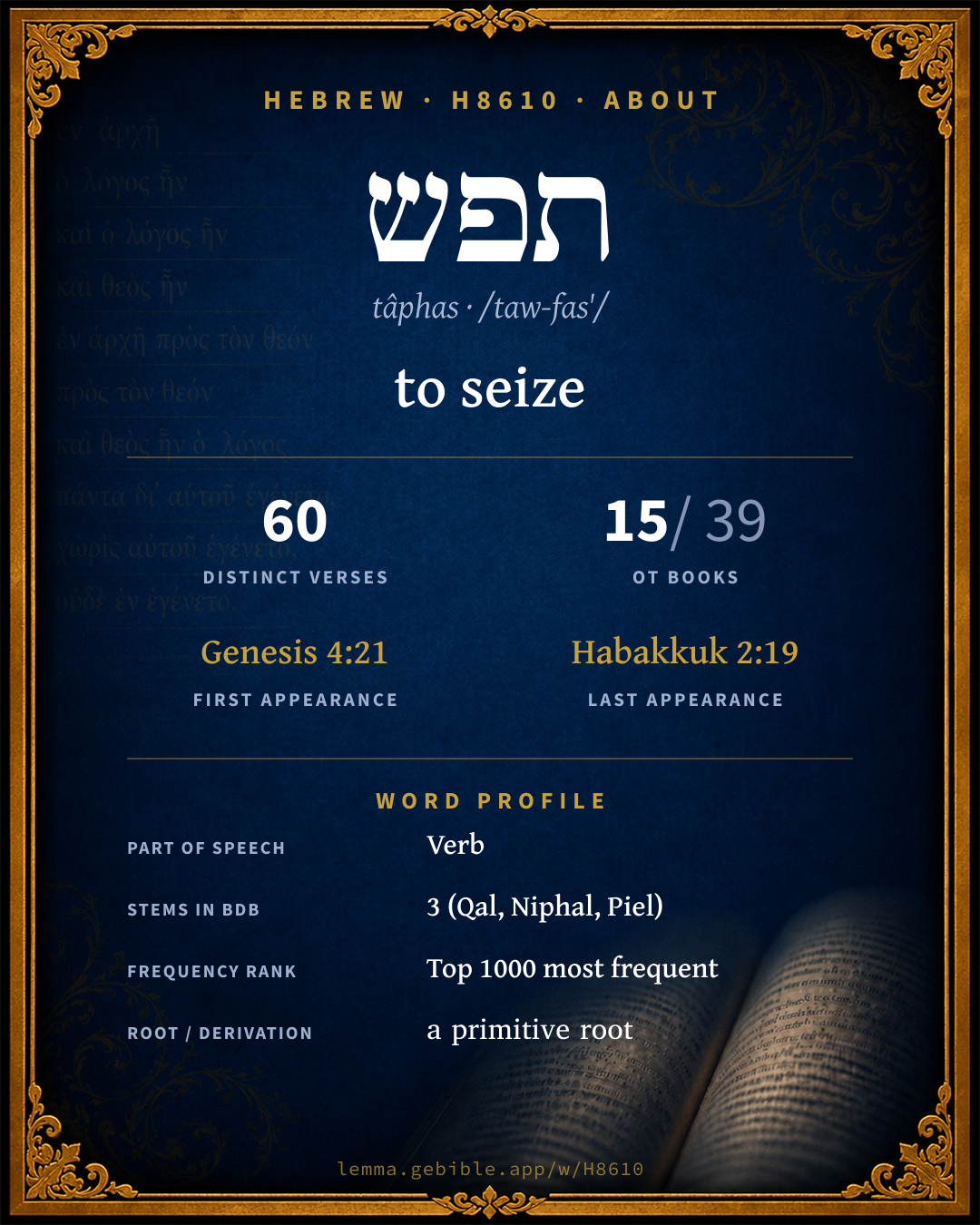
תָּפַשׂ
to seize
‘to seize’ is one of 3 main senses fuller range ↓
Full lexicon entry — Brown-Driver-Briggs (BDB)
From Brown-Driver-Briggs (BDB)
Where this word appears
See every Qal verb in the Hebrew Bible →
Grammar key — what these labels mean
Part of speech
- Verb
- An action or state-of-being word.
Stem
- Qal
- The basic, simple active stem — the plain form of the verb (“he wrote”). Here: ‘lay hold of’
- Niphal
- Usually the simple passive or reflexive of the Qal (“he was written”).
- Piel
- An intensive or resultative active stem.
Form
- Participle Active
- A verbal adjective expressing ongoing or characteristic action (“writing / one who writes”).
- Sequential Imperfect
- An imperfect with prefixed waw — the standard past-narrative form (waw-consecutive imperfect).
- Perfect
- A completed action or state — Hebrew marks aspect (completeness) more than strict tense (“he wrote”).
- Imperative
- A direct command (“write!”).
- Sequential Perfect
- A perfect with prefixed waw continuing a preceding imperfect or command (waw-consecutive perfect).
- Infinitive Construct
- A bound verbal noun, frequently with prepositions (“to write / in writing”).
- Imperfect
- An incomplete, ongoing, or future action (“he will / would write”).
- Infinitive Absolute
- An unbound verbal noun, often intensifying or standing in for a finite verb.
- Participle Passive
- A verbal adjective expressing action received (“written”).
State
- Construct
- A noun bound to a following noun in a possessive / “of” relationship (the construct chain).
- Absolute
- The independent form of a noun, not bound to a following word.
Person
- 3rd Person
- The one spoken about (“he / she / it / they”).
- 2nd Person
- The one addressed (“you”).
- 1st Person
- The speaker (“I / we”).
Gender
- Masculine
- Grammatically masculine.
- Feminine
- Grammatically feminine.
- Common
- Either gender — not distinguished for this form.
Number
- Plural
- More than one (in Hebrew, generally three or more).
- Singular
- One.
10 verses where H8610 appears in the Qal stem in the Book of Jeremiah. Filtered view — show all forms. Click any verse to open its interlinear word-by-word view. Verse text shown in the World English Bible for context — . Each verse’s Hebrew form is shown with its reference; the English is not keyword-highlighted, since the data carries no word-level English alignment. Use “Compare translations” on any verse to read it across multiple English versions. This concordance covers the Hebrew Bible; Septuagint (Greek Old Testament) occurrences are not indexed here.
Jeremiah
- Jeremiah 2:8 וְ/תֹפְשֵׂ֤י conj + Qal ptcp.act mp cs The priests didn't say, Where is Yahweh? and those who handle the law didn't know me: the rulers also transgressed against me, and the prophets prophesied by Baal, and walked after things that do not profit.
- Jeremiah 26:8 וַ/יִּתְפְּשׂ֨וּ conj + Qal wimpf 3mp It happened, when Jeremiah had made an end of speaking all that Yahweh had commanded him to speak to all the people, that the priests and the prophets and all the people laid hold on him, saying, You shall surely die.
- Jeremiah 34:3 תָּפֹ֣שׂ תִּתָּפֵ֔שׂ Qal inf.abs Niphal impf 2ms and you shall not escape out of his hand, but shall surely be taken, and delivered into his hand; and your eyes shall see the eyes of the king of Babylon, and he shall speak with you mouth to mouth, and you shall go to Babylon.
- Jeremiah 37:13 וַ/יִּתְפֹּ֞שׂ conj + Qal wimpf 3ms When he was in the gate of Benjamin, a captain of the guard was there, whose name was Irijah, the son of Shelemiah, the son of Hananiah; and he laid hold on Jeremiah the prophet, saying, You are falling away to the Chaldeans.
- Jeremiah 37:14 וַ/יִּתְפֹּ֤שׂ conj + Qal wimpf 3ms Then said Jeremiah, It is false; I am not falling away to the Chaldeans. But he didn't listen to him; so Irijah laid hold on Jeremiah, and brought him to the princes.
- Jeremiah 40:10 תְּפַשְׂתֶּֽם Qal pf 2mp As for me, behold, I will dwell at Mizpah, to stand before the Chaldeans who shall come to us: but you, gather you wine and summer fruits and oil, and put them in your vessels, and dwell in your cities that you have taken.
- Jeremiah 46:9 תֹּפְשֵׂ֣י תֹּפְשֵׂ֖י Qal ptcp.act mp cs Qal ptcp.act mp cs Go up, you horses; and rage, you chariots; and let the mighty men go forth: Cush and Put, who handle the shield; and the Ludim, who handle and bend the bow.
- Jeremiah 49:16 תֹּפְשִׂ֖י Qal ptcp.act ms cs As for your terror, the pride of your heart has deceived you, O you who dwell in the clefts of the rock, who hold the height of the hill: though you should make your nest as high as the eagle, I will bring you down from there, says Yahweh.
- Jeremiah 50:16 וְ/תֹפֵ֥שׂ conj + Qal ptcp.act ms cs Cut off the sower from Babylon, and him who handles the sickle in the time of harvest: for fear of the oppressing sword they shall turn everyone to his people, and they shall flee everyone to his own land.
- Jeremiah 52:9 וַֽ/יִּתְפְּשׂוּ֙ conj + Qal wimpf 3mp Then they took the king, and carried him up to the king of Babylon to Riblah in the land of Hamath; and he gave judgment on him.
About this entry
At a glance — auto-summarized from this page’s data, not written by a person. Every figure links to its source below. This summary describes the numbers; it doesn’t interpret them.
The Hebrew verb תפש centers on the idea of “to seize.” Its English rendering has broadened — “took” classically, “captured” (Berean Standard Bible) in modern versions; see the renderings breakdown. Spanning 60 verses in 15 books, it ranks among the moderately common words of the Hebrew Bible. Jeremiah dominates its distribution — 16 of 60 verses. Across 3 stems, its meaning turns on the binyan (Qal, Niphal). Dig into 60-verse concordance and the renderings breakdown below.
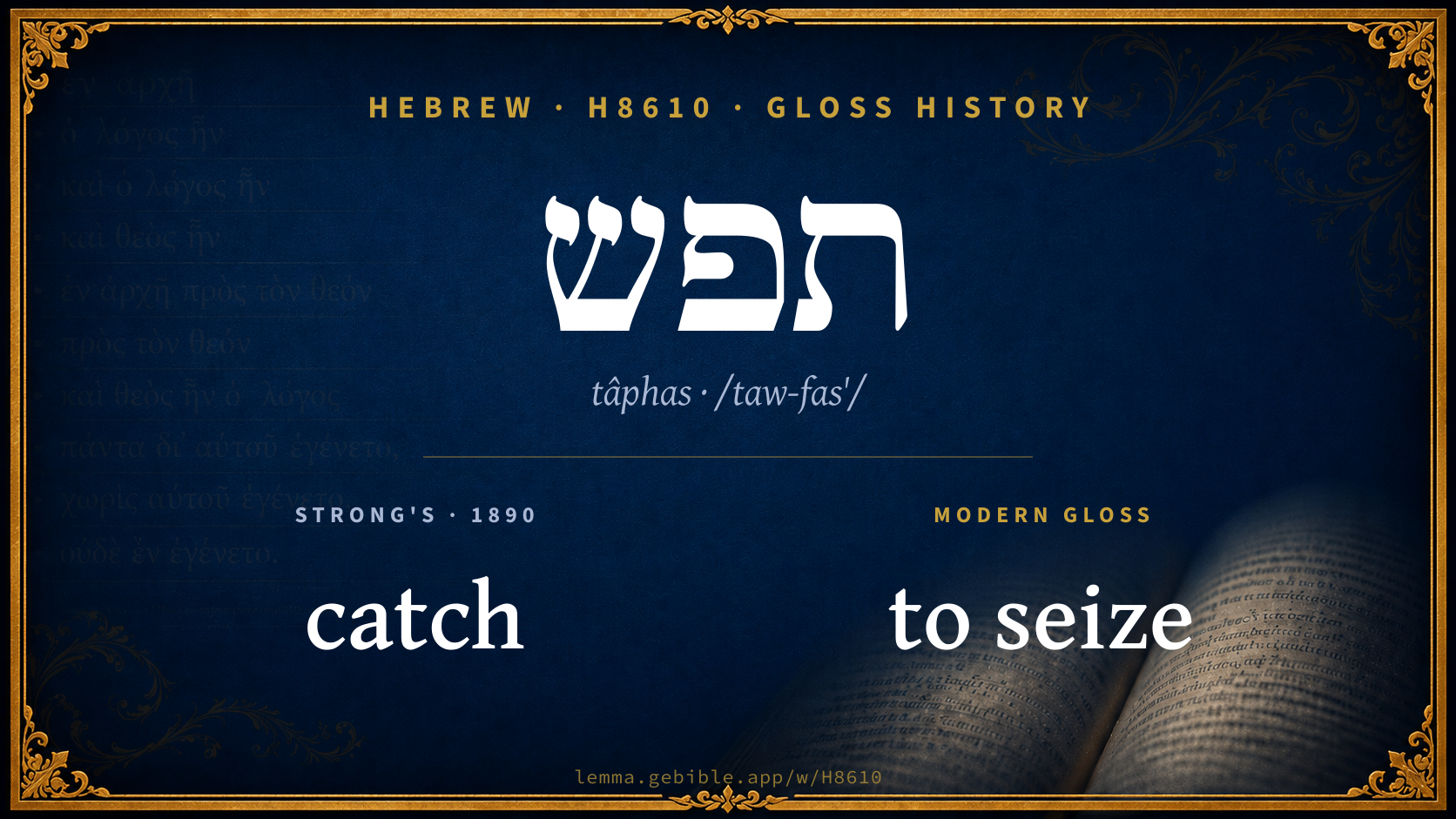
Gloss history
Strong's 1890 vs modern scholarship
About this word
Strong's H8610 catalogs a Hebrew word from the Hebrew Old Testament.
These counts are not copied from any lexicon or concordance. They are computed here, from the morphology-tagged Hebrew Old Testament. What Lemma adds →
- 60
- distinct verses
- The word appears in 60 distinct verses.
- 15 / 39
- OT books
- The word appears in 15 of 39 Old Testament books.
- #597
- by frequency
- Top 1000 most frequent Hebrew words (rank 597 of 8,640 Hebrew words by occurrence).
View all 60 occurrences in the concordance →
By section of the Old Testament
By traditional corpus
Conventional, traditional groupings — biblical authorship is debated, so this is a traditional corpus grouping, not an authorship claim. Each share is this word’s portion of its verses in that division of the Hebrew canon. Each figure is a share of the word’s 60 distinct verses.
- Prophets (Nevi'im) 47 verses · 78%
- Torah (Pentateuch) 8 verses · 13%
- Writings (Ketuvim) 5 verses · 8%
How translations render this word
Counts come from each version’s own published word-to-Strong’s tagging or interlinear alignment — an approximate guide to how each version renders this word, not a word-level alignment the data otherwise carries. Because each total is that version’s own tagged count, the per-version totals vary from one another and need not match the appearance or distinct-verse counts above. These counts may also differ from a printed concordance because Lemma counts each distinctly tagged rendering and does not collapse phrase taggings into a single head-word total. This is a fixed set of word-tagged versions (KJV, ASV, BSB, ULT) and does not change with the reading translation you choose elsewhere. Each version’s license is shown beside its name below (and on Sources).
- King James Version: Took 8×, Take 7×, They took 5×
- American Standard Version: They took 5×, Took 4×, Him 3×
- Berean Standard Bible: Captured 5×, Seized 3×, Take them 3×
- unfoldingWord Literal Text: Seize them 3×, He captured them 2×, He was caught 2×
King James Version Public Domain
Renders H8610 across 64 tagged occurrences — most commonly:
Plus 31 renderings that appear only once — usually multi-word phrases or single function words the recovered tagging swept in, not distinct renderings. Not rendered by a distinct English word in 1 further occurrence.
American Standard Version Public Domain
Renders H8610 across 64 tagged occurrences — most commonly:
Plus 38 renderings that appear only once — usually multi-word phrases or single function words the recovered tagging swept in, not distinct renderings.
Berean Standard Bible Public Domain
Renders H8610 across 63 tagged occurrences — most commonly:
Plus 46 renderings that appear only once — usually multi-word phrases or single function words the recovered tagging swept in, not distinct renderings. Not rendered by a distinct English word in 1 further occurrence.
unfoldingWord Literal Text CC BY-SA 4.0
Renders H8610 across 52 tagged occurrences — most commonly:
Plus 37 renderings that appear only once — usually multi-word phrases or single function words the recovered tagging swept in, not distinct renderings.
Senses in the full BDB
Hebrew verbs can shift meaning by stem (binyan): Qal is the basic action, Niphal is often passive or reflexive, Piel often intensifies or makes it factitive, and Hiphil is typically causative. The senses below are grouped under the stem BDB assigns to each.
What do BDB’s symbols mean?
BDB uses these scholarly abbreviations:
| Symbol | Meaning |
|---|---|
| 𝔊 | the Septuagint (the ancient Greek translation, LXX) |
| 𝔙 | the Vulgate (the Latin translation) |
| 𝔖 | the Syriac version (the Peshitta) |
| 𝔗 | the Targum (the Aramaic translation) |
| ψ | the Psalms |
| √ | root (the underlying root or stem) |
| ‖ | parallel passage (a synonymous or contrasted parallel) |
| † | the dagger: every passage where the word occurs is cited |
The 5 senses and sub-senses the full Brown-Driver-Briggs lexicon distinguishes for this word, in lexicon order (not ranked by frequency), with BDB’s own verbatim wording and sub-sense lettering. Shown in Hebrew script with BDB’s own scholarly abbreviations. The condensed entry is in the Lexicon Entry tab. See also the Forms in the corpus table below.
Qal
- Pf. 3 ms. ת׳ 2 K 14:13 +, sf. consec. וּתְפָשָׂהּ Dt 22:28, etc.; Impf. 3 ms. יִתְפּשֹׁ Is 3:6, 1 pl. נִתְפְשֵׂם 2 K 7:12, etc.; Imv. mpl. תִּפְשׂוּ 1 K 18:40, etc.; Inf. abs. תָּפשֹׁ Je 34:3; cstr. תְּפשֹׁ Ez 14:5, לִתְפּשֹׁ 21:16; 30:21, sf. לְתָפְשָׂהּ Dt 20:19, etc.; Pt. תֹּפֵשׂ Gn 4:21 +, cstr. תֹּפְשִׂי Je 49:16 (Ges§ 90 1), etc.;— e.g. 2 Kings 14:13
- 1. lay hold of, seize (with the hand), acc. pers. Gn 39:12 (J; + בְּבִגְדוֹ), ב pers. Is 3:6; Dt 21:19; 22:28; Je 37:14; Ez 29:7 (in fig.; + ב instr.); c. ב rei 1 K 11:30; Dt 9:17; arrest, catch, acc. pers. 1 S 23:26; 1 K 13:4; 18:40(×2) Je 26:8; 37:13, 2 K 14:13 = 2 Ch 25:23; 2 K 25:6 = Je 52:9, ψ 71:11; in phrase catch, capture alive (חַי), acc. pers. Jos 8:23 (JE), 1 S 15:8; 1 K 20:18(×2); 2 K 7:12; 10:14(×2); seize city (acc.) Jos 8:8 (JE), 2 K 14:7; 16:9; 18:13 = Is 36:1; Dt 20:19; Je 40:10; fig. Ez 14:5 seize Isr. (acc.) by (ב) their heart (terrorize them); Pr 30:9 seize (do violence to) the name (acc.) of my God; תָּפוּשׂ זָהָב Hb 2:19 grasped (sheathed) in gold; ת׳ מְרוֹם גִּבְעָה Je 49:16 holding (occupying) the height of the hill. e.g. Genesis 39:12
- 2. grasp in order to wield, wield, use skillfully: grasp sword בַּכָּף Ez 21:16 (acc. om.), cf. 30:21 (ב of sword), and especially pt.: תֹּפֵשׂ הַקֶּשֶׁת Am 2:15, תֹּפֵשׂ כִּנּוֹר Gn 4:21 (J), ת׳ מַגָּל Je 50:16, תֹּפְשֵׂי מָגֵן 46:9a (del. ת׳ v 9 b 𝔊 Gie Co Du), ת׳ מָשׁוֹט Ez 27:29, ת׳ חֲרָבוֹת 38:4; even ת׳ הַתּוֹרָה Je 2:8 they that handle (deal with, are expert in) the law, ת׳ הַמִּלְחָמָה Nu 31:27 (P) those skilled in war.—Je 34:3 v. infr. e.g. Ezekiel 21:16
Niphal
- Pf. 3 ms. נִתְפַּשׂ Ez 19:4, 2 fs. נִתְפַשְׂתְּ Je 50:24, etc.; Impf. 3 fs. וַתִּתָּפֵשׂ 51:41, 2 ms. תִּתָּפֵשׂ Je 34:3; 38:23, etc.; Inf. cstr. לְהִתָּפֵשׂ Ez 21:28;—be seized, arrested, caught (sometimes ‖ נִלְכַּד), subj. pers., Je 38:23 (ב instr.), 50:24 (fig. of Bab.), also (c. ב instr.) Ez 12:13; 17:20; 19:4, 8 (both fig. of Israel), 21:29, and (without ב) v 28 Nu 5:13; + Inf. abs. Qal תָּפשֹׁ תִּתָּפֵשׂ Je 34:3; be seized, of fortress, city Je 48:41; 51:41 (both ‖ נִלְכַּד), 50:46, cf. 51:32; fig. ψ 10:2 may they be caught in (ב) the devices which they have planned. e.g. Ezekiel 19:4
Piel
- Impf. 2 ms. תְּתַפֵּשׂ Pr 30:28 a lizard thou mayest grasp with the hands (ב);—or read תִּתָּפֵשׂ Niph. Impf. 3 fs., v. De Toy. e.g. Proverbs 30:28
Senses from the full Brown-Driver-Briggs lexicon (Brown, Driver, Briggs; Oxford 1906 — public domain), digitized via Sefaria, supplemented by the OpenScriptures HebrewLexicon (CC BY 4.0). Full attribution on Sources.
Word origin
vb. lay hold of, wield (= NH תָּפַשׂ, תָּפַס, Aramaic תְּפַשׂ, תְּפַס);—
— Brown-Driver-Briggs (Oxford 1906, public domain), digitized via Sefaria, supplemented by the OpenScriptures HebrewLexicon (CC BY 4.0). See Sources.
Origin: a primitive root
Jastrow Dictionary
A second Hebrew/Aramaic lexicon for comparison, covering Aramaic and post-biblical (Talmudic, Targumic, Midrashic) usage that the biblical-Hebrew BDB does not. Matched by lemma rather than by Strong’s number, so a lemma may carry more than one Jastrow headword (shown separately below), and the entries cover usage well beyond the Bible.
תָּפַס
- to seize, take hold on; to take effect. Keth. 84ᵇ את תּוֹפֵס לבעל חוב וכ׳ thou seizest property in behalf of a creditor when the debtor owes others, ואמר ר׳ י׳ התופס וכ׳ and R. J. has decided that he who seizes in behalf of a creditor when there are other claimants has not taken legal possession. Ib. top והוא שת׳ מחיים (his possession is effectual) when he has seized it during the decedent’s life-time. Ab. Zar. 8ᵇ (expl. קרטיסיס) יום שתָּפְסָה בו רומי מלכות the day when Rome took hold of the government (of the east, v. תְּפִיסָה). Y. Taan. IV, 68ᶜ top היה משה תוֹפְשָׂן Moses held fast on them (the tablets). R. Hash. 4ᵇ, a. fr. תָּפַסְתָּ מרובה וכ׳, v. מוּעָט. B. Mets. 102ᵇ, a. e. תְּפוֹס לשון אחרון hold to the latter expression, i.e. if an agreement contains two discrepant clauses, the second is legally recognized; Tem. 26ᵃ, a. e. תפוס לשון ראשון the first clause (of a vow) is legally recognized. Yeb. 10ᵇ, a. fr. אין קידושין תּוֹפְסִין וכ׳, v. קִידּוּשׁ. Y. Dem. VI, 25ᵇ תָּפְשָׂה מדת הדין וכ׳ justice takes hold on him &c., i.e. the full rigor of the law is applied against him &c. Num. R. s. 111 (ref. to Prov. III, 34) אלו הנזירים שתּוֹפְשִׂים ענוה בעצמן וכ׳ that means the Nazarites who choose humility for themselves, who abstain from wine &c. Ib. 108 ותְפָשָׂם and arrested them, v. לוּפָר. Snh. 64ᵃ מפני מה תפסה תורה לשון מולך why does the Biblical text choose the word Molekh (in place of idol in general)? Y. Ber. VII, 11ᶜ top, a. e. תופסין אותו seize him, take him to task, v. נַקְדָּן. Ab. Zar. 64ᵃ דמי … מי תוֹפֶסֶת דמיה וכ׳ how about money which was realized by the sale of an idol, in the hands of a gentile? does the idol hold its equivalent in gentile hands or not?, i.e. does the money in gentile hands retain its character as compensation for an idol, and is it thus forbidden to a Jew? Ex. R. s. 1520 היה שלמה תופס פיו וכ׳ Solomon controlled his mouth, in order not to speak before &c. Gen. R. s. 12 כל … תופסין את הלשון וזה אינו תופס וכ׳ all other letters catch the tongue (require an effort of the organs of speech), but this (the Hé) does not catch &c. (is merely a breathing sound).—Part. pass. תָּפוּס, תָּפוּשׂ; f. תְּפוּסָה, תְּפוּשָׂה &c. a) (cmp. אָחוּז s. v. אָחַז) holding. Y. Taan. l. c. היה משה ת׳ בטפחיים Moses was holding two handbreadths (of the tablets). Ex. R. s. 46, beg. היה ת׳ בלוחות וכ׳ he held the tablets, and would not believe that Israel had sinned. Sifra B’ḥuck. Par. 2, ch. VIII תְּפוּסֵי מעשה וכ׳ holding to the deeds of their fathers, generation after generation; a. e.—b) seized, captured. Mekh. Mishp., s. 17 תפוסה the outraged woman, opp. מפותה the seduced. e.g. Proverbs 3:34
- to be seized, arrested; to have one’s property seized; to be made responsible. Ex. R. s. 1518 בן בית שנ׳ על ידי בעל וכ׳ a domestic servant who was seized for his employer’s debt. Tosef. Ḥull. II, 24 נ׳ ע"ד מינות, v. מִינוּת. Ib. ונִתְפַּסְתִּי על וכ׳ and therefore I was arrested on the suspicion of heresy. Ab. Zar. 17ᵇ כשנִתְפְּסוּ ר׳ אלעזר וכ׳ when R. El. a. R. H. b. T. were arrested (by Roman officials, for rebellious conduct). Ib. אשריך שנִתְפַּסְתָּ על וכ׳ happy art thou, for thou hast been arrested on one charge only, and woe me that I have been arrested on five charges. B. Bath. 16ᵇ אין אדם נ׳ על צערו Ms. M. (ed. בשעת) no man is taken to account for what he speaks in his distress. Sabb. 33ᵇ נִתְפָּסִים על הדור are seized for the debt (die for the sins) of their generation. Y. Keth. XIII, 35ᵈ כל הנ׳ על חבירו חייב ליתן לו in every case if one’s property was seized for a neighbor’s debt, the latter has to reimburse him; ib. אין לך נ׳ וכ׳ in no case must he reimburse him, except in the case of annona and head-tax; Y. B. Kam. X, end, 7ᶜ; Y. Ned. IV, beg. 38ᶜ. Deut. R. s. 2, beg. (prov.) הוי זהיר שלא תִתָּפֵס מקום דבורך take care that thou be not caught on the spot where thou speakest (held to thy word); a. fr.
- to cause to be seized, cause to take hold. Y. Succ. IV, 54ᵈ top ראה שהִתְפִּיסָתְךָ התורה לשון וכ׳ behold, the Law has made thee use the expression of endearment &c. Tem. 2ᵃ הכל מַתְפִּיסִין בתמורה all persons can cause the seizure of the substitute together with the original by exchanging a consecrated animal (v. תְּמוּרָה). Ib. 9ᵃ מי מַתְפִּיס בדבר שאינו שלו can one cause the seizure of a thing which is not his?; a. e.—[Ned. 11ᵇ, sq. מתפיס, v. next w.]
- (v. טָפַס) to climb, rise. Gen. R. s. 66, end (ref. to Prov. XXX, 28) באיזה זכות השממית מְתַפֶּשֶׂת בזכות וכ׳ for what merit does the spider (Esau-Rome) climb (rise to power)? For the merit of those hands (with which Esau nursed his father, by ref. to Gen. XXVII, 31); Yalk. ib. 115; Yalk. Prov. 963 תְּתַפֵּשׂ. e.g. Proverbs 30:28
- , Hithparel הִתַּרְפֵּס same. Y. Erub. V, 22ᵈ top רואה אותו כי מִיתַּרְפֵּס ועולה מְתַרְפֵּס ויורד, (v. טָפַס) you look upon it (measure the distance for Sabbath purposes) as if one would climb up and climb down (the wady).
תְּפַס
- , to seize, catch. Targ. Ps. X, 9. Targ. II Esth. III, 8; a. e.—Keth. 84ᵇ קריביה … תָּפוּס פרה וכ׳ relatives of R. J. seized a cow that belonged to heirs, out of an alley; שפיר תְּפַסְתּוּהָ you have seized her legally; ib. תַּפְסִיתוּהָ. Ib. ההוא … דתַפְסֵי תורא מיניה there was a cowherd for heirs (minors) from whom they (creditors) seized an ox; מחיים תְּפִיסְנָא ליה I took it when the father was yet living; a. fr.—Part. pass. תָּפִיס holding. B. Mets. 102ᵇ משום דת׳ because he is in possession; הכא נמי קא ת׳ here, too, he is in possession; a. e.
- to cause to seize, to deposit with (as security). B. Bath. 174ᵃ אַתְפְּסֵיה (not אתפסוה); ib.ᵇ דאתפסיה (not דאתפסה); Keth. 107ᵃ דאַתְפְּסָהּ צררי, v. צְרָרָא I.
- ; Ithpe. אִתְּפִיס, אִתְּפִישׁ
- 1. to be seized, arrested. Targ. Koh. XI, 4 (ed. Vien. מִתְפַּס).—Tem. 26ᵇ למימרא דתחת לישנא דאִיתַּפּוּסֵי הוא shall we say that taḥath has the meaning of being arrested, i.e. if you say, this animal shall be taḥath (in the place of) that animal, it becomes consecrated according to the law of exchange (תְּמוּרָה)? Ib. תחת … לישנא דאתפוסי ולישנא דאחולי taḥath appears in the sense of being arrested and in the sense of redeeming; לישנא דאיתפוסי דכתיב וכ׳ in the sense of being arrested, as we read (Lev. XIII, 23) &c. Ib. 27ᵃ; a. e. e.g. Leviticus 13:23
- 2. to be deposited. Keth. 107ᵇ לא מִתְּפִיס, v. צְרָרָא I.
- 3. to hold one’s self, cling to. Ned. 11ᵇ בהיתירא קא מתפיס he clings to the idea of permission, i.e. by saying, ‘this thing be unto me like flesh of a peace-offering after the blood has been sprinkled’, he proves that he means to emphasize the permission to enjoy the thing; אלא כגון … בעיקרו קא מתפיס ות׳ but in a case like this, when he puts down flesh of a peace-offering, and places some permitted food beside it, and says, ‘this be like this’: does he mean to refer to the original condition of the peace-offering &c.? (v. צִנְנָא). Ib. 12ᵃ בקרבן קא תפיס he refers to the sacred character of a sacrifice; כמתפיס בדבר האסור as if referring to something ritually forbidden (not to something made forbidden by consecration or vow). Ib. בעיקר קא מתפיס he refers to the original day (of his father’s death). Naz. 22ᵇ, v. צִנְנָא. Ib. 21ᵃ חד בחבריה מתפיס (in saying, ‘and I’) each refers to him that spoke immediately before him; בקמא מִיתַּפְּסֵי they all refer to the first person; a. e.
תָּפַשׂ
- , v. תָּפַס, תְּפַס.
A Dictionary of the Targumim, the Talmud Babli and Yerushalmi, and the Midrashic Literature (Marcus Jastrow; London, Luzac, 1903) — Public Domain. Digitized via Sefaria. Digitized via Sefaria. Full attribution on Sources.
Forms in the corpus
The 57 distinct written forms H8610 takes in the Hebrew Bible, most frequent first — each parse links to that stem’s occurrences in the concordance. Hebrew forms include their vowel points and cantillation, so a single lemma takes many written forms.
Septuagint verse parallels
This word appears in 54 verses that also exist in the Greek Old Testament (Septuagint), out of the 60 Hebrew verses it occurs in. You can read those verses in Greek by switching the Old Testament edition to the Septuagint.
Read these verses in the Septuagint
- Genesis 4:21
- Numbers 5:13
- Deuteronomy 9:17
- Joshua 8:8
- 1 Samuel 15:8
- 1 Kings 11:30
- 2 Kings 7:12
- 2 Chronicles 25:23
- Psalms 10:2
- Proverbs 30:9
- Isaiah 3:6
- Jeremiah 2:8
This is a verse-level parallel only — the same verses exist in both the Hebrew and Greek Old Testaments. No word-level Hebrew↔Greek correspondence is claimed: the data carries no such alignment, so no Greek word is shown as this Hebrew word’s translation. Coverage is not total — the Septuagint omits the deuterocanon and renumbers the Psalms, so some Hebrew verses have no direct Greek parallel.