
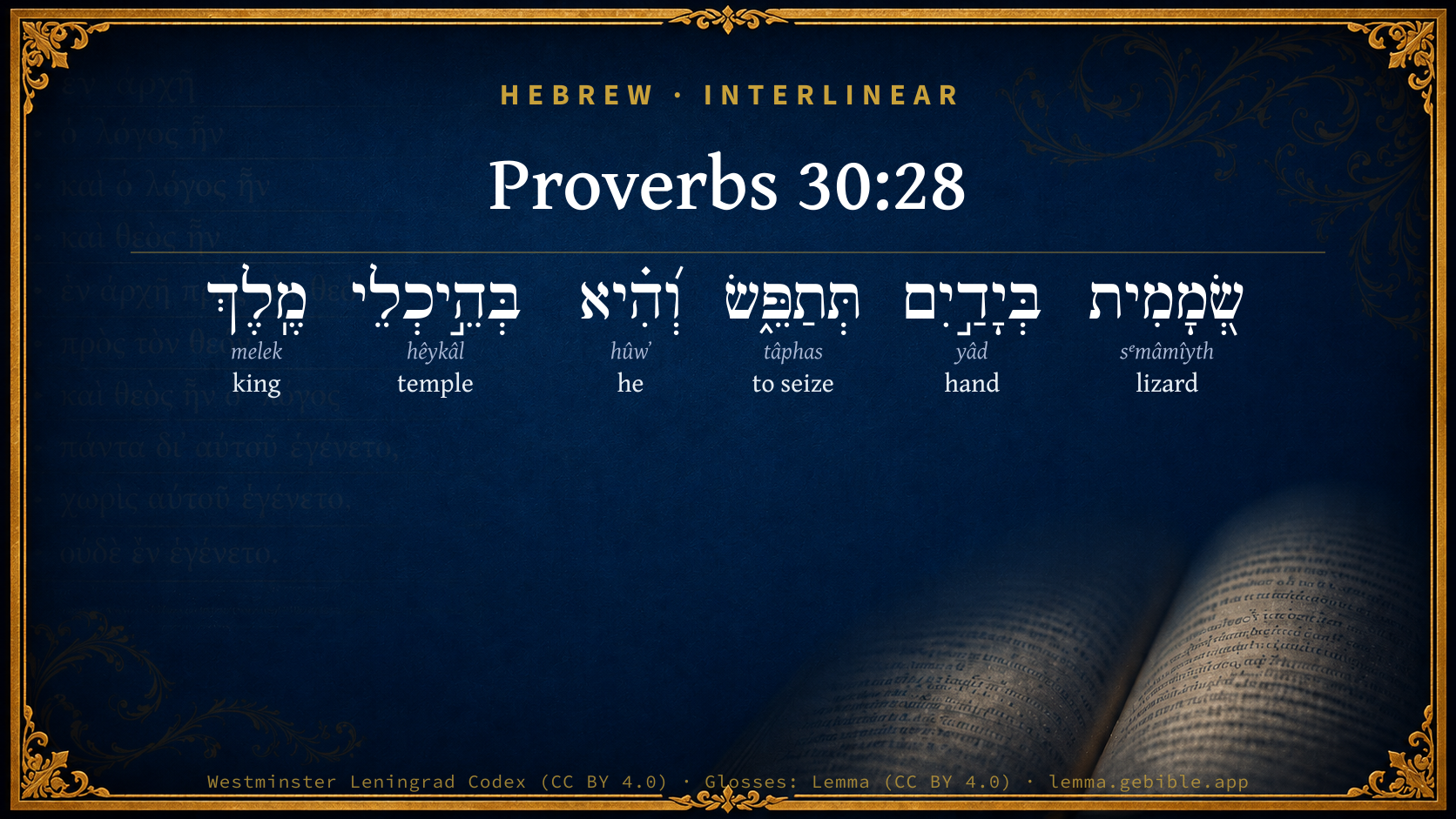
Proverbs 30:28

Hebrew (Westminster Leningrad Codex) Proverbs 30:28 appears in the Hebrew Old Testament. The text above is from the Westminster Leningrad Codex. Each word links to its Strong’s number, a concise gloss, and parsing drawn from the Open Scriptures Hebrew Bible morphology. Click any word for its full Brown-Driver-Briggs (BDB) entry.
Download image
Cite this verse

Proverbs 30:28 (World English Bible). Public Domain. Lemma interlinear Bible study tool, https://lemma.gebible.app/v/proverbs/30/28.

Show BibTeX & RIS
BibTeX
RIS
English Translation
You can catch a lizard with your hands, Yet it is in kings' palaces.
World English Bible · Public Domain
Highlights
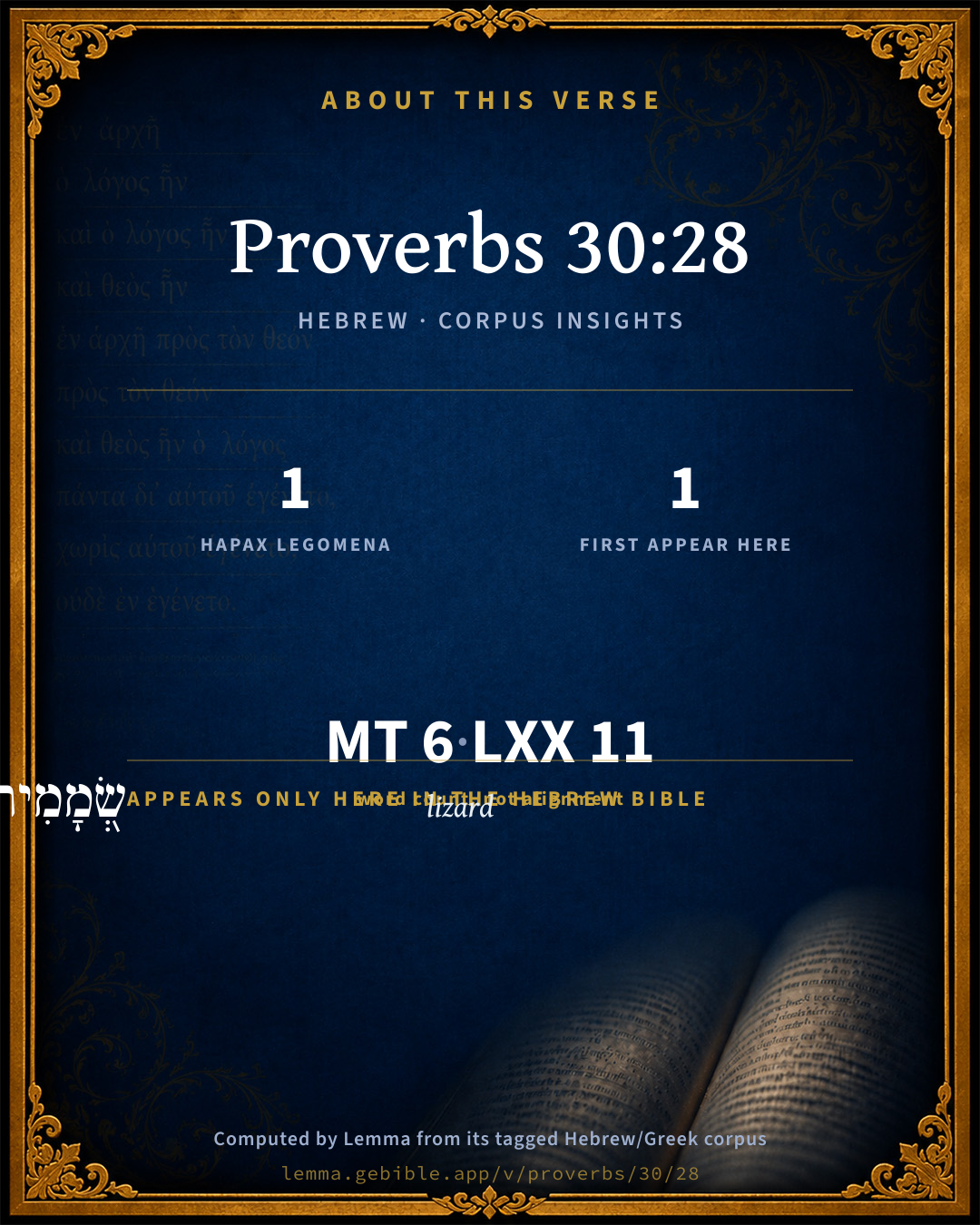
  • 1 hapax legomenon — only here in the Hebrew Bible
  • 1 first appearance in the Hebrew Bible
Full analysis ↓
Download a study sheet

One document with this verse’s original text, its word-by-word gloss line, the meaning frame, cross-references with their text, attributed commentary, and full source and license credits — printable, and it pastes into notes with its structure intact.

This verse Autodidact and up

Study sheet (.html) Plain text (.txt)

A passage Seminary Student

Up to 50 verses in one chapter. A passage sheet keeps up to 6 commentary sources and 12 cross-references per verse, in the order this page ranks them, and says so on the sheet whenever that leaves anything out. Ask for a single verse and you get the Autodidact verse sheet above.

Everything on this page stays free to read, with no account — the sheet is a download of what is already on screen, not access to it.

Want to remove ads? Support Godless Engineer
Compare translations 3

The same verse in 3 English versions, stacked beneath the original-language interlinear above. Click any original word for its lexicon entry.

Each is an independent rendering of the whole verse — the interlinear is not word-aligned to these translations.

Highlighted words mark where these versions differ — a whole-verse word diff, not a word-by-word alignment.

  • World English Bible Public Domain
    You can catch a lizard with your hands, Yet it is in kings' palaces.
  • King James Version Public Domain
    The spider taketh hold with her hands, and is in kings' palaces.
  • unfoldingWord Literal Text CC BY-SA 4.0
    You can catch a lizard with hands, yet it in the palaces of the king.

unfoldingWord Literal Text — © unfoldingWord, licensed CC BY-SA 4.0. Word-aligned USFM3 via Door43 (git.door43.org/unfoldingWord/en_ult).

Versions to compare (up to 4)

3 of 4 selected

Show all 18 translations

Every available English version of this verse, each an independent rendering of the whole verse.

  • World English Bible Public Domain
    You can catch a lizard with your hands, Yet it is in kings' palaces.
  • Berean Standard Bible Public Domain
    and the lizard can be caught in one’s hands, yet it is found in the palaces of kings.
  • Majority Standard Bible Public Domain
    and the lizard can be caught in one’s hands, yet it is found in the palaces of kings.
  • King James Version Public Domain
    The spider taketh hold with her hands, and is in kings' palaces.
  • American Standard Version (1901) Public Domain
    The lizard taketh hold with her hands, Yet is she in kings' palaces.
  • Revised Version (1885) Public Domain
    The lizard taketh hold with her hands, yet is she in kings’ palaces,
  • Geneva Bible (1599) Public Domain
    The spider taketh holde with her handes, and is in Kings palaces.
  • Douay-Rheims (1899) Public Domain
    The stellio supporteth itself on hands, and dwelleth in kings' houses.
  • Young's Literal Translation Public Domain
    A spider with two hands taketh hold, And is in the palaces of a king.
  • Literal Standard Version CC BY-SA 4.0
    A spider with two hands takes hold, || And is in the palaces of a king.
  • Unlocked Literal Bible CC BY-SA 4.0
    As for the lizard, you can hold it in your two hands, yet they are found in kings' palaces.
  • unfoldingWord Literal Text CC BY-SA 4.0
    You can catch a lizard with hands, yet it in the palaces of the king.
  • Darby Bible Public Domain
    thou takest hold of the lizard with the hands, yet is she in kings' palaces.
  • World Messianic Bible Public Domain
    You can catch a lizard with your hands, yet it is in kings’ palaces.
  • Webster's Bible Public Domain
    The spider taketh hold with her hands, and is in king's palaces.
  • Free Bible Version CC BY-SA 4.0
    Lizards—you can catch them in your hands, but they live in the king's palace.
  • Bible in Basic English Public Domain
    You may take the lizard in your hands, but it is in kings' houses.
  • JPS Tanakh (1917) Public Domain
    The spider thou canst take with the hands, yet is she in kings' palaces.

Literal Standard Version (2020), Covenant Press — licensed CC BY-SA 4.0. Text via the HelloAO Bible API (eBible.org). Unlocked Literal Bible (unfoldingWord) — licensed CC BY-SA 4.0. Text via the HelloAO Bible API (eBible.org). unfoldingWord Literal Text — © unfoldingWord, licensed CC BY-SA 4.0. Word-aligned USFM3 via Door43 (git.door43.org/unfoldingWord/en_ult). Free Bible Version, Dr. Jonathan Gallagher — licensed CC BY-SA 4.0. Text via the HelloAO Bible API (eBible.org).

Word by word

More ways to search: Search by grammar → Find every occurrence → Compare this word →

Practice this passage: Drill this verse → Learn its vocabulary →

About this verse

These counts appear in no published source. They are computed here, from the morphology-tagged text and Lemma’s own curated glosses. What Lemma adds →

6
words
6
distinct lemmas
Wisdom
section

Notable vocabulary

1 hapax legomenon — a word that appears only here in the entire Hebrew Bible:

  • שְׂ֭מָמִית lizard H8079

First appearance in Scripture

This word makes its first canonical appearance in the Hebrew Bible here:

  • שְׂ֭מָמִית lizard H8079

Grammatical profile

  • 1 verb
  • 4 nouns
  • 1 pronoun

Verb forms

  • תְּתַפֵּ֑שׂ Piel · Imperfect

Hebrew & Septuagint length

In English translation the verse runs 14 words from the Hebrew and 19 from the Septuagint (LXX English) — closely comparable.

A rough comparison of the two English renderings, which tokenize alike — not a word-level alignment.

Word counts can differ between the Hebrew and the Greek without any difference in meaning — e.g. the Hebrew direct-object marker אֵת has no separate Greek word, and Greek often adds the article ὁ.

In the original languages it is 6 Hebrew tokens and 11 Greek tokens — but the two are counted differently (Hebrew bundles its prefixes and suffixes into one token; the Greek is in lemma form), so that isn’t a like-for-like length.

Hebrew and Greek witnesses Masoretic Hebrew ↔ Greek Septuagint

The same verse in the two great witnesses to the Old Testament, shown verse-for-verse.

These are two independent witnesses, not word-aligned to each other, and the Septuagint is shown in lemma (dictionary) form.

Hebrew Proverbs 30:28 Masoretic · Westminster Leningrad Codex

שְׂ֭מָמִית בְּיָדַ֣יִם תְּתַפֵּ֑שׂ וְ֝הִ֗יא בְּהֵ֣יכְלֵי מֶֽלֶךְ

You can catch a lizard with your hands, Yet it is in kings' palaces.

World English Bible · Public Domain

Greek LXX Proverbs 30:28 Septuagint · lemma form

καί καλαβώτης χείρ ἐρειδόμενος καί εὐάλωτος εἰμί καταοἰκέω ἐν ὀχύρωμα βασιλεύς

And the eft, which supports itself by its hands, and is easily taken, dwells in the fortresses of kings.

LXX2012 (modern English Septuagint) · Public Domain

On this verse, The Pulpit Commentary discusses the Septuagint’s reading. Read the note in Commentary ↓

Hebrew: Westminster Leningrad Codex (CC BY 4.0). Greek: Septuagint (public domain); English from LXX2012 (modern English Septuagint) (Public Domain). How the Septuagint differs from the Hebrew →

Commentary

Notes on Proverbs 30:28 from classic Christian and Jewish commentators (each source and its license shown beneath its notes). The classic Christian expositions comment on the surrounding passage and are grouped to its opening verse, so a note may address several verses; the Jewish commentaries on the Tanakh (Rashi and others) are per-verse, so they appear only where the commentator wrote on this verse.

Lemma curates 59 commentaries, every one of them public domain or Creative Commons licensed, each selected and text-cleaned for this edition rather than reprinted as found. About our sources →

Trapp's Complete Commentary

John Trapp

Pro 30:28 The spider taketh hold with her hands, and is in kings’ palaces.

Ver. 28. The spider taketh hold with her hands.] Some render it the ape, and the Hebrew semamith is somewhat like the Latin simia, a creature that is very witty, active, and imitative, taking hold with his hands (such as they are) and doing strange feats; being therefore much in king’s palaces, who delight to look upon them, as Solomon did, for recreation. If we take it for the spider, she doth her work painfully and curiously, spins a finer thread than any woman can do, builds a finer house than any man can do, in manner and form like to the tent of an emperor. This base creature may teach us this wisdom, saith one, not to be bunglers or slubberers in our works, but to be exact in our trades, and labour so to excel therein, that our doings may be commendable and admirable.

John Trapp, A Commentary or Exposition upon All the Books of the Old and New Testament (1647–1656) — public domain. Text from a community e-Sword module.

Geneva Bible (1599)

Geneva Bible translators

If man be not able to compass these common things by his wisdom, we cannot attribute wisdom to man, but folly.

Geneva Bible (1599) marginal notes — public domain. Text via Bolls.life.

Jamieson, Fausset & Brown

Robert Jamieson, A. R. Fausset & David Brown

spider--tolerated, even in palaces, to destroy flies.

taketh . . . hands--or, uses with activity the limbs provided for taking prey.

Jamieson, Fausset & Brown — Commentary Critical and Explanatory on the Whole Bible (1871) — public domain (CC PDM 1.0). Text via the HelloAO Bible API.

Ellicott's Commentary for English Readers

(28) The spider taketh hold with her hands.—The lizard, rather than the spider, seems to be here intended. As each first line of these four verses is an expression of weakness, it has been proposed to translate thus: “The lizard thou canst catch with the hands, and yet,” etc. (Comp. for this praise of wisdom, Ecc_9:14 sqq.)

A Bible Commentary for English Readers, edited by Charles John Ellicott (1878–1897) — public domain. Text from a community e-Sword module.

The Cambridge Bible for Schools and Colleges

gen. ed. J. J. S. Perowne

28. the spider] Rather, the lizard. The Heb. word occurs here only.

taketh hold with her hands] If this rendering be retained, the reference may be to the animal “taking hold of,” catching its prey (“Quid, cum me domi sedentem stellio, muscas captans vel araneas retibus suis implicans, sæpe intentum fecit?” August. Confess, 10. 35). But it is better to understand it of the marvellous power of “taking hold of,” adhering to, the surfaces over which it glides. “Many members of this family of Saura are characterised by a peculiar lamellated structure on the under surface of the toes, by means of which they are enabled to run over the smoothest surfaces, and even in an inverted position, like house-flies on a cieling.” Smiths Dict. of Bible, Art. Lizard.

The alternative rendering, thou canst seize with thy hands (R.V. marg.) brings out, as in the other three examples in this quatrain, the weak point as a foil to the wisdom exhibited: you can catch the lizard with your hands, and yet she makes her way into king’s palaces. But this is done sufficiently by the former rendering: the lizard has nothing better to rely on than its agility, and yet it gains an entry by it into kings’ palaces.

The Cambridge Bible for Schools and Colleges (gen. ed. J. J. S. Perowne; Cambridge University Press, 1878–1918) — public domain. Text from a community e-Sword module.

John Gill's Exposition

The spider taketh hold with her hands,.... On the thread she spins, or on the flies and bees she catches in her web. This is a small creature, yet very wise; what a curious thread does she spin! what a fine web does she weave! with what exactness and proportion is it framed! as if she understood the rules of mathematics and architecture;

and is in kings' palaces; as well as in the houses of poor people, and in temples also; we read (y) of one in the temple of Ceres, which drew its web over the face of the image: and though her webs are oftentimes destroyed, especially in kings' palaces; yet such is her constancy and assiduity, and her unwearied application to business, that, as fast as they are destroyed, she attempts to restore them. This creature is an emblem of diligence in things temporal and spiritual; which those that use in the former sense shall stand before kings, and not before mean men; and in the latter sense shall have the presence of the King of kings, and dwell in his palace here and hereafter: also of worldly minded men, who labour to be rich; spend their time, and take a great deal of pains for mere trifles; weave curious webs, and, after all, only catch flies; and those they cannot hold, uncertain riches, which make themselves wings and fly away. Likewise this creature may resemble hypocrites, whose hope and trust are as the spider's web, built upon their own righteousness, spun out of their own hearts; a fine, thin, slender thread, which cannot bear one stroke of the besom of divine justice; such as these are in the palaces of Christ the King, are in his churches, hypocrites in Zion; see Job 8:13. Aben Ezra interprets it of the ape: the same David de Pomis (z) observes, and Mr. Weemse (a), who seems to incline to this sense; and this creature King Solomon, no doubt, had in his palace, since his navy brought many of these, every three years, from those parts to which it was sent, Kg1 10:22; and to these hands more properly belong than to spiders, and are taken into king's palaces for their pleasure and diversion; but to these there is one objection, that this creature is not a little one. Others understand it of the "lizard", that sort which is called "stellio"; but it is a question whether this is to be found in king's palaces. Bellonius (b) makes mention of a kind of lizard, which creeps into walls and catches flies, and is called by the Greeks "samiamiton", a name very near the Hebrew word here used: and Pliny (c) speaks of the "stellio", or lizard, as being in doors, windows, and chambers; and as a very fraudulent and deceitful creature to men, none more so; and also as poisonous, as this creature in the text by its name seems to be: and Austin (d) makes mention of the lizard as a domestic animal; which catches flies as the spider, with whom he joins it. The Targum, Jarchi, and Gersom, take it to be the spider, as we do; which may be thought most likely, since the creature here meant seems to have its name from the Arabic word "sam", which signifies poison (e); though it is affirmed (f) the spider is not poisonous; as is well known by persons who have frequently swallowed them, without any more harm than happens to hens, robin red breasts, and other birds, who make them their daily food; and so men have been bit by them, without any ill consequence: wherefore it is still thought by some that the lizard is more probably meant; since some sorts of them are poisonous (g), though not all, for some are eatable; See Gill on Lev 11:30.

(y) Aelian. Var. Hist. l. 12. c. 57. (z) Lexic. fol. 216. 1. (a) Exercitat. l. 1. exercitat. 4. p. 31. (b) Apud Dieteric. Antiqu. Biblio. p. 470. (c) Nat. Hist. l. 3o. c. 10. (d) Confess. l. 10. c. 35. (e) Golius, col. 1208. Hottinger. Smegin Oriental. l. 1. c. 7. p. 199. (f) Philosoph. Transact. abridged, vol. 2. p. 800. and vol. 5. part. 1. p. 24. (g) Plin. Nat. Hist. l. 22. c. 25. & l. 29. c. 4.

John Gill's Exposition of the Whole Bible (1746–1763) — public domain (CC PDM 1.0). Text via the HelloAO Bible API.

Albert Barnes' Notes on the Bible

Spider - Rather, the Gecko (or Stellio), a genus of the lizard tribe, many species of which haunt houses, make their way through crevices in the walls, and with feet that secrete a venomous exudation catch the spiders or the flies they find there.

Albert Barnes' Notes on the Bible (1834–1885) — public domain. Text from a community e-Sword/MySword module.

Haydock's Catholic Bible Commentary

The stellio. A kind of house lizard, marked with spots like stars, from whence it has its name. (Challoner) --- Hebrew semamith. (Haydock) --- It probably provides food against the stormy season, like ants. (Bochart) (Calmet) --- Others understand "the spider," (Kimchi) or "monkey." (Vatable, &c.)

George Leo Haydock (1774–1849), Haydock's Catholic Family Bible and Commentary, 1859 edition — public domain. Excludes Psalms (Douay-Rheims chapter numbering differs from Protestant) and Deuterocanonical books (Catholic canon only).

Matthew Poole's English Annotations

The spider taketh hold of the thread which she spins out of her own bowels with her hands; with her legs, which he calls hands, because they serve her for the same purpose, to do her work, to weave her web, and to catch gnats or flies, &c.

Is in kings’ palaces; is not only in poor cottages, but many times in palaces also, where she makes a shift to keep her abode, notwithstanding all the care and pains which is taken to sweep and cleanse it.

Matthew Poole's English Annotations on the Holy Bible (1683–1685) — public domain. Text from a community e-Sword/MySword module.

The Pulpit Commentary

The spider taketh hold with her hands. Semamith or shemamith is some sort of lizard, probably the gecko. Kalabwthv , Septuagint; stellio, Vulgate. The Authorized Version alludes either to its fanlike foot, which enables it to run up walls and to cling to ceilings, or to its power of exuding from its feet a certain poisonous humour by which it catches flies and other insects. But the above translation, as well as that of the Septuagint and the Vulgate manibus nititur, is incorrect, The first line, in accordance with the method pursued in the three cases previously, ought to give some expression denoting weakness or littleness, whereas by the above rendering it is rather strength and activity that are signified. The translation therefore should run, as in the Revised Version margin, "The lizard thou canst seize with thy hand," and yet it is in king"s palaces. Small as it is, and easy to catch and crush, it is agile and clever enough to make its way into the very palace of the king, and to dwell there. Septuagint, "And the lizard, supporting itself by its hands, and being easy to catch (eualwtov ), dwelleth in kings" strongholds." This combines the two interpretations given above. St. Gregory takes the lizard as the type of the simple, earnest man, who often succeeds better than the clever. "Many that are quick-witted, while they grow slack from carelessness, continue in bad practices, and the simple folk, which have no wing of ability to stand them in stead, the excellency of their practice bears up to attain to the walls of the eternal kingdom. Whereas, then, "the lizard climbeth with his hands," he "is in kings" palaces;" in that the plain man, by earnestness of right practice, reaches that point whereunto the man of ability never mounts" ("Moral.," 6:12, Oxford transl.). The ancient expositors see in these verses a presentation of the Church of God, weak on its human side and despised by men, yet exceeding wise (1Co_1:27) like the ant, laying up treasure in heaven, providing for death and eternity; like the coney, making the Rock her refuge; like the locusts, moving forward a mighty army in battle array; like the lizard, active in movement, holding the truth tenaciously, and dwelling in the palace of the great King.

The Pulpit Commentary (1880–1919), ed. H.D.M. Spence-Jones & Joseph S. Exell — public domain. Text from a community e-Sword module.

John Wesley's Explanatory Notes

Hands - With her legs, which he calls hands, because they serve her for the same use, to do her work, to weave her web, and to catch gnats or flies. Palaces - Is not only in poor cottages, but many times in palaces also.

John Wesley, Explanatory Notes Upon the Whole Bible (1754–1765) — public domain. Text via the GEBible commentary corpus.

Rashi

Rabbi Shlomo Yitzchaki (Rashi)

The spider Erinee in Old French. [Araignee in modern French.]

grasps with [her] hands With her hands she grasps and clings to the walls.

Rashi on the Tanakh — English translations: “The Judaica Press complete Tanach with Rashi, translated by A. J. Rosenberg” (CC BY 4.0); “Pentateuch with Rashi's commentary by M. Rosenbaum and A.M. Silbermann, 1929-1934” (public domain); “The Metsudah Tanach series, Lakewood, N.J” (CC BY 4.0); and “The Book of Joshua, Metsudah Publications, 1997” (CC BY 4.0). Text via Sefaria.

Lesson kit

Teaching starters — assembled from the data on this page, not authored interpretation. Every prompt links to the verse data it draws on. Edit before teaching.

Proverbs, in the Wisdom, opens this verse with 6 words (6 distinct Hebrew lemmas). Its most distinctive word is sᵉmâmîyth (“lizard”). A historical commentator’s framing appears above. Read the whole chapter for the surrounding context.

Discussion questions

  1. The word sᵉmâmîyth carries the sense “lizard.” How does it shape the verse?
  2. This verse holds 1 word here found nowhere else in the Hebrew Bible. What might the rare word draw attention to?
  3. The word “lizard” first appears here in Scripture. What is being introduced at this debut?
  4. The translations on this page render this verse differently — a whole-verse word diff, not a word-by-word alignment. What might account for the different wordings?
  5. The verb «תְּתַפֵּ֑שׂ» is Piel Imperfect. How does its form color the action?
  6. Reading how Trapp's Complete Commentary and Geneva Bible (1599) read this verse, where do the two commentators agree and where do they part?

Things to notice

Reading settings

Reading text

Shown beneath each verse's original-language words.

Old Testament
Old Testament edition

Read the OT as the Masoretic Hebrew (MT) or the Greek Septuagint (LXX).

English shown for the Greek Septuagint (in the Hebrew ↔ Greek comparison).

Comparing translations? Open the Compare panel on any verse page to stack up to four side by side.