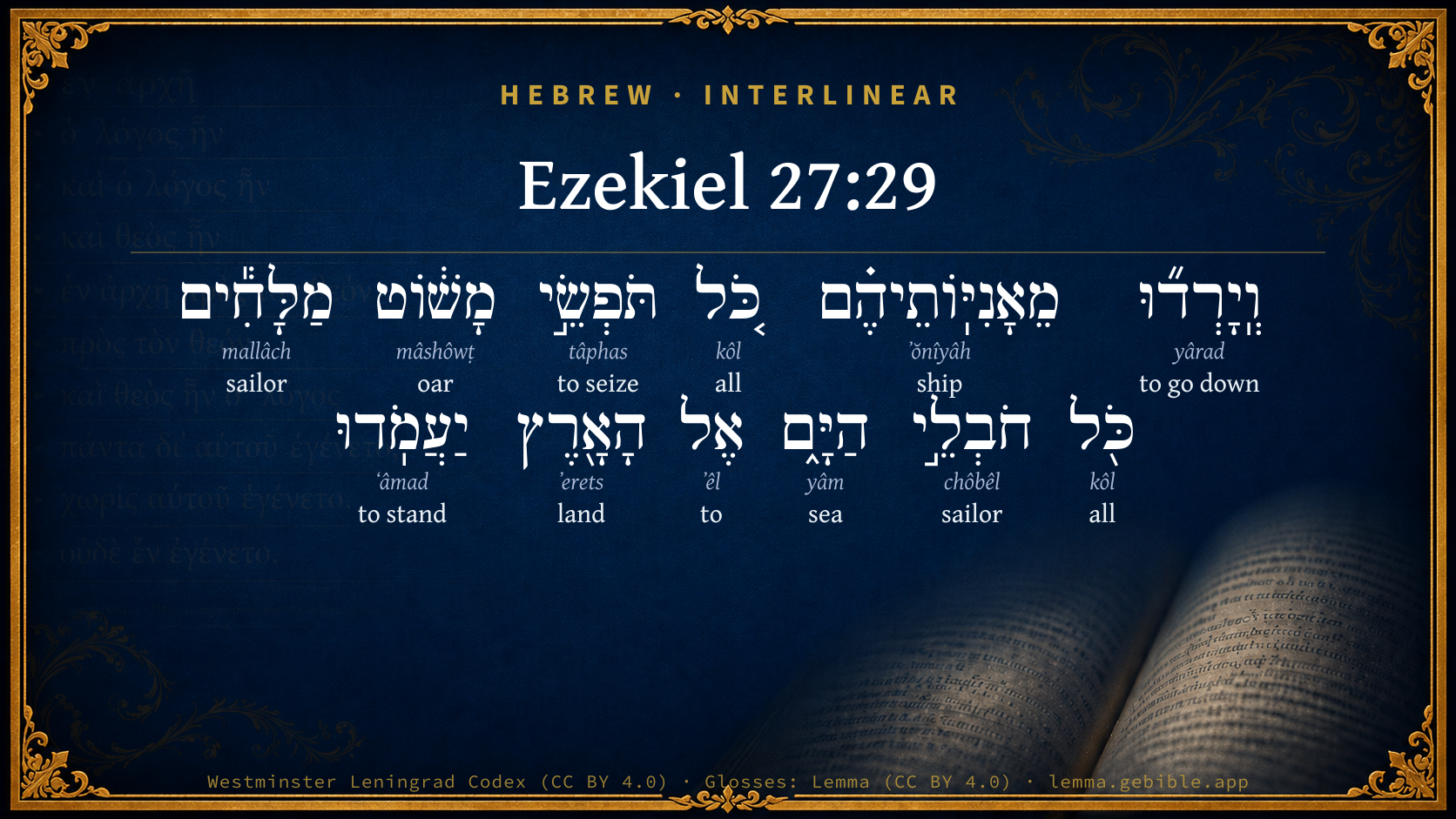
Ezekiel 27:29

Hebrew (Westminster Leningrad Codex) Ezekiel 27:29 appears in the Hebrew Old Testament. The text above is from the Westminster Leningrad Codex. Each word links to its Strong’s number, a concise gloss, and parsing drawn from the Open Scriptures Hebrew Bible morphology. Click any word for its full Brown-Driver-Briggs (BDB) entry.
Download image
Cite this verse

Ezekiel 27:29 (World English Bible). Public Domain. Lemma interlinear Bible study tool, https://lemma.gebible.app/v/ezekiel/27/29.

Show BibTeX & RIS
BibTeX
RIS
English Translation
All who handled the oar, the mariners, [and] all the pilots of the sea, shall come down from their ships; they shall stand on the land,
World English Bible · Public Domain
Download a study sheet

One document with this verse’s original text, its word-by-word gloss line, the meaning frame, cross-references with their text, attributed commentary, and full source and license credits — printable, and it pastes into notes with its structure intact.

This verse Autodidact and up

Study sheet (.html) Plain text (.txt)

A passage Seminary Student

Up to 50 verses in one chapter. A passage sheet keeps up to 6 commentary sources and 12 cross-references per verse, in the order this page ranks them, and says so on the sheet whenever that leaves anything out. Ask for a single verse and you get the Autodidact verse sheet above.

Everything on this page stays free to read, with no account — the sheet is a download of what is already on screen, not access to it.

Want to remove ads? Support Godless Engineer
Compare translations 3

The same verse in 3 English versions, stacked beneath the original-language interlinear above. Click any original word for its lexicon entry.

Each is an independent rendering of the whole verse — the interlinear is not word-aligned to these translations.

Highlighted words mark where these versions differ — a whole-verse word diff, not a word-by-word alignment.

  • World English Bible Public Domain
    All who handled the oar, the mariners, [and] all the pilots of the sea, shall come down from their ships; they shall stand on the land,
  • King James Version Public Domain
    And all that handle the oar, the mariners, and all the pilots of the sea, shall come down from their ships, they shall stand upon the land;
  • unfoldingWord Literal Text CC BY-SA 4.0
    All those who handle oars will come down from their ships; mariners and all the pilots on the sea will stand on the land.

unfoldingWord Literal Text — © unfoldingWord, licensed CC BY-SA 4.0. Word-aligned USFM3 via Door43 (git.door43.org/unfoldingWord/en_ult).

Versions to compare (up to 4)

3 of 4 selected

Show all 18 translations

Every available English version of this verse, each an independent rendering of the whole verse.

  • World English Bible Public Domain
    All who handled the oar, the mariners, [and] all the pilots of the sea, shall come down from their ships; they shall stand on the land,
  • Berean Standard Bible Public Domain
    All who handle the oars will abandon their ships. The sailors and all the captains of the sea will stand on the shore.
  • Majority Standard Bible Public Domain
    All who handle the oars will abandon their ships. The sailors and all the captains of the sea will stand on the shore.
  • King James Version Public Domain
    And all that handle the oar, the mariners, and all the pilots of the sea, shall come down from their ships, they shall stand upon the land;
  • American Standard Version (1901) Public Domain
    And all that handled the oar, the mariners, `and' all the pilots of the sea, shall come down from their ships; they shall stand upon the land,
  • Revised Version (1885) Public Domain
    And all that handle the oar, the mariners, and all the pilots of the sea, shall come down from their ships, they shall stand upon the land,
  • Geneva Bible (1599) Public Domain
    And all that handle the ore, the mariners and al the pilots of the sea shall come downe from their shippes, and shall stand vpon the land,
  • Douay-Rheims (1899) Public Domain
    And all that handled the oar shall come down from their ships: the mariners, and all the pilots of the sea shall stand upon the land:
  • Young's Literal Translation Public Domain
    And come down from their ships have all handling an oar, Mariners, all the pilots of the sea, on the land they stand,
  • Literal Standard Version CC BY-SA 4.0
    And all handling an oar come down from their ships, || Mariners [and] all the pilots of the sea stand on the land,
  • Unlocked Literal Bible CC BY-SA 4.0
    All those who handle oars will come down from their ships; mariners and all the pilots on the sea will stand on the land.
  • unfoldingWord Literal Text CC BY-SA 4.0
    All those who handle oars will come down from their ships; mariners and all the pilots on the sea will stand on the land.
  • Darby Bible Public Domain
    And all that handle the oar, the mariners, all the pilots of the sea, shall come down from their ships; they shall stand upon the land,
  • World Messianic Bible Public Domain
    All who handle the oars, the mariners and all the pilots of the sea, will come down from their ships. They will stand on the land,
  • Webster's Bible Public Domain
    And all that handle the oar, the mariners, and all the pilots of the sea, shall come down from their ships, they shall stand upon the land;
  • Free Bible Version CC BY-SA 4.0
    All the rowers abandon their ships. The sailors and all the ships' officers stand on the shore.
  • Bible in Basic English Public Domain
    And all the boatmen, the seamen and those who are expert at guiding a ship through the sea, will come down from their ships and take their places on the land;
  • JPS Tanakh (1917) Public Domain
    And all that handle the oar, the mariners, and all the pilots of the sea, shall come down from their ships, they shall stand upon the land,

Literal Standard Version (2020), Covenant Press — licensed CC BY-SA 4.0. Text via the HelloAO Bible API (eBible.org). Unlocked Literal Bible (unfoldingWord) — licensed CC BY-SA 4.0. Text via the HelloAO Bible API (eBible.org). unfoldingWord Literal Text — © unfoldingWord, licensed CC BY-SA 4.0. Word-aligned USFM3 via Door43 (git.door43.org/unfoldingWord/en_ult). Free Bible Version, Dr. Jonathan Gallagher — licensed CC BY-SA 4.0. Text via the HelloAO Bible API (eBible.org).

Word by word

More ways to search: Search by grammar → Find every occurrence → Compare this word →

Practice this passage: Drill this verse → Learn its vocabulary →

מָשׁ֔וֹט
mâshôwṭ
H4880
“oar”
Noun, Common, Masculine, Singular, Absolute
Part of Speech
Noun
Type
Common
Gender
Masculine
Number
Singular
State
Absolute
Full BDB Definition

Origin: from H7751

TWOT: 2344e

oar
  1. וְֽיָרְד֞וּ yârad H3381 “and · to go down” Conjunction + Verb, Qal, Sequential Perfect, 3rd Person, Common, Plural
  2. מֵאָנִיּֽוֹתֵיהֶ֗ם ʼŏnîyâh H591 “from · ships · their” Preposition + Noun, Common, Feminine, Plural, Construct + Suffix, Personal, 3rd Person, Masculine, Plural
  3. כֹּ֚ל kôl H3605 “all of” Noun, Common, Masculine, Singular, Construct
  4. תֹּפְשֵׂ֣י tâphas H8610 “seizing” Verb, Qal, Participle Active, Masculine, Plural, Construct
  5. מַלָּחִ֕ים mallâch H4419 “sailors” Noun, Common, Masculine, Plural, Absolute
  6. כֹּ֖ל kôl H3605 “all of” Noun, Common, Masculine, Singular, Construct
  7. חֹבְלֵ֣י chôbêl H2259 “sailors of” Noun, Common, Masculine, Plural, Construct
  8. הַיָּ֑ם yâm H3220 “the · sea” Particle, Definite Article + Noun, Common, Masculine, Singular, Absolute
  9. אֶל ʼêl H413 “to” Preposition
  10. הָאָ֖רֶץ ʼerets H776 “the · land” Particle, Definite Article + Noun, Common, Both, Singular, Absolute
  11. יַעֲמֹֽדוּ ʻâmad H5975 “to stand” Verb, Qal, Imperfect, 3rd Person, Masculine, Plural

About this verse

These counts appear in no published source. They are computed here, from the morphology-tagged text and Lemma’s own curated glosses. What Lemma adds →

12
words
11
distinct lemmas
Prophets
section

Notable vocabulary

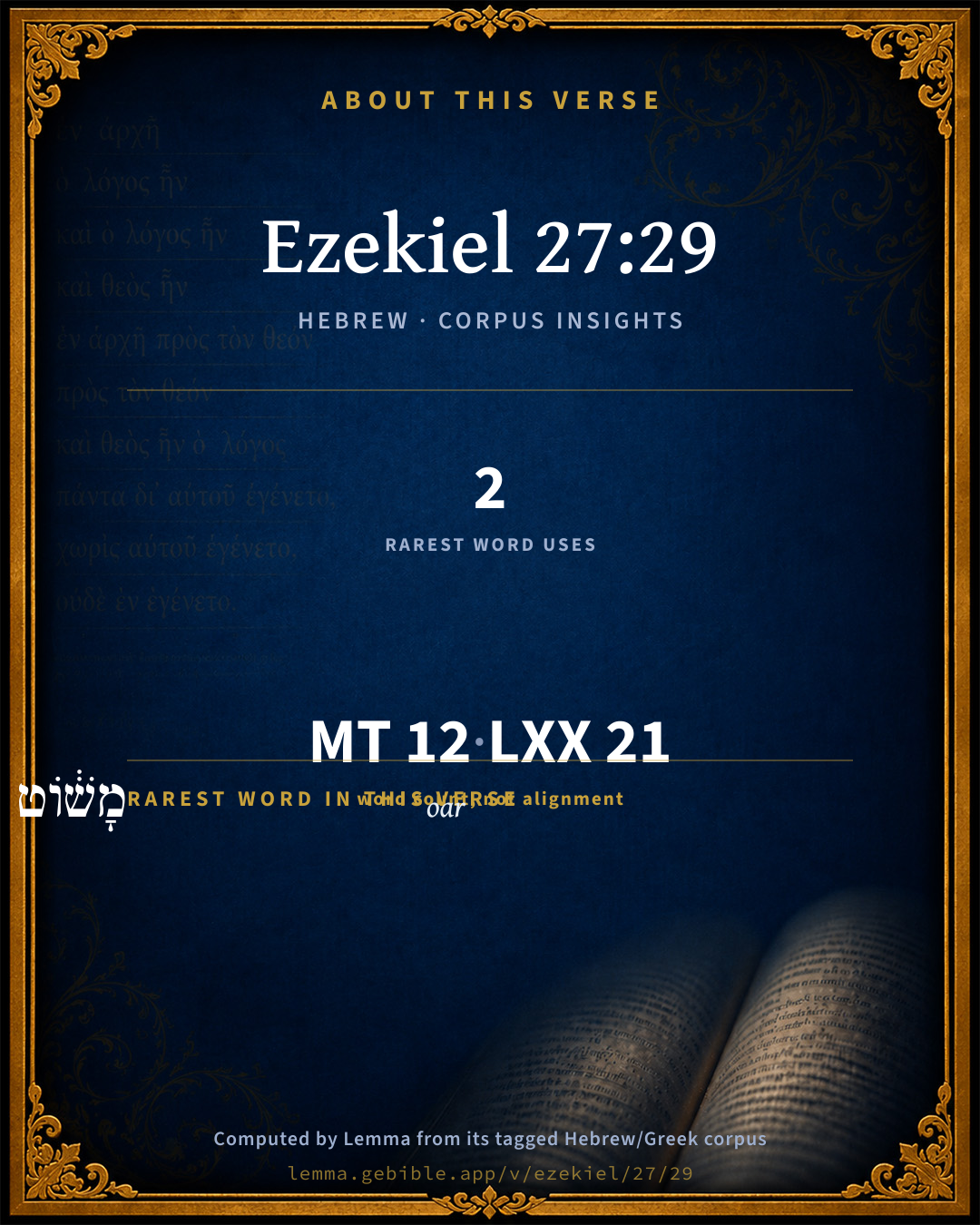
The rarest word here is מָשׁ֔וֹט oar H4880 — appearing just 2 times in the whole Hebrew Bible.

Shared distinctive vocabulary

מָשׁ֔וֹט oar H4880 occurs in 2 verses of the Hebrew Bible. Also found in:

Grammatical profile

  • 3 verbs
  • 8 nouns
  • 1 preposition

Verb forms

  • וְֽיָרְד֞וּ Qal · Sequential Perfect
  • תֹּפְשֵׂ֣י Qal · Participle Active
  • יַעֲמֹֽדוּ Qal · Imperfect

Repetition

A word recurs within this verse — often emphatic in Hebrew:

  • כֹּ֚ל all H3605 ×2

Hebrew & Septuagint length

In English translation the verse runs 26 words from the Hebrew and 24 from the Septuagint (LXX English) — closely comparable.

A rough comparison of the two English renderings, which tokenize alike — not a word-level alignment.

Word counts can differ between the Hebrew and the Greek without any difference in meaning — e.g. the Hebrew direct-object marker אֵת has no separate Greek word, and Greek often adds the article ὁ.

In the original languages it is 12 Hebrew tokens and 21 Greek tokens — but the two are counted differently (Hebrew bundles its prefixes and suffixes into one token; the Greek is in lemma form), so that isn’t a like-for-like length.

Cross-references

3

Topical passages linked to Ezekiel 27:29 in the Treasury of Scripture Knowledge — connected by theme and wording, ordered by reader-vote popularity; previews shown in the World English Bible.

  • Ezekiel 26:16 Then all the princes of the sea shall come down from their thrones, and lay aside their robes, and strip off their embroidered garments: they shall clothe themselves with trembling; they shall sit on the ground, and shall tremble every moment, and be astonished at you.
  • Ezekiel 32:10 Yes, I will make many peoples amazed at you, and their kings shall be horribly afraid for you, when I shall brandish my sword before them; and they shall tremble at every moment, every man for his own life, in the day of your fall.
  • Revelation 18:17–24 For in an hour such great riches are made desolate.' Every shipmaster, and everyone who sails anywhere, and mariners, and as many as gain their living by sea, stood far away,

Cross-references courtesy of OpenBible.info (CC BY 4.0).

Hebrew and Greek witnesses Masoretic Hebrew ↔ Greek Septuagint

The same verse in the two great witnesses to the Old Testament, shown verse-for-verse.

These are two independent witnesses, not word-aligned to each other, and the Septuagint is shown in lemma (dictionary) form.

Hebrew Ezekiel 27:29 Masoretic · Westminster Leningrad Codex

וְֽיָרְד֞וּ מֵאָנִיּֽוֹתֵיהֶ֗ם כֹּ֚ל תֹּפְשֵׂ֣י מָשׁ֔וֹט מַלָּחִ֕ים כֹּ֖ל חֹבְלֵ֣י הַיָּ֑ם אֶל הָאָ֖רֶץ יַעֲמֹֽדוּ

All who handled the oar, the mariners, [and] all the pilots of the sea, shall come down from their ships; they shall stand on the land,

World English Bible · Public Domain

Greek LXX Ezekiel 27:29 Septuagint · lemma form

καί καταβαίνω ἀπό ὁ πλοῖον πᾶς ὁ κωπηλάτης σύ καί ὁ ἐπιβάτης καί ὁ πρωρεύς ὁ θάλασσα ἐπί ὁ γῆ ἵστημι

And all the rowers and the mariners shall come down from the ships, and the pilots of the sea shall stand on the land.

LXX2012 (modern English Septuagint) · Public Domain

Hebrew: Westminster Leningrad Codex (CC BY 4.0). Greek: Septuagint (public domain); English from LXX2012 (modern English Septuagint) (Public Domain). How the Septuagint differs from the Hebrew →

Targum (Aramaic paraphrase)

1

The Targum is the ancient Jewish Aramaic paraphrase of the Hebrew Scriptures — an interpretive translation, not the Hebrew text itself. Onkelos (literal) and Pseudo-Jonathan (expansive) render the Torah, and Jonathan the Prophets. Coverage is partial: where no permissively-licensed English translation exists for a verse, only the Aramaic is shown. This is verse-level text, not a word-by-word alignment to the Hebrew.

  1. Targum Jonathan Prophets (Joshua–Malachi)
    וְיִחֲתוּן מִסְפִינֵיהוֹן כָּל אָחֲדֵי מָשׁוֹט סַפָנִין כָּל פַּרְנָסֵי יַמָא עַל אַרְעָא יְקוּמוּן:

    (no public-domain English translation for this verse)

    Targum Jonathan — Aramaic: “Mikraot Gedolot” (public domain). English: “Sefaria Community Translation” (CC0 1.0 (public-domain dedication)); “London "Chaldee Paraphrase," 1871” (public domain). Text via Sefaria.

Commentary

Notes on Ezekiel 27:29 from classic Christian and Jewish commentators (each source and its license shown beneath its notes). The classic Christian expositions comment on the surrounding passage and are grouped to its opening verse, so a note may address several verses; the Jewish commentaries on the Tanakh (Rashi and others) are per-verse, so they appear only where the commentator wrote on this verse.

Lemma curates 59 commentaries, every one of them public domain or Creative Commons licensed, each selected and text-cleaned for this edition rather than reprinted as found. About our sources →

Trapp's Complete Commentary

John Trapp

Eze 27:29 And all that handle the oar, the mariners, [and] all the pilots of the sea, shall come down from their ships, they shall stand upon the land;

Ver. 29. And all that handle the oar.] That have escaped to land with their lives.

John Trapp, A Commentary or Exposition upon All the Books of the Old and New Testament (1647–1656) — public domain. Text from a community e-Sword module.

Jamieson, Fausset & Brown

Robert Jamieson, A. R. Fausset & David Brown

So on the downfall of spiritual Babylon (Rev 18:17, &c.).

shall stand upon . . . land--being cast out of their ships in which heretofore they prided themselves.

Jamieson, Fausset & Brown — Commentary Critical and Explanatory on the Whole Bible (1871) — public domain (CC PDM 1.0). Text via the HelloAO Bible API.

Ellicott's Commentary for English Readers

(29) Shall come down from their ships.—The colonies and dependencies of Tyre are, in keeping with the figure, the smaller craft which escape to the shore, and there lament the fall of their mistress.

A Bible Commentary for English Readers, edited by Charles John Ellicott (1878–1897) — public domain. Text from a community e-Sword module.

The Cambridge Bible for Schools and Colleges

gen. ed. J. J. S. Perowne

29. All seafaring men raise a lamentation over the shipwreck of the gallant vessel.

The Cambridge Bible for Schools and Colleges (gen. ed. J. J. S. Perowne; Cambridge University Press, 1878–1918) — public domain. Text from a community e-Sword module.

John Gill's Exposition

And shall cause their voice to be heard against thee,.... The rulers and governors of the city, for having taken a false step in provoking the enemy, and then holding out the siege no longer, as it was thought they might and would: or rather "over thee", or, "for thee" (h); mourning over the city, and lamenting its sad case; see Rev 18:9,

and shall cry bitterly; with great weeping, howling, and shrieking:

and they shall cast dust upon their heads; a custom used in the eastern countries, in time of mourning and sorrow; see Rev 18:19,

and they shall wallow themselves in ashes: or roll themselves in them, another custom used in mourning; see Jer 6:26.

(h) "de te", Junius & Tremellius, Polanus, "super te"; Piscator, Cocceius, Starckius.

John Gill's Exposition of the Whole Bible (1746–1763) — public domain (CC PDM 1.0). Text via the HelloAO Bible API.

Albert Barnes' Notes on the Bible

As Tyre is figured by a large vessel, so are the subject-states by smaller boats which accompany the great ship. These terrified by the storm approach the land. Tyre is hopelessly swallowed up, crew and all, in the midst of the sea. The small crafts escape to shore.

Albert Barnes' Notes on the Bible (1834–1885) — public domain. Text from a community e-Sword/MySword module.

Matthew Poole's English Annotations

In the allegory of a miserable shipwreck, the prophet sets forth Tyre’s fall, and in this verse he represents them all shifting out of the shattered sinking ship, in great confusion, and greater fear; the slaves quit the oars, the mariners throw up the tacklings, pilots leave the helm, all make for the long boat and the land, where they bewail their undone condition. Or it may be more literally understood thus; All sea-faring men, who got their living by service done for Tyre at sea, seeing her utterly broken, shall leave the ships, get to land, that elsewhere they may get employment, or by a timely flight save themselves, and bewail their old masters’ fall.

Matthew Poole's English Annotations on the Holy Bible (1683–1685) — public domain. Text from a community e-Sword/MySword module.

Whedon's Commentary on the Bible

Daniel D. Whedon

29-31. All those who have charge of other ships (nations) shall “hiss” in dismay (Davidson, compare 1Ki_9:8) and lament over (not “against”) her, regretting their loss of trade, and perhaps fearing for themselves a like destruction. For the signs of mourning see Eze_7:18; Jos_7:6; Job_2:12; Jer_6:26; Jer_25:34. Professor Morris Jastrow, Jr., has shown that the custom of putting earth or dust upon the head is a very ancient custom among the Semites and is the survival of an act which originally formed part of the burial rites. He reproduces one of the oldest monuments of Babylon in which the corpses of the enemy are seen lying exposed to the vultures, the greatest misfortune that could befall a dead person (compare Appendix, chap. 32), while the dead soldiers of the victorious army are arranged in symmetrical rows beneath a funeral mound of earth. Those who were building the mound (the mourning comrades or relatives) had thrown off all their clothing, excepting a loin girdle of sackcloth, and carried upon their heads their baskets of earth. This custom led in after ages to the tearing or tearing off the garments of the mourners and the placing dust or earth upon their heads. The ashes so often mentioned were probably from the funeral expiatory sacrifice (Journal of the American Oriental Society, vol. 20:1899).

Daniel D. Whedon (gen. ed.), Commentary on the Old and New Testaments (1874–1909) — public domain. Text from a community e-Sword module.

The Pulpit Commentary

Vers. 29-31. And all that handle the oar, etc. The picture is, perhaps, figurative. As Tyre itself was the great state-ship, so the other ships may stand for the other Phoenician cities that beheld her downfall. Looking to the picture itself, it presents the rowers and others as feeling that, if the great ship had been wrecked, there was little hope of safety for them, and so they leave their ships and stand on the coast wailing. (For casting dust, as a sign of mourning, see Jos_7:6; 1Sa_4:12; Job_2:12, et al.; for "wallowing in the dust," Jer_6:26 Jer_25:34; Mic_1:10-16. For the "baldness" and "sackcloth" of Ver. 31, see Eze_7:18)

The Pulpit Commentary (1880–1919), ed. H.D.M. Spence-Jones & Joseph S. Exell — public domain. Text from a community e-Sword module.

John Wesley's Explanatory Notes

Shall come down - ln the allegory of a miserable shipwreck, the prophet sets forth the fall of Tyre; and in this verse he represents them all shifting out of the sinking ship, in great confusion.

John Wesley, Explanatory Notes Upon the Whole Bible (1754–1765) — public domain. Text via the GEBible commentary corpus.

Rashi

Rabbi Shlomo Yitzchaki (Rashi)

they will stand upon the land What use have we anymore with ships? Where shall we take our wares from now on?

Rashi on the Tanakh — English translations: “The Judaica Press complete Tanach with Rashi, translated by A. J. Rosenberg” (CC BY 4.0); “Pentateuch with Rashi's commentary by M. Rosenbaum and A.M. Silbermann, 1929-1934” (public domain); “The Metsudah Tanach series, Lakewood, N.J” (CC BY 4.0); and “The Book of Joshua, Metsudah Publications, 1997” (CC BY 4.0). Text via Sefaria.

Lesson kit

Teaching starters — assembled from the data on this page, not authored interpretation. Every prompt links to the verse data it draws on. Edit before teaching.

Ezekiel, in the Prophets, opens this verse with 12 words (11 distinct Hebrew lemmas). Its most distinctive word is mâshôwṭ (“oar”). A historical commentator’s framing appears above. Read the whole chapter for the surrounding context.

Discussion questions

  1. How does “oar” (mâshôwṭ) shape what this verse is saying?
  2. How does Ezekiel 27:6, which shares the word «oar», read alongside this verse?
  3. What does the repetition of “all” (2× in this one verse) do in this verse?
  4. These translations render this verse differently; the difference is in the English rendering, not the original. What questions does that raise?
  5. «וְֽיָרְד֞וּ» is a Qal Sequential Perfect verb. How does that grammatical form shape the action described?
  6. Compare how Trapp's Complete Commentary and Jamieson, Fausset & Brown read this verse. Where do they agree or differ?

Things to notice

Reading settings

Reading text

Shown beneath each verse's original-language words.

Old Testament
Old Testament edition

Read the OT as the Masoretic Hebrew (MT) or the Greek Septuagint (LXX).

English shown for the Greek Septuagint (in the Hebrew ↔ Greek comparison).

Comparing translations? Open the Compare panel on any verse page to stack up to four side by side.