Jeremiah 52:9

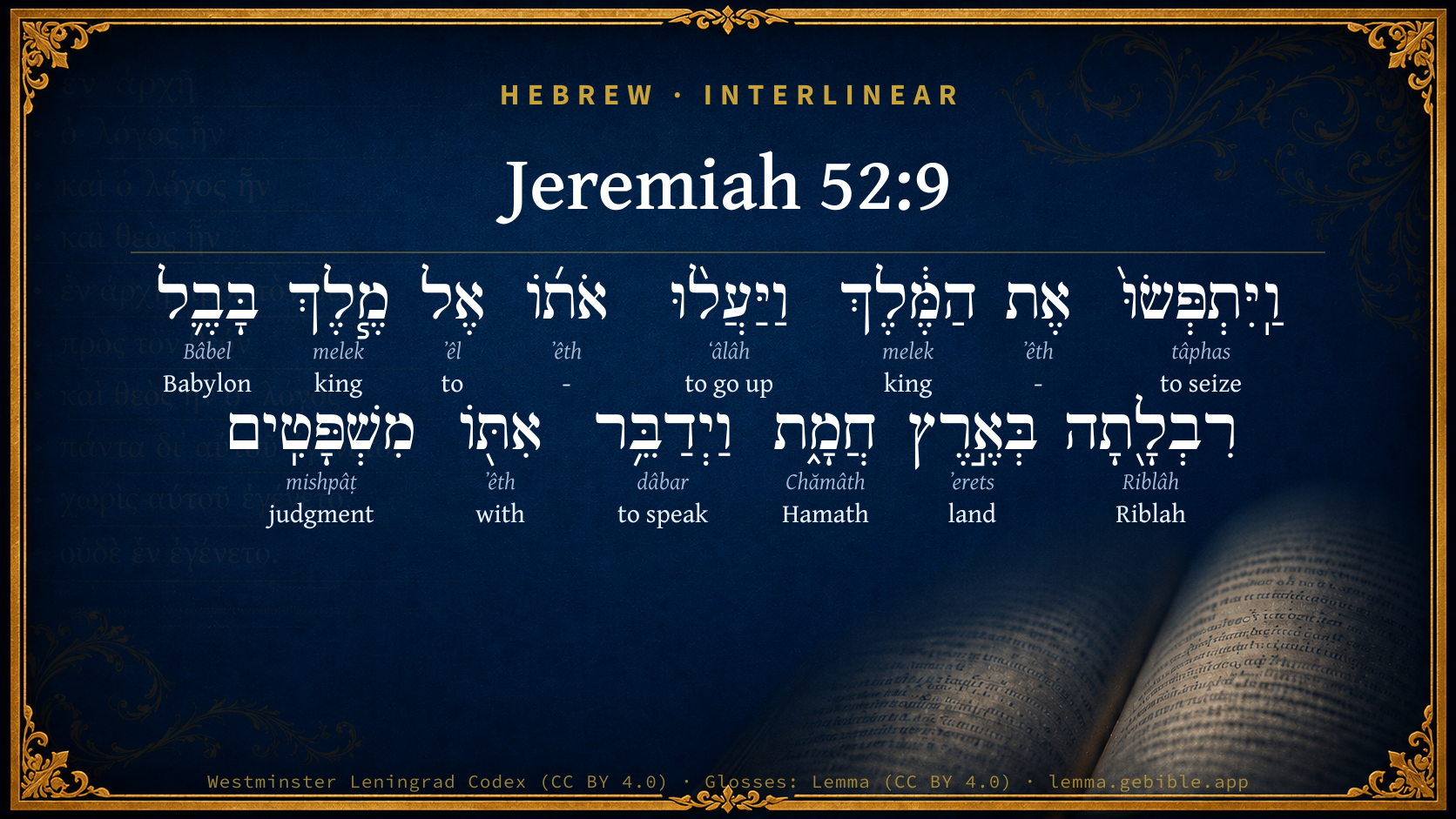
Hebrew (Westminster Leningrad Codex) Jeremiah 52:9 appears in the Hebrew Old Testament. The text above is from the Westminster Leningrad Codex. Each word links to its Strong’s number, a concise gloss, and parsing drawn from the Open Scriptures Hebrew Bible morphology. Click any word for its full Brown-Driver-Briggs (BDB) entry.
Download image
Cite this verse

Jeremiah 52:9 (World English Bible). Public Domain. Lemma interlinear Bible study tool, https://lemma.gebible.app/v/jeremiah/52/9.

Show BibTeX & RIS
BibTeX
RIS
English Translation
Then they took the king, and carried him up to the king of Babylon to Riblah in the land of Hamath; and he gave judgment on him.
World English Bible · Public Domain
Download a study sheet

One document with this verse’s original text, its word-by-word gloss line, the meaning frame, cross-references with their text, attributed commentary, and full source and license credits — printable, and it pastes into notes with its structure intact.

This verse Autodidact and up

Study sheet (.html) Plain text (.txt)

A passage Seminary Student

Up to 50 verses in one chapter. A passage sheet keeps up to 6 commentary sources and 12 cross-references per verse, in the order this page ranks them, and says so on the sheet whenever that leaves anything out. Ask for a single verse and you get the Autodidact verse sheet above.

Everything on this page stays free to read, with no account — the sheet is a download of what is already on screen, not access to it.

Want to remove ads? Support Godless Engineer
Compare translations 3

The same verse in 3 English versions, stacked beneath the original-language interlinear above. Click any original word for its lexicon entry.

Each is an independent rendering of the whole verse — the interlinear is not word-aligned to these translations.

Highlighted words mark where these versions differ — a whole-verse word diff, not a word-by-word alignment.

  • World English Bible Public Domain
    Then they took the king, and carried him up to the king of Babylon to Riblah in the land of Hamath; and he gave judgment on him.
  • King James Version Public Domain
    Then they took the king, and carried him up unto the king of Babylon to Riblah in the land of Hamath; where he gave judgment upon him.
  • unfoldingWord Literal Text CC BY-SA 4.0
    They captured the king and brought him up to the king of Babylon at Riblah in the land of Hamath, where he passed sentence on him.

unfoldingWord Literal Text — © unfoldingWord, licensed CC BY-SA 4.0. Word-aligned USFM3 via Door43 (git.door43.org/unfoldingWord/en_ult).

Versions to compare (up to 4)

3 of 4 selected

Show all 18 translations

Every available English version of this verse, each an independent rendering of the whole verse.

  • World English Bible Public Domain
    Then they took the king, and carried him up to the king of Babylon to Riblah in the land of Hamath; and he gave judgment on him.
  • Berean Standard Bible Public Domain
    The Chaldeans seized the king and brought him up to the king of Babylon at Riblah in the land of Hamath, where he pronounced judgment on Zedekiah.
  • Majority Standard Bible Public Domain
    The Chaldeans seized the king and brought him up to the king of Babylon at Riblah in the land of Hamath, where he pronounced judgment on Zedekiah.
  • King James Version Public Domain
    Then they took the king, and carried him up unto the king of Babylon to Riblah in the land of Hamath; where he gave judgment upon him.
  • American Standard Version (1901) Public Domain
    Then they took the king, and carried him up unto the king of Babylon to Riblah in the land of Hamath; and he gave judgment upon him.
  • Revised Version (1885) Public Domain
    Then they took the king, and carried him up unto the king of Babylon to Riblah in the land of Hamath; and he gave judgment upon him.
  • Geneva Bible (1599) Public Domain
    Then they tooke the king and caryed him vp vnto the king of Babel to Riblah in the lande of Hamath, where he gaue iudgement vpon him.
  • Douay-Rheims (1899) Public Domain
    And when they had taken the king, they carried him to the king of Babylon to Reblatha, which is in the land of Emath: and he gave judgment upon him.
  • Young's Literal Translation Public Domain
    and they capture the king, and bring him up unto the king of Babylon to Riblah, in the land of Hamath, and he speaketh with him -- judgments.
  • Literal Standard Version CC BY-SA 4.0
    and they capture the king, and bring him up to the king of Babylon at Riblah, in the land of Hamath, and he speaks with him—judgments.
  • Unlocked Literal Bible CC BY-SA 4.0
    They captured the king and brought him up to the king of Babylon at Riblah in the land of Hamath, where he passed sentence on him.
  • unfoldingWord Literal Text CC BY-SA 4.0
    They captured the king and brought him up to the king of Babylon at Riblah in the land of Hamath, where he passed sentence on him.
  • Darby Bible Public Domain
    And they took the king, and brought him up to the king of Babylon, unto Riblah in the land of Hamath, and he pronounced judgment upon him.
  • World Messianic Bible Public Domain
    Then they took the king, and carried him up to the king of Babylon to Riblah in the land of Hamath; and he pronounced judgment on him.
  • Webster's Bible Public Domain
    Then they took the king, and carried him to the king of Babylon to Riblah in the land of Hamath; where he gave judgment upon him.
  • Free Bible Version CC BY-SA 4.0
    They captured the king and took him to the king of Babylon at Riblah, where he sentenced him.
  • Bible in Basic English Public Domain
    Then they made the king a prisoner and took him up to the king of Babylon to Riblah in the land of Hamath to be judged.
  • JPS Tanakh (1917) Public Domain
    Then they took the king, and carried him up unto the king of Babylon to Riblah in the land of Hamath; and he gave judgment upon him.

Literal Standard Version (2020), Covenant Press — licensed CC BY-SA 4.0. Text via the HelloAO Bible API (eBible.org). Unlocked Literal Bible (unfoldingWord) — licensed CC BY-SA 4.0. Text via the HelloAO Bible API (eBible.org). unfoldingWord Literal Text — © unfoldingWord, licensed CC BY-SA 4.0. Word-aligned USFM3 via Door43 (git.door43.org/unfoldingWord/en_ult). Free Bible Version, Dr. Jonathan Gallagher — licensed CC BY-SA 4.0. Text via the HelloAO Bible API (eBible.org).

Word by word

More ways to search: Search by grammar → Find every occurrence → Compare this word →

Practice this passage: Drill this verse → Learn its vocabulary →

רִבְלָ֖תָה
Riblâh
H7247
“Riblah · toward”
Noun, Proper + Suffix, Demonstrative
Part of Speech
Noun
Type
Proper
Full BDB Definition

Origin: from an unused root meaning to be fruitful

TWOT: None

Riblah = "fertility" - a place on the eastern boundary of Israel - a town in the land of Hamath on the great road between Babylon and Palestine
  1. וַֽיִּתְפְּשׂוּ֙ tâphas H8610 “and · to seize” Conjunction + Verb, Qal, Sequential Imperfect, 3rd Person, Masculine, Plural
  2. אֶת ʼêth H853 “-” Particle, Direct Object
  3. הַמֶּ֔לֶךְ melek H4428 “the · king” Particle, Definite Article + Noun, Common, Masculine, Singular, Absolute
  4. וַיַּעֲל֨וּ ʻâlâh H5927 “and · to go up” Conjunction + Verb, Hiphil, Sequential Imperfect, 3rd Person, Masculine, Plural
  5. אֹת֜וֹ ʼêth H853 “- · him” Particle, Direct Object + Suffix, Personal, 3rd Person, Masculine, Singular
  6. אֶל ʼêl H413 “to” Preposition
  7. מֶ֧לֶךְ melek H4428 “king of” Noun, Common, Masculine, Singular, Construct
  8. בָּבֶ֛ל Bâbel H894 “Babylon” Noun, Proper
  9. בְּאֶ֣רֶץ ʼerets H776 “in/at · land of” Preposition + Noun, Common, Both, Singular, Construct
  10. חֲמָ֑ת Chămâth H2574 “Hamath” Noun, Proper
  11. וַיְדַבֵּ֥ר dâbar H1696 “and · to speak” Conjunction + Verb, Piel, Sequential Imperfect, 3rd Person, Masculine, Singular
  12. אִתּ֖וֹ ʼêth H854 “with · him” Preposition + Suffix, Personal, 3rd Person, Masculine, Singular
  13. מִשְׁפָּטִֽים mishpâṭ H4941 “judgments” Noun, Common, Masculine, Plural, Absolute

About this verse

These counts appear in no published source. They are computed here, from the morphology-tagged text and Lemma’s own curated glosses. What Lemma adds →

14
words
12
distinct lemmas
Prophets
section

Notable vocabulary

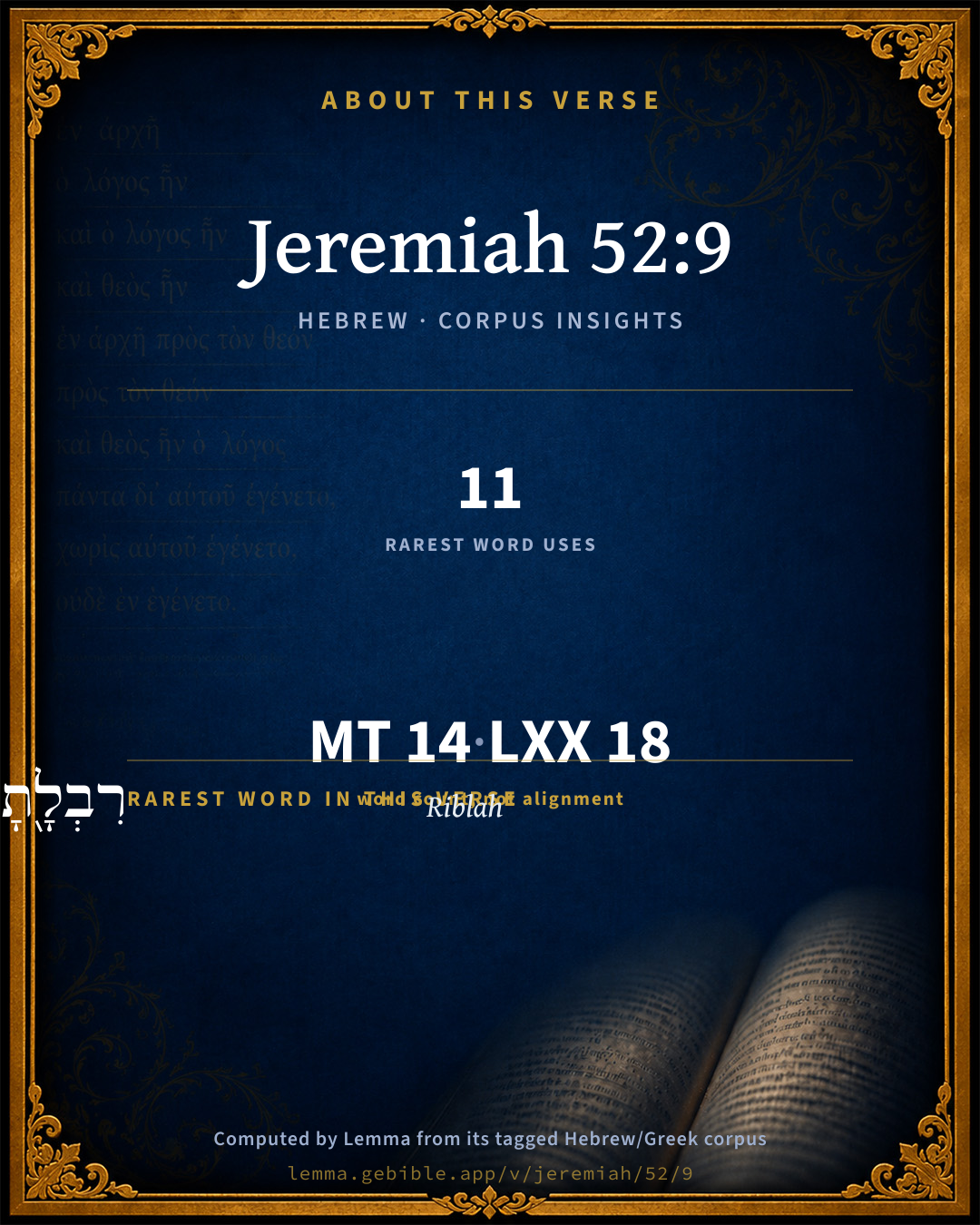
The rarest word here is רִבְלָ֖תָה Riblah H7247 — appearing just 11 times in the whole Hebrew Bible.

Shared distinctive vocabulary

רִבְלָ֖תָה Riblah H7247 occurs in 11 verses of the Hebrew Bible. Also found in:

Grammatical profile

  • 3 verbs
  • 7 nouns
  • 2 prepositions
  • 2 particles

Verb forms

  • וַֽיִּתְפְּשׂוּ֙ Qal · Sequential Imperfect
  • וַיַּעֲל֨וּ Hiphil · Sequential Imperfect
  • וַיְדַבֵּ֥ר Piel · Sequential Imperfect

Repetition

A word recurs within this verse — often emphatic in Hebrew:

  • הַמֶּ֔לֶךְ king H4428 ×2

Hebrew & Septuagint length

In the original languages it is 14 Hebrew tokens and 18 Greek tokens — but the two are counted differently (Hebrew bundles its prefixes and suffixes into one token; the Greek is in lemma form), so that isn’t a like-for-like length.

Cross-references

11

Topical passages linked to Jeremiah 52:9 in the Treasury of Scripture Knowledge — connected by theme and wording, ordered by reader-vote popularity; previews shown in the World English Bible.

  • Numbers 13:21 So they went up, and spied out the land from the wilderness of Zin to Rehob, to the entrance of Hamath.
  • Jeremiah 39:5 But the army of the Chaldeans pursued after them, and overtook Zedekiah in the plains of Jericho: and when they had taken him, they brought him up to Nebuchadrezzar king of Babylon to Riblah in the land of Hamath; and he gave judgment on him.
  • Joshua 13:5 and the land of the Gebalites, and all Lebanon, toward the sunrise, from Baal Gad under Mount Hermon to the entrance of Hamath;
  • 2 Kings 25:6 Then they took the king, and carried him up to the king of Babylon to Riblah; and they gave judgment on him.
  • Numbers 34:11 and the border shall go down from Shepham to Riblah, on the east side of Ain; and the border shall go down, and shall reach to the side of the sea of Chinnereth eastward;
  • 1 Kings 8:65 So Solomon held the feast at that time, and all Israel with him, a great assembly, from the entrance of Hamath to the brook of Egypt, before Yahweh our God, seven days and seven days, even fourteen days.
  • 2 Kings 23:33 Pharaoh Necoh put him in bonds at Riblah in the land of Hamath, that he might not reign in Jerusalem; and put the land to a tribute of one hundred talents of silver, and a talent of gold.
  • 2 Chronicles 8:3 Solomon went to Hamath-zobah, and prevailed against it.
  • 2 Chronicles 33:11 Therefore Yahweh brought on them the captains of the host of the king of Assyria, who took Manasseh in chains, and bound him with fetters, and carried him to Babylon.
  • Jeremiah 32:4–5 and Zedekiah king of Judah shall not escape out of the hand of the Chaldeans, but shall surely be delivered into the hand of the king of Babylon, and shall speak with him mouth to mouth, and his eyes shall see his eyes;
  • Ezekiel 21:25–27 You, deadly wounded wicked one, the prince of Israel, whose day is come, in the time of the iniquity of the end,

Cross-references courtesy of OpenBible.info (CC BY 4.0).

Hebrew and Greek witnesses Masoretic Hebrew ↔ Greek Septuagint

The same verse in the two great witnesses to the Old Testament, shown verse-for-verse.

These are two independent witnesses, not word-aligned to each other, and the Septuagint is shown in lemma (dictionary) form.

Hebrew Jeremiah 52:9 Masoretic · Westminster Leningrad Codex

וַֽיִּתְפְּשׂוּ֙ אֶת הַמֶּ֔לֶךְ וַיַּעֲל֨וּ אֹת֜וֹ אֶל מֶ֧לֶךְ בָּבֶ֛ל רִבְלָ֖תָה בְּאֶ֣רֶץ חֲמָ֑ת וַיְדַבֵּ֥ר אִתּ֖וֹ מִשְׁפָּטִֽים

Then they took the king, and carried him up to the king of Babylon to Riblah in the land of Hamath; and he gave judgment on him.

World English Bible · Public Domain

Greek LXX Structure differs

In the Septuagint, Jeremiah is about an eighth shorter than the Hebrew and arranges its material differently — the Oracles Against the Nations (Hebrew chapters 46–51) appear in the middle of the Greek book, after 25:13. Because the chapter and verse boundaries do not line up, a verse-for-verse comparison with the Hebrew is not shown.

A verse-for-verse comparison isn’t shown here because the chapters and verses don’t line up. Switch to the LXX edition with the MT / LXX toggle above to read the Greek directly.

Hebrew: Westminster Leningrad Codex (CC BY 4.0). Greek: Septuagint (public domain); English from a public-domain English Septuagint. How the Septuagint differs from the Hebrew →

Targum (Aramaic paraphrase)

1

The Targum is the ancient Jewish Aramaic paraphrase of the Hebrew Scriptures — an interpretive translation, not the Hebrew text itself. Onkelos (literal) and Pseudo-Jonathan (expansive) render the Torah, and Jonathan the Prophets. Coverage is partial: where no permissively-licensed English translation exists for a verse, only the Aramaic is shown. This is verse-level text, not a word-by-word alignment to the Hebrew.

  1. Targum Jonathan Prophets (Joshua–Malachi)
    וַאֲחִידוּ יַת מַלְכָּא וְאַסִיקוּ יָתֵיהּ לְוַת מַלְכָּא דְבָבֶל לְדִבְלָת בְּאַרְעָא דַחֲמָת וּמַלֵיל עִמֵיהּ פִּתְגָמֵי דִינִין:

    (no public-domain English translation for this verse)

    Targum Jonathan — Aramaic: “Mikraot Gedolot” (public domain). English: “Sefaria Community Translation” (CC0 1.0 (public-domain dedication)); “London "Chaldee Paraphrase," 1871” (public domain). Text via Sefaria.

Commentary

Notes on Jeremiah 52:9 from classic Christian and Jewish commentators (each source and its license shown beneath its notes). The classic Christian expositions comment on the surrounding passage and are grouped to its opening verse, so a note may address several verses; the Jewish commentaries on the Tanakh (Rashi and others) are per-verse, so they appear only where the commentator wrote on this verse.

Lemma curates 59 commentaries, every one of them public domain or Creative Commons licensed, each selected and text-cleaned for this edition rather than reprinted as found. About our sources →

Tyndale Open Study Notes

Tyndale Open Resources

52:9 Riblah, which Jeremiah recorded as being in the land of Hamath (see 39:5), was several hundred miles north of Jerusalem.

Tyndale Open Study Notes — © Tyndale Open Resources, licensed CC BY-SA 4.0. Text via the HelloAO Bible API.

Geneva Bible (1599)

Geneva Bible translators

Read 2 Kings 25:6; Jer. 39:5.

Geneva Bible (1599) marginal notes — public domain. Text via Bolls.life.

Jamieson, Fausset & Brown

Robert Jamieson, A. R. Fausset & David Brown

gave judgment upon him--as guilty of rebellion and perjury (Jer 52:3; compare Eze 23:24).

Jamieson, Fausset & Brown — Commentary Critical and Explanatory on the Whole Bible (1871) — public domain (CC PDM 1.0). Text via the HelloAO Bible API.

Adam Clarke's Commentary

Verse 9. King of Babylon to Riblah] See Clarke on Jer 39:5.

Adam Clarke's Commentary on the Bible (1810–1826) — public domain. Text from a community e-Sword/MySword module.

Ellicott's Commentary for English Readers

(9) To Riblah in the land of Hamath.—The descriptive words are omitted in 2Ki_25:6. (See Note on Jer_39:5.)

He gave judgment upon him.—In 2Ki_25:6, they gave judgment. So in the next verse “the king of Babylon slew” takes the place of “they slew” in 2Ki_25:7.

A Bible Commentary for English Readers, edited by Charles John Ellicott (1878–1897) — public domain. Text from a community e-Sword module.

The Cambridge Bible for Schools and Colleges

gen. ed. J. J. S. Perowne

9. Riblah] See on Jer_39:5.

he gave judgement upon him] For mg. spake judgements with him see on Jer_1:16.

The Cambridge Bible for Schools and Colleges (gen. ed. J. J. S. Perowne; Cambridge University Press, 1878–1918) — public domain. Text from a community e-Sword module.

John Gill's Exposition

And the king of Babylon slew the sons of Zedekiah before his eyes,.... Or, however, ordered them to be slain; See Gill on Jer 39:6;

he slew also all the princes of Judah in Riblah; who, together with the king's sons, were taken with him; or, however, were taken in Jerusalem, and brought to Riblah; which of them is not certain, very probably the former.

John Gill's Exposition of the Whole Bible (1746–1763) — public domain (CC PDM 1.0). Text via the HelloAO Bible API.

Whedon's Commentary on the Bible

Daniel D. Whedon

9-11. Then they took the king — Zedekiah, king of Judah.

Put him in prison — Namely, in Babylon.

Till the day of his death — Yet it appears that toward the close of his life his confinement was less rigorous than when he was first taken to Babylon, and that an honourable interment was given him after his death. This is the purport of the promise made to him through Jeremiah while yet in Judea, as recorded in Jer_34:1-5.

Daniel D. Whedon (gen. ed.), Commentary on the Old and New Testaments (1874–1909) — public domain. Text from a community e-Sword module.

The Pulpit Commentary

Gave judgment. (see on Jer_1:16)

The Pulpit Commentary (1880–1919), ed. H.D.M. Spence-Jones & Joseph S. Exell — public domain. Text from a community e-Sword module.

unfoldingWord translationNotes

Door43 World Missions Community

at Riblah in the land of Hamath

Riblah was a town in the territory of Hamath. (See: How to Translate Names)

passed sentence on him

"decided how to punish him"

slaughtered Zedekiah's sons before his own eyes

The eyes are a synecdoche for the whole person. The reader should also understand that others probably helped the king of Babylon kill Zedekiah's sons. AT: "forced Zedekiah to watch as the king of Babylon slaughtered Zedekiah's sons" (See: Synecdoche)

he put out Zedekiah's eyes

"the king's men made Zedekiah blind." Use the common words for making a person blind. It is not clear that the king of Babylon took Zedekiah's eyes out of his head. The reader should also understand that others probably helped the king of Babylon make Zedekiah blind.

the day of his death

the day of Zedekiah's death

translationWords

Hamath

slaughter

bronze

prison

die

unfoldingWord translationNotes — © Distant Shores Media and the Door43 World Missions Community, licensed CC BY-SA 4.0. Source: git.door43.org/Door43/en_tn.

Lesson kit

Teaching starters — assembled from the data on this page, not authored interpretation. Every prompt links to the verse data it draws on. Edit before teaching.

Jeremiah, in the Prophets, opens this verse with 14 words (12 distinct Hebrew lemmas). Its most distinctive word is Riblâh (“Riblah”). A historical commentator’s framing appears above. Read the whole chapter for the surrounding context.

Discussion questions

  1. The word Riblâh carries the sense “Riblah.” How does it shape the verse?
  2. How does Numbers 34:11, which shares the word «Riblah», read alongside this verse?
  3. What does the repetition of “king” (2× in this one verse) do in this verse?
  4. The translations on this page render this verse differently — a whole-verse word diff, not a word-by-word alignment. What might account for the different wordings?
  5. «וַֽיִּתְפְּשׂוּ֙» is a Qal Sequential Imperfect verb. How does that grammatical form shape the action described?
  6. Compare how Tyndale Open Study Notes and Geneva Bible (1599) read this verse. Where do they agree or differ?

Things to notice

Reading settings

Reading text

Shown beneath each verse's original-language words.

Old Testament
Old Testament edition

Read the OT as the Masoretic Hebrew (MT) or the Greek Septuagint (LXX).

English shown for the Greek Septuagint (in the Hebrew ↔ Greek comparison).

Comparing translations? Open the Compare panel on any verse page to stack up to four side by side.