Ezekiel 14:5

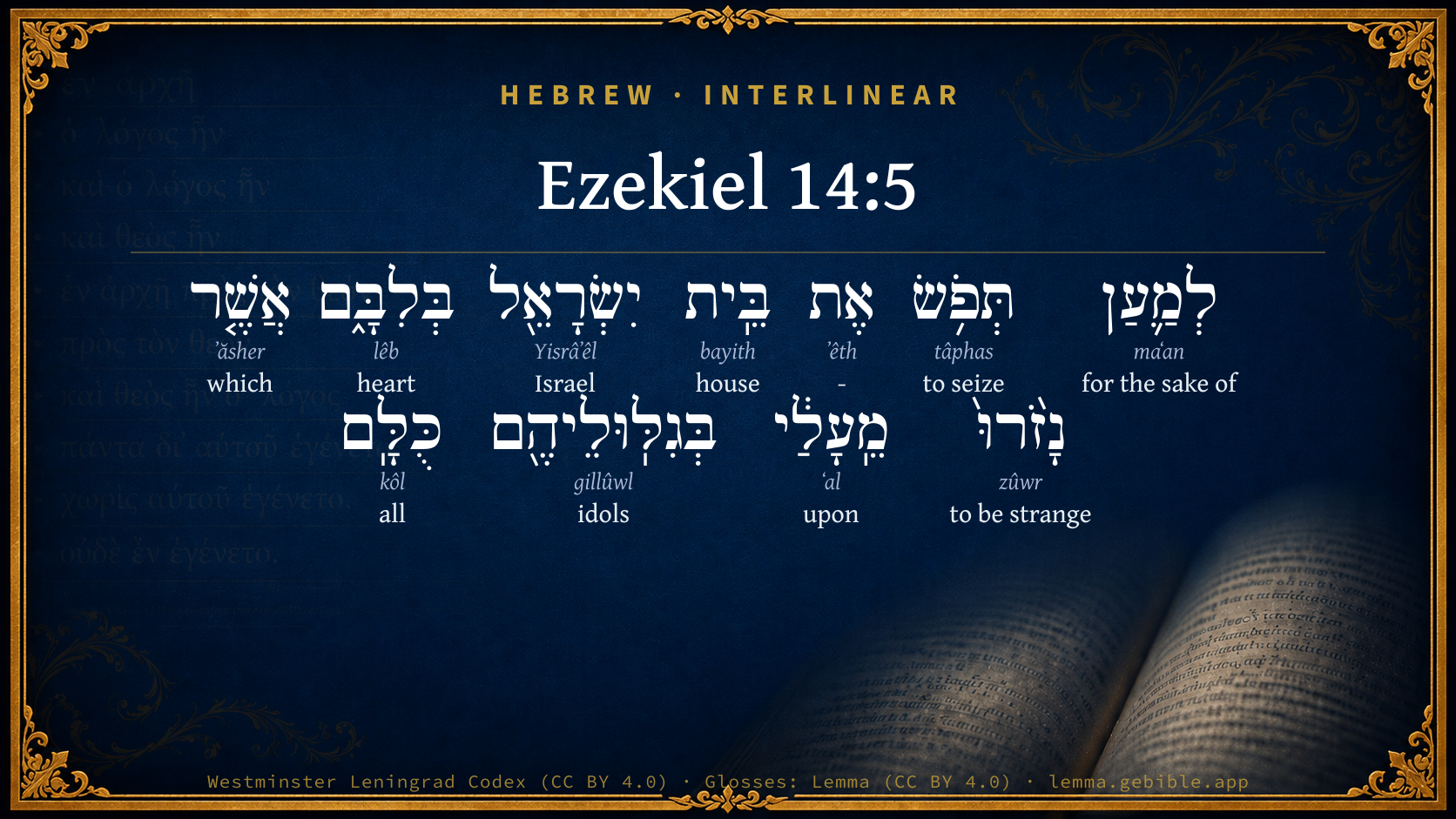
Hebrew (Westminster Leningrad Codex) Ezekiel 14:5 appears in the Hebrew Old Testament. The text above is from the Westminster Leningrad Codex. Each word links to its Strong’s number, a concise gloss, and parsing drawn from the Open Scriptures Hebrew Bible morphology. Click any word for its full Brown-Driver-Briggs (BDB) entry.
Download image
Cite this verse

Ezekiel 14:5 (World English Bible). Public Domain. Lemma interlinear Bible study tool, https://lemma.gebible.app/v/ezekiel/14/5.

Show BibTeX & RIS
BibTeX
RIS
English Translation
that I may take the house of Israel in their own heart, because they are all estranged from me through their idols.
World English Bible · Public Domain
Download a study sheet

One document with this verse’s original text, its word-by-word gloss line, the meaning frame, cross-references with their text, attributed commentary, and full source and license credits — printable, and it pastes into notes with its structure intact.

This verse Autodidact and up

Study sheet (.html) Plain text (.txt)

A passage Seminary Student

Up to 50 verses in one chapter. A passage sheet keeps up to 6 commentary sources and 12 cross-references per verse, in the order this page ranks them, and says so on the sheet whenever that leaves anything out. Ask for a single verse and you get the Autodidact verse sheet above.

Everything on this page stays free to read, with no account — the sheet is a download of what is already on screen, not access to it.

Want to remove ads? Support Godless Engineer
Compare translations 3

The same verse in 3 English versions, stacked beneath the original-language interlinear above. Click any original word for its lexicon entry.

Each is an independent rendering of the whole verse — the interlinear is not word-aligned to these translations.

Highlighted words mark where these versions differ — a whole-verse word diff, not a word-by-word alignment.

  • World English Bible Public Domain
    that I may take the house of Israel in their own heart, because they are all estranged from me through their idols.
  • King James Version Public Domain
    That I may take the house of Israel in their own heart, because they are all estranged from me through their idols.
  • unfoldingWord Literal Text CC BY-SA 4.0
    I will do this so that I may take back the house of Israel in their hearts that have been driven far from me through their idols.’

unfoldingWord Literal Text — © unfoldingWord, licensed CC BY-SA 4.0. Word-aligned USFM3 via Door43 (git.door43.org/unfoldingWord/en_ult).

Versions to compare (up to 4)

3 of 4 selected

Show all 18 translations

Every available English version of this verse, each an independent rendering of the whole verse.

  • World English Bible Public Domain
    that I may take the house of Israel in their own heart, because they are all estranged from me through their idols.
  • Berean Standard Bible Public Domain
    so that I may take hold of the hearts of the people of Israel. For because of their idols, they are all estranged from Me.’
  • Majority Standard Bible Public Domain
    so that I may take hold of the hearts of the people of Israel. For because of their idols, they are all estranged from Me.’
  • King James Version Public Domain
    That I may take the house of Israel in their own heart, because they are all estranged from me through their idols.
  • American Standard Version (1901) Public Domain
    that I may take the house of Israel in their own heart, because they are all estranged from me through their idols.
  • Revised Version (1885) Public Domain
    that I may take the house of Israel in their own heart, because they are all estranged from me through their idols.
  • Geneva Bible (1599) Public Domain
    That I may take the house of Israel in their owne heart, because they are all departed from me through their idoles.
  • Douay-Rheims (1899) Public Domain
    That the house of Israel may be caught in their own heart, with which they have departed from me through all their idols.
  • Young's Literal Translation Public Domain
    in order to catch the house of Israel by their heart, in that they have become estranged from off me by their idols -- all of them.
  • Literal Standard Version CC BY-SA 4.0
    in order to catch the house of Israel by their heart, in that they have become estranged from off Me by their idols—all of them.
  • Unlocked Literal Bible CC BY-SA 4.0
    I will do this so that I may take back the house of Israel in their hearts that have been driven far from me through their idols.'
  • unfoldingWord Literal Text CC BY-SA 4.0
    I will do this so that I may take back the house of Israel in their hearts that have been driven far from me through their idols.’
  • Darby Bible Public Domain
    that I may take the house of Israel by their own heart, because they are all estranged from me through their idols.
  • World Messianic Bible Public Domain
    that I may take the house of Israel in their own heart, because they are all estranged from me through their idols.”’
  • Webster's Bible Public Domain
    That I may take the house of Israel in their own heart, because they are all estranged from me through their idols.
  • Free Bible Version CC BY-SA 4.0
    Like this I might have the people of Israel decide to recommit themselves to me. Right now, because of their idols, all of them treat me as their enemy.
  • Bible in Basic English Public Domain
    So as to take the children of Israel in the thoughts of their hearts, because they have become strange to me through their false gods.
  • JPS Tanakh (1917) Public Domain
    that I may take the house of Israel in their own heart, because they are all turned away from Me through their idols.

Literal Standard Version (2020), Covenant Press — licensed CC BY-SA 4.0. Text via the HelloAO Bible API (eBible.org). Unlocked Literal Bible (unfoldingWord) — licensed CC BY-SA 4.0. Text via the HelloAO Bible API (eBible.org). unfoldingWord Literal Text — © unfoldingWord, licensed CC BY-SA 4.0. Word-aligned USFM3 via Door43 (git.door43.org/unfoldingWord/en_ult). Free Bible Version, Dr. Jonathan Gallagher — licensed CC BY-SA 4.0. Text via the HelloAO Bible API (eBible.org).

Word by word

More ways to search: Search by grammar → Find every occurrence → Compare this word →

Practice this passage: Drill this verse → Learn its vocabulary →

בְּגִלּֽוּלֵיהֶ֖ם
gillûwl
H1544
“in/at · idols · their”
Preposition + Noun, Common, Masculine, Plural, Construct + Suffix, Personal, 3rd Person, Masculine, Plural
Part of Speech
Preposition + Noun
Type
Common
Gender
Masculine
Number
Plural
State
Construct
Full BDB Definition

Origin: from H1556

TWOT: 353h

idols
  1. לְמַ֛עַן maʻan H4616 “for the sake of” Preposition
  2. תְּפֹ֥שׂ tâphas H8610 “to seize” Verb, Qal, Infinitive Construct
  3. אֶת ʼêth H853 “-” Particle, Direct Object
  4. בֵּֽית bayith H1004 “house of” Noun, Common, Masculine, Singular, Construct
  5. יִשְׂרָאֵ֖ל Yisrâʼêl H3478 “Israel” Noun, Proper
  6. בְּלִבָּ֑ם lêb H3820 “in/at · heart · their” Preposition + Noun, Common, Masculine, Singular, Construct + Suffix, Personal, 3rd Person, Masculine, Plural
  7. אֲשֶׁ֤ר ʼăsher H834 “which” Particle, Relative
  8. נָזֹ֨רוּ֙ zûwr H2114 “to be strange” Verb, Niphal, Perfect, 3rd Person, Common, Plural
  9. מֵֽעָלַ֔י ʻal H5921 “from · upon · me” Preposition + Preposition + Suffix, Personal, 1st Person, Common, Singular
  10. כֻּלָּֽם kôl H3605 “all · their” Noun, Common, Masculine, Singular, Construct + Suffix, Personal, 3rd Person, Masculine, Plural

About this verse

These counts appear in no published source. They are computed here, from the morphology-tagged text and Lemma’s own curated glosses. What Lemma adds →

11
words
11
distinct lemmas
Prophets
section

Shared distinctive vocabulary

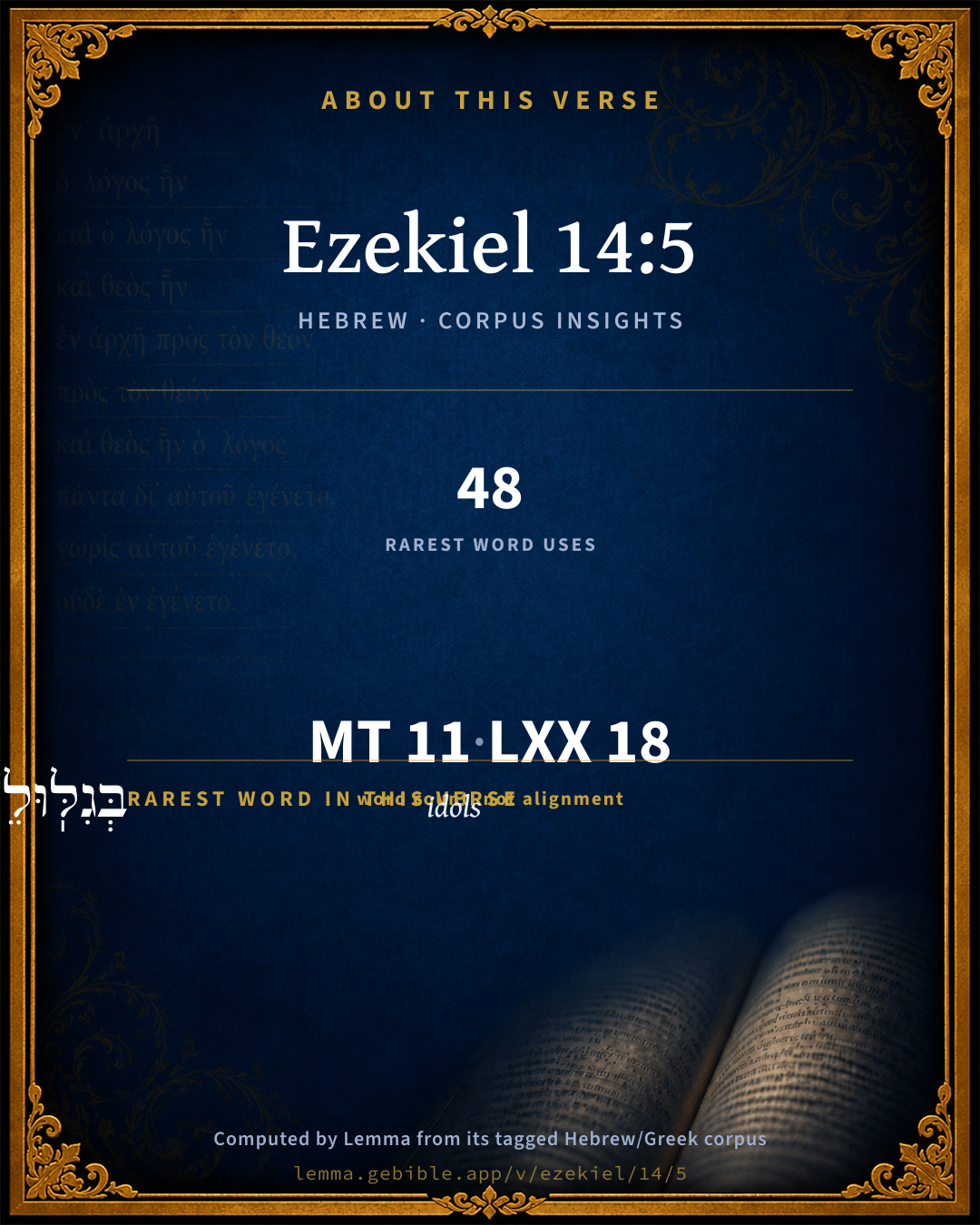
בְּגִלּֽוּלֵיהֶ֖ם idols H1544 occurs in 45 verses of the Hebrew Bible. Also found in:

Grammatical profile

  • 2 verbs
  • 5 nouns
  • 2 prepositions
  • 2 particles

Verb forms

  • תְּפֹ֥שׂ Qal · Infinitive Construct
  • נָזֹ֨רוּ֙ Niphal · Perfect

Hebrew & Septuagint length

In English translation the verse runs 22 words from the Hebrew and 21 from the Septuagint (LXX English) — closely comparable.

A rough comparison of the two English renderings, which tokenize alike — not a word-level alignment.

Word counts can differ between the Hebrew and the Greek without any difference in meaning — e.g. the Hebrew direct-object marker אֵת has no separate Greek word, and Greek often adds the article ὁ.

In the original languages it is 11 Hebrew tokens and 18 Greek tokens — but the two are counted differently (Hebrew bundles its prefixes and suffixes into one token; the Greek is in lemma form), so that isn’t a like-for-like length.

Cross-references

18

Topical passages linked to Ezekiel 14:5 in the Treasury of Scripture Knowledge — connected by theme and wording, ordered by reader-vote popularity; previews shown in the World English Bible.

  • Isaiah 1:4 Ah sinful nation, A people loaded with iniquity, A seed of evil-doers, Children who deal corruptly! They have forsaken Yahweh. They have despised the Holy One of Israel. They are estranged and backward.
  • Zechariah 11:8 I cut off the three shepherds in one month; for my soul was weary of them, and their soul also loathed me.
  • Deuteronomy 32:15–16 But Jeshurun grew fat, and kicked: You have grown fat, you are grown thick, you are become sleek; Then he forsook God who made him, Lightly esteemed the Rock of his salvation.
  • Jeremiah 2:5 thus says Yahweh, What unrighteousness have your fathers found in me, that they have gone far from me, and have walked after vanity, and are become vain?
  • Jeremiah 2:11–13 Has a nation changed [its] gods, which yet are no gods? but my people have changed their glory for that which does not profit.
  • Jeremiah 2:31–32 Generation, see the word of Yahweh. Have I been a wilderness to Israel? or a land of thick darkness? why say my people, We are broken loose; we will come no more to you?
  • Ezekiel 14:9–10 If the prophet be deceived and speak a word, I, Yahweh, have deceived that prophet, and I will stretch out my hand on him, and will destroy him from the midst of my people Israel.
  • Hosea 10:2 Their heart is divided. Now they will be found guilty. He will demolish their altars. He will destroy their sacred stones.
  • Zechariah 7:11–14 But they refused to listen, and turned their backs, and stopped their ears, that they might not hear.
  • Romans 1:21–23 Because, knowing God, they didn't glorify him as God, neither gave thanks, but became vain in their reasoning, and their senseless heart was darkened.
  • Romans 1:28 Even as they refused to have God in their knowledge, God gave them up to a reprobate mind, to do those things which are not fitting;
  • Romans 1:30 backbiters, hateful to God, insolent, haughty, boastful, inventors of evil things, disobedient to parents,
  • Romans 8:7 because the mind of the flesh is hostile towards God; for it is not subject to God's law, neither indeed can it be.
  • Galatians 6:7 Don't be deceived. God is not mocked, for whatever a man sows, that will he also reap.
  • Ephesians 4:18 being darkened in their understanding, alienated from the life of God, because of the ignorance that is in them, because of the hardening of their hearts;
  • Colossians 1:21 You, being in past times alienated and enemies in your mind in your evil works,
  • 2 Thessalonians 2:9–11 even he whose coming is according to the working of Satan with all power and signs and lying wonders,
  • Hebrews 3:12 Beware, brothers, lest perhaps there be in any one of you an evil heart of unbelief, in falling away from the living God;

Cross-references courtesy of OpenBible.info (CC BY 4.0).

Hebrew and Greek witnesses Masoretic Hebrew ↔ Greek Septuagint

The same verse in the two great witnesses to the Old Testament, shown verse-for-verse.

These are two independent witnesses, not word-aligned to each other, and the Septuagint is shown in lemma (dictionary) form.

Hebrew Ezekiel 14:5 Masoretic · Westminster Leningrad Codex

לְמַ֛עַן תְּפֹ֥שׂ אֶת בֵּֽית יִשְׂרָאֵ֖ל בְּלִבָּ֑ם אֲשֶׁ֤ר נָזֹ֨רוּ֙ מֵֽעָלַ֔י בְּגִלּֽוּלֵיהֶ֖ם כֻּלָּֽם

that I may take the house of Israel in their own heart, because they are all estranged from me through their idols.

World English Bible · Public Domain

Greek LXX Ezekiel 14:5 Septuagint · lemma form

ὅπως πλαγιάζω ὁ οἶκος ὁ ἰσραήλ κατά ὁ καρδία αὐτός ὁ ἀποἀλλοτριόω ἀπό ἐγώ ἐν ὁ ἐνθύμημα αὐτός

that he should turn aside the house of Israel, according to their hearts that are estranged from me in their thoughts.

LXX2012 (modern English Septuagint) · Public Domain

On this verse, Haydock's Catholic Bible Commentary discusses the Septuagint’s reading. Read the note in Commentary ↓

Hebrew: Westminster Leningrad Codex (CC BY 4.0). Greek: Septuagint (public domain); English from LXX2012 (modern English Septuagint) (Public Domain). How the Septuagint differs from the Hebrew →

Targum (Aramaic paraphrase)

1

The Targum is the ancient Jewish Aramaic paraphrase of the Hebrew Scriptures — an interpretive translation, not the Hebrew text itself. Onkelos (literal) and Pseudo-Jonathan (expansive) render the Torah, and Jonathan the Prophets. Coverage is partial: where no permissively-licensed English translation exists for a verse, only the Aramaic is shown. This is verse-level text, not a word-by-word alignment to the Hebrew.

  1. Targum Jonathan Prophets (Joshua–Malachi)
    בְּדִיל לְקָרָבָא יַת בֵּית יִשְׂרָאֵל לְמִתַּן תִּיוּבְתָּא בְּלִבְּהוֹן דִסְטוֹ מִבָּתַר פּוּלְחָנִי וְאִסְתָּאָבוּ בְּפוּלְחַן טַעֲוָתְהוֹן כּוּלְהוֹן:

    (no public-domain English translation for this verse)

    Targum Jonathan — Aramaic: “Mikraot Gedolot” (public domain). English: “Sefaria Community Translation” (CC0 1.0 (public-domain dedication)); “London "Chaldee Paraphrase," 1871” (public domain). Text via Sefaria.

Commentary

Notes on Ezekiel 14:5 from classic Christian and Jewish commentators (each source and its license shown beneath its notes). The classic Christian expositions comment on the surrounding passage and are grouped to its opening verse, so a note may address several verses; the Jewish commentaries on the Tanakh (Rashi and others) are per-verse, so they appear only where the commentator wrote on this verse.

Lemma curates 59 commentaries, every one of them public domain or Creative Commons licensed, each selected and text-cleaned for this edition rather than reprinted as found. About our sources →

Trapp's Complete Commentary

John Trapp

Eze 14:5 That I may take the house of Israel in their own heart, because they are all estranged from me through their idols.

Ver. 5. That I may take the house of Israel in their own heart.] Ut deprehendam, or, as others, ut reprehendam; that I may convince their consciences of their impieties, and sting them to the heart with unquestionable conviction and horror.

Because they are all estranged from me.] And fallen in with the devil, who is ειδωλοχαρης, as saith Synesius, a great promoter of idolatry. Idola sunt prima saliva, et initium deficiendi a Deo. {a} Idolatry paveth the way to utter apostasy.

{a} Oecolamp.

John Trapp, A Commentary or Exposition upon All the Books of the Old and New Testament (1647–1656) — public domain. Text from a community e-Sword module.

The Biblical Illustrator

Joseph S. Exell

Eze_14:5-6

They are all estranged from Me through their idols.

Alienation from God

We read here, in Gods own words, His rule of dealing with persons who come to Him in a certain disposition of mind.

1. The word estranged implies a former condition of close relationship and affection, from which they have since fallen. You would not apply the term to foreigners. You would not say of a Frenchman that he was estranged from this country, simply because he never belonged to it; but if an Englishman resided so long in Paris as to lose his patriotism and interest in our affairs, you would say that he was estranged. So, again, you would not say of a mere acquaintance, if you ceased to see him, that he was estranged from you; but if the love of an old friend grow cold, if a child become indifferent to his home, or a husband fail in his devotion to his wife, you describe such a falling off as estrangement. In this temper certain elders of Israel presented themselves before the prophet of God. They came to inquire His will and seek His aid. What self-delusion, then, is this! what blindness of heart! Men coming to God to inquire of Him, and not knowing that there is that within them which will forbid Gods hearing them! Who has persuaded them to come this way at all? No voice but that of their own heart! And yet do you say that it is their heart which bars the way of God against them? Estranged from Me through their idols! Oh, to us, who may be as these elders of Israel, how hard does this rule of God press upon us! Like them, only far more favoured in all spiritual blessings, with everything to turn our feet towards God, the very currents of society swaying us in this direction, the breeze of fashion gently impelling us hither, the hand of custom with its constant but almost unfelt pressure laid upon the helm of our daily life to guide us within the haven of the Church. We learn to say our prayers, and prayer becomes a trick of words. Bibles are cheap, and in every mans hand. And yet, even now, there may be amongst us some who do not remember, that with idols in our heart we are estranged from God, and that He will not be inquired of by us at all!

2. But this is not the worst. The question God puts expects the answer No; and yet it is not the answer which He gives it. His answer admits us to a nearer view of His mysterious dealings with man. We see Him work by a rule that we know nothing of, a rule of mystery, marvellous and inscrutable, but one which example and experience teach us He applies with unerring force. When men thus estranged and alienated from Him in heart present themselves in person before Him, He does not refuse them an audience. They pray--He hears--their prayer is answered: but how fatal is the gift which He grants! I the Lord will answer him that cometh according to the multitude of his idols. What illustrations of the Divine conduct does Scripture offer both in the Old Testament and the New! The Jews clamoured for a king, and God gave them one, but in this wise,--I gave thee a king in Mine anger, and took him away in My wrath. They cried in the wilderness for flesh,--So they did eat, and were well filled, for He gave them their own desire; they were not disappointed of their lust. But while the meat was yet in their mouths, etc., and smote down the chosen men that were in Israel. Balaam received the kings messengers a second time, and though God had once answered him, he professed to inquire of Him again. He came with idols in his heart, his affection estranged from God: and what was the result? Did God forbid his praying? Oh that He had done so! Did He refuse his prayer? Alas! He granted it, saying, Rise up and go with them. And Balaam, too happy to get the permission, went. But Gods anger was kindled because he went: and the end was that he fell from sin to sin, selling himself to do the tempters work; and he died among Gods enemies, his own pious prayers and blessings ringing the curse of the hypocrite in his ears. There is yet another example nearer the person of the blessed Lord Himself; and therefore the warning is more terrible. Jesus chose but twelve to help Him in His work; and even on one of these He looked--a man with idols in his heart--and said of him, Have not I chosen you twelve, and one of you is a devil? This man came near to Christ, as the eleven: he passed as one of them. He was with them almost up to the very last; he just wanted a little time to go away and finally arrange the plot, and that time he had. God gave him the opportunity,--say not gave, but permitted him. Jesus looked at him and said, What thou doest, do quickly. Was ever prayer heard like that? was ever man on earth answered after the multitude of his idols like that?

3. Gods purpose in answering the evil desires of hearts alienated from His love. Their heart is to become their snare, the net in which they shall be caught, the pitfall in which they shall be entrapped. Your talents and tastes and affections and ruling desires,--the gifts with which natures hand has made you rich, the inheritance with which you started in life,--your physical strength, your youth, your beauty, your wit, your attractiveness, your amiable temper, your power of sympathy, your grace of manner, your aptitude for business, your strong will, your influence over others--with these you made your casts early in life: they have brought you in glittering spoils and stores of comfort, and have enriched your home with pleasures and with wealth. But these very instruments of gain, what else have you done with them? Have they entangled you too much in the world? impeded you on your way to God? implicated you dangerously with others? Have you ensnared others, and made inextricable confusion in their projects of a peaceful, holy, happy life? And now, as you grow older, are you so involved in this worlds business that you cannot escape its toils? When Christ, the rightful Master of your heart, calls to you from the quiet shore, and bids you leave your nets, and become, if not expressly fishers of men, yet at least servants in His work, is your heart free to follow Him? is your heart His at all? nay, is your heart your own to give? Have you not given it away already to idols, to false gods, to the world? or it may be, you have lost your heart in sin! (Archdeacon Furse.)

Things that estrange the heart from God

It was a true and beautiful remark made by the mother of Wm. Allan, the Quaker chemist, when she was seeking to win her son to give more attention to religion, and to devote less time to the prosecution of his studies in his favourite and fascinating science: Remember, my boy, that Christ cast even the doves out of the temple. The lesson thus gently taught was effectually taken to heart. Young Allan learned, with lasting profit, that the most innocent and lawful of earthly objects of interest may not occupy that central place in our affections which our Saviour claims for Himself; but in the souls of the redeemed all other desires will, without painful effort, arrange themselves at due distances from this centre.

Repent, and turn yourselves from your idols.--

Repentance

1. Repentance is a turning from sin to God. It is not any turning, but a turning of the judgment, so that men judge otherwise of God, of His laws and ways, of sin, of themselves, than before; a turning of the will and affections, so that they are carried wholly and fully unto God (Joe_2:12).

2. Repentance is a continued act. It is a grace, and must have its daily operation, as well as other graces. Where a spring breaks forth it is always flowing.

3. Sinners should stir up themselves, and do the utmost which lies in their power to further their turning unto God. Turn yourselves from your idols; use all arguments you can to cause your hearts to turn from idols, and from other sinful ways. Consider--

(1) That they are separated from the Lord (Isa_59:2).

(2) That mans life is short, and the pleasures of sin but for a season.

(3) The daily treasuring up of wrath, and danger of final impenitency (Rom_2:5). It is a seal of condemnation.

(4) The condemnations of a mans own heart and conscience (Isa_57:20-21).

(5) Absolute necessity of repenting and turning unto God (Luk_13:3). Except ye repent, ye shall all likewise perish.

4. True repentance and turning to the Lord doth manifest itself in the effects and fruits of it: it hath meet fruit (Mat_3:8), worthy fruit (Luk_3:8). Now, here are three effects thereof in these words:

(1) When the soul is truly turned to God it seeks to turn others; it is not content that itself is come to God, but would have many come to Him.

(2) It dispenses with no sin; it saith not, Lord, be merciful to me in this, but turns from all abominations, from every idol, the most daring sin shall then go to it (Hos_14:8).

(3) It avoids the occasions of sin and appearances of evil. (W. Greenhill, M. A.)

Sin not tolerated

When his people at Wittenberg showed him their licences to sin, Luthers answer was, Unless you repent you will all perish.. . . Please God, Ill make a hole in his drum, he said, when he first heard of Tetzel selling these indulgences. (Anecdotes of Luther.)

The Biblical Illustrator, edited by Joseph S. Exell (c. 1880s–1900s) — public domain. Text from a community e-Sword module.

Geneva Bible (1599)

Geneva Bible translators

That is, convince them by their own conscience.

Geneva Bible (1599) marginal notes — public domain. Text via Bolls.life.

Jamieson, Fausset & Brown

Robert Jamieson, A. R. Fausset & David Brown

That I may take--that is, unveil and overtake with punishment the dissimulation and impiety of Israel hid in their own heart. Or, rather, "That I may punish them by answering them after their own hearts"; corresponding to "according to the multitude of his idols" (see on Eze 14:4); an instance is given in Eze 14:9; Rom 1:28; Th2 2:11, God giving them up in wrath to their own lie.

idols--though pretending to "inquire" of Me, "in their hearts" they are "estranged from Me," and love "idols."

Jamieson, Fausset & Brown — Commentary Critical and Explanatory on the Whole Bible (1871) — public domain (CC PDM 1.0). Text via the HelloAO Bible API.

John Calvin's Commentaries

He shows God’s object in being unwilling to dismiss without an answer the hypocrites who still impiously trifled with him. He says, that I may seize the house of Israel in their heart. It is yet asked how the impious are seized, when God answers them neither according to the opinion of their mind nor their expectation, but pronounces what they dislike and fear most grievously. I reply, that the impious are answered when they are driven to madness, and God thus extracts from them what was formerly hidden in their own hearts. He says, therefore, that their impiety may be manifest to all, I will answer them. For as long as God spares the impious, they endeavor to soothe him by a kind of flattery; but when they see that they take nothing by their false blandishments, then they roar, nay, bellow furiously against God: thus they are caught in their own hearts: that is, all their former dissembling is made bare, so that all may easily perceive that there never was a spark of piety in their hearts. God, therefore, bears witness that his answers would be of this kind, that he may take the house of Israel in their hearts; that is, that his severity may draw out into the light what was formerly hidden; for the word of God is a two-edged sword, and examines all the sentiments of men. (Hebrews 4:12.) Some are so slain by this sword that they grow wise again; but others are stung with fury when they see that they must engage with the power of God; therefore they are seized in their own hearts when God twists from them what they would willingly have kept always hidden. Since they have estranged themselves from me, literally, in their idols. This passage is explained in two ways, as we have said. Some say, because they separated themselves; but I approve of the other version, because they have alienated themselves, and we shall understand the point more clearly afterwards when the subject leads us to it. They alienated themselves, then, from God; that is, when they had utterly declined from God’s law; yet, as long as this was concealed, they still wore their masks. The separation of which the Prophet here speaks seems to be referred to this pretense. Since, then, they so alienated themselves from me by their idols; that is, he says they are deceived in thinking that they cannot be discovered, and that their abominations, however foul they are, will remain secret. And this agrees with the last clause, namely, that he would seize the hypocrites in their own heart.

John Calvin's Commentaries (1540-1563) — public domain. Text from the Calvin Translation Society English edition (1840s-50s) via the Christian Classics Ethereal Library (ccel.org). Calvin's coverage is partial (roughly two-thirds of the Bible); uncommented books and verses are honest gaps, never fabricated. The 19th-century editor's footnotes and remarks are omitted so the notes are faithfully Calvin's own voice.

The Cambridge Bible for Schools and Colleges

gen. ed. J. J. S. Perowne

5. take … in their own heart] The sinner’s sin is like a snare in which he is captured and destroyed; sin carries its own retribution in itself (Job_8:4). The phrase “take them in their own heart” is explained by the words that follow, “because they are all estranged from me through their idols.” Their “heart” is the idolatrous direction of their thoughts and affections; in this they shall be taken (Eze_14:3-4; Eze_14:7).

The Cambridge Bible for Schools and Colleges (gen. ed. J. J. S. Perowne; Cambridge University Press, 1878–1918) — public domain. Text from a community e-Sword module.

John Gill's Exposition

That I may take the house of Israel in their own heart,.... By which they are ensnared, and drawn aside to their ruin; being given up to strong delusions, to believe a lie, and worship idols; God threatening to answer them by righteous judgments, and thereby take the wickedness, the hypocrisy, and idolatry, that were in their hearts, and expose and make it manifest unto others; or, by punishing them, to draw out the corruption and sin that were in them, that it might be seen what a wicked people they were. The Targum interprets the text in another way,

"that I may bring near the house of Israel, and put repentance into their hearts;''

because they are all estranged from me through their idols; they grew shy of God and his worship, when they fell into idolatry. Alienation from God, from the life of God, from the law of God, from the worship of God, and of the affections from him, is owing to some idol or another set up in the heart, or before the eye; whatever is worshipped besides God, or gains the ascendant in the heart, alienates from him; and God will not admit of a rival, he cannot and will not bear it; and for this reason he inflicts punishment, or answers in a terrible way.

John Gill's Exposition of the Whole Bible (1746–1763) — public domain (CC PDM 1.0). Text via the HelloAO Bible API.

Albert Barnes' Notes on the Bible

That I may take ... - i. e., that I may take them, as in a snare, deceived by their own heart.

Albert Barnes' Notes on the Bible (1834–1885) — public domain. Text from a community e-Sword/MySword module.

Haydock's Catholic Bible Commentary

The. Septuagint, "he may ensnare the house," (Haydock) or "to bring" unto repentance. (Chaldean) (Calmet)

George Leo Haydock (1774–1849), Haydock's Catholic Family Bible and Commentary, 1859 edition — public domain. Excludes Psalms (Douay-Rheims chapter numbering differs from Protestant) and Deuterocanonical books (Catholic canon only).

Matthew Poole's English Annotations

That I may convince and pierce their very hearts, or lay open what is in their heart, and discover their hypocrisy and impiety; because they have shamefully followed idols, which now in their distress neither know the cause, or can frame a remedy; and what folly is it to choose such gods! what greater impiety than this, to adhere to idols, and forsake God, the only true God and Saviour?

Estranged from me; minds that increase their averseness to God. Idolatry draws the man more and more from the Lord.

Matthew Poole's English Annotations on the Holy Bible (1683–1685) — public domain. Text from a community e-Sword/MySword module.

Whedon's Commentary on the Bible

Daniel D. Whedon

5. That I may take… in their own heart — “The sinner’s sin is like a snare in which he is captured and destroyed; sin carries its own retribution in itself (Job_8:4). Their ‘heart’ is the idolatrous direction of their thoughts and affections; in this they shall be taken (Eze_14:3-4; Eze_14:7).” — Davidson.

Daniel D. Whedon (gen. ed.), Commentary on the Old and New Testaments (1874–1909) — public domain. Text from a community e-Sword module.

The Pulpit Commentary

That I may take the house of Israel, etc. The words me a threat rather than a promise. The "double-hearted" shall be taken in the snare which they have made for themselves.

The Pulpit Commentary (1880–1919), ed. H.D.M. Spence-Jones & Joseph S. Exell — public domain. Text from a community e-Sword module.

John Wesley's Explanatory Notes

Take - That I may lay open what is in their heart, and discover their hypocrisy, and impiety. Through their idols - It is always through some idol or other, that the hearts of men are estranged from God: some creature has gained that place in the heart, which belongs to none but God.

John Wesley, Explanatory Notes Upon the Whole Bible (1754–1765) — public domain. Text via the GEBible commentary corpus.

Rashi

Rabbi Shlomo Yitzchaki (Rashi)

In order to take hold of the house of Israel, etc. In order to draw the house of Israel near, to put repentance into their hearts.

who have drawn away Heb. נָזֹרוּ, like (Gen. 48:26): “the one separated (נְזִיר) from his brothers” furent asevrez in Old French; were severed, separated.

Rashi on the Tanakh — English translations: “The Judaica Press complete Tanach with Rashi, translated by A. J. Rosenberg” (CC BY 4.0); “Pentateuch with Rashi's commentary by M. Rosenbaum and A.M. Silbermann, 1929-1934” (public domain); “The Metsudah Tanach series, Lakewood, N.J” (CC BY 4.0); and “The Book of Joshua, Metsudah Publications, 1997” (CC BY 4.0). Text via Sefaria.

Lesson kit

Teaching starters — assembled from the data on this page, not authored interpretation. Every prompt links to the verse data it draws on. Edit before teaching.

Ezekiel, in the Prophets, opens this verse with 11 words (11 distinct Hebrew lemmas). Its most distinctive word is gillûwl (“idols”). A historical commentator’s framing appears above. Read the whole chapter for the surrounding context.

Discussion questions

  1. What does “idols” (gillûwl) contribute to the verse as a whole?
  2. How does Leviticus 26:30, which shares the word «idols», read alongside this verse?
  3. The translations on this page render this verse differently — a whole-verse word diff, not a word-by-word alignment. What might account for the different wordings?
  4. «תְּפֹ֥שׂ» is a Qal Infinitive Construct verb. How does that grammatical form shape the action described?
  5. Compare how Trapp's Complete Commentary and The Biblical Illustrator read this verse. Where do they agree or differ?

Things to notice

Reading settings

Reading text

Shown beneath each verse's original-language words.

Old Testament
Old Testament edition

Read the OT as the Masoretic Hebrew (MT) or the Greek Septuagint (LXX).

English shown for the Greek Septuagint (in the Hebrew ↔ Greek comparison).

Comparing translations? Open the Compare panel on any verse page to stack up to four side by side.