Ezekiel 19:8

Hebrew (Westminster Leningrad Codex) Ezekiel 19:8 appears in the Hebrew Old Testament. The text above is from the Westminster Leningrad Codex. Each word links to its Strong’s number, a concise gloss, and parsing drawn from the Open Scriptures Hebrew Bible morphology. Click any word for its full Brown-Driver-Briggs (BDB) entry.
Download image
Cite this verse

Ezekiel 19:8 (World English Bible). Public Domain. Lemma interlinear Bible study tool, https://lemma.gebible.app/v/ezekiel/19/8.

Show BibTeX & RIS
BibTeX
RIS
English Translation
Then the nations set against him on every side from the provinces; and they spread their net over him; he was taken in their pit.
World English Bible · Public Domain
Download a study sheet

One document with this verse’s original text, its word-by-word gloss line, the meaning frame, cross-references with their text, attributed commentary, and full source and license credits — printable, and it pastes into notes with its structure intact.

This verse Autodidact and up

Study sheet (.html) Plain text (.txt)

A passage Seminary Student

Up to 50 verses in one chapter. A passage sheet keeps up to 6 commentary sources and 12 cross-references per verse, in the order this page ranks them, and says so on the sheet whenever that leaves anything out. Ask for a single verse and you get the Autodidact verse sheet above.

Everything on this page stays free to read, with no account — the sheet is a download of what is already on screen, not access to it.

Want to remove ads? Support Godless Engineer
Compare translations 3

The same verse in 3 English versions, stacked beneath the original-language interlinear above. Click any original word for its lexicon entry.

Each is an independent rendering of the whole verse — the interlinear is not word-aligned to these translations.

Highlighted words mark where these versions differ — a whole-verse word diff, not a word-by-word alignment.

  • World English Bible Public Domain
    Then the nations set against him on every side from the provinces; and they spread their net over him; he was taken in their pit.
  • King James Version Public Domain
    Then the nations set against him on every side from the provinces, and spread their net over him: he was taken in their pit.
  • unfoldingWord Literal Text CC BY-SA 4.0
    But the nations came against him from the surrounding provinces; they spread their nets over him. He was caught in their trap.

unfoldingWord Literal Text — © unfoldingWord, licensed CC BY-SA 4.0. Word-aligned USFM3 via Door43 (git.door43.org/unfoldingWord/en_ult).

Versions to compare (up to 4)

3 of 4 selected

Show all 18 translations

Every available English version of this verse, each an independent rendering of the whole verse.

  • World English Bible Public Domain
    Then the nations set against him on every side from the provinces; and they spread their net over him; he was taken in their pit.
  • Berean Standard Bible Public Domain
    Then the nations set out against him from the provinces on every side. They spread their net over him; he was trapped in their pit.
  • Majority Standard Bible Public Domain
    Then the nations set out against him from the provinces on every side. They spread their net over him; he was trapped in their pit.
  • King James Version Public Domain
    Then the nations set against him on every side from the provinces, and spread their net over him: he was taken in their pit.
  • American Standard Version (1901) Public Domain
    Then the nations set against him on every side from the provinces; and they spread their net over him; he was taken in their pit.
  • Revised Version (1885) Public Domain
    Then the nations set against him on every side from the provinces: and they spread their net over him; he was taken in their pit.
  • Geneva Bible (1599) Public Domain
    Then the nations set against him on euery side of the countreys, and laide their nets for him: so he was taken in their pit.
  • Douay-Rheims (1899) Public Domain
    And the nations Game together against him on every side out of the provinces, and they spread their net over him, in their wounds he was taken.
  • Young's Literal Translation Public Domain
    And set against it do nations Round about from the provinces. And they spread out for it their net, In their pit it hath been caught.
  • Literal Standard Version CC BY-SA 4.0
    And surrounding nations set against him from the provinces. And they spread out their net for him, || He has been caught in their pit.
  • Unlocked Literal Bible CC BY-SA 4.0
    But the nations came against him from the surrounding provinces; they spread their nets over him. He was caught in their trap.
  • unfoldingWord Literal Text CC BY-SA 4.0
    But the nations came against him from the surrounding provinces; they spread their nets over him. He was caught in their trap.
  • Darby Bible Public Domain
    Then the nations set against him on every side from the provinces, and spread their net over him; he was taken in their pit.
  • World Messianic Bible Public Domain
    Then the nations attacked him on every side from the provinces. They spread their net over him. He was taken in their pit.
  • Webster's Bible Public Domain
    Then the nations set against him on every side from the provinces, and spread their net over him: he was taken in their pit.
  • Free Bible Version CC BY-SA 4.0
    Then the people of the countries all around attacked him. They threw their net over him; he was caught in their trap.
  • Bible in Basic English Public Domain
    Then the nations came against him from the kingdoms round about: their net was stretched over him and he was taken in the hole they had made.
  • JPS Tanakh (1917) Public Domain
    Then the nations cried out against him on every side from the provinces; and they spread their net over him, he was taken in their pit.

Literal Standard Version (2020), Covenant Press — licensed CC BY-SA 4.0. Text via the HelloAO Bible API (eBible.org). Unlocked Literal Bible (unfoldingWord) — licensed CC BY-SA 4.0. Text via the HelloAO Bible API (eBible.org). unfoldingWord Literal Text — © unfoldingWord, licensed CC BY-SA 4.0. Word-aligned USFM3 via Door43 (git.door43.org/unfoldingWord/en_ult). Free Bible Version, Dr. Jonathan Gallagher — licensed CC BY-SA 4.0. Text via the HelloAO Bible API (eBible.org).

Word by word

More ways to search: Search by grammar → Find every occurrence → Compare this word →

Practice this passage: Drill this verse → Learn its vocabulary →

רִשְׁתָּ֖ם
resheth
H7568
“net · their”
Noun, Common, Feminine, Singular, Construct + Suffix, Personal, 3rd Person, Masculine, Plural
Part of Speech
Noun
Type
Common
Gender
Feminine
Number
Singular
State
Construct
Full BDB Definition

Origin: from H3423

TWOT: 920c

net - net - for catching - of judgment (figuratively) - of leaders leading people to sin - as a trap for man - network (brazen - for altar of tabernacle)
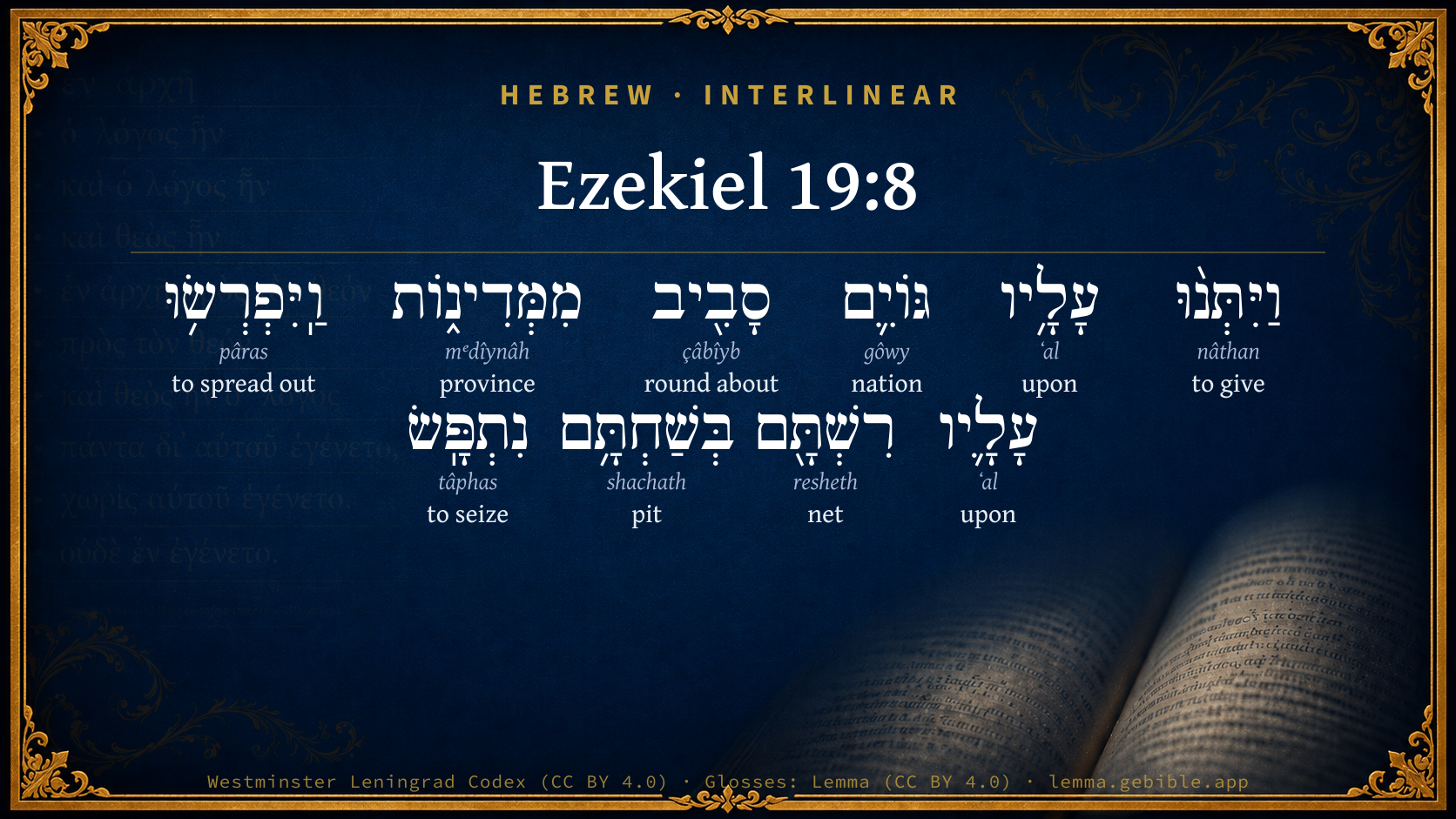
  1. וַיִּתְּנ֨וּ nâthan H5414 “and · to give” Conjunction + Verb, Qal, Sequential Imperfect, 3rd Person, Masculine, Plural
  2. עָלָ֥יו ʻal H5921 “upon · him” Preposition + Suffix, Personal, 3rd Person, Masculine, Singular
  3. גּוֹיִ֛ם gôwy H1471 “nations” Noun, Common, Masculine, Plural, Absolute
  4. סָבִ֖יב çâbîyb H5439 “round about” Noun, Common, Both, Singular, Absolute
  5. מִמְּדִינ֑וֹת mᵉdîynâh H4082 “from · provinces” Preposition + Noun, Common, Feminine, Plural, Absolute
  6. וַֽיִּפְרְשׂ֥וּ pâras H6566 “and · to spread out” Conjunction + Verb, Qal, Sequential Imperfect, 3rd Person, Masculine, Plural
  7. עָלָ֛יו ʻal H5921 “upon · him” Preposition + Suffix, Personal, 3rd Person, Masculine, Singular
  8. בְּשַׁחְתָּ֥ם shachath H7845 “in/at · pit · their” Preposition + Noun, Common, Feminine, Singular, Construct + Suffix, Personal, 3rd Person, Masculine, Plural
  9. נִתְפָּֽשׂ tâphas H8610 “to seize” Verb, Niphal, Perfect, 3rd Person, Masculine, Singular

About this verse

These counts appear in no published source. They are computed here, from the morphology-tagged text and Lemma’s own curated glosses. What Lemma adds →

10
words
9
distinct lemmas
Prophets
section

Notable vocabulary

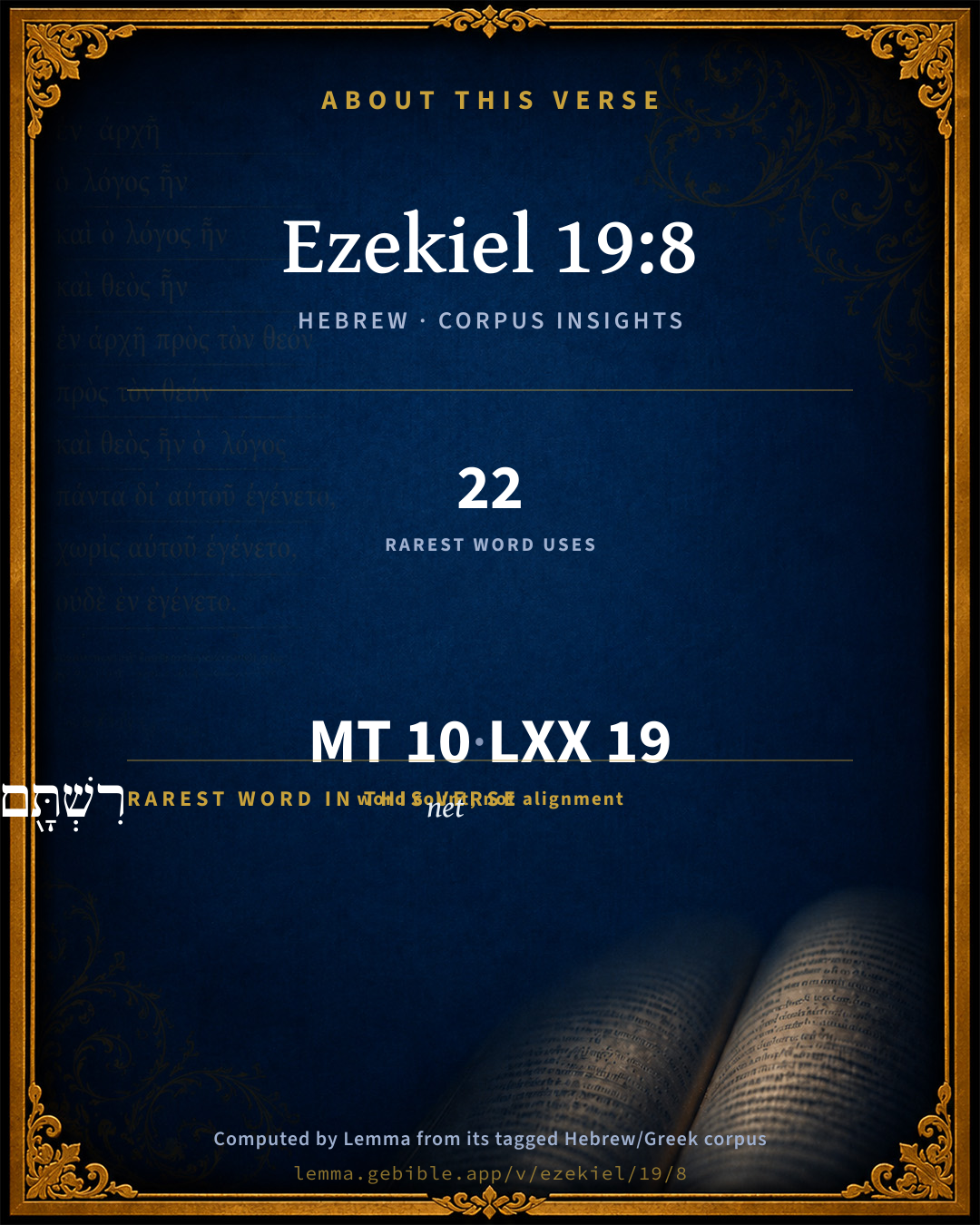
The rarest word here is רִשְׁתָּ֖ם net H7568 — appearing just 22 times in the whole Hebrew Bible.

Shared distinctive vocabulary

רִשְׁתָּ֖ם net H7568 occurs in 21 verses of the Hebrew Bible. Also found in:

Grammatical profile

  • 3 verbs
  • 5 nouns
  • 2 prepositions

Verb forms

  • וַיִּתְּנ֨וּ Qal · Sequential Imperfect
  • וַֽיִּפְרְשׂ֥וּ Qal · Sequential Imperfect
  • נִתְפָּֽשׂ Niphal · Perfect

Repetition

A word recurs within this verse — often emphatic in Hebrew:

  • עָלָ֥יו upon H5921 ×2

Hebrew & Septuagint length

In English translation the verse runs 25 words from the Hebrew and 24 from the Septuagint (LXX English) — closely comparable.

A rough comparison of the two English renderings, which tokenize alike — not a word-level alignment.

Word counts can differ between the Hebrew and the Greek without any difference in meaning — e.g. the Hebrew direct-object marker אֵת has no separate Greek word, and Greek often adds the article ὁ.

In the original languages it is 10 Hebrew tokens and 19 Greek tokens — but the two are counted differently (Hebrew bundles its prefixes and suffixes into one token; the Greek is in lemma form), so that isn’t a like-for-like length.

Cross-references

6

Topical passages linked to Ezekiel 19:8 in the Treasury of Scripture Knowledge — connected by theme and wording, ordered by reader-vote popularity; previews shown in the World English Bible.

  • Lamentations 4:20 The breath of our nostrils, the anointed of Yahweh, was taken in their pits; Of whom we said, Under his shadow we shall live among the nations.
  • Ezekiel 12:13 My net also will I spread on him, and he shall be taken in my snare; and I will bring him to Babylon to the land of the Chaldeans; yet shall he not see it, though he shall die there.
  • Ezekiel 19:4 The nations also heard of him; he was taken in their pit; and they brought him with hooks to the land of Egypt.
  • 2 Kings 24:1–6 In his days Nebuchadnezzar king of Babylon came up, and Jehoiakim became his servant three years: then he turned and rebelled against him.
  • 2 Kings 24:11 Nebuchadnezzar king of Babylon came to the city, while his servants were besieging it;
  • Ezekiel 17:20 I will spread my net on him, and he shall be taken in my snare, and I will bring him to Babylon, and will enter into judgment with him there for his trespass that he has trespassed against me.

Cross-references courtesy of OpenBible.info (CC BY 4.0).

Hebrew and Greek witnesses Masoretic Hebrew ↔ Greek Septuagint

The same verse in the two great witnesses to the Old Testament, shown verse-for-verse.

These are two independent witnesses, not word-aligned to each other, and the Septuagint is shown in lemma (dictionary) form.

Hebrew Ezekiel 19:8 Masoretic · Westminster Leningrad Codex

וַיִּתְּנ֨וּ עָלָ֥יו גּוֹיִ֛ם סָבִ֖יב מִמְּדִינ֑וֹת וַֽיִּפְרְשׂ֥וּ עָלָ֛יו רִשְׁתָּ֖ם בְּשַׁחְתָּ֥ם נִתְפָּֽשׂ

Then the nations set against him on every side from the provinces; and they spread their net over him; he was taken in their pit.

World English Bible · Public Domain

Greek LXX Ezekiel 19:8 Septuagint · lemma form

καί δίδωμι ἐπί αὐτός ἔθνος ἐκ χώρα κυκλόθεν καί ἐκ ἐπιἐτάζω ἐπί αὐτός δίκτυον αὐτός ἐν διαφθορά αὐτός συνλαμβάνω

Then the nations set upon him from the countries round about, and they spread their nets upon him: he was taken in their pit.

LXX2012 (modern English Septuagint) · Public Domain

Hebrew: Westminster Leningrad Codex (CC BY 4.0). Greek: Septuagint (public domain); English from LXX2012 (modern English Septuagint) (Public Domain). How the Septuagint differs from the Hebrew →

Targum (Aramaic paraphrase)

1

The Targum is the ancient Jewish Aramaic paraphrase of the Hebrew Scriptures — an interpretive translation, not the Hebrew text itself. Onkelos (literal) and Pseudo-Jonathan (expansive) render the Torah, and Jonathan the Prophets. Coverage is partial: where no permissively-licensed English translation exists for a verse, only the Aramaic is shown. This is verse-level text, not a word-by-word alignment to the Hebrew.

  1. Targum Jonathan Prophets (Joshua–Malachi)
    וְאִתְכְּנִישׁוּ עֲלוֹהִי עַמְמַיָא סְחוֹר סְחוֹר מִמְדִינָתָא וּפְרָסוּ עֲלוֹהִי מְצָדַתְהוֹן בִּסְרִיגַתְהוֹן אִתְאַחַד:

    (no public-domain English translation for this verse)

    Targum Jonathan — Aramaic: “Mikraot Gedolot” (public domain). English: “Sefaria Community Translation” (CC0 1.0 (public-domain dedication)); “London "Chaldee Paraphrase," 1871” (public domain). Text via Sefaria.

Commentary

Notes on Ezekiel 19:8 from classic Christian and Jewish commentators (each source and its license shown beneath its notes). The classic Christian expositions comment on the surrounding passage and are grouped to its opening verse, so a note may address several verses; the Jewish commentaries on the Tanakh (Rashi and others) are per-verse, so they appear only where the commentator wrote on this verse.

Lemma curates 59 commentaries, every one of them public domain or Creative Commons licensed, each selected and text-cleaned for this edition rather than reprinted as found. About our sources →

Trapp's Complete Commentary

John Trapp

Eze 19:8 Then the nations set against him on every side from the provinces, and spread their net over him: he was taken in their pit.

Ver. 8. Then the nations set against him on every side.] Nebuchadnezzar, with the neighbour nations his auxiliaries.

They spread their net over him.] As they did also over the two last kings, though not here specified, Jehoiakim and Zedekiah, because they chose rather to run the hazard of ruin by rebellion, than to continue safely with slavery.

He was taken in their pit.] See Eze 19:4, an ordinary way of taking lions, as Pliny telleth us. Leones maxime foveis capiuntur.

John Trapp, A Commentary or Exposition upon All the Books of the Old and New Testament (1647–1656) — public domain. Text from a community e-Sword module.

Tyndale Open Study Notes

Tyndale Open Resources

19:8-9 Jehoiakim was captured and killed by the Babylonians in Judah. Jehoiachin was exiled to Babylon along with Ezekiel. Zedekiah’s reign ended with the destruction of Jerusalem in 586 BC.

Tyndale Open Study Notes — © Tyndale Open Resources, licensed CC BY-SA 4.0. Text via the HelloAO Bible API.

Geneva Bible (1599)

Geneva Bible translators

Nebuchadnezzar with his great army which was gathered of divers nations.

Geneva Bible (1599) marginal notes — public domain. Text via Bolls.life.

Jamieson, Fausset & Brown

Robert Jamieson, A. R. Fausset & David Brown

the nations--the Chaldeans, Syrians, Moab, and Ammon (Kg2 24:2).

Jamieson, Fausset & Brown — Commentary Critical and Explanatory on the Whole Bible (1871) — public domain (CC PDM 1.0). Text via the HelloAO Bible API.

Adam Clarke's Commentary

Verse 8. The nations set against him] The Chaldeans, Syrians, Moabites, and Ammonites, and the king of Babylon - king of many nations.

He was taken] The city was taken by Nebuchadnezzar; and Jehoiakim was taken prisoner, and sent in chains to Babylon.

Adam Clarke's Commentary on the Bible (1810–1826) — public domain. Text from a community e-Sword/MySword module.

John Calvin's Commentaries

Since the word נתן, nethen, is often taken for “to utter a voice,” some explain this passage, that the nations came with great clamor against King Jehoiakim, as when an attack is made against a wild beast, the assailants mutually excite and encourage each other. They understand it, that such a clamor was raised on all sides that they rushed with one consent against King Jehoiakim. But since the same word means “to put,” it may, in my opinion, be properly applied to counsel, since they took counsel, that is, determined among themselves to take him captive. The passive sense does not suit at all. Now, then, we understand the Prophet’s meaning when he says, that the Gentiles had resolved against him, that is, had conspired to take him. No doubt the Chaldaeans were assisted by all their neighbors. First, we know that the Jews were hated by other nations; then the audacity and rashness of this king provoked many to send for the Babylonians, and eagerly to assist them; and because they scarcely dared to engage in the war by themselves, they conspired against King Jehoiakim under the protection of others. Thus far concerning other nations, for this cannot, be meant of the Chaldaeans alone; because, although they had other tribes under their sway, yet that monarchy had devoured the Assyrians, whose people made a portion of the Chaldaean army. Then the Prophet speaks of a circuit, and says, that King Jehoiakim was shut in on all sides: hence this must be ascribed to the neighboring nations, who not only favored the Babylonians, but assisted them with troops and wealth, as is sufficiently gathered from other passages.

At length he says, they expanded their net, by which metaphor he means plans, desires, and efforts. For before the neighboring nations openly declared war against the Jews, there is no doubt that they took secret counsel as to the best way of attracting the Chaldaeans to their side, and of insinuating themselves by various arts, as if they were laying snares; although by the word net we may also understand whatsoever apparatus they used for destroying King Jehoiakim. In fine, he says that he was taken in the pit of the nations, that is, was oppressed as well by snares as by open violence. He uses the word pitfall, in accordance with the resemblance of the king to a lion; but there is nothing absurd in extending the phrase to any hostile violence by which Jehoiakim was oppressed. It follows —

John Calvin's Commentaries (1540-1563) — public domain. Text from the Calvin Translation Society English edition (1840s-50s) via the Christian Classics Ethereal Library (ccel.org). Calvin's coverage is partial (roughly two-thirds of the Bible); uncommented books and verses are honest gaps, never fabricated. The 19th-century editor's footnotes and remarks are omitted so the notes are faithfully Calvin's own voice.

Ellicott's Commentary for English Readers

(8) The nations.—As in Eze_19:4, for one nation: in that case Egypt, in this Babylon. The plural is naturally used, as several nations were concerned in the whole history, of which single particulars only are here mentioned.

A Bible Commentary for English Readers, edited by Charles John Ellicott (1878–1897) — public domain. Text from a community e-Sword module.

John Gill's Exposition

Then the nations set against him,.... Or, "gave against him" (y); that is, their voice, as Kimchi; they called to one another, to gather together against him; they gave their counsel against him; they, joined together, agreed, and combined against him, and disposed their armies, and set them in array against him:

on every side from the provinces; Nebuchadnezzar and his auxiliaries, which consisted of the people of the provinces all around, who were brought together, and placed round about Jerusalem, at the siege of it; particularly the bands of the Chaldeans, Syrians, Moabites, and Ammonites, Kg2 24:1;

and spread their net over him; which may be expressive both of the policy, crafty and secret contrivances and designs, of Jehoiakim's enemies; and of their external force and hostile power against him:

he was taken in their pit; which they dug for him, or by the means which they contrived for his ruin, and which they put in execution and effected: the metaphor of a lion is carried on, and the manner of taking one is alluded to, which is commonly in pits, as Pliny (z) says; and the Arabs now dig a pit where lions are observed to enter, and covering it over slightly with reeds, of small branches of trees, they frequently decoy and catch them (a).

(y) "et ediderunt vocem"; Vatablus. (z) "Capere eos ardui erat quondam operis, foveisque maxime". Plin. Nat. Hist. l. 8. c. 16. (a) Dr. Shaw's Travels, p. 172. Ed. 2.

John Gill's Exposition of the Whole Bible (1746–1763) — public domain (CC PDM 1.0). Text via the HelloAO Bible API.

Haydock's Catholic Bible Commentary

Nations: rovers of Chaldea, Syria, &c., 4 Kings xxiv. 2. (Worthington) --- Wounds. Hebrew, "pit." He was besieged, (4 Kings xxiv. 11.; Calmet) and gave himself up. (Haydock)

George Leo Haydock (1774–1849), Haydock's Catholic Family Bible and Commentary, 1859 edition — public domain. Excludes Psalms (Douay-Rheims chapter numbering differs from Protestant) and Deuterocanonical books (Catholic canon only).

Matthew Poole's English Annotations

The nations which were feudatory to Nebuchadnezzar, and were bound to assist him in his wars.

Set against him; by order of the king of Babylon gathered together to hunt this lion, to make war on this revolting king.

On every side; surrounded him that he might not escape.

The provinces which belonged to the Babylonish kingdom, and were governed by presidents, or petty kings, vassals to Nebuchadnezzar.

Spread their net over him; soon got him into their toils, as huntsmen get a lion, or other wild beast, into their net.

He was taken in their pit: see Eze 19:4.

Matthew Poole's English Annotations on the Holy Bible (1683–1685) — public domain. Text from a community e-Sword/MySword module.

John Wesley's Explanatory Notes

The nations - Which were tributary to Nebuchadnezzar. Set against - By order of the king of Babylon. The provinces - Which belonged to the Babylonish kingdom.

John Wesley, Explanatory Notes Upon the Whole Bible (1754–1765) — public domain. Text via the GEBible commentary corpus.

unfoldingWord translationNotes

Door43 World Missions Community

General Information:

Yahweh continues to describe the nation of Israel as a lioness and the kings of the kingdom of Judah as her cubs. (See: Metaphor)

from the surrounding provinces

"from the provinces surrounding the land of Israel"

He was caught in their trap

This can be stated in active form. AT: "They caught him in their trap" (See: Active or Passive)

his voice would no longer be heard

This can be stated in active form. AT: "people would no longer hear his voice" (See: Active or Passive)

translationWords

nation

province

king

Babylon

stronghold

voice

Israel

unfoldingWord translationNotes — © Distant Shores Media and the Door43 World Missions Community, licensed CC BY-SA 4.0. Source: git.door43.org/Door43/en_tn.

Rashi

Rabbi Shlomo Yitzchaki (Rashi)

And nations gathered around against him from provinces (II Kings 24:2): “And the Lord incited against him bands of Chaldeans, bands of Arameans, and bands of Moabites, and bands of the children of Ammon.” “And nations gathered against him.”

וַיִתְּנוּ [is rendered by Jonathan as:] and they gathered.

Rashi on the Tanakh — English translations: “The Judaica Press complete Tanach with Rashi, translated by A. J. Rosenberg” (CC BY 4.0); “Pentateuch with Rashi's commentary by M. Rosenbaum and A.M. Silbermann, 1929-1934” (public domain); “The Metsudah Tanach series, Lakewood, N.J” (CC BY 4.0); and “The Book of Joshua, Metsudah Publications, 1997” (CC BY 4.0). Text via Sefaria.

Lesson kit

Teaching starters — assembled from the data on this page, not authored interpretation. Every prompt links to the verse data it draws on. Edit before teaching.

Ezekiel, in the Prophets, opens this verse with 10 words (9 distinct Hebrew lemmas). Its most distinctive word is resheth (“net”). A historical commentator’s framing appears above. Read the whole chapter for the surrounding context.

Discussion questions

  1. How does “net” (resheth) shape what this verse is saying?
  2. How does Exodus 27:4, which shares the word «net», read alongside this verse?
  3. What does the repetition of “upon” (2× in this one verse) do in this verse?
  4. The translations on this page render this verse differently — a whole-verse word diff, not a word-by-word alignment. What might account for the different wordings?
  5. «וַיִּתְּנ֨וּ» is a Qal Sequential Imperfect verb. How does that grammatical form shape the action described?
  6. Compare how Trapp's Complete Commentary and Tyndale Open Study Notes read this verse. Where do they agree or differ?

Things to notice

Reading settings

Reading text

Shown beneath each verse's original-language words.

Old Testament
Old Testament edition

Read the OT as the Masoretic Hebrew (MT) or the Greek Septuagint (LXX).

English shown for the Greek Septuagint (in the Hebrew ↔ Greek comparison).

Comparing translations? Open the Compare panel on any verse page to stack up to four side by side.