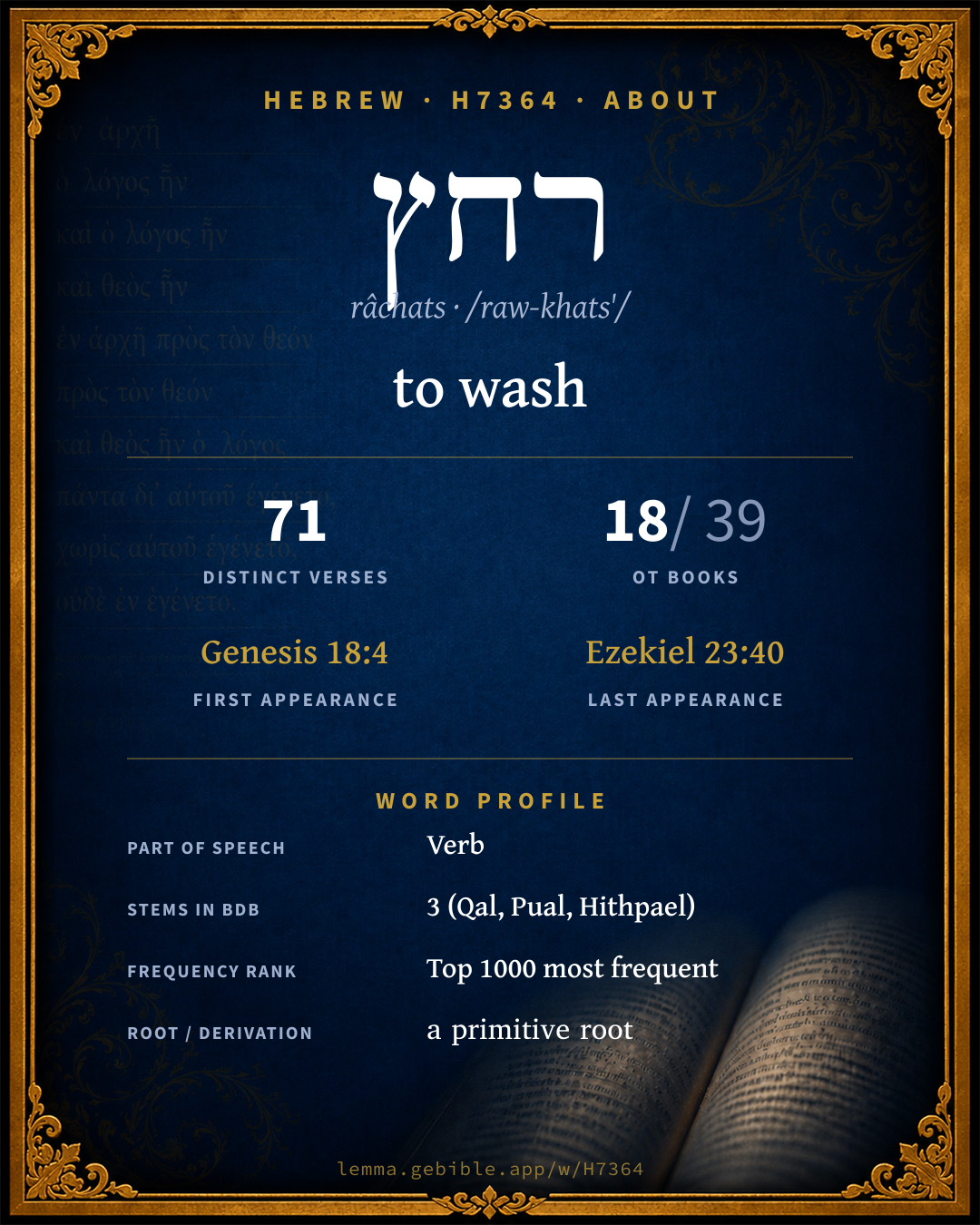
רָחַץ
to wash
also: wash off, wash away, bathe fuller range ↓
Full lexicon entry — Brown-Driver-Briggs (BDB)
From Brown-Driver-Briggs (BDB)
Where this word appears
See every Qal verb in the Hebrew Bible →
Grammar key — what these labels mean
Part of speech
- Verb
- An action or state-of-being word.
Stem
- Qal
- The basic, simple active stem — the plain form of the verb (“he wrote”). Here: ‘trans. wash’
- Pual
- The passive counterpart of the Piel.
- Hithpael
- The reflexive or reciprocal stem (the subject acts on itself).
Form
- Sequential Perfect
- A perfect with prefixed waw continuing a preceding imperfect or command (waw-consecutive perfect).
- Infinitive Construct
- A bound verbal noun, frequently with prepositions (“to write / in writing”).
- Imperfect
- An incomplete, ongoing, or future action (“he will / would write”).
- Sequential Imperfect
- An imperfect with prefixed waw — the standard past-narrative form (waw-consecutive imperfect).
- Perfect
- A completed action or state — Hebrew marks aspect (completeness) more than strict tense (“he wrote”).
- Imperative
- A direct command (“write!”).
- Participle Active
- A verbal adjective expressing ongoing or characteristic action (“writing / one who writes”).
State
- Absolute
- The independent form of a noun, not bound to a following word.
Person
- 3rd Person
- The one spoken about (“he / she / it / they”).
- 2nd Person
- The one addressed (“you”).
- 1st Person
- The speaker (“I / we”).
Gender
- Masculine
- Grammatically masculine.
- Common
- Either gender — not distinguished for this form.
- Feminine
- Grammatically feminine.
Number
- Singular
- One.
- Plural
- More than one (in Hebrew, generally three or more).
68 distinct verses where H7364 appears in the Qal stem, across 17 books. Filtered view — show all forms. Click any verse to open its interlinear word-by-word view. Verse text shown in the World English Bible for context — . Each verse’s Hebrew form is shown with its reference; the English is not keyword-highlighted, since the data carries no word-level English alignment. Use “Compare translations” on any verse to read it across multiple English versions. This concordance covers the Hebrew Bible; Septuagint (Greek Old Testament) occurrences are not indexed here.
Genesis 5 verses
- Genesis 18:4 וְ/רַחֲצ֖וּ conj + Qal impv 2mp Now let a little water be fetched, wash your feet, and rest yourselves under the tree.
- Genesis 19:2 וְ/רַחֲצ֣וּ conj + Qal impv 2mp and he said, "See now, my lords, please turn aside into your servant's house, stay all night, wash your feet, and you will rise up early, and go on your way." They said, "No, but we will stay in the street all night."
- Genesis 24:32 לִ/רְחֹ֣ץ prep + Qal inf.cs The man came into the house, and he unloaded the camels. He gave straw and provender for the camels, and water to wash his feet and the feet of the men who were with him.
- Genesis 43:24 וַ/יִּרְחֲצ֣וּ conj + Qal wimpf 3mp The man brought the men into Joseph's house, and gave them water, and they washed their feet. He gave their donkeys fodder.
- Genesis 43:31 וַ/יִּרְחַ֥ץ conj + Qal wimpf 3ms He washed his face, and came out. He controlled himself, and said, "Serve the meal."
Exodus 11 verses
- Exodus 2:5 לִ/רְחֹ֣ץ prep + Qal inf.cs Pharaoh's daughter came down to bathe at the river. Her maidens walked along by the riverside. She saw the basket among the reeds, and sent her handmaid to get it.
- Exodus 29:4 וְ/רָחַצְתָּ֥ conj + Qal wpf 2ms You shall bring Aaron and his sons to the door of the tent of meeting, and shall wash them with water.
- Exodus 29:17 וְ/רָחַצְתָּ֤ conj + Qal wpf 2ms You shall cut the ram into its pieces, and wash its innards, and its legs, and put them with its pieces, and with its head.
- Exodus 30:18 לְ/רָחְצָ֑ה prep + Qal inf.cs "You shall also make a basin of brass, and the base of it of brass, in which to wash. You shall put it between the tent of meeting and the altar, and you shall put water in it.
- Exodus 30:19 וְ/רָחֲצ֛וּ conj + Qal wpf 3cp Aaron and his sons shall wash their hands and their feet in it.
- Exodus 30:20 יִרְחֲצוּ Qal impf 3mp When they go into the tent of meeting, they shall wash with water, that they not die; or when they come near to the altar to minister, to burn an offering made by fire to Yahweh.
- Exodus 30:21 וְ/רָחֲצ֛וּ conj + Qal wpf 3cp So they shall wash their hands and their feet, that they not die: and it shall be a statute forever to them, even to him and to his descendants throughout their generations."
- Exodus 40:12 וְ/רָחַצְתָּ֥ conj + Qal wpf 2ms You shall bring Aaron and his sons to the door of the tent of meeting, and shall wash them with water.
- Exodus 40:30 לְ/רָחְצָֽה prep + Qal inf.cs He set the basin between the tent of meeting and the altar, and put water therein, with which to wash.
- Exodus 40:31 וְ/רָחֲצ֣וּ conj + Qal wpf 3cp Moses, Aaron, and his sons washed their hands and their feet there.
- Exodus 40:32 יִרְחָ֑צוּ Qal impf 3mp When they went into the tent of meeting, and when they came near to the altar, they washed, as Yahweh commanded Moses.
Leviticus 26 verses
- Leviticus 1:9 יִרְחַ֣ץ Qal impf 3ms but its innards and its legs he shall wash with water. The priest shall burn the whole on the altar, for a burnt offering, an offering made by fire, of a sweet savor to Yahweh.
- Leviticus 1:13 יִרְחַ֣ץ Qal impf 3ms but the innards and the legs he shall wash with water. The priest shall offer the whole, and burn it on the altar. It is a burnt offering, an offering made by fire, of a sweet savor to Yahweh.
- Leviticus 8:6 וַ/יִּרְחַ֥ץ conj + Qal wimpf 3ms Moses brought Aaron and his sons, and washed them with water.
- Leviticus 8:21 רָחַ֣ץ Qal pf 3ms He washed the innards and the legs with water; and Moses burned the whole ram on the altar. It was a burnt offering for a sweet savor. It was an offering made by fire to Yahweh; as Yahweh commanded Moses.
- Leviticus 9:14 וַ/יִּרְחַ֥ץ conj + Qal wimpf 3ms He washed the innards and the legs, and burned them on the burnt offering on the altar.
- Leviticus 14:8 וְ/רָחַ֤ץ conj + Qal wpf 3ms "He who is to be cleansed shall wash his clothes, and shave off all his hair, and bathe himself in water; and he shall be clean. After that he shall come into the camp, but shall dwell outside his tent seven days.
- Leviticus 14:9 וְ/רָחַ֧ץ conj + Qal wpf 3ms It shall be on the seventh day, that he shall shave all his hair off his head and his beard and his eyebrows, even all his hair he shall shave off. He shall wash his clothes, and he shall bathe his body in water, then he shall be clean.
- Leviticus 15:5 וְ/רָחַ֥ץ conj + Qal wpf 3ms Whoever touches his bed shall wash his clothes, and bathe himself in water, and be unclean until the evening.
- Leviticus 15:6 וְ/רָחַ֥ץ conj + Qal wpf 3ms He who sits on anything whereon the man who has the discharge sat shall wash his clothes, and bathe himself in water, and be unclean until the evening.
- Leviticus 15:7 וְ/רָחַ֥ץ conj + Qal wpf 3ms "'He who touches the body of him who has the discharge shall wash his clothes, and bathe himself in water, and be unclean until the evening.
- Leviticus 15:8 וְ/רָחַ֥ץ conj + Qal wpf 3ms "'If he who has the discharge spits on him who is clean, then he shall wash his clothes, and bathe himself in water, and be unclean until the evening.
- Leviticus 15:10 וְ/רָחַ֥ץ conj + Qal wpf 3ms Whoever touches anything that was under him shall be unclean until the evening. He who carries those things shall wash his clothes, and bathe himself in water, and be unclean until the evening.
- Leviticus 15:11 וְ/רָחַ֥ץ conj + Qal wpf 3ms "'Whoever he who has the discharge touches, without having rinsed his hands in water, he shall wash his clothes, and bathe himself in water, and be unclean until the evening.
- Leviticus 15:13 וְ/רָחַ֧ץ conj + Qal wpf 3ms "'When he who has a discharge is cleansed of his discharge, then he shall count to himself seven days for his cleansing, and wash his clothes; and he shall bathe his flesh in running water, and shall be clean.
- Leviticus 15:16 וְ/רָחַ֥ץ conj + Qal wpf 3ms "'If any man has an emission of semen, then he shall bathe all his flesh in water, and be unclean until the evening.
- Leviticus 15:18 וְ/רָחֲצ֣וּ conj + Qal wpf 3cp If a man lies with a woman and there is an emission of semen, they shall both bathe themselves in water, and be unclean until the evening.
- Leviticus 15:21 וְ/רָחַ֥ץ conj + Qal wpf 3ms Whoever touches her bed shall wash his clothes, and bathe himself in water, and be unclean until the evening.
- Leviticus 15:22 וְ/רָחַ֥ץ conj + Qal wpf 3ms Whoever touches anything that she sits on shall wash his clothes, and bathe himself in water, and be unclean until the evening.
- Leviticus 15:27 וְ/רָחַ֥ץ conj + Qal wpf 3ms Whoever touches these things shall be unclean, and shall wash his clothes, and bathe himself in water, and be unclean until the evening.
- Leviticus 16:4 וְ/רָחַ֥ץ conj + Qal wpf 3ms He shall put on the holy linen coat, and he shall have the linen breeches on his body, and shall put on the linen sash, and he shall be dressed with the linen turban. They are the holy garments. He shall bathe his body in water, and put them on.
- Leviticus 16:24 וְ/רָחַ֨ץ conj + Qal wpf 3ms Then he shall bathe himself in water in a holy place, and put on his garments, and come out and offer his burnt offering and the burnt offering of the people, and make atonement for himself and for the people.
- Leviticus 16:26 וְ/רָחַ֥ץ conj + Qal wpf 3ms "He who lets the goat go for the scapegoat shall wash his clothes, and bathe his flesh in water, and afterward he shall come into the camp.
- Leviticus 16:28 וְ/רָחַ֥ץ conj + Qal wpf 3ms He who burns them shall wash his clothes, and bathe his flesh in water, and afterward he shall come into the camp.
- Leviticus 17:15 וְ/רָחַ֥ץ conj + Qal wpf 3ms "'Every person that eats what dies of itself, or that which is torn by animals, whether he is native-born or a foreigner, he shall wash his clothes, and bathe himself in water, and be unclean until the evening: then he shall be clean.
- Leviticus 17:16 יִרְחָ֑ץ Qal impf 3ms But if he doesn't wash them, or bathe his flesh, then he shall bear his iniquity.'"
- Leviticus 22:6 רָחַ֥ץ Qal pf 3ms the person that touches any such shall be unclean until the evening, and shall not eat of the holy things, unless he bathe his body in water.
Numbers 3 verses
- Numbers 19:7 וְ/רָחַ֤ץ conj + Qal wpf 3ms Then the priest shall wash his clothes, and he shall bathe his flesh in water, and afterward he shall come into the camp, and the priest shall be unclean until the even.
- Numbers 19:8 וְ/רָחַ֥ץ conj + Qal wpf 3ms He who burns her shall wash his clothes in water, and bathe his flesh in water, and shall be unclean until the even.
- Numbers 19:19 וְ/רָחַ֥ץ conj + Qal wpf 3ms and the clean person shall sprinkle on the unclean on the third day, and on the seventh day: and on the seventh day he shall purify him; and he shall wash his clothes, and bathe himself in water, and shall be clean at even.
Deuteronomy 2 verses
- Deuteronomy 21:6 יִרְחֲצוּ֙ Qal impf 3mp All the elders of that city, who are nearest to the slain man, shall wash their hands over the heifer whose neck was broken in the valley;
- Deuteronomy 23:11 יִרְחַ֣ץ Qal impf 3ms but it shall be, when evening comes on, he shall bathe himself in water; and when the sun is down, he shall come within the camp.
Judges 1 verse
Ruth 1 verse
1 Samuel 1 verse
2 Samuel 3 verses
- 2 Samuel 11:2 רֹחֶ֖צֶת Qal ptcp.act fs It happened at evening, that David arose from off his bed, and walked on the roof of the king's house: and from the roof he saw a woman bathing; and the woman was very beautiful to look on.
- 2 Samuel 11:8 וּ/רְחַ֣ץ conj + Qal impv 2ms David said to Uriah, Go down to your house, and wash your feet. Uriah departed out of the king's house, and there followed him a mess [of food] from the king.
- 2 Samuel 12:20 וַ/יִּרְחַ֣ץ conj + Qal wimpf 3ms Then David arose from the earth, and washed, and anointed himself, and changed his clothing; and he came into the house of Yahweh, and worshiped: then he came to his own house; and when he required, they set bread before him, and he ate.
1 Kings 1 verse
2 Kings 3 verses
- 2 Kings 5:10 וְ/רָחַצְתָּ֤ conj + Qal wpf 2ms Elisha sent a messenger to him, saying, Go and wash in the Jordan seven times, and your flesh shall come again to you, and you shall be clean.
- 2 Kings 5:12 אֶרְחַ֥ץ Qal impf 1cs Aren't Abanah and Pharpar, the rivers of Damascus, better than all the waters of Israel? may I not wash in them, and be clean? So he turned and went away in a rage.
- 2 Kings 5:13 רְחַ֥ץ Qal impv 2ms His servants came near, and spoke to him, and said, My father, if the prophet had bid you do some great thing, wouldn't you have done it? how much rather then, when he says to you, Wash, and be clean?
2 Chronicles 1 verse
Job 1 verse
Psalms 3 verses
- Psalms 26:6 אֶרְחַ֣ץ Qal impf 1cs I will wash my hands in innocence, So I will go about your altar, Yahweh;
- Psalms 58:10 יִ֝רְחַ֗ץ Qal impf 3ms The righteous shall rejoice when he sees the vengeance. He shall wash his feet in the blood of the wicked;
- Psalms 73:13 וָ/אֶרְחַ֖ץ conj + Qal wimpf 1cs Surely in vain I have cleansed my heart, And washed my hands in innocence,
Song of Solomon 2 verses
Isaiah 2 verses
- Isaiah 1:16 רַחֲצוּ֙ Qal impv 2mp Wash yourselves, make yourself clean. Put away the evil of your doings from before my eyes; Cease to do evil.
- Isaiah 4:4 רָחַ֣ץ Qal pf 3ms when the Lord shall have washed away the filth of the daughters of Zion, and shall have purged the blood of Jerusalem from its midst, by the spirit of justice, and by the spirit of burning.
Ezekiel 2 verses
- Ezekiel 16:9 וָ/אֶרְחָצֵ֣/ךְ conj + Qal wimpf 1cs + sfx pers 2fs Then washed I you with water; yes, I thoroughly washed away your blood from you, and I anointed you with oil.
- Ezekiel 23:40 רָחַ֛צְתְּ Qal pf 2fs Furthermore you have sent for men who come from far, to whom a messenger was sent, and, behold, they came; for whom you did wash yourself, paint your eyes, and deck yourself with ornaments,
About this entry
At a glance — auto-summarized from this page’s data, not written by a person. Every figure links to its source below. This summary describes the numbers; it doesn’t interpret them.
At its core, רחץ (râchats) means “to wash.” Older and newer Bibles part ways — “bathe” in the King James Version, “he shall bathe” (unfoldingWord Literal Text) in modern versions. See the renderings breakdown. It turns up in 71 verses across 18 books, a moderately common footprint. The word gravitates to Leviticus (37%), then Exodus and Genesis. Different stems carry different senses — BDB groups them under 3 stems, among them Qal and Pual. Dig into 71-verse concordance and the renderings breakdown below.
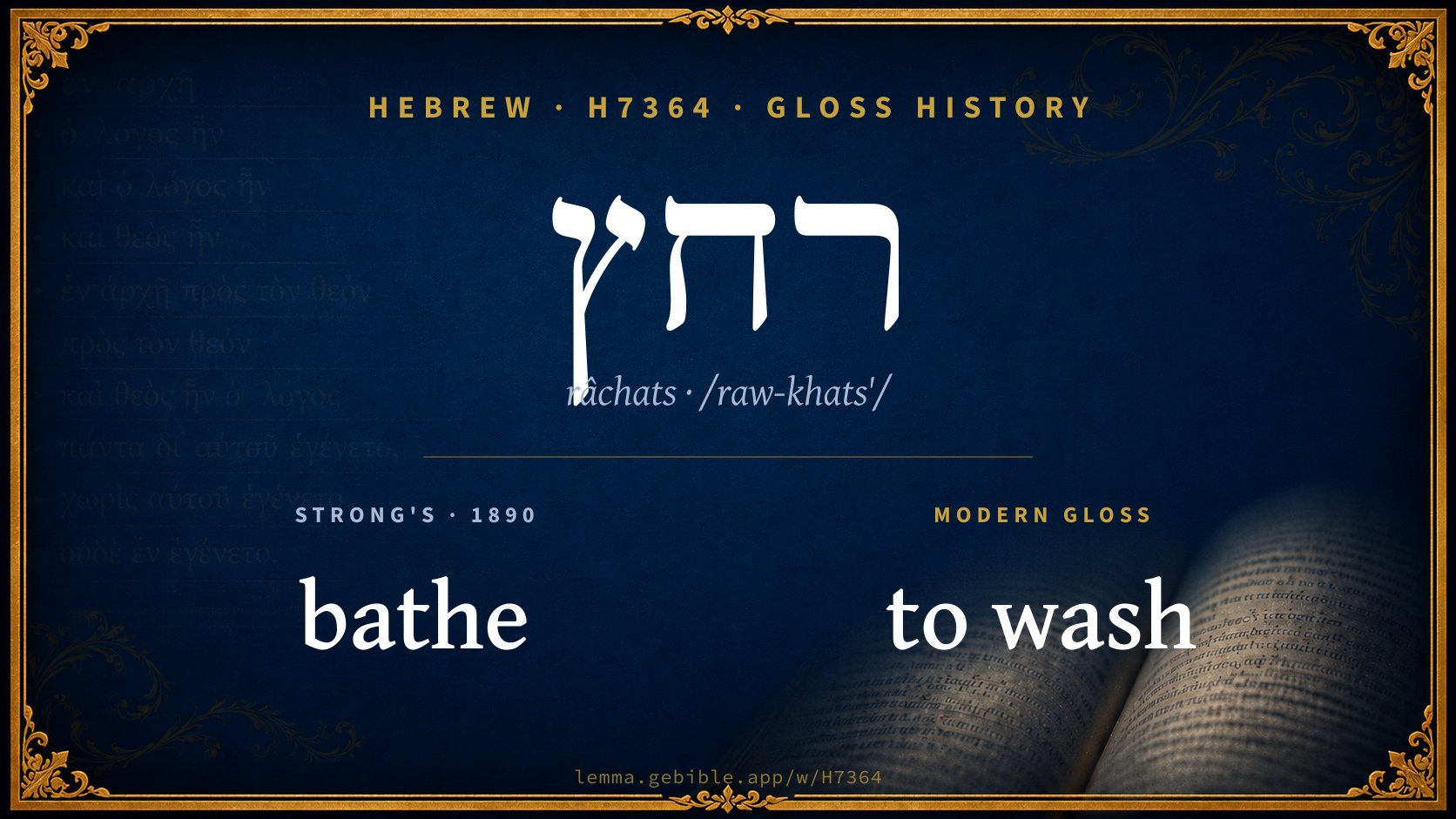
Gloss history
Strong's 1890 vs modern scholarship
About this word
Strong's H7364 catalogs a Hebrew word from the Hebrew Old Testament.
These counts are not copied from any lexicon or concordance. They are computed here, from the morphology-tagged Hebrew Old Testament. What Lemma adds →
- 71
- distinct verses
- The word appears in 71 distinct verses.
- 18 / 39
- OT books
- The word appears in 18 of 39 Old Testament books.
- #550
- by frequency
- Top 1000 most frequent Hebrew words (rank 550 of 8,640 Hebrew words by occurrence).
View all 71 occurrences in the concordance →
By section of the Old Testament
By traditional corpus
Conventional, traditional groupings — biblical authorship is debated, so this is a traditional corpus grouping, not an authorship claim. Each share is this word’s portion of its verses in that division of the Hebrew canon. Each figure is a share of the word’s 71 distinct verses.
- Torah (Pentateuch) 47 verses · 66%
- Prophets (Nevi'im) 14 verses · 20%
- Writings (Ketuvim) 10 verses · 14%
How translations render this word
Counts come from each version’s own published word-to-Strong’s tagging or interlinear alignment — an approximate guide to how each version renders this word, not a word-level alignment the data otherwise carries. Because each total is that version’s own tagged count, the per-version totals vary from one another and need not match the appearance or distinct-verse counts above. These counts may also differ from a printed concordance because Lemma counts each distinctly tagged rendering and does not collapse phrase taggings into a single head-word total. This is a fixed set of word-tagged versions (KJV, ASV, BSB, ULT) and does not change with the reading translation you choose elsewhere. Each version’s license is shown beside its name below (and on Sources).
- King James Version: Bathe 16×, Wash 15×, He shall wash 6×
- American Standard Version: Wash 10×, Bathe 9×, He shall bathe 6×
- Berean Standard Bible: Bathe 19×, Wash 10×, Washing 4×
- unfoldingWord Literal Text: He shall bathe 18×, Wash 9×, Bathe 5×
King James Version Public Domain
Renders H7364 across 72 tagged occurrences — most commonly:
Plus 21 renderings that appear only once — usually multi-word phrases or single function words the recovered tagging swept in, not distinct renderings.
American Standard Version Public Domain
Renders H7364 across 64 tagged occurrences — most commonly:
Plus 21 renderings that appear only once — usually multi-word phrases or single function words the recovered tagging swept in, not distinct renderings.
Berean Standard Bible Public Domain
Renders H7364 across 72 tagged occurrences — most commonly:
Plus 23 renderings that appear only once — usually multi-word phrases or single function words the recovered tagging swept in, not distinct renderings.
unfoldingWord Literal Text CC BY-SA 4.0
Renders H7364 across 79 tagged occurrences — most commonly:
Plus 24 renderings that appear only once — usually multi-word phrases or single function words the recovered tagging swept in, not distinct renderings.
Senses in the full BDB
Hebrew verbs can shift meaning by stem (binyan): Qal is the basic action, Niphal is often passive or reflexive, Piel often intensifies or makes it factitive, and Hiphil is typically causative. The senses below are grouped under the stem BDB assigns to each. This entry also uses Pual (the passive of Piel) and Hithpael (reflexive or reciprocal).
What do BDB’s symbols mean?
BDB uses these scholarly abbreviations:
| Symbol | Meaning |
|---|---|
| 𝔊 | the Septuagint (the ancient Greek translation, LXX) |
| 𝔙 | the Vulgate (the Latin translation) |
| 𝔖 | the Syriac version (the Peshitta) |
| 𝔗 | the Targum (the Aramaic translation) |
| ψ | the Psalms |
| √ | root (the underlying root or stem) |
| ‖ | parallel passage (a synonymous or contrasted parallel) |
| † | the dagger: every passage where the word occurs is cited |
The 5 senses and sub-senses the full Brown-Driver-Briggs lexicon distinguishes for this word, in lexicon order (not ranked by frequency), with BDB’s own verbatim wording and sub-sense lettering. Shown in Hebrew script with BDB’s own scholarly abbreviations. The condensed entry is in the Lexicon Entry tab. See also the Forms in the corpus table below.
Qal
- Pf. 3 ms. ר׳ Is 4:4 +, etc.; Impf. 3 ms. יִרְחַץ Dt 23:12 + etc.; Imv. ms. רְחַץ 2 S 11:8; 2 K 5:13; mpl. רַחֲצוּ Gn 18:4 +; Inf. cstr. רְחֹץ Gn 24:32 +, לְרָחְצָה Ex 30:18 +; Pt. fs. רֹחֶ֫צֶת 2 S 11:2, fpl. רֹחֲצוֹת Ct 5:12;— e.g. Isaiah 4:4
- 1. trans. wash (with water), c. acc. feet (רגלים; בַּמַּיִם often expr.), Gn 18:4; 19:2; 24:32; 43:24 (all J), Ju 19:21; 1 S 25:41; 2 S 11:8; Ct 5:3; יִר׳ פְּעָמָיו בְּדַם הָרָשָׁע ψ 58:11 (fig. of righteous, at י׳’s vengeance); c. acc. hands (יָדַיִם) Dt 21:6 (+ עַל over, in ceremonial, to express innocence), hence fig. אֶר׳ כַּפַּי בְּנִקָּיוֹן ψ 26:6; 73:13; hands and feet Ex 30:19 (+ מִן of laver), v 21; 40:31 (+ מִן id.; all P); c. acc. face (פָּנָיו) Gn 43:31 (J); c. acc. pers. Ez 16:9; Ex 29:4; 40:12; Lv 8:6 (all P), acc. בְּשָׂרוֹ (often ‖ כבּס of garments), Lv 14:9; 15:13 + 9 times P (H); c. acc. of parts of sacrificial victim Ex 29:17; Lv 1:9, 13; 8:21; 9:14; wash off, away, c. acc. of filth Is 4:4 (fig.). e.g. Genesis 18:4
- 2. intrans. wash, bathe (oneself): Ex 2:5 (E), 2 S 11:2; 12:20 1 K 22:38; 2 K 5:10, 12, 13; Is 1:16; Ez 23:40 (+ ל pers. of whom), Ru 3:3; Lv 14:8 + 14 times P (often ‖ כבּס); + ב of laver 2 Ch 4:6(×2); of eyes, bathed in milk (בֶּחָלָב) Ct 5:12 (fig.); Jb 29:6 (fig.), v. הָלִיךְ. e.g. Exodus 2:5
Pual
- Pf. 3 ms. רֻחָ֑ץ Pr 30:12 be washed (+ מִן of filth, fig.); 2 fs. בְּמַיִם לֹא רֻחַצְתְּ Ez 16:4 (in fig.). e.g. Proverbs 30:12
Hithpael
- Pf. 1 s. הִתְרָחַצְתִּי במו שׁלג Jb 9:30 if I washed myself in snow (fig.). e.g. Job 9:30
Senses from the full Brown-Driver-Briggs lexicon (Brown, Driver, Briggs; Oxford 1906 — public domain), digitized via Sefaria, supplemented by the OpenScriptures HebrewLexicon (CC BY 4.0). Full attribution on Sources.
Word origin
vb. wash, wash off, away, bathe (NH = BH; Arabic رَحَضَ (also of garments); Ethiopic ርሕፀ:, ረሐፀ:, sweat; cf. Assyrian raḫâṣu, overflow, flood (on ḫ = ح v. NöZMG xi (1886), 727));—
— Brown-Driver-Briggs (Oxford 1906, public domain), digitized via Sefaria, supplemented by the OpenScriptures HebrewLexicon (CC BY 4.0). See Sources.
Origin: a primitive root
Jastrow Dictionary
A second Hebrew/Aramaic lexicon for comparison, covering Aramaic and post-biblical (Talmudic, Targumic, Midrashic) usage that the biblical-Hebrew BDB does not. Matched by lemma rather than by Strong’s number, so a lemma may carry more than one Jastrow headword (shown separately below), and the entries cover usage well beyond the Bible.
רָחַץ
- (b. h.) to bathe, wash. Sabb. 122ᵃ מותר לִרְחוֹץ בה מיד it is permitted to bathe in it immediately (after the exit of the Sabbath); ib. 151ᵃ; Makhsh. II, 5 רוֹחֵץ מיד. Ber. 15ᵃ מי שאין … לרחוץ ידיו (Ms. M. ליטול) he that has no water with which to wash his hands (before prayer). Tosef. Keth. VII, 6 ורוֹחֶצֶת במרחץ עם כל אדם a woman that bathes in a bath-house with all kind of people (loses her jointure). Y. ib. VII, 31ᵇ bot. (as a case for divorce) הדירה שלא תִרְחֲצִי וכ׳ if he bound her by a vow (saying), thou shalt not bathe in a bath-house; a. fr.—Part. pass. רָחוּץ. Zeb. 17ᵇ שלא רְחוּץ ידים וכ׳ not having washed his hands and feet (before a sacred function); Tosef. Men. I, 9. Ib. 12 שלא רחוץ, Var. ולא רָחְצוּ.
- 1. same, same, to wash, cleanse. Ib. 10 משפשף ומַרְחִיץ he rubs and washes (hands and feet). Ber. l. c. (ref. to Ps. XXVI, 6) דכתיב אֶרְחַץ ולא אַרְחִיץ (v. Ms. M., Rabb. D. S. a. l.) it is written erḥats (I bathe), and not arḥits (I cleanse), i.e. washing of hands as a symbolical act is equal to immersion. Y. Keth. V, 30ᵃ bot. ומַרְחֶצֶת לו וכ׳ she must bathe his feet (personally attend to his foot-bath). Yalk. Cant. 988 שמַרְחִיצִין את ישראל וכ׳ who cleanse Israel from sins; a. e. e.g. Psalms 26:6
- 2. to cause to bathe. Num. R. s. 132 עתיד … ולהַרְחִיצָם בנחלי חלב the Lord shall cause them to drink …, and to bathe in rivers of milk. Sabb. l. c.; Makhsh. l. c. מרחץ המרחצת בשבת a bath-house that allows bathing (is heated and open) on the Sabbath. Y. Ber. II, 4ᶜ bot. מרחץ ואע"פ שאינה מרחצת a bath-house, even if it is not in use.
- to cleanse.—Part. pass. מְרוּחָץ; pl. מְרוּחָצִין. Cant. R. to IV, 4 שהיו כולן מר׳ מן העונות they were all cleansed of their sins.
- to be cleansed. Yalk. Cant. l. c. שהטיף … ונִרְחֲצוּ מעונותיהם the Lord dropped dew upon them, and they were cleansed of their sins.
רְחֵץ
- (with על, or ב־) to lean on; to trust; to be safe. Targ. Ps. CXVIII, 8, sq. Ib. 10, sq. Targ. Y. I Gen. XXVII, 40. Targ. Job XII, 6; a. fr.—Y. Ber. II, 5ᵃ רְחִיצַיָּא אנן we are sure (cmp. מובטח, v. בָּטַח). Snh. 7ᵃ גברא דרחיצנא עליה וכ׳ the man in whom I trusted lifted up his club &c.; a. e.
- same. Targ. II Kings XVIII, 19, sq. Targ. Ps. XXV, 2. Ib. XXXVI, 8 Ms. (v. רוּחְצָן). Targ. Jer. XLIX, 4; a. fr.—B. Bath. 91ᵇ דמודי … דמִתְרְחִיץ עליהון וכ׳ he who assents to them (pretends to share their errors) falls into their hand; he who confides in them,—what is his is theirs. Y. Sabb. II, 5ᵇ לא תִתְרְחֵץ על צלותי rely not on my prayer. Cant. R. to VII, 2 בגין דאִיתְרְחִיצוּ ביה because they trusted in him; a. e.
- to cause to trust. Targ. Is. XXXVI, 15; Targ. II Kings XVIII, 30. Targ. Jer. XXIX, 31.
A Dictionary of the Targumim, the Talmud Babli and Yerushalmi, and the Midrashic Literature (Marcus Jastrow; London, Luzac, 1903) — Public Domain. Digitized via Sefaria. Digitized via Sefaria. Full attribution on Sources.
Forms in the corpus
The 45 distinct written forms H7364 takes in the Hebrew Bible, most frequent first — each parse links to that stem’s occurrences in the concordance. Hebrew forms include their vowel points and cantillation, so a single lemma takes many written forms.
Same root — word family
Other BDB entries built from the same root as H7364, grouped by Strong’s listed origin. These share a root / origin per the lexicon — not necessarily a shared meaning. Each links to that word’s own entry.
Derived from this word
Compare all same-root words → They share a root, not necessarily a meaning.
Septuagint verse parallels
This word appears in 71 verses that also exist in the Greek Old Testament (Septuagint), out of the 71 Hebrew verses it occurs in. You can read those verses in Greek by switching the Old Testament edition to the Septuagint.
Read these verses in the Septuagint
- Genesis 18:4
- Exodus 2:5
- Leviticus 1:9
- Numbers 19:7
- Deuteronomy 21:6
- Judges 19:21
- Ruth 3:3
- 1 Samuel 25:41
- 2 Samuel 11:2
- 1 Kings 22:38
- 2 Kings 5:10
- 2 Chronicles 4:6
This is a verse-level parallel only — the same verses exist in both the Hebrew and Greek Old Testaments. No word-level Hebrew↔Greek correspondence is claimed: the data carries no such alignment, so no Greek word is shown as this Hebrew word’s translation. Coverage is not total — the Septuagint omits the deuterocanon and renumbers the Psalms, so some Hebrew verses have no direct Greek parallel.