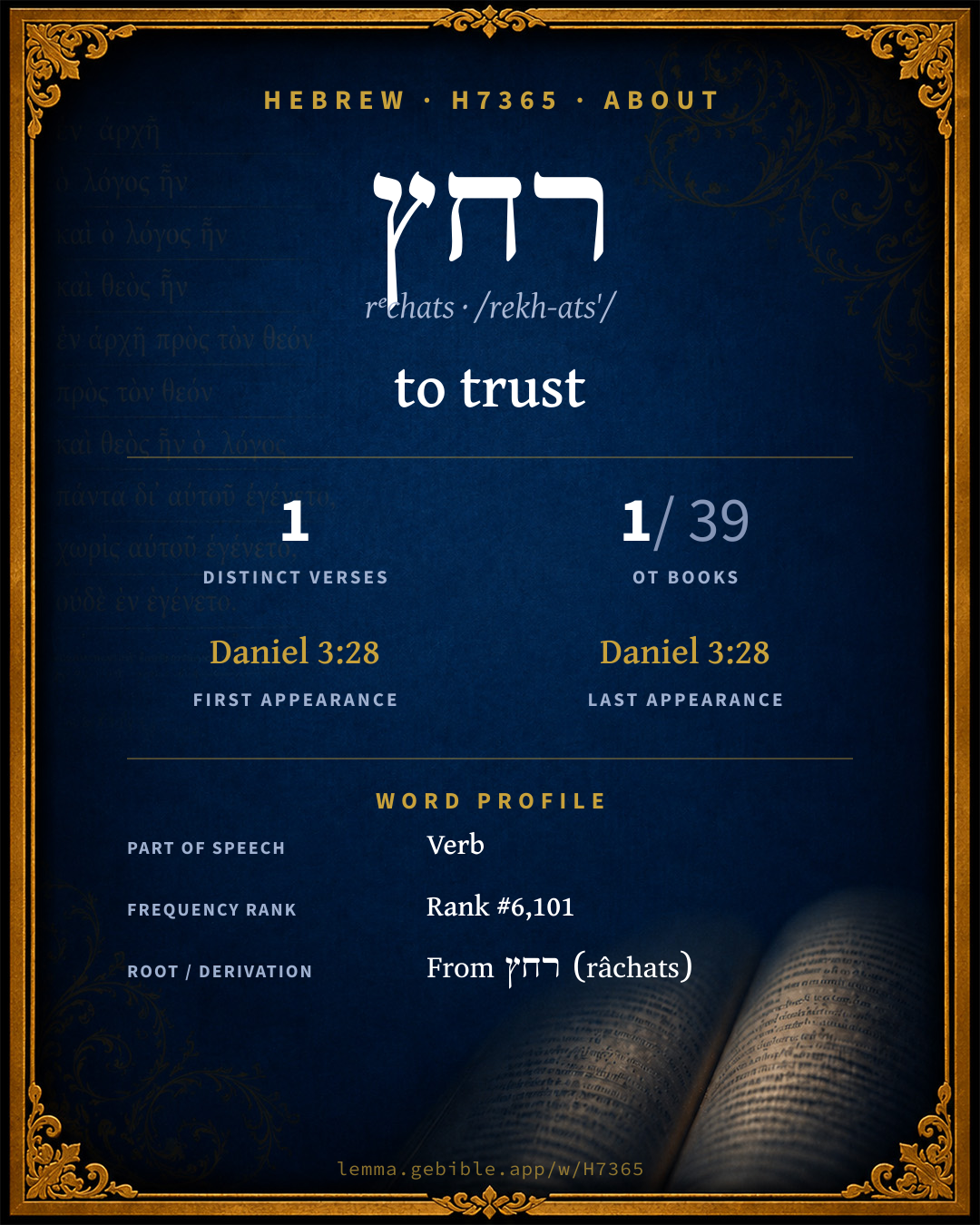
רְחַץ
to trust
‘to trust’ is one of 2 main senses fuller range ↓
Full lexicon entry — Brown-Driver-Briggs (BDB)
From Brown-Driver-Briggs (BDB)
Where this word appears
Grammar key — what these labels mean
Part of speech
- Verb
- An action or state-of-being word.
Form
- Perfect
- A completed action or state — Hebrew marks aspect (completeness) more than strict tense (“he wrote”).
Person
- 3rd Person
- The one spoken about (“he / she / it / they”).
Gender
- Masculine
- Grammatically masculine.
Number
- Plural
- More than one (in Hebrew, generally three or more).
Every verse where H7365 appears — 1 distinct verse across 1 book. Click any verse to open its interlinear word-by-word view. Verse text shown in the World English Bible for context — . Each verse’s Hebrew form is shown with its reference; the English is not keyword-highlighted, since the data carries no word-level English alignment. Use “Compare translations” on any verse to read it across multiple English versions. This concordance covers the Hebrew Bible; Septuagint (Greek Old Testament) occurrences are not indexed here.
Daniel 1 verse
About this entry
At a glance — auto-summarized from this page’s data, not written by a person. Every figure links to its source below. This summary describes the numbers; it doesn’t interpret them.
“to trust” is the headline sense of the Hebrew verb רחץ (rᵉchats). With only 1 verse it sits in the long tail of Hebrew Bible vocabulary. More than three-quarters of its appearances fall in Daniel. A true hapax — its single appearance is Daniel 3:28. Catalogued under 2 senses, its meaning is not single-sense. See the sense tree, 1-verse concordance, and the renderings breakdown below.
Gloss history
Strong's 1890 vs modern scholarship
About this word
Strong's H7365 catalogs a Hebrew word from the Hebrew Old Testament.
These counts are not copied from any lexicon or concordance. They are computed here, from the morphology-tagged Hebrew Old Testament. What Lemma adds →
- 1
- distinct verses
- The word appears in 1 distinct verse.
- 1 / 39
- OT books
- The word appears in 1 of 39 Old Testament books.
- #6,101
- by frequency
- Rank #6,101 (rank 6,101 of 8,640 Hebrew words by occurrence).
View all 1 occurrence in the concordance →
Most concentrated in
- Daniel 1 verse 100%
By section of the Old Testament
By traditional corpus
Conventional, traditional groupings — biblical authorship is debated, so this is a traditional corpus grouping, not an authorship claim. Each share is this word’s portion of its verses in that division of the Hebrew canon. Each figure is a share of the word’s 1 distinct verse.
- Writings (Ketuvim) 1 verse · 100%
How translations render this word
Counts come from each version’s own published word-to-Strong’s tagging or interlinear alignment — an approximate guide to how each version renders this word, not a word-level alignment the data otherwise carries. Because each total is that version’s own tagged count, the per-version totals vary from one another and need not match the appearance or distinct-verse counts above. These counts may also differ from a printed concordance because Lemma counts each distinctly tagged rendering and does not collapse phrase taggings into a single head-word total. This is a fixed set of word-tagged versions (KJV, ASV, BSB, ULT) and does not change with the reading translation you choose elsewhere. Each version’s license is shown beside its name below (and on Sources).
- King James Version: Trusted 1×
- American Standard Version: Trusted 1×
- Berean Standard Bible: Trusted 1×
- unfoldingWord Literal Text: Trusted 1×
King James Version Public Domain
Renders H7365 across 1 tagged occurrence — most commonly:
American Standard Version Public Domain
Renders H7365 across 1 tagged occurrence — most commonly:
Berean Standard Bible Public Domain
Renders H7365 across 1 tagged occurrence — most commonly:
unfoldingWord Literal Text CC BY-SA 4.0
Renders H7365 across 1 tagged occurrence — most commonly:
Senses in BDB
The 2 senses BDB distinguishes for this word, in lexicon order (not ranked by frequency or importance). The full entry — with sub-senses — is in the Lexicon Entry tab.
- to trust
- (Hithpeil) to set one's trust on
Word origin
[ רְחַץ ] vb. trust;— Hithpe. Dn 3:28.
— Brown-Driver-Briggs (Oxford 1906, public domain), digitized via Sefaria, supplemented by the OpenScriptures HebrewLexicon (CC BY 4.0). See Sources.
Derived from רחץ (râchats) (H7364) — to wash.
Jastrow Dictionary
A second Hebrew/Aramaic lexicon for comparison, covering Aramaic and post-biblical (Talmudic, Targumic, Midrashic) usage that the biblical-Hebrew BDB does not. Matched by lemma rather than by Strong’s number, so a lemma may carry more than one Jastrow headword (shown separately below), and the entries cover usage well beyond the Bible.
רָחַץ
- (b. h.) to bathe, wash. Sabb. 122ᵃ מותר לִרְחוֹץ בה מיד it is permitted to bathe in it immediately (after the exit of the Sabbath); ib. 151ᵃ; Makhsh. II, 5 רוֹחֵץ מיד. Ber. 15ᵃ מי שאין … לרחוץ ידיו (Ms. M. ליטול) he that has no water with which to wash his hands (before prayer). Tosef. Keth. VII, 6 ורוֹחֶצֶת במרחץ עם כל אדם a woman that bathes in a bath-house with all kind of people (loses her jointure). Y. ib. VII, 31ᵇ bot. (as a case for divorce) הדירה שלא תִרְחֲצִי וכ׳ if he bound her by a vow (saying), thou shalt not bathe in a bath-house; a. fr.—Part. pass. רָחוּץ. Zeb. 17ᵇ שלא רְחוּץ ידים וכ׳ not having washed his hands and feet (before a sacred function); Tosef. Men. I, 9. Ib. 12 שלא רחוץ, Var. ולא רָחְצוּ.
- 1. same, same, to wash, cleanse. Ib. 10 משפשף ומַרְחִיץ he rubs and washes (hands and feet). Ber. l. c. (ref. to Ps. XXVI, 6) דכתיב אֶרְחַץ ולא אַרְחִיץ (v. Ms. M., Rabb. D. S. a. l.) it is written erḥats (I bathe), and not arḥits (I cleanse), i.e. washing of hands as a symbolical act is equal to immersion. Y. Keth. V, 30ᵃ bot. ומַרְחֶצֶת לו וכ׳ she must bathe his feet (personally attend to his foot-bath). Yalk. Cant. 988 שמַרְחִיצִין את ישראל וכ׳ who cleanse Israel from sins; a. e. e.g. Psalms 26:6
- 2. to cause to bathe. Num. R. s. 132 עתיד … ולהַרְחִיצָם בנחלי חלב the Lord shall cause them to drink …, and to bathe in rivers of milk. Sabb. l. c.; Makhsh. l. c. מרחץ המרחצת בשבת a bath-house that allows bathing (is heated and open) on the Sabbath. Y. Ber. II, 4ᶜ bot. מרחץ ואע"פ שאינה מרחצת a bath-house, even if it is not in use.
- to cleanse.—Part. pass. מְרוּחָץ; pl. מְרוּחָצִין. Cant. R. to IV, 4 שהיו כולן מר׳ מן העונות they were all cleansed of their sins.
- to be cleansed. Yalk. Cant. l. c. שהטיף … ונִרְחֲצוּ מעונותיהם the Lord dropped dew upon them, and they were cleansed of their sins.
רְחֵץ
- (with על, or ב־) to lean on; to trust; to be safe. Targ. Ps. CXVIII, 8, sq. Ib. 10, sq. Targ. Y. I Gen. XXVII, 40. Targ. Job XII, 6; a. fr.—Y. Ber. II, 5ᵃ רְחִיצַיָּא אנן we are sure (cmp. מובטח, v. בָּטַח). Snh. 7ᵃ גברא דרחיצנא עליה וכ׳ the man in whom I trusted lifted up his club &c.; a. e.
- same. Targ. II Kings XVIII, 19, sq. Targ. Ps. XXV, 2. Ib. XXXVI, 8 Ms. (v. רוּחְצָן). Targ. Jer. XLIX, 4; a. fr.—B. Bath. 91ᵇ דמודי … דמִתְרְחִיץ עליהון וכ׳ he who assents to them (pretends to share their errors) falls into their hand; he who confides in them,—what is his is theirs. Y. Sabb. II, 5ᵇ לא תִתְרְחֵץ על צלותי rely not on my prayer. Cant. R. to VII, 2 בגין דאִיתְרְחִיצוּ ביה because they trusted in him; a. e.
- to cause to trust. Targ. Is. XXXVI, 15; Targ. II Kings XVIII, 30. Targ. Jer. XXIX, 31.
A Dictionary of the Targumim, the Talmud Babli and Yerushalmi, and the Midrashic Literature (Marcus Jastrow; London, Luzac, 1903) — Public Domain. Digitized via Sefaria. Digitized via Sefaria. Full attribution on Sources.
Same root — word family
Other BDB entries built from the same root as H7365, grouped by Strong’s listed origin. These share a root / origin per the lexicon — not necessarily a shared meaning. Each links to that word’s own entry.
Derives from
Shares the same root
Compare all same-root words → They share a root, not necessarily a meaning.
Septuagint verse parallels
This word appears in 1 verse that also exists in the Greek Old Testament (Septuagint), out of the 1 Hebrew verse it occurs in. You can read those verses in Greek by switching the Old Testament edition to the Septuagint.
Read these verses in the Septuagint
This is a verse-level parallel only — the same verses exist in both the Hebrew and Greek Old Testaments. No word-level Hebrew↔Greek correspondence is claimed: the data carries no such alignment, so no Greek word is shown as this Hebrew word’s translation. Coverage is not total — the Septuagint omits the deuterocanon and renumbers the Psalms, so some Hebrew verses have no direct Greek parallel.