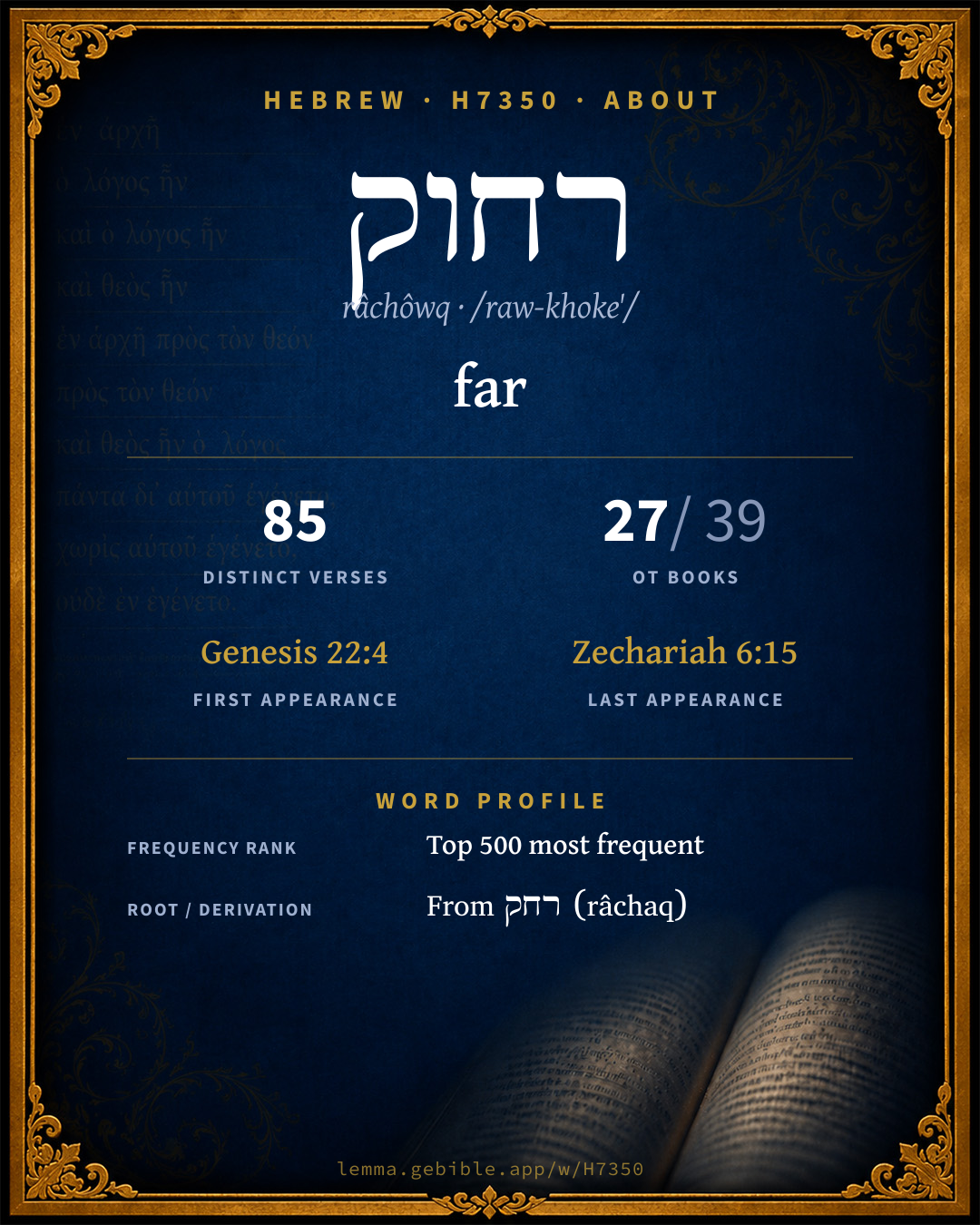
רָחֹק
far
also: remote, distant, distant lands, distant ones fuller range ↓
Full lexicon entry — Brown-Driver-Briggs (BDB)
From Brown-Driver-Briggs (BDB)
Where this word appears
Grammar key — what these labels mean
Part of speech
- Adjective
- A word that describes or qualifies a noun.
State
- Absolute
- The independent form of a noun, not bound to a following word.
Gender
- Masculine
- Grammatically masculine.
- Feminine
- Grammatically feminine.
Number
- Singular
- One.
- Plural
- More than one (in Hebrew, generally three or more).
Every verse where H7350 appears in the Book of Isaiah — 18 distinct verses. Click any verse to open its interlinear word-by-word view. Verse text shown in the World English Bible for context — . Each verse’s Hebrew form is shown with its reference; the English is not keyword-highlighted, since the data carries no word-level English alignment. Use “Compare translations” on any verse to read it across multiple English versions. This concordance covers the Hebrew Bible; Septuagint (Greek Old Testament) occurrences are not indexed here.
Isaiah
- Isaiah 5:26 מֵ/רָח֔וֹק prep + Adjective Adjective ms He will lift up a banner to the nations from far, And he will whistle for them from the end of the earth. Behold, they will come speedily and swiftly.
- Isaiah 22:3 מֵ/רָח֖וֹק prep + Adjective Adjective ms All your rulers fled away together, they were bound by the archers; all who were found of you were bound together; they fled afar off.
- Isaiah 22:11 מֵֽ/רָח֖וֹק prep + Adjective Adjective ms you made also a reservoir between the two walls for the water of the old pool. But you didn't look to him who had done this, neither did you have respect for him who purposed it long ago.
- Isaiah 23:7 מֵֽ/רָח֖וֹק prep + Adjective Adjective ms Is this your joyous [city], whose antiquity is of ancient days, whose feet carried her afar off to sojourn?
- Isaiah 25:1 מֵֽ/רָח֖וֹק prep + Adjective Adjective ms Yahweh, you are my God; I will exalt you, I will praise your name; for you have done wonderful things, [even] counsels of old, in faithfulness [and] truth.
- Isaiah 33:13 רְחוֹקִ֖ים adj Adjective mp Hear, you who are far off, what I have done; and, you who are near, acknowledge my might.
- Isaiah 37:26 לְ/מֵֽ/רָחוֹק֙ prep + prep + Adjective Adjective ms Have you not heard how I have done it long ago, and formed it of ancient times? now have I brought it to pass, that it should be your to lay waste fortified cities into ruinous heaps.
- Isaiah 39:3 רְחוֹקָ֛ה adj Adjective fs Then came Isaiah the prophet to king Hezekiah, and said to him, What said these men? and from whence came they to you? Hezekiah said, They are come from a far country to me, even from Babylon.
- Isaiah 43:6 מֵ/רָח֔וֹק prep + Adjective Adjective ms I will tell the north, Give up; and to the south, Don't keep back; bring my sons from far, and my daughters from the end of the earth;
- Isaiah 46:12 הָ/רְחוֹקִ֖ים ptcl def.art + Adjective Adjective mp Listen to me, you stout-hearted, who are far from righteousness:
- Isaiah 49:1 מֵ/רָח֑וֹק prep + Adjective Adjective ms Listen, isles, to me; and listen, you peoples, from far: Yahweh has called me from the womb; from the bowels of my mother has he made mention of my name:
- Isaiah 49:12 מֵ/רָח֖וֹק prep + Adjective Adjective ms Behold, these shall come from far; and, behold, these from the north and from the west; and these from the land of Sinim.
- Isaiah 57:9 מֵ֣/רָחֹ֔ק prep + Adjective Adjective ms You went to the king with oil, and did increase your perfumes, and did send your ambassadors far off, and did debase yourself even to Sheol.
- Isaiah 57:19 לָ/רָח֧וֹק prep det + Adjective Adjective ms I create the fruit of the lips: Peace, peace, to him who is far off and to him who is near, says Yahweh; and I will heal him.
- Isaiah 59:14 מֵ/רָח֣וֹק prep + Adjective Adjective ms Justice is turned away backward, and righteousness stands afar off; for truth is fallen in the street, and uprightness can't enter.
- Isaiah 60:4 מֵ/רָח֣וֹק prep + Adjective Adjective ms Lift up your eyes round about, and see: they all gather themselves together, they come to you; your sons shall come from far, and your daughters shall be carried in the arms.
- Isaiah 60:9 מֵֽ/רָח֔וֹק prep + Adjective Adjective ms Surely the isles shall wait for me, and the ships of Tarshish first, to bring your sons from far, their silver and their gold with them, for the name of Yahweh your God, and for the Holy One of Israel, because he has glorified you.
- Isaiah 66:19 הָ/רְחֹקִ֗ים ptcl def.art + Adjective Adjective mp I will set a sign among them, and I will send such as escape of them to the nations, to Tarshish, Pul, and Lud, who draw the bow, to Tubal and Javan, to the isles afar off, who have not heard my fame, neither have seen my glory; and they shall declare my glory among the nations.
About this entry
At a glance — auto-summarized from this page’s data, not written by a person. Every figure links to its source below. This summary describes the numbers; it doesn’t interpret them.
“far” is the headline sense of the Hebrew word רחוק (râchôwq). Its English rendering has broadened — “afar off” classically, “afar” (Berean Standard Bible) and “distant” (unfoldingWord Literal Text) in modern versions; see the renderings breakdown. The Hebrew Bible uses it across 85 verses — moderately common. Its earliest occurrence is Genesis 22:4. Beyond “far” it also covers “remote”, “distant”, and “distant lands” — see its full sense range. See the sense tree, 85-verse concordance, and the renderings breakdown below.
Gloss history
Strong's 1890 vs modern scholarship
About this word
Strong's H7350 catalogs a Hebrew word from the Hebrew Old Testament.
These counts are not copied from any lexicon or concordance. They are computed here, from the morphology-tagged Hebrew Old Testament. What Lemma adds →
- 85
- distinct verses
- The word appears in 85 distinct verses.
- 27 / 39
- OT books
- The word appears in 27 of 39 Old Testament books.
- #481
- by frequency
- Top 500 most frequent Hebrew words (rank 481 of 8,640 Hebrew words by occurrence).
View all 85 occurrences in the concordance →
By section of the Old Testament
By traditional corpus
Conventional, traditional groupings — biblical authorship is debated, so this is a traditional corpus grouping, not an authorship claim. Each share is this word’s portion of its verses in that division of the Hebrew canon. Each figure is a share of the word’s 85 distinct verses.
- Prophets (Nevi'im) 46 verses · 54%
- Writings (Ketuvim) 27 verses · 32%
- Torah (Pentateuch) 12 verses · 14%
How translations render this word
Counts come from each version’s own published word-to-Strong’s tagging or interlinear alignment — an approximate guide to how each version renders this word, not a word-level alignment the data otherwise carries. Because each total is that version’s own tagged count, the per-version totals vary from one another and need not match the appearance or distinct-verse counts above. These counts may also differ from a printed concordance because Lemma counts each distinctly tagged rendering and does not collapse phrase taggings into a single head-word total. This is a fixed set of word-tagged versions (KJV, ASV, BSB, ULT) and does not change with the reading translation you choose elsewhere. Each version’s license is shown beside its name below (and on Sources).
- King James Version: Afar off 22×, Far 20×, Far off 5×
- American Standard Version: Afar off 22×, Far 17×, Far off 5×
- Berean Standard Bible: Afar 13×, Far 12×, Distance 10×
- unfoldingWord Literal Text: Distant 13×, Far away 13×, Afar 10×
King James Version Public Domain
Renders H7350 across 84 tagged occurrences — most commonly:
Plus 21 renderings that appear only once — usually multi-word phrases or single function words the recovered tagging swept in, not distinct renderings.
American Standard Version Public Domain
Renders H7350 across 84 tagged occurrences — most commonly:
Plus 24 renderings that appear only once — usually multi-word phrases or single function words the recovered tagging swept in, not distinct renderings.
Berean Standard Bible Public Domain
Renders H7350 across 84 tagged occurrences — most commonly:
Plus 21 renderings that appear only once — usually multi-word phrases or single function words the recovered tagging swept in, not distinct renderings.
unfoldingWord Literal Text CC BY-SA 4.0
Renders H7350 across 85 tagged occurrences — most commonly:
Plus 8 renderings that appear only once — usually multi-word phrases or single function words the recovered tagging swept in, not distinct renderings.
Senses in the full BDB
What do BDB’s symbols mean?
BDB uses these scholarly abbreviations:
| Symbol | Meaning |
|---|---|
| 𝔊 | the Septuagint (the ancient Greek translation, LXX) |
| 𝔙 | the Vulgate (the Latin translation) |
| 𝔖 | the Syriac version (the Peshitta) |
| 𝔗 | the Targum (the Aramaic translation) |
| ψ | the Psalms |
| √ | root (the underlying root or stem) |
| ‖ | parallel passage (a synonymous or contrasted parallel) |
| † | the dagger: every passage where the word occurs is cited |
The 6 senses and sub-senses the full Brown-Driver-Briggs lexicon distinguishes for this word, in lexicon order (not ranked by frequency), with BDB’s own verbatim wording and sub-sense lettering. Shown in Hebrew script with BDB’s own scholarly abbreviations. The condensed entry is in the Lexicon Entry tab. See also the Forms in the corpus table below.
- 1. adj.
- a. of space: distant, land Jos 9:6, 9 (+ מְאֹד), Dt 29:21; 1 K 8:41, 46 = 2 Ch 6:32, 36; 2 K 20:14 = Is 39:3, אִיִּים ר׳ Is 66:19 + perhaps ψ 65:6 (Che We read אִיִּם for יָם; Weir in Che גּוֹיִם; MT makes ר׳ = distant ones, people); c. מִן pers., of peoples Jos 9:22 (JE), Ju 18:7, persons Ez 22:5; Ne 4:13; Pr 15:29 (י׳, fig.), cf. Je 12:2 (id.), cities Dt 20:15, so (מִן loc.) Ju 18:28; abs. of people Jo 4:8, persons Is 33:13; 57:19; Je 25:26; Ez 6:12; Zc 6:15; Pr 27:10; Dn 9:7 Est 9:20, cities Je 48:24, tress ψ 56:1 (title; v. יוֹנָה ad fin., p. 401), of distant journey Nu 9:10 (P); fig., רָחוֹק pred. (indef.) Ec 7:24, of י׳’s מִצְוָה Dt 30:11; c. מִן pers. (i.e. absent from, lacking to), of salvation ψ 119:155, wisdom Ec 7:23; of pers. c. מִן of act or quality Is 46:12 ψ 22:2; of price, c. מִן comp. = far beyond Pr 31:10. e.g. Joshua 9:6
- b. of time: לְעִתִּים רְחוֹקוֹת Ez 12:27. e.g. Ezekiel 12:27
- 2. n.m. always sing.:
- a. of space: distance Jos 3:4 (D); elsewhere c. prep.: (1) מֵר׳ from a distance, c. verbs implying motion, physical or mental: look Gn 22:4 (E) 37:18 (J) Jb 2:12; 36:25; bring Dt 28:49; Is 43:6; 60:9, cf. Je 46:27; come Is 49:12; 60:4 Hb 1:8; hear Is 49:1; smell Jb 39:25; remember Je 51:50; understand ψ 139:2; 139:2 transfer to b. also worship Ex 24:1 (J); (2) מֵר׳ at a distance (מִן 1 c) Ex 2:4 (E), 20:18, 21 (E, Gi v 15, 18), 1 S 26:13; 2 K 2:7; Is 5:26; 59:14; Je 31:3 ψ 38:12, cf. אֱלֹהֵי מֵר׳ Je 23:23 a God afar off (on cstr. cf. Ges§ 130a; אלהים ר׳ Gie, cf. 𝔊); (3) מֵר׳ to a distance (מִן 1 c) Is 22:3; 23:7 Pr 7:19; (4) בְּר׳ at a distance ψ 10:1; עַד־ר׳ to a distance Mi 4:3; also c. two prepp.: (5) לְמֵר׳ from (מִן 9 b), Jb 36:3; 39:29; (6) עַד־מֵר׳ (iii. עַד I. 1 a) to a distance Is 57:9 + Ne 12:43 van d. H. (עַד om. Baer Gi); even (7) עַד־לְמֵר׳ (עַד III.) 2 Ch 26:15; Ezr 3:13. e.g. Joshua 3:4
- b. of time, מֵר׳ long ago Is 22:11, c. noun = ancient, of long standing 25:1; לְמֵר׳ long ago 2 K 19:25 = Is 37:26; from a far 2 S 7:19 = 1 Ch 17:17. e.g. Isaiah 22:11
Senses from the full Brown-Driver-Briggs lexicon (Brown, Driver, Briggs; Oxford 1906 — public domain), digitized via Sefaria, supplemented by the OpenScriptures HebrewLexicon (CC BY 4.0). Full attribution on Sources.
Word origin
adj. distant, far, et n.m. Jos 3:4 distance (LagBN 31);—abs. רָחֹק Ex 2:4 +, רָחוֹק Ez 6:12 +; fs. רְחֹקָה Dt 30:11 +, רְחוֹקָה Jos 6:9 +; mpl. רְחֹקִים Dt 13:8 +, etc., fpl. abs. רְחֹקוֹת Je 48:24 +, etc.;—often opp. קָרוֹב:
— Brown-Driver-Briggs (Oxford 1906, public domain), digitized via Sefaria, supplemented by the OpenScriptures HebrewLexicon (CC BY 4.0). See Sources.
Derived from רחק (râchaq) (H7368) — to be far.
Jastrow Dictionary
A second Hebrew/Aramaic lexicon for comparison, covering Aramaic and post-biblical (Talmudic, Targumic, Midrashic) usage that the biblical-Hebrew BDB does not. Matched by lemma rather than by Strong’s number, so a lemma may carry more than one Jastrow headword (shown separately below), and the entries cover usage well beyond the Bible.
רִחוּק
- , v. רִיחוּק, רִיחוֹק.
רָחוֹק
- distant, removed. Snh. VI, 2 היה ר׳ מבית וכ׳ when the culprit arrived at a distance of about ten cubits from the place of execution. Ib. 3. Pes. IX, 1 מי … או בדרך ר׳ he who (on the fourteenth day of Nisan) was unclean or on a distant journey (Num. IX, 10). Ib. 2 לפיכך … מפני שרחוקה ודאי וכ׳ (Bab. ed. 93ᵇ רחוק) therefore is the Hé (of רחוקה, Num. l. c.) dotted, not that it necessarily be distant (that he be really far away), but that he be outside of the Temple court (and unable to enter in time); Y. ib. 36ᵈ ה"א … איש ר׳ ואין דרך ר׳ the Hé is dotted to intimate that the man is at a distance (רחוק), not that the way be far; a. fr.—שמועה ר׳, v. שְׁמוּעָה.—Pl. רְחוֹקִים, רְחוֹקִין; רְחוֹקוֹת. Sabb. 182ᵃ קרובים נעשו ר׳; Lev. R. s. 18, v. קָרוֹב. Sifré Num. 131, v. סָמַךְ; a. fr. e.g. Numbers 9:10
A Dictionary of the Targumim, the Talmud Babli and Yerushalmi, and the Midrashic Literature (Marcus Jastrow; London, Luzac, 1903) — Public Domain. Digitized via Sefaria. Digitized via Sefaria. Full attribution on Sources.
Forms in the corpus
The 59 distinct written forms H7350 takes in the Hebrew Bible, most frequent first — each parse links to that state’s occurrences in the concordance. Hebrew forms include their vowel points and cantillation, so a single lemma takes many written forms.
| Form | Parsing | Example | Uses |
|---|---|---|---|
| מֵ/רָחֽוֹק | Adjective, Adjective, Masculine, Singular, Absolute | Job 36:25 | 4 |
| מֵ/רָח֣וֹק | Adjective, Adjective, Masculine, Singular, Absolute | Habakkuk 1:8 | 3 |
| מֵ/רָחֹ֑ק | Adjective, Adjective, Masculine, Singular, Absolute | Exodus 2:4 | 3 |
| מֵ/רָחֹֽק | Adjective, Adjective, Masculine, Singular, Absolute | Exodus 24:1 | 3 |
| מֵֽ/רָח֔וֹק | Adjective, Adjective, Masculine, Singular, Absolute | Isaiah 60:9 | 3 |
| מֵֽ/רָח֖וֹק | Adjective, Adjective, Masculine, Singular, Absolute | Isaiah 22:11 | 3 |
| רְחוֹקָ֖ה | Adjective, Adjective, Feminine, Singular, Absolute | 1 Kings 8:41 | 3 |
| רָח֣וֹק | Adjective, Adjective, Masculine, Singular, Absolute | Joshua 3:4 | 3 |
| לְ/מֵ/רָח֑וֹק | Adjective, Adjective, Masculine, Singular, Absolute | 1 Chronicles 17:17 | 2 |
| לְ/מֵֽ/רָחוֹק֙ | Adjective, Adjective, Masculine, Singular, Absolute | 2 Kings 19:25 | 2 |
| מֵ/רָח֑וֹק | Adjective, Adjective, Masculine, Singular, Absolute | 2 Kings 2:7 | 2 |
| מֵ/רָח֔וֹק | Adjective, Adjective, Masculine, Singular, Absolute | Isaiah 5:26 | 2 |
| מֵ/רָח֖וֹק | Adjective, Adjective, Masculine, Singular, Absolute | Isaiah 22:3 | 2 |
| מֵ/רָחוֹק֙ | Adjective, Adjective, Masculine, Singular, Absolute | Deuteronomy 28:49 | 2 |
| רְחוֹקִ֖ים | Adjective, Adjective, Masculine, Plural, Absolute | Isaiah 33:13 | 2 |
| רְחוֹקָ֛ה | Adjective, Adjective, Feminine, Singular, Absolute | 2 Kings 20:14 | 2 |
| רָח֑וֹק | Adjective, Adjective, Masculine, Singular, Absolute | Joel 3:8 | 2 |
| בְּ/רָח֑וֹק | Adjective, Adjective, Masculine, Singular, Absolute | Psalms 10:1 | 1 |
| הָ/רְחֹק֖וֹת | Adjective, Adjective, Feminine, Plural, Absolute | Jeremiah 48:24 | 1 |
| הָ/רְחֹקִ֗ים | Adjective, Adjective, Masculine, Plural, Absolute | Isaiah 66:19 | 1 |
| הָ/רְחֹקִ֣ים | Adjective, Adjective, Masculine, Plural, Absolute | Deuteronomy 13:7 | 1 |
| הָ/רְחֹקֹ֥ת | Adjective, Adjective, Feminine, Plural, Absolute | Deuteronomy 20:15 | 1 |
| הָ/רְחוֹקִ֖ים | Adjective, Adjective, Masculine, Plural, Absolute | Isaiah 46:12 | 1 |
| הָ/רָח֞וֹק | Adjective, Adjective, Masculine, Singular, Absolute | Ezekiel 6:12 | 1 |
| וְ/הָ/רְחֹק֥וֹת | Adjective, Adjective, Feminine, Plural, Absolute | Ezekiel 22:5 | 1 |
| וְ/הָ/רְחֹקִ֗ים | Adjective, Adjective, Masculine, Plural, Absolute | Daniel 9:7 | 1 |
| וְ/הָ/רְחוֹקִֽים | Adjective, Adjective, Masculine, Plural, Absolute | Esther 9:20 | 1 |
| וְ/הָֽ/רְחֹקִים֙ | Adjective, Adjective, Masculine, Plural, Absolute | Jeremiah 25:26 | 1 |
| וְ/רָח֖וֹק | Adjective, Adjective, Masculine, Singular, Absolute | Jeremiah 12:2 | 1 |
| וְ/רָחֹ֖ק | Adjective, Adjective, Masculine, Singular, Absolute | Proverbs 31:10 | 1 |
| וּ/רְחֹקִ֥ים | Adjective, Adjective, Masculine, Plural, Absolute | Judges 18:7 | 1 |
| וּ/רְחוֹקִ֣ים | Adjective, Adjective, Masculine, Plural, Absolute | Zechariah 6:15 | 1 |
| וּֽ֭/מֵ/רָחוֹק | Adjective, Adjective, Masculine, Singular, Absolute | Job 39:25 | 1 |
| לְ/מֵ/רָחֽוֹק | Adjective, Adjective, Masculine, Singular, Absolute | Ezra 3:13 | 1 |
| לְ/מֵ֣/רָח֔וֹק | Adjective, Adjective, Masculine, Singular, Absolute | 2 Chronicles 26:15 | 1 |
| לְ/מֵֽ/רָח֑וֹק | Adjective, Adjective, Masculine, Singular, Absolute | 2 Samuel 7:19 | 1 |
| לְ֝/מֵ/רָח֗וֹק | Adjective, Adjective, Masculine, Singular, Absolute | Job 39:29 | 1 |
| לָ/רָח֧וֹק | Adjective, Adjective, Masculine, Singular, Absolute | Isaiah 57:19 | 1 |
| מֵ/רָח֕וֹק | Adjective, Adjective, Masculine, Singular, Absolute | Jeremiah 31:3 | 1 |
| מֵ/רָחֹ֥ק | Adjective, Adjective, Masculine, Singular, Absolute | Psalms 38:11 | 1 |
| מֵ֣/רָחֹ֔ק | Adjective, Adjective, Masculine, Singular, Absolute | Isaiah 57:9 | 1 |
| מֵֽ/רָחֹ֑ק | Adjective, Adjective, Masculine, Singular, Absolute | 1 Samuel 26:13 | 1 |
| מֵֽ/רָחֹֽק | Adjective, Adjective, Masculine, Singular, Absolute | Exodus 20:18 | 1 |
| מֵֽ/רָחוֹק֙ | Adjective, Adjective, Masculine, Singular, Absolute | Jeremiah 51:50 | 1 |
| רְ֭חֹקִים | Adjective, Adjective, Masculine, Plural, Absolute | Psalms 56:1 | 1 |
| רְֽחוֹקָה | Adjective, Adjective, Feminine, Singular, Absolute | Judges 18:28 | 1 |
| רְחֹקִֽים | Adjective, Adjective, Masculine, Plural, Absolute | Psalms 65:5 | 1 |
| רְחֹקָ֖ה | Adjective, Adjective, Feminine, Singular, Absolute | Deuteronomy 30:11 | 1 |
| רְחֹקָ֜הׄ | Adjective, Adjective, Feminine, Singular, Absolute | Numbers 9:10 | 1 |
| רְחוֹק֖וֹת | Adjective, Adjective, Feminine, Plural, Absolute | Ezekiel 12:27 | 1 |
| רְחוֹקִ֨ים | Adjective, Adjective, Masculine, Plural, Absolute | Joshua 9:22 | 1 |
| רְחוֹקָ֑ה | Adjective, Adjective, Feminine, Singular, Absolute | Deuteronomy 29:22 | 1 |
| רְחוֹקָ֗ה | Adjective, Adjective, Feminine, Singular, Absolute | 2 Chronicles 6:32 | 1 |
| רְחוֹקָ֤ה | Adjective, Adjective, Feminine, Singular, Absolute | Joshua 9:9 | 1 |
| רְחוֹקָ֥ה | Adjective, Adjective, Feminine, Singular, Absolute | Ecclesiastes 7:23 | 1 |
| רְחוֹקָה֙ | Adjective, Adjective, Feminine, Singular, Absolute | Joshua 9:6 | 1 |
| רָח֖וֹק | Adjective, Adjective, Masculine, Singular, Absolute | Ecclesiastes 7:24 | 1 |
| רָח֥וֹק | Adjective, Adjective, Masculine, Singular, Absolute | Psalms 22:1 | 1 |
| רָחֽוֹק | Adjective, Adjective, Masculine, Singular, Absolute | Proverbs 27:10 | 1 |
Same root — word family
Other BDB entries built from the same root as H7350, grouped by Strong’s listed origin. These share a root / origin per the lexicon — not necessarily a shared meaning. Each links to that word’s own entry.
Derives from
Shares the same root
Derived from this word
Compare all same-root words → Showing 4 of 5 — not the complete family. They share a root, not necessarily a meaning.
Septuagint verse parallels
This word appears in 77 verses that also exist in the Greek Old Testament (Septuagint), out of the 85 Hebrew verses it occurs in. You can read those verses in Greek by switching the Old Testament edition to the Septuagint.
Read these verses in the Septuagint
- Genesis 22:4
- Exodus 2:4
- Numbers 9:10
- Deuteronomy 13:7
- Joshua 3:4
- Judges 18:7
- 1 Samuel 26:13
- 2 Samuel 7:19
- 1 Kings 8:41
- 2 Kings 2:7
- 1 Chronicles 17:17
- 2 Chronicles 6:32
This is a verse-level parallel only — the same verses exist in both the Hebrew and Greek Old Testaments. No word-level Hebrew↔Greek correspondence is claimed: the data carries no such alignment, so no Greek word is shown as this Hebrew word’s translation. Coverage is not total — the Septuagint omits the deuterocanon and renumbers the Psalms, so some Hebrew verses have no direct Greek parallel.