Job 39:25

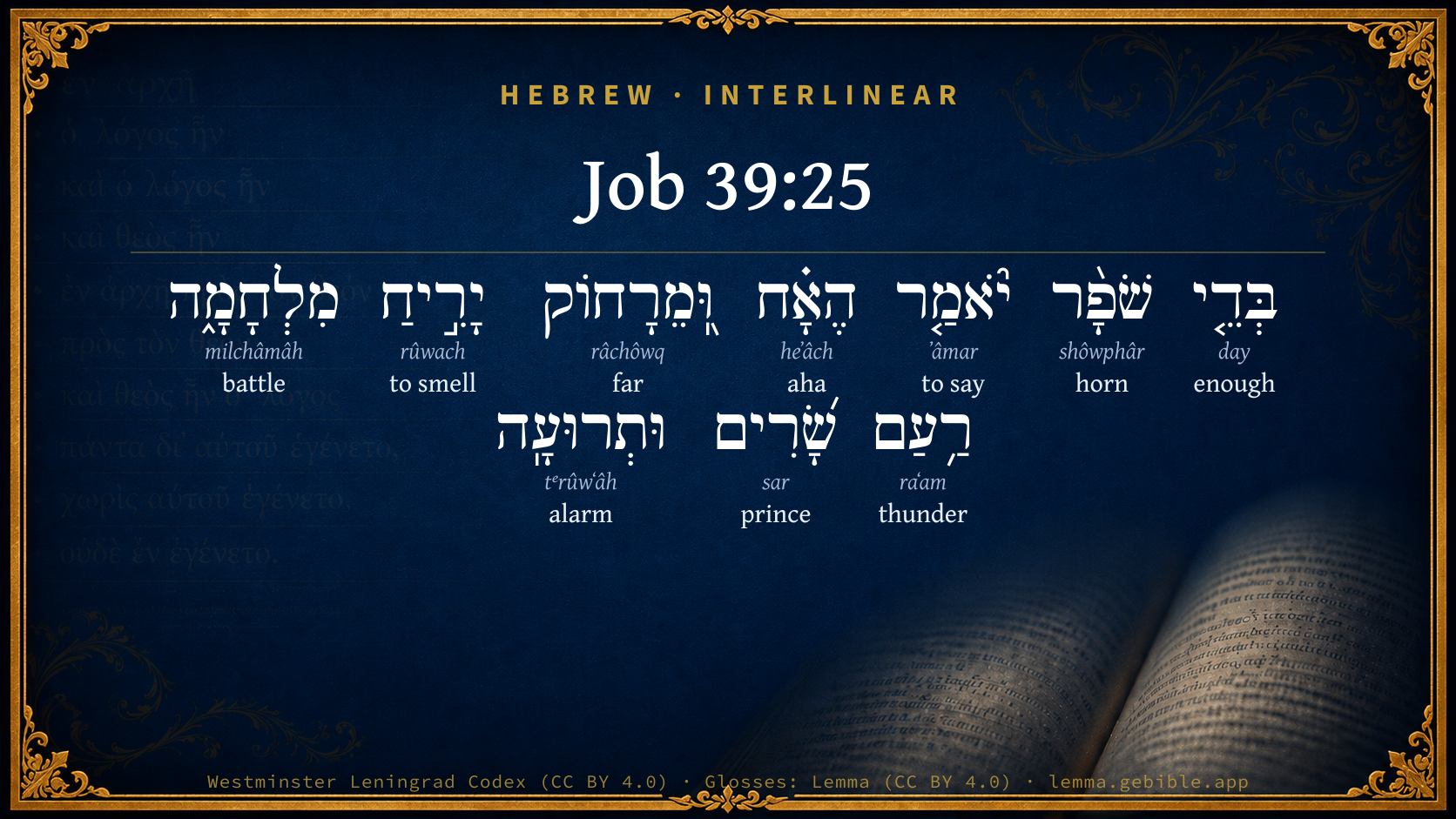
Hebrew (Westminster Leningrad Codex) Job 39:25 appears in the Hebrew Old Testament. The text above is from the Westminster Leningrad Codex. Each word links to its Strong’s number, a concise gloss, and parsing drawn from the Open Scriptures Hebrew Bible morphology. Click any word for its full Brown-Driver-Briggs (BDB) entry.
Download image
Cite this verse

Job 39:25 (World English Bible). Public Domain. Lemma interlinear Bible study tool, https://lemma.gebible.app/v/job/39/25.

Show BibTeX & RIS
BibTeX
RIS
English Translation
As often as the trumpet sounds he snorts, 'Aha!' He smells the battle afar off, The thunder of the captains, and the shouting.
World English Bible · Public Domain
Highlights
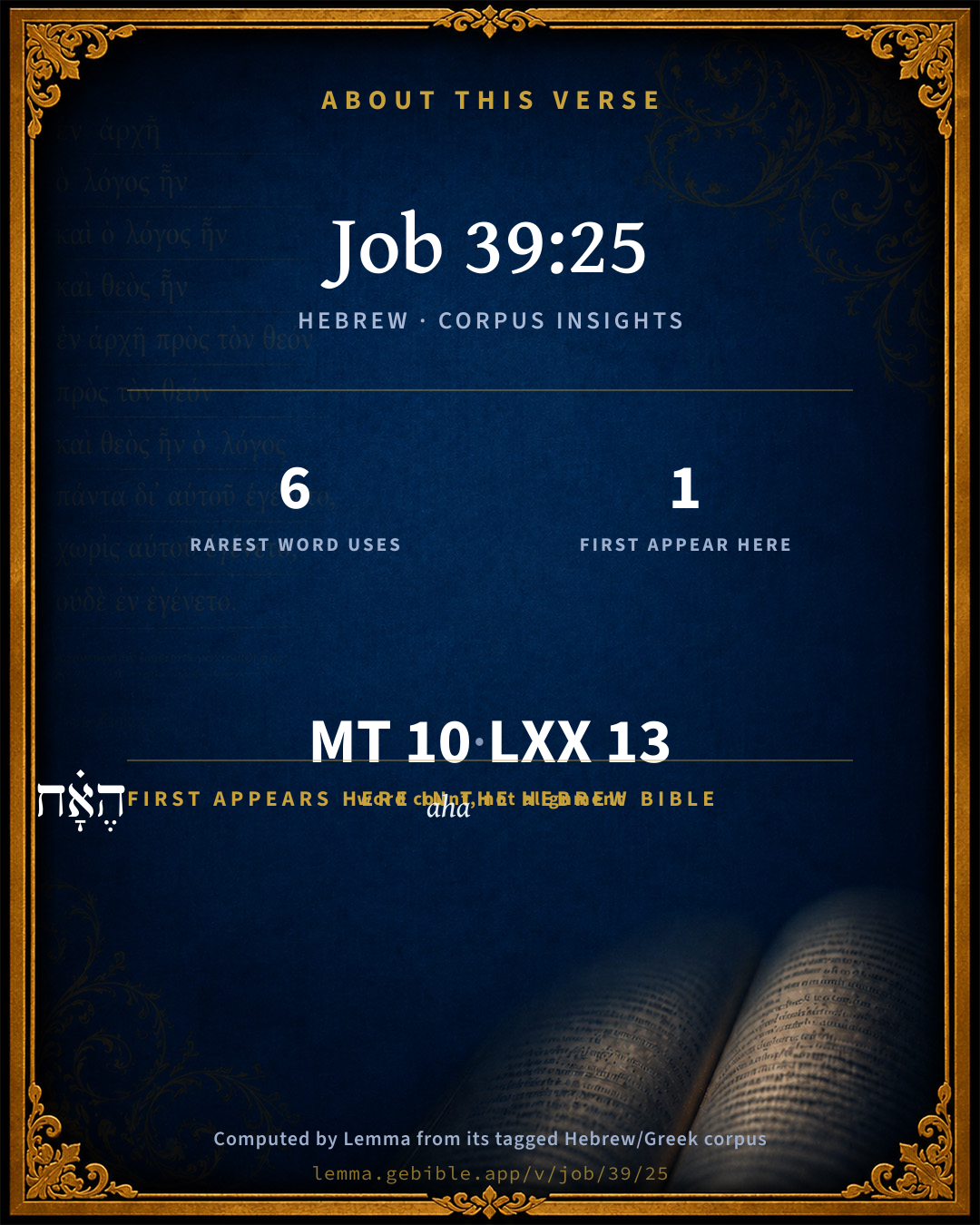
  • 1 first appearance in the Hebrew Bible
Full analysis ↓
Download a study sheet

One document with this verse’s original text, its word-by-word gloss line, the meaning frame, cross-references with their text, attributed commentary, and full source and license credits — printable, and it pastes into notes with its structure intact.

This verse Autodidact and up

Study sheet (.html) Plain text (.txt)

A passage Seminary Student

Up to 50 verses in one chapter. A passage sheet keeps up to 6 commentary sources and 12 cross-references per verse, in the order this page ranks them, and says so on the sheet whenever that leaves anything out. Ask for a single verse and you get the Autodidact verse sheet above.

Everything on this page stays free to read, with no account — the sheet is a download of what is already on screen, not access to it.

Want to remove ads? Support Godless Engineer
Compare translations 3

The same verse in 3 English versions, stacked beneath the original-language interlinear above. Click any original word for its lexicon entry.

Each is an independent rendering of the whole verse — the interlinear is not word-aligned to these translations.

Highlighted words mark where these versions differ — a whole-verse word diff, not a word-by-word alignment.

  • World English Bible Public Domain
    As often as the trumpet sounds he snorts, 'Aha!' He smells the battle afar off, The thunder of the captains, and the shouting.
  • King James Version Public Domain
    He saith among the trumpets, Ha, ha; and he smelleth the battle afar off, the thunder of the captains, and the shouting.
  • unfoldingWord Literal Text CC BY-SA 4.0
    In the abundance of the horn, it says, ‘Aha!’ And it smells the battle from far away, the thunder of the princes and the battle-cry.

unfoldingWord Literal Text — © unfoldingWord, licensed CC BY-SA 4.0. Word-aligned USFM3 via Door43 (git.door43.org/unfoldingWord/en_ult).

Versions to compare (up to 4)

3 of 4 selected

Show all 18 translations

Every available English version of this verse, each an independent rendering of the whole verse.

  • World English Bible Public Domain
    As often as the trumpet sounds he snorts, 'Aha!' He smells the battle afar off, The thunder of the captains, and the shouting.
  • Berean Standard Bible Public Domain
    At the blast of the horn, he snorts with fervor. He catches the scent of battle from afar—the shouts of captains and the cry of war.
  • Majority Standard Bible Public Domain
    At the blast of the horn, he snorts with fervor. He catches the scent of battle from afar, the shouts of captains and the cry of war.
  • King James Version Public Domain
    He saith among the trumpets, Ha, ha; and he smelleth the battle afar off, the thunder of the captains, and the shouting.
  • American Standard Version (1901) Public Domain
    As oft as the trumpet `soundeth' he saith, Aha! And he smelleth the battle afar off, The thunder of the captains, and the shouting.
  • Revised Version (1885) Public Domain
    As oft as the trumpet soundeth he saith, Aha! and he smelleth the battle afar off, the thunder of the captains, and the shouting.
  • Geneva Bible (1599) Public Domain
    He mocketh at feare, and is not afraid, and turneth not backe from the sworde,
  • Douay-Rheims (1899) Public Domain
    When he heareth the trumpet he saith: Ha, ha: he smelleth the battle afar off, the encouraging of the captains, and the shouting of the army.
  • Young's Literal Translation Public Domain
    Among the trumpets he saith, Aha, And from afar he doth smell battle, Roaring of princes and shouting.
  • Literal Standard Version CC BY-SA 4.0
    Among the horns he says, Aha, || And from afar he smells battle, || Roaring of princes and shouting.
  • Unlocked Literal Bible CC BY-SA 4.0
    Whenever the trumpet sounds, he says, 'Aha!' He smells the battle from far away— the thunderous shouts of the commanders and the outcries.
  • unfoldingWord Literal Text CC BY-SA 4.0
    In the abundance of the horn, it says, ‘Aha!’ And it smells the battle from far away, the thunder of the princes and the battle-cry.
  • Darby Bible Public Domain
    At the noise of the trumpets he saith, Aha! and he smelleth the battle afar off, the thunder of the captains, and the shouting.
  • World Messianic Bible Public Domain
    As often as the shofar sounds he snorts, ‘Aha!’ He smells the battle afar off, the thunder of the captains, and the shouting.
  • Webster's Bible Public Domain
    \\39:22\\He mocketh at fear, and is not affrighted; neither turneth he back from the sword.
  • Free Bible Version CC BY-SA 4.0
    Whenever the trumpet calls, it is ready; he senses the sound of battle from far away, he hears the commanders shouting.
  • Bible in Basic English Public Domain
    In his strength he goes out against the arms of war, turning not away from the sword.
  • JPS Tanakh (1917) Public Domain
    As oft as he heareth the horn he saith: 'Ha, ha!' and he smelleth the battle afar off, the thunder of the captains, and the shouting.

Literal Standard Version (2020), Covenant Press — licensed CC BY-SA 4.0. Text via the HelloAO Bible API (eBible.org). Unlocked Literal Bible (unfoldingWord) — licensed CC BY-SA 4.0. Text via the HelloAO Bible API (eBible.org). unfoldingWord Literal Text — © unfoldingWord, licensed CC BY-SA 4.0. Word-aligned USFM3 via Door43 (git.door43.org/unfoldingWord/en_ult). Free Bible Version, Dr. Jonathan Gallagher — licensed CC BY-SA 4.0. Text via the HelloAO Bible API (eBible.org).

Word by word

More ways to search: Search by grammar → Find every occurrence → Compare this word →

Practice this passage: Drill this verse → Learn its vocabulary →

About this verse

These counts appear in no published source. They are computed here, from the morphology-tagged text and Lemma’s own curated glosses. What Lemma adds →

10
words
10
distinct lemmas
Wisdom
section

Notable vocabulary

The rarest word here is רַ֥עַם thunder H7482 — appearing just 6 times in the whole Hebrew Bible.

First appearance in Scripture

This word makes its first canonical appearance in the Hebrew Bible here:

Shared distinctive vocabulary

רַ֥עַם thunder H7482 occurs in 6 verses of the Hebrew Bible. Also found in:

Grammatical profile

  • 2 verbs
  • 6 nouns
  • 1 adjective
  • 1 particle

Verb forms

  • יֹ֘אמַ֤ר Qal · Imperfect
  • יָרִ֣יחַ Hiphil · Imperfect

Hebrew & Septuagint length

In English translation the verse runs 23 words from the Hebrew and 19 from the Septuagint (LXX English) — closely comparable.

A rough comparison of the two English renderings, which tokenize alike — not a word-level alignment.

Word counts can differ between the Hebrew and the Greek without any difference in meaning — e.g. the Hebrew direct-object marker אֵת has no separate Greek word, and Greek often adds the article ὁ.

In the original languages it is 10 Hebrew tokens and 13 Greek tokens — but the two are counted differently (Hebrew bundles its prefixes and suffixes into one token; the Greek is in lemma form), so that isn’t a like-for-like length.

Cross-references

3

Topical passages linked to Job 39:25 in the Treasury of Scripture Knowledge — connected by theme and wording, ordered by reader-vote popularity; previews shown in the World English Bible.

  • Psalms 70:3 Let them be turned because of their shame Who say, "Aha! Aha!"
  • Ezekiel 26:2 Son of man, because Tyre has said against Jerusalem, Aha, she is broken: the gate of the peoples; she is turned to me; I shall be replenished, now that she is laid waste:
  • Ezekiel 36:2 Thus says the Lord Yahweh: Because the enemy has said against you, Aha! and, The ancient high places are ours in possession;

Cross-references courtesy of OpenBible.info (CC BY 4.0).

Hebrew and Greek witnesses Masoretic Hebrew ↔ Greek Septuagint

The same verse in the two great witnesses to the Old Testament, shown verse-for-verse.

These are two independent witnesses, not word-aligned to each other, and the Septuagint is shown in lemma (dictionary) form.

Hebrew Job 39:25 Masoretic · Westminster Leningrad Codex

בְּדֵ֤י שֹׁפָ֨ר יֹ֘אמַ֤ר הֶאָ֗ח וּֽ֭מֵרָחוֹק יָרִ֣יחַ מִלְחָמָ֑ה רַ֥עַם שָׂ֝רִים וּתְרוּעָֽה

As often as the trumpet sounds he snorts, 'Aha!' He smells the battle afar off, The thunder of the captains, and the shouting.

World English Bible · Public Domain

Greek LXX Job 39:25 Septuagint · lemma form

σάλπιγξ δέ σημαίνω λέγω εὖγε πόρρωθεν δέ ὀσφραίνομαι πόλεμος σύν ἅλμα καί κραυγή

And when the trumpet sounds, he says, Aha! and afar off he smells the war with prancing and neighing.

LXX2012 (modern English Septuagint) · Public Domain

On this verse, Haydock's Catholic Bible Commentary discusses the Septuagint’s reading. Read the note in Commentary ↓

Hebrew: Westminster Leningrad Codex (CC BY 4.0). Greek: Septuagint (public domain); English from LXX2012 (modern English Septuagint) (Public Domain). How the Septuagint differs from the Hebrew →

Commentary

Notes on Job 39:25 from classic Christian and Jewish commentators (each source and its license shown beneath its notes). The classic Christian expositions comment on the surrounding passage and are grouped to its opening verse, so a note may address several verses; the Jewish commentaries on the Tanakh (Rashi and others) are per-verse, so they appear only where the commentator wrote on this verse.

Lemma curates 59 commentaries, every one of them public domain or Creative Commons licensed, each selected and text-cleaned for this edition rather than reprinted as found. About our sources →

Trapp's Complete Commentary

John Trapp

Job 39:25 He saith among the trumpets, Ha, ha; and he smelleth the battle afar off, the thunder of the captains, and the shouting.

Ver. 25. He saith among the trumpets, Ha, ha] Or, Euge. A note of rejoicing, which he seemeth to utter in his language: these are poetic terms.

He smelleth out the battle afar off] He knows that the onset is about to be given. Pliny writeth, That horses will perceive beforehand the very time of the fight, if it be but

By the thunder of the captains, and the shouting] The captains’ adhortations and the soldiers’ acclamations, &c. The Hebrew word signifieth the noise either of joy or sorrow: both are commonly heard in battles. "For every battle of the warrior is with confused noise, and garments rolled in blood," Isa 9:5. The glory of all this that is said of the horse the Lord assumeth to himself; and yet the horse is not so courageous, but that he is as much afraid of and troubled at the sight of the stone Taraxippe (which therehence also hath its name) as the elephant is at the sight of a hog, and a lion of a cock, wherewith they have a natural antipathy, as naturalists tell us (Bodin. Theat. Nat. p. 407).

John Trapp, A Commentary or Exposition upon All the Books of the Old and New Testament (1647–1656) — public domain. Text from a community e-Sword module.

Jamieson, Fausset & Brown

Robert Jamieson, A. R. Fausset & David Brown

saith--poetically applied to his mettlesome neighing, whereby he shows his love of the battle.

smelleth--snuffeth; discerneth (Isa 11:3, Margin).

thunder--thundering voice.

Jamieson, Fausset & Brown — Commentary Critical and Explanatory on the Whole Bible (1871) — public domain (CC PDM 1.0). Text via the HelloAO Bible API.

Adam Clarke's Commentary

Verse 25. He saith among the trumpets, Ha, ha] The original is peculiarly emphatical: האח Heach! a strong, partly nasal, partly guttural sound, exactly resembling the first note which the horse emits in neighing. The strong, guttural sounds in this hemistich are exceedingly expressive: האח ומרחוק יריח מלחמה Heach! umerachok yariach milchamah; "Heach, for from afar he scenteth the battle."

The reader will perceive that Mr. Good has given a very different meaning to Job 39:20 from that in the present text, Canst thou make him afraid as a grasshopper? by translating the Hebrew thus: -

"Hast thou given him to launch forth as an arrow?"

The word ארבה arbeh, which we translate locust or grasshopper, and which he derives from רבה rabah, the א aleph being merely formative, he says, "may as well mean an arrow as it does in Job 16:13, רביו rabbaiv, 'His arrows fly around me.'" The verb רעש raash in the word התועישנו hatharishennu, "Canst thou make him afraid?' he contends, "signifies to tremble, quiver, rush, launch, dart forth; and, taken in this sense, it seems to unite the two ideas of rapidity and coruscation." This is the principal alteration which this learned man has made in the text.

I shall conclude on this subject by giving Coverdale's translation: Hast thou geven the horse his strength, or lerned him how to bow down his neck with feare; that he letteth himself be dryven forth like a greshopper, where as the stout neyenge that he maketh is fearfull? He breaketh the grounde with the hoffes of his fete chearfully in his strength, and runneth to mete the harnest men. He layeth aside all feare, his stomach is not abated, neither starteth he aback for eny swerde. Though the qyvers rattle upon him, though the speare and shilde glistre: yet russheth he in fearsley, and beateth upon the grounde. He feareth not the noise of the trompettes, but as soone as he heareth the shawmes blowe, Tush (sayeth he) for he smelleth the batell afarre of, the noyse, the captaynes, and the shoutinge. This is wonderfully nervous, and at the same time accurate.

Adam Clarke's Commentary on the Bible (1810–1826) — public domain. Text from a community e-Sword/MySword module.

Ellicott's Commentary for English Readers

(25) He saith among the trumpets—Literally, when there are plenty of trumpets: 1 e., as often as the trumpet soundeth.

A Bible Commentary for English Readers, edited by Charles John Ellicott (1878–1897) — public domain. Text from a community e-Sword module.

The Cambridge Bible for Schools and Colleges

gen. ed. J. J. S. Perowne

25. he saith among the trumpets] Rather, as oft as the trumpet soundeth he saith, Ha, ha! The “thunder” of the captains is the roar of command; and the “shouting” is the battle-cry of the soldiery.

Has Job created this wonder of beauty and fierceness and endowed him with his extraordinary qualities, which make him mingle in the conflicts of men with a fury and lust of battle greater even than their own?

The Cambridge Bible for Schools and Colleges (gen. ed. J. J. S. Perowne; Cambridge University Press, 1878–1918) — public domain. Text from a community e-Sword module.

John Gill's Exposition

He saith among the trumpets, ha, ha,.... As pleased with the sound of them, rejoicing thereat, and which he signifies by neighing;

and he smelleth the battle afar off; which respects not so much the distance of place as of time; he perceives beforehand that it is near, by the preparations making for it, and particularly by what follows; so Pliny (b) says of horses, they presage a fight. The thunder of the captains, and the shouting; they understand an engagement is just about to start by the loud and thundering voice of the captains, exhorting and spiralling up their men, and giving them the word of command; and by the clamorous shout of the soldiers echoing to the speech of their captains; and which are given forth upon an onset, both to animate one another, and intimidate the enemy. Bootius (c) observes, that Virgil (d) and Oppianus (e) say most of the same things in praise of the horse which are here said, and seem to have taken them from hence; and some (f) give the horse the preference to the lion, which, when it departs from a fight, never returns, whereas the horse will. This is an emblem both of good men, Zac 10:3; and of bad men, Jer 8:6.

(b) Nat. Hist. l. 8. c. 42. (c) Animadvers. Sacr. l. 3. c. 6. s. 1. (d) Georgic. l. 3. (e) Cyneget. l. 1. (f) Horus Aegypt. apud Steeb. Coelum Sephirot. Heb. c. 6. s. 1. p. 106.

John Gill's Exposition of the Whole Bible (1746–1763) — public domain (CC PDM 1.0). Text via the HelloAO Bible API.

Albert Barnes' Notes on the Bible

He saith among the trumpets, Ha, ha - That is,” When the trumpet sounds, his voice is heard “as if” he said, Aha - or said that he heard the sound calling him to the battle.” The reference is to the impatient neighing of the war horse about to rush into the conflict.

And he smelleth the battle afar off - That is, he snuffs, as it were, for the slaughter. The reference is to the effect of an approaching army upon a spirited war-horse, as if he perceived the approach by the sense of smelling, and longed to be in the midst of the battle.

The thunder of the captains - literally, “the war-cry of the princes.” The reference is to the loud voices of the leaders of the army commanding the hosts under them. In regard to the whole of this magnificent description of the war-horse, the reader may consult Bochart, “Hieroz.” P. i. L. ii. c. viii., where the phrases used are considered and illustrated at length. The leading idea. here is, that the war-horse evinced the wisdom and the power of God. His majesty, energy, strength, impatience for the battle, and spirit, were proofs of the greatness of Him who had made him, and might be appealed to as illustrating His perfections. Much as people admire the noble horse, and much as they take pains to train him for the turf or for battle, yet how seldom do they refer to it as illustrating the power and greatness of the Creator; and, it may be added, how seldom do they use the horse as if he were one of the grand and noble works of God!

Albert Barnes' Notes on the Bible (1834–1885) — public domain. Text from a community e-Sword/MySword module.

Haydock's Catholic Bible Commentary

Ha. Literally, "Vah," a sound of joy, (Menochius) or of contempt. Septuagint, The trumpet having given the sign, he will say, Well: Euge. Nothing could be more poetically descriptive of the war-horse. (Haydock)

George Leo Haydock (1774–1849), Haydock's Catholic Family Bible and Commentary, 1859 edition — public domain. Excludes Psalms (Douay-Rheims chapter numbering differs from Protestant) and Deuterocanonical books (Catholic canon only).

Matthew Poole's English Annotations

Ha, ha; an expression of joy and alacrity, declared by his proud neighings; whereby he doth in some sort answer the sound of the trumpets, in way of scorn and challenge.

He smelleth, i.e. he perceiveth, as this phrase is used, Jdg 16:9.

Afar off; at some distance, either of place, or rather of time, as the word is most frequently used. He perceives by the motion of the soldiers, and the clattering of the arms, that the battle is at hand, which is very welcome to him.

The thunder of the captains; by which he understands, either the military orations which the captains make and deliver with a loud voice to animate their soldiers to the battle; or rather the loud and joyful clamour begun by the commanders, and followed by the soldiers, when they are ready to join battle, that thereby they may both daunt their enemies, and encourage themselves.

Matthew Poole's English Annotations on the Holy Bible (1683–1685) — public domain. Text from a community e-Sword/MySword module.

Whedon's Commentary on the Bible

Daniel D. Whedon

25. He saith among the trumpets — At every blast, (literally, “trumpet,”) he saith, Aha!

Smelleth the battle — A like instinct is attributed to the horse in Pliny — “He presages the battle.” Layard, in his “New Discoveries,” (p. 330,) says: “Although docile as a lamb, and requiring no other guide than the halter, when the Arab mare hears the war-cry of the tribe, and sees the quivering spear of her rider, her eyes glitter with fire, her blood-red nostrils open wide, her neck is nobly arched, and her tail and mane are raised and spread out to the wind. The Bedawin proverb says, that a highbred mare, when at full speed, should hide her rider between her neck and her tail.”

Daniel D. Whedon (gen. ed.), Commentary on the Old and New Testaments (1874–1909) — public domain. Text from a community e-Sword module.

The Pulpit Commentary

He saith among the trumpets, Ha, ha! literally, at the trumpet; i.e. at the sound of the trumpet. The utterance, "Ha, ha!" (heakh)" is an imitation of the horse"s snort or neigh. And he smelleth the battle afar off. Not merely presages it, as Pliny Bye (Equi praesagiunt pugnam, "Hist. Nat," 8:42), or perceives it. but seems to scent it. The open and quivering nostrils raise this idea. The thunder of the captains, and the shouting. On the great noise made by advancing armies in ancient times, see 2Ki_7:6 Isa_5:28-30 Jer_8:16, etc.

The Pulpit Commentary (1880–1919), ed. H.D.M. Spence-Jones & Joseph S. Exell — public domain. Text from a community e-Sword module.

John Wesley's Explanatory Notes

Ha, ha - An expression of joy and alacrity declared by his proud neighings. Thunder - The loud and joyful clamour begun by the commanders, and followed by the soldiers when they are ready to join battle.

John Wesley, Explanatory Notes Upon the Whole Bible (1754–1765) — public domain. Text via the GEBible commentary corpus.

Rashi

Rabbi Shlomo Yitzchaki (Rashi)

To many shofaroth Heb. בדי, an expression of (Lev. 25:28), “sufficient (די) to get it back,” to many shofaroth.

he says, ‘Hurrah!’ An expression that (the passersby) (the slaves—Berechiah) say when they are happy, much as they say, ‘Woe!’ out of pain.

Rashi on the Tanakh — English translations: “The Judaica Press complete Tanach with Rashi, translated by A. J. Rosenberg” (CC BY 4.0); “Pentateuch with Rashi's commentary by M. Rosenbaum and A.M. Silbermann, 1929-1934” (public domain); “The Metsudah Tanach series, Lakewood, N.J” (CC BY 4.0); and “The Book of Joshua, Metsudah Publications, 1997” (CC BY 4.0). Text via Sefaria.

Lesson kit

Teaching starters — assembled from the data on this page, not authored interpretation. Every prompt links to the verse data it draws on. Edit before teaching.

Job, in the Wisdom, opens this verse with 10 words (10 distinct Hebrew lemmas). Its most distinctive word is raʻam (“thunder”). A historical commentator’s framing appears above. Read the whole chapter for the surrounding context.

Discussion questions

  1. How does “thunder” (raʻam) shape what this verse is saying?
  2. The word “aha” first appears here in Scripture. What is being introduced at this debut?
  3. Job 26:14 shares the word «thunder» with this verse. How do the two illuminate each other?
  4. The translations on this page render this verse differently — a whole-verse word diff, not a word-by-word alignment. What might account for the different wordings?
  5. The verb «יֹ֘אמַ֤ר» is Qal Imperfect. How does its form color the action?
  6. Reading how Trapp's Complete Commentary and Jamieson, Fausset & Brown read this verse, where do the two commentators agree and where do they part?

Things to notice

Reading settings

Reading text

Shown beneath each verse's original-language words.

Old Testament
Old Testament edition

Read the OT as the Masoretic Hebrew (MT) or the Greek Septuagint (LXX).

English shown for the Greek Septuagint (in the Hebrew ↔ Greek comparison).

Comparing translations? Open the Compare panel on any verse page to stack up to four side by side.