
2 Kings 20:14

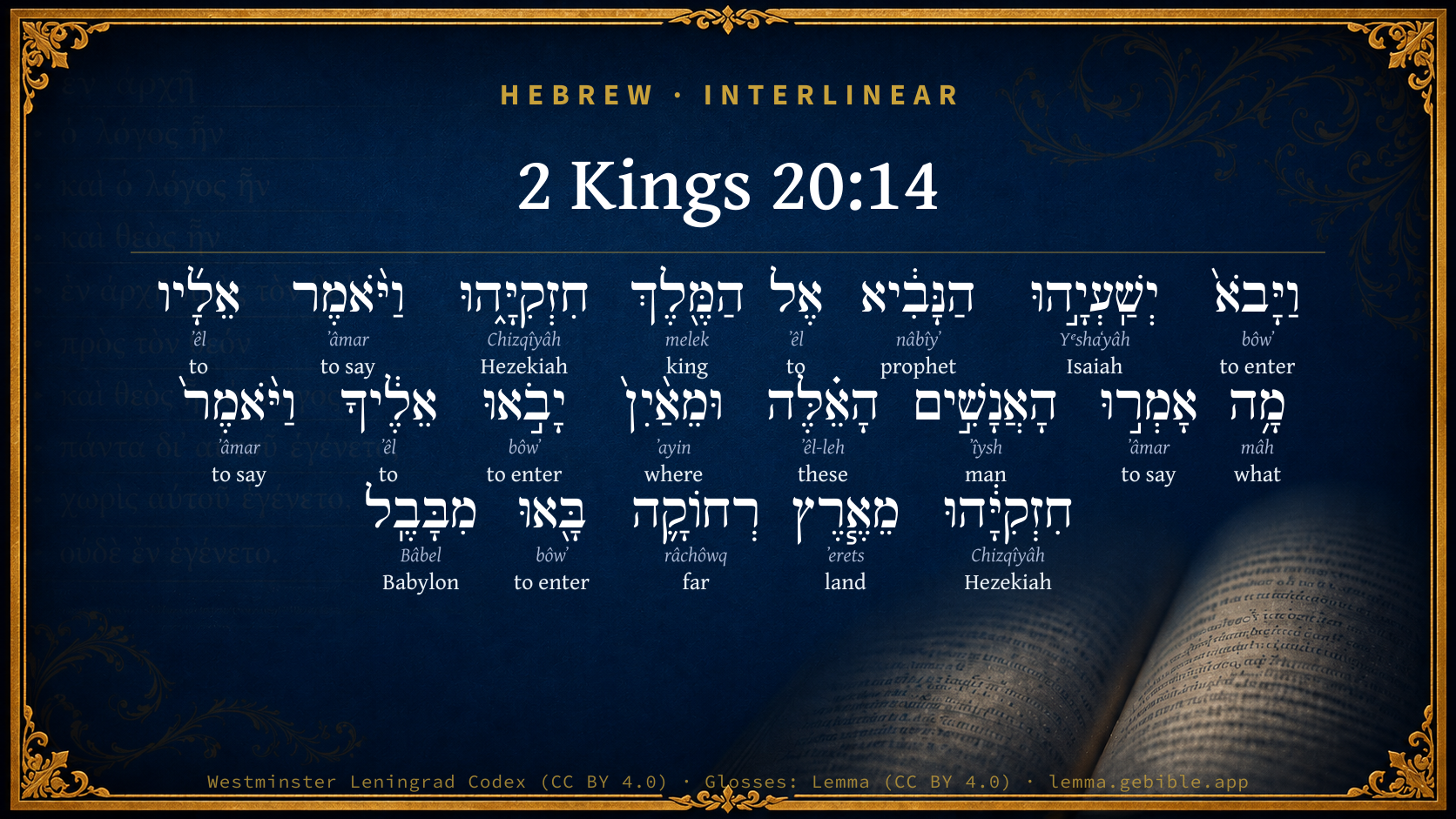
Hebrew (Westminster Leningrad Codex) 2 Kings 20:14 appears in the Hebrew Old Testament. The text above is from the Westminster Leningrad Codex. Each word links to its Strong’s number, a concise gloss, and parsing drawn from the Open Scriptures Hebrew Bible morphology. Click any word for its full Brown-Driver-Briggs (BDB) entry.
Download image
Cite this verse

2 Kings 20:14 (World English Bible). Public Domain. Lemma interlinear Bible study tool, https://lemma.gebible.app/v/2-kings/20/14.

Show BibTeX & RIS
BibTeX
RIS
English Translation
Then came Isaiah the prophet to king Hezekiah, and said to him, What said these men? and from whence came they to you? Hezekiah said, They are come from a far country, even from Babylon.
World English Bible · Public Domain
Download a study sheet

One document with this verse’s original text, its word-by-word gloss line, the meaning frame, cross-references with their text, attributed commentary, and full source and license credits — printable, and it pastes into notes with its structure intact.

This verse Autodidact and up

Study sheet (.html) Plain text (.txt)

A passage Seminary Student

Up to 50 verses in one chapter. A passage sheet keeps up to 6 commentary sources and 12 cross-references per verse, in the order this page ranks them, and says so on the sheet whenever that leaves anything out. Ask for a single verse and you get the Autodidact verse sheet above.

Everything on this page stays free to read, with no account — the sheet is a download of what is already on screen, not access to it.

Want to remove ads? Support Godless Engineer
Compare translations 3

The same verse in 3 English versions, stacked beneath the original-language interlinear above. Click any original word for its lexicon entry.

Each is an independent rendering of the whole verse — the interlinear is not word-aligned to these translations.

Highlighted words mark where these versions differ — a whole-verse word diff, not a word-by-word alignment.

  • World English Bible Public Domain
    Then came Isaiah the prophet to king Hezekiah, and said to him, What said these men? and from whence came they to you? Hezekiah said, They are come from a far country, even from Babylon.
  • King James Version Public Domain
    Then came Isaiah the prophet unto king Hezekiah, and said unto him, What said these men? and from whence came they unto thee? And Hezekiah said, They are come from a far country, even from Babylon.
  • unfoldingWord Literal Text CC BY-SA 4.0
    And Isaiah the prophet came to King Hezekiah and said to him, “What did these men say, and from where did they come to you?” And Hezekiah said, “They came from a distant land, from Babylon.”

unfoldingWord Literal Text — © unfoldingWord, licensed CC BY-SA 4.0. Word-aligned USFM3 via Door43 (git.door43.org/unfoldingWord/en_ult).

Versions to compare (up to 4)

3 of 4 selected

Show all 18 translations

Every available English version of this verse, each an independent rendering of the whole verse.

  • World English Bible Public Domain
    Then came Isaiah the prophet to king Hezekiah, and said to him, What said these men? and from whence came they to you? Hezekiah said, They are come from a far country, even from Babylon.
  • Berean Standard Bible Public Domain
    Then the prophet Isaiah went to King Hezekiah and asked, “Where did those men come from, and what did they say to you?” “They came from a distant land,” Hezekiah replied, “from Babylon.”
  • Majority Standard Bible Public Domain
    Then the prophet Isaiah went to King Hezekiah and asked, “Where did those men come from, and what did they say to you?” “They came from a distant land,” Hezekiah replied, “from Babylon.”
  • King James Version Public Domain
    Then came Isaiah the prophet unto king Hezekiah, and said unto him, What said these men? and from whence came they unto thee? And Hezekiah said, They are come from a far country, even from Babylon.
  • American Standard Version (1901) Public Domain
    Then came Isaiah the prophet unto king Hezekiah, and said unto him, What said these men? and from whence came they unto thee? And Hezekiah said, They are come from a far country, even from Babylon.
  • Revised Version (1885) Public Domain
    Then came Isaiah the prophet unto king Hezekiah, and said unto him, What said these men? and from whence came they unto thee? And Hezekiah said, They are come from a far country, even from Babylon.
  • Geneva Bible (1599) Public Domain
    Then Isaiah the Prophet came vnto King Hezekiah, and saide vnto him, What saide these men? and from whence came they to thee? And Hezekiah said, They be come from a farre countrey, euen from Babel.
  • Douay-Rheims (1899) Public Domain
    And Isaias the prophet came to king Ezechias, and said to him: What said these men? or from whence came they to thee? And Ezechias said to him: From a far country they came to me out of Babylon.
  • Young's Literal Translation Public Domain
    And Isaiah the prophet cometh in unto king Hezekiah, and saith unto him, `What said these men? and whence come they unto thee?' And Hezekiah saith, `From a land afar off they have come -- from Babylon.'
  • Literal Standard Version CC BY-SA 4.0
    And Isaiah the prophet comes to King Hezekiah and says to him, “What did these men say? And from where do they come to you?” And Hezekiah says, “They have come from a far-off land—from Babylon.”
  • Unlocked Literal Bible CC BY-SA 4.0
    Then Isaiah the prophet came to King Hezekiah and asked him, “What did these men say to you? Where did they come from?” Hezekiah said, “They came from the distant country of Babylon.”
  • unfoldingWord Literal Text CC BY-SA 4.0
    And Isaiah the prophet came to King Hezekiah and said to him, “What did these men say, and from where did they come to you?” And Hezekiah said, “They came from a distant land, from Babylon.”
  • Darby Bible Public Domain
    Then came the prophet Isaiah to king Hezekiah and said to him, What said these men? and from whence came they to thee? And Hezekiah said, They came from a far country, from Babylon.
  • World Messianic Bible Public Domain
    Then Isaiah the prophet came to King Hezekiah, and said to him, “What did these men say? From where did they come to you?” Hezekiah said, “They have come from a far country, even from Babylon.”
  • Webster's Bible Public Domain
    Then came Isaiah the prophet to king Hezekiah, and said to him, What said these men? and from whence came they to thee? And Hezekiah said, They have come from a far country even from Babylon.
  • Free Bible Version CC BY-SA 4.0
    Then the prophet Isaiah went to King Hezekiah and asked him, “Where did those men come from, and what did they tell you?” “They came from a long way away, from Babylon,” Hezekiah replied.
  • Bible in Basic English Public Domain
    Then Isaiah the prophet came to King Hezekiah and said to him, What did these men say and where did they come from? And Hezekiah said, They came from a far country, even from Babylon.
  • JPS Tanakh (1917) Public Domain
    Then came Isaiah the prophet unto king Hezekiah, and said unto him: 'What said these men? and from whence came they unto thee?' And Hezekiah said: 'They are come from a far country, even from Babylon.'

Literal Standard Version (2020), Covenant Press — licensed CC BY-SA 4.0. Text via the HelloAO Bible API (eBible.org). Unlocked Literal Bible (unfoldingWord) — licensed CC BY-SA 4.0. Text via the HelloAO Bible API (eBible.org). unfoldingWord Literal Text — © unfoldingWord, licensed CC BY-SA 4.0. Word-aligned USFM3 via Door43 (git.door43.org/unfoldingWord/en_ult). Free Bible Version, Dr. Jonathan Gallagher — licensed CC BY-SA 4.0. Text via the HelloAO Bible API (eBible.org).

Word by word

More ways to search: Search by grammar → Find every occurrence → Compare this word →

Practice this passage: Drill this verse → Learn its vocabulary →

וּמֵאַ֨יִן֙
ʼayin
H370
“and · from · where”
Conjunction + Preposition + Particle, Interrogative
Part of Speech
Conjunction + Preposition + Particle
Type
Interrogative
Full BDB Definition

Origin: probably identical with H369 in the sense of query (compare H336 )

TWOT: 75f

where?, whence?
  1. וַיָּבֹא֙ bôwʼ H935 “and · to enter” Conjunction + Verb, Qal, Sequential Imperfect, 3rd Person, Masculine, Singular
  2. יְשַֽׁעְיָ֣הוּ Yᵉshaʻyâh H3470 “Isaiah” Noun, Proper
  3. הַנָּבִ֔יא nâbîyʼ H5030 “the · prophet” Particle, Definite Article + Noun, Common, Masculine, Singular, Absolute
  4. אֶל ʼêl H413 “to” Preposition
  5. הַמֶּ֖לֶךְ melek H4428 “the · king” Particle, Definite Article + Noun, Common, Masculine, Singular, Absolute
  6. חִזְקִיָּ֑הוּ Chizqîyâh H2396 “Hezekiah” Noun, Proper
  7. וַיֹּ֨אמֶר ʼâmar H559 “and · to say” Conjunction + Verb, Qal, Sequential Imperfect, 3rd Person, Masculine, Singular
  8. אֵלָ֜יו ʼêl H413 “to · him” Preposition + Suffix, Personal, 3rd Person, Masculine, Singular
  9. מָ֥ה mâh H4100 “what” Particle, Interrogative
  10. אָמְר֣וּ ʼâmar H559 “to say” Verb, Qal, Perfect, 3rd Person, Common, Plural
  11. הָאֲנָשִׁ֣ים ʼîysh H376 “the · men” Particle, Definite Article + Noun, Common, Masculine, Plural, Absolute
  12. הָאֵ֗לֶּה ʼêl-leh H428 “the · these” Particle, Definite Article + Pronoun, Demonstrative, Common, Plural
  13. יָבֹ֣אוּ bôwʼ H935 “to enter” Verb, Qal, Imperfect, 3rd Person, Masculine, Plural
  14. אֵלֶ֔יךָ ʼêl H413 “to · you” Preposition + Suffix, Personal, 2nd Person, Masculine, Singular
  15. וַיֹּ֨אמֶר֙ ʼâmar H559 “and · to say” Conjunction + Verb, Qal, Sequential Imperfect, 3rd Person, Masculine, Singular
  16. חִזְקִיָּ֔הוּ Chizqîyâh H2396 “Hezekiah” Noun, Proper
  17. מֵאֶ֧רֶץ ʼerets H776 “from · land” Preposition + Noun, Common, Both, Singular, Absolute
  18. רְחוֹקָ֛ה râchôwq H7350 “far” Adjective, Adjective, Feminine, Singular, Absolute
  19. בָּ֖אוּ bôwʼ H935 “to enter” Verb, Qal, Perfect, 3rd Person, Common, Plural
  20. מִבָּבֶֽל Bâbel H894 “from · Babylon” Preposition + Noun, Proper

About this verse

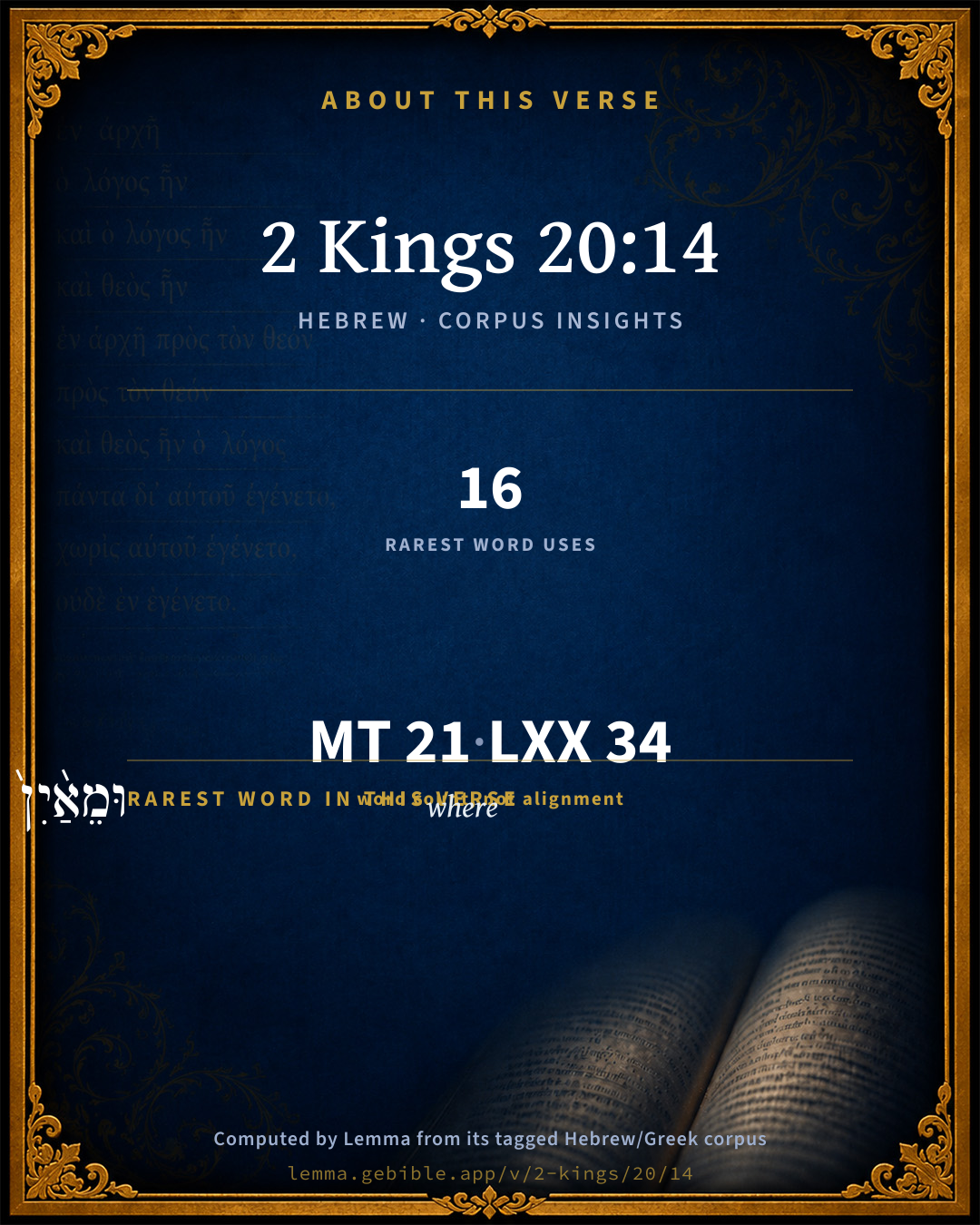
These counts appear in no published source. They are computed here, from the morphology-tagged text and Lemma’s own curated glosses. What Lemma adds →

21
words
14
distinct lemmas
Historical
section

Notable vocabulary

The rarest word here is וּמֵאַ֨יִן֙ where H370 — appearing just 16 times in the whole Hebrew Bible.

Shared distinctive vocabulary

וּמֵאַ֨יִן֙ where H370 occurs in 16 verses of the Hebrew Bible. Also found in:

Grammatical profile

  • 6 verbs
  • 8 nouns
  • 1 adjective
  • 1 pronoun
  • 3 prepositions
  • 2 particles

Verb forms

  • וַיָּבֹא֙ Qal · Sequential Imperfect
  • וַיֹּ֨אמֶר Qal · Sequential Imperfect
  • אָמְר֣וּ Qal · Perfect
  • יָבֹ֣אוּ Qal · Imperfect
  • וַיֹּ֨אמֶר֙ Qal · Sequential Imperfect
  • בָּ֖אוּ Qal · Perfect

Repetition

Words recur within this verse — often emphatic in Hebrew:

  • וַיָּבֹא֙ to enter H935 ×3
  • וַיֹּ֨אמֶר to say H559 ×3
  • חִזְקִיָּ֑הוּ Hezekiah H2396 ×2
  • אֶל to H413 ×3

Hebrew & Septuagint length

In English translation the verse runs 35 words from the Hebrew and 37 from the Septuagint (LXX English) — closely comparable.

A rough comparison of the two English renderings, which tokenize alike — not a word-level alignment.

Word counts can differ between the Hebrew and the Greek without any difference in meaning — e.g. the Hebrew direct-object marker אֵת has no separate Greek word, and Greek often adds the article ὁ.

In the original languages it is 21 Hebrew tokens and 34 Greek tokens — but the two are counted differently (Hebrew bundles its prefixes and suffixes into one token; the Greek is in lemma form), so that isn’t a like-for-like length.

Cross-references

15

Topical passages linked to 2 Kings 20:14 in the Treasury of Scripture Knowledge — connected by theme and wording, ordered by reader-vote popularity; previews shown in the World English Bible.

  • Deuteronomy 28:49 Yahweh will bring a nation against you from far, from the end of the earth, as the eagle flies; a nation whose language you shall not understand;
  • Joshua 9:6 They went to Joshua to the camp at Gilgal, and said to him, and to the men of Israel, We are come from a far country: now therefore make you a covenant with us.
  • Joshua 9:9 They said to him, From a very far country your servants are come because of the name of Yahweh your God: for we have heard the fame of him, and all that he did in Egypt,
  • 2 Samuel 12:7–15 Nathan said to David, "You are the man. This is what Yahweh, the God of Israel, says: 'I anointed you king over Israel, and I delivered you out of the hand of Saul.
  • 2 Kings 5:25–26 But he went in, and stood before his master. Elisha said to him, Whence come you, Gehazi? He said, Your servant went no where.
  • 2 Chronicles 16:7–10 At that time Hanani the seer came to Asa king of Judah, and said to him, Because you have relied on the king of Syria, and have not relied on Yahweh your God, therefore is the host of the king of Syria escaped out of your hand.
  • 2 Chronicles 25:7–9 But there came a man of God to him, saying, O king, don't let the army of Israel go with you; for Yahweh is not with Israel, [to wit], with all the children of Ephraim.
  • 2 Chronicles 25:15–16 Therefore the anger of Yahweh was kindled against Amaziah, and he sent to him a prophet, who said to him, Why have you sought after the gods of the people, which have not delivered their own people out of your hand?
  • Psalms 141:5 Let the righteous strike me, it is kindness; Let him reprove me, it is like oil on the head; Don't let my head refuse it; Yet my prayer is always against evil deeds.
  • Proverbs 25:12 As an ear-ring of gold, and an ornament of fine gold, So is a wise reprover to an obedient ear.
  • Isaiah 13:5 They come from a far country, from the uttermost part of heaven, even Yahweh, and the weapons of his indignation, to destroy the whole land.
  • Isaiah 39:3–8 Then came Isaiah the prophet to king Hezekiah, and said to him, What said these men? and from whence came they to you? Hezekiah said, They are come from a far country to me, even from Babylon.
  • Jeremiah 26:18–19 Micah the Morashtite prophesied in the days of Hezekiah king of Judah; and he spoke to all the people of Judah, saying, Thus says Yahweh of Hosts: Zion shall be plowed as a field, and Jerusalem shall become heaps, and the mountain of the house as the high places of a forest.
  • Amos 7:12–13 Amaziah also said to Amos, "You seer, go, flee away into the land of Judah, and there eat bread, and prophesy there:
  • Mark 6:18–19 For John said to Herod, "It is not lawful for you to have your brother's wife."

Cross-references courtesy of OpenBible.info (CC BY 4.0).

Hebrew and Greek witnesses Masoretic Hebrew ↔ Greek Septuagint

The same verse in the two great witnesses to the Old Testament, shown verse-for-verse.

These are two independent witnesses, not word-aligned to each other, and the Septuagint is shown in lemma (dictionary) form.

Hebrew 2 Kings 20:14 Masoretic · Westminster Leningrad Codex

וַיָּבֹא֙ יְשַֽׁעְיָ֣הוּ הַנָּבִ֔יא אֶל הַמֶּ֖לֶךְ חִזְקִיָּ֑הוּ וַיֹּ֨אמֶר אֵלָ֜יו מָ֥ה אָמְר֣וּ הָאֲנָשִׁ֣ים הָאֵ֗לֶּה וּמֵאַ֨יִן֙ יָבֹ֣אוּ אֵלֶ֔יךָ וַיֹּ֨אמֶר֙ חִזְקִיָּ֔הוּ מֵאֶ֧רֶץ רְחוֹקָ֛ה בָּ֖אוּ מִבָּבֶֽל

Then came Isaiah the prophet to king Hezekiah, and said to him, What said these men? and from whence came they to you? Hezekiah said, They are come from a far country, even from Babylon.

World English Bible · Public Domain

Greek LXX 2 Kings 20:14 Septuagint · lemma form

καί εἰςἔρχομαι ησαιας ὁ προφήτης πρός ὁ βασιλεύς εζεκιας καί εἶπον πρός αὐτός τίς λαλέω ὁ ἀνήρ οὗτος καί πόθεν ἥκω πρός σύ καί εἶπον εζεκιας ἐκ γῆ πόρρωθεν ἥκω πρός ἐγώ ἐκ βαβυλών

And Esaias the prophet went in to king Ezekias, and said to him, What said these men? and whence came they to you? And Ezekias said, they came to me from a distant land, even from Babylon.

LXX2012 (modern English Septuagint) · Public Domain

Hebrew: Westminster Leningrad Codex (CC BY 4.0). Greek: Septuagint (public domain); English from LXX2012 (modern English Septuagint) (Public Domain). How the Septuagint differs from the Hebrew →

Targum (Aramaic paraphrase)

1

The Targum is the ancient Jewish Aramaic paraphrase of the Hebrew Scriptures — an interpretive translation, not the Hebrew text itself. Onkelos (literal) and Pseudo-Jonathan (expansive) render the Torah, and Jonathan the Prophets. Coverage is partial: where no permissively-licensed English translation exists for a verse, only the Aramaic is shown. This is verse-level text, not a word-by-word alignment to the Hebrew.

  1. Targum Jonathan Prophets (Joshua–Malachi)
    וַאֲתָא יְשַׁעְיָה נְבִיָא לְוַת מַלְכָּא חִזְקִיָה וַאֲמַר לֵיהּ מָה אֲמָרוּ לָךְ גַבְרַיָא הָאִלֵין וּמְנָן אֲתוֹ לְוָתָךְ וַאֲמַר חִזְקִיָה מֵאַרְעָא רְחִיקָא אֲתוֹ לְוָתִי מִבָּבֶל:

    (no public-domain English translation for this verse)

    Targum Jonathan — Aramaic: “Mikraot Gedolot” (public domain). English: “Sefaria Community Translation” (CC0 1.0 (public-domain dedication)); “London "Chaldee Paraphrase," 1871” (public domain). Text via Sefaria.

Commentary

Notes on 2 Kings 20:14 from classic Christian and Jewish commentators (each source and its license shown beneath its notes). The classic Christian expositions comment on the surrounding passage and are grouped to its opening verse, so a note may address several verses; the Jewish commentaries on the Tanakh (Rashi and others) are per-verse, so they appear only where the commentator wrote on this verse.

Lemma curates 59 commentaries, every one of them public domain or Creative Commons licensed, each selected and text-cleaned for this edition rather than reprinted as found. About our sources →

Trapp's Complete Commentary

John Trapp

2Ki 20:14 Then came Isaiah the prophet unto king Hezekiah, and said unto him, What said these men? and from whence came they unto thee? And Hezekiah said, They are come from a far country, [even] from Babylon.

Ver. 14. What said these men? &c.] Very wisely doth the prophet fetch about the business, that he may prick the bladder, and let out the pride, that now lay festering in Hezekiah’s heart.

Even from Babylon.] Which is said to be six hundred and eighty miles from Jerusalem.

John Trapp, A Commentary or Exposition upon All the Books of the Old and New Testament (1647–1656) — public domain. Text from a community e-Sword module.

Joseph Benson's Commentary

2Ki 20:14-15. Hezekiah said, They are come from a far country — A vain-glorious expression, intimating the great honour which he had from all parts, far and near. Even from Babylon — That potent monarchy; which he mentions to magnify his own honour and happiness. What have they seen in thy house? — He asks, not because he was ignorant of it, but in order that, from Hezekiah’s answer, he might take occasion of delivering God’s message to him.

Joseph Benson's Commentary on the Old and New Testaments (1811–1818) — public domain. Text from a community e-Sword module.

Ellicott's Commentary for English Readers

(14) What said these men?—“Isaiah, with that fearless assumption of a superior position which we have noticed in Isaiah 7, at once challenges the king to explain his conduct. Jehovah’s will is opposed to all coquetting with foreign powers. (Comp. Isa_30:1.)” [Cheyne.]

From a far country.—So the Assyrian kings describe Palestine as “a far off land,” using the same adjective (rûqu).

A Bible Commentary for English Readers, edited by Charles John Ellicott (1878–1897) — public domain. Text from a community e-Sword module.

The Cambridge Bible for Schools and Colleges

gen. ed. J. J. S. Perowne

14. What said these men?] Hezekiah does not answer this question. To tell of the proposals which had been made to him by the Babylonians, and of the remarks which had been called forth in praise of all that he had shewn them, would have provoked some reproach from God’s prophet, who was probably averse to any alliance with foreign and idolatrous powers, knowing that in Jehovah there was present help so long as His people trusted in Him only.

even from Babylon] Except as one of the places whence colonists were brought to occupy Samaria (2Ki_17:24), Babylon has not before come into Jewish history. Soon it begins to figure largely, especially in the writings of the prophets, and at last becomes the victor of Jerusalem, and the scene of the long captivity of the two tribes.

The Cambridge Bible for Schools and Colleges (gen. ed. J. J. S. Perowne; Cambridge University Press, 1878–1918) — public domain. Text from a community e-Sword module.

Albert Barnes' Notes on the Bible

Hezekiah did not answer Isaiah’s first question, “What said these men?” but only his second. Probably he knew that Isaiah would oppose reliance on an “arm of flesh.”

Babylon now for the first time became revealed to the Jews as an actual power in the world, which might effect them politically. As yet even the prophets had spoken but little of the great southern city; up to this time she had been little more to them than Tyre, or Tarshish, or any other rich and powerful idolatrous city. Henceforth, all this was wholly changed. The prophetic utterance of Isaiah on this occasion 2Ki 20:16-18 never was, never could be, forgotten. He followed it up with a burst of prophecy Isa. 40–66, in which Babylon usurps altogether the place of Assyria as Israel’s enemy, and the captivity being assumed as a matter of certainty, the hopes of the people are directed onward beyond it to the Return. Other prophets took up the strain and repeated it Hab 1:6-11; Hab 2:5-8; Mic 4:10. Babylon thus became henceforth, in lieu of Assyria, the great object of the nation’s fear and hatred.

Albert Barnes' Notes on the Bible (1834–1885) — public domain. Text from a community e-Sword/MySword module.

Matthew Poole's English Annotations

They are come from a far country; a vain-glorious expression, intimating the great honour which he had from all parts, both far and near.

Even from Babylon, that great and potent monarchy; which he speaks to magnify his own honour and happiness.

Matthew Poole's English Annotations on the Holy Bible (1683–1685) — public domain. Text from a community e-Sword/MySword module.

Whedon's Commentary on the Bible

Daniel D. Whedon

14. From a far country — This thought seems to have flattered his vanity and pride. He must needs be great who receives ambassadors from such a far country as Babylon.

Daniel D. Whedon (gen. ed.), Commentary on the Old and New Testaments (1874–1909) — public domain. Text from a community e-Sword module.

The Pulpit Commentary

Then came Isaiah the prophet unto King Hezekiah; and said unto him. When a prophet came, unsummoned, into king"s presence, it was usually to rebuke him. (comp. 2Sa_12:1 2Sa_24:11-13; 1Ki_13:1, 2 18:15-18 21:18-22; 2Ki_1:15, 2Ki_1:16; 2Ch_12:5 2Ch_16:7 2Ch_20:37 2Ch_25:7, 2Ch_25:15, etc.) What said these men? and from whence came they unto thee? Isaiah does not ask because he does not know, but to obtain a confession, on which he may base the message that he has to deliver. And Hezekiah said, They are come from a far country, even from Babylon. Note first, that Hezekiah does not give any answer to the prophet"s first question, "What said these men?" being unwilling probably to make known the overtures that he had received from them, since he knows that Isaiah is opposed to any reliance on an "arm of flesh:" and secondly, that he answers the second question, not with shame, but with complacency, "They are come to me from a very far country, whither my fame has reached even from Babylon are they come, "the glory of kingdoms, the beauty of the Chaldees" excellency"." (Isa_13:19) Self-satisfaction shows itself in the answer. He thinks it redounds to his honor that he has been sought out from so great a distance, and by so great a city.

The Pulpit Commentary (1880–1919), ed. H.D.M. Spence-Jones & Joseph S. Exell — public domain. Text from a community e-Sword module.

unfoldingWord translationNotes

Door43 World Missions Community

these men

This refers to the men sent to King Hezekiah with a message and gifts from Marduk-Baladan.

They have seen everything in my house. There is nothing among my valuable things that I have not shown them

Hezekiah repeats the same idea in two ways to emphasize his point. (See: Hyperbole and Generalization and Parallelism)

There is nothing among my valuable things that I have not shown them

"Nothing" and "not" cancel each other out to make the idea positive. This exaggeration is used for emphasis. AT: "I showed them absolutely every one of my valuable things" (See: Double Negatives)

translationWords

Isaiah

prophet

king

Hezekiah

unfoldingWord translationNotes — © Distant Shores Media and the Door43 World Missions Community, licensed CC BY-SA 4.0. Source: git.door43.org/Door43/en_tn.

Rashi

Rabbi Shlomo Yitzchaki (Rashi)

”They came from a distant land.” This is one of the three [men] whom the Holy One, Blessed Is He, tested and found them to be a pot of muddy water: [The three are,] Kayin, Chizkiyohu and Bilam. Kayin [said], “I don't know, am I my brother's keeper?” He should have said, ”Master of the Universe are all hidden things not revealed to You?” as it is [stated] in [Midrash] Tanchuma. Bilam, when the Omnipresent said to him, ”Who are these men with you?” he should have said, “Adonoy God, You know!” as it is stated concerning Yechezkeil, but he replied arrogantly, ”Balak son of Tzippor, king of Moav, sent them to me,” [i.e.,] many people seek me. Chizkiyohu should have replied to Yeshayohu, ”You are the prophet of the Omnipresent, yet you are asking me?” [Instead,] Chizkiyohu began to become haughty, and said, ”They came to me from a distant land.” Therefore, he was punished, and also [he was punished] because he rejoiced over them, and served them at his table.

Rashi on the Tanakh — English translations: “The Judaica Press complete Tanach with Rashi, translated by A. J. Rosenberg” (CC BY 4.0); “Pentateuch with Rashi's commentary by M. Rosenbaum and A.M. Silbermann, 1929-1934” (public domain); “The Metsudah Tanach series, Lakewood, N.J” (CC BY 4.0); and “The Book of Joshua, Metsudah Publications, 1997” (CC BY 4.0). Text via Sefaria.

Lesson kit

Teaching starters — assembled from the data on this page, not authored interpretation. Every prompt links to the verse data it draws on. Edit before teaching.

2 Kings, in the Historical, opens this verse with 21 words (14 distinct Hebrew lemmas). Its most distinctive word is ʼayin (“where”). A historical commentator’s framing appears above. Read the whole chapter for the surrounding context.

Discussion questions

  1. How does “where” (ʼayin) shape what this verse is saying?
  2. How does Genesis 29:4, which shares the word «where», read alongside this verse?
  3. What does the repetition of “to enter” (3× in this one verse) do in this verse?
  4. These translations render this verse differently; the difference is in the English rendering, not the original. What questions does that raise?
  5. «וַיָּבֹא֙» is a Qal Sequential Imperfect verb. How does that grammatical form shape the action described?
  6. Compare how Trapp's Complete Commentary and Joseph Benson's Commentary read this verse. Where do they agree or differ?

Things to notice

Reading settings

Reading text

Shown beneath each verse's original-language words.

Old Testament
Old Testament edition

Read the OT as the Masoretic Hebrew (MT) or the Greek Septuagint (LXX).

English shown for the Greek Septuagint (in the Hebrew ↔ Greek comparison).

Comparing translations? Open the Compare panel on any verse page to stack up to four side by side.