Jeremiah 51:50

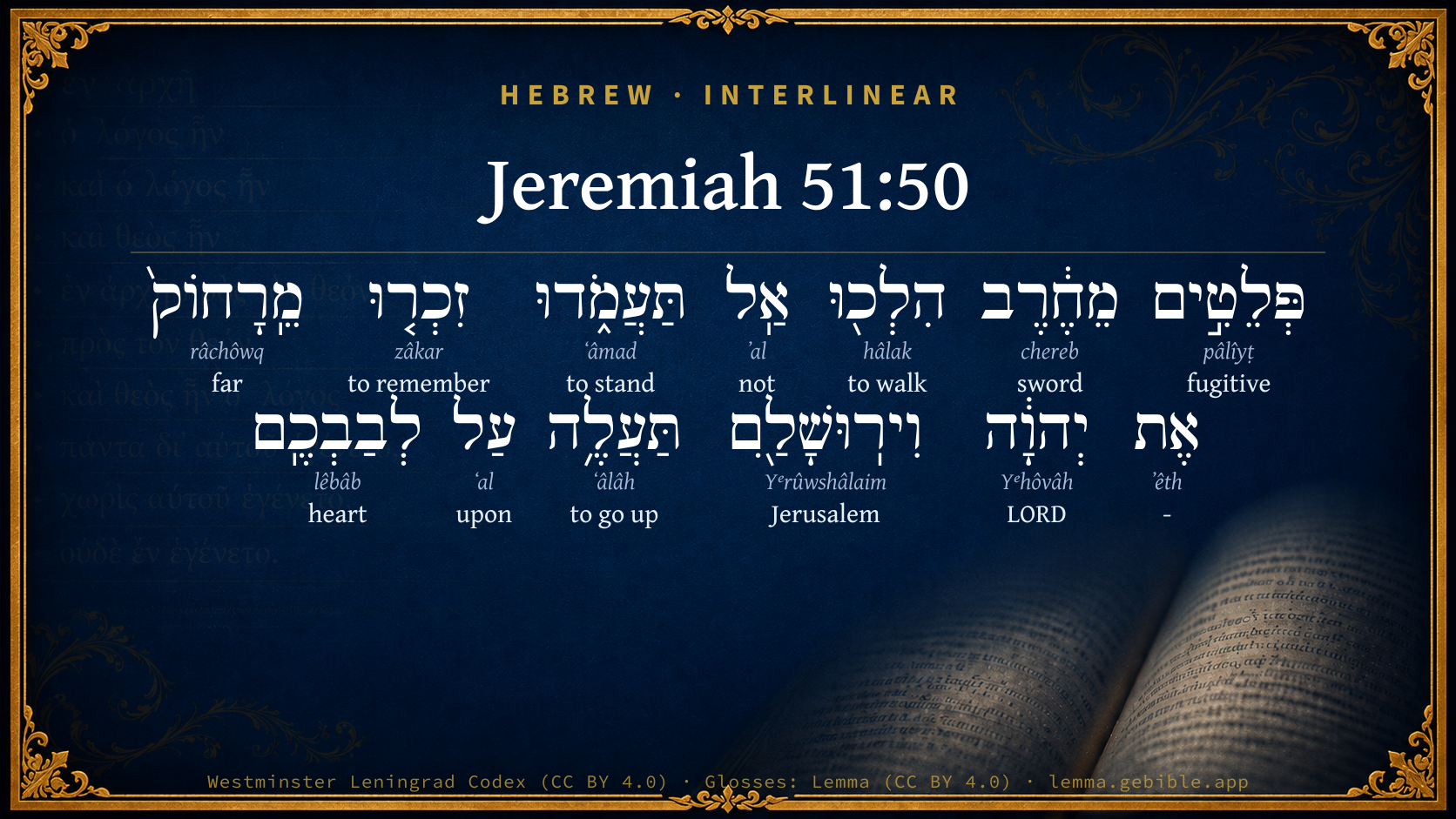
Hebrew (Westminster Leningrad Codex) Jeremiah 51:50 appears in the Hebrew Old Testament. The text above is from the Westminster Leningrad Codex. Each word links to its Strong’s number, a concise gloss, and parsing drawn from the Open Scriptures Hebrew Bible morphology. Click any word for its full Brown-Driver-Briggs (BDB) entry.
Download image
Cite this verse

Jeremiah 51:50 (World English Bible). Public Domain. Lemma interlinear Bible study tool, https://lemma.gebible.app/v/jeremiah/51/50.

Show BibTeX & RIS
BibTeX
RIS
English Translation
You who have escaped the sword, go you, don't stand still; remember Yahweh from afar, and let Jerusalem come into your mind.
World English Bible · Public Domain
Download a study sheet

One document with this verse’s original text, its word-by-word gloss line, the meaning frame, cross-references with their text, attributed commentary, and full source and license credits — printable, and it pastes into notes with its structure intact.

This verse Autodidact and up

Study sheet (.html) Plain text (.txt)

A passage Seminary Student

Up to 50 verses in one chapter. A passage sheet keeps up to 6 commentary sources and 12 cross-references per verse, in the order this page ranks them, and says so on the sheet whenever that leaves anything out. Ask for a single verse and you get the Autodidact verse sheet above.

Everything on this page stays free to read, with no account — the sheet is a download of what is already on screen, not access to it.

Want to remove ads? Support Godless Engineer
Compare translations 3

The same verse in 3 English versions, stacked beneath the original-language interlinear above. Click any original word for its lexicon entry.

Each is an independent rendering of the whole verse — the interlinear is not word-aligned to these translations.

Highlighted words mark where these versions differ — a whole-verse word diff, not a word-by-word alignment.

  • World English Bible Public Domain
    You who have escaped the sword, go you, don't stand still; remember Yahweh from afar, and let Jerusalem come into your mind.
  • King James Version Public Domain
    Ye that have escaped the sword, go away, stand not still: remember the LORD afar off, and let Jerusalem come into your mind.
  • unfoldingWord Literal Text CC BY-SA 4.0
    Survivors of the sword, go away! Do not stay still. Call Yahweh to mind from far away; let Jerusalem come to mind.

unfoldingWord Literal Text — © unfoldingWord, licensed CC BY-SA 4.0. Word-aligned USFM3 via Door43 (git.door43.org/unfoldingWord/en_ult).

Versions to compare (up to 4)

3 of 4 selected

Show all 18 translations

Every available English version of this verse, each an independent rendering of the whole verse.

  • World English Bible Public Domain
    You who have escaped the sword, go you, don't stand still; remember Yahweh from afar, and let Jerusalem come into your mind.
  • Berean Standard Bible Public Domain
    You who have escaped the sword, depart and do not linger! Remember the LORD from far away, and let Jerusalem come to mind.”
  • Majority Standard Bible Public Domain
    You who have escaped the sword, depart and do not linger! Remember the LORD from far away, and let Jerusalem come to mind.”
  • King James Version Public Domain
    Ye that have escaped the sword, go away, stand not still: remember the LORD afar off, and let Jerusalem come into your mind.
  • American Standard Version (1901) Public Domain
    Ye that have escaped the sword, go ye, stand not still; remember Jehovah from afar, and let Jerusalem come into your mind.
  • Revised Version (1885) Public Domain
    Ye that have escaped the sword, go ye, stand not still; remember the LORD from afar, and let Jerusalem come into your mind.
  • Geneva Bible (1599) Public Domain
    Ye that haue escaped the sworde, goe away, stand not still: remember the Lord a farre of, and let Ierusalem come into your minde.
  • Douay-Rheims (1899) Public Domain
    You that have escaped the sword, come away, stand not still: remember the Lord afar off, and let Jerusalem come into your mind.
  • Young's Literal Translation Public Domain
    Ye escaped of the sword, go on, stand not, Remember ye from afar Jehovah, And let Jerusalem come up on your heart.
  • Literal Standard Version CC BY-SA 4.0
    You escaped of the sword, go on, do not stand, || Remember YHWH from afar, || And let Jerusalem come up on your heart.
  • Unlocked Literal Bible CC BY-SA 4.0
    Survivors of the sword, go away! Do not stay still. Call Yahweh to mind from far away; let Jerusalem come to mind.
  • unfoldingWord Literal Text CC BY-SA 4.0
    Survivors of the sword, go away! Do not stay still. Call Yahweh to mind from far away; let Jerusalem come to mind.
  • Darby Bible Public Domain
    Ye that have escaped the sword, go, stand not still: remember Jehovah from afar, and let Jerusalem come into your mind.
  • World Messianic Bible Public Domain
    You who have escaped the sword, go! Don’t stand still! Remember the LORD from afar, and let Jerusalem come into your mind.”
  • Webster's Bible Public Domain
    Ye that have escaped the sword, go away, stand not still: remember the LORD afar off, and let Jerusalem come into your mind.
  • Free Bible Version CC BY-SA 4.0
    Those of you who have managed to escape being killed, leave now! Don't delay! Remember the Lord in this far away place; think about Jerusalem.
  • Bible in Basic English Public Domain
    You who have got away safe from the sword, go, waiting for nothing; have the Lord in memory when you are far away, and keep Jerusalem in mind.
  • JPS Tanakh (1917) Public Domain
    Ye that have escaped the sword, go ye, stand not still; remember the LORD from afar, and let Jerusalem come into your mind.

Literal Standard Version (2020), Covenant Press — licensed CC BY-SA 4.0. Text via the HelloAO Bible API (eBible.org). Unlocked Literal Bible (unfoldingWord) — licensed CC BY-SA 4.0. Text via the HelloAO Bible API (eBible.org). unfoldingWord Literal Text — © unfoldingWord, licensed CC BY-SA 4.0. Word-aligned USFM3 via Door43 (git.door43.org/unfoldingWord/en_ult). Free Bible Version, Dr. Jonathan Gallagher — licensed CC BY-SA 4.0. Text via the HelloAO Bible API (eBible.org).

Word by word

More ways to search: Search by grammar → Find every occurrence → Compare this word →

Practice this passage: Drill this verse → Learn its vocabulary →

פְּלֵטִ֣ים
pâlîyṭ
H6412
“fugitives”
Noun, Common, Masculine, Plural, Absolute
Part of Speech
Noun
Type
Common
Gender
Masculine
Number
Plural
State
Absolute
Full BDB Definition

Origin: from H6403

TWOT: 1774b , 1774c

refugee, fugitive, escaped one
  1. מֵחֶ֔רֶב chereb H2719 “from · sword” Preposition + Noun, Common, Feminine, Singular, Absolute
  2. הִלְכ֖וּ hâlak H1980 “walk” Verb, Qal, Imperative, 2nd Person, Masculine, Plural
  3. אַֽל ʼal H408 “not” Particle, Negative
  4. תַּעֲמֹ֑דוּ ʻâmad H5975 “to stand” Verb, Qal, Jussive, 2nd Person, Masculine, Plural
  5. זִכְר֤וּ zâkar H2142 “remember” Verb, Qal, Imperative, 2nd Person, Masculine, Plural
  6. מֵֽרָחוֹק֙ râchôwq H7350 “from · far” Preposition + Adjective, Adjective, Masculine, Singular, Absolute
  7. אֶת ʼêth H853 “-” Particle, Direct Object
  8. יְהוָ֔ה Yᵉhôvâh H3068 “LORD” Noun, Proper
  9. וִירֽוּשָׁלִַ֖ם Yᵉrûwshâlaim H3389 “and · Jerusalem” Conjunction + Noun, Proper
  10. תַּעֲלֶ֥ה ʻâlâh H5927 “to go up” Verb, Qal, Imperfect, 3rd Person, Feminine, Singular
  11. עַל ʻal H5921 “upon” Preposition
  12. לְבַבְכֶֽם lêbâb H3824 “heart · your” Noun, Common, Masculine, Singular, Construct + Suffix, Personal, 2nd Person, Masculine, Plural

About this verse

These counts appear in no published source. They are computed here, from the morphology-tagged text and Lemma’s own curated glosses. What Lemma adds →

13
words
13
distinct lemmas
Prophets
section

Notable vocabulary

The rarest word here is פְּלֵטִ֣ים fugitive H6412 — appearing just 24 times in the whole Hebrew Bible.

Shared distinctive vocabulary

פְּלֵטִ֣ים fugitive H6412 occurs in 23 verses of the Hebrew Bible. Also found in:

Grammatical profile

  • 4 verbs
  • 5 nouns
  • 1 adjective
  • 1 preposition
  • 2 particles

Verb forms

  • הִלְכ֖וּ Qal · Imperative
  • תַּעֲמֹ֑דוּ Qal · Jussive
  • זִכְר֤וּ Qal · Imperative
  • תַּעֲלֶ֥ה Qal · Imperfect

Cross-references

22

Topical passages linked to Jeremiah 51:50 in the Treasury of Scripture Knowledge — connected by theme and wording, ordered by reader-vote popularity; previews shown in the World English Bible.

  • Jeremiah 44:28 Those who escape the sword shall return out of the land of Egypt into the land of Judah, few in number; and all the remnant of Judah, who have gone into the land of Egypt to sojourn there, shall know whose word shall stand, mine, or theirs.
  • Psalms 122:6 Pray for the peace of Jerusalem. Those who love you will prosper.
  • Ezra 1:3–5 Whoever there is among you of all his people, his God be with him, and let him go up to Jerusalem, which is in Judah, and build the house of Yahweh, the God of Israel (he is God), which is in Jerusalem.
  • Isaiah 51:11 The ransomed of Yahweh shall return, and come with singing to Zion; and everlasting joy shall be on their heads: they shall obtain gladness and joy; [and] sorrow and sighing shall flee away.
  • Isaiah 52:11–12 Depart you, depart you, go you out from there, touch no unclean thing; go you out of the midst of her; cleanse yourselves, you who bear the vessels of Yahweh.
  • Jeremiah 51:45 My people, go you out of the midst of her, and save yourselves every man from the fierce anger of Yahweh.
  • Daniel 9:2–3 in the first year of his reign I, Daniel, understood by the books the number of the years about which the word of Yahweh came to Jeremiah the prophet, for the accomplishing of the desolations of Jerusalem, even seventy years.
  • Revelation 18:4 I heard another voice from heaven, saying, "Come out of her, my people, that you have no participation in her sins, and that you don't receive of her plagues,
  • Deuteronomy 30:1–4 It shall happen, when all these things are come on you, the blessing and the curse, which I have set before you, and you shall call them to mind among all the nations, where Yahweh your God has driven you,
  • Psalms 102:13–14 You will arise and have mercy on Zion; For it is time to have pity on her. Yes, the set time has come.
  • Psalms 137:5–6 If I forget you, Jerusalem, Let my right hand forget its skill.
  • Jeremiah 50:8 Flee out of the midst of Babylon, and go forth out of the land of the Chaldeans, and be as the male goats before the flocks.
  • Jeremiah 51:6 Flee out of the midst of Babylon, and save every man his life; don't be cut off in her iniquity: for it is the time of Yahweh's vengeance; he will render to her a recompense.
  • Zechariah 2:7–9 'Come, Zion! Escape, you who dwell with the daughter of Babylon.'
  • Nehemiah 1:2–4 that Hanani, one of my brothers, came, he and certain men out of Judah; and I asked them concerning the Jews who had escaped, who were left of the captivity, and concerning Jerusalem.
  • Nehemiah 2:3–5 I said to the king, Let the king live forever: why should not my face be sad, when the city, the place of my fathers' tombs, lies waste, and the gates of it are consumed with fire?
  • Jeremiah 29:12–14 You shall call on me, and you shall go and pray to me, and I will listen to you.
  • Jeremiah 31:21 Set up road signs, make guideposts; set your heart toward the highway, even the way by which you went: turn again, virgin of Israel, turn again to these your cities.
  • Daniel 9:16–19 Lord, according to all your righteousness, let your anger and please let your wrath be turned away from your city Jerusalem, your holy mountain; because for our sins, and for the iniquities of our fathers, Jerusalem and your people are become a reproach to all who are round about us.
  • Deuteronomy 4:29–31 But from there you shall seek Yahweh your God, and you shall find him, when you search after him with all your heart and with all your soul.
  • Isaiah 52:2 Shake yourself from the dust; arise, sit [on your throne], Jerusalem: loose yourself from the bonds of your neck, captive daughter of Zion.
  • Isaiah 48:20 Go you forth from Babylon, flee you from the Chaldeans; with a voice of singing declare you, tell this, utter it even to the end of the earth: say you, Yahweh has redeemed his servant Jacob.

Cross-references courtesy of OpenBible.info (CC BY 4.0).

Hebrew and Greek witnesses Masoretic Hebrew ↔ Greek Septuagint

The same verse in the two great witnesses to the Old Testament, shown verse-for-verse.

These are two independent witnesses, not word-aligned to each other, and the Septuagint is shown in lemma (dictionary) form.

Hebrew Jeremiah 51:50 Masoretic · Westminster Leningrad Codex

פְּלֵטִ֣ים מֵחֶ֔רֶב הִלְכ֖וּ אַֽל תַּעֲמֹ֑דוּ זִכְר֤וּ מֵֽרָחוֹק֙ אֶת יְהוָ֔ה וִירֽוּשָׁלִַ֖ם תַּעֲלֶ֥ה עַל לְבַבְכֶֽם

You who have escaped the sword, go you, don't stand still; remember Yahweh from afar, and let Jerusalem come into your mind.

World English Bible · Public Domain

Greek LXX Structure differs

In the Septuagint, Jeremiah is about an eighth shorter than the Hebrew and arranges its material differently — the Oracles Against the Nations (Hebrew chapters 46–51) appear in the middle of the Greek book, after 25:13. Because the chapter and verse boundaries do not line up, a verse-for-verse comparison with the Hebrew is not shown.

A verse-for-verse comparison isn’t shown here because the chapters and verses don’t line up. Switch to the LXX edition with the MT / LXX toggle above to read the Greek directly.

Hebrew: Westminster Leningrad Codex (CC BY 4.0). Greek: Septuagint (public domain); English from a public-domain English Septuagint. How the Septuagint differs from the Hebrew →

Targum (Aramaic paraphrase)

1

The Targum is the ancient Jewish Aramaic paraphrase of the Hebrew Scriptures — an interpretive translation, not the Hebrew text itself. Onkelos (literal) and Pseudo-Jonathan (expansive) render the Torah, and Jonathan the Prophets. Coverage is partial: where no permissively-licensed English translation exists for a verse, only the Aramaic is shown. This is verse-level text, not a word-by-word alignment to the Hebrew.

  1. Targum Jonathan Prophets (Joshua–Malachi)
    מְשֵׁיזְבַיָא מֵחַרְבָּא גְלוֹ לָא תִתְעַכְּבוּן אִדְכָּרוּ מֵרָחִיק יַת פּוּלְחָנָא דַייָ וִירוּשְׁלֵם תִּסַק עַל לִבְּכוֹן:

    (no public-domain English translation for this verse)

    Targum Jonathan — Aramaic: “Mikraot Gedolot” (public domain). English: “Sefaria Community Translation” (CC0 1.0 (public-domain dedication)); “London "Chaldee Paraphrase," 1871” (public domain). Text via Sefaria.

Commentary

Notes on Jeremiah 51:50 from classic Christian and Jewish commentators (each source and its license shown beneath its notes). The classic Christian expositions comment on the surrounding passage and are grouped to its opening verse, so a note may address several verses; the Jewish commentaries on the Tanakh (Rashi and others) are per-verse, so they appear only where the commentator wrote on this verse.

Lemma curates 59 commentaries, every one of them public domain or Creative Commons licensed, each selected and text-cleaned for this edition rather than reprinted as found. About our sources →

Trapp's Complete Commentary

John Trapp

Jer 51:50 Ye that have escaped the sword, go away, stand not still: remember the LORD afar off, and let Jerusalem come into your mind.

Ver. 50. Ye that have escaped the sword,] sc., Of the Medes and Persians, who at the taking of the city killed all promiscuously.

Go away, stand not still.] Haste home to your own country, for therefore hath the Lord delivered you from so many deaths and dangers. See Jer 51:25.

Remember the Lord afar off.] Should not we mind heaven, and hasten thither? If a heathen could say, ought we not much more, Fugiendum est ad clarissimum patriam; ibi Pater, ibi omnia, Haste we home to heaven; there is our Father, there are all things.

John Trapp, A Commentary or Exposition upon All the Books of the Old and New Testament (1647–1656) — public domain. Text from a community e-Sword module.

Joseph Benson's Commentary

Jer 51:50-51. Ye that have escaped the sword — Namely, the sword which wasted Babylon. Go away, stand not still — This is spoken to the Jews, who, attending to the advice given them, Jer 51:45, withdrew from Babylon in time, and so escaped the sword by which they otherwise might have fallen. And here they are advised to flee still farther and farther off; but amidst all to remember their native country, and in particular Jerusalem, and the God they had worshipped there; and to pray for the restoration of the city and temple; and that he would avenge himself of the Babylonians for laying them in ruins. We are confounded, because we have heard reproach — The prophet here represents the words or thoughts of the pious exiles, when they heard the Babylonians speaking of Jehovah with contempt, and deriding them for worshipping him, who could not, they said, deliver his city and temple out of their hands, or preserve them from being destroyed. For strangers are come into the sanctuaries of the Lord’s house — The word sanctuaries, in the plural, is likewise used Psa 73:17, though our English reads there, sanctuary. Probably the several courts of the temple are meant by sanctuaries.

Joseph Benson's Commentary on the Old and New Testaments (1811–1818) — public domain. Text from a community e-Sword module.

Whedon's Commentary on the Bible

Daniel D. Whedon

FINAL SUMMING UP, Jer_51:50-58.

50. Remember the Lord afar off — Namely, in Babylon, the land of your captivity. Such language as this would be well suited to stir up the hopes and affections of the captive Israelites. and induce a longing to return to their own land.

Daniel D. Whedon (gen. ed.), Commentary on the Old and New Testaments (1874–1909) — public domain. Text from a community e-Sword module.

Keil & Delitzsch

C. F. Keil & F. Delitzsch

Final summing up of the offence and the punishment of Babylon. Jer 51:50. "Ye who have escaped the sword, depart, do not stay! remember Jahveh from afar, and let Jerusalem come into your mind. Jer 51:51. We were ashamed, because we heard reproach; shame hath covered our face, for strangers have come into the holy places of the house of Jahveh. Jer 51:52. Therefore, behold, days are coming, saith Jahveh, when I will take vengeance on her graven images; and through all her land shall the wounded groan. Jer 51:53. Though Babylon ascended to heaven, and fortified the height of her strength, yet from me there shall come destroyers to her, saith Jahveh. Jer 51:54. The noise of a cry [comes] from Babylon, and great destruction from the land of the Chaldeans. Jer 51:55. For Jahveh lays waste Babylon, and destroys out of her the great noise; and her waves sound like many waters: a noise of their voice is uttered. Jer 51:56. For there comes against her, against Babylon, a destroyer, and her heroes are taken; each one of their bows is broken: for Jahveh is a God of retributions, He shall certainly recompense. Jer 51:57. And I will make drunk her princes and her wise men, her governors and her lieutenant-governors, and her heroes, so that they shall sleep an eternal sleep, and not awake, saith the King, whose name is Jahveh of hosts. Jer 51:58. Thus saith Jahveh of hosts: The broad walls of Babylon shall be utterly destroyed, and her high gates shall be burned with fire, so that nations toil for nothing, and peoples for the fire, and thus are weary."

Once more there is addressed to Israel the call to return immediately; cf. Jer 51:45 and Jer 50:8. The designation, "those who have escaped from the sword," is occasioned by the mention in Jer 51:49 of those who are slain: it is not to be explained (with Ngelsbach) from the circumstance that the prophet sees before him the massacre of the Babylonians as something that has already taken place. This view of the matter agrees neither with what precedes nor what follows, where the punishment of Babylon is set forth as yet to come. It is those who have escaped from the sword of Babylon during the exercise of its sway that are meant, not those who remain, spared in the conquest of Babylon. They are to go, not to stand or linger on the road, lest they be overtaken, with others, by the judgment falling upon Babylon; they are also to remember, from afar, Jahveh the faithful covenant God, and Jerusalem, that they may hasten their return. הלכוּ is a form of the imperative from הלך; it occurs only here, and has probably been chosen instead of לכוּ, because this form, in the actual use of language, had gradually lost its full meaning, and become softened down to a mere interjection, while emphasis is here placed on the going. After the call there follows, in Jer 51:51, the complaint, "We have lived to see the dishonour caused by the desecration of our sanctuary." This complaint does not permit of being taken as an answer or objection on the part of those who are summoned to return, somewhat in this spirit: "What is the good of our remembering Jahveh and Jerusalem? Truly we have thence a remembrance only of the deepest shame and dishonour" (Ngelsbach). Such an objection the prophet certainly would have answered with a reproof for the want of weakness of faith. Ewald accordingly takes Jer 51:51 as containing "a confession which the exiles make in tears, and filled with shame, regarding the previous state of dishonour in which they themselves, as well as the holy place, have been." On this view, those who are exhorted to return encourage themselves by this confession and prayer to zeal in returning; and it would be necessary to supply dicite before Jer 51:51, and to take בּשׁנוּ as meaning, "We are ashamed because we have heard scoffing, and because enemies have come into the holy places of Jahveh's house." But they might have felt no shame on account of this dishonour that befell them. בּושׁ signifies merely to be ashamed in consequence of the frustration of some hope, not the shame of repentance felt on doing wrong. Hence, with Calvin and others, we must take the words of Jer 51:51 as a scruple which the prophet expresses in the name of the people against the summons to remember Jahveh and Jerusalem, that he may remove the objection. The meaning is thus something like the following: "We may say, indeed, that disgrace has been imposed on us, for we have experienced insult and dishonour; but in return for this, Babylon will now be laid waste and destroyed." The plural המּקדּשׁים denotes the different holy places of the temple, as in Ps. 68:36. The answer which settles this objection is introduced, Jer 51:52, by the formula, "Therefore, behold, days are coming," which connects itself with the contents of Jer 51:51 : "Therefore, because we were obliged to listen to scoffing, and barbarians have forced their way into the holy places of the house of our God, - therefore will Jahveh punish Babylon for these crimes," The suffixes in פּסיליה and ארצהּ refer to Babylon. חלל is used in undefined generality, "slain, pierced through."

Keil & Delitzsch — Biblical Commentary on the Old Testament (1861–1891) — public domain (CC PDM 1.0). Text via the HelloAO Bible API. (Old Testament only.)

Geneva Bible (1599)

Geneva Bible translators

Ye that are now captives in Babylon.

Geneva Bible (1599) marginal notes — public domain. Text via Bolls.life.

Jamieson, Fausset & Brown

Robert Jamieson, A. R. Fausset & David Brown

escaped . . . sword--namely, of the Medes. So great will be the slaughter that even some of God's people shall be involved in it, as they had deserved.

afar off--though ye are banished far off from where ye used formerly to worship God.

let Jerusalem come into your mind--While in exile remember your temple and city, so as to prefer them to all the rest of the world wherever ye may be (Isa 62:6).

Jamieson, Fausset & Brown — Commentary Critical and Explanatory on the Whole Bible (1871) — public domain (CC PDM 1.0). Text via the HelloAO Bible API.

Adam Clarke's Commentary

Verse 50. Ye that have escaped the sword] The Jews.

Let Jerusalem come into your mind.] Pray for its restoration; and embrace the first opportunity offered of returning thither.

Adam Clarke's Commentary on the Bible (1810–1826) — public domain. Text from a community e-Sword/MySword module.

John Calvin's Commentaries

The Prophet again bids the faithful quickly to flee from Chaldea; but he says, They who remain from the sword He then intimates that the slaughter would be such, that it would include many of God’s people, and that they would be destroyed. And we know that many among them deserved such a sad end; but the Prophet now turns to address those who had been preserved through God’s special favor. He then bids them to depart and not to stand still or stay.

Now, we said yesterday what was the object of this exhortation, even that the faithful might feel assured of their free return to their own country, from which, nevertheless, they thought they were perpetually excluded; for they had wholly despaired of deliverance, though it had been so often promised. This exhortation, then, contains a promise; and in the meantime the Prophet reminds us, that though God inflicted a temporary punishment on the chosen people, yet his vengeance on the Babylonians would be perpetual. For God not only tempers his rigor towards the faithful when he chastises them, but he also gives them a happy issue, so that all their afflictions become helps to their salvation, as Paul also teaches us. (Romans 8:28.) In short, the punishments inflicted by God on his children are so many medicines; for he always consults their safety even when he manifests tokens of his wrath. But the case with the ungodly is different; for all their punishments are perpetual, even those which seem to have an end. How so? because they lead to eternal ruin. This is what the Prophet means when he bids those who remained, to flee from Chaldea, according to what we observed yesterday, when he said, Flee ye from the indignation of God’s wrath. There is, then, an implied comparison between the punishment which brings ultimate ruin on the reprobate, and the temporary punishment inflicted by God on his children.

He bids them to remember Jehovah from afar Some apply this to the seventy years, but, in my view, in a sense too restricted. I then doubt not but that the Prophet bids them to entertain hope and to look to God, however far they may have been driven from him, as though he were wholly alienated from them. The Israelites had then been driven into distant lands, as though God never meant to restore them. As, then, the distance was so great between Chaldea and Judea, what else could come into the minds of the miserable exiles but that God was far removed from them, so that it was in vain for them to seek or call upon him? The Prophet obviates this want of faith, and raises their confidence, so that they might not cease to flee to God, though they had been driven into distant lands: Be, then, mindful of Jehovah from afar

Then he adds, Let Jerusalem ascend on your heart; that is, though so many obstacles may intercept your faith, yet think of Jerusalem. The condition of the people required that they should be thus animated, for they might otherwise, as it has been said, have a hundred times despaired, and have thus become torpid in their calamities. Then the Prophet testifies that an access to God was open to them, and that though they were removed far, he yet had a care for them, and was ready to bring help whenever called upon And for the same reason he bids them to direct their minds to Jerusalem, so as to prefer the Temple of God to all the world, and never to rest quiet until God restored them, and liberty were given them of worshipping him there.

Now this passage deserves special notice, as it applies to us at this day; for when the scattering of the Church takes place, we think that we are forsaken by God, and we also conclude that he is far away from us, so that he is sought in vain. As, then, we are wont, being inclined to distrust, to become soon torpid in our calamities, as though we were very remote from God, and as though he did not turn his eyes to look on our miseries, let us apply to ourselves what is here said, even to remember Jehovah from afar; that is, when we seem to be involved in extreme miseries, when God hides his face from us and seems to be afar off; in short, when we think ourselves forsaken, and circumstances appear as proving this, we ought still to contend with all such obstacles until our faith triumphs, and to employ our thoughts in remembering God, though he may be apparently alienated from us. Let us also learn to direct our minds to the Church; for however miserable our condition may be, it is yet better than the happiness which the ungodly seek for themselves in the world. When, therefore, we see the ungodly flattering themselves as to their possessions, when we see them pleased and delighted as though God were dealing indulgently with them, let then Jerusalem come to our minds, That is, let us prefer the state of the Church, which may be yet sad and deformed, and such as we would shun, were we to follow our own inclinations. Let then the condition of the Church come to our minds, that is, let us embrace the miseries common to the godly, and let it be more pleasant to us to be connected with the children of God in all their afflictions, than to be inebriated with the prosperity of those who only delight in the world, and are at the same time accursed by God. This is the improvement which we ought to make of what is here taught. It now follows, —

John Calvin's Commentaries (1540-1563) — public domain. Text from the Calvin Translation Society English edition (1840s-50s) via the Christian Classics Ethereal Library (ccel.org). Calvin's coverage is partial (roughly two-thirds of the Bible); uncommented books and verses are honest gaps, never fabricated. The 19th-century editor's footnotes and remarks are omitted so the notes are faithfully Calvin's own voice.

Ellicott's Commentary for English Readers

(50) Ye that have escaped the sword . . .—The words call on the people to fulfil the prediction of Jer_50:4-5. Even in that distant land, “afar off” from the Temple of Jehovah, they are to remember that they are Israelites, and to think of Jerusalem as their home. In Psa_137:5-6 we have, as it were, by anticipation, the answer of the exiles. They had not forgotten Jerusalem in the revelry of their conquerors. They were not likely to forget her when their conquerors were, in their turn, conquered.

A Bible Commentary for English Readers, edited by Charles John Ellicott (1878–1897) — public domain. Text from a community e-Sword module.

The Cambridge Bible for Schools and Colleges

gen. ed. J. J. S. Perowne

50. Let those in exile in Babylon, who have escaped death, hasten their return to Jerusalem, while yet there is time.

The Cambridge Bible for Schools and Colleges (gen. ed. J. J. S. Perowne; Cambridge University Press, 1878–1918) — public domain. Text from a community e-Sword module.

John Gill's Exposition

Wherefore, behold, the days come, saith the Lord, that I will do judgment upon her graven images,.... Destroy their gods, who have reproached the God of Israel, and profaned his sanctuaries; and for that reason; See Gill on Jer 51:47; it is an answer to the objection and complaint of the Jews, and is designed for their comfort and encouragement:

and through all her land the wounded shall groan; because of their wounds and pain; and which their idols could not cure, ease, or prevent.

John Gill's Exposition of the Whole Bible (1746–1763) — public domain (CC PDM 1.0). Text via the HelloAO Bible API.

Albert Barnes' Notes on the Bible

Afar off - Or, from afar, from Chaldaea, far away from Yahweh’s dwelling in Jerusalem. The verse is a renewed entreaty to the Jews to leave Babylon and journey homewards, as soon as Cyrus grants them permission.

Albert Barnes' Notes on the Bible (1834–1885) — public domain. Text from a community e-Sword/MySword module.

Haydock's Catholic Bible Commentary

Mind. Offer sacrifices of thanks on Sion, (Haydock) both Jews and other nations. (Calmet)

George Leo Haydock (1774–1849), Haydock's Catholic Family Bible and Commentary, 1859 edition — public domain. Excludes Psalms (Douay-Rheims chapter numbering differs from Protestant) and Deuterocanonical books (Catholic canon only).

Matthew Poole's English Annotations

It is hard to resolve whether the prophet here speaks to the Chaldeans, or the Medes, or the Jews, though most understand it of the Jews, whom God would have leave Babylon as soon as they should have a liberty proclaimed; and to remember when they came into Judea the great things, both of justice toward the Chaldeans and mercy toward them, which God had done; and keep Jerusalem in their mind, as the place where they were to worship God according to his direction, and for which God had so wrought.

Matthew Poole's English Annotations on the Holy Bible (1683–1685) — public domain. Text from a community e-Sword/MySword module.

The Pulpit Commentary

Vers. 50-58. Conclusion of the prophecy.

Ye that have escaped the sword. Evidently Jews are the persons addressed. It is not, however, perfectly clear whether the escape is from the sword of Babylon or from that of Divine vengeance. The parallel Isa_24:14 would suggest the latter; but in the following verses the fall of Babylon is described as still to come. Stand not still. Lest ye be overtaken by the judgment.

The duty and encouragement of the saved.

I THE DUTY. "Stand not still.

1. Why the duty is requisite. Past deliverance is no security for the future. The first arrow missed the mark, but the second may strike. The tide advances; though the waves have not yet reached us, they will overwhelm us if we remain where we are.

(1) It is possible to avoid one earthly trouble and succumb to another to escape the sword and fall a prey to the pestilence.

(2) It is possible to escape much distress in this world and then to fall under a terrible doom in the next world.

(3) It is possible to be safe now from the terrible effects of sin and to yield to future temptation and so bring upon our heads ruin in the future.

2. How the duty is to be performed.

(1) We must be prayerful. As the danger is ever renewed so must the grace be. Therefore we need to be always seeking aid from heaven.

(2) We must be watchful.. New dangers may arise at any moment.

(3) We must be anxious to flee from evil. Our whole course must be with the back to the city of Destruction.

(4) we must be diligent. The attainments of the past will not suffice. Forgetting those things which are behind, we must press forward. The Christian"s safety is not in indolent reliance upon Christ, but in trustful obedience.

II THE ENCOURAGEMENT. "Remember the Lord from afar, and let Jerusalem come into your mind

1. God"s grace in the past is an encouragement for the future. Past deliverances will not secure us against future danger, but they wall furnish reasons for seeking safety again in God.

2. The chief reason for pressing diligently and hopefully forward is to be found in the contemplation of God. His holiness should make us fear sin; his love should make us trust in his helping grace. That we may not stand still, we should "remember the Lord.

3. Our very remoteness from God should urge us not to stand still We may have wandered far from God in sin, or have forgotten him among the crowd of worldly distractions. But when we realize our condition, when we come to ourselves, we shall see that our only safety will be in arising and going to our Father. We can never be too far to return by Christ" the Way." The further we are from God the greater is our danger, the nearer we approach him the more of his grace and help shall we enjoy.

4. Thoughts of our mission and destiny should induce us not to stand still. The Jews are to remember Jerusalem, their ancient home, the seat of their future destinies. If there were no such city they might despair in their exile. The thought of Jerusalem suggests a centre of union and an aim for the future. If a man loses all hope, he loses himself. When we think of our possible future and of our mission, we are roused to take up the tangled threads and weave our life"s work with patience according to the pattern of God"s will.

The charge to them that are spared.

This charge, addressed to Israelites spared from Babylon, may be applied to all in Christ. For

I ALL IN CHRIST ARE SPARED ONES. Spared from:

1. The condemnation due to sin.

2. The abiding tyranny of sin.

3. The crushing power of sorrow.

4. The misery of alienation from God.

5. The might of death.

II TO SUCH THIS THREEFOLD CHARGE IS ADDRESSED.

1. They are to "go away, stand not still. As Israel from Babylon that had enslaved them, so these from the sins which. God has forgiven them. "Let him that nameth the name of Christ depart from iniquity." Many Jews despised this charge, and stayed on in Babylon. Some not merely stayed in Babylon as Jews, but probably far more of them were "mingled with the heathen, and learned their ways." "Evil communications corrupt good manners." Even those who disobeyed only the letter of the command suffered, whilst those who disobeyed both the letter and the spirit were simply lost, cut off from the house of Israel. And they who have received Christ, if they do not break away from their old sins and from all that would hold them in bondage to such sins, will lose their religion and are in sore peril of apostatizing from Christ. Therefore let such put further and further distance between themselves and their former life, lest again they be entangled and. overcome.

2. To "remember the lord afar off. In their sin and misery God seemed afar off to Israel. "My way is hid from the Lord, and my judgment is passed over from my God such was their grievous lament. But they were to remember him, turn their thoughts and prayers toward him, and believingly wait his promised answer. And to the believer now "it doth not yet appear what we shall be;" we are far off from that; but we are to remember the Lord, though we be yet in condition and character so far off from him. Remember him in our meditations, prayers, purposes, and aims; wait on him, and so renew our strength.

3. "Let Jerusalem come into your mind." How blessed to be there! how she demands our earnest service! her joys, her sanctity, her children, her employ; our place there prepared for us, and our preparation for the place. So remember her, and so be delivered from being wearied and faint in our minds. C.

A timely recollection and its practical effect.

Jehovah is making his severest judgments to fall on Babylon. How severe they are is indicated by the fact that two long chapters are occupied with denunciations upon her. But all the time Israel is in her midst. Israelites are domiciled and settled down. How far they lived by themselves and how far they mingled with their captors we cannot tell. One thing, however, we are sure of, that in the midst of so much destruction to Babylon they, or at least the bulk of them, were preserved. It must have been a very discomposing time for them, even though they had tolerable confidence that all would turn out right. There may be real safety where as yet there is not clear perception of it, and therefore no possibility of untroubled peace.

But at last the danger is over, and what will the Israelite do then? He may elect, for reasons personal to himself, to stay in Babylon. He may be tempted to forget his duty as a part in a greater whole. Not for himself, however, not to further any aims of his own, was he thus preserved. He has escaped the sword only that he may the better serve God. Present ease, pleasant associations, may rise attractively in his mind. Not, of course, that these could be found in desolated Babylon, hut they might surely be found somewhere else than in Jerusalem so far away. Against natural thoughts of this kind the prophet"s word comes in here as a guard. It is a word for those Israelites living in Babylon at the time of Babylon"s downfall. The things near to them, which their eyes see and their hands handle, are the least important. The really important considerations are those which may most easily be forgotten. Thus, so to speak, they must be pushed before the mind. Every right-hearted Israelite would keep the God and the city of his fathers in his heart. And so we should keep Jehovah and Jerusalem in mind. The greatest duties and hopes of our life come from our connection with such recollections. Y.

The Pulpit Commentary (1880–1919), ed. H.D.M. Spence-Jones & Joseph S. Exell — public domain. Text from a community e-Sword module.

John Wesley's Explanatory Notes

Ye - Ye Jews, leave Babylon as soon as liberty is proclaimed. Remember - And remember in Judea the great things both of justice and mercy which God hath done.

John Wesley, Explanatory Notes Upon the Whole Bible (1754–1765) — public domain. Text via the GEBible commentary corpus.

unfoldingWord translationNotes

Door43 World Missions Community

General Information:

Jeremiah speaks to the Israelite people in verse 50.

Survivors of the sword

The sword is a metonym for war, in which soldiers use swords. AT: "You who have survived the war" (See: Metonymy)

Call Yahweh to mind from far away; let Jerusalem come to mind

The phrases "Call ... to mind" and "come to mind" are idioms that mean to think about or remember. AT: "Though you are far away, think about Yahweh; think about Jerusalem" (See: Idiom)

insults

words that one person uses to offend another

reproach has covered our faces

The speakers' reaction to people expressing disapproval of them is spoken of as if it were a cover placed over the speakers' faces. AT: "our faces show that we are hurt because others disapprove of us" or "we cover our faces in shame because others disapprove of us" (See: Metaphor)

translationWords

sword

Jerusalem

shame

reproach

face

alien

holy place

house of God

unfoldingWord translationNotes — © Distant Shores Media and the Door43 World Missions Community, licensed CC BY-SA 4.0. Source: git.door43.org/Door43/en_tn.

Rashi

Rabbi Shlomo Yitzchaki (Rashi)

Fugitives from the sword Israel, who was exiled into her midst, who escaped the sword of Nebuzaradan.

Rashi on the Tanakh — English translations: “The Judaica Press complete Tanach with Rashi, translated by A. J. Rosenberg” (CC BY 4.0); “Pentateuch with Rashi's commentary by M. Rosenbaum and A.M. Silbermann, 1929-1934” (public domain); “The Metsudah Tanach series, Lakewood, N.J” (CC BY 4.0); and “The Book of Joshua, Metsudah Publications, 1997” (CC BY 4.0). Text via Sefaria.

Lesson kit

Teaching starters — assembled from the data on this page, not authored interpretation. Every prompt links to the verse data it draws on. Edit before teaching.

Jeremiah, in the Prophets, opens this verse with 13 words (13 distinct Hebrew lemmas). Its most distinctive word is pâlîyṭ (“fugitive”). A historical commentator’s framing appears above. Read the whole chapter for the surrounding context.

Discussion questions

  1. What does “fugitive” (pâlîyṭ) contribute to the verse as a whole?
  2. Genesis 14:13 shares the word «fugitive» with this verse. How do the two illuminate each other?
  3. These translations render this verse differently. What is at stake in choosing one wording over another?
  4. The verb «הִלְכ֖וּ» is Qal Imperative. How does its form color the action?
  5. Reading how Trapp's Complete Commentary and Joseph Benson's Commentary read this verse, where do the two commentators agree and where do they part?

Things to notice

Reading settings

Reading text

Shown beneath each verse's original-language words.

Old Testament
Old Testament edition

Read the OT as the Masoretic Hebrew (MT) or the Greek Septuagint (LXX).

English shown for the Greek Septuagint (in the Hebrew ↔ Greek comparison).

Comparing translations? Open the Compare panel on any verse page to stack up to four side by side.