

Isaiah 46:12

Hebrew (Westminster Leningrad Codex) Isaiah 46:12 appears in the Hebrew Old Testament. The text above is from the Westminster Leningrad Codex. Each word links to its Strong’s number, a concise gloss, and parsing drawn from the Open Scriptures Hebrew Bible morphology. Click any word for its full Brown-Driver-Briggs (BDB) entry.
Download image
Cite this verse

Isaiah 46:12 (World English Bible). Public Domain. Lemma interlinear Bible study tool, https://lemma.gebible.app/v/isaiah/46/12.

Show BibTeX & RIS
BibTeX
RIS
English Translation
Listen to me, you stout-hearted, who are far from righteousness:
World English Bible · Public Domain
Download a study sheet

One document with this verse’s original text, its word-by-word gloss line, the meaning frame, cross-references with their text, attributed commentary, and full source and license credits — printable, and it pastes into notes with its structure intact.

This verse Autodidact and up

Study sheet (.html) Plain text (.txt)

A passage Seminary Student

Up to 50 verses in one chapter. A passage sheet keeps up to 6 commentary sources and 12 cross-references per verse, in the order this page ranks them, and says so on the sheet whenever that leaves anything out. Ask for a single verse and you get the Autodidact verse sheet above.

Everything on this page stays free to read, with no account — the sheet is a download of what is already on screen, not access to it.

Want to remove ads? Support Godless Engineer
Compare translations 3

The same verse in 3 English versions, stacked beneath the original-language interlinear above. Click any original word for its lexicon entry.

Each is an independent rendering of the whole verse — the interlinear is not word-aligned to these translations.

Highlighted words mark where these versions differ — a whole-verse word diff, not a word-by-word alignment.

  • World English Bible Public Domain
    Listen to me, you stout-hearted, who are far from righteousness:
  • King James Version Public Domain
    Hearken unto me, ye stouthearted, that are far from righteousness:
  • unfoldingWord Literal Text CC BY-SA 4.0
    “Listen to me, strong of heart, far from righteousness!

unfoldingWord Literal Text — © unfoldingWord, licensed CC BY-SA 4.0. Word-aligned USFM3 via Door43 (git.door43.org/unfoldingWord/en_ult).

Versions to compare (up to 4)

3 of 4 selected

Show all 18 translations

Every available English version of this verse, each an independent rendering of the whole verse.

  • World English Bible Public Domain
    Listen to me, you stout-hearted, who are far from righteousness:
  • Berean Standard Bible Public Domain
    Listen to Me, you stubborn people, far removed from righteousness:
  • Majority Standard Bible Public Domain
    Listen to Me, you stubborn people, far removed from righteousness:
  • King James Version Public Domain
    Hearken unto me, ye stouthearted, that are far from righteousness:
  • American Standard Version (1901) Public Domain
    Hearken unto me, ye stout-hearted, that are far from righteousness:
  • Revised Version (1885) Public Domain
    Hearken unto me, ye stouthearted, that are far from righteousness:
  • Geneva Bible (1599) Public Domain
    Heare me, ye stubburne hearted, that are farre from iustice.
  • Douay-Rheims (1899) Public Domain
    I have brought my justice near, it shall not be afar off: and my salvation shall not tarry. I will give salvation in Sion, and my glory in Israel.
  • Young's Literal Translation Public Domain
    Hearken unto Me, ye mighty in heart, Who are far from righteousness.
  • Literal Standard Version CC BY-SA 4.0
    Listen to Me, you mighty in heart, || Who are far from righteousness.
  • Unlocked Literal Bible CC BY-SA 4.0
    Listen to me, you stubborn people, who are far from doing what is right.
  • unfoldingWord Literal Text CC BY-SA 4.0
    “Listen to me, strong of heart, far from righteousness!
  • Darby Bible Public Domain
    Hearken unto me, ye stout-hearted, that are far from righteousness:
  • World Messianic Bible Public Domain
    Listen to me, you stubborn-hearted, who are far from righteousness!
  • Webster's Bible Public Domain
    Hearken to me, ye stout-hearted, that are far from righteousness:
  • Free Bible Version CC BY-SA 4.0
    Listen to me, you stubborn people, who are such a long way from doing what's right!
  • Bible in Basic English Public Domain
    Give ear to me, you feeble-hearted, who have no faith in my righteousness:
  • JPS Tanakh (1917) Public Domain
    Hearken unto Me, ye stout-hearted, that are far from righteousness:

Literal Standard Version (2020), Covenant Press — licensed CC BY-SA 4.0. Text via the HelloAO Bible API (eBible.org). Unlocked Literal Bible (unfoldingWord) — licensed CC BY-SA 4.0. Text via the HelloAO Bible API (eBible.org). unfoldingWord Literal Text — © unfoldingWord, licensed CC BY-SA 4.0. Word-aligned USFM3 via Door43 (git.door43.org/unfoldingWord/en_ult). Free Bible Version, Dr. Jonathan Gallagher — licensed CC BY-SA 4.0. Text via the HelloAO Bible API (eBible.org).

Word by word

More ways to search: Search by grammar → Find every occurrence → Compare this word →

Practice this passage: Drill this verse → Learn its vocabulary →

About this verse

These counts appear in no published source. They are computed here, from the morphology-tagged text and Lemma’s own curated glosses. What Lemma adds →

6
words
6
distinct lemmas
Prophets
section

Notable vocabulary

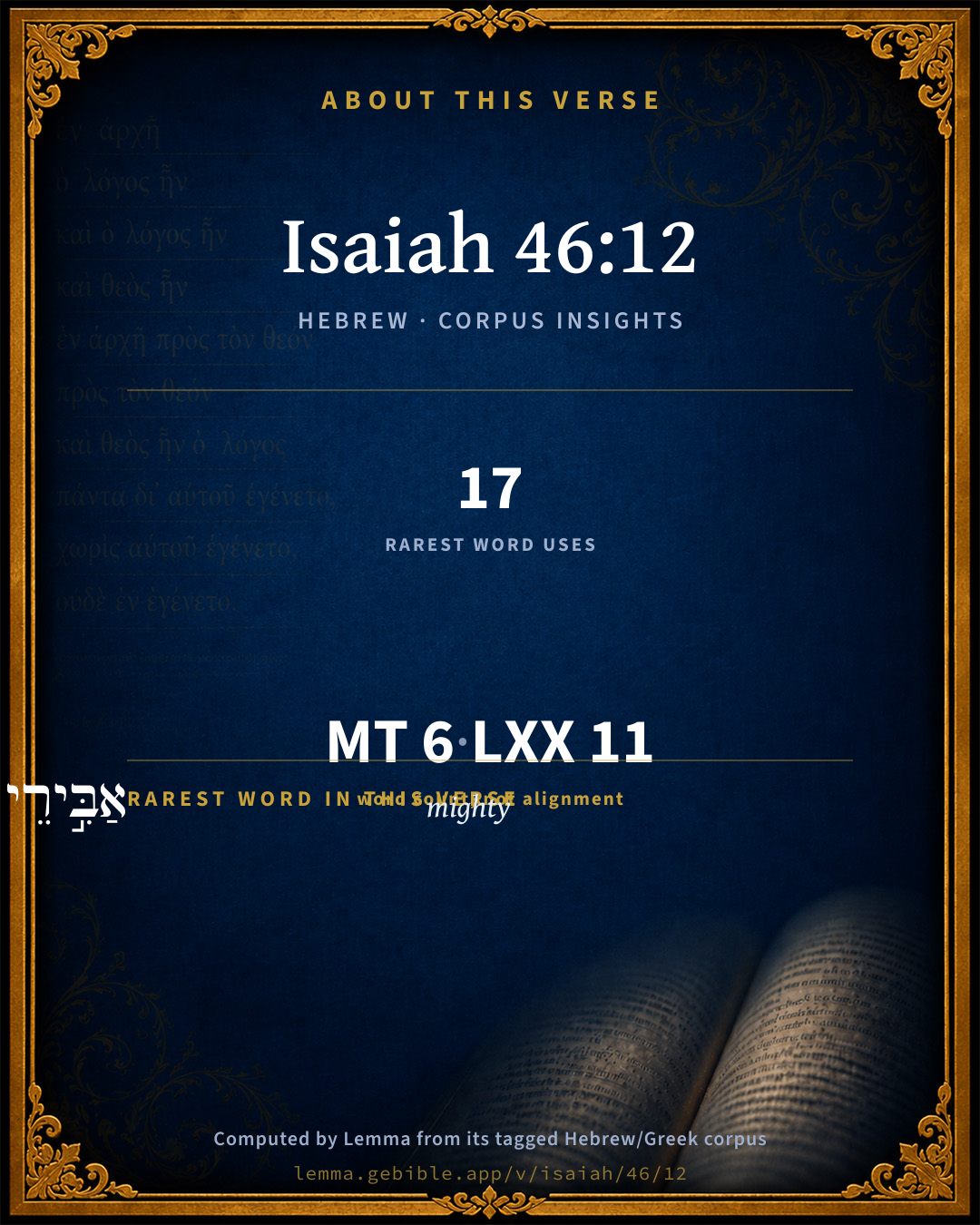
The rarest word here is אַבִּ֣ירֵי mighty H47 — appearing just 17 times in the whole Hebrew Bible.

Shared distinctive vocabulary

אַבִּ֣ירֵי mighty H47 occurs in 17 verses of the Hebrew Bible. Also found in:

Grammatical profile

  • 1 verb
  • 2 nouns
  • 2 adjectives
  • 1 preposition

Verb forms

  • שִׁמְע֥וּ Qal · Imperative

Hebrew & Septuagint length

In English translation the verse runs 10 words from the Hebrew and 11 from the Septuagint (LXX English) — closely comparable.

A rough comparison of the two English renderings, which tokenize alike — not a word-level alignment.

Word counts can differ between the Hebrew and the Greek without any difference in meaning — e.g. the Hebrew direct-object marker אֵת has no separate Greek word, and Greek often adds the article ὁ.

In the original languages it is 6 Hebrew tokens and 11 Greek tokens — but the two are counted differently (Hebrew bundles its prefixes and suffixes into one token; the Greek is in lemma form), so that isn’t a like-for-like length.

Cross-references

18

Topical passages linked to Isaiah 46:12 in the Treasury of Scripture Knowledge — connected by theme and wording, ordered by reader-vote popularity; previews shown in the World English Bible.

  • Jeremiah 2:5 thus says Yahweh, What unrighteousness have your fathers found in me, that they have gone far from me, and have walked after vanity, and are become vain?
  • Isaiah 46:3 Listen to me, house of Jacob, and all the remnant of the house of Israel, that have been borne [by me] from their birth, that have been carried from the womb;
  • Ephesians 2:13 But now in Christ Jesus you who once were far off are made near in the blood of Christ.
  • Psalms 49:1 Hear this, all you peoples. Listen, all you inhabitants of the world,
  • Psalms 76:5 Valiant men lie plundered, They have slept their last sleep. None of the men of war can lift their hands.
  • Psalms 119:150 They draw near who follow after wickedness. They are far from your law.
  • Psalms 119:155 Salvation is far from the wicked, For they don't seek your statutes.
  • Proverbs 1:22–23 "How long, you simple ones, will you love simplicity? How long will mockers delight themselves in mockery, And fools hate knowledge?
  • Proverbs 8:1–5 Doesn't wisdom cry out? Doesn't understanding raise her voice?
  • Isaiah 28:23 Give you ear, and hear my voice; listen, and hear my speech.
  • Isaiah 48:4 Because I knew that you are obstinate, and your neck is an iron sinew, and your brow brass;
  • Zechariah 7:11–12 But they refused to listen, and turned their backs, and stopped their ears, that they might not hear.
  • Isaiah 45:20 Assemble yourselves and come; draw near together, you who have escaped from the nations: they have no knowledge who carry the wood of their engraved image, and pray to a god that can't save.
  • Isaiah 48:1 Hear you this, house of Jacob, who are called by the name of Israel, and are come forth out of the waters of Judah; who swear by the name of Yahweh, and make mention of the God of Israel, but not in truth, nor in righteousness
  • Malachi 3:13–15 "Your words have been stout against me," says Yahweh. "Yet you say, 'What have we spoken against you?'
  • Acts 7:51 "You stiff-necked and uncircumcised in heart and ears, you always resist the Holy Spirit! As your fathers did, so you do.
  • Ephesians 5:14 Therefore he says, "Awake, you who sleep, and arise from the dead, and Christ will shine on you."
  • Revelation 3:17–18 Because you say, 'I am rich, and have gotten riches, and have need of nothing;' and don't know that you are the wretched one, miserable, poor, blind, and naked;

Cross-references courtesy of OpenBible.info (CC BY 4.0).

Hebrew and Greek witnesses Masoretic Hebrew ↔ Greek Septuagint

The same verse in the two great witnesses to the Old Testament, shown verse-for-verse.

These are two independent witnesses, not word-aligned to each other, and the Septuagint is shown in lemma (dictionary) form.

Hebrew Isaiah 46:12 Masoretic · Westminster Leningrad Codex

שִׁמְע֥וּ אֵלַ֖י אַבִּ֣ירֵי לֵ֑ב הָרְחוֹקִ֖ים מִצְּדָקָֽה

Listen to me, you stout-hearted, who are far from righteousness:

World English Bible · Public Domain

Greek LXX Isaiah 46:12 Septuagint · lemma form

ἀκούω ἐγώ ὁ ἀποὀλλύω ὁ καρδία ὁ μακράν ἀπό ὁ δικαιοσύνη

Listen to me, you⌃ senseless ones, that are far from righteousness:

LXX2012 (modern English Septuagint) · Public Domain

On this verse, The Cambridge Bible for Schools and Colleges discusses the Septuagint’s reading. Read the note in Commentary ↓

Hebrew: Westminster Leningrad Codex (CC BY 4.0). Greek: Septuagint (public domain); English from LXX2012 (modern English Septuagint) (Public Domain). How the Septuagint differs from the Hebrew →

Targum (Aramaic paraphrase)

1

The Targum is the ancient Jewish Aramaic paraphrase of the Hebrew Scriptures — an interpretive translation, not the Hebrew text itself. Onkelos (literal) and Pseudo-Jonathan (expansive) render the Torah, and Jonathan the Prophets. Coverage is partial: where no permissively-licensed English translation exists for a verse, only the Aramaic is shown. This is verse-level text, not a word-by-word alignment to the Hebrew.

  1. Targum Jonathan Prophets (Joshua–Malachi)
    קַבִּילוּ לְמֵימְרִי תַּקִיפֵי לִבָּא דִרְחִיקִין מִזְכוּתָא:

    Hearken unto my WORD, ye stout-hearted, that are far from righteousness.

    Targum Jonathan — Aramaic: “Mikraot Gedolot” (public domain). English: “Sefaria Community Translation” (CC0 1.0 (public-domain dedication)); “London "Chaldee Paraphrase," 1871” (public domain). Text via Sefaria.

Commentary

Notes on Isaiah 46:12 from classic Christian and Jewish commentators (each source and its license shown beneath its notes). The classic Christian expositions comment on the surrounding passage and are grouped to its opening verse, so a note may address several verses; the Jewish commentaries on the Tanakh (Rashi and others) are per-verse, so they appear only where the commentator wrote on this verse.

Lemma curates 59 commentaries, every one of them public domain or Creative Commons licensed, each selected and text-cleaned for this edition rather than reprinted as found. About our sources →

Trapp's Complete Commentary

John Trapp

Isa 46:12 Hearken unto me, ye stouthearted, that [are] far from righteousness:

Ver. 12. Hearken unto me, ye stouthearted.] Ye cruel Chaldeans; and here some begin the next chapter.

That are far from righteousness.] And therefore not far from ruin. {Psa 119:155}

John Trapp, A Commentary or Exposition upon All the Books of the Old and New Testament (1647–1656) — public domain. Text from a community e-Sword module.

The Biblical Illustrator

Joseph S. Exell

Isa_46:12-13

Hearken unto Me, ye stout-hearted

Gods voice to sinners

I.

A WRETCHED CONDITION.

1. Insensibility to the good. Stout-hearted. The word stout-hearted does not mean courageous, intrepid, morally brave; it means hardness, obduracy, spiritual stubbornness. It represents a soul dead to all that is spiritually true and good.

2. Alienation from the good. Far from righteousness. To be far from righteousness is to be far from all that is noble, Godlike, and happy; it is to be in the kingdom of darkness, and in regions under the ban of Heaven.

II. A GLORIOUS PROMISE. I bring near My righteousness, &c. Righteousness and salvation are in morals convertible terms. The promise is, Divine deliverance to men in this wretched condition. This deliverance God brings near to the sinner. Near--

1. In the Gospel of Christ.

2. In the ministry of the good.

3. In the suggestions of conscience.

4. In the spiritual influence of events.

III. AN URGENT DUTY. Hearken unto Me.

1. Earnestly. Withdraw thine ear from the din of worldliness, sinful thoughts, and carnal passions, and open it to Me when I speak. Adjust yourself in a listening attitude.

2. Constantly. I am constantly speaking in nature, in conscience, in history, as well as in the Gospel. All My voices are one in significance and aim. I am calling you to My righteousness and salvation.

3. Practically. What I say attend to. Dont let My voice pass away in mere impressions. Act on My counsels, obey My behests. (Homilist.)

Gods call to the unrighteous

1. The first thing on which we would fasten your attention is that Gods dealings with mankind have been all of a character which may be called unexpected. We do not believe that any reason could have been given why men should be redeemed, had the question been proposed to higher ranks of intelligence. Nay, forasmuch as no provision had been made for the rescue of fallen angels, it could not have been imagined that any would have been made for the rescue of fallen man; the conclusion must rather have been that ruin followed inevitably on rebellion, and there could not be reconciliation where once there had been offence. Even now that we know of the Mediators interference we can trace it to nothing but the unmeasured love of God, and can give no account of the wondrous matter of our redemption save that so it pleased Him who worketh all things after the counsel of His own will.

2. We may be sure, that having summoned the stout-hearted to hearken, the words which immediately follow are such as God knows to be specially adapted to the case of the stout-hearted, that is, to contain the motives which are most likely to bring them to contrition and repentance. The nearness of salvation is made an argument with the ungodly why they should turn from evil courses, just as preached the Baptist--Repent ye, for the kingdom of heaven is at hand.

3. God goes on to speak with more distinctness of His purposes of mercy And I will place salvation in Zion for Israel My glory. We may believe of this prophecy as of similar ones where Zion is mentioned, that it refers originally to what Christ would accomplish at His first appearing in Judea, and delineates also what He would effect at His Second Advent. This salvation God placed in Zion, for it was only by the going up of the Mediator as a victim to the altar, by His ascending the Cross erected upon Calvary, that the curse of the law was exhausted and the honour of the Divine attributes secured. For Israel My glory. Wonderful words! I had thought that the heavens declared Thy glory; I read of the glory of the Lord like a devouring fire abiding in Sinai; and when the sun and moon are withdrawn from the firmament, of the New Jerusalem I am told that the glory of God doth lighten, it. In such cases, if I cannot define the glory, I am at least dazzled by its shinnings, and there Is something of correspondence between what I know of the nature of God and what I hear of His glory. But that man, fallen, sinful man should be His glory, the mortal the glory of the immortal, the corruptible the glory of the incorruptible--in this is a mystery which might seem too deep to be fathomed by our searchings, yet not a mystery while I have the Bible in my hands and know what God hath done for us men and for our salvation. (H. Melvill, B. D.)

The ungodly world

I. THE UNHAPPY MORAL CONDITION OF THE WORLD.

1. A condition of moral stubbornness.

2. Of moral unrighteousness.

II. THE GLORIOUS REMEDIAL PROVISION OF HEAVEN. I bring near, &c.

1. Christ has brought righteousness very near to mankind. It is inculcated in His teaching, exemplified in His life, honoured in His death.

2. Christ has brought salvation very near to mankind. It comes within the reach of all to whom His Gospel is preached. Say not in thine heart who shall ascend up into heaven, &c.

III. THE URGENT SPIRITUAL DUTY OF MANKIND. Hearken unto Me. Why this attention?

1. It is only by faith that the remedial provision can be enjoyed.

2. It is only by attention that this faith can be attained. Faith cometh by hearing, and hearing by the Word of God. (Homilist.)

The Biblical Illustrator, edited by Joseph S. Exell (c. 1880s–1900s) — public domain. Text from a community e-Sword module.

Joseph Benson's Commentary

Isa 46:12-13. Hearken unto me, ye stout-hearted — “God had addressed those kindly who had suffered themselves, through imprudence, to be seduced from the right way, and whose conversion might more reasonably be expected; but he speaks more severely to the hypocrites, the incredulous, the fierce and proud in heart, who obstinately doubted the completion of his excellent promises: ‘O you, says he, who are yourselves far from faith, truth, integrity, and all true piety, but full of deceit, hypocrisy, incredulity, and who complain that my salvation is far off, and call my fidelity in question, hearken to me, and know that my righteousness, or justification, is not far off, but near at hand, and shortly to be revealed.’” I bring near my righteousness — Though you are unrighteous, I will show myself a righteous and faithful God, making good my promise of delivering you out of Babylon after seventy years. It shall not be far off — Namely, my work of saving you from captivity. I will place salvation in Zion — I will bring my people from Babylon to Zion, and there I will save them from all their enemies; for Israel my glory — In whom I will again glory, as my people, and the illustrious monuments of my wisdom, power, truth, and goodness; whom I will make a great and glorious people, though now they are mean and contemptible, and among whom I will once more settle my glorious presence and ordinances.

Joseph Benson's Commentary on the Old and New Testaments (1811–1818) — public domain. Text from a community e-Sword module.

Keil & Delitzsch

C. F. Keil & F. Delitzsch

A third admonition is addressed to the forts esprits in Isa 46:12, Isa 46:13. "Hearken to me, ye strong-hearted, that are far from righteousness! I have brought my righteousness near; it is not far off, and my salvation tarrieth not: and I give salvation in Zion, my glory to Israel." All that is called in Hellenic and Hellenistic νοῦς λόγος συνείδησις θυμός, is comprehended in καρδία; and everything by which bâsâr and nephesh are affected comes into the light of consciousness in the heart (Psychol. p. 251). According to this biblico-psychological idea, לב אבּיתי may signify either the courageous (Psa 76:6), or, as in this instance, the strong-minded; but as a synonym of לב סהזקי (Eze 2:4) and לב קשׁי (Eze 3:7), viz., in the sense of those who resist the impressions of the work and grace of God in their consciousness of mental superiority to anything of the kind, and not in the sense of those who have great mental endowments. These are "far from righteousness" (tsedâqâh), that is to say, they have despaired of the true, loving fidelity of Jehovah, and have no wish for any further knowledge of it. Therefore they shall hear, and possibly not without impression, that this loving fidelity is about to manifest itself, and salvation is about to be realized. Jehovah has given salvation in Zion, that is to say, is giving it even now, so that it will become once more the centre of the renovated nation, and impart its glory to this, so that it may shine in the splendour bestowed upon it by its God. We have here the side of light and love, turned towards us by the two-faced tsedâqâh, as a parallel word to theshū‛âh, or salvation. With this admonition to the indifferent and careless, to whom the salvation of which they have given up all hope is proclaimed as at the door, this prophecy is brought to a close. In three distinct stages, commencing with "hearken," "remember," "hearken," it has unfolded the spiritual influences which the fact declared in Isa 46:1, Isa 46:2 ought to have upon Israel, and resembles a pastoral sermon in its tone.

Keil & Delitzsch — Biblical Commentary on the Old Testament (1861–1891) — public domain (CC PDM 1.0). Text via the HelloAO Bible API. (Old Testament only.)

MacLaren's Expositions of Holy Scripture

Alexander MacLaren

Isaiah

A RIGHTEOUSNESS NEAR AND A SWIFT SALVATION

Isa 46:12 - Isa 46:13.

God has promised that He will dwell with him that is humble and of a contrite heart. Jesus has shed the oil of His benediction on the poor in spirit. It is the men who form the exact antithesis to these characters who are addressed here. The ‘stout-hearted’ are those who, being untouched in conscience and ignorant of their sin, are self-reliant and almost defiant before God. That temper is branded here, though, of course, there is a sense in which a stout heart is a priceless possession, but that sort of stoutness of heart is best secured by the contrite of heart. Those who are far from righteousness are those who are not only sinful in act, but do not desire to be otherwise, having no approximation or drawing towards a nobler life, by aspiration or effort.

To such men God speaks, as in the tone of a royal proclamation; and what should we expect to hear pealing from His lips? Words of rebuke, warning, condemnation? No; His voice is gentle and wooing, and does not threaten blows, but proffers blessings: ‘I will bring near My righteousness. It shall not be far off,’ though the stout-hearted maybe ‘far from’ it. Here we have a divine proclamation of a divine Love that will not let us away from its presence; of a divine Work for us that is finished without us; of an all-sufficient Gift to us.

I. A divine proclamation of a divine Love that will not let us away from its presence.

There is a great contest between God and man: man seeking to withdraw from God, and God following in patient, persistent love.

1. In general terms God keeps near us, however far away we go from Him.

Think of our forgetfulness of Him and His continual thought of us. Think of our alienated hearts and His unchanging love.

We cannot turn away His care, we cannot exhaust His compassion, we cannot alienate His heart. All men everywhere are objects of these, as in every corner of the world the sky is overhead, and all lands have sunshine.

What a picture of divine patience and placability that truth points for us! It shows the Father coming after His prodigal son, and so surpasses even the pearl of the parables.

2. The special reference to Christ’s work.

That work is the exhibition in manhood and to men of a perfect righteousness.

It is the implanting in the corrupt world of a new beginning. It is the clothing us with Christ’s righteousness, for which we are forgiven and in which we are sanctified.

So Christ’s work is God’s coming to bring near His righteousness, and now ‘it is nigh thee in thy mouth and in thy heart.’

II. A divine proclamation of a divine Work which is finished without us.

The divine righteousness and its consequence are here represented as being brought near while men are still ‘stout-hearted.’ We must feel the emphasis laid on ‘I will bring near My righteousness,’ and the impression of merciful speed given by ‘My salvation shall not tarry.’ The whole suggests such thoughts as these:-

The divine love is not drawn out by anything in us, but pours out on us, even while we are far off and indifferent to it. His bringing near of righteousness, and setting His salvation to run very swiftly side by side with it, originates in Himself. It is the self-impelled and self-fed flow of a fountain, and we need no pump or machinery to draw it forth.

The divine work is accomplished without man’s co-operation.

‘It is finished,’ was Christ’s dying cry. But what is finished?- Bringing the righteousness near. What still remains to be done?-Making it mine. And that is accomplished by faith.

It is mine if by faith I claim it as mine, and knit myself with Him who is righteousness and salvation for every man that they may be accessible to and possessed by any man.

A man may be far from righteousness though it is near him and all around him. Like Gideon’s fleece, he may be dry when all is wet, or like some rock in a field, barren and sullen, while all around the corn is waving.

III. The proclamation of an all-sufficient Gift.

Righteousness, salvation, glory, are here brought together in significant sequence. They are but several names for the same divine gift, looked at from different angles. A diamond flashes varying prismatic hues from its different facets.

That encyclopaedical gift, which in regard to man considered as sinful brings pardon and a new nature ‘in righteousness and holiness of truth,’ brings deliverance from peril and from every form of evil and death, to him considered as exposed to consequences of sin both physical and moral, and a true though limited participation in the divine glory, even now, with the hope of entering into the blaze of it hereafter, to him as considered as made in the divine image and having lost it.

And all this wonderful triple hope, rapturous and impossible as it seems when we think of man as he is, and of each of ourselves as we each feel ourselves to be, is for us a sober certainty and a fact sufficiently accomplished, to give firm ground for our largest expectations if we hold fast by Jesus who brings that all-sufficient gift of God within reach of each of us. The divine patience and love follow us in all our wild wanderings, praying us ‘with much entreaty that we should receive the gift.’ Jesus, who is God’s righteousness and love incarnate, beseeches us to take Him, and in Him righteousness, salvation, and glory.

Alexander MacLaren, Expositions of Holy Scripture (1904–1910) — public domain. Text from a community e-Sword module.

Tyndale Open Study Notes

Tyndale Open Resources

46:12 Formerly, Israel cared little for doing right (literally righteousness; see also 58:2; 59:9).

Tyndale Open Study Notes — © Tyndale Open Resources, licensed CC BY-SA 4.0. Text via the HelloAO Bible API.

Geneva Bible (1599)

Geneva Bible translators

Which by your incredulity would let the performance of my promise.

Geneva Bible (1599) marginal notes — public domain. Text via Bolls.life.

Jamieson, Fausset & Brown

Robert Jamieson, A. R. Fausset & David Brown

stout-hearted--stubborn in resisting God (Psa 76:5; Act 7:51).

far from righteousness-- (Isa 59:9; Hab 2:4).

Jamieson, Fausset & Brown — Commentary Critical and Explanatory on the Whole Bible (1871) — public domain (CC PDM 1.0). Text via the HelloAO Bible API.

Adam Clarke's Commentary

Verse 12. Hearken unto me, ye stout-hearted - This is an address to the Babylonians, stubbornly bent on the practice of injustice towards the Israelites.

Adam Clarke's Commentary on the Bible (1810–1826) — public domain. Text from a community e-Sword/MySword module.

Ellicott's Commentary for English Readers

(12) Ye stouthearted.—The word, like analogous terms in Eze_2:4; Eze_3:7, implies at once obduracy and ignorance. Such as these are self-excluded at once from the “righteousness” and the “salvation” of Jehovah, which ultimately imply, and coincide with each other. Their unfaithfulness, however, does not hinder the faithfulness of God. He brings near His salvation to all who are ready to receive it. (Comp. Isa_56:1.)

A Bible Commentary for English Readers, edited by Charles John Ellicott (1878–1897) — public domain. Text from a community e-Sword module.

The Cambridge Bible for Schools and Colleges

gen. ed. J. J. S. Perowne

12, 13. A call to repentance based on the nearness of deliverance.

ye stouthearted] The phrase means in Psa_76:5 “courageous”; here it is rather akin to “stiff-hearted” in Eze_2:4. The LXX. reads “ye that have lost heart” (אבדי לב for אבירי לב), and this is accepted as the true text by certain commentators. The sense is too weak in this connexion; if there are men who on the eve of deliverance are “far from righteousness” they are surely those who are in more or less conscious opposition to the divine purpose (cf. Isa_45:9). “Righteousness” in Isa_46:13 is parallel to “salvation,” and denotes the manifestation of Jehovah’s righteousness in the deliverance of Israel. In this verse it is more natural to understand it in its forensic sense, of the right relation to God, which is the condition of sharing in the outward salvation. see Appendix, Note II.

The Cambridge Bible for Schools and Colleges (gen. ed. J. J. S. Perowne; Cambridge University Press, 1878–1918) — public domain. Text from a community e-Sword module.

John Gill's Exposition

Hearken unto me, ye stout hearted,.... This is not an address to the Chaldeans, as Kimchi and others think, who were merciless and cruel to the Jews, and far from doing that which was right unto them, but oppressed them, and would not let them go; but to the Jews themselves, at least to the wicked and profligate among them, who were always a stouthearted, stiffnecked, and a rebellious people; and even those who made more presences to religion were only self-righteous, and were far from true righteousness. The whole may be applied to all persons destitute of the grace of God, professors or profane, who are stout or stubborn hearted; have hard and impenitent hearts; proud and haughty in their hearts; proud of their wisdom, power, and strength; stout in their hearts against God, as appears by their words and actions; oppose themselves to the people of God, his word and ordinances; and some so daring as to make a mock at sin, at religion, and a future state, and outbrave death itself; though when God calls them to an account, as he sometimes does by his judgments here, and will at the last judgment hereafter; or by the workings of his Spirit upon them, convincing them of sin, righteousness, and judgment; their hearts fail, and they cannot be strong and endure; when his word comes with power, and they hear it, and feel the energy of it, they are cut to the heart, and their stout and proud spirits are brought down, and made to submit: even such

that are far from righteousness; as all men are in a state of nature, none are righteous, no, not one, but are full of all unrighteousness; even those that are the most righteous and religious, externally, are without a righteousness; they do not attain to one by the law of works; they go about to establish their own, and do not submit to the righteousness of God, and so are far from it: and indeed all God's elect, in a state of unregeneracy, are far from any knowledge of the righteousness of Christ, they not being yet convinced of the need of it, and it having not yet been revealed and applied unto them, and received by faith; now these are called upon to hear the word externally, which coming with power, causes them to hear spiritually what follows:

John Gill's Exposition of the Whole Bible (1746–1763) — public domain (CC PDM 1.0). Text via the HelloAO Bible API.

Albert Barnes' Notes on the Bible

Hearken unto me - This is designed to call the attention of the skeptical and unbelieving Jews to the important truth which he was delivering. Many among them might be disposed to say that the fulfillment was delayed, and he therefore calls upon them to attend particularly to his solemn declarations.

Ye stout-hearted - The phrase ‘stout-hearted’ would naturally, denote those who were bold and courageous. But here it evidently means those whose hearts were strong against God; who nerved themselves to resist and oppose his plans and government; who were stubborn and rebellious.

Albert Barnes' Notes on the Bible (1834–1885) — public domain. Text from a community e-Sword/MySword module.

Haydock's Catholic Bible Commentary

Israel. It shall no longer be a reproach. Cyrus shall restore my people to their own country. But Christ more full accomplished what is here declared respecting the establishment of his Church. (Calmet)

George Leo Haydock (1774–1849), Haydock's Catholic Family Bible and Commentary, 1859 edition — public domain. Excludes Psalms (Douay-Rheims chapter numbering differs from Protestant) and Deuterocanonical books (Catholic canon only).

Matthew Poole's English Annotations

Ye stout-hearted; or, ye whose hearts are proud, or hard, or stubborn. He speaks either,

1. To the Babylonians, You who are stout against God, and say or think that neither God nor any man can deliver my people out of your hands: or rather,

2. To the house of Jacob, expressed Isa 46:3, where he bespeaks them in the same words here used, hearken to me; and to whom alone he directeth his speech in this whole chapter; for though he speaketh of the Babylonians, yet he doth not speak to them; and to whom the prophet, for the most part, turneth his speech in all his prophecies, unless where there is something in the text or context which determineth it to some other person or people. And this very crime of stoutness or hardness of heart is most justly and most frequently charged upon the Jews by their own prophets every where, because of their gross contempt of and incorrigibleness under all God’s words and works. And the prophet speaks this either to the Jews of his generation, or rather to that generation which was carried captive to Babylon, whose stout-heartedness is particularly noted and reproved, Zec 7:11,12. Compare Mal 3:1,3-15.

That are far from righteousness; that are not only void of, but enemies to righteousness and true holiness; that give up yourselves to wickedness, that despise my counsels, and promises, and threatenings.

Matthew Poole's English Annotations on the Holy Bible (1683–1685) — public domain. Text from a community e-Sword/MySword module.

Whedon's Commentary on the Bible

Daniel D. Whedon

12, 13. Hearken… ye stout-hearted — The strong of heart, who are far from righteousness, are all who, despite of these almighty demonstrations, still harden themselves, whether heathen or apostate Jews. The Lord still entreats them, showing unwillingness to give them up. As usual, there is in him compassion as well as power. These show unalterable love on Jehovah’s part, and exhibit his character as one with that of our blessed Lord in the New Testament. See Matthew 2.

I bring… my righteousness — “Righteousness,” here, has the elements of demanding and bestowing — demanding men to submit, and be-stowing pardon on submission. This attribute is in constant exercise.

It shall not be far off — Salvation is the object for which it is in exercise, for which it is present. Zion is the seat of the devotions of the true Israel. The shekinah, or divine glory, shines within Zion and upon a regenerate people.

This is the theology of Isaiah, and it is the glorious Gospel throughout the Bible.

Daniel D. Whedon (gen. ed.), Commentary on the Old and New Testaments (1874–1909) — public domain. Text from a community e-Sword module.

The Pulpit Commentary

Vers. 12, 13. AN ADMONITION TO THE OBDURATE IN ISRAEL. God"s mercy extends even to those who resist his grace. They who have been hitherto stiff-necked and "far from righteousness," have a special warning addressed to them, Salvation is drawing nigh; the deliverance of Israel is approaching; there is no time to lose; will they not east in their lot with the true Israel, and take advantage of the deliverance when it comes?

Ye stout-hearted. (comp. Eze_2:6 Eze_3:7; and infra, Isa_48:4) The LXX translate by sklhrokardioi .

Stout-heartedness.

"Ye stout-hearted, that are far from righteousness." Ezekiel has other terms. "For they are impudent children and stiff-hearted"; (Eze_2:4) "For all the house of Israel are impudent and hard-hearted". (Eze_3:7) The term "stout-hearted" expresses stubborn and confirmed opposition, rebelliousness, obduracy, a state of mind and heart that is beyond the influence of any gracious pleadings and persuasions. And such "stout-heartedness" involves the man"s own self-willed exclusion from the "righteousness of God." The stout-hearted man gets far away from God, because he has no intentions of obedience to him. The plea of the text is sent to those exiles who were slow to believe in their deliverance through the agency of Cyrus; and it must be admitted that all the later information we have concerning Cyrus helps us to understand how unlikely a person he was for the carrying out of Jehovah"s purposes. Not even yet have we sufficient information to permit our understanding the national circumstances and political pressure which, humanly speaking, led to the restoration. The plea of the text is full of force for all sinners who refuse to accept the offers of mercy and salvation which God has been pleased to make to them. The "stout-hearted" can even refuse God"s mercy in Christ Jesus. But the refusal is rebellion and insult; and the stone that should be a foundation must prove a stone that falls and crushes. Matthew Henry regards these "stout-hearted" as "the unhumbled Jews, that have been long under the hammer, long in the furnace, but are not broken, are not melted; that, like the unbelieving, murmuring Israelites in the wilderness, think themselves far from God"s righteousness (that is, from the performance of his promise, and his appearing to judge for them), and by their distrusts set themselves at a yet further distance from it, and keep good things from themselves, as their fathers, who could not enter into the land of promise because of unbelief." A study of this state and condition of mind and feeling may follow along three lines.

I STOUT-HEARTEDNESS AS A NATURAL DISPOSITION. There is a natural obstinacy, a self-willed tendency to object and to resist, which parental training ought to correct, test it should get established as a bad bias for life. Severe child-chastisements only can check this evil.

II STOUT-HEARTEDNESS AS A PRODUCT OF CIRCUMSTANCES. Illustrate from the distressed condition of exiles in Babylon, the long delay in Divine deliverance, etc. We can hardly wonder that some should say, "Why should we wait for God any longer?

III STOUT-HEARTEDNESS AS A RESULT OF ACTS OF WILFULNESS. Nothing is more morally injurious than for us to be successful in first transgressions and little sins, and so to become hardened and proud in our hearts. R.T.

The Pulpit Commentary (1880–1919), ed. H.D.M. Spence-Jones & Joseph S. Exell — public domain. Text from a community e-Sword module.

J. A. Alexander on Isaiah

Joseph Addison Alexander

“Hearken to me, ye stout of heart, those far from righteousness.” By an easy and natural association, he subjoins to these proofs of His own divinity, both past and future, a warning to those who were unwilling to receive them. ‘Strength of heart’ implies, though it does not directly signify, stubbornness or obstinacy and a settled opposition to the will of God. The same persons are described as ‘far from righteousness’, which some understand as meaning far from rectitude or truth, (i.e., deceitful, insincere). But the only natural interpretation is the one which gives the words their obvious and usual sense, as signifying those who are not righteous before God, in other words the wicked, the words far from expressing the decree of their depravity.

Joseph Addison Alexander, The Prophecies of Isaiah (1846–1847; New York: Scribner, 1870–1878) — public domain. Text from a community e-Sword module.

unfoldingWord translationNotes

Door43 World Missions Community

General Information:

Yahweh continues speaking to the people of Israel.

who are far from doing what is right

Yahweh speaks of the people stubbornly doing wrong as if they were physically far away from doing the right thing. (See: Metaphor)

my salvation does not wait

Yahweh speaks of saving his people soon as if his salvation were a person who does not wait to act. The abstract noun "salvation" can be translated with a verb. AT: "I will not wait to save you" (See: Personification and Abstract Nouns)

translationWords

people group

righteous

save

Zion

Israel

unfoldingWord translationNotes — © Distant Shores Media and the Door43 World Missions Community, licensed CC BY-SA 4.0. Source: git.door43.org/Door43/en_tn.

Rashi

Rabbi Shlomo Yitzchaki (Rashi)

stout-hearted You who have strengthened your heart among the heathens (the nations [Parshandatha, K’li Paz]) and have clung to Me.

that are far from righteousness For it has been a long time for you, and I have not demonstrated to you My righteousness to redeem you.

Rashi on the Tanakh — English translations: “The Judaica Press complete Tanach with Rashi, translated by A. J. Rosenberg” (CC BY 4.0); “Pentateuch with Rashi's commentary by M. Rosenbaum and A.M. Silbermann, 1929-1934” (public domain); “The Metsudah Tanach series, Lakewood, N.J” (CC BY 4.0); and “The Book of Joshua, Metsudah Publications, 1997” (CC BY 4.0). Text via Sefaria.

Ibn Ezra

Rabbi Abraham ibn Ezra

Stouthearted, that do not believe in the word of the Lord, but are hardened in their hearts.

Ibn Ezra on the Tanakh — English translations: “Sefaria Community Translation” (CC0 1.0 (public-domain dedication)); “Yalkut, Sifsei Chachomim Chumash, Metsudah Publications, 2009” (CC BY 4.0); and “Commentary of Ibn Ezra on Isaiah - trans. by M. Friedlander, 1873” (public domain). Text via Sefaria.

Lesson kit

Teaching starters — assembled from the data on this page, not authored interpretation. Every prompt links to the verse data it draws on. Edit before teaching.

Isaiah, in the Prophets, opens this verse with 6 words (6 distinct Hebrew lemmas). Its most distinctive word is ʼabbîyr (“mighty”). A historical commentator’s framing appears above. Read the whole chapter for the surrounding context.

Discussion questions

  1. The word ʼabbîyr carries the sense “mighty.” How does it shape the verse?
  2. Judges 5:22 shares the word «mighty» with this verse. How do the two illuminate each other?
  3. These translations render this verse differently; the difference is in the English rendering, not the original. What questions does that raise?
  4. The verb «שִׁמְע֥וּ» is Qal Imperative. How does its form color the action?
  5. Reading how Trapp's Complete Commentary and The Biblical Illustrator read this verse, where do the two commentators agree and where do they part?

Things to notice

Reading settings

Reading text

Shown beneath each verse's original-language words.

Old Testament
Old Testament edition

Read the OT as the Masoretic Hebrew (MT) or the Greek Septuagint (LXX).

English shown for the Greek Septuagint (in the Hebrew ↔ Greek comparison).

Comparing translations? Open the Compare panel on any verse page to stack up to four side by side.