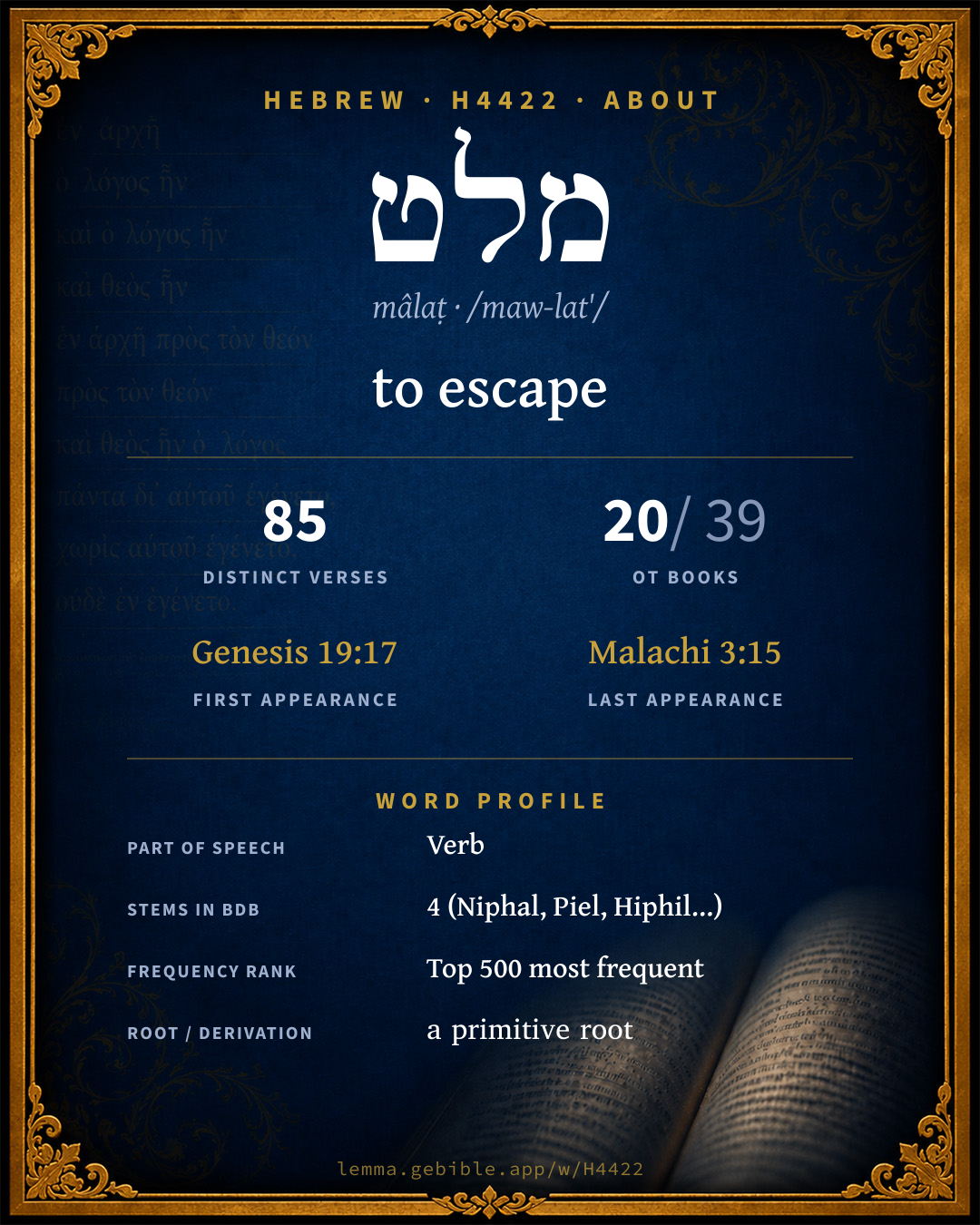
מָלַט
to escape
‘to escape’ is one of 10 main senses fuller range ↓
Full lexicon entry — Brown-Driver-Briggs (BDB)
From Brown-Driver-Briggs (BDB)
Where this word appears
See every Niphal verb in the Hebrew Bible →
Grammar key — what these labels mean
Part of speech
- Verb
- An action or state-of-being word.
Stem
- Niphal
- Usually the simple passive or reflexive of the Qal (“he was written”). Here: ‘slip away’
- Piel
- An intensive or resultative active stem. Here: ‘lay’
- Hiphil
- The causative active stem (“he caused / brought about”). Here: ‘give birth to a male child Is 66’
- Hithpael
- The reflexive or reciprocal stem (the subject acts on itself). Here: ‘slip forth’
Form
- Imperfect
- An incomplete, ongoing, or future action (“he will / would write”).
- Sequential Imperfect
- An imperfect with prefixed waw — the standard past-narrative form (waw-consecutive imperfect).
- Perfect
- A completed action or state — Hebrew marks aspect (completeness) more than strict tense (“he wrote”).
- Imperative
- A direct command (“write!”).
- Sequential Perfect
- A perfect with prefixed waw continuing a preceding imperfect or command (waw-consecutive perfect).
- Infinitive Construct
- A bound verbal noun, frequently with prepositions (“to write / in writing”).
- Cohortative
- A first-person volitional form expressing wish or resolve (“let me / let us write”).
- Jussive
- A third- or second-person volitional form expressing wish or command (“let him write”).
- Participle Active
- A verbal adjective expressing ongoing or characteristic action (“writing / one who writes”).
- Participle Passive
- A verbal adjective expressing action received (“written”).
- Infinitive Absolute
- An unbound verbal noun, often intensifying or standing in for a finite verb.
State
- Absolute
- The independent form of a noun, not bound to a following word.
Person
- 3rd Person
- The one spoken about (“he / she / it / they”).
- 1st Person
- The speaker (“I / we”).
- 2nd Person
- The one addressed (“you”).
Gender
- Masculine
- Grammatically masculine.
- Common
- Either gender — not distinguished for this form.
- Feminine
- Grammatically feminine.
Number
- Singular
- One.
- Plural
- More than one (in Hebrew, generally three or more).
26 distinct verses where H4422 appears in the Piel stem, across 11 books. Filtered view — show all forms. Click any verse to open its interlinear word-by-word view. Verse text shown in the World English Bible for context — . Each verse’s Hebrew form is shown with its reference; the English is not keyword-highlighted, since the data carries no word-level English alignment. Use “Compare translations” on any verse to read it across multiple English versions. This concordance covers the Hebrew Bible; Septuagint (Greek Old Testament) occurrences are not indexed here.
1 Samuel 1 verse
2 Samuel 2 verses
- 2 Samuel 19:5 הַֽ/מְמַלְּטִ֤ים ptcl def.art + Piel ptcp.act mp Joab came into the house to the king, and said, You have shamed this day the faces of all your servants, who this day have saved your life, and the lives of your sons and of your daughters, and the lives of your wives, and the lives of your concubines;
- 2 Samuel 19:9 מִלְּטָ֨/נוּ֙ Piel pf 3ms + sfx pers 1cp All the people were at strife throughout all the tribes of Israel, saying, The king delivered us out of the hand of our enemies, and he saved us out of the hand of the Philistines; and now he is fled out of the land from Absalom.
1 Kings 1 verse
2 Kings 1 verse
Job 4 verses
- Job 6:23 וּ/מַלְּט֥וּ/נִי conj + Piel impv 2mp + sfx pers 1cs Or, 'Deliver me from the adversary's hand?' Or, 'Redeem me from the hand of the oppressors?'
- Job 20:20 יְמַלֵּֽט Piel impf 3ms "Because he knew no quietness within him, He shall not save anything of that in which he delights.
- Job 22:30 יְֽמַלֵּ֥ט וְ֝/נִמְלַ֗ט Piel impf 3ms conj + Niphal wpf 3ms He will even deliver him who is not innocent; Yes, he shall be delivered through the cleanness of your hands."
- Job 29:12 אֲ֭מַלֵּט Piel impf 1cs Because I delivered the poor who cried, And the fatherless also, who had none to help him.
Psalms 5 verses
- Psalms 33:17 יְמַלֵּֽט Piel impf 3ms A horse is a vain thing for safety, Neither does he deliver any by his great power.
- Psalms 41:1 יְֽמַלְּטֵ֥/הוּ Piel impf 3ms + sfx pers 3ms Blessed is he who considers the poor: Yahweh will deliver him in the day of evil.
- Psalms 89:48 יְמַלֵּ֨ט Piel impf 3ms What man is he who shall live and not see death, Who shall deliver his soul from the power of Sheol? Selah.
- Psalms 107:20 וִֽ֝/ימַלֵּ֗ט conj + Piel impf 3ms He sends his word, and heals them, And delivers them from their graves.
- Psalms 116:4 מַלְּטָ֥/ה Piel impv 2ms + sfx h Then called I on the name of Yahweh: "Yahweh, I beg you, deliver my soul."
Ecclesiastes 2 verses
- Ecclesiastes 8:8 יְמַלֵּ֥ט Piel impf 3ms There is no man who has power over the spirit to contain the spirit; neither does he have power over the day of death. There is no discharge in war; neither shall wickedness deliver those who practice it.
- Ecclesiastes 9:15 וּ/מִלַּט conj + Piel pf 3ms Now a poor wise man was found in it, and he by his wisdom delivered the city; yet no man remembered that same poor man.
Isaiah 3 verses
- Isaiah 34:15 וַ/תְּמַלֵּ֔ט conj + Piel wimpf 3fs There shall the dart-snake make her nest, and lay, and hatch, and gather under her shade; yes, there shall the kites be gathered, everyone with her mate.
- Isaiah 46:2 מַלֵּ֣ט Piel inf.cs They stoop, they bow down together; they could not deliver the burden, but themselves are gone into captivity.
- Isaiah 46:4 וַ/אֲמַלֵּֽט conj + Piel impf 1cs and even to old age I am he, and even to gray hairs will I carry you. I have made, and I will bear; yes, I will carry, and will deliver.
Jeremiah 4 verses
- Jeremiah 39:18 מַלֵּט֙ אֲמַלֶּטְ/ךָ֔ Piel inf.abs Piel impf 1cs + sfx pers 2ms For I will surely save you, and you shall not fall by the sword, but your life shall be for a prey to you; because you have put your trust in me, says Yahweh.
- Jeremiah 48:6 מַלְּט֣וּ Piel impv 2mp Flee, save your lives, and be like the heath in the wilderness.
- Jeremiah 51:6 וּ/מַלְּטוּ֙ conj + Piel impv 2mp Flee out of the midst of Babylon, and save every man his life; don't be cut off in her iniquity: for it is the time of Yahweh's vengeance; he will render to her a recompense.
- Jeremiah 51:45 וּ/מַלְּט֖וּ conj + Piel impv 2mp My people, go you out of the midst of her, and save yourselves every man from the fierce anger of Yahweh.
Ezekiel 1 verse
Amos 2 verses
- Amos 2:14 יְמַלֵּ֥ט Piel impf 3ms Flight will perish from the swift; And the strong won't strengthen his force; Neither shall the mighty deliver himself;
- Amos 2:15 יְמַלֵּ֑ט יְמַלֵּ֖ט Piel impf 3ms Piel impf 3ms Neither shall he stand who handles the bow; And he who is swift of foot won't escape; Neither shall he who rides the horse deliver himself;
About this entry
At a glance — auto-summarized from this page’s data, not written by a person. Every figure links to its source below. This summary describes the numbers; it doesn’t interpret them.
“to escape” is the headline sense of the Hebrew verb מלט (mâlaṭ). Older and newer Bibles part ways — “escaped” in the King James Version, “escape” (Berean Standard Bible) in modern versions. See the renderings breakdown. It appears 85 verses across 20 books of the Hebrew Bible, among its moderately common vocabulary. Scripture first uses it in Genesis 19:17. Across 4 stems, its meaning turns on the binyan (Niphal, Piel). See the sense tree, 85-verse concordance, and the renderings breakdown below.
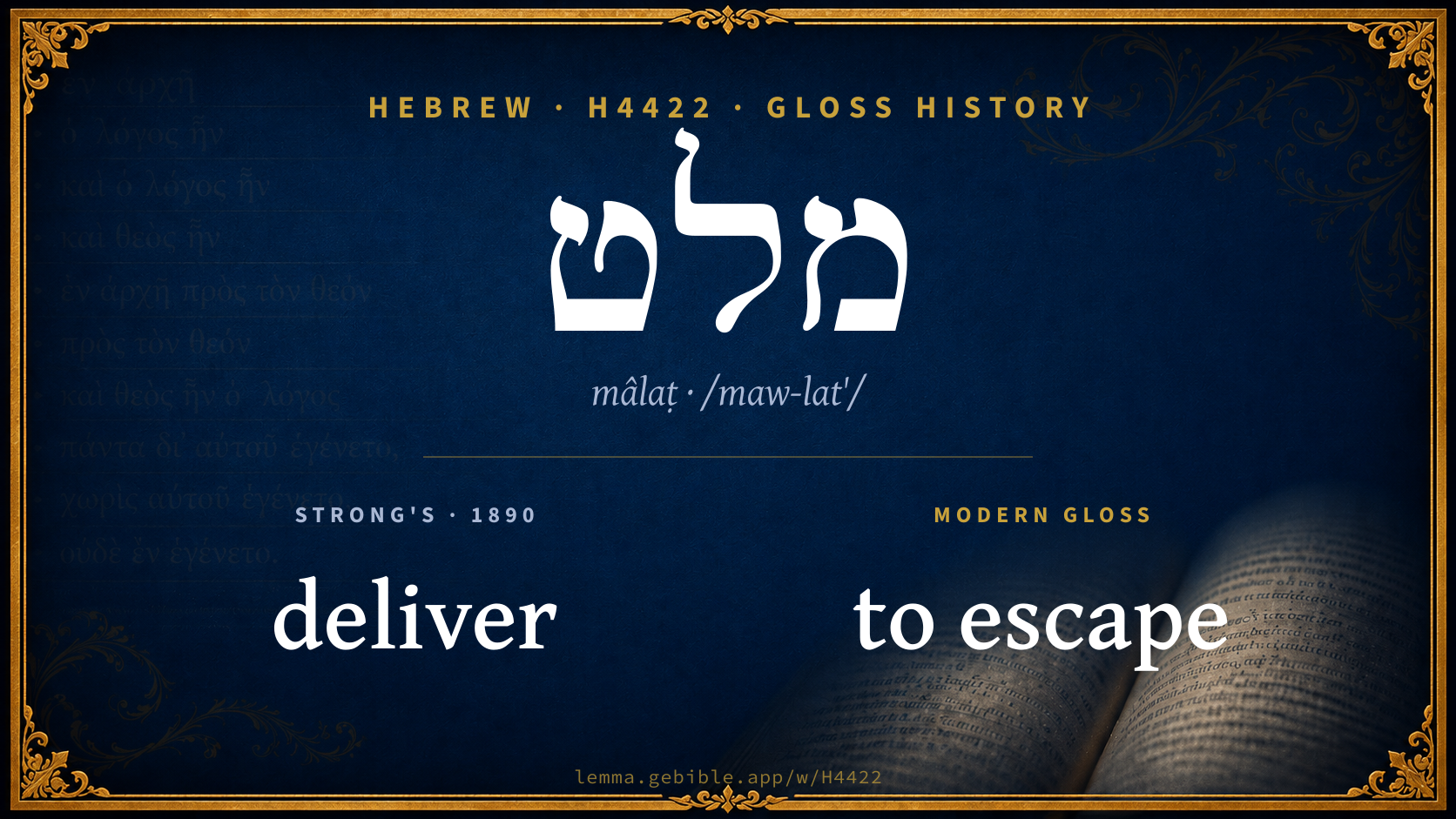
Gloss history
Strong's 1890 vs modern scholarship
About this word
Strong's H4422 catalogs a Hebrew word from the Hebrew Old Testament.
These counts are not copied from any lexicon or concordance. They are computed here, from the morphology-tagged Hebrew Old Testament. What Lemma adds →
- 85
- distinct verses
- The word appears in 85 distinct verses.
- 20 / 39
- OT books
- The word appears in 20 of 39 Old Testament books.
- #437
- by frequency
- Top 500 most frequent Hebrew words (rank 437 of 8,640 Hebrew words by occurrence).
View all 85 occurrences in the concordance →
By section of the Old Testament
By traditional corpus
Conventional, traditional groupings — biblical authorship is debated, so this is a traditional corpus grouping, not an authorship claim. Each share is this word’s portion of its verses in that division of the Hebrew canon. Each figure is a share of the word’s 85 distinct verses.
- Prophets (Nevi'im) 54 verses · 64%
- Writings (Ketuvim) 27 verses · 32%
- Torah (Pentateuch) 4 verses · 5%
How translations render this word
Counts come from each version’s own published word-to-Strong’s tagging or interlinear alignment — an approximate guide to how each version renders this word, not a word-level alignment the data otherwise carries. Because each total is that version’s own tagged count, the per-version totals vary from one another and need not match the appearance or distinct-verse counts above. These counts may also differ from a printed concordance because Lemma counts each distinctly tagged rendering and does not collapse phrase taggings into a single head-word total. This is a fixed set of word-tagged versions (KJV, ASV, BSB, ULT) and does not change with the reading translation you choose elsewhere. Each version’s license is shown beside its name below (and on Sources).
- King James Version: Escaped 12×, Deliver 8×, Escape 7×
- American Standard Version: Escaped 12×, Escape 10×, Shall be delivered 5×
- Berean Standard Bible: Escape 17×, Escaped 11×, Have escaped 5×
- unfoldingWord Literal Text: Escape 14×, Escaped 8×, And 5×
King James Version Public Domain
Renders H4422 across 95 tagged occurrences — most commonly:
Plus other, less common renderings. Plus 41 renderings that appear only once — usually multi-word phrases or single function words the recovered tagging swept in, not distinct renderings.
American Standard Version Public Domain
Renders H4422 across 95 tagged occurrences — most commonly:
Plus other, less common renderings. Plus 42 renderings that appear only once — usually multi-word phrases or single function words the recovered tagging swept in, not distinct renderings.
Berean Standard Bible Public Domain
Renders H4422 across 93 tagged occurrences — most commonly:
Plus 39 renderings that appear only once — usually multi-word phrases or single function words the recovered tagging swept in, not distinct renderings. Not rendered by a distinct English word in 2 further occurrences.
unfoldingWord Literal Text CC BY-SA 4.0
Renders H4422 across 105 tagged occurrences — most commonly:
Plus other, less common renderings. Plus 46 renderings that appear only once — usually multi-word phrases or single function words the recovered tagging swept in, not distinct renderings.
14 senses and sub-senses in the full BDB
Hebrew verbs can shift meaning by stem (binyan): Qal is the basic action, Niphal is often passive or reflexive, Piel often intensifies or makes it factitive, and Hiphil is typically causative. The senses below are grouped under the stem BDB assigns to each. This entry also uses Hithpael (reflexive or reciprocal).
What do BDB’s symbols mean?
BDB uses these scholarly abbreviations:
| Symbol | Meaning |
|---|---|
| 𝔊 | the Septuagint (the ancient Greek translation, LXX) |
| 𝔙 | the Vulgate (the Latin translation) |
| 𝔖 | the Syriac version (the Peshitta) |
| 𝔗 | the Targum (the Aramaic translation) |
| ψ | the Psalms |
| √ | root (the underlying root or stem) |
| ‖ | parallel passage (a synonymous or contrasted parallel) |
| † | the dagger: every passage where the word occurs is cited |
The 14 senses and sub-senses the full Brown-Driver-Briggs lexicon distinguishes for this word, in lexicon order (not ranked by frequency), with BDB’s own verbatim wording and sub-sense lettering. Shown in Hebrew script with BDB’s own scholarly abbreviations. The condensed entry is in the Lexicon Entry tab. See also the Forms in the corpus table below.
Niphal
- Pf. 3 ms. נִמְלַט Ju 3:26 + 6 times; 3 fs. נִמְלְטָה ψ 124:7, with וְ cons. וְנִמְלָ֑טָה Je 48:19; 3 mpl. נִמְלָ֑טוּ 2 S 4:6 + 8 times Pf.; Impf. יִמָּלֵט Am 9:1 + 13 times; וַיִּמּ׳ Ju 3:26 + 7 times; 1 s. אִמָּֽלְטָה Gn 19:20 +; 3 mpl. וַיִּמָּלֵ֑טוֹּ Mal 3:15 + 12 times Impf.; Imv. הִמָּלֵט Gn 19:17(×2), 22; f. הִמָּֽלְטִי Zc 2:11; Inf. abs. הִמָּלֵט 1 S 27:1 (but read אִם אִמָּלֵט 𝔊 We Dr Löhr HPS; > Th Kit Bu ins. אִם bef. הִמּ׳); cstr. id., Gn 19:19 Est 4:3; Pt. נִמְלָט 1 K 19:17(×2);— e.g. Judges 3:26
- 1. slip away אִמָּֽלְטָה נָּא וְאֶרְאֶה אֶת־אֶחָ֑י 1 S 20:29 let me slip away to see my brethren; slip through, or past (into the house) 2 S 4:6 (cf. Dr HPS and Pi. 1, Hiph. 2; > Klo נִלְאָ֑טוּ, √ לאט, after 𝔊 ἔλαθον). e.g. 1 Samuel 20:29
- 2. escape, Ju 3:29 1 S 19:10 (‖ נוּס), v 12, 18 (both ‖ בָּרַה), v 17; 22:20 (‖ בָּרַה), 30:17 1 K 18:40; 20:20 (‖ נוּס), 2 K 10:24 Is 20:6 (‖ נִצַּל, נוּס), 49:24, 25 Je 46:6; 48:8, 19 (‖ נוּס), Ez 17:15(×2), 18 Am 9:1 Jo 3:5 Zc 2:11 Mal 3:15 ψ 124:7 Pr 19:5 Jb 1:15, 16, 17, 19; c. מִן of place whence 1 S 23:13 2 S 1:3 ψ 124:7; c. אֶל־ = whither 1 S 22:1; 27:1(×2); c. עַד Ju 3:26; c. ָה loc., Gn 19:17, 19, 20, 22 (J), Ju 3:26; c. acc. 2 K 19:37 = Is 37:38, Est 4:13; c. מִן of person from whom Ec 7:26; c. מִיַּד 1 S 27:1 2 Ch 16:7 Je 32:4; 34:3; 38:18, 23 Dn 11:41; מִפְּנֵי Je 41:15; מֵחֶרֶב 1 K 19, 17(×2); c. עַל־נֶפֶשׁ for one’s life Gn 19:17. e.g. Judges 3:29
- 3. pass. be delivered ψ 22:6 Pr 11:21; 28:26 Jb 22:30 Dn 12:1 (later usage). e.g. Psalms 22:6
Piel
- Pf. 3 ms. מִלֵּט Ez 33:5; וּמִלַּט־ Ec 9:15; sf. מִלְּטֵ֫נוּ 2 S 19:10; Impf. יְמַלֵּט Am 2:14 + 8 times, sf. יְמַלְּטֵ֫הוּ ψ 41:2; + 5 times Impf.; Imv. מַלְּטָה ψ 116:4; f. מַלְּטִי 1 K 1:12; + 4 times Imv.; Inf. abs. מַלֵּט Is 46:2 Je 39:18; Pt. מְמַלֵּט 1 S 19:11; pl. מְמַלְּטִים 2 S 19:6;— e.g. Ezekiel 33:5
- 1. lay (eggs; i.e. let them slip out; of arrow-snake) Is 34:15 e.g. Isaiah 34:15
- 2. let escape: וימלטו עצמתיו 2 K 23:18 and so they let his bones (the prophet’s) escape (from the burning). e.g. 2 Kings 23:18
- 3. deliver, abs. Is 46:4; c. acc. Is 46:2 Je 39:18(×2) ψ 41:2 Jb 22:30; 29:12 Ec 8:8; 9:15; c. מִיַּד Jb 6:23; מִכַּף 2 S 19:10; מִשְּׁחִיתוֹתָם ψ 107:20; elsewhere מִלֵּט נֶפֶשׁ deliver, save, life 1 S 19:11; 2 S 19:6; 1 K 1:12 Je 48:6; 51:6, 45 Ez 33:5 Am 2:14, 15 ψ 89:49; 116:4; נפשׁ om. Am 2:15 ψ 33:17 Jb 20:20.—(This form not in Hex, Ju., Ch., Is. 1) e.g. Isaiah 46:4
Hiphil
- Pf. 3 ms. הִמְלִיט Is 31:5; 3 fs. הִמְ֫לִיטָה Is 66:7. e.g. Isaiah 31:5
- 1. give birth to a male child Is 66:7 (‖ יָֽלְדָה, cf. Pi. 1). e.g. Isaiah 66:7
- 2. deliver: abs. Is 31:5 (‖ הִצִּיל גָּנַן, פָּסַח). e.g. Isaiah 31:5
Hithpael
- Impf. 1 s. וָאֶתְמַלְּטָה Jb 19:20; 3 mpl. יִתְמַלְּטוּ Jb 41:11. e.g. Job 19:20
- 1. slip forth, escape (sparks of fire from jaws of crocodile; RV leap forth) Jb 41:11. e.g. Job 41:11
- 2. escape (with the skin of the teeth, the gums; only these left unattacked by leprosy) Jb 19:20. e.g. Job 19:20
Senses from the full Brown-Driver-Briggs lexicon (Brown, Driver, Briggs; Oxford 1906 — public domain), digitized via Sefaria, supplemented by the OpenScriptures HebrewLexicon (CC BY 4.0). Full attribution on Sources.
Word origin
vb. slip away (not in Qal) (NH מִילּוּט rescue; 𝔗 מְלַט (rare) = BH; Arabic مَلِطَ is have scanty hair; iv. cast the foetus without hair; [slip away, escape from hand is مَلِصَ]);—
— Brown-Driver-Briggs (Oxford 1906, public domain), digitized via Sefaria, supplemented by the OpenScriptures HebrewLexicon (CC BY 4.0). See Sources.
Origin: a primitive root
Jastrow Dictionary
A second Hebrew/Aramaic lexicon for comparison, covering Aramaic and post-biblical (Talmudic, Targumic, Midrashic) usage that the biblical-Hebrew BDB does not. Matched by lemma rather than by Strong’s number, so a lemma may carry more than one Jastrow headword (shown separately below), and the entries cover usage well beyond the Bible.
מָלַט
- (b. h.) [to stand forth, project (cmp. בָּלַט),] to escape.
- to rescue. Midr. Till. to Ps. XLI ביום רעה אֲמַלֶּטְךָ on the day of evil I shall save thee. Taan. 23ᵃ מִילַּטְתּוֹ בתפלתךָ thou hast saved it (the generation) through thy prayer. Yalk. Ps. 777 מיכל מְמַלֶּטֶת וכ׳ Michael helped David to escape from within and Jonathan from without; a. e.
- to be saved, to escape. Esth. R. introd. נח ראש לנִמְלָטִים Noah is the first of those saved (mentioned in the Bible). Koh. R. to IX, 15 כל השומע ליצר טוב נ׳ whosoever listens to the suggestions of his good inclination will be saved; a. e.
- same. Yalk. Deut. 854 ואתם מִתְמַלְּטִים וכ׳ and you will be saved from the judgment of &c.
מְלַט
- Ithpe. אִתְמְלִיט to be saved. Targ. Prov. XIX, 5 נִתְמְלִיט (ed. Wil. נִתְמַלֵט; Ms. נתפליט).
מֶלֶט
- m. (b. h.), pl. מִלְטִין, v. מַלְטֵט
A Dictionary of the Targumim, the Talmud Babli and Yerushalmi, and the Midrashic Literature (Marcus Jastrow; London, Luzac, 1903) — Public Domain. Digitized via Sefaria. Digitized via Sefaria. Full attribution on Sources.
Forms in the corpus
The 77 distinct written forms H4422 takes in the Hebrew Bible, most frequent first — each parse links to that stem’s occurrences in the concordance. Hebrew forms include their vowel points and cantillation, so a single lemma takes many written forms.
The 60 most common forms are shown; 17 rarer forms follow in the full concordance.
Same root — word family
Other BDB entries built from the same root as H4422, grouped by Strong’s listed origin. These share a root / origin per the lexicon — not necessarily a shared meaning. Each links to that word’s own entry.
Derived from this word
Compare all same-root words → They share a root, not necessarily a meaning.
Septuagint verse parallels
This word appears in 78 verses that also exist in the Greek Old Testament (Septuagint), out of the 85 Hebrew verses it occurs in. You can read those verses in Greek by switching the Old Testament edition to the Septuagint.
Read these verses in the Septuagint
- Genesis 19:17
- Judges 3:26
- 1 Samuel 19:10
- 2 Samuel 1:3
- 1 Kings 1:12
- 2 Kings 10:24
- 2 Chronicles 16:7
- Esther 4:13
- Job 1:15
- Psalms 22:5
- Proverbs 11:21
- Ecclesiastes 7:26
This is a verse-level parallel only — the same verses exist in both the Hebrew and Greek Old Testaments. No word-level Hebrew↔Greek correspondence is claimed: the data carries no such alignment, so no Greek word is shown as this Hebrew word’s translation. Coverage is not total — the Septuagint omits the deuterocanon and renumbers the Psalms, so some Hebrew verses have no direct Greek parallel.