
Jeremiah 51:45

Hebrew (Westminster Leningrad Codex) Jeremiah 51:45 appears in the Hebrew Old Testament. The text above is from the Westminster Leningrad Codex. Each word links to its Strong’s number, a concise gloss, and parsing drawn from the Open Scriptures Hebrew Bible morphology. Click any word for its full Brown-Driver-Briggs (BDB) entry.
Download image
Cite this verse

Jeremiah 51:45 (World English Bible). Public Domain. Lemma interlinear Bible study tool, https://lemma.gebible.app/v/jeremiah/51/45.

Show BibTeX & RIS
BibTeX
RIS
English Translation
My people, go you out of the midst of her, and save yourselves every man from the fierce anger of Yahweh.
World English Bible · Public Domain
Download a study sheet

One document with this verse’s original text, its word-by-word gloss line, the meaning frame, cross-references with their text, attributed commentary, and full source and license credits — printable, and it pastes into notes with its structure intact.

This verse Autodidact and up

Study sheet (.html) Plain text (.txt)

A passage Seminary Student

Up to 50 verses in one chapter. A passage sheet keeps up to 6 commentary sources and 12 cross-references per verse, in the order this page ranks them, and says so on the sheet whenever that leaves anything out. Ask for a single verse and you get the Autodidact verse sheet above.

Everything on this page stays free to read, with no account — the sheet is a download of what is already on screen, not access to it.

Want to remove ads? Support Godless Engineer
Compare translations 3

The same verse in 3 English versions, stacked beneath the original-language interlinear above. Click any original word for its lexicon entry.

Each is an independent rendering of the whole verse — the interlinear is not word-aligned to these translations.

Highlighted words mark where these versions differ — a whole-verse word diff, not a word-by-word alignment.

  • World English Bible Public Domain
    My people, go you out of the midst of her, and save yourselves every man from the fierce anger of Yahweh.
  • King James Version Public Domain
    My people, go ye out of the midst of her, and deliver ye every man his soul from the fierce anger of the LORD.
  • unfoldingWord Literal Text CC BY-SA 4.0
    Go out from her midst, my people. Let each of you save his own life from the fury of my wrath.

unfoldingWord Literal Text — © unfoldingWord, licensed CC BY-SA 4.0. Word-aligned USFM3 via Door43 (git.door43.org/unfoldingWord/en_ult).

Versions to compare (up to 4)

3 of 4 selected

Show all 18 translations

Every available English version of this verse, each an independent rendering of the whole verse.

  • World English Bible Public Domain
    My people, go you out of the midst of her, and save yourselves every man from the fierce anger of Yahweh.
  • Berean Standard Bible Public Domain
    Come out of her, My people! Save your lives, each of you, from the fierce anger of the LORD.
  • Majority Standard Bible Public Domain
    Come out of her, My people! Save your lives, each of you, from the fierce anger of the LORD.
  • King James Version Public Domain
    My people, go ye out of the midst of her, and deliver ye every man his soul from the fierce anger of the LORD.
  • American Standard Version (1901) Public Domain
    My people, go ye out of the midst of her, and save yourselves every man from the fierce anger of Jehovah.
  • Revised Version (1885) Public Domain
    My people, go ye out of the midst of her, and save yourselves every man from the fierce anger of the LORD.
  • Geneva Bible (1599) Public Domain
    My people, go out of the middes of her, and deliuer yee euery man his soule from the fierce wrath of the Lord,
  • Douay-Rheims (1899) Public Domain
    Go out of the midst of her, my people: that every man may save his life from the fierce wrath of the Lord.
  • Young's Literal Translation Public Domain
    Go forth from its midst, O My people, And deliver ye, each his soul, Because of the fierceness of the anger of Jehovah,
  • Literal Standard Version CC BY-SA 4.0
    Go forth from her midst, O My people, || And let each deliver his soul, || Because of the fierceness of the anger of YHWH,
  • Unlocked Literal Bible CC BY-SA 4.0
    Go out from her midst, my people. Let each of you save his own life from the fury of my wrath.
  • unfoldingWord Literal Text CC BY-SA 4.0
    Go out from her midst, my people. Let each of you save his own life from the fury of my wrath.
  • Darby Bible Public Domain
    Go ye out of the midst of her, my people, and deliver every man his soul from the fierce anger of Jehovah!
  • World Messianic Bible Public Domain
    “My people, go away from the middle of her, and each of you save yourselves from the LORD’s fierce anger.
  • Webster's Bible Public Domain
    My people, depart from the midst of her, and deliver ye every man his soul from the fierce anger of the LORD.
  • Free Bible Version CC BY-SA 4.0
    My people, come out of her! Each one of you, save yourselves from the Lord's furious anger.
  • Bible in Basic English Public Domain
    My people, go out from her, and let every man get away safe from the burning wrath of the Lord.
  • JPS Tanakh (1917) Public Domain
    My people, go ye out of the midst of her, and save yourselves every man from the fierce anger of the LORD.

Literal Standard Version (2020), Covenant Press — licensed CC BY-SA 4.0. Text via the HelloAO Bible API (eBible.org). Unlocked Literal Bible (unfoldingWord) — licensed CC BY-SA 4.0. Text via the HelloAO Bible API (eBible.org). unfoldingWord Literal Text — © unfoldingWord, licensed CC BY-SA 4.0. Word-aligned USFM3 via Door43 (git.door43.org/unfoldingWord/en_ult). Free Bible Version, Dr. Jonathan Gallagher — licensed CC BY-SA 4.0. Text via the HelloAO Bible API (eBible.org).

Word by word

More ways to search: Search by grammar → Find every occurrence → Compare this word →

Practice this passage: Drill this verse → Learn its vocabulary →

מֵחֲר֖וֹן
chârôwn
H2740
“from · anger of”
Preposition + Noun, Common, Masculine, Singular, Construct
Part of Speech
Preposition + Noun
Type
Common
Gender
Masculine
Number
Singular
State
Construct
Full BDB Definition

Origin: from H2734

TWOT: 736a

anger, heat, burning (of anger) - always used of God's anger
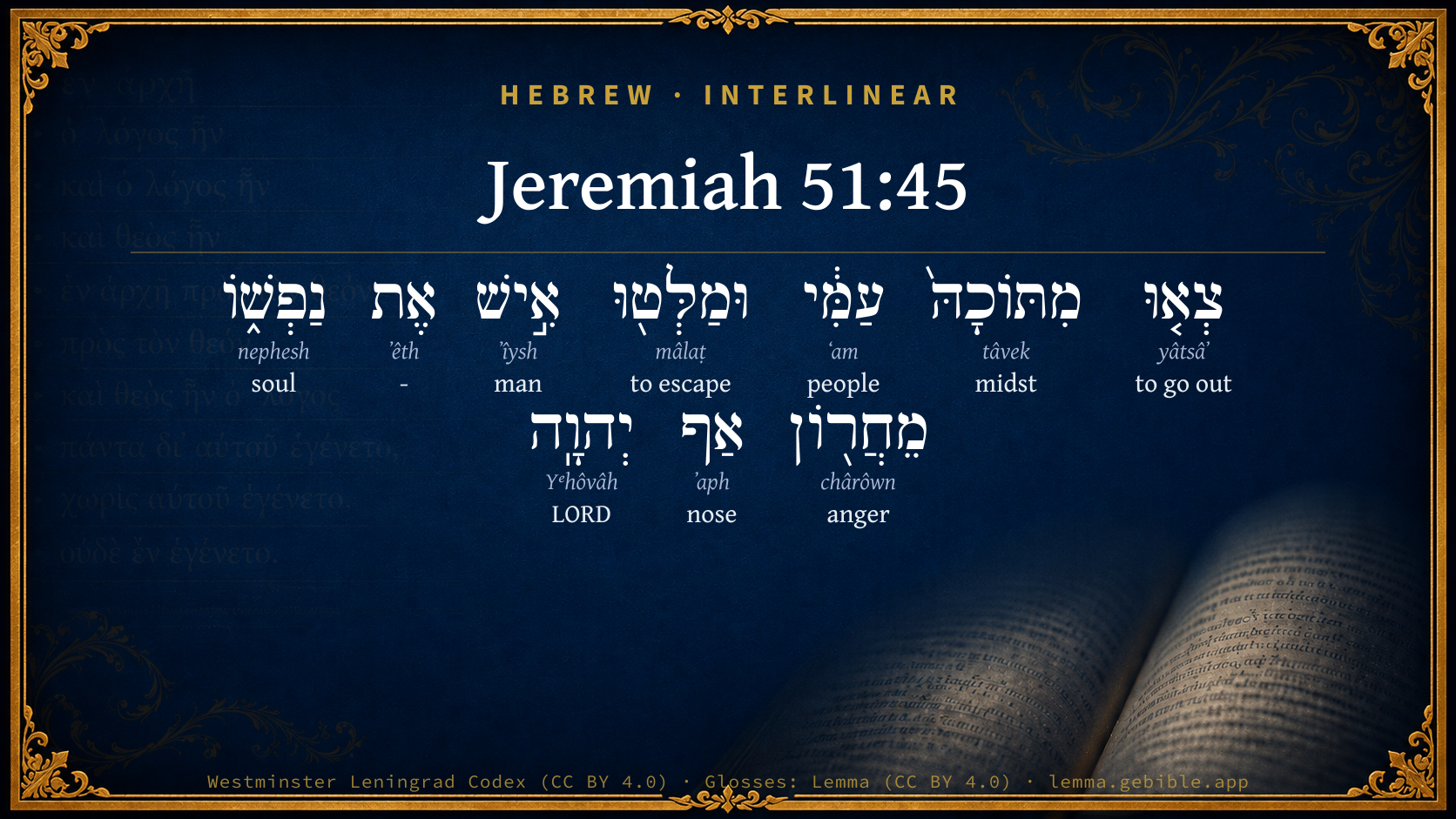
  1. צְא֤וּ yâtsâʼ H3318 “go out” Verb, Qal, Imperative, 2nd Person, Masculine, Plural
  2. מִתּוֹכָהּ֙ tâvek H8432 “from · midst · her” Preposition + Noun, Common, Masculine, Singular, Construct + Suffix, Personal, 3rd Person, Feminine, Singular
  3. עַמִּ֔י ʻam H5971 “people · my” Noun, Common, Masculine, Singular, Construct + Suffix, Personal, 1st Person, Common, Singular
  4. וּמַלְּט֖וּ mâlaṭ H4422 “and · escape” Conjunction + Verb, Piel, Imperative, 2nd Person, Masculine, Plural
  5. אִ֣ישׁ ʼîysh H376 “man” Noun, Common, Masculine, Singular, Absolute
  6. אֶת ʼêth H853 “-” Particle, Direct Object
  7. נַפְשׁ֑וֹ nephesh H5315 “soul · his” Noun, Common, Both, Singular, Construct + Suffix, Personal, 3rd Person, Masculine, Singular
  8. אַף ʼaph H639 “nose” Particle, Accusative
  9. יְהוָֽה Yᵉhôvâh H3068 “LORD” Noun, Proper

About this verse

These counts appear in no published source. They are computed here, from the morphology-tagged text and Lemma’s own curated glosses. What Lemma adds →

10
words
10
distinct lemmas
Prophets
section

Shared distinctive vocabulary

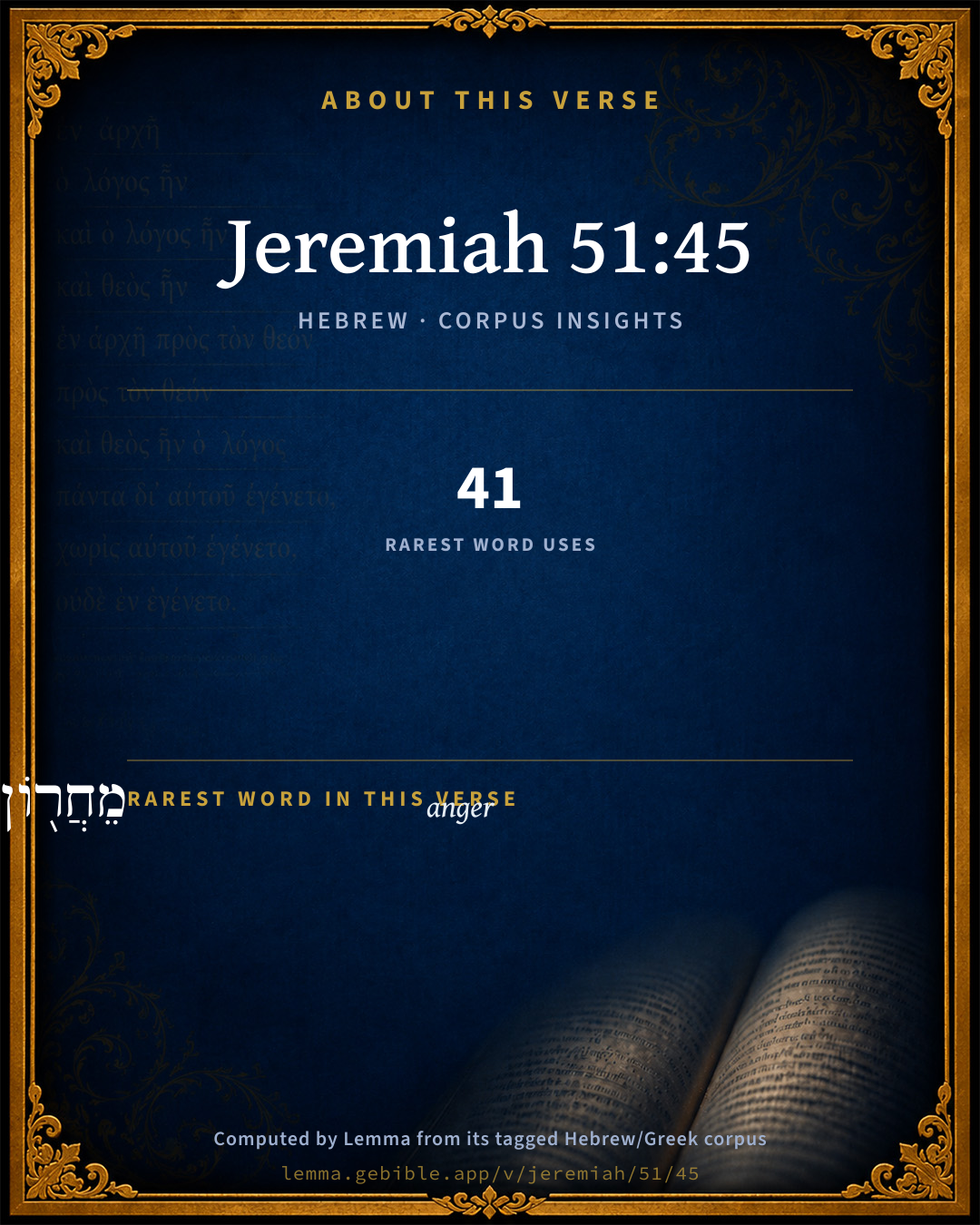
מֵחֲר֖וֹן anger H2740 occurs in 40 verses of the Hebrew Bible. Also found in:

Grammatical profile

  • 2 verbs
  • 6 nouns
  • 2 particles

Verb forms

  • צְא֤וּ Qal · Imperative
  • וּמַלְּט֖וּ Piel · Imperative

Cross-references

12

Topical passages linked to Jeremiah 51:45 in the Treasury of Scripture Knowledge — connected by theme and wording, ordered by reader-vote popularity; previews shown in the World English Bible.

  • Isaiah 48:20 Go you forth from Babylon, flee you from the Chaldeans; with a voice of singing declare you, tell this, utter it even to the end of the earth: say you, Yahweh has redeemed his servant Jacob.
  • Jeremiah 51:6 Flee out of the midst of Babylon, and save every man his life; don't be cut off in her iniquity: for it is the time of Yahweh's vengeance; he will render to her a recompense.
  • Revelation 18:4 I heard another voice from heaven, saying, "Come out of her, my people, that you have no participation in her sins, and that you don't receive of her plagues,
  • Genesis 19:12–16 The men said to Lot, "Do you have anybody else here? Sons-in-law, your sons, your daughters, and whoever you have in the city, bring them out of the place:
  • Numbers 16:26 He spoke to the congregation, saying, Depart, I pray you, from the tents of these wicked men, and touch nothing of theirs, lest you be consumed in all their sins.
  • Jeremiah 50:8 Flee out of the midst of Babylon, and go forth out of the land of the Chaldeans, and be as the male goats before the flocks.
  • Acts 2:40 With many other words he testified, and exhorted them, saying, "Save yourselves from this crooked generation!"
  • 2 Corinthians 6:17 Therefore, "'Come out from among them, And be separate,' says the Lord, 'Touch no unclean thing. I will receive you.
  • Revelation 14:8–11 Another, a second angel, followed, saying, "Babylon the great has fallen, which has made all the nations to drink of the wine of the wrath of her sexual immorality."
  • Jeremiah 51:9 We would have healed Babylon, but she is not healed: forsake her, and let us go everyone into his own country; for her judgment reaches to heaven, and is lifted up even to the skies.
  • Jeremiah 51:50 You who have escaped the sword, go you, don't stand still; remember Yahweh from afar, and let Jerusalem come into your mind.
  • Zechariah 2:7 'Come, Zion! Escape, you who dwell with the daughter of Babylon.'

Cross-references courtesy of OpenBible.info (CC BY 4.0).

Hebrew and Greek witnesses Masoretic Hebrew ↔ Greek Septuagint

The same verse in the two great witnesses to the Old Testament, shown verse-for-verse.

These are two independent witnesses, not word-aligned to each other, and the Septuagint is shown in lemma (dictionary) form.

Hebrew Jeremiah 51:45 Masoretic · Westminster Leningrad Codex

צְא֤וּ מִתּוֹכָהּ֙ עַמִּ֔י וּמַלְּט֖וּ אִ֣ישׁ אֶת נַפְשׁ֑וֹ מֵחֲר֖וֹן אַף יְהוָֽה

My people, go you out of the midst of her, and save yourselves every man from the fierce anger of Yahweh.

World English Bible · Public Domain

Greek LXX Structure differs

In the Septuagint, Jeremiah is about an eighth shorter than the Hebrew and arranges its material differently — the Oracles Against the Nations (Hebrew chapters 46–51) appear in the middle of the Greek book, after 25:13. Because the chapter and verse boundaries do not line up, a verse-for-verse comparison with the Hebrew is not shown.

A verse-for-verse comparison isn’t shown here because the chapters and verses don’t line up. Switch to the LXX edition with the MT / LXX toggle above to read the Greek directly.

Hebrew: Westminster Leningrad Codex (CC BY 4.0). Greek: Septuagint (public domain); English from a public-domain English Septuagint. How the Septuagint differs from the Hebrew →

Targum (Aramaic paraphrase)

1

The Targum is the ancient Jewish Aramaic paraphrase of the Hebrew Scriptures — an interpretive translation, not the Hebrew text itself. Onkelos (literal) and Pseudo-Jonathan (expansive) render the Torah, and Jonathan the Prophets. Coverage is partial: where no permissively-licensed English translation exists for a verse, only the Aramaic is shown. This is verse-level text, not a word-by-word alignment to the Hebrew.

  1. Targum Jonathan Prophets (Joshua–Malachi)
    פּוּקוּ מִגַוָהּ עַמִי וְשֵׁיזִיבוּ גְבַר יַת נַפְשֵׁיהּ מִתְּקוֹף רוּגְזָא דַיָי:

    (no public-domain English translation for this verse)

    Targum Jonathan — Aramaic: “Mikraot Gedolot” (public domain). English: “Sefaria Community Translation” (CC0 1.0 (public-domain dedication)); “London "Chaldee Paraphrase," 1871” (public domain). Text via Sefaria.

Commentary

Notes on Jeremiah 51:45 from classic Christian and Jewish commentators (each source and its license shown beneath its notes). The classic Christian expositions comment on the surrounding passage and are grouped to its opening verse, so a note may address several verses; the Jewish commentaries on the Tanakh (Rashi and others) are per-verse, so they appear only where the commentator wrote on this verse.

Lemma curates 59 commentaries, every one of them public domain or Creative Commons licensed, each selected and text-cleaned for this edition rather than reprinted as found. About our sources →

Trapp's Complete Commentary

John Trapp

Jer 51:45 My people, go ye out of the midst of her, and deliver ye every man his soul from the fierce anger of the LORD.

Ver. 45. My people, go ye out of the midst of her.] This is much pressed, {Jer 48:6} and it was but need; for many of the Jews were as hardly drawn to depart thence as a dog, ab uncto corio, from a fat morsel.

John Trapp, A Commentary or Exposition upon All the Books of the Old and New Testament (1647–1656) — public domain. Text from a community e-Sword module.

Joseph Benson's Commentary

Jer 51:45-46. My people, go ye out of the midst of her, &c. — See note on Jer 50:8. And lest your heart faint, and ye fear for the rumour, &c. — “Lest the rumours of new forces, ready to join themselves to the Babylonians, dishearten you, and make you despair of seeing so great an empire subdued by any human power.” A rumour shall come one year, and after that in another year — This seems to be an idiomatic phrase, denoting that terrifying rumours should continue year after year. And in these words the prophet, by God’s direction, gives signs or tokens to the captive Jews, whereby they might know the exact time when Babylon should be taken, and, consequently, when they should remove from the city into some other place, that they might not be terrified, and induced to quit the city before there was any occasion for their doing so; and he acquaints them that there should come a rumour one year, namely, of Cyrus’s preparations against the Babylonians; and that the next year there should be another rumour, namely, as we may suppose, of Cyrus’s march into Asia, and his victories there, and of his drawing nearer and nearer to Babylon every day. And violence in the land, ruler against ruler — “It is possible,” says Blaney, “that the contests between the adverse powers of Babylon and Media, during which the dominions of the former were subjected to the miseries of foreign invasion, may alone be here intended. But Berosus, the Chaldean historian, as cited by Josephus, Contra Apion, lib. 1., gives an account of civil violences and disorders that were committed in the land after the death of Nebuchadnezzar, whose son, Evil-merodach, was, after a short reign, murdered, and his throne usurped by one of his subjects. The usurper’s son, who succeeded him, was also murdered in his turn, and the kingdom restored to the lawful heir; and all this happened in the course of a few years previous to the foreign invasion. These therefore, I think, are more likely to be the violence in this passage alluded to, and introduced as the forerunners of still greater devastations.”

Joseph Benson's Commentary on the Old and New Testaments (1811–1818) — public domain. Text from a community e-Sword module.

Tyndale Open Study Notes

Tyndale Open Resources

51:45-53 The Lord was concerned about the spiritual and physical well-being of the Jewish exiles in Babylon, where their political situation was perilous. The Lord pointed to the future, when the exiles would be redeemed from disgrace and return with great joy to live in their own land.

51:45 As the Lord described the terrors of his angry judgment against Babylon,, he pointed his people to their homeland to assure them of their safety.

Tyndale Open Study Notes — © Tyndale Open Resources, licensed CC BY-SA 4.0. Text via the HelloAO Bible API.

Jamieson, Fausset & Brown

Robert Jamieson, A. R. Fausset & David Brown

(See on Jer 51:6).

Jamieson, Fausset & Brown — Commentary Critical and Explanatory on the Whole Bible (1871) — public domain (CC PDM 1.0). Text via the HelloAO Bible API.

Adam Clarke's Commentary

Verse 45. My people, go ye out] A warning to all the Jews in Babylon to leave the city, and escape for their lives.

Adam Clarke's Commentary on the Bible (1810–1826) — public domain. Text from a community e-Sword/MySword module.

John Calvin's Commentaries

Here the Prophet exhorts the Israelites to flee from Chaldea and Assyria. Yet this exhortation was intended for another purpose, to encourage them in the hope of deliverance; for it was hardly credible that they should ever have a free exit, for Babylon was to them like a sepulcher. As then he exhorts them as to their deliverance, he intimates that God would be their redeemer, as he had promised. But he shows that God’s vengeance on Babylon would be dreadful, when he says, Flee from the indignation of God’s wrath.

We must, however, observe, that the faithful were thus awakened, lest, being inebriated with the indulgences of the Chaldeans, they should obstinately remain there, when God stretched forth his hand to them; for we know what happened when liberty to return was given to the Israelites — a small portion only returned; some despised the great favor of God; they were so accustomed to their habitations, and were so fixed there, that they made no account of the Temple, nor of the land promised them by God. The Prophet, then, that he might withdraw the faithful from such indulgences, says, that all who, in their torpor, remained there, would be miserable, because the indignation of God would kindle against that city. We now perceive the object of the Prophet.

It appears, indeed, but a simple exhortation to the Jews to remove, that they might not be polluted with the filth of Babylon, but another end is also to be regarded, proposed by the holy Prophet. This exhortation, then, contains in it a promise of return, as though he had said, that they were not to fear, because liberty would at length be given them, as God had promised. In the meantime, a stimulant is added to the promise, lest the Israelites should be delighted with the pleasures of Chaldea, and thus despise the inheritance promised them by God; for we know how great was the pleasantness of that land, and how great was the abundance it possessed of all blessings; for the fruitfulness of that land is more celebrated than that of all other countries. No wonder, then, that the Prophet so strongly urged the Jews to return, and that he set before them the vengeance of God to frighten them with terror, in case they slumbered in Chaldea. And he afterwards adds, —

John Calvin's Commentaries (1540-1563) — public domain. Text from the Calvin Translation Society English edition (1840s-50s) via the Christian Classics Ethereal Library (ccel.org). Calvin's coverage is partial (roughly two-thirds of the Bible); uncommented books and verses are honest gaps, never fabricated. The 19th-century editor's footnotes and remarks are omitted so the notes are faithfully Calvin's own voice.

Ellicott's Commentary for English Readers

(45) Go ye out of the midst of her . . .—The prophet repeats, with all the emphasis of iteration, the summons of Jer_50:8; Jer_51:6. The “fierce anger of the Lord” is that which was directed primarily against Babylon, but which would also fall on those who chose to remain and become “partakers in her plagues.” (Compare Rev_18:4.)

A Bible Commentary for English Readers, edited by Charles John Ellicott (1878–1897) — public domain. Text from a community e-Sword module.

The Cambridge Bible for Schools and Colleges

gen. ed. J. J. S. Perowne

45. go ye out] See Jer_51:6, Jer_50:8; Isa_52:11.

The Cambridge Bible for Schools and Colleges (gen. ed. J. J. S. Perowne; Cambridge University Press, 1878–1918) — public domain. Text from a community e-Sword module.

John Gill's Exposition

Therefore, behold, the days come that I will do judgment on the graven images of Babylon,.... Because of the connection of these words, some understand Jer 51:46 of the report of the deliverance of the Jews time after time; and yet nothing came of it, which disheartened them; and they were used more cruelly, and with greater violence, by the Chaldeans and their kings, one after another; and "therefore" the following things are said; but the particle may be rendered "moreover" (n), as some observe; or "surely", certainly, of a truth, as in Jer 5:2; the time is hastening on, the above things being done, when judgment shall be executed, not only upon Bel the chief idol, Jer 51:44; but upon all the idols of the Chaldeans; which should be broke to pieces, and stripped of everything about them that was valuable; the Medes and Persians having no regard to images in their worship; though Dr. Prideaux (o) thinks that what is here said, and in Jer 51:44; were fulfilled by Xerxes, when he destroyed and pillaged the Babylonian temples:

and her whole land shall be confounded; the inhabitants of it, when they see their images destroyed, in which they trusted for their safety:

and all her slain shall fall in the midst of her; in the midst of Babylon; where the king and his army were shut up, and dared not move out; and where they were slain when the army of Cyrus entered.

(n) "praeterea"; so Gataker. (o) Connexion, par. 1. B. 2. p. 101. B. 4. p. 242, 243.

John Gill's Exposition of the Whole Bible (1746–1763) — public domain (CC PDM 1.0). Text via the HelloAO Bible API.

Albert Barnes' Notes on the Bible

The fierce anger of the Lord - i. e., against Babylon. The people of God are to flee away that they may not be involved in the miseries of Babylon. See the Jer 50:8 note.

Albert Barnes' Notes on the Bible (1834–1885) — public domain. Text from a community e-Sword/MySword module.

Matthew Poole's English Annotations

These words are an exhortation to the Jews to be willing, upon the first proclamation of liberty by Cyrus, to go out of Babylon, notwithstanding the pleasantness of the place, and that now their stakes had been pitched there many years, because of the ruin which should most certainly come on that place.

Matthew Poole's English Annotations on the Holy Bible (1683–1685) — public domain. Text from a community e-Sword/MySword module.

The Pulpit Commentary

Flight from the city of Destruction.

As Christ advised his disciples to flee from Jerusalem when the judgment of heaven was about to fall, Jeremiah here calla upon the Hebrew residents in Babylon to escape from the doomed city. The parallel suggests that similar circumstances may render similar conduct again desirable.

I THE SINFUL WORLD IS A CITY OF DESTRUCTION. The world as God created it. is good and safe. But man has made the world a dangerous place by his abuse of its lower properties. Thus the worldly spirit is an evil spirit, and the prince of this world is the supreme power of wickedness. Jesus Christ blended together his picture of the destruction of Jerusalem with a larger vision of the end of the world. In what way the wider and more distant fulfilment of his prophecy will come about we cannot tell; the day of it is known to no man, not even to the "Son of man". (Mat_24:36) Meanwhile the world lies under a certain doom. It has been so corrupted and abused that to yield to its spirit, to follow its ways, to live mainly for its advantages, is to court ruin.

II THE CHRISTIAN IS URGED TO FLEE FROM THIS CITY OF DESTRUCTION. (2Co_6:16-18; 2Co_7:1) It would seem that the sharp line of separation between the world and the Church is melting away. Perhaps it was somewhat stiff and arbitrary. Many innocent things were once put under the ban which most of us would not now think of condemning, and an unhealthy sanctimoniousness was fostered by the idea that strictness was holiness. We are growing more free and more reasonable in some respects, learning that "every creature of God is good, and nothing is to be rejected, if it be received with thanksgiving: for it is sanctified through the Word of God and prayer." Moreover, we may hope that the Spirit of Christ has penetrated into the world beyond the boundaries of the Church, so that the very atmosphere of worldly society is more or less permeated by purifying Christian ideas. Nevertheless the approach of the world and the Church is mutual If the world is coming nearer to the Church, the Church is in some respects approaching the world. A worldly spirit in business, in pleasure, even in religion, is too apparent. We forget that we are pilgrims and strangers here and seek another city. We live too much as if worldly prosperity were the goal of life. We need to be reminded that this is not our rest, that in so far as we yield to the spirit of worldliness we court the doom of the city of Destruction.

III THE CHRISTIAN"S FLIGHT FROM THE CITY OF DESTRUCTION MUST BE SPIRITUAL. Jews were to flee bodily from Babylon and Christians from Jerusalem But the flight we need is wholly different in character. Monks and hermits thought to flee from the world by hiding within still cloisters or far away among desert solitudes. But they made a double mistake. They neglected their duty to the world and yet they did not escape from the evil of it. We may carry the world into the wilderness, for it is in our hearts. While we have bodies and live on the earth no change of place will be an escape from the world. Then we have a mission to fulfil, and no pretence of care for our own souls can excuse us for shirking the work of life; certain views of salvation are often put forth according to which Christianity is supreme selfishness the saving of one"s own soul even though others suffer. These are false. The great duty of the Christian is to live for me good of his fellow men. To do this he must be in the world. Intercourse with the world for such a purpose is right. It is foolish to visit an infected locality for pleasure, but divinely charitable to do so to minister to the sick. The flight from the world must be escape from its spirit, its evil influence, its sinful delights. Christ prays, not that we shall be taken out of the world, but that we shall be saved from the evil of it. Through him we may have this deliverance, because he has "overcome the world."

The Pulpit Commentary (1880–1919), ed. H.D.M. Spence-Jones & Joseph S. Exell — public domain. Text from a community e-Sword module.

John Wesley's Explanatory Notes

Go out of her - At all hazards escape for your lives.

John Wesley, Explanatory Notes Upon the Whole Bible (1754–1765) — public domain. Text via the GEBible commentary corpus.

Keil & Delitzsch

C. F. Keil & F. Delitzsch

Since Babylon will be punished by the Lord with destruction, the people of God are to flee out of it, and to preserve their lives from the fierce anger of Jahveh, which will discharge itself on Babylon. חרון אף, as in Jer 4:8, Jer 4:26, etc.

Keil & Delitzsch — Biblical Commentary on the Old Testament (1861–1891) — public domain (CC PDM 1.0). Text via the HelloAO Bible API. (Old Testament only.)

unfoldingWord translationNotes

Door43 World Missions Community

the news that is heard in the land

This can be stated in active form. AT: "when you hear the news that is in the land" (See: Active or Passive)

Ruler will be against ruler

The ruler is a metonym for the nations under his control. AT: "Nations will fight against other nations" (See: Metonymy)

translationWords

people of God

save

life

wrath

heart

fear

rule

unfoldingWord translationNotes — © Distant Shores Media and the Door43 World Missions Community, licensed CC BY-SA 4.0. Source: git.door43.org/Door43/en_tn.

Lesson kit

Teaching starters — assembled from the data on this page, not authored interpretation. Every prompt links to the verse data it draws on. Edit before teaching.

Jeremiah, in the Prophets, opens this verse with 10 words (10 distinct Hebrew lemmas). Its most distinctive word is chârôwn (“anger”). A historical commentator’s framing appears above. Read the whole chapter for the surrounding context.

Discussion questions

  1. The word chârôwn carries the sense “anger.” How does it shape the verse?
  2. Exodus 15:7 shares the word «anger» with this verse. How do the two illuminate each other?
  3. The translations on this page render this verse differently — a whole-verse word diff, not a word-by-word alignment. What might account for the different wordings?
  4. The verb «צְא֤וּ» is Qal Imperative. How does its form color the action?
  5. Reading how Trapp's Complete Commentary and Joseph Benson's Commentary read this verse, where do the two commentators agree and where do they part?

Things to notice

Reading settings

Reading text

Shown beneath each verse's original-language words.

Old Testament
Old Testament edition

Read the OT as the Masoretic Hebrew (MT) or the Greek Septuagint (LXX).

English shown for the Greek Septuagint (in the Hebrew ↔ Greek comparison).

Comparing translations? Open the Compare panel on any verse page to stack up to four side by side.