
Job 41:11

Hebrew (Westminster Leningrad Codex) Job 41:11 appears in the Hebrew Old Testament. The text above is from the Westminster Leningrad Codex. Each word links to its Strong’s number, a concise gloss, and parsing drawn from the Open Scriptures Hebrew Bible morphology. Click any word for its full Brown-Driver-Briggs (BDB) entry.
Download image
Cite this verse

Job 41:11 (World English Bible). Public Domain. Lemma interlinear Bible study tool, https://lemma.gebible.app/v/job/41/11.

Show BibTeX & RIS
BibTeX
RIS
English Translation
Who has first given to me, that I should repay him? Everything under the heavens is mine.
World English Bible · Public Domain
Download a study sheet

One document with this verse’s original text, its word-by-word gloss line, the meaning frame, cross-references with their text, attributed commentary, and full source and license credits — printable, and it pastes into notes with its structure intact.

This verse Autodidact and up

Study sheet (.html) Plain text (.txt)

A passage Seminary Student

Up to 50 verses in one chapter. A passage sheet keeps up to 6 commentary sources and 12 cross-references per verse, in the order this page ranks them, and says so on the sheet whenever that leaves anything out. Ask for a single verse and you get the Autodidact verse sheet above.

Everything on this page stays free to read, with no account — the sheet is a download of what is already on screen, not access to it.

Want to remove ads? Support Godless Engineer
Compare translations 3

The same verse in 3 English versions, stacked beneath the original-language interlinear above. Click any original word for its lexicon entry.

Each is an independent rendering of the whole verse — the interlinear is not word-aligned to these translations.

Highlighted words mark where these versions differ — a whole-verse word diff, not a word-by-word alignment.

  • World English Bible Public Domain
    Who has first given to me, that I should repay him? Everything under the heavens is mine.
  • King James Version Public Domain
    Who hath prevented me, that I should repay him? whatsoever is under the whole heaven is mine.
  • unfoldingWord Literal Text CC BY-SA 4.0
    Who has anticipated me and I shall repay? Beneath all of the skies, it to me.

unfoldingWord Literal Text — © unfoldingWord, licensed CC BY-SA 4.0. Word-aligned USFM3 via Door43 (git.door43.org/unfoldingWord/en_ult).

Versions to compare (up to 4)

3 of 4 selected

Show all 18 translations

Every available English version of this verse, each an independent rendering of the whole verse.

  • World English Bible Public Domain
    Who has first given to me, that I should repay him? Everything under the heavens is mine.
  • Berean Standard Bible Public Domain
    Who has given to Me that I should repay him? Everything under heaven is Mine.
  • Majority Standard Bible Public Domain
    Who has given to Me that I should repay him? Everything under heaven is Mine.
  • King James Version Public Domain
    Who hath prevented me, that I should repay him? whatsoever is under the whole heaven is mine.
  • American Standard Version (1901) Public Domain
    Who hath first given unto me, that I should repay him? `Whatsoever is' under the whole heaven is mine.
  • Revised Version (1885) Public Domain
    Who hath first given unto me, that I should repay him? whatsoever is under the whole heaven is mine.
  • Geneva Bible (1599) Public Domain
    Out of his nostrels commeth out smoke, as out of a boyling pot or caldron.
  • Douay-Rheims (1899) Public Domain
    Out of his nostrils goeth smoke, like that of a pot heated and boiling.
  • Young's Literal Translation Public Domain
    Who hath brought before Me and I repay? Under the whole heavens it `is' mine.
  • Literal Standard Version CC BY-SA 4.0
    Who has brought before Me and I repay? Under the whole heavens it [is] Mine.
  • Unlocked Literal Bible CC BY-SA 4.0
    Who has first given anything to me in order that I should repay him? Whatever is under the whole sky is mine.
  • unfoldingWord Literal Text CC BY-SA 4.0
    Who has anticipated me and I shall repay? Beneath all of the skies, it to me.
  • Darby Bible Public Domain
    Who hath first given to me, that I should repay [him]? [Whatsoever is] under the whole heaven is mine.
  • World Messianic Bible Public Domain
    Who has first given to me, that I should repay him? Everything under the heavens is mine.
  • Webster's Bible Public Domain
    \\41:20\\Out of his nostrils issueth smoke, as out of a seething pot or caldron.
  • Free Bible Version CC BY-SA 4.0
    Who has confronted me with any claim that I should repay? Everything under heaven belongs to me.
  • Bible in Basic English Public Domain
    Smoke comes out of his nose, like a pot boiling on the fire.
  • JPS Tanakh (1917) Public Domain
    (41-3) Who hath given Me anything beforehand, that I should repay him? Whatsoever is under the whole heaven is Mine.

Literal Standard Version (2020), Covenant Press — licensed CC BY-SA 4.0. Text via the HelloAO Bible API (eBible.org). Unlocked Literal Bible (unfoldingWord) — licensed CC BY-SA 4.0. Text via the HelloAO Bible API (eBible.org). unfoldingWord Literal Text — © unfoldingWord, licensed CC BY-SA 4.0. Word-aligned USFM3 via Door43 (git.door43.org/unfoldingWord/en_ult). Free Bible Version, Dr. Jonathan Gallagher — licensed CC BY-SA 4.0. Text via the HelloAO Bible API (eBible.org).

Word by word

More ways to search: Search by grammar → Find every occurrence → Compare this word →

Practice this passage: Drill this verse → Learn its vocabulary →

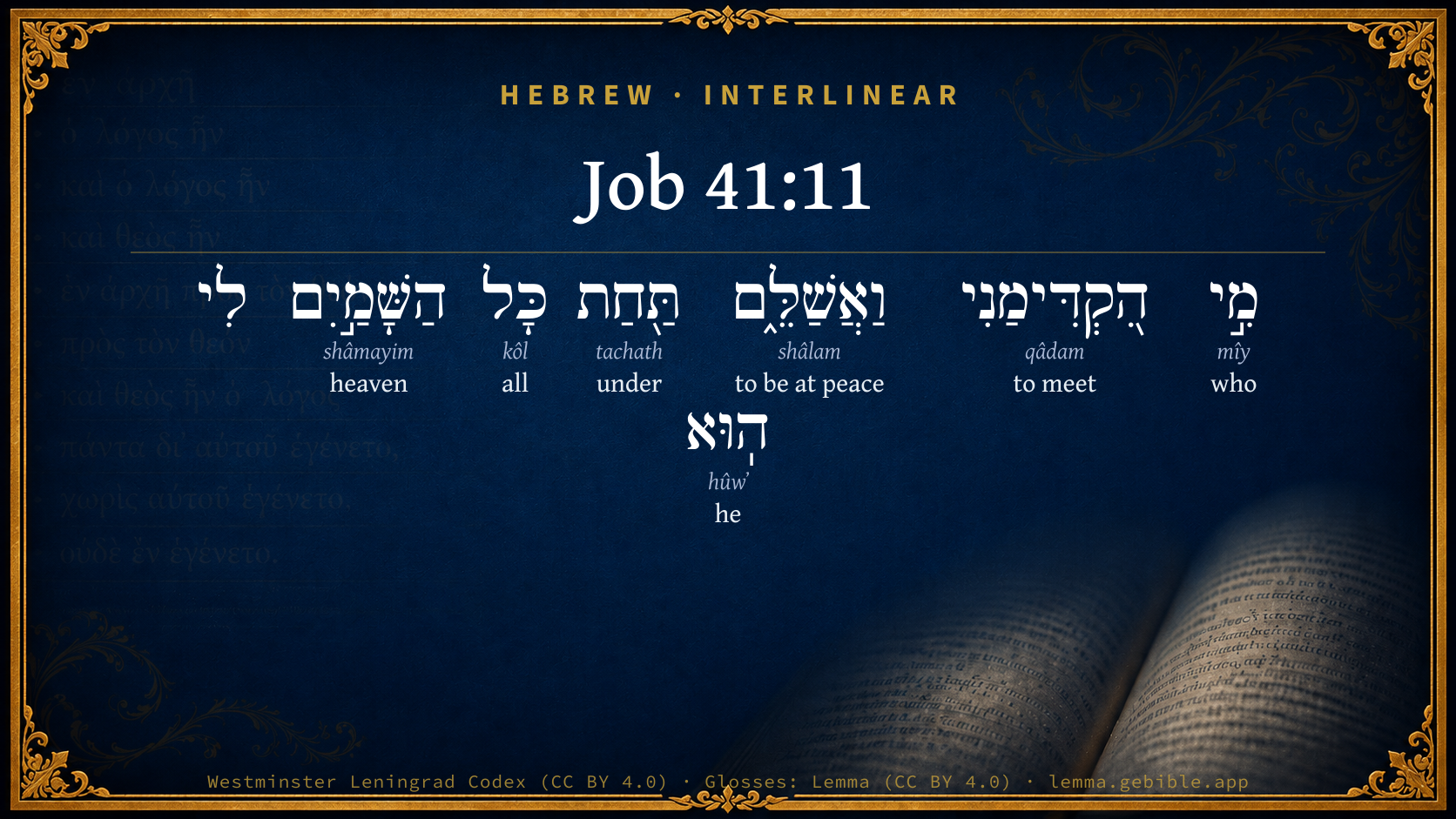
הִ֭קְדִּימַנִי
qâdam
H6923
“to meet · me”
Verb, Hiphil, Perfect, 3rd Person, Masculine, Singular + Suffix, Personal, 1st Person, Common, Singular
Part of Speech
Verb
Stem
Hiphil
Form
Perfect
Person
3rd Person
Gender
Masculine
Number
Singular
Full BDB Definition

Origin: a primitive root

TWOT: 1988

to meet, come or be in front, confront, go before - (Piel) - to meet, confront, come to meet, receive - to go before, go in front, be in front - to lead, be beforehand, anticipate, forestall - (Hiphil) - to come in front - to confront, anticipate
  1. מִ֣י mîy H4310 “who” Particle, Interrogative
  2. וַאֲשַׁלֵּ֑ם shâlam H7999 “and · to be at peace” Conjunction + Verb, Piel, Imperfect, 1st Person, Common, Singular
  3. תַּ֖חַת tachath H8478 “under” Preposition
  4. כָּל kôl H3605 “all of” Noun, Common, Masculine, Singular, Construct
  5. הַשָּׁמַ֣יִם shâmayim H8064 “the · heaven(s)” Particle, Definite Article + Noun, Common, Masculine, Plural, Absolute
  6. הֽוּא hûwʼ H1931 “he” Pronoun, Personal, 3rd Person, Masculine, Singular

About this verse

These counts appear in no published source. They are computed here, from the morphology-tagged text and Lemma’s own curated glosses. What Lemma adds →

8
words
7
distinct lemmas
Wisdom
section

Shared distinctive vocabulary

הִ֭קְדִּימַנִי to meet H6923 occurs in 25 verses of the Hebrew Bible. Also found in:

Grammatical profile

  • 2 verbs
  • 2 nouns
  • 1 pronoun
  • 2 prepositions
  • 1 particle

Verb forms

  • הִ֭קְדִּימַנִי Hiphil · Perfect
  • וַאֲשַׁלֵּ֑ם Piel · Imperfect

Hebrew & Septuagint length

In English translation the verse runs 17 words from the Hebrew and 14 from the Septuagint (LXX English) — closely comparable.

A rough comparison of the two English renderings, which tokenize alike — not a word-level alignment.

Word counts can differ between the Hebrew and the Greek without any difference in meaning — e.g. the Hebrew direct-object marker אֵת has no separate Greek word, and Greek often adds the article ὁ.

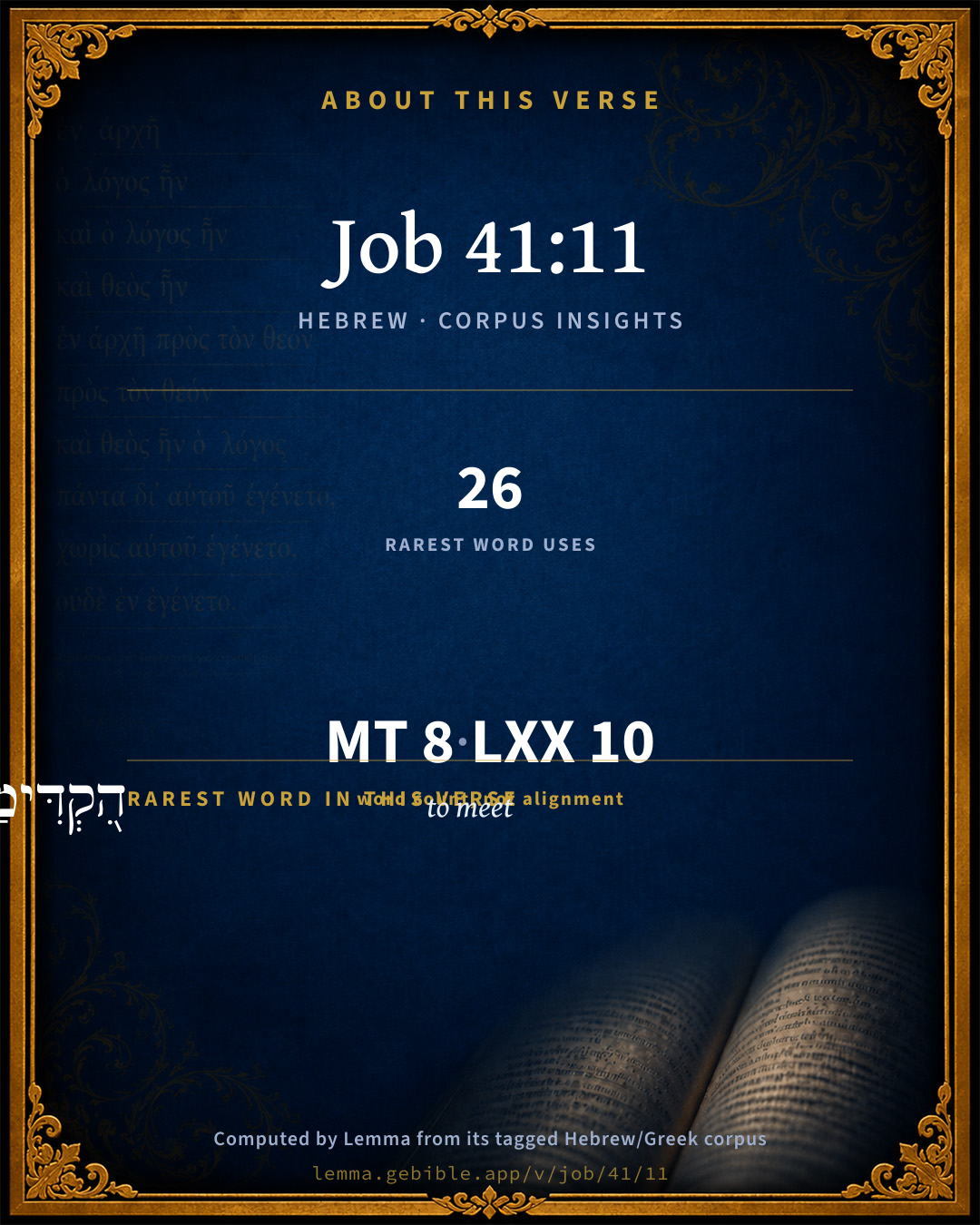
In the original languages it is 8 Hebrew tokens and 10 Greek tokens — but the two are counted differently (Hebrew bundles its prefixes and suffixes into one token; the Greek is in lemma form), so that isn’t a like-for-like length.

Cross-references

12

Topical passages linked to Job 41:11 in the Treasury of Scripture Knowledge — connected by theme and wording, ordered by reader-vote popularity; previews shown in the World English Bible.

  • Romans 11:35 "Or who has first given to him, And it will be repaid to him again?"
  • Psalms 24:1 The earth is Yahweh's, with its fullness; The world, and those who dwell therein.
  • 1 Chronicles 29:11–14 Yours, Yahweh, is the greatness, the power, the glory, the victory, and the majesty: for all that is in the heavens and in the earth is yours. Yours is the kingdom, Yahweh, and you are exalted as head above all.
  • Job 35:7 If you are righteous, what do you give him? Or what does he receive from your hand?
  • Deuteronomy 10:14 Behold, to Yahweh your God belongs heaven and the heaven of heavens, the earth, with all that is therein.
  • Psalms 50:12 If I were hungry, I would not tell you, For the world is mine, and all that is in it.
  • Exodus 19:5 Now therefore, if you will indeed obey my voice, and keep my covenant, then you shall be my own possession from among all peoples; for all the earth is mine;
  • 1 Corinthians 10:26 for "the earth is the Lord's, and its fullness."
  • Job 22:2–3 "Can a man be profitable to God? Surely he who is wise is profitable to himself.
  • Psalms 21:3 For you meet him with the blessings of goodness; You set a crown of fine gold on his head.
  • Psalms 115:16 The heavens are the heavens of Yahweh; But the earth has he given to the children of men.
  • 1 Corinthians 10:28 But if anyone says to you, "This was offered to idols," don't eat it for the sake of the one who told you, and for the sake of conscience. For "the earth is the Lord's, and all its fullness."

Cross-references courtesy of OpenBible.info (CC BY 4.0).

Hebrew and Greek witnesses Masoretic Hebrew ↔ Greek Septuagint

The same verse in the two great witnesses to the Old Testament, shown verse-for-verse.

These are two independent witnesses, not word-aligned to each other, and the Septuagint is shown in lemma (dictionary) form.

Hebrew Job 41:11 Masoretic · Westminster Leningrad Codex

מִ֣י הִ֭קְדִּימַנִי וַאֲשַׁלֵּ֑ם תַּ֖חַת כָּל הַשָּׁמַ֣יִם לִי הֽוּא

Who has first given to me, that I should repay him? Everything under the heavens is mine.

World English Bible · Public Domain

Greek LXX Job 41:11 Septuagint · lemma form

ἐκ στόμα αὐτός ἐκπορεύομαι λαμπάς καίω καί διαῥίπτω ἐσχάρα πῦρ

Out of his nostrils proceeds smoke of a furnace burning with fire of coals.

LXX2012 (modern English Septuagint) · Public Domain

Hebrew: Westminster Leningrad Codex (CC BY 4.0). Greek: Septuagint (public domain); English from LXX2012 (modern English Septuagint) (Public Domain). How the Septuagint differs from the Hebrew →

Commentary

Notes on Job 41:11 from classic Christian and Jewish commentators (each source and its license shown beneath its notes). The classic Christian expositions comment on the surrounding passage and are grouped to its opening verse, so a note may address several verses; the Jewish commentaries on the Tanakh (Rashi and others) are per-verse, so they appear only where the commentator wrote on this verse.

Lemma curates 59 commentaries, every one of them public domain or Creative Commons licensed, each selected and text-cleaned for this edition rather than reprinted as found. About our sources →

Matthew Henry's Commentary

God, having in the foregoing verses shown Job how unable he was to deal with the leviathan, here sets forth his own power in that massy mighty creature. Here is,

I. God's sovereign dominion and independency laid down, Job 41:11. 1. That he is indebted to none of his creatures. If any pretend he is indebted to them, let them make their demand and prove their debt, and they shall receive it in full and not by composition: "Who has prevented me?" that is, "who has laid any obligations upon me by any services he has done me? Who can pretend to be before-hand with me? If any were, I would not long be behind-hand with them; I would soon repay them." The apostle quotes this for the silencing of all flesh in God's presence, Rom 11:35. Who hath first given to him, and it shall be recompensed to him again? As God does not inflict upon us the evils we have deserved, so he does bestow upon us the favours we have not deserved. 2. That he is the rightful Lord and owner of all the creatures: "Whatsoever is under the whole heaven, animate or inanimate, is mine (and particularly this leviathan), at my command and disposal, what I have an incontestable property in and dominion over." All is his; we are his, all we have and do; and therefore we cannot make God our debtor; but of thy own, Lord, have we given thee. All is his, and therefore, if he were indebted to any, he has wherewithal to repay them; the debt is in good hands. All is his, and therefore he needs not our services, nor can he be benefited by them. If I were hungry I would not tell thee, for the world is mind and the fulness thereof, Psa 50:12.

II. The proof and illustration of it, from the wonderful structure of the leviathan, Job 41:12.

1. The parts of his body, the power he exerts, especially when he is set upon, and the comely proportion of the whole of him, are what God will not conceal, and therefore what we must observe and acknowledge the power of God in. Though he is a creature of monstrous bulk, yet there is in him a comely proportion. In our eye beauty lies in that which is small (inest sua gratia parvis - little things have a gracefulness all their own) because we ourselves are so; but in God's eye even the leviathan is comely; and, if he pronounce even the whale, event he crocodile, so, it is not for us to say of any of the works of his hands that they are ugly of ill-favoured; it is enough to say so, as we have cause, of our own works. God here goes about to give us an anatomical view (as it were) of the leviathan; for his works appear most beautiful and excellent, and his wisdom and power appear most in them, when they are taken in pieces and viewed in their several parts and proportions. (1.) The leviathan, even prima facie - at first sight, appears formidable and inaccessible, Job 41:13, Job 41:14. Who dares come so near him while he is alive as to discover or take a distinct view of the face of the garment, the skin with which he is clothed as with a garment, so near him as to bridle him like a horse and so lead him away, so near him as to be within reach of his jaws, which are like a double bridle? Who will venture to look into his mouth, as we do into a horse's mouth? He that opens the doors of his face will see his teeth terrible round about, strong and sharp, and fitted to devour; it would make a man tremble to think of having a leg or an arm between them. (2.) His scales are his beauty and strength, and therefore his pride, Job 41:15-17. The crocodile is indeed remarkable for his scales; if we understand it of the whale, we must understand by these shields (for so the word is) the several coats of his skin; or there might be whales in that country with scales. That which is remarkable concerning the scales is that they stick so close together, by which he is not only kept warm, for no air can pierce him, but kept safe, for no sword can pierce him through those scales. Fishes, that live in the water, are fortified accordingly by the wisdom of Providence, which gives clothes as it gives cold. (3.) He scatters terror with his very breath and looks; if he sneeze or spout up water, it is like a light shining, either with the froth or the light of the sun shining through it, Job 41:18. The eyes of the whale are reported to shine in the night-time like a flame, or, as here, like the eye-lids of the morning; the same they say of the crocodile. The breath of this creature is so hot and fiery, from the great natural heat within, that burning lamps and sparks of fire, smoke and a flame, are said to go out of his mouth, even such as one would think sufficient to set coals on fire, Job 41:19-21. Probably these hyperbolical expressions are used concerning the leviathan to intimate the terror of the wrath of God, for that is it which all this is designed to convince us of. Fire out of his mouth devours, Psa 18:7, Psa 18:8. The breath of the Almighty, like a stream of brimstone, kindles Tophet, and will for ever keep it burning, Isa 30:33. The wicked one shall be consumed with the breath of his mouth, Th2 2:8. (4.) He is of invincible strength and most terrible fierceness, so that he frightens all that come in his way, but is not himself frightened by any. Take a view of his neck, and there remains strength, Job 41:22. his head and his body are well set together. Sorrow rejoices (or rides in triumph) before him, for he makes terrible work wherever he comes. Or, Those storms which are the sorrow of others are his joys; what is tossing to others is dancing to him. His flesh is well knit, Job 41:23. The flakes of it are joined so closely together, and are so firm, that it is hard to pierce it; he is as if he were all bone. His flesh is of brass, which Job had complained his was not, Job 6:12. His heart is as firm as a stone, Job 41:24. He has spirit equal to his bodily strength, and, though he is bulky, he is sprightly, and not unwieldy. As his flesh and skin cannot be pierced, so his courage cannot be daunted; but, on the contrary, he daunts all he meets and puts them into a consternation (Job 41:25): When he raises up himself like a moving mountain in the great waters even the mighty are afraid lest he should overturn their ships or do them some other mischief. By reason of the breakings he makes in the water, which threaten death, they purify themselves, confess their sins, betake themselves to their prayers, and get ready for death. We read (Job 3:8) of those who, when they raise up a leviathan, are in such a fright that they curse the day. It was a fear which, it seems, used to drive some to their curses and others to their prayers; for, as now, so then there were seafaring men of different characters and on whom the terrors of the sea have contrary effects; but all agree there is a great fright among them when the leviathan raises up himself. (5.) All the instruments of slaughter that are used against him do him no hurt and therefore are not error to him, Job 41:26-29. The sword and the spear, which wound nigh at hand, are nothing to him; the darts, arrows, and sling-stones, which wound at a distance, do him no damage; nature has so well armed him cap-a-pie - at all points, against them all. The defensive weapons which men use when they engage with the leviathan, as the habergeon, or breast-plate, often serve men no more than their offensive weapons; iron and brass are to him as straw and rotten wood, and he laughs at them. It is the picture of a hard-hearted sinner, that despises the terrors of the Almighty and laughs at all the threatenings of his word. The leviathan so little dreads the weapons that are used against him that, to show how hardy he is, he chooses to lie on the sharp stones, the sharp-pointed things (Job 41:30), and lies as easy there as if he lay on the soft mire. Those that would endure hardness must inure themselves to it. (6.) His very motion in the water troubles it and puts it into a ferment, Job 41:31, Job 41:32. When he rolls, and tosses, and makes a stir in the water, or is in pursuit of his prey, he makes the deep to boil like a pot, he raises a great froth and foam upon the water, such as is upon a boiling pot, especially a pot of boiling ointment; and he makes a path to shine after him, which even a ship in the midst of the sea does not, Pro 30:19. One may trace the leviathan under water by the bubbles on the surface; and yet who can take that advantage against him in pursuing him? Men track hares in the snow and kill them, but he that tracks the leviathan dares not come near him.

2. Having given this particular account of his parts, and his power, and his comely proportion, he concludes with four things in general concerning this animal: - (1.) That he is a non-such among the inferior creatures: Upon earth there is not his like, Job 41:33. No creature in this world is comparable to him for strength and terror. Or the earth is here distinguished from the sea: His dominion is not upon the earth (so some), but in the waters. None of all the savage creatures upon earth come near him for bulk and strength, and it is well for man that he is confined to the waters and there has a watch set upon him (Job 7:12) by the divine Providence, for, if such a terrible creature were allowed to roam and ravage upon this earth, it would be an unsafe and uncomfortable habitation for the children of men, for whom it is intended. (2.) That he is more bold and daring than any other creature whatsoever: He is made without fear. The creatures are as they are made; the leviathan has courage in his constitution, nothing can frighten him; other creatures, quite contrary, seem as much designed for flying as this for fighting. So, among men, some are in their natural temper bold, others are timorous. (3.) That he is himself very proud; though lodged in the deep, yet he beholds all high things, Job 41:34. The rolling waves, the impending rocks, the hovering clouds, and the ships under sail with top and top-gallant, this mighty animal beholds with contempt, for he does not think they either lessen him or threaten him. Those that are great are apt to be scornful. (4.) That he is a king over all the children of pride, that is, he is the proudest of all proud ones. He has more to be proud of (so Mr. Caryl expounds it) than the proudest people in the world have; and so it is a mortification to the haughtiness and lofty looks of men. Whatever bodily accomplishments men are proud of, and puffed up with, the leviathan excels them and is a king over them. Some read it so as to understand it of God: He that beholds all high things, even he, is King over all the children of pride; he can tame the behemoth (Job 40:19) and the leviathan, big as they are, and stout-hearted as they are. This discourse concerning those two animals was brought in to prove that it is God only who can look upon proud men and abase them, bring them low and tread them down, and hide them in the dust (Job 40:11-13), and so it concludes with a quod erat demonstrandum - which was to be demonstrated; there is one that beholds all high things, and, wherein men deal proudly, is above them; he is King over all the children of pride, whether brutal or rational, and can make them all either bend or break before him, Isa 2:11. The lofty looks of man shall be humbled, and the haughtiness of men shall be bowed down, and thus the Lord alone shall be exalted.

Matthew Henry's Commentary on the Whole Bible (1708–1710) — public domain (CC PDM 1.0). Text via the HelloAO Bible API.

Trapp's Complete Commentary

John Trapp

Job 41:11 Who hath prevented me, that I should repay [him? whatsoever is] under the whole heaven is mine.

Ver. 11. Who hath prevented me, that I should repay him?] Who can tax me wath injustice, who am bound to no man, but owner of all things? If any one can say I am beholden to him, let him prove it, and I shall readily requite it, he shall have no cause at all to complain about me as ungrateful, Rom 11:34-35.

Whatsoever is under the whole heaven is mine] The devil told our Saviour that all was his, and to whomsoever he would he gave it, Luk 4:6. The pope also (that firstborn of the devil) takes upon him, as lord of all, to dispose of spirituals or temporals in all countries, as Boniface VIII wrote to Philip, king of France, who answered him with a Sciat fatuitas tua, &c.; and as the pope that then was gave our Henry VIII’s kingdom, primo oecupaturo, to him that should first take it; but he slighted him with Os Papae et oculus Diaboli in eodem sunt praedicamento. It is for God alone to say, as Dan 4:32, I rule in the kingdom of men, and give it to whomsoever I will. How then can I do any man wrong who am obliged to none, but all are engaged to me for all they have?

John Trapp, A Commentary or Exposition upon All the Books of the Old and New Testament (1647–1656) — public domain. Text from a community e-Sword module.

Joseph Benson's Commentary

Job 41:11. Who hath prevented me? — Namely, with offices or services done for me, and thereby hath laid the first obligation upon me, for which I am indebted to him? That I should repay him? — Should be engaged to requite his favours? Who came beforehand with me in kindnesses? inasmuch as all men, and all things under heaven, are mine, made by my hand, and enriched with all their endowments by my favour. The apostle quotes this sentiment for the silencing of all flesh in God’s presence, (Rom 11:35,) Who hath first given to him, and it shall be recompensed to him again? For of him, and through him, and to him, are all things. As God doth not inflict upon us the evils we have deserved, so he doth bestow upon us the favours we have not deserved. Having said, and largely proved, that man could not contend with God in power, he now adds that he cannot contend with him in, or with respect to justice; because God oweth him nothing, nor is any way obliged to him: which having briefly hinted, to prevent an objection, he returns to his former argument, the description of leviathan.

Joseph Benson's Commentary on the Old and New Testaments (1811–1818) — public domain. Text from a community e-Sword module.

Jamieson, Fausset & Brown

Robert Jamieson, A. R. Fausset & David Brown

prevented--done Me a favor first: anticipated Me with service (Psa 21:3). None can call Me to account ("stand before Me," Job 41:10) as unjust, because I have withdrawn favors from him (as in Job's case): for none has laid Me under a prior obligation by conferring on Me something which was not already My own. What can man give to Him who possesses all, including man himself? Man cannot constrain the creature to be his "servant" (Job 41:4), much less the Creator.

Jamieson, Fausset & Brown — Commentary Critical and Explanatory on the Whole Bible (1871) — public domain (CC PDM 1.0). Text via the HelloAO Bible API.

Adam Clarke's Commentary

Verse 11. Who hath prevented me] Who is it that hath laid me under obligation to him? Do I need my creatures? All under the heavens is my property.

Adam Clarke's Commentary on the Bible (1810–1826) — public domain. Text from a community e-Sword/MySword module.

Ellicott's Commentary for English Readers

(11) Who hath prevented me?—It is manifest that this appeal would come more appropriately at the end of the following detailed description than, as it does here, just before it. “Who hath prevented me,” &c., of course means, Who hath first given to me, that I should repay him?

A Bible Commentary for English Readers, edited by Charles John Ellicott (1878–1897) — public domain. Text from a community e-Sword module.

The Cambridge Bible for Schools and Colleges

gen. ed. J. J. S. Perowne

11. who hath prevented me] Rather, who hath first given to me? So Tyndale, Or who hathe geven me anye thinge afore hand, that I am bounde to reward him agayne? As none dare contend with God (Job_41:10), so none have any ground of contention with Him. None hath given aught to God, so as to have a claim against Him, for all things under the heavens are His; comp. Psa_50:10 seq.

The Cambridge Bible for Schools and Colleges (gen. ed. J. J. S. Perowne; Cambridge University Press, 1878–1918) — public domain. Text from a community e-Sword module.

John Gill's Exposition

Who hath prevented me, that one should repay him?.... First given me something that was not my own, and so laid me under an obligation to him to make a return. The apostle seems to have respect to this passage, Rom 11:35;

whatsoever is under the whole heaven is mine; the fowls of the air, the cattle on a thousand hills, the fulness of the earth; gold, silver: precious stones, &c. All things are made by him, are his property and at his dispose; and therefore no man on earth can give him what he has not a prior right unto; see Psa 24:1.

John Gill's Exposition of the Whole Bible (1746–1763) — public domain (CC PDM 1.0). Text via the HelloAO Bible API.

Albert Barnes' Notes on the Bible

Who hath prevented me? - As this verse is here rendered, its meaning, and the reason why it is introduced, are not very apparent. It almost looks, indeed, as if it were an interpolation, or had been introduced from some other place, and torn from its proper connection. Dr. Harris proposes to remove the principal difficulty by translating it,

“Who will stand before me, yea, presumptuously?

Whatsoever is beneath the whole heaven is mine.

I cannot be confounded at his limbs and violence,

Nor at his power, or the strength of his frame.”

It may be doubted, however, whether the original will admit of this translation. Rosenmuller, Umbreit, and Noyes, unite in supposing the meaning to be, “Who has done me a favor, that I must repay him?” But perhaps the true idea of the passage may be arrived at by adverting to the meaning of the word rendered “prevented” - קדם qâdam. It properly means in the Piel, to go before; to precede; to anticipate, Psa 17:13; Psa 119:148. Then it means to rush upon suddenly; to seize; to go to meet anyone either for succor, Psa 59:11, or for a different purpose. Isa 37:33, “no shield shall come up against her.” יקדמנה yaqâdamenâh “i. e.” against the city. So Job 30:27, “The days of affliction prevented me.” A similar meaning occurs in the Hiphil form in Amo 9:10, “The evil shall not overtake us nor prevent us;” that is, shall not rush upon us as if by anticipation, or when we are off our guard.

If some idea of this kind be supposed to be conveyed by the word here, it will probably express the true sense. “Who is able to seize upon me suddenly, or when I am off my guard; to anticipate my watchfulness and my power of resistance so as to compel me to recompense him, or so to overmaster me as to lay me under obligation to confer on him the favors which he demands?” There may be an allusion to the manner in which wild beasts are taken, when the hunter springs his gin suddenly, anticipates the power of the animal, rushes unexpectedly upon him, and compels him to yield. God says that no one could thus surprise and overpower him. Thus explained, the sentiment agrees with the argument which the Almighty is presenting. He is showing his right to reign and do all his pleasure. He appeals, in proof of this, to his great and mighty works, and especially to those specimens of the animal creation which “man” could not tame or overcome. The argument is this: “If man cannot surprise and subdue these creatures of the Almighty, and compel “them” to render him service, how can he expect to constrain the Creator himself to be tributary to him, or to grant him the favors which he demands?”

Whatsoever is under the whole heaven is mine - That is, “All belong to me; all are subject to me; all are mine, to be conferred on whom I please. No one can claim them as his own: no one can wrest them from me.” This claim to the proprietorship of all created things, is designed “here” to show to Job that over a Being thus supreme man could exert no control. It is his duty, therefore, to submit to him without a complaint, and to receive with gratitude what he chooses to confer.

Albert Barnes' Notes on the Bible (1834–1885) — public domain. Text from a community e-Sword/MySword module.

Haydock's Catholic Bible Commentary

Smoke; breath, or streams of water sent upwards.

George Leo Haydock (1774–1849), Haydock's Catholic Family Bible and Commentary, 1859 edition — public domain. Excludes Psalms (Douay-Rheims chapter numbering differs from Protestant) and Deuterocanonical books (Catholic canon only).

Matthew Poole's English Annotations

Who hath prevented me, to wit, with offices or service done for me, by which he hath laid the first obligation upon me, for which I am indebted to him? Who can be beforehand with me in kindnesses, since not only the leviathan, but all men, and, as it follows, all things under heaven, are mine, made by my hand and enriched with all their endowments by my favour, without which, O Job, thou wouldst not have had either reason or such to use so perversely to reproach my providence. Having now said and largely proved that man could not contend with God in power, he now adds, that he cannot do it in justice, because God oweth him nothing, nor is any way obliged to him; which having briefly hinted to prevent an objection, he returns to his former argument, the description of the leviathan.

That I should repay him; that I should be engaged to requite his favours.

Whatsoever is under the whole heaven is mine; created by my power and favour, and wholly in my possession, and at my dispose, and therefore cannot possibly prevent me, as was now said.

Matthew Poole's English Annotations on the Holy Bible (1683–1685) — public domain. Text from a community e-Sword/MySword module.

Whedon's Commentary on the Bible

Daniel D. Whedon

11. Prevented me — First given to me. Tyndale’s rendering will express the idea: “Or who hathe given me anye thinge afore hand, that I am bounde to reward him agayne.” Comp. Job_34:13; Isa_40:13-15; and Rom_11:35-36. The lengthened description of leviathan is interrupted, that Job may be again reminded of its moral import — that God is governor; that his dominion is world wide, because all belongs to him: that he is under no obligations to his creatures on account of favours received; therefore, if he give, it must be exclusively of grace. “This digression in Jehovah’s speech does not disturb the harmony of the passage. It is an agreeable change, after the long description of the sea monster.” — Umbreit.

Daniel D. Whedon (gen. ed.), Commentary on the Old and New Testaments (1874–1909) — public domain. Text from a community e-Sword module.

The Pulpit Commentary

Who hath prevented me, that I should repay him? i.e. "Who hath laid me under any obligation, so that I should be bound to fall in with his views, and take such a course as he might prescribe?" The allusion is to Job"s persistent demand for a hearing a controversy (Job_9:34, 35 10:3 13:3, 22 23:3-7, etc.) a trial, in which he shall plead with God, and God with him, upon even terms as it were, and so the truth concerning him, his sins, his integrity, his sufferings, and their cause or causes, shall be made manifest. God resists any and every claim that is made on him to justify himself and his doings to a creature. He is not a debtor to any. If he explains himself to any extent, if he condescends to give an account of any of his doings, it is of pure grace and favour. It has been observed that we might have expected this to be the conclusion of the entire discourse begun in Job 38; and that no doubt would have been, according to ordinary laws of human composition, its more proper place. But Hebrew poetry is erratic, and pays little regard to logical lawn If anything important has been omitted in its more proper place, it is inserted in one which is, humanly speaking, less proper. The details concerning the crocodile, which are calculated to deepen the general impression, having been passed over where we might have expected them, are here subjoined, as filling out the description of vers. 1-10.

The universal rule of God.

This is witnessed to even by leviathan. The splendid terror of the water-master is depicted in order that we may be made to feel in some way how great God must be, who made him and who rules over him.

I IT INCLUDES THE PHYSICAL UNIVERSE. All nature is as much under the hand and power of God to-day as when it first appeared at the dawn of creation. Even the disorder and confusion that have entered into nature have not been able to tear it away from the rule of God. God rules through terror and confusion and death as truly as through beauty and life. God does not confine himself to what we call the spiritual. He is not only concerned with that which, in the narrow sense of the word, we understand as "the religious." He is the great Architect, Mechanic, Engineer, of the universe.

II IT IS NOT ALWAYS VISIBLE TO MAN. The hand that guides is unseen. The reign of law seems to drive back the reign of God. Thus Matthew Arnold writes"The sea of faith Was once, too, at the full and round earth"s shore, Lay like the folds of a bright girdle furled; But now I only hear Its melancholy, long, withdrawing roar, Retreating, to the breath Of the night wind, down the vast edges drear And naked shingles of the world.

III IT IS NOT THE LESS REAL BECAUSE IT IS UNSEEN. We cannot see the guiding hand, but often we can most thankfully detect its presence by the providential result. We may not be able to discern the steersman for the driving spray, but if we have come safely into port we may be sure that he is at-the helm. The reign of law cannot dispense with the rule of God, if God is the great Lawgiver. The most wonderful scientific truth that has been brought home to recent generations is the fixed and uniform system of law in nature. How came this to be so? and how is it that the rigorous laws make for the well-being of God"s creatures, as they obviously do? Surely law itself points to a ruling mind. The world is not left to itself, or it would be in chaos. The order of the world throughout, extending to the most distant galaxy of stars, proclaims the universal rule of its one Lord.

IV IT WILL MAKE ITSELF FELT BY THOSE WHO DO NOT ACKNOWLEDGE IT AT PRESENT. Our denial of God"s universal rule does not destroy it. We do not abrogate God"s laws by ignoring them. The existence of an atheist does not mean the non-existence of God. For the present God waits, giving us our trial, and opportunities for knowing him peaceably and happily. But some day we must behold his throne of glory, if that throne exists at all. Then it will be well for us to have acknowledged it first, and to approach it as his obedient servants coming home from their toil. W.F.A.

The Pulpit Commentary (1880–1919), ed. H.D.M. Spence-Jones & Joseph S. Exell — public domain. Text from a community e-Sword module.

John Wesley's Explanatory Notes

Prevented - Hath laid the first obligation upon me, for which I am indebted to him. Who can be before-hand with me in kindnesses, since all things under heaven are mine.

John Wesley, Explanatory Notes Upon the Whole Bible (1754–1765) — public domain. Text via the GEBible commentary corpus.

Rashi

Rabbi Shlomo Yitzchaki (Rashi)

From his mouth From the flame that goes forth from his mouth.

From his mouth go firebrands Firebrands come forth from his mouth.

sparks of fire Like firebrands.

go forth like foam Heb. יתמלטו. Its interpretation is according to the context, escumicer in Old French [going forth like foam].

Rashi on the Tanakh — English translations: “The Judaica Press complete Tanach with Rashi, translated by A. J. Rosenberg” (CC BY 4.0); “Pentateuch with Rashi's commentary by M. Rosenbaum and A.M. Silbermann, 1929-1934” (public domain); “The Metsudah Tanach series, Lakewood, N.J” (CC BY 4.0); and “The Book of Joshua, Metsudah Publications, 1997” (CC BY 4.0). Text via Sefaria.

Lesson kit

Teaching starters — assembled from the data on this page, not authored interpretation. Every prompt links to the verse data it draws on. Edit before teaching.

Job, in the Wisdom, opens this verse with 8 words (7 distinct Hebrew lemmas). Its most distinctive word is qâdam (“to meet”). A historical commentator’s framing appears above. Read the whole chapter for the surrounding context.

Discussion questions

  1. What does “to meet” (qâdam) contribute to the verse as a whole?
  2. Deuteronomy 23:4 shares the word «to meet» with this verse. How do the two illuminate each other?
  3. The translations on this page render this verse differently — a whole-verse word diff, not a word-by-word alignment. What might account for the different wordings?
  4. The verb «הִ֭קְדִּימַנִי» is Hiphil Perfect. How does its form color the action?
  5. Reading how Matthew Henry's Commentary and Trapp's Complete Commentary read this verse, where do the two commentators agree and where do they part?

Things to notice

Reading settings

Reading text

Shown beneath each verse's original-language words.

Old Testament
Old Testament edition

Read the OT as the Masoretic Hebrew (MT) or the Greek Septuagint (LXX).

English shown for the Greek Septuagint (in the Hebrew ↔ Greek comparison).

Comparing translations? Open the Compare panel on any verse page to stack up to four side by side.