
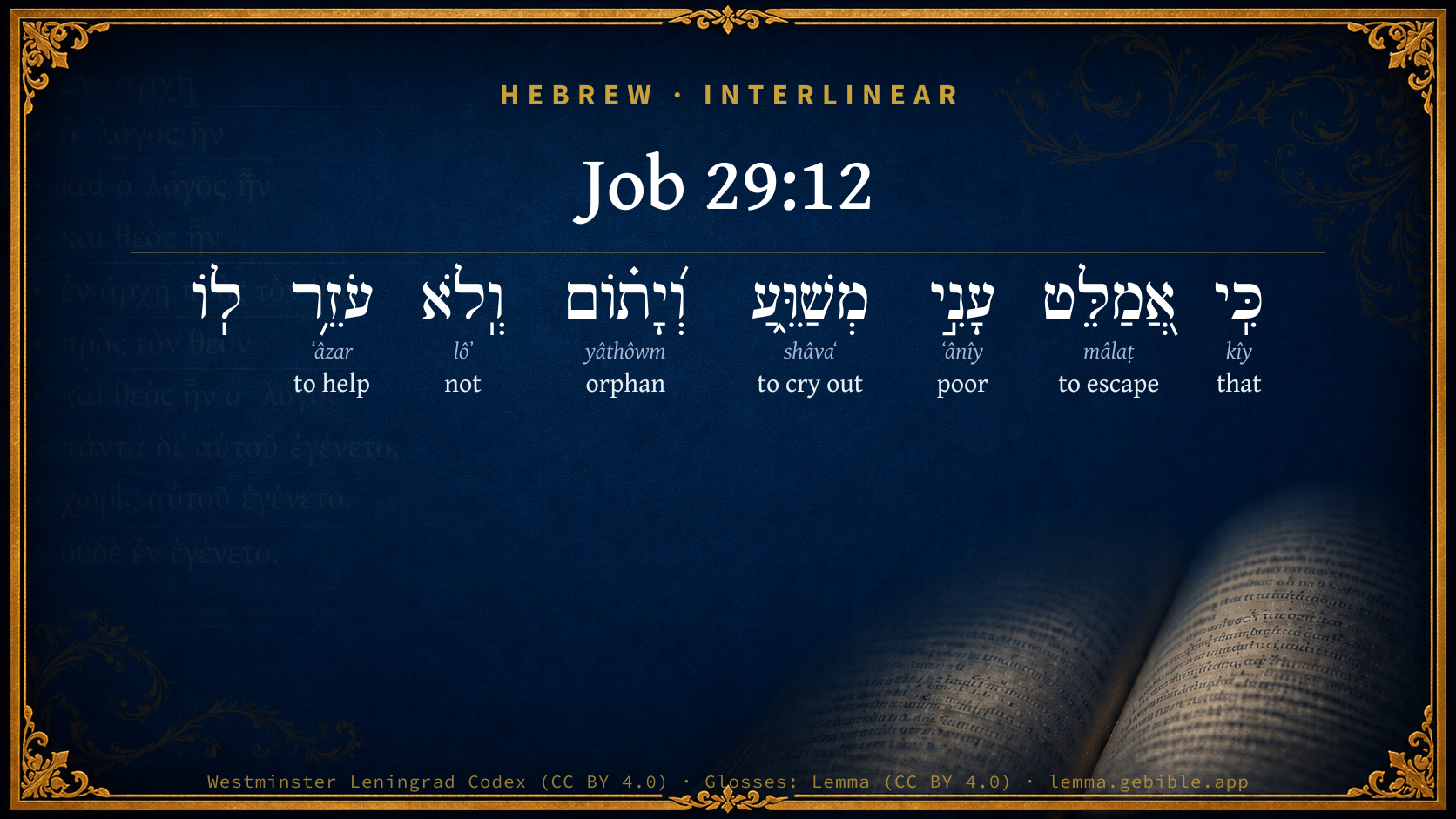
Job 29:12

Hebrew (Westminster Leningrad Codex) Job 29:12 appears in the Hebrew Old Testament. The text above is from the Westminster Leningrad Codex. Each word links to its Strong’s number, a concise gloss, and parsing drawn from the Open Scriptures Hebrew Bible morphology. Click any word for its full Brown-Driver-Briggs (BDB) entry.
Download image
Cite this verse

Job 29:12 (World English Bible). Public Domain. Lemma interlinear Bible study tool, https://lemma.gebible.app/v/job/29/12.

Show BibTeX & RIS
BibTeX
RIS
English Translation
Because I delivered the poor who cried, And the fatherless also, who had none to help him.
World English Bible · Public Domain
Download a study sheet

One document with this verse’s original text, its word-by-word gloss line, the meaning frame, cross-references with their text, attributed commentary, and full source and license credits — printable, and it pastes into notes with its structure intact.

This verse Autodidact and up

Study sheet (.html) Plain text (.txt)

A passage Seminary Student

Up to 50 verses in one chapter. A passage sheet keeps up to 6 commentary sources and 12 cross-references per verse, in the order this page ranks them, and says so on the sheet whenever that leaves anything out. Ask for a single verse and you get the Autodidact verse sheet above.

Everything on this page stays free to read, with no account — the sheet is a download of what is already on screen, not access to it.

Want to remove ads? Support Godless Engineer
Compare translations 3

The same verse in 3 English versions, stacked beneath the original-language interlinear above. Click any original word for its lexicon entry.

Each is an independent rendering of the whole verse — the interlinear is not word-aligned to these translations.

Highlighted words mark where these versions differ — a whole-verse word diff, not a word-by-word alignment.

  • World English Bible Public Domain
    Because I delivered the poor who cried, And the fatherless also, who had none to help him.
  • King James Version Public Domain
    Because I delivered the poor that cried, and the fatherless, and him that had none to help him.
  • unfoldingWord Literal Text CC BY-SA 4.0
    because I rescued the afflicted crying out and the fatherless when no help to him.

unfoldingWord Literal Text — © unfoldingWord, licensed CC BY-SA 4.0. Word-aligned USFM3 via Door43 (git.door43.org/unfoldingWord/en_ult).

Versions to compare (up to 4)

3 of 4 selected

Show all 18 translations

Every available English version of this verse, each an independent rendering of the whole verse.

  • World English Bible Public Domain
    Because I delivered the poor who cried, And the fatherless also, who had none to help him.
  • Berean Standard Bible Public Domain
    because I rescued the poor who cried out and the fatherless who had no helper.
  • Majority Standard Bible Public Domain
    because I rescued the poor who cried out and the fatherless who had no helper.
  • King James Version Public Domain
    Because I delivered the poor that cried, and the fatherless, and him that had none to help him.
  • American Standard Version (1901) Public Domain
    Because I delivered the poor that cried, The fatherless also, that had none to help him.
  • Revised Version (1885) Public Domain
    Because I delivered the poor that cried, the fatherless also, that had none to help him.
  • Geneva Bible (1599) Public Domain
    For I deliuered the poore that cryed, and the fatherlesse, and him that had none to helpe him.
  • Douay-Rheims (1899) Public Domain
    Because I had delivered the poor man that cried out; and the fatherless that had no helper.
  • Young's Literal Translation Public Domain
    For I deliver the afflicted who is crying, And the fatherless who hath no helper.
  • Literal Standard Version CC BY-SA 4.0
    For I deliver the afflicted who is crying, || And the fatherless who has no helper.
  • Unlocked Literal Bible CC BY-SA 4.0
    because I rescued the one who was poor when he cried out, and the one who had no father when he had no one to help him.
  • unfoldingWord Literal Text CC BY-SA 4.0
    because I rescued the afflicted crying out and the fatherless when no help to him.
  • Darby Bible Public Domain
    For I delivered the afflicted that cried, and the fatherless who had no helper.
  • World Messianic Bible Public Domain
    because I delivered the poor who cried, and the fatherless also, who had no one to help him,
  • Webster's Bible Public Domain
    Because I delivered the poor that cried, and the fatherless, and him that had none to help him.
  • Free Bible Version CC BY-SA 4.0
    because I gave to the poor who called out to me and the orphans who had no one to help them.
  • Bible in Basic English Public Domain
    For I was a saviour to the poor when he was crying for help, to the child with no father, and to him who had no supporter.
  • JPS Tanakh (1917) Public Domain
    Because I delivered the poor that cried, the fatherless also, that had none to help him.

Literal Standard Version (2020), Covenant Press — licensed CC BY-SA 4.0. Text via the HelloAO Bible API (eBible.org). Unlocked Literal Bible (unfoldingWord) — licensed CC BY-SA 4.0. Text via the HelloAO Bible API (eBible.org). unfoldingWord Literal Text — © unfoldingWord, licensed CC BY-SA 4.0. Word-aligned USFM3 via Door43 (git.door43.org/unfoldingWord/en_ult). Free Bible Version, Dr. Jonathan Gallagher — licensed CC BY-SA 4.0. Text via the HelloAO Bible API (eBible.org).

Word by word

More ways to search: Search by grammar → Find every occurrence → Compare this word →

Practice this passage: Drill this verse → Learn its vocabulary →

About this verse

These counts appear in no published source. They are computed here, from the morphology-tagged text and Lemma’s own curated glosses. What Lemma adds →

8
words
7
distinct lemmas
Wisdom
section

Notable vocabulary

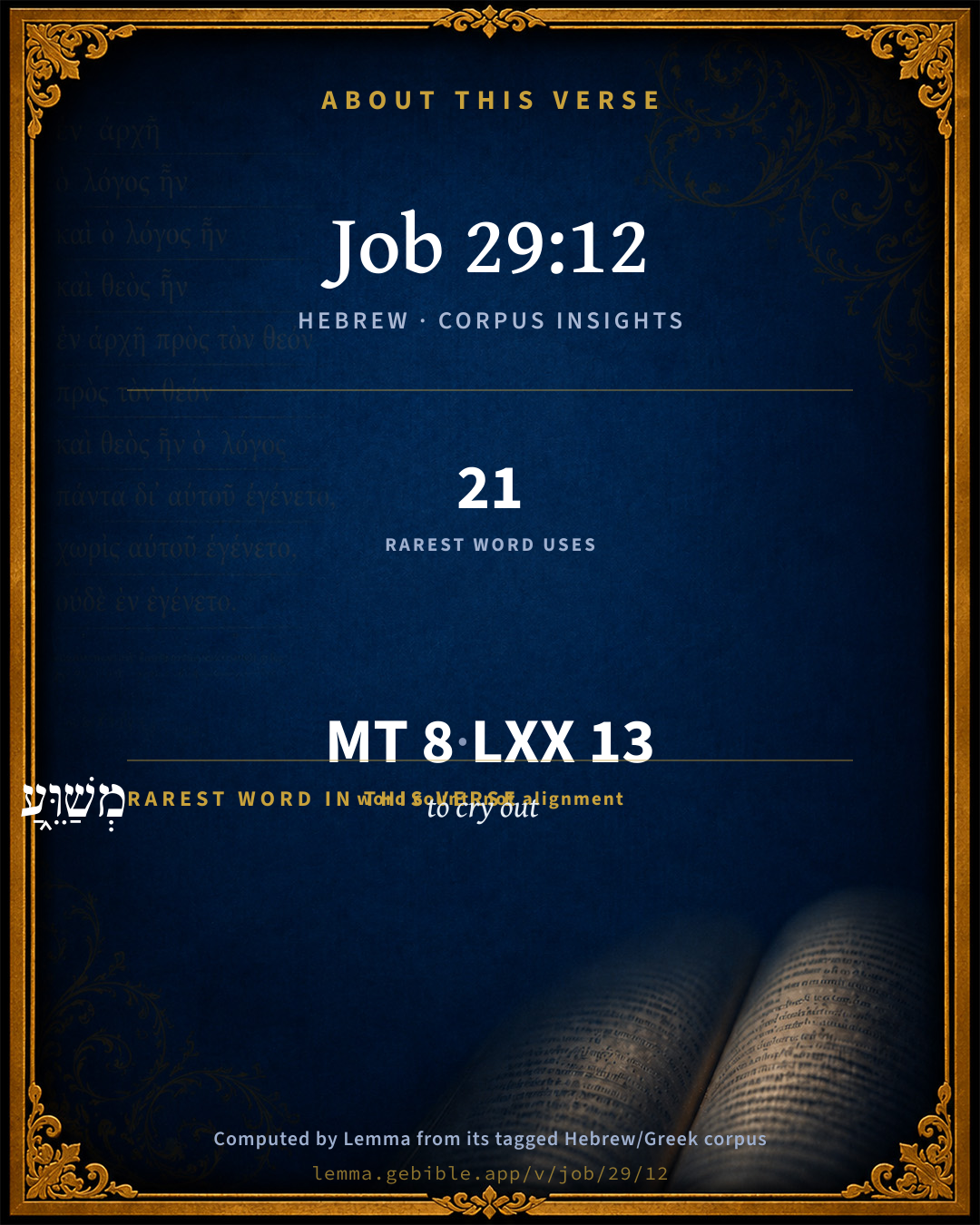
The rarest word here is מְשַׁוֵּ֑עַ to cry out H7768 — appearing just 21 times in the whole Hebrew Bible.

Shared distinctive vocabulary

מְשַׁוֵּ֑עַ to cry out H7768 occurs in 21 verses of the Hebrew Bible. Also found in:

Grammatical profile

  • 3 verbs
  • 1 noun
  • 1 adjective
  • 1 preposition
  • 1 conjunction
  • 1 particle

Verb forms

  • אֲ֭מַלֵּט Piel · Imperfect
  • מְשַׁוֵּ֑עַ Piel · Participle Active
  • עֹזֵ֥ר Qal · Participle Active

Hebrew & Septuagint length

In English translation the verse runs 17 words from the Hebrew and 20 from the Septuagint (LXX English) — closely comparable.

A rough comparison of the two English renderings, which tokenize alike — not a word-level alignment.

Word counts can differ between the Hebrew and the Greek without any difference in meaning — e.g. the Hebrew direct-object marker אֵת has no separate Greek word, and Greek often adds the article ὁ.

In the original languages it is 8 Hebrew tokens and 13 Greek tokens — but the two are counted differently (Hebrew bundles its prefixes and suffixes into one token; the Greek is in lemma form), so that isn’t a like-for-like length.

Cross-references

14

Topical passages linked to Job 29:12 in the Treasury of Scripture Knowledge — connected by theme and wording, ordered by reader-vote popularity; previews shown in the World English Bible.

  • Psalms 72:12 For he will deliver the needy when he cries; The poor, who has no helper.
  • Proverbs 21:13 Whoever stops his ears at the cry of the poor, He will also cry out, but shall not be heard.
  • Exodus 22:22–24 "You shall not take advantage of any widow or fatherless child.
  • James 1:27 Pure religion and undefiled before our God and Father is this: to visit the fatherless and widows in their affliction, and to keep oneself unstained by the world.
  • Deuteronomy 10:18 He does execute justice for the fatherless and widow, and loves the foreigner, in giving him food and clothing.
  • Psalms 68:5 A father of the fatherless, and a defender of the widows, Is God in his holy habitation.
  • Psalms 82:2–4 "How long will you judge unjustly, And show partiality to the wicked?" Selah.
  • Proverbs 24:11–12 Rescue those who are being led away to death! Indeed, hold back those who are staggering to the slaughter!
  • Nehemiah 5:2–13 For there were that said, We, our sons and our daughters, are many: let us get grain, that we may eat and live.
  • Job 22:5–9 Isn't your wickedness great? Neither is there any end to your iniquities.
  • Job 24:4 They turn the needy out of the way. The poor of the earth all hide themselves.
  • Job 31:17 Or have eaten my morsel alone, And the fatherless has not eaten of it
  • Job 31:21 If I have lifted up my hand against the fatherless, Because I saw my help in the gate:
  • Jeremiah 22:16 He judged the cause of the poor and needy; then it was well. Wasn't this to know me? says Yahweh.

Cross-references courtesy of OpenBible.info (CC BY 4.0).

Hebrew and Greek witnesses Masoretic Hebrew ↔ Greek Septuagint

The same verse in the two great witnesses to the Old Testament, shown verse-for-verse.

These are two independent witnesses, not word-aligned to each other, and the Septuagint is shown in lemma (dictionary) form.

Hebrew Job 29:12 Masoretic · Westminster Leningrad Codex

כִּֽי אֲ֭מַלֵּט עָנִ֣י מְשַׁוֵּ֑עַ וְ֝יָת֗וֹם וְֽלֹא עֹזֵ֥ר לֽוֹ

Because I delivered the poor who cried, And the fatherless also, who had none to help him.

World English Bible · Public Domain

Greek LXX Job 29:12 Septuagint · lemma form

διασώζω γάρ πτωχός ἐκ χείρ δυνάστης καί ὀρφανός ὅς οὐ εἰμί βοηθός βοηθέω

For I saved the poor out of the hand of the oppressor, and helped the fatherless who had no helper.

LXX2012 (modern English Septuagint) · Public Domain

Hebrew: Westminster Leningrad Codex (CC BY 4.0). Greek: Septuagint (public domain); English from LXX2012 (modern English Septuagint) (Public Domain). How the Septuagint differs from the Hebrew →

Commentary

Notes on Job 29:12 from classic Christian and Jewish commentators (each source and its license shown beneath its notes). The classic Christian expositions comment on the surrounding passage and are grouped to its opening verse, so a note may address several verses; the Jewish commentaries on the Tanakh (Rashi and others) are per-verse, so they appear only where the commentator wrote on this verse.

Lemma curates 59 commentaries, every one of them public domain or Creative Commons licensed, each selected and text-cleaned for this edition rather than reprinted as found. About our sources →

Trapp's Complete Commentary

John Trapp

Job 29:12 Because I delivered the poor that cried, and the fatherless, and [him that had] none to help him.

Ver. 12. Because I delivered the poor that cried] Here are set forth the true causes of that great respect that was generally given Job; he was a good justicer, such as Jethro describeth, Exo 18:21. He hated, much more than did Mithridates, such as maliciously persecuted virtue forsaken of fortune. And as James V of Scotland was called the poor man’s king, so might Job well have been; for no sooner could a poor body cry to him for help but he relieved him, and rescued him out of the hands of his oppressor (Cassiodor.). Theodoric of old, and Gustavus, king of Swedes, of late, are famous for so doing (Mr Clark).

And the fatherless, and him that had none, &c.] The fatherless and friendless, from whom he could not expect any reward. He was not of those who follow the administration of justice as a trade only, with an unquenchable and unconscionable desire of gain, but held out a constant course of integrity, and righted those whom others would have slighted.

John Trapp, A Commentary or Exposition upon All the Books of the Old and New Testament (1647–1656) — public domain. Text from a community e-Sword module.

The Biblical Illustrator

Joseph S. Exell

Job_29:12

Because I delivered the poor that cried.

The use and application of wealth and authority

These words naturally lead us to reflect on the noble use and improvement this venerable person made of his former prosperity; to consider our own duty as represented to us in his example; and the proper objects of our compassion.

I. The proper use and application of wealth and authority. The distinctions which arise from power and subjection, from riches and poverty, from ease and affliction, appear so unequally and irregularly divided among men, and with so little regard to moral reasons, that by some superficial observers they have been formed into an objection against the wisdom and justice of God. But they execute a wise and regular scheme of providence; are necessary to preserve the order and economy of human society, and unite and endear mankind to one another. Wealth and authority must be acknowledged to distinguish us only as superior servants, appointed by our common Master, to do justice in the family and give everyone their meat in due season. We are not to imagine these favours are indulged us merely for our own sakes, to enable us to live in splendour and ease. The poor have a right and property in the abundance of those who are better supplied. Neither is any man farther justified in engrossing and hoarding up the common bounties of heaven, than may consist with this claim. These pleas of natural reason and justice religion has enforced with the authority of a positive command. With regard to the object, we are to observe, that both the obligations of the duty, and the measures prescribed to it, are under some limitations; for though our benevolence is required to be universal, yet our abilities are confined to a much narrower compass, and therefore oblige us to choice and distinction in the external applications of our charity. The motives that should prevail with us to comply with these great obligations, laid on us by justice and our religion, are that inward joy and complacency which flow back upon the soul from acts of mercy and liberality; and above all, those inestimable rewards which the Gospel has taught us to expect from these duties; pardon of sin here, and the eternal treasures of heaven hereafter.

II. The words allow us to take some inferior views into the account. While we are employed in the exercise of beneficence and charity, we appear in the venerable character of substitutes of God, commissioned by Him to reach down and distribute His blessings among our fellow subjects. On the returns of gratitude from the objects of our charity, and from the world who are witnesses of it, we are permitted to reflect with pleasure as a present encouragement designed by God to excite and reward our virtue. The other motive here proposed for our encouragement, the blessings of those whom we relieve, is in its nature properly religious; derives all its force from a conviction of our dependence on Providence, and the efficacy of human prayers. (J. Rogers, D. D.)

Eyes to the blind

That is not egotism. It is not the utterance of a puffed-up spirit. Egotism is too frequently the child of the shallows. Rarely, if ever, does it issue out of a deep and troubled heart. Egotism flourishes best where profound sorrow is least known. And here is a man who is overwhelmed with sorrow. Death has darkened every window in his home, and he is burdened with the weight of an almost intolerable grief. This is no place in which to find light, egotistical speech. Whatever words this man may speak will be crushed out of him by the very burden of his grief. It is a man going into his yesterdays to find some solace for the sorrow of today. He is calling upon memory to provide a little hearts ease for his present bitter distress. Thrice happy the man who can call such memories to help him in the hour of his distress! The poor that cried, and the fatherless, and those ready to perish, and the widow and the lame and the blind still make their appeals in the land, and it is true today as ever that the only Christian response is the one that was made by the patriarch Job. I have noticed that controversy about the distressed and the unfortunate is often regarded as a substitute for their relief. Abstract discussions often result in misty speculations which only obscure ones personal duty. It is often the case that controversy abounds where sympathy should reign. Again and again we find this illustrated in the experiences of our Lord. You find controversialists discussing the abstract question why such and such a man was born blind, while the blind man himself was soliciting practical aid. I believe that there is a vast amount of suffering and distress which might be effectually checked by some rearrangement of our social and economic conditions. I do not think that in these matters legislation is altogether impotent. At any rate, we can see to it that legislation puts a premium upon virtue, and not upon vice. But when legislation has done its utmost, misfortune will still be with us. In the presence of these things, surrounded by them on every side, what is the Christian attitude? The attitude of the patriarch Job. Christianity is a gospel of compassion and practical help, and to be devoid of these things is to be altogether an alien from the commonwealth of Israel. This is not new. The youngest child in this assembly could tell us that Christianity without helpfulness is a great absurdity. But while we all know these things, the danger is that we have got the right ideas without the correspondingly right feelings. It is so easy to be orthodox in mind but heterodox in heart; to have Christian ideas, but non-Christian feelings. Our Christianity may be intelligent but not sympathetic. What we want is the orthodox feeling united to the orthodox thought. How is this to be attained? I do not think we shall ever have a really deep feeling for our fellow sufferers until we have deeply suffered too. You begin to pray for the sailors when your own boy is on the deep. When you have a crippled child what a heart you have for the maimed! It sometimes seems as though God cannot draw us together in common feeling without taking us through a common sorrow. There is nothing so welds hearts together. I know of nothing more pathetic in the life of Browning than the reconciliation of himself and the great actor Macready. They had been close and intimate friends, but for some trifle or other they quarrelled, and each went his own way, and for years their helpful intercourse was broken. Then came a great trouble. About the same time they lost their wives, and a little while after, as each was walking out in his loneliness in a quiet way in a London suburb, they suddenly met face to face, and Browning, with a great burst of emotion, seized his old friends hand, and said, Oh, Macready; and Macready, with an aching heart, replied, Oh, Browning. That was all they could say to each other, and in the fires of a great and common grief the two severed lives were welded again. But if we have not been deepened by suffering, we can do something to deepen ourselves. Let us get face to face with realities. First of all we can remember the old trite commonplace that truth is stranger than fiction. We can find more pitiful things to weep over in any one street in this city than in all the works of fiction which may issue from the press in the course of the year. I dont know what Christ will have to say to people who weep over their novels, but who never weep over the great cities as He did because of their distresses and their woes. (J. H. Jowett, M. A.)

Sympathy should be practical

An Italian coastguard officer reported a shipwreck to his Government in these words: We saw the wreck, and we attempted to give every assistance possible through the speaking trumpet. We shouted ourselves quite hoarse, and notwithstanding which next morning twenty corpses were washed ashore. A well-known Scotch professor used to tell this story, and add: Too much of our benevolence is of the speaking trumpet variety, and even this we boast about. The Samaritan of the New Testament represents the benevolence of which the world stands in greatest need.

Piety and riches

I. The text shows the nature of a truly righteous and powerful character, aided by great secular possessions. Job was very rich; he was also very pious

1. His impartial justice.

2. His broad charity.

3. His timely assistance of the needy.

4. His exemplary leadership.

In all these we see a truly powerful and noble character. Piety, charity, justice, grandly blended and exemplified. We see at least that there is no incompatibility between a holy character and vast secular wealth.

II. The text shows that the most perfect piety is no security against the loss of great secular abundance. Wealth may go, but piety shall remain.

III. The text shows that the rich pious man, being in danger of losing his wealth, should, while he possesses it, use it wisely. This should inspire us--

1. To promptitude and liberality in our gifts; and

2. To a right discretion of the objects we support. It would be difficult to estimate such a life as is here set forth. A rich good man abounds with resources of good in every direction of Gods glory and the welfare of man. And if so be that the wealth be taken from us, we never lose our piety, which is the far greater possession. (Thomas Colclough.)

The Biblical Illustrator, edited by Joseph S. Exell (c. 1880s–1900s) — public domain. Text from a community e-Sword module.

Geneva Bible (1599)

Geneva Bible translators

Because his adversaries did so much charge him with wickedness, he is compelled to render account of his life.

Geneva Bible (1599) marginal notes — public domain. Text via Bolls.life.

Jamieson, Fausset & Brown

Robert Jamieson, A. R. Fausset & David Brown

The grounds on which Job was praised (Job 29:11), his helping the afflicted (Psa 72:12) who cried to him for help, as a judge, or as one possessed of means of charity. Translate: "The fatherless who had none to help him."

Jamieson, Fausset & Brown — Commentary Critical and Explanatory on the Whole Bible (1871) — public domain (CC PDM 1.0). Text via the HelloAO Bible API.

Adam Clarke's Commentary

Verse 12. Because I delivered the poor that cried] This appears to be intended as a refutation of the charges produced by Eliphaz, Job 22:5-10, to confute which Job appeals to facts, and to public testimony.

Adam Clarke's Commentary on the Bible (1810–1826) — public domain. Text from a community e-Sword/MySword module.

The Cambridge Bible for Schools and Colleges

gen. ed. J. J. S. Perowne

12. and him that had none to help him] Perhaps, the fatherless, that had none to help him, only two classes being referred to, the “poor” and the “fatherless.”

The Cambridge Bible for Schools and Colleges (gen. ed. J. J. S. Perowne; Cambridge University Press, 1878–1918) — public domain. Text from a community e-Sword module.

John Gill's Exposition

Because I delivered the poor that cried,.... This honour and esteem he had not because of his grandeur and riches, because of his worldly wealth and substance, but because of the goodness of his disposition, and because of the good he did to men, his acts of pity and compassion to the poor, and of the justice he did to all men; the poor and the afflicted, when they cried to him for help, he delivered them out of the hands of their oppressors:

and the fatherless; the care and defence of which belongs to judges and civil magistrates, see Psa 82:1;

and him that had none to help him; as the poor and fatherless seldom have; there is power on the side of the oppressors of them, but they have few or none to take their parts, and to be their comforters, Ecc 4:1; in these instances Job imitated God, and was a follower of him, as a dear child of his; who, when this and the other poor man cries unto him, he hears, saves, and delivers out of all their troubles; he is the helper, yea, the father of the fatherless, and the judge of the widow; and, when there is no help from men, he is a present help in times of need.

John Gill's Exposition of the Whole Bible (1746–1763) — public domain (CC PDM 1.0). Text via the HelloAO Bible API.

Albert Barnes' Notes on the Bible

Because I delivered the poor that cried - This is spoken of himself as a magistrate or judge - for the whole description relates to that. The meaning is, that when the poor man, who had no means of employing counsel, brought his cause before him, he heard him and delivered him from the grasp of the oppressor. He never made an appeal to him in vain; compare Pro 21:13; Pro 24:11-12.

And the fatherless - The orphan who brought his cause before him. He became the patron and protector of those whose natural protectors - their parents - had been removed by death; compare the notes at Isa 1:17.

And him that had none to help him - The poor man who had no powerful patron. Job says that, as a magistrate, he particularly regarded the cause of such persons, and saw that justice was done them - a beautiful image of the administration of justice in patriarchal times. This is the sense in which our translators understood this. But the parallelism seems rather to require that this should be applied to the fatherless who had no one to aid him, and the Hebrew, by understanding the ו (w) conjunctive as meaning “when,” will bear this construction. So it is understood by Rosenmuller, Umbreit, Herder, and Noyes.

Albert Barnes' Notes on the Bible (1834–1885) — public domain. Text from a community e-Sword/MySword module.

Matthew Poole's English Annotations

I delivered from his potent oppressor. They did not honour me for my great wealth or power, but for my impartial justice and pity to the afflicted, and courage in maintaining their cause and right against their mighty adversaries.

None to help him; none that would own or help them, partly because they were poor, and unable to recompense them for it; and partly because their enemies were great, and likely to crush both them and their helpers; which made Job’s virtue more glorious.

Matthew Poole's English Annotations on the Holy Bible (1683–1685) — public domain. Text from a community e-Sword/MySword module.

Whedon's Commentary on the Bible

Daniel D. Whedon

12. A most courteous reply to the cruel calumnies of Eliphaz, Job_22:6-9.

Daniel D. Whedon (gen. ed.), Commentary on the Old and New Testaments (1874–1909) — public domain. Text from a community e-Sword module.

The Pulpit Commentary

Because I delivered the poor that cried (compare the Instructions of Amen-em-hat: "Because I have made the afflicted ones free from their afflictions, so that their cries are heard no more" ("Records of the Past," vol. 2 p. 12). And again the Inscription of Ameni-Amenemha: "No little child have I injured; no widow have I oppressed; no fisherman have I hindered; no shepherd have I detained; no foreman have I taken from his gang to employ him in forced labour" (ibid., vol. 12:63). And the fatherless, and him that had none to help him (compare what is said of the ideal king in Psa_72:12-14, "He shall deliver the needy when he crieth; the poor also, and him that hath no helper. He shall spare the poor and needy, and shall sabre the souls of the needy. He shall redeem their soul from deceit and violence: and precious shall their blood be in his sight"). Championship of the poor was anciently regarded as characteristic of the wise, good, strong ruler.

The Pulpit Commentary (1880–1919), ed. H.D.M. Spence-Jones & Joseph S. Exell — public domain. Text from a community e-Sword module.

Kretzmann's Popular Commentary

Paul E. Kretzmann

Job Speaks of his Benevolence and the Honor Accorded Him

v. 12. Because I delivered the poor that cried, making a plea for assistance, and the fatherless, and him that had none to help him, the orphan who had no helper, Job practised true benevolence, dispensed real charity.

v. 13. The blessing of him that was ready to perish came upon me, the forsaken and miserable ones blessed him with grateful wishes for the help he gave them; and I caused the widow’s heart to sing for joy, by the willing charity which he dispensed, relieving her of all her cares of this life.

v. 14. I put on righteousness, and it clothed me, putting it on as a robe, wearing it always, so that the proper holy conduct at all times was identified with him; my judgment was as a robe and a diadem, justice and fairness in all his dealings were his mantle and his turban, characterizing him before all men.

v. 15. I was eyes to the blind, and feet was I to the lame, his charity and largess was so great as to make men forget their misfortunes, no matter whether these consisted even in lameness or blindness.

v. 16. I was a father to the poor, attending to the wants of the needy like a natural father; and the cause which I knew not I searched out, he made it his business to find out about the friendless in the community, in order to come to their assistance in anything they needed.

v. 17. And I brake the jaws of the wicked, of all the hard-hearted, who oppressed the poor, especially of unrighteous judges, and plucked the spoil out of his teeth, rescuing them from the power of the wicked, as out of the claws of beasts of prey. In this way had Job spent his days, dispensing benevolence on all sides.

v. 18. Then I said, I shall die in my nest, safe in the bosom of his family, and I shall multiply my days as the sand, dying in a ripe old age, after the grains of sand in the hour-glass of his life had fully run their course.

v. 19. My root was spread out by the waters, he had hoped that he would flourish like a tree plentifully watered, and the dew lay all night upon my branch, like the moisture which sustains the life of the desert plant.

v. 20. My glory was fresh in me, he thought he would always be given the honor which he then enjoyed, and my bow was renewed in my hand, the bow being a symbol of manliness and strength, which, he trusted, would always grow young again.

v. 21. Unto me men gave ear and waited, they paused for Job to speak first, his counsel being decisive, and kept silence at my counsel, not presuming to contradict him.

v. 22. After my words they spake not again, his solution of the matter under consideration being final; and my speech dropped upon them, as the refreshing rain does upon the dry soil eager for its fructifying power.

v. 23. And they waited for me as for the rain, to have his counsel come to them as such a gentle shower; and they opened their mouth wide as for the latter rain, the rain of early spring, which determines the richness of the harvest.

v. 24. If I laughed on them, they believed it not, literally, "when they had no confidence," when they were despondent about something, his cheering smile gave them new courage; and the light of my countenance they cast not down, could not darken; no matter how cheerless the prospect, they could not take the hopefulness out of Job’s heart nor the encouraging smile from his face.

v. 25. I chose out their way and sat chief, he took pleasure in attending their assemblies and in taking part in their affairs, and dwelt as a king in the army, assuming the leadership altogether naturally, as one that comforteth the mourners, with the encouragement which a true leader will give to those depending on him. Such was Job’s happiness and prosperity, and such were his hopes for the future in the days when he was an honored man in the community.

Paul E. Kretzmann, Popular Commentary of the Bible (1921–1924) — public domain. Text from a community e-Sword module.

Lesson kit

Teaching starters — assembled from the data on this page, not authored interpretation. Every prompt links to the verse data it draws on. Edit before teaching.

Job, in the Wisdom, opens this verse with 8 words (7 distinct Hebrew lemmas). Its most distinctive word is shâvaʻ (“to cry out”). A historical commentator’s framing appears above. Read the whole chapter for the surrounding context.

Discussion questions

  1. The word shâvaʻ carries the sense “to cry out.” How does it shape the verse?
  2. How does Job 19:7, which shares the word «to cry out», read alongside this verse?
  3. The translations on this page render this verse differently — a whole-verse word diff, not a word-by-word alignment. What might account for the different wordings?
  4. «אֲ֭מַלֵּט» is a Piel Imperfect verb. How does that grammatical form shape the action described?
  5. Compare how Trapp's Complete Commentary and The Biblical Illustrator read this verse. Where do they agree or differ?

Things to notice

Reading settings

Reading text

Shown beneath each verse's original-language words.

Old Testament
Old Testament edition

Read the OT as the Masoretic Hebrew (MT) or the Greek Septuagint (LXX).

English shown for the Greek Septuagint (in the Hebrew ↔ Greek comparison).

Comparing translations? Open the Compare panel on any verse page to stack up to four side by side.