
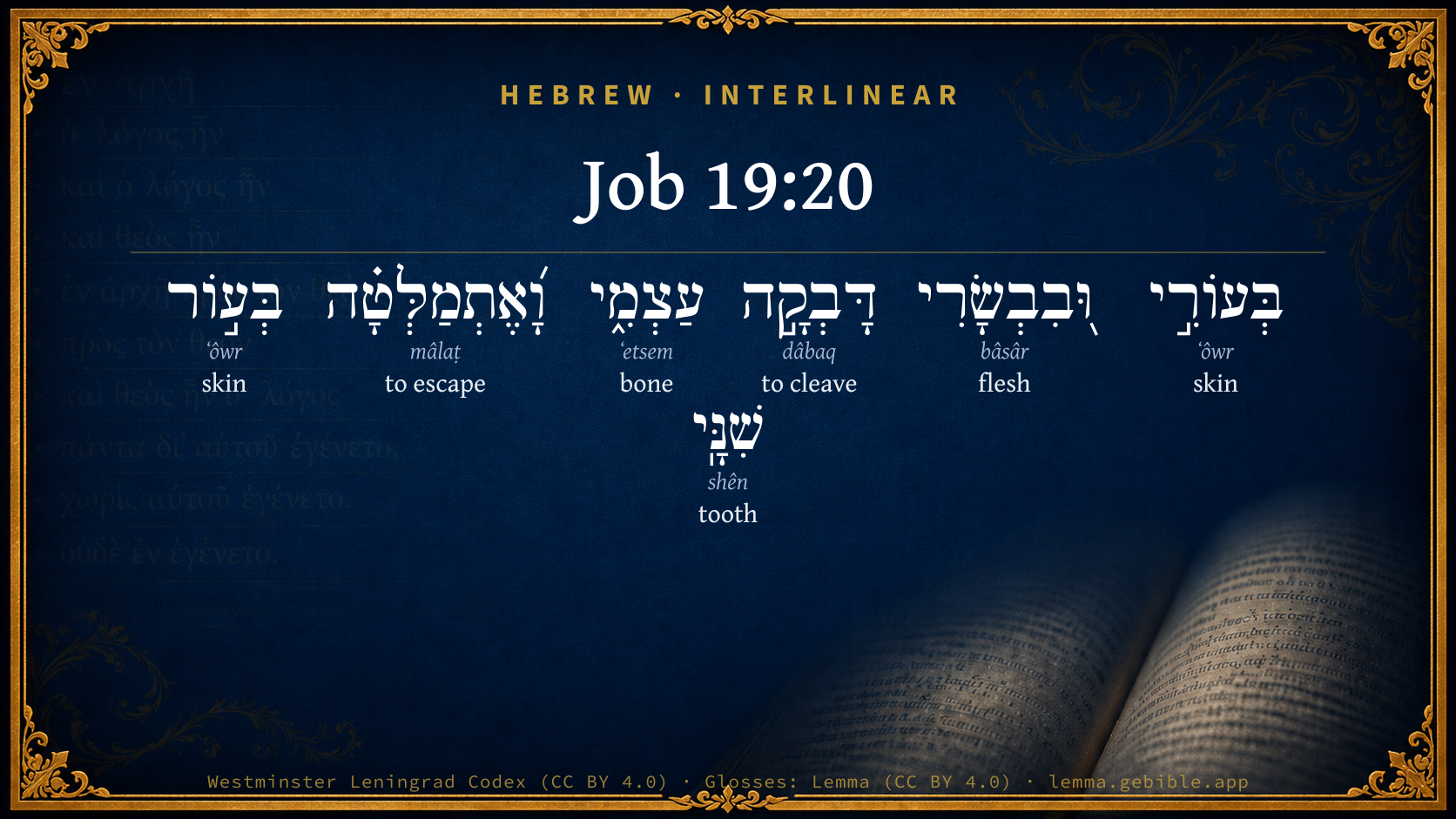
Job 19:20

Hebrew (Westminster Leningrad Codex) Job 19:20 appears in the Hebrew Old Testament. The text above is from the Westminster Leningrad Codex. Each word links to its Strong’s number, a concise gloss, and parsing drawn from the Open Scriptures Hebrew Bible morphology. Click any word for its full Brown-Driver-Briggs (BDB) entry.
Download image
Cite this verse

Job 19:20 (World English Bible). Public Domain. Lemma interlinear Bible study tool, https://lemma.gebible.app/v/job/19/20.

Show BibTeX & RIS
BibTeX
RIS
English Translation
My bones stick to my skin and to my flesh. I have escaped by the skin of my teeth.
World English Bible · Public Domain
Download a study sheet

One document with this verse’s original text, its word-by-word gloss line, the meaning frame, cross-references with their text, attributed commentary, and full source and license credits — printable, and it pastes into notes with its structure intact.

This verse Autodidact and up

Study sheet (.html) Plain text (.txt)

A passage Seminary Student

Up to 50 verses in one chapter. A passage sheet keeps up to 6 commentary sources and 12 cross-references per verse, in the order this page ranks them, and says so on the sheet whenever that leaves anything out. Ask for a single verse and you get the Autodidact verse sheet above.

Everything on this page stays free to read, with no account — the sheet is a download of what is already on screen, not access to it.

Want to remove ads? Support Godless Engineer
Compare translations 3

The same verse in 3 English versions, stacked beneath the original-language interlinear above. Click any original word for its lexicon entry.

Each is an independent rendering of the whole verse — the interlinear is not word-aligned to these translations.

Highlighted words mark where these versions differ — a whole-verse word diff, not a word-by-word alignment.

  • World English Bible Public Domain
    My bones stick to my skin and to my flesh. I have escaped by the skin of my teeth.
  • King James Version Public Domain
    My bone cleaveth to my skin and to my flesh, and I am escaped with the skin of my teeth.
  • unfoldingWord Literal Text CC BY-SA 4.0
    My bone clings to my skin and to my flesh, and I have escaped with the skin of my teeth.

unfoldingWord Literal Text — © unfoldingWord, licensed CC BY-SA 4.0. Word-aligned USFM3 via Door43 (git.door43.org/unfoldingWord/en_ult).

Versions to compare (up to 4)

3 of 4 selected

Show all 18 translations

Every available English version of this verse, each an independent rendering of the whole verse.

  • World English Bible Public Domain
    My bones stick to my skin and to my flesh. I have escaped by the skin of my teeth.
  • Berean Standard Bible Public Domain
    My skin and flesh cling to my bones; I have escaped by the skin of my teeth.
  • Majority Standard Bible Public Domain
    My skin and flesh cling to my bones; I have escaped by the skin of my teeth.
  • King James Version Public Domain
    My bone cleaveth to my skin and to my flesh, and I am escaped with the skin of my teeth.
  • American Standard Version (1901) Public Domain
    My bone cleaveth to my skin and to my flesh, And I am escaped with the skin of my teeth.
  • Revised Version (1885) Public Domain
    My bone cleaveth to my skin and to my flesh, and I am escaped with the skin of my teeth.
  • Geneva Bible (1599) Public Domain
    My bone cleaueth to my skinne and to my flesh, and I haue escaped with the skinne of my teeth.
  • Douay-Rheims (1899) Public Domain
    The flesh being consumed. My bone hath cleaved to my skin, and nothing but lips are left about my teeth.
  • Young's Literal Translation Public Domain
    To my skin and to my flesh Cleaved hath my bone, And I deliver myself with the skin of my teeth.
  • Literal Standard Version CC BY-SA 4.0
    To my skin and to my flesh || My bone has cleaved, || And I deliver myself with the skin of my teeth.
  • Unlocked Literal Bible CC BY-SA 4.0
    My bones cling to my skin and to my flesh; I survive only by the skin of my teeth.
  • unfoldingWord Literal Text CC BY-SA 4.0
    My bone clings to my skin and to my flesh, and I have escaped with the skin of my teeth.
  • Darby Bible Public Domain
    My bones cleave to my skin and to my flesh, and I am escaped with the skin of my teeth.
  • World Messianic Bible Public Domain
    My bones stick to my skin and to my flesh. I have escaped by the skin of my teeth.
  • Webster's Bible Public Domain
    My bone cleaveth to my skin and to my flesh, and I have escaped with the skin of my teeth.
  • Free Bible Version CC BY-SA 4.0
    I've been reduced to skin and bones and I survive by the skin of my teeth.
  • Bible in Basic English Public Domain
    My bones are joined to my skin, and I have got away with my flesh in my teeth.
  • JPS Tanakh (1917) Public Domain
    My bone cleaveth to my skin and to my flesh, and I am escaped with the skin of my teeth.

Literal Standard Version (2020), Covenant Press — licensed CC BY-SA 4.0. Text via the HelloAO Bible API (eBible.org). Unlocked Literal Bible (unfoldingWord) — licensed CC BY-SA 4.0. Text via the HelloAO Bible API (eBible.org). unfoldingWord Literal Text — © unfoldingWord, licensed CC BY-SA 4.0. Word-aligned USFM3 via Door43 (git.door43.org/unfoldingWord/en_ult). Free Bible Version, Dr. Jonathan Gallagher — licensed CC BY-SA 4.0. Text via the HelloAO Bible API (eBible.org).

Word by word

More ways to search: Search by grammar → Find every occurrence → Compare this word →

Practice this passage: Drill this verse → Learn its vocabulary →

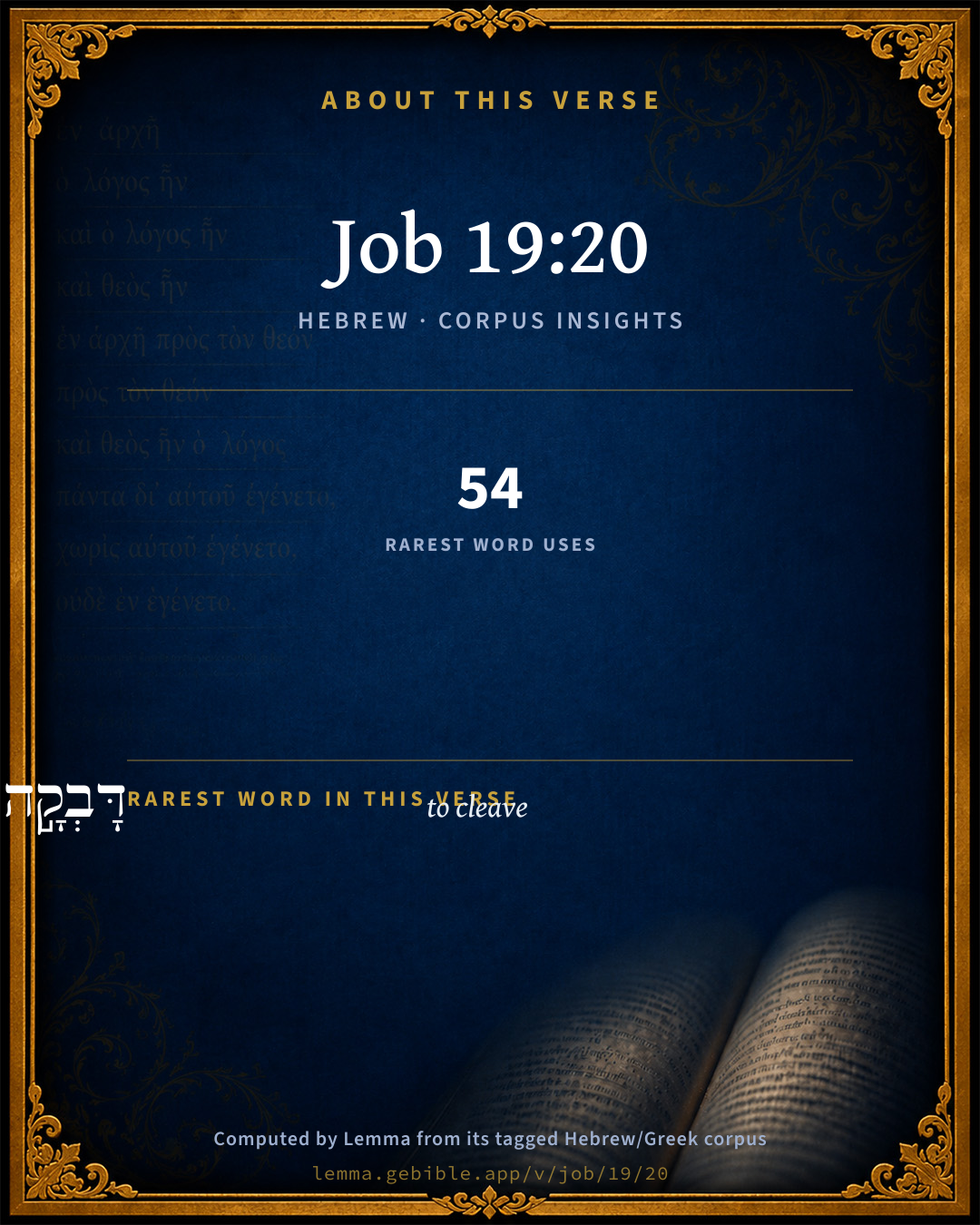
דָּבְקָ֣ה
dâbaq
H1692
“to cleave”
Verb, Qal, Perfect, 3rd Person, Feminine, Singular
Part of Speech
Verb
Stem
Qal
Form
Perfect
Person
3rd Person
Gender
Feminine
Number
Singular
Full BDB Definition

Origin: a primitive root

TWOT: 398

to cling, stick, stay close, cleave, keep close, stick to, stick with, follow closely, join to, overtake, catch - (Qal) - to cling, cleave to - to stay with - (Pual) to be joined together - (Hiphil) - to cause to cleave to - to pursue closely - to overtake - (Hophal) to be made to cleave
  1. בְּעוֹרִ֣י ʻôwr H5785 “in/at · skin · my” Preposition + Noun, Common, Masculine, Singular, Construct + Suffix, Personal, 1st Person, Common, Singular
  2. וּ֭בִבְשָׂרִי bâsâr H1320 “and · in/at · flesh · my” Conjunction + Preposition + Noun, Common, Masculine, Singular, Construct + Suffix, Personal, 1st Person, Common, Singular
  3. עַצְמִ֑י ʻetsem H6106 “bone · my” Noun, Common, Feminine, Singular, Construct + Suffix, Personal, 1st Person, Common, Singular
  4. וָ֝אֶתְמַלְּטָ֗ה mâlaṭ H4422 “and · to escape” Conjunction + Verb, Hithpael, Sequential Imperfect, 1st Person, Common, Singular + Suffix, h
  5. בְּע֣וֹר ʻôwr H5785 “in/at · skin of” Preposition + Noun, Common, Masculine, Singular, Construct
  6. שִׁנָּֽי shên H8127 “teeth · my” Noun, Common, Both, Dual, Construct + Suffix, Personal, 1st Person, Common, Singular

About this verse

These counts appear in no published source. They are computed here, from the morphology-tagged text and Lemma’s own curated glosses. What Lemma adds →

7
words
6
distinct lemmas
Wisdom
section

Shared distinctive vocabulary

דָּבְקָ֣ה to cleave H1692 occurs in 52 verses of the Hebrew Bible. Also found in:

Grammatical profile

  • 2 verbs
  • 5 nouns

Verb forms

  • דָּבְקָ֣ה Qal · Perfect
  • וָ֝אֶתְמַלְּטָ֗ה Hithpael · Sequential Imperfect

Repetition

A word recurs within this verse — often emphatic in Hebrew:

  • בְּעוֹרִ֣י skin H5785 ×2

Hebrew & Septuagint length

In English translation the verse runs 19 words from the Hebrew and 15 from the Septuagint (LXX English) — closely comparable.

A rough comparison of the two English renderings, which tokenize alike — not a word-level alignment.

Word counts can differ between the Hebrew and the Greek without any difference in meaning — e.g. the Hebrew direct-object marker אֵת has no separate Greek word, and Greek often adds the article ὁ.

Cross-references

12

Topical passages linked to Job 19:20 in the Treasury of Scripture Knowledge — connected by theme and wording, ordered by reader-vote popularity; previews shown in the World English Bible.

  • Psalms 102:5 By reason of the voice of my groaning, My bones stick to my skin.
  • Lamentations 4:8 Their visage is blacker than a coal; they are not known in the streets: Their skin cleaves to their bones; it is withered, it is become like a stick.
  • Job 33:19–22 He is chastened also with pain on his bed, With continual strife in his bones;
  • Job 2:4–6 Satan answered Yahweh, and said, "Skin for skin. Yes, all that a man has will he give for his life.
  • Job 7:5 My flesh is clothed with worms and clods of dust. My skin closes up, and breaks out afresh.
  • Job 30:30 My skin grows black and peels from me. My bones are burned with heat.
  • Psalms 22:14–17 I am poured out like water. All my bones are out of joint. My heart is like wax; It is melted within me.
  • Psalms 32:3–4 When I kept silence, my bones wasted away through my groaning all day long.
  • Psalms 38:3 There is no soundness in my flesh because of your indignation, Neither is there any health in my bones because of my sin.
  • Psalms 102:3 For my days consume away like smoke. My bones are burned as a firebrand.
  • Lamentations 3:4 My flesh and my skin has he made old; he has broken my bones.
  • Lamentations 5:10 Our skin is black like an oven, Because of the burning heat of famine.

Cross-references courtesy of OpenBible.info (CC BY 4.0).

Hebrew and Greek witnesses Masoretic Hebrew ↔ Greek Septuagint

The same verse in the two great witnesses to the Old Testament, shown verse-for-verse.

These are two independent witnesses, not word-aligned to each other, and the Septuagint is shown in lemma (dictionary) form.

Hebrew Job 19:20 Masoretic · Westminster Leningrad Codex

בְּעוֹרִ֣י וּ֭בִבְשָׂרִי דָּבְקָ֣ה עַצְמִ֑י וָ֝אֶתְמַלְּטָ֗ה בְּע֣וֹר שִׁנָּֽי

My bones stick to my skin and to my flesh. I have escaped by the skin of my teeth.

World English Bible · Public Domain

Greek LXX Job 19:20 Septuagint · lemma form

ἐν δέρμα ἐγώ σήπω ὁ σάρξ ἐγώ ὁ δέ ὀστέον ἐγώ ἐν ὀδούς ἔχω

My flesh is corrupt under my skin, and my bones are held in my teeth.

LXX2012 (modern English Septuagint) · Public Domain

Hebrew: Westminster Leningrad Codex (CC BY 4.0). Greek: Septuagint (public domain); English from LXX2012 (modern English Septuagint) (Public Domain). How the Septuagint differs from the Hebrew →

Commentary

Notes on Job 19:20 from classic Christian and Jewish commentators (each source and its license shown beneath its notes). The classic Christian expositions comment on the surrounding passage and are grouped to its opening verse, so a note may address several verses; the Jewish commentaries on the Tanakh (Rashi and others) are per-verse, so they appear only where the commentator wrote on this verse.

Lemma curates 59 commentaries, every one of them public domain or Creative Commons licensed, each selected and text-cleaned for this edition rather than reprinted as found. About our sources →

Trapp's Complete Commentary

John Trapp

Job 19:20 My bone cleaveth to my skin and to my flesh, and I am escaped with the skin of my teeth.

Ver. 20. My bone cleaveth to my skin] My skin is a bag of bones. I am become a mere skeleton, and may well cry out, O my leanness, my leanness! So bare I am grown, that little appeareth in me but skin and bones, Isa 24:16. My bone cleaveth to my skin as to my flesh (so it may be read), that is, as once it did in my flesh, when I was well lined within. Now, alas! I lie under a miserable marasmus; and should therefore be pitied, as being a just object of your commiseration, Ossa sub incurvis apparent arida lumbis.

And I am escaped with the skin of my teeth] Escaped I am, and come off (as out of a hot skirmish) with my life, and very little else. All I have left me whole is the skin of my teeth; that is, of my gums, into which my teeth are engrafted; the rest of my body is all over a scab. The Vulgate rendereth it, My lips only about my teeth are left me untouched. And Junius gives this gloss, Job had nothing left him but the instrument of speech. These, say some, the devil purposely meddled not with, as hoping that therewith he would curse God. Curse him he might with his heart only; but this would have pleased the devil nothing so well as to hear him do it with his tongue, Hoc fecisse Satanam volunt, ut voluntatem caperet (Merc.). This is the conceit of some of the Jewish doctors. But it is better to ascribe this escape to the good providence of God than to the malice of the devil.

John Trapp, A Commentary or Exposition upon All the Books of the Old and New Testament (1647–1656) — public domain. Text from a community e-Sword module.

The Biblical Illustrator

Joseph S. Exell

Job_19:20

And I am escaped with the skin of my teeth.

A narrow escape

Job had it hard. What with boils, and bereavements, and bankruptcy, and a foolish wife, he wished he was dead. His flesh was gone, and his bones were dry. His teeth wasted away until nothing but the enamel seemed left. He cries out, I am escaped with the skin of my teeth. There has been some difference of opinion about this passage. St. Jerome, and Schultens, and Doctors Good and Peele and Barnes, have all tried their forceps on Jobs teeth. You deny my interpretation, and say, What did Job know about the enamel of the teeth? He knew everything about it. Dental surgery is almost as old as the earth. The mummies of Egypt, thousands of years old, are found today with gold filling in their teeth. Ovid, and Horace, and Solomon, and Moses wrote about these important factors of the body. To other provoking complaints, Job, I think, had added an exasperating toothache; and putting his hand against the inflamed face, he says, I am escaped with the skin of my teeth. A very narrow escape, you say, for Jobs body and soul; but there are thousands of men who make just as narrow escape for their soul. There was a time when the partition between them and ruin was no thicker than a tooths enamel; but as Job finally escaped, so have they. (T. De Witt Talmage.)

The Biblical Illustrator, edited by Joseph S. Exell (c. 1880s–1900s) — public domain. Text from a community e-Sword module.

Joseph Benson's Commentary

Job 19:20. My bone — Or, bones, the singular collectively being put for the plural: cleaveth to my skin — Namely, immediately, the flesh next to the skin being consumed. The sense is, Afflictions have so wasted me, that I am little more than skin and bone. And to my flesh — Or, As to my flesh; as closely as it does to those remainders of my flesh, which are left in my inward parts. And I am escaped with the skin of my teeth — I am scarcely free from sores in any part of my skin, except that of my gums, which holdeth and covereth the roots of my teeth. Schultens says, that “it seems to be a proverbial expression, for those who lie beaten and covered with wounds from head to foot, and whose mouths also are broken with blows, so that, being half dead, they are scarcely able to breathe.” Heath and Le Clerc render the verse, My bones pierce through my skin, and my flesh and my teeth slip out from my gums.

Joseph Benson's Commentary on the Old and New Testaments (1811–1818) — public domain. Text from a community e-Sword module.

Tyndale Open Study Notes

Tyndale Open Resources

19:20 escaped death by the skin of my teeth: This is an idiom for a narrow escape; the Hebrew could also mean that Job was reduced to a skeleton with a toothy skull.

Tyndale Open Study Notes — © Tyndale Open Resources, licensed CC BY-SA 4.0. Text via the HelloAO Bible API.

Geneva Bible (1599)

Geneva Bible translators

All my flesh was consumed.

Besides these great losses and most cruel unkindness, he was touched in his own person, as followeth.

Geneva Bible (1599) marginal notes — public domain. Text via Bolls.life.

Jamieson, Fausset & Brown

Robert Jamieson, A. R. Fausset & David Brown

Extreme meagerness. The bone seemed to stick in the skin, being seen through it, owing to the flesh drying up and falling away from the bone. The Margin, "as to my flesh," makes this sense clearer. The English Version, however, expresses the same: "And to my flesh," namely, which has fallen away from the bone, instead of firmly covering it.

skin of my teeth--proverbial. I have escaped with bare life; I am whole only with the skin of my teeth; that is, my gums alone are whole, the rest of the skin of my body is broken with sores (Job 7:5; Psa 102:5). Satan left Job his speech, in hope that he might therewith curse God.

Jamieson, Fausset & Brown — Commentary Critical and Explanatory on the Whole Bible (1871) — public domain (CC PDM 1.0). Text via the HelloAO Bible API.

Adam Clarke's Commentary

Verse 20. My bone cleaveth to my skin.] My flesh is entirely wasted away, and nothing but skin and bone left.

I am escaped with the skin of my teeth.] I have had the most narrow escape. If I still live, it is a thing to be wondered at, my sufferings and privations have been so great. To escape with the skin of the teeth seems to have been a proverbial expression, signifying great difficulty. I had as narrow an escape from death, as the thickness of the enamel on the teeth. I was within a hair's breadth of destruction; see on Job 19:11.

Adam Clarke's Commentary on the Bible (1810–1826) — public domain. Text from a community e-Sword/MySword module.

Ellicott's Commentary for English Readers

(20) My bone cleaveth to my skin and to my flesh in one indistinguishable mass, and I have escaped with the skin of my teeth, because the teeth have no skin, or, as others explain, because the teeth have fallen out. This expression, which is by no means clear in the context, has passed into a proverb expressive of a very narrow escape—a meaning which can only by inference be obtained from this place in Job.

A Bible Commentary for English Readers, edited by Charles John Ellicott (1878–1897) — public domain. Text from a community e-Sword module.

The Cambridge Bible for Schools and Colleges

gen. ed. J. J. S. Perowne

20. The desertion and loathing of mankind is universal, and to this is added his exhausted state from disease.

My bone cleaveth to my skin] The words describe his emaciated condition, cf. Lam_4:8; Psa_102:5, My bones cleave to my skin (marg. flesh); Psa_22:17, I may tell (count) all my bones.

escaped with the skin of my teeth] i. e. with nothing else. The “skin of my teeth” is usually held to mean the gums, which Job represents as still sound, otherwise he would be unable to speak; the last stage of his disease has not yet been reached. In Job_19:17 however he referred to his fetid breath, and in such distempers the mouth and throat are usually rapidly affected. Besides, such a sense is prosaic and flat. The phrase is probably proverbial; the meaning of Job being that he is wholly fallen a prey to his disease, cf. Amo_3:12.

The Cambridge Bible for Schools and Colleges (gen. ed. J. J. S. Perowne; Cambridge University Press, 1878–1918) — public domain. Text from a community e-Sword module.

John Gill's Exposition

Have pity upon me, have pity upon me,.... Instead of calumny and censure, his case called for compassion; and the phrase is doubled, to denote the vehemence of his affliction, the ardency of his soul, the anguish of his spirits, the great distress he was in, and the earnest desire he had to have pity shown him; and in which he may be thought not only to make a request to his friends for it, but to give them a reproof for want of it:

O ye my friends; as they once showed themselves to be, and now professed they were; and since they did, pity might be reasonably expected from them; for even common humanity, and much more friendship, required it of them, that they should be pitiful and courteous, and put on bowels of mercy and kindness, and commiserate his sad estate, and give him all the succour, relief, and comfort they could, see Job 6:14;

for the hand of God has touched me; his afflicting hand, which is a mighty one; it lay hard and heavy upon him, and pressed him sore; for though it was but a touch of his hand, it was more than he could well bear; for it was the touch of the Almighty, who "toucheth the hills, and they smoke", Psa 104:32; and if he lays his hand ever so lightly on houses of clay, which have their foundation in the dust, they cannot support under the weight of it, since they are crushed before the moth, or as easily as a moth is crushed.

John Gill's Exposition of the Whole Bible (1746–1763) — public domain (CC PDM 1.0). Text via the HelloAO Bible API.

Albert Barnes' Notes on the Bible

My bone cleaveth to my skin and to my flesh - The meaning of this probably is, “my skin and flesh are dried up so that the bone seems adhere to the skin, and so tht the form of the bone becomes visible.” It is designed to denote a state of great emaciation, and describes an effect which we often see.

And I am escaped with the skin of my teeth - A very difficult expression, and which has greatly perplexed commentators, and on whose meaning they are by no means agreed. Dr. Good renders it, “and in the skin of my teeth am I dissolved;” but what that means is as difficult of explanation as the original. Noyes, “and I have scarcely escaped with the skin of my teeth.” Herde, (as translated by Marsh,) “and scarcely the skin in my teeth have I brought away as a spoil.” He says that “the figure is taken from the prey which wild beasts carry in their teeth; his skin is his poor and wretched body, which alone he had escaped with. His friends are represented as carnivorous animals which gnaw upon his skin, upon the poor remnant of life;” but the Hebrew will not bear this construction. Poole observes, quaintly enough, that it means, “I am scarcely sound and whole and free from sores in any part of my skin, except that of my jaws, which holdeth and covereth the roots of my teeth. This being, as divers observe, the devil’s policy, to leave his mouth untouched, that be might more freely express his mind, and vent his blasphemies against God, which he supposed sharp pain would force him to do.” Schultens has mentioned four different interpretations given to the phrase, none of which seems to be perfectly satisfactory. They are the following:

(1) That it means that the skin “about” the teeth alone was preserved, or the gums and the lips, so that he had the power of speaking, though every other part was wasted away, and this exposition is given, accompanied with the suggestion that his faculty of speech was preserved entire by Satan, in order that he might be “able” to utter the language of complaint and blasphemy against God.

(2) That he was emaciated and exhausted completely, “except” the skin about his teeth, that is, his lips, and that by them he was kept alive; that if it were not for them he could not breathe, but must soon expire.

(3) That the teeth themselves had fallen out by the force of disease, and that nothing was left but the gums. This opinion Schultens himself adopts. The image, be says, is taken from pugilists, whose teeth are knocked out by each other; and the meaning he supposes to be, that Job had been treated by his disease in the same manner. So violent had it been that he had lost all his teeth and nothing was left but his gums.

(4) A fourth opinion is, that the reference is to the “enamel” of the teeth, and that the meaning is, that such was the force and extent of his afflictions that all his teeth became hollow and were decayed, leaving only the enamel. It is difficult to determine the true sense amidst a multitude of learned conjectures; but probably the most simple and easy interpretation is the best. It may mean that he was “almost” consumed. Disease had preyed upon his frame until he was wasted away. Nothing was left but his lips, or his gums; he was just able to speak, and that was all. So Jerome renders it, delicta sunt tantummodo labia circa dentes meos. Luther renders it, und kann meine Zahne mit der Haut nicht bedecken - “and I cannot cover my teeth with the skin;” that is, with the lips.

Albert Barnes' Notes on the Bible (1834–1885) — public domain. Text from a community e-Sword/MySword module.

Haydock's Catholic Bible Commentary

CHAPTER XIX.

Teeth. I am like a skeleton, so strangely emaciated, and my flesh corrupted: even my bones are not entire. (Haydock) --- Hebrew, "I have escaped with the skin of my teeth." Only my gums are left. My bones cut the skin. Symmachus, "I tore my skin with my teeth."

George Leo Haydock (1774–1849), Haydock's Catholic Family Bible and Commentary, 1859 edition — public domain. Excludes Psalms (Douay-Rheims chapter numbering differs from Protestant) and Deuterocanonical books (Catholic canon only).

Matthew Poole's English Annotations

My bone, i.e. my bones; the singular collectively put for the plural, as Job 2:5; Pro 15:30.

Cleaveth to my skin, to wit, immediately, the fat and flesh next to the skin being consumed. The sense is, I am worn to skin and bone: see the same phrase Psa 102:5.

And to my flesh; or, as (the particle and being often so used, as hath been observed before) to my flesh, i.e. either as formerly it clave to my flesh, or as near and as closely as it doth to these remainders of flesh which are left in my inward parts.

I am escaped with the skin of my teeth; I am scarce sound and whole and free from sores in any part of my skin, except that of my jaws, which holdeth and covereth the roots of my teeth. This being, as divers observe, the devil’s policy, to leave his mouth untouched, that he might more freely express his mind, and vent his blasphemies against God, which he supposed sharp pain would force him to do, and which he knew would be of pernicious consequence not only to Job, but to others also.

Matthew Poole's English Annotations on the Holy Bible (1683–1685) — public domain. Text from a community e-Sword/MySword module.

Whedon's Commentary on the Bible

Daniel D. Whedon

20. The skin of my teeth — In the last stages of the disease (elephantiasis) the tongue and the gums are attacked, and the mouth filled with ulcers so as to render continuous speech impossible. This terrible infliction he has (he means to say) thus far escaped. The Germans call the gums zahn-fleisch, tooth-flesh, which, indeed, is the rendering Hitzig gives. An old English physician (Smith) in his “Portrait of Old Age,” (p. 69,) had hit upon the true sense of this passage. “There are two parts of the teeth: the basis and the radix, that is, the part which eminently appears white above the gums; this is that part which is within the gums, and stands fixed in the mandibles. Now, by Job’s skin or covering of his teeth, it is apparent he meant the gums which cover the roots of the teeth.” Wordsworth unnecessarily regards it “as a proverbial paradox.” Job is now in extremis. In the preceding chapter, while yet he could, he chanted his requiem. The next stage of his disease means death. There is but the skin of his teeth between him and sure destruction.

Daniel D. Whedon (gen. ed.), Commentary on the Old and New Testaments (1874–1909) — public domain. Text from a community e-Sword module.

The Pulpit Commentary

My bone cleaveth to my skin and to my flesh. Here the third source of Job"s misery is brought forward his painful and incurable disease. This has brought him to such a pitch of emaciation that his bones seem to adhere to the tightened skin, and the scanty and shrunken muscles, that cover them. (comp. Job_33:21 and Lam_4:8) Such emaciation of the general frame is quite compatible with the unsightly swelling of certain parts of the body which characterizes elephantiasis. And I am escaped with the skin of my teeth. The expression is, no doubt, proverbial, and signifies "barely escaped;" but its origin is obscure.

The Pulpit Commentary (1880–1919), ed. H.D.M. Spence-Jones & Joseph S. Exell — public domain. Text from a community e-Sword module.

John Wesley's Explanatory Notes

Skin - Immediately, the fat and flesh next to the skin being consumed. As - As closely as it doth to these remainders of flesh which are left in my inward parts.

John Wesley, Explanatory Notes Upon the Whole Bible (1754–1765) — public domain. Text via the GEBible commentary corpus.

unfoldingWord translationNotes

Door43 World Missions Community

General Information:

Job continues to speak to his three friends.

My bones cling to my skin and to my flesh

"I am just skin and bones" or "My skin sticks to my bones." Job speaks of his bones, skin, and flesh to describe his appearance. He was extremely thin, and people could easily see the shape of his bones. Some languages have idioms for this.

I survive only by the skin of my teeth

This idiom means that he is barely surviving, that he almost does not survive. AT: "I am barely alive" or "I hardly survive" (See: Idiom)

Have pity upon me

"Have compassion on me"

for the hand of God has touched me

Here "touched me" is a metonym for "hit me." And, "hand" represents God's power. Causing Job to suffer is spoken of as if Yahweh were physically hitting him with his hand. AT: "because God has afflicted me" (See: Metonymy and Metaphor)

Why do you pursue me ... God does?

Job uses this question to complain about how his friends are treating him. AT: "Do not persecute me ... God does!" (See: Rhetorical Question)

Will you ever be satisfied with my flesh?

Job uses this question to complain about how his friends are treating him. AT: "You have consumed my flesh enough!" or "Stop consuming my flesh!" (See: Rhetorical Question)

Will you ever be satisfied with my flesh?

Job speaks of his friends speaking so cruelly to him as if they were wild beasts eating up another animal. AT: "Stop violently slandering me." or "Stop attacking me with your words." (See: Metaphor)

translationWords

flesh

hand

persecute

consume

unfoldingWord translationNotes — © Distant Shores Media and the Door43 World Missions Community, licensed CC BY-SA 4.0. Source: git.door43.org/Door43/en_tn.

Rashi

Rabbi Shlomo Yitzchaki (Rashi)

My bones cleaved because I am emaciated from thickness of flesh.

by the skin of my teeth All his flesh was afflicted with boils and worms except his gums.

Rashi on the Tanakh — English translations: “The Judaica Press complete Tanach with Rashi, translated by A. J. Rosenberg” (CC BY 4.0); “Pentateuch with Rashi's commentary by M. Rosenbaum and A.M. Silbermann, 1929-1934” (public domain); “The Metsudah Tanach series, Lakewood, N.J” (CC BY 4.0); and “The Book of Joshua, Metsudah Publications, 1997” (CC BY 4.0). Text via Sefaria.

Lesson kit

Teaching starters — assembled from the data on this page, not authored interpretation. Every prompt links to the verse data it draws on. Edit before teaching.

Job, in the Wisdom, opens this verse with 7 words (6 distinct Hebrew lemmas). Its most distinctive word is dâbaq (“to cleave”). A historical commentator’s framing appears above. Read the whole chapter for the surrounding context.

Discussion questions

  1. The word dâbaq carries the sense “to cleave.” How does it shape the verse?
  2. How does Genesis 2:24, which shares the word «to cleave», read alongside this verse?
  3. What does the repetition of “skin” (2× in this one verse) do in this verse?
  4. These translations render this verse differently. What is at stake in choosing one wording over another?
  5. «דָּבְקָ֣ה» is a Qal Perfect verb. How does that grammatical form shape the action described?
  6. Compare how Trapp's Complete Commentary and The Biblical Illustrator read this verse. Where do they agree or differ?

Things to notice

Reading settings

Reading text

Shown beneath each verse's original-language words.

Old Testament
Old Testament edition

Read the OT as the Masoretic Hebrew (MT) or the Greek Septuagint (LXX).

English shown for the Greek Septuagint (in the Hebrew ↔ Greek comparison).

Comparing translations? Open the Compare panel on any verse page to stack up to four side by side.