
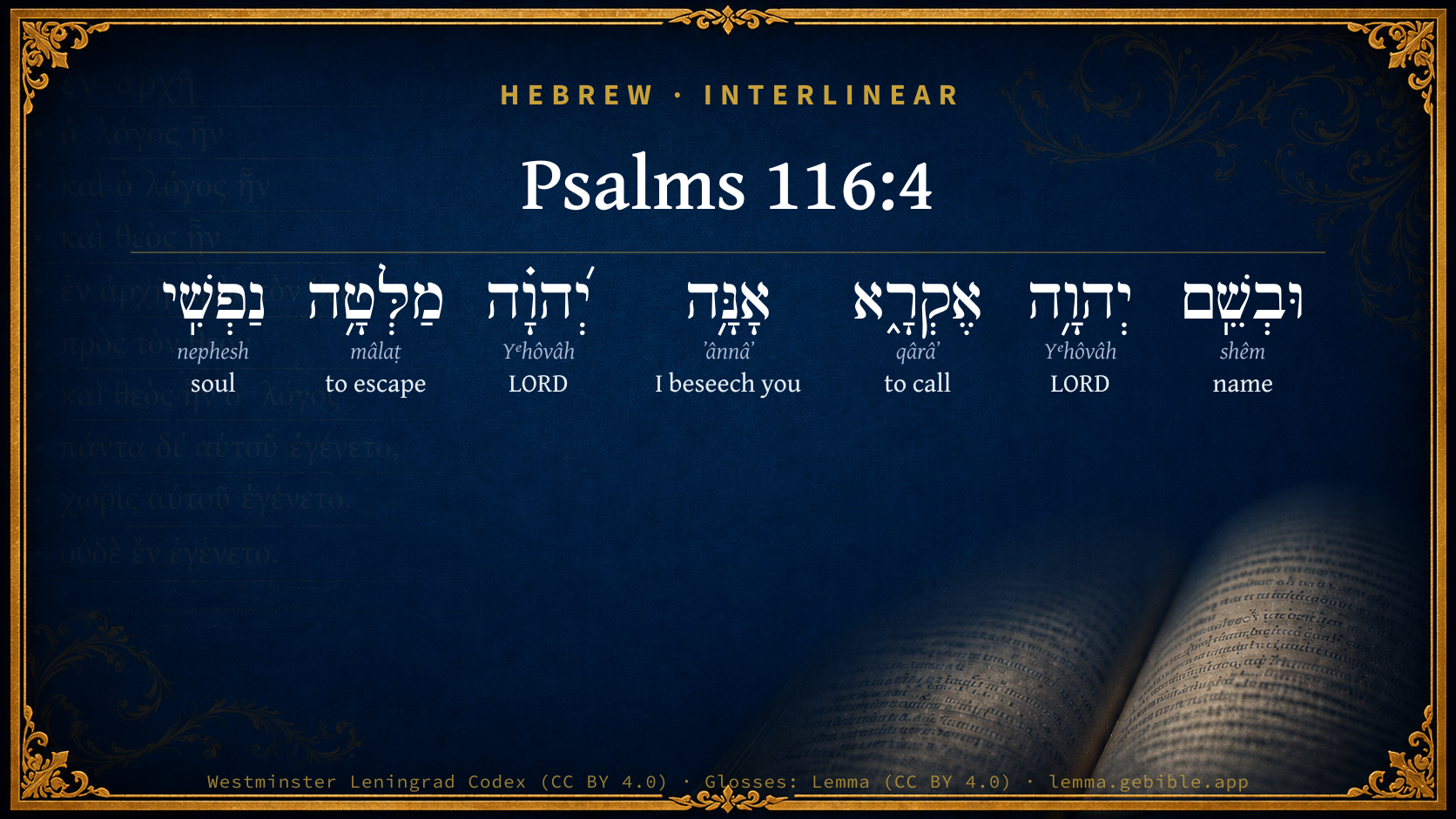
Psalms 116:4

Hebrew (Westminster Leningrad Codex) Psalms 116:4 appears in the Hebrew Old Testament. The text above is from the Westminster Leningrad Codex. Each word links to its Strong’s number, a concise gloss, and parsing drawn from the Open Scriptures Hebrew Bible morphology. Click any word for its full Brown-Driver-Briggs (BDB) entry.
Download image
Cite this verse

Psalms 116:4 (World English Bible). Public Domain. Lemma interlinear Bible study tool, https://lemma.gebible.app/v/psalms/116/4.

Show BibTeX & RIS
BibTeX
RIS
English Translation
Then called I on the name of Yahweh: "Yahweh, I beg you, deliver my soul."
World English Bible · Public Domain
Download a study sheet

One document with this verse’s original text, its word-by-word gloss line, the meaning frame, cross-references with their text, attributed commentary, and full source and license credits — printable, and it pastes into notes with its structure intact.

This verse Autodidact and up

Study sheet (.html) Plain text (.txt)

A passage Seminary Student

Up to 50 verses in one chapter. A passage sheet keeps up to 6 commentary sources and 12 cross-references per verse, in the order this page ranks them, and says so on the sheet whenever that leaves anything out. Ask for a single verse and you get the Autodidact verse sheet above.

Everything on this page stays free to read, with no account — the sheet is a download of what is already on screen, not access to it.

Want to remove ads? Support Godless Engineer
Compare translations 3

The same verse in 3 English versions, stacked beneath the original-language interlinear above. Click any original word for its lexicon entry.

Each is an independent rendering of the whole verse — the interlinear is not word-aligned to these translations.

Highlighted words mark where these versions differ — a whole-verse word diff, not a word-by-word alignment.

  • World English Bible Public Domain
    Then called I on the name of Yahweh: "Yahweh, I beg you, deliver my soul."
  • King James Version Public Domain
    Then called I upon the name of the LORD; O LORD, I beseech thee, deliver my soul.
  • unfoldingWord Literal Text CC BY-SA 4.0
    Then I called on the name of Yahweh: “Please Yahweh, rescue my life.”

unfoldingWord Literal Text — © unfoldingWord, licensed CC BY-SA 4.0. Word-aligned USFM3 via Door43 (git.door43.org/unfoldingWord/en_ult).

Versions to compare (up to 4)

3 of 4 selected

Show all 17 translations

Every available English version of this verse, each an independent rendering of the whole verse.

  • World English Bible Public Domain
    Then called I on the name of Yahweh: "Yahweh, I beg you, deliver my soul."
  • Berean Standard Bible Public Domain
    Then I called on the name of the LORD: “O LORD, deliver my soul!”
  • Majority Standard Bible Public Domain
    Then I called on the name of the LORD: “O LORD, deliver my soul!”
  • King James Version Public Domain
    Then called I upon the name of the LORD; O LORD, I beseech thee, deliver my soul.
  • American Standard Version (1901) Public Domain
    Then called I upon the name of Jehovah: O Jehovah, I beseech thee, deliver my soul.
  • Revised Version (1885) Public Domain
    Then called I upon the name of the LORD; O LORD, I beseech thee, deliver my soul.
  • Geneva Bible (1599) Public Domain
    Then I called vpon the Name of the Lord, saying, I beseech thee, O Lord, deliuer my soule.
  • Young's Literal Translation Public Domain
    And in the name of Jehovah I call: I pray Thee, O Jehovah, deliver my soul,
  • Literal Standard Version CC BY-SA 4.0
    And in the Name of YHWH I call: Ah, now, O YHWH, deliver my soul,
  • Unlocked Literal Bible CC BY-SA 4.0
    Then I called on the name of Yahweh: “Please Yahweh, rescue my life.”
  • unfoldingWord Literal Text CC BY-SA 4.0
    Then I called on the name of Yahweh: “Please Yahweh, rescue my life.”
  • Darby Bible Public Domain
    Then called I upon the name of Jehovah: I beseech thee, Jehovah, deliver my soul.
  • World Messianic Bible Public Domain
    Then I called on the LORD’s name: “LORD, I beg you, deliver my soul.”
  • Webster's Bible Public Domain
    Then I called upon the name of the LORD; O LORD, I beseech thee, deliver my soul.
  • Free Bible Version CC BY-SA 4.0
    Then I cried out to the Lord, “Lord, please save me!”
  • Bible in Basic English Public Domain
    Then I made my prayer to the Lord, saying, O Lord, take my soul out of trouble.
  • JPS Tanakh (1917) Public Domain
    But I called upon the name of the LORD: 'I beseech thee, O LORD, deliver my soul.'

Literal Standard Version (2020), Covenant Press — licensed CC BY-SA 4.0. Text via the HelloAO Bible API (eBible.org). Unlocked Literal Bible (unfoldingWord) — licensed CC BY-SA 4.0. Text via the HelloAO Bible API (eBible.org). unfoldingWord Literal Text — © unfoldingWord, licensed CC BY-SA 4.0. Word-aligned USFM3 via Door43 (git.door43.org/unfoldingWord/en_ult). Free Bible Version, Dr. Jonathan Gallagher — licensed CC BY-SA 4.0. Text via the HelloAO Bible API (eBible.org).

Word by word

More ways to search: Search by grammar → Find every occurrence → Compare this word →

Practice this passage: Drill this verse → Learn its vocabulary →

About this verse

These counts appear in no published source. They are computed here, from the morphology-tagged text and Lemma’s own curated glosses. What Lemma adds →

7
words
6
distinct lemmas
Wisdom
section

Notable vocabulary

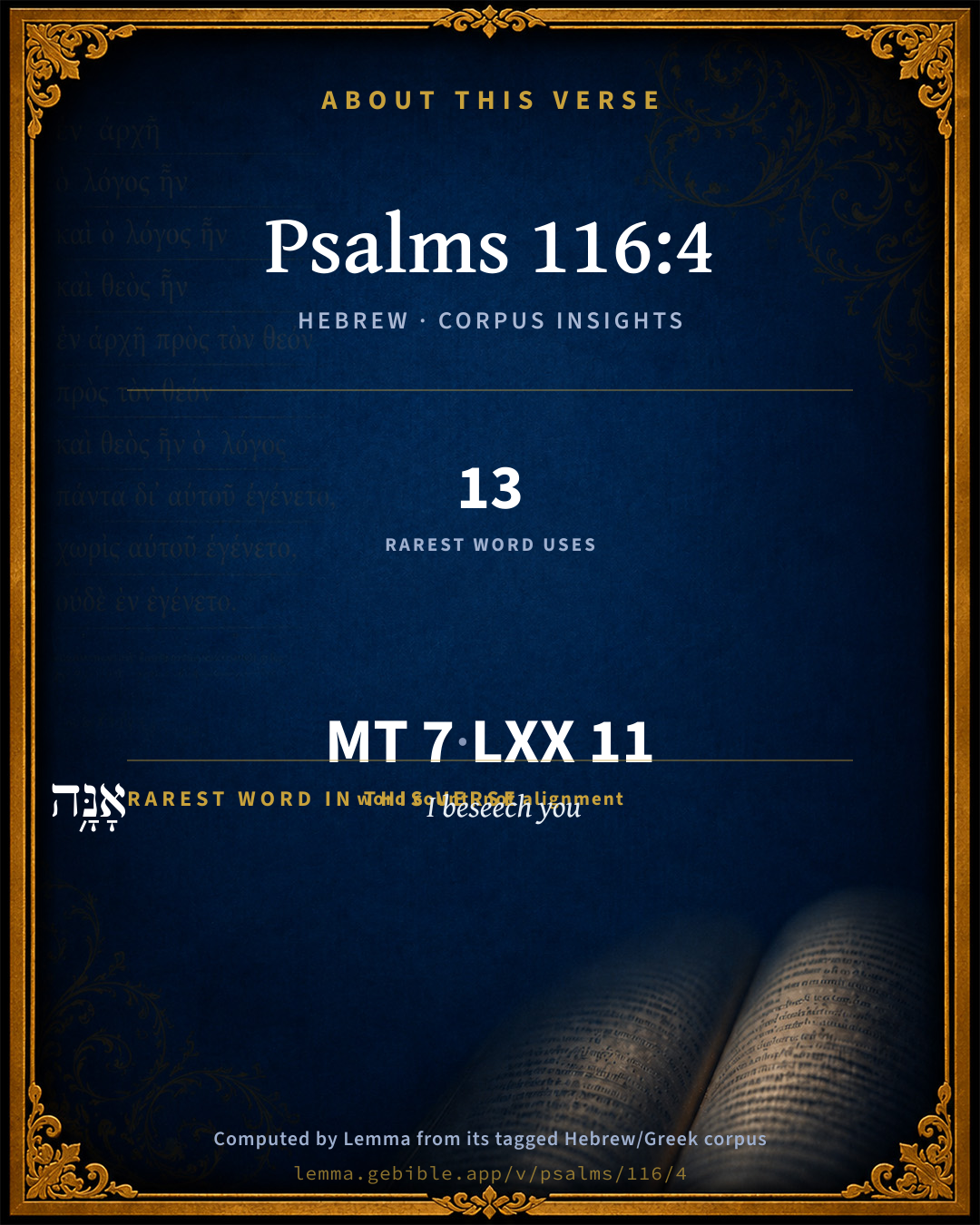
The rarest word here is אָנָּ֥ה I beseech you H577 — appearing just 13 times in the whole Hebrew Bible.

Shared distinctive vocabulary

אָנָּ֥ה I beseech you H577 occurs in 12 verses of the Hebrew Bible. Also found in:

Grammatical profile

  • 2 verbs
  • 4 nouns
  • 1 particle

Verb forms

  • אֶקְרָ֑א Qal · Imperfect
  • מַלְּטָ֥ה Piel · Imperative

Repetition

A word recurs within this verse — often emphatic in Hebrew:

  • יְהוָ֥ה LORD H3068 ×2

Hebrew & Septuagint length

In English translation the verse runs 15 words from the Hebrew and 14 from the Septuagint (LXX English) — closely comparable.

A rough comparison of the two English renderings, which tokenize alike — not a word-level alignment.

Word counts can differ between the Hebrew and the Greek without any difference in meaning — e.g. the Hebrew direct-object marker אֵת has no separate Greek word, and Greek often adds the article ὁ.

In the original languages it is 7 Hebrew tokens and 11 Greek tokens — but the two are counted differently (Hebrew bundles its prefixes and suffixes into one token; the Greek is in lemma form), so that isn’t a like-for-like length.

Cross-references

19

Topical passages linked to Psalms 116:4 in the Treasury of Scripture Knowledge — connected by theme and wording, ordered by reader-vote popularity; previews shown in the World English Bible.

  • Psalms 118:5 Out of my distress, I called on Yah. Yah answered me with freedom.
  • Psalms 22:20 Deliver my soul from the sword, My precious life from the power of the dog.
  • Psalms 143:6–9 I spread forth my hands to you. My soul thirsts for you, like a parched land. Selah.
  • Luke 23:42–43 He said to Jesus, "Lord, remember me when you come into your Kingdom."
  • Psalms 30:7–8 You, Yahweh, when you favored me, made my mountain to stand strong. But when you hid your face, I was troubled.
  • Psalms 50:15 Call on me in the day of trouble. I will deliver you, and you will honor me."
  • Psalms 142:4–6 Look on my right, and see; For there is no one who is concerned for me. Refuge has fled from me. No one cares for my soul.
  • Luke 18:13 But the tax collector, standing far away, wouldn't even lift up his eyes to heaven, but beat his breast, saying, 'God, be merciful to me, a sinner!'
  • 2 Chronicles 33:12–13 When he was in distress, he begged Yahweh his God, and humbled himself greatly before the God of his fathers.
  • Psalms 6:4 Return, Yahweh. Deliver my soul, And save me for your loving kindness' sake.
  • Psalms 18:6 In my distress I called on Yahweh, And cried to my God. He heard my voice out of his temple, My cry before him came into his ears.
  • Psalms 22:1–3 My God, my God, why have you forsaken me? Why are you so far from helping me, and from the words of my groaning?
  • Psalms 25:17 The troubles of my heart are enlarged. Oh bring me out of my distresses.
  • Psalms 34:6 This poor man cried, and Yahweh heard him, And saved him out of all his troubles.
  • Psalms 40:12–13 For innumerable evils have surrounded me. My iniquities have overtaken me, so that I am not able to look up. They are more than the hairs of my head. My heart has failed me.
  • Psalms 130:1–2 Out of the depths I have cried to you, Yahweh.
  • Isaiah 37:15–20 Hezekiah prayed to Yahweh, saying,
  • Isaiah 38:1–3 In those days was Hezekiah sick to death. Isaiah the prophet the son of Amoz came to him, and said to him, Thus says Yahweh, Set your house in order; for you shall die, and not live.
  • John 2:2 Jesus also was invited, with his disciples, to the marriage.

Cross-references courtesy of OpenBible.info (CC BY 4.0).

Hebrew and Greek witnesses Masoretic Hebrew ↔ Greek Septuagint

The same verse in the two great witnesses to the Old Testament, shown verse-for-verse.

You’re reading Greek Psalm 114 (Hebrew Psalm 116). The Septuagint counts the superscription, so verse numbers can differ from the Hebrew — chapter-level alignment, not verse-by-verse. Numbering follows Rahlfs.

These are two independent witnesses, not word-aligned to each other, and the Septuagint is shown in lemma (dictionary) form.

Hebrew Psalms 116:4 Masoretic · Westminster Leningrad Codex

וּבְשֵֽׁם יְהוָ֥ה אֶקְרָ֑א אָנָּ֥ה יְ֝הוָ֗ה מַלְּטָ֥ה נַפְשִֽׁי

Then called I on the name of Yahweh: "Yahweh, I beg you, deliver my soul."

World English Bible · Public Domain

Greek LXX Greek Psalm 114:4 Septuagint · lemma form

καί ὁ ὄνομα κύριος ἐπικαλέω ὦ κύριος ῥύομαι ὁ ψυχή ἐγώ

The idols of the nations are silver and gold, the works of men's hands.

LXX2012 (modern English Septuagint) · Public Domain

Hebrew: Westminster Leningrad Codex (CC BY 4.0). Greek: Septuagint (public domain); English from LXX2012 (modern English Septuagint) (Public Domain). How the Septuagint differs from the Hebrew →

Commentary

Notes on Psalms 116:4 from classic Christian and Jewish commentators (each source and its license shown beneath its notes). The classic Christian expositions comment on the surrounding passage and are grouped to its opening verse, so a note may address several verses; the Jewish commentaries on the Tanakh (Rashi and others) are per-verse, so they appear only where the commentator wrote on this verse.

Lemma curates 59 commentaries, every one of them public domain or Creative Commons licensed, each selected and text-cleaned for this edition rather than reprinted as found. About our sources →

Trapp's Complete Commentary

John Trapp

Psa 116:4 Then called I upon the name of the LORD; O LORD, I beseech thee, deliver my soul.

Ver. 4. Then called I upon the name of the Lord] That strong tower, whereunto the righteous run and are safe, Pro 18:10. Others have other refuges, the witch of Endor, the god of Ekron, the arm of flesh, &c.

O Lord, I beseech thee] Ana, blandientis et deprecantis particula. The psalmist here hath a sweet way of insinuating, and getting within the Lord; which, oh that we could skill of ( Sic et Nαι Phm 1:20 Rev 1:7).

Deliver my soul] q.d. It is my soul, Lord, my precious soul, "that is sought after; oh, deliver my soul, from the sword, my darling from the power of the dog," Psa 22:20.

John Trapp, A Commentary or Exposition upon All the Books of the Old and New Testament (1647–1656) — public domain. Text from a community e-Sword module.

J. A. Alexander on Psalms

Joseph Addison Alexander

4. (Psa 116:4) And on the name of Jehovah I call; ah now, Jehovah, deliver my soul! The future in the first clause may be strictly translated (I will call) as expressing the determination which he formed in the midst of his disress. See above on Psa 18:4; Psa 18:6. Ah now corresponds exactly, both in origin and meaning, to the intensive particle of entreaty, which the common version paraphrases, I beseech thee. One of the elements of which it is compounded occurs above, Psa 115:2.

Joseph Addison Alexander, The Psalms Translated and Explained (1850) — public domain. Text from a community e-Sword module.

Tyndale Open Study Notes

Tyndale Open Resources

116:4 This is the first of three times that the psalmist calls on the Lord’s name (i.e., reputation).

Tyndale Open Study Notes — © Tyndale Open Resources, licensed CC BY-SA 4.0. Text via the HelloAO Bible API.

The Cambridge Bible for Schools and Colleges

gen. ed. J. J. S. Perowne

4. the name of Jehovah, more emphatically than Jehovah alone, denotes His revealed character (Exo_34:5), to which the Psalmist appealed, and not in vain.

The Cambridge Bible for Schools and Colleges (gen. ed. J. J. S. Perowne; Cambridge University Press, 1878–1918) — public domain. Text from a community e-Sword module.

John Gill's Exposition

Then called I upon the name of the Lord,.... Upon the Lord himself in prayer for speedy deliverance; or "in the name of the Lord" (h), in the name of the Messiah, the only Mediator between God and man; "saying", as follows, and which word may be supplied,

O Lord, I beseech thee, deliver my soul; from these sorrows and pains, from these afflictions and distresses, from death and the grave, and from wrath, and a sense of it, and fears about it.

(h) "in nomine Domini", Montanus, Musculus, Vatablus.

John Gill's Exposition of the Whole Bible (1746–1763) — public domain (CC PDM 1.0). Text via the HelloAO Bible API.

Albert Barnes' Notes on the Bible

Then called I upon the name of the Lord - Upon the Lord. I had no other refuge. I felt that I must perish unless he should interpose, and I pleaded with him for deliverance and life. Compare the notes at Psa 18:6.

O Lord, I beseech thee, deliver my soul - My life. Save me from death. This was not a cry for salvation, but for life. It is an example for us, however, to call on God when we feel that the soul is in danger of perishing, for then, as in the case of the psalmist, we have no other refuge but God.

Albert Barnes' Notes on the Bible (1834–1885) — public domain. Text from a community e-Sword/MySword module.

The Treasury of David

Charles H. Spurgeon

Ver. 4. Then I called upon the name of the LORD. Prayer is never out of season, he prayed then, when things were at their worst. When the good man could not run to God, he called to him. In his extremity his faith came to the front: it was useless to call on man, and it may have seemed almost as useless to appeal to the Lord; but yet he did with his whole soul invoke all the attributes which make up the sacred name of Jehovah, and thus he proved the truth of his confidence. We can some of us remember certain very special times of trial of which we can now say, "then called I upon the name of the Lord." The Psalmist appealed to the Lord's mercy, truth, power, and faithfulness, and this was his prayer,

O Lord, I beseech thee, deliver my soul. This form of petition is short, comprehensive, to the point, humble, and earnest. It were well if all our prayers were moulded upon this model; perhaps they would be if we were in similar circumstances to those of the Psalmist, for real trouble produces real prayer. Here we have no multiplicity of words, and no fine arrangement of sentences; everything is simple and natural; there is not a redundant syllable, and yet there is not one lacking.

Ver. 4. The name of the LORD. God's name, as it is set out in the word, is both a glorious name, full of majesty; and also a gracious name, full of mercy. His majesty worketh fear and reverence, his mercy faith and confidence. By these graces man's heart is kept within such a compass, that he will neither presume above that which is meet, nor despond more than there is cause. But where God's name is not rightly known, it cannot be avoided but that they who come before him must needs rush upon the rock of presumption, or sink into the gulf of desperation. Necessary, therefore, it is that God be known of them that pray to him, that in truth they may say, "We have called upon the name of the LORD." Be persuaded hereby so to offer up your spiritual sacrifice of supplication to God, that he may have respect to your persons and prayers, as he had respect to Abel and his offering. Learn to know the name of God, as in his word it is made known; and then, especially when you draw near to him, meditate on his name. Assuredly God will take good notice of them that take due notice of him, and will open his ears to them by name who rightly call upon his name. William Gouge.

Ver. 4. O LORD, I beseech thee, deliver my soul. A short prayer for so great a suit, and yet as short as it was, it prevailed. If we wondered before at the power of God, we may wonder now at the power of prayer, that can prevail with God, for obtaining of that which in nature is impossible, and to reason is incredible. Sir Richard Baker.

Ver. 4. We learn here that there is nothing better and more effectual in distressing agonies than assiduous prayerThen called I upon the name of the LORD; but in such prayers the first care ought to be for the salvation of the soulI beseech thee, deliver my soul; for, this being done, God also either removes or mitigates the bodily disease. Solomon Gesner.

Psalms 116:5*

Charles H. Spurgeon's The Treasury of David (1869–1885) — public domain. Psalms only. Text from a community e-Sword/MySword module.

Whedon's Commentary on the Bible

Daniel D. Whedon

4. Then called I—At a moment when my case was beyond all human help.

Upon the name— “A stronger expression than merely to call upon the Lord,” (Hengstenberg,) for it supposes the supplicant’s faith to rest assuredly on the historically manifested character of God.

Daniel D. Whedon (gen. ed.), Commentary on the Old and New Testaments (1874–1909) — public domain. Text from a community e-Sword module.

The Pulpit Commentary

Then celled I upon the Name of the Lord. "Hezekiah turned his face toward the wall, and prayed unto the Lord". (Isa_38:2) O Lord, I beseech thee, deliver my soul. (compare the words of Isa_38:3, "Remember now, O Lord, I beseech thee

The Pulpit Commentary (1880–1919), ed. H.D.M. Spence-Jones & Joseph S. Exell — public domain. Text from a community e-Sword module.

Lesson kit

Teaching starters — assembled from the data on this page, not authored interpretation. Every prompt links to the verse data it draws on. Edit before teaching.

Psalms, in the Wisdom, opens this verse with 7 words (6 distinct Hebrew lemmas). Its most distinctive word is ʼânnâʼ (“I beseech you”). A historical commentator’s framing appears above. Read the whole chapter for the surrounding context.

Discussion questions

  1. What does “I beseech you” (ʼânnâʼ) contribute to the verse as a whole?
  2. Genesis 50:17 shares the word «I beseech you» with this verse. How do the two illuminate each other?
  3. “LORD” occurs 2× in this one verse. What is the effect of the repetition?
  4. The translations on this page render this verse differently — a whole-verse word diff, not a word-by-word alignment. What might account for the different wordings?
  5. The verb «אֶקְרָ֑א» is Qal Imperfect. How does its form color the action?
  6. Reading how Trapp's Complete Commentary and J. A. Alexander on Psalms read this verse, where do the two commentators agree and where do they part?

Things to notice

Reading settings

Reading text

Shown beneath each verse's original-language words.

Old Testament
Old Testament edition

Read the OT as the Masoretic Hebrew (MT) or the Greek Septuagint (LXX).

English shown for the Greek Septuagint (in the Hebrew ↔ Greek comparison).

Comparing translations? Open the Compare panel on any verse page to stack up to four side by side.