
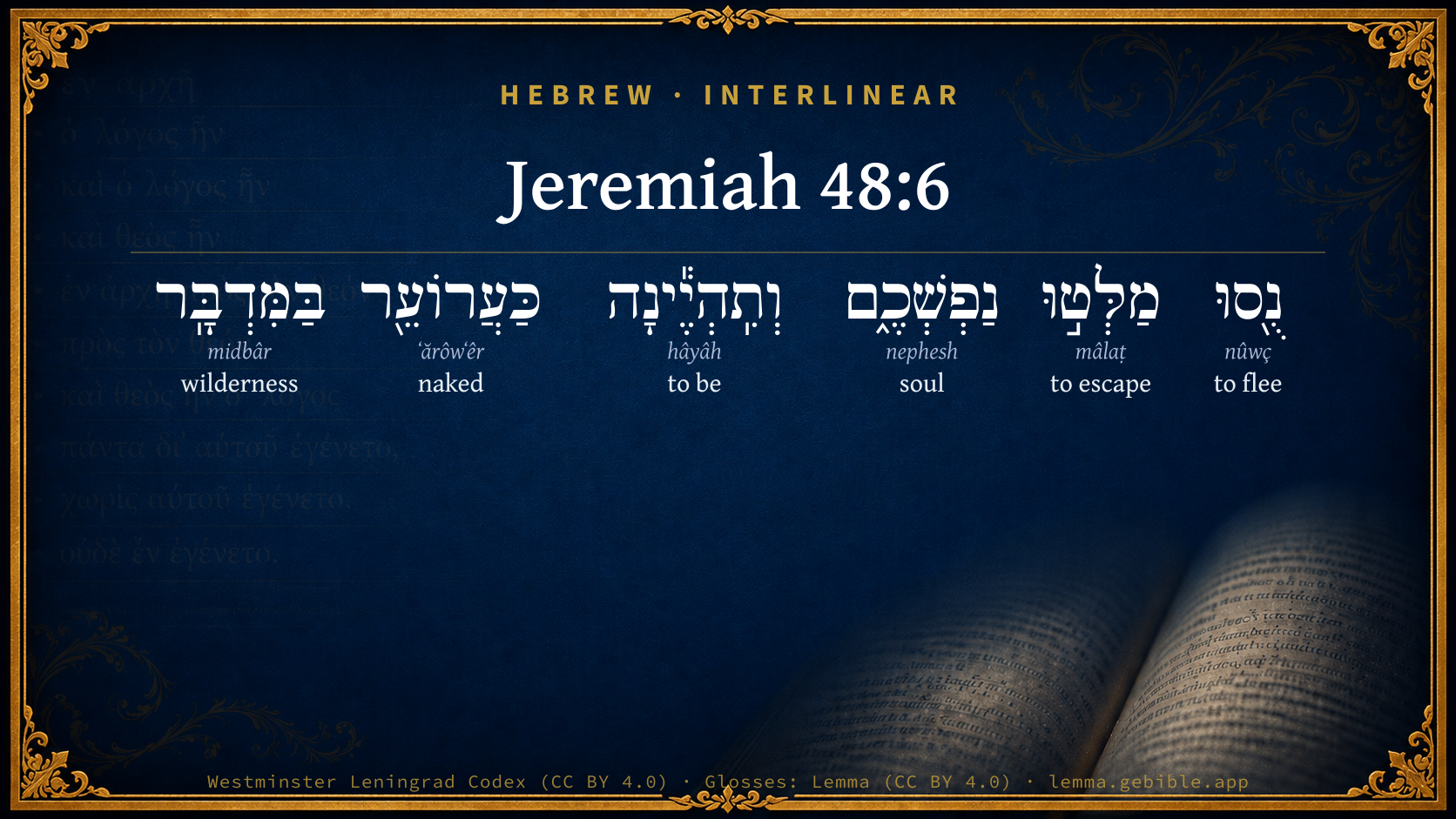
Jeremiah 48:6

Hebrew (Westminster Leningrad Codex) Jeremiah 48:6 appears in the Hebrew Old Testament. The text above is from the Westminster Leningrad Codex. Each word links to its Strong’s number, a concise gloss, and parsing drawn from the Open Scriptures Hebrew Bible morphology. Click any word for its full Brown-Driver-Briggs (BDB) entry.
Download image
Cite this verse

Jeremiah 48:6 (World English Bible). Public Domain. Lemma interlinear Bible study tool, https://lemma.gebible.app/v/jeremiah/48/6.

Show BibTeX & RIS
BibTeX
RIS
English Translation
Flee, save your lives, and be like the heath in the wilderness.
World English Bible · Public Domain
Download a study sheet

One document with this verse’s original text, its word-by-word gloss line, the meaning frame, cross-references with their text, attributed commentary, and full source and license credits — printable, and it pastes into notes with its structure intact.

This verse Autodidact and up

Study sheet (.html) Plain text (.txt)

A passage Seminary Student

Up to 50 verses in one chapter. A passage sheet keeps up to 6 commentary sources and 12 cross-references per verse, in the order this page ranks them, and says so on the sheet whenever that leaves anything out. Ask for a single verse and you get the Autodidact verse sheet above.

Everything on this page stays free to read, with no account — the sheet is a download of what is already on screen, not access to it.

Want to remove ads? Support Godless Engineer
Compare translations 3

The same verse in 3 English versions, stacked beneath the original-language interlinear above. Click any original word for its lexicon entry.

Each is an independent rendering of the whole verse — the interlinear is not word-aligned to these translations.

Highlighted words mark where these versions differ — a whole-verse word diff, not a word-by-word alignment.

  • World English Bible Public Domain
    Flee, save your lives, and be like the heath in the wilderness.
  • King James Version Public Domain
    Flee, save your lives, and be like the heath in the wilderness.
  • unfoldingWord Literal Text CC BY-SA 4.0
    Flee! Save your lives and become like a juniper bush in the wilderness.

unfoldingWord Literal Text — © unfoldingWord, licensed CC BY-SA 4.0. Word-aligned USFM3 via Door43 (git.door43.org/unfoldingWord/en_ult).

Versions to compare (up to 4)

3 of 4 selected

Show all 18 translations

Every available English version of this verse, each an independent rendering of the whole verse.

  • World English Bible Public Domain
    Flee, save your lives, and be like the heath in the wilderness.
  • Berean Standard Bible Public Domain
    ‘Flee! Run for your lives! Become like a juniper in the desert.’
  • Majority Standard Bible Public Domain
    ‘Flee! Run for your lives! Become like a juniper in the desert.’
  • King James Version Public Domain
    Flee, save your lives, and be like the heath in the wilderness.
  • American Standard Version (1901) Public Domain
    Flee, save your lives, and be like the heath in the wilderness.
  • Revised Version (1885) Public Domain
    Flee, save your lives, and be like the heath in the wilderness.
  • Geneva Bible (1599) Public Domain
    Flee and saue your liues, and be like vnto the heath in the wildernesse.
  • Douay-Rheims (1899) Public Domain
    Flee, save your lives: and be as heath in the wilderness.
  • Young's Literal Translation Public Domain
    Flee ye, deliver yourselves, Ye are as a naked thing in a wilderness.
  • Literal Standard Version CC BY-SA 4.0
    Flee, deliver yourselves, || You are as a naked thing in a wilderness.
  • Unlocked Literal Bible CC BY-SA 4.0
    Flee! Save your lives and become like a juniper bush in the wilderness.
  • unfoldingWord Literal Text CC BY-SA 4.0
    Flee! Save your lives and become like a juniper bush in the wilderness.
  • Darby Bible Public Domain
    Flee, save your lives, and be like a shrub in the wilderness.
  • World Messianic Bible Public Domain
    Flee! Save your lives! Be like the juniper bush in the wilderness.
  • Webster's Bible Public Domain
    Flee, save your lives, and be like the heath in the wilderness.
  • Free Bible Version CC BY-SA 4.0
    Run away! Save yourselves! Be like a scrawny tamarisk tree in the desert!
  • Bible in Basic English Public Domain
    Go in flight, get away with your lives, and let your faces be turned to Aroer in the Arabah.
  • JPS Tanakh (1917) Public Domain
    Flee, save your lives, and be like a tamarisk in the wilderness.

Literal Standard Version (2020), Covenant Press — licensed CC BY-SA 4.0. Text via the HelloAO Bible API (eBible.org). Unlocked Literal Bible (unfoldingWord) — licensed CC BY-SA 4.0. Text via the HelloAO Bible API (eBible.org). unfoldingWord Literal Text — © unfoldingWord, licensed CC BY-SA 4.0. Word-aligned USFM3 via Door43 (git.door43.org/unfoldingWord/en_ult). Free Bible Version, Dr. Jonathan Gallagher — licensed CC BY-SA 4.0. Text via the HelloAO Bible API (eBible.org).

Word by word

More ways to search: Search by grammar → Find every occurrence → Compare this word →

Practice this passage: Drill this verse → Learn its vocabulary →

About this verse

These counts appear in no published source. They are computed here, from the morphology-tagged text and Lemma’s own curated glosses. What Lemma adds →

6
words
6
distinct lemmas
Prophets
section

Notable vocabulary

The rarest word here is כַּעֲרוֹעֵ֖ר naked H6176 — appearing just 2 times in the whole Hebrew Bible.

Shared distinctive vocabulary

כַּעֲרוֹעֵ֖ר naked H6176 occurs in 2 verses of the Hebrew Bible. Also found in:

Grammatical profile

  • 3 verbs
  • 3 nouns

Verb forms

  • נֻ֖סוּ Qal · Imperative
  • מַלְּט֣וּ Piel · Imperative
  • וְתִֽהְיֶ֕ינָה Qal · Imperfect

Cross-references

10

Topical passages linked to Jeremiah 48:6 in the Treasury of Scripture Knowledge — connected by theme and wording, ordered by reader-vote popularity; previews shown in the World English Bible.

  • Jeremiah 17:6 For he shall be like the heath in the desert, and shall not see when good comes, but shall inhabit the parched places in the wilderness, a salt land and not inhabited.
  • Job 30:3–7 They are gaunt from lack and famine. They gnaw the dry ground, in the gloom of waste and desolation.
  • Jeremiah 51:6 Flee out of the midst of Babylon, and save every man his life; don't be cut off in her iniquity: for it is the time of Yahweh's vengeance; he will render to her a recompense.
  • Genesis 19:17 It came to pass, when they had taken them out, that he said, "Escape for your life! Don't look behind you, neither stay anywhere in the plain. Escape to the mountain, lest you be consumed!"
  • Psalms 11:1 In Yahweh, I take refuge. How can you say to my soul, "Flee as a bird to your mountain!"
  • Proverbs 6:4–5 Give no sleep to your eyes, Nor slumber to your eyelids.
  • Matthew 24:16–18 then let those who are in Judea flee to the mountains.
  • Luke 3:7 He said therefore to the multitudes who went out to be baptized by him, "You offspring of vipers, who warned you to flee from the wrath to come?
  • Luke 17:31–33 In that day, he who will be on the housetop, and his goods in the house, let him not go down to take them away. Let him who is in the field likewise not turn back.
  • Hebrews 6:18 that by two immutable things, in which it is impossible for God to lie, we may have a strong encouragement, who have fled for refuge to take hold of the hope set before us.

Cross-references courtesy of OpenBible.info (CC BY 4.0).

Hebrew and Greek witnesses Masoretic Hebrew ↔ Greek Septuagint

The same verse in the two great witnesses to the Old Testament, shown verse-for-verse.

These are two independent witnesses, not word-aligned to each other, and the Septuagint is shown in lemma (dictionary) form.

Hebrew Jeremiah 48:6 Masoretic · Westminster Leningrad Codex

נֻ֖סוּ מַלְּט֣וּ נַפְשְׁכֶ֑ם וְתִֽהְיֶ֕ינָה כַּעֲרוֹעֵ֖ר בַּמִּדְבָּֽר

Flee, save your lives, and be like the heath in the wilderness.

World English Bible · Public Domain

Greek LXX Structure differs

In the Septuagint, Jeremiah is about an eighth shorter than the Hebrew and arranges its material differently — the Oracles Against the Nations (Hebrew chapters 46–51) appear in the middle of the Greek book, after 25:13. Because the chapter and verse boundaries do not line up, a verse-for-verse comparison with the Hebrew is not shown.

A verse-for-verse comparison isn’t shown here because the chapters and verses don’t line up. Switch to the LXX edition with the MT / LXX toggle above to read the Greek directly.

On this verse, Ellicott's Commentary for English Readers discusses the Septuagint’s reading. Read the note in Commentary ↓

Hebrew: Westminster Leningrad Codex (CC BY 4.0). Greek: Septuagint (public domain); English from a public-domain English Septuagint. How the Septuagint differs from the Hebrew →

Targum (Aramaic paraphrase)

1

The Targum is the ancient Jewish Aramaic paraphrase of the Hebrew Scriptures — an interpretive translation, not the Hebrew text itself. Onkelos (literal) and Pseudo-Jonathan (expansive) render the Torah, and Jonathan the Prophets. Coverage is partial: where no permissively-licensed English translation exists for a verse, only the Aramaic is shown. This is verse-level text, not a word-by-word alignment to the Hebrew.

  1. Targum Jonathan Prophets (Joshua–Malachi)
    עֲרָקוּ שֵׁיזִיבוּ נַפְשֵׁיכוֹן וַהֲווֹ כְּמִגְדַל עֲרוֹעֵר דְשָׁרָן בִשְׁכוּנִין בְּמַדְבְּרָא:

    (no public-domain English translation for this verse)

    Targum Jonathan — Aramaic: “Mikraot Gedolot” (public domain). English: “Sefaria Community Translation” (CC0 1.0 (public-domain dedication)); “London "Chaldee Paraphrase," 1871” (public domain). Text via Sefaria.

Commentary

Notes on Jeremiah 48:6 from classic Christian and Jewish commentators (each source and its license shown beneath its notes). The classic Christian expositions comment on the surrounding passage and are grouped to its opening verse, so a note may address several verses; the Jewish commentaries on the Tanakh (Rashi and others) are per-verse, so they appear only where the commentator wrote on this verse.

Lemma curates 59 commentaries, every one of them public domain or Creative Commons licensed, each selected and text-cleaned for this edition rather than reprinted as found. About our sources →

Trapp's Complete Commentary

John Trapp

Jer 48:6 Flee, save your lives, and be like the heath in the wilderness.

Ver. 6. Flee, save your lives.] Whatever else ye lose.

And be like the heath in the wilderness.] Which is little worth. See Jer 17:6. Sit there sad and solitary.

John Trapp, A Commentary or Exposition upon All the Books of the Old and New Testament (1647–1656) — public domain. Text from a community e-Sword module.

The Biblical Illustrator

Joseph S. Exell

Jer_48:6

Flee, save your lives.

The Christians flight

Such was the warning addressed to Moab by the Lord of hosts, the God of Israel. The Chaldeans were about to lay waste the land of the Moabites--a punishment which they justly deserved for their iniquities and for their long-continued opposition to the people of God But even in wrath the Lord remembers mercy; or, to use the beautiful language of the prophet, He stayeth His rough wind in the day of the east wind. Though Moab shall be punished, her cities overturned, and the country laid waste and desolate, her princes, people, and priests carried into captivity, yet an opportunity is afforded for at least a remnant to escape. Flee, save your lives, and be like the heath in the wilderness.

I. From what are we to flee? In a word, from everything that would wean his heart from God and endanger the safety of his soul, the Christian is to flee--from all evil and mischief, from sin, from the world, the flesh, and the works of the devil, from hardness of heart and contempt of Gods Word and commandment.

II. For what are we to flee? The life of your soul is concerned; and unless you flee from what stands in your way to God, and blocks up your return to Him, the wrath of God will assuredly overtake you, and you will become a prey to your enemies, to those who seek your life. It is for glory, and honour, and immortality we should flee--blessings of infinite value, prizes beyond all price--nay, far beyond the power of human tongue to tell of their inestimable preciousness; we should flee for the favour of God, the forgiveness of our sins, the worth of our souls, the love and glory of Christ, and the beauty and happiness of holiness. And we should hasten our flight, for the time is short, and death advancing.

III. Where should we flee? Lord, to whom shall we go? Thou hast the words of eternal life; and we believe, &c. Such was Simon Peters declaration. Such is the confession of Gods people still. To the Lord Jesus Christ, and Him crucified, must the sinner flee. He must go as he is, and he like the heath in the wilderness, destitute of fruit or value, fit only for fuel, and seek to be engrafted in the living Vine. For Moab, we may observe, was commanded merely to flee. Whatever would oppose their progress should be put away. (C. A. Maginn, M. A.)

Flee for your life

I. Whence you are to flee.

II. where you are to flee.

III. How you are to flee.

IV. When you are to flee

V. Why you are to flee. (H. Macmillan, D. D.)

The Biblical Illustrator, edited by Joseph S. Exell (c. 1880s–1900s) — public domain. Text from a community e-Sword module.

Geneva Bible (1599)

Geneva Bible translators

Hide yourselves in barren places, where the enemy will not pursue after you, Jer. 17:6.

Geneva Bible (1599) marginal notes — public domain. Text via Bolls.life.

Jamieson, Fausset & Brown

Robert Jamieson, A. R. Fausset & David Brown

They exhort one another to flee.

heath--or the juniper (see on Jer 17:6). MAURER translates, "Be like one naked in the wilderness." But the sense is, Live in the wilderness like the heath, or juniper; do not "trust in" walls (Jer 48:7) [GROTIUS]. (Compare Mat 24:16-18).

Jamieson, Fausset & Brown — Commentary Critical and Explanatory on the Whole Bible (1871) — public domain (CC PDM 1.0). Text via the HelloAO Bible API.

Adam Clarke's Commentary

Verse 6. Flee, save your lives] The enemy is in full pursuit of you.

Be like the heath] כערוער caaroer, "like Aroer;" which some take for a city, others for a blasted or withered tree. It is supposed that a place of this name lay towards the north, in the land of the Ammonites, on a branch of the river Jabbok; surrounded by deserts. Save yourselves by getting into the wilderness, where the pursuing foe will scarcely think it worth his while to follow you, as the wilderness itself must soon destroy you.

Adam Clarke's Commentary on the Bible (1810–1826) — public domain. Text from a community e-Sword/MySword module.

John Calvin's Commentaries

Then he adds, Flee, save: this is the crying of distress; for miserable men, as the case is in extreme evils, mutually exhort one another, Flee, save your lives He then compares them to a tamarisk. The word ערוער, oruor, designates a country, as it is probable, and there were also two cities of this name. However, ערער, oror, is a tamarisk, as we have already seen in Jeremiah 17:6. Some render it, “a tower;” and the words of Isaiah in Isaiah 17:2, are perverted by some to maintain another meaning; for they think that ערוער, oruor, means the cot of shepherds in the desert; but I prefer the opinion of those who render it “tamarisk,” or juniper, though the Prophet seems to me to allude to the city Aroer, or to a region of that name, but I rather think to the city. He then says, And ye shall be as a tamarisk in the desert: and it is known from other places that Aroer was in the land of Moab.

We now then perceive what the Prophet means: that Moab would be like a juniper in the desert, that is, a barren tree, which never grows to any size; and then it is dry, because it is not cherished by any rain, nor fed by any moisture from the ground. It is in this sense, as we have stated, that our Prophet took the similitude in Jeremiah 17:5-8:

“Blessed,” he says, “is the man who trusts in Jehovah, for he shall be like a tree planted near waters: cursed is the man who trusts in man, and who makes flesh his arm, and withdraws his heart from Jehovah; for he shall be as the tamarisk of the desert;”

that is, he shall be barren and dry, without any moisture or support. It now follows: —

John Calvin's Commentaries (1540-1563) — public domain. Text from the Calvin Translation Society English edition (1840s-50s) via the Christian Classics Ethereal Library (ccel.org). Calvin's coverage is partial (roughly two-thirds of the Bible); uncommented books and verses are honest gaps, never fabricated. The 19th-century editor's footnotes and remarks are omitted so the notes are faithfully Calvin's own voice.

Ellicott's Commentary for English Readers

(6) Be like the heath in the wilderness.—Here, as in Jer_17:6, the stunted solitary shrub in the desert is taken as the type of desolation. The LXX., which adopts the meaning in Jer_17:6, here strangely enough gives “as a wild ass in the wilderness.” Psa_11:1 gives us an example of a like comparison. Here probably there is, as before, a paronomasia on the name of the Moabite city Aroer, which closely resembles the Hebrew word for “heath.” In thus finding an ominous significance in the names of cities, Jeremiah follows in the wake of Micah 1.

A Bible Commentary for English Readers, edited by Charles John Ellicott (1878–1897) — public domain. Text from a community e-Sword module.

The Cambridge Bible for Schools and Colleges

gen. ed. J. J. S. Perowne

6. the heath] See on Jer_17:6. The LXX read somewhat differently from MT., rendering wild ass (as shy and difficult to capture). This is probably right. Cp. Job_39:5.

The Cambridge Bible for Schools and Colleges (gen. ed. J. J. S. Perowne; Cambridge University Press, 1878–1918) — public domain. Text from a community e-Sword module.

John Gill's Exposition

Flee, save your lives,.... These are either the words of the Moabites, their cry of destruction mentioned in the latter part of Jer 48:5; who, seeing nothing but ruin before their eyes, advise one another to flee in all haste, and save their lives if possible, since nothing else could be saved: or else they are the words of the prophet, giving counsel to the Moabites to betake themselves to flight for the safety of their lives, these being in great danger; so Abarbinel; with whom others agree, only think they are spoken ironically; suggesting, that when they had endeavoured by flight to save their lives, it would be to no purpose; they should not escape the hands of their enemies; which seems to be the truest sense:

and be like the heath in the wilderness; which is called "erice", or "ling", which grows in waste places. Kimchi and Menachem in Jarchi interpret it of a tree that grows in dry and desert places; a low, naked, barren, fruitless shrub; signifying, that, when they were fled from their habitations, they should be as solitary and stripped of all their good things as such a bare and naked shrub in a desert. Kimchi's note is, that when they had left their cities and fled, their cities would be as the heath in the wilderness. The Targum is,

"and be ye as the tower of Aroer, "as they" who dwell in tents in the wilderness.''

Jarchi observes that the tower of Aroer was built in the wilderness, and there was no inhabitant round it but those that dwelt in tents; and, the tower standing where there was no inhabitant, it looked like a waste. The Septuagint version is very foreign, "as a wild ass in the wilderness"; which is followed by the Arabic version.

John Gill's Exposition of the Whole Bible (1746–1763) — public domain (CC PDM 1.0). Text via the HelloAO Bible API.

Albert Barnes' Notes on the Bible

Like the heath - Or, Like a destitute man. See the marginal reference note.

Albert Barnes' Notes on the Bible (1834–1885) — public domain. Text from a community e-Sword/MySword module.

Haydock's Catholic Bible Commentary

CHAPTER XLVIII.

Heath, or tamarick, chap. xvii. 6. Hebrew Haroher.

George Leo Haydock (1774–1849), Haydock's Catholic Family Bible and Commentary, 1859 edition — public domain. Excludes Psalms (Douay-Rheims chapter numbering differs from Protestant) and Deuterocanonical books (Catholic canon only).

Matthew Poole's English Annotations

It is of no great moment whether we understand these as the words of the Moabites, calling one to another to flee, and save their lives, though they lost all they had, and left themselves as bare as a naked tree; or as the words of the prophets speaking to the Moabites to the same sense.

Matthew Poole's English Annotations on the Holy Bible (1683–1685) — public domain. Text from a community e-Sword/MySword module.

Whedon's Commentary on the Bible

Daniel D. Whedon

6. Be like the heath, etc. — See note on Jer_17:6.

Daniel D. Whedon (gen. ed.), Commentary on the Old and New Testaments (1874–1909) — public domain. Text from a community e-Sword module.

The Pulpit Commentary

Flee, save your lives; literally, your souls. The prophet"s human feeling prompts him to this counsel; but he knows full well that a life of abject misery is the utmost that can be hoped for. And be like the heath in the wilderness; literally, and (your souls) shall be like destitute ones in the wilderness. Imagine the ease of one who has been robbed of everything, and left alone in the desert; not less miserable is that of the Moabite fugitives. The word rendered "the heath" (aro"er) is either miswritten for ar"ar, which occurs in the sense of "destitute" in Jer_17:6 (see note), or also a rare plural form of the same word. The sense remains the same. It is tempting to see an allusion to one of the towns called Aroer. (as in Isa_17:2) But the only Aroer the prophet could be thinking of is that on the Amen, (Deu_2:36) which could not be described as "in the wilderness.

HOMILIES BY S. CONWAY Ver. 6. "The heath in the wilderness.

Such will the sinner be; for, like it, he will be:

1. Barren. No rich, strength-sustaining fruit does the heath bear. A mere hard berry. The camel and the ass may browse thereupon, but it is no food for man. "Can men gather grapes of thorns, or figs of thistles?" And thus barren of good is the sinner.

2. Unlovely. There is no form nor beauty about the heath; a stunted, misshapen shrub. Its wood can be used for no manufacture. It is fit only to be burned. And when our eyes are opened to see things as they are, sin and the sinner will appear in all moral unloveliness; all present outward charm gone, and only their evil deformity seen.

3. Alone. Surrounded by drear expanse of sand; no companion trees to form it into a grove or a verdant mass of plant life. And so will the sinner be one day. Christ goes with the believer down the dark valley, but the sinner goes forth alone. He stands at the bar of God with no advocate. None of all his old companions can redeem his soul or give to God a ransom for him. Alone; helpless.

4. The gracious influences of Heaven do him no good. The dew and the rain, the sun"s warmth, come upon it; but it remains the unlovely, solitary, barren thing it ever was. So the impenitent man is visited by the influences of Heaven, the pleading of the Spirit, the varied means of grace; but they avail him not.

5. Soon to perish. The driving sand, the scorching heat, the browsing camel, the encampment fire, all threaten its life, and by one or other of them it soon perishes. And they who are like to it are never safe. "How are they destroyed as in a moment!" Conclusion. But the godly are not so. "He shall be like a tree planted by," etc.. (Ps 1) C.

The Pulpit Commentary (1880–1919), ed. H.D.M. Spence-Jones & Joseph S. Exell — public domain. Text from a community e-Sword module.

John Wesley's Explanatory Notes

And be - Save your lives, though all ye have be lost.

John Wesley, Explanatory Notes Upon the Whole Bible (1754–1765) — public domain. Text via the GEBible commentary corpus.

unfoldingWord translationNotes

Door43 World Missions Community

Save your lives

The word "your" refers to the people of Moab.

become like a juniper bush in the wilderness

The people fleeing from their cities into the desert is compared to a bush or shrub that grows in the desert. AT: "become like a shrub that grows in the wilderness" (See: Simile and Translate Unknowns)

because of your trust

The abstract noun "trust" can be stated as a verb. AT: "because you trusted" (See: Abstract Nouns)

in your practices

"in your own efforts" or "in your own work"

you also will be captured

This can be stated in active form. AT: "the enemy army will also capture you" (See: Active or Passive)

Then Chemosh will go away into captivity

"Chemosh" is the chief god of the Moabites. This means the enemy army will take the idol of Chemosh that the people made to worship. AT: "The enemy army will take your god Chemosh as a captive" (See: How to Translate Names and Assumed Knowledge and Implicit Information)

translationWords

save

life

desert

trust

captive

priest

unfoldingWord translationNotes — © Distant Shores Media and the Door43 World Missions Community, licensed CC BY-SA 4.0. Source: git.door43.org/Door43/en_tn.

Rashi

Rabbi Shlomo Yitzchaki (Rashi)

like Aro’er The tower of Aro’er that is made in the desert, and there is no civilization around it except tent dwellers, and a tower standing without an inhabited region appears as ruins. So did Jonathan render it. (See Isaiah 17:2, Commentary Digest.) But Menahem (Machbereth Menahem p. 137) explained כּערוער as the name of a tree of the forest trees.

Rashi on the Tanakh — English translations: “The Judaica Press complete Tanach with Rashi, translated by A. J. Rosenberg” (CC BY 4.0); “Pentateuch with Rashi's commentary by M. Rosenbaum and A.M. Silbermann, 1929-1934” (public domain); “The Metsudah Tanach series, Lakewood, N.J” (CC BY 4.0); and “The Book of Joshua, Metsudah Publications, 1997” (CC BY 4.0). Text via Sefaria.

Lesson kit

Teaching starters — assembled from the data on this page, not authored interpretation. Every prompt links to the verse data it draws on. Edit before teaching.

Jeremiah, in the Prophets, opens this verse with 6 words (6 distinct Hebrew lemmas). Its most distinctive word is ʻărôwʻêr (“naked”). A historical commentator’s framing appears above. Read the whole chapter for the surrounding context.

Discussion questions

  1. What does “naked” (ʻărôwʻêr) contribute to the verse as a whole?
  2. How does Jeremiah 17:6, which shares the word «naked», read alongside this verse?
  3. These translations render this verse differently. What is at stake in choosing one wording over another?
  4. «נֻ֖סוּ» is a Qal Imperative verb. How does that grammatical form shape the action described?
  5. Compare how Trapp's Complete Commentary and The Biblical Illustrator read this verse. Where do they agree or differ?

Things to notice

Reading settings

Reading text

Shown beneath each verse's original-language words.

Old Testament
Old Testament edition

Read the OT as the Masoretic Hebrew (MT) or the Greek Septuagint (LXX).

English shown for the Greek Septuagint (in the Hebrew ↔ Greek comparison).

Comparing translations? Open the Compare panel on any verse page to stack up to four side by side.