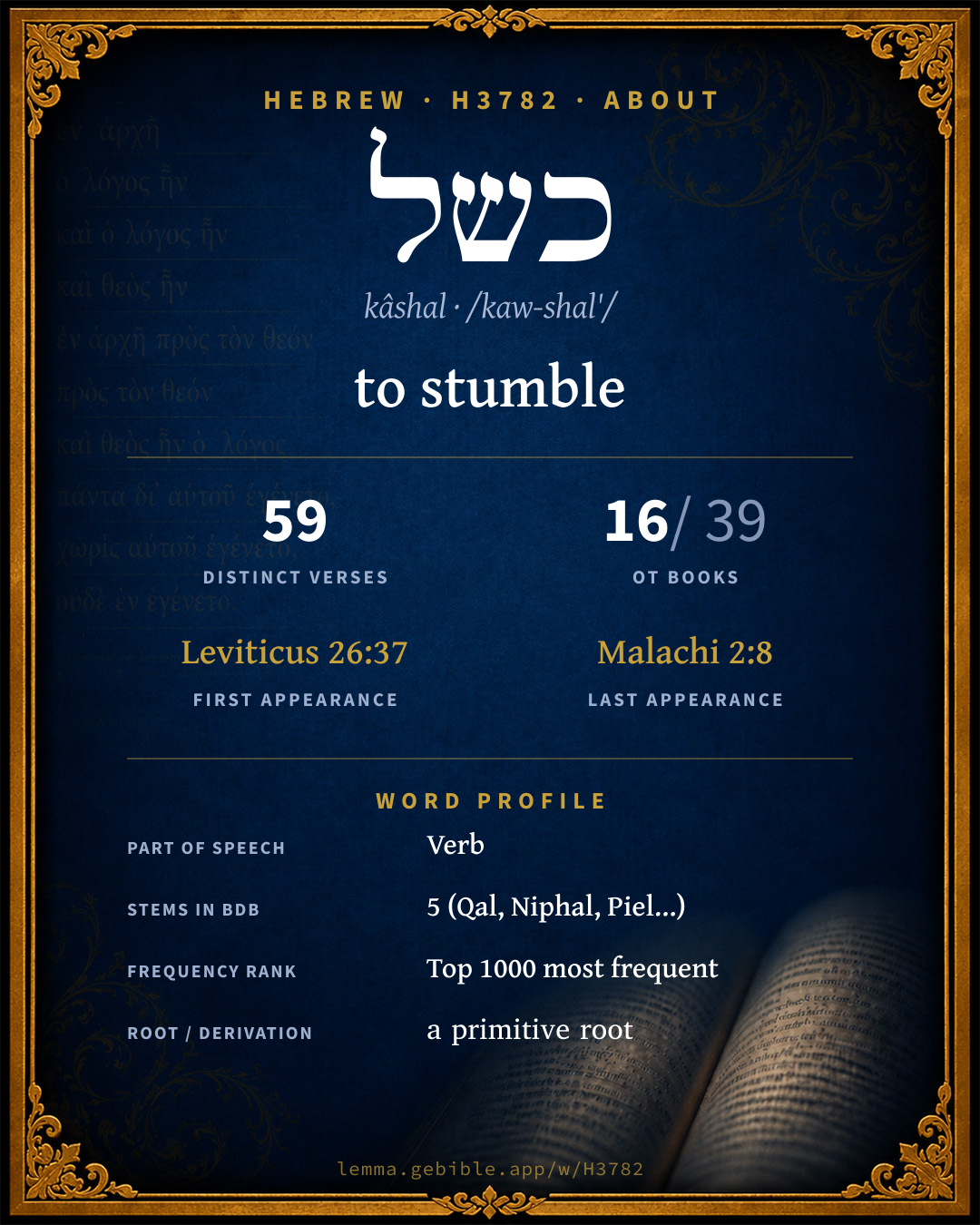
כָּשַׁל
to stumble
also: stagger, totter fuller range ↓
Full lexicon entry — Brown-Driver-Briggs (BDB)
From Brown-Driver-Briggs (BDB)
Where this word appears
See every Qal verb in the Hebrew Bible →
Grammar key — what these labels mean
Part of speech
- Verb
- An action or state-of-being word.
Stem
- Niphal
- Usually the simple passive or reflexive of the Qal (“he was written”). Here: ‘consec.’
- Qal
- The basic, simple active stem — the plain form of the verb (“he wrote”). Here: ‘stumble at’
- Hiphil
- The causative active stem (“he caused / brought about”). Here: ‘cause to stumble’
- Hophal
- The passive counterpart of the Hiphil (“he was caused to…”). Here: ‘only Pt.’
- Piel
- An intensive or resultative active stem. Here: ‘only apparent’
Form
- Imperfect
- An incomplete, ongoing, or future action (“he will / would write”).
- Perfect
- A completed action or state — Hebrew marks aspect (completeness) more than strict tense (“he wrote”).
- Participle Active
- A verbal adjective expressing ongoing or characteristic action (“writing / one who writes”).
- Sequential Perfect
- A perfect with prefixed waw continuing a preceding imperfect or command (waw-consecutive perfect).
- Infinitive Construct
- A bound verbal noun, frequently with prepositions (“to write / in writing”).
- Sequential Imperfect
- An imperfect with prefixed waw — the standard past-narrative form (waw-consecutive imperfect).
- Participle Passive
- A verbal adjective expressing action received (“written”).
- Infinitive Absolute
- An unbound verbal noun, often intensifying or standing in for a finite verb.
State
- Absolute
- The independent form of a noun, not bound to a following word.
Person
- 3rd Person
- The one spoken about (“he / she / it / they”).
- 2nd Person
- The one addressed (“you”).
- 1st Person
- The speaker (“I / we”).
Gender
- Masculine
- Grammatically masculine.
- Common
- Either gender — not distinguished for this form.
- Feminine
- Grammatically feminine.
Number
- Plural
- More than one (in Hebrew, generally three or more).
- Singular
- One.
Grammatical forms 29 distinct
- Verb, Niphal, Imperfect, 3rd Person, Masculine, Plural 15 times (23%)
- Verb, Qal, Perfect, 3rd Person, Common, Plural 7 times (11%)
- Verb, Qal, Participle Active, Masculine, Singular, Absolute 5 times (8%)
- Verb, Qal, Sequential Perfect, 3rd Person, Common, Plural 4 times (6%)
- Verb, Qal, Sequential Perfect, 3rd Person, Masculine, Singular 3 times (5%)
- Verb, Qal, Perfect, 3rd Person, Masculine, Singular 3 times (5%)
- Verb, Niphal, Sequential Perfect, 3rd Person, Common, Plural 2 times (3%)
- Verb, Qal, Perfect, 3rd Person, Feminine, Singular 2 times (3%)
+21 more forms (24 occurrences)
Parsed forms decoded from the imported morphology (morphhb / Westminster Leningrad Codex — WLC text public domain, morphhb tagging CC BY 4.0), counted across 65 parsed occurrences — not distinct verses.
Every verse where H3782 appears — 59 distinct verses across 16 books. Click any verse to open its interlinear word-by-word view. Verse text shown in the World English Bible for context — . Each verse’s Hebrew form is shown with its reference; the English is not keyword-highlighted, since the data carries no word-level English alignment. Use “Compare translations” on any verse to read it across multiple English versions. This concordance covers the Hebrew Bible; Septuagint (Greek Old Testament) occurrences are not indexed here.
Leviticus 1 verse
1 Samuel 1 verse
2 Chronicles 3 verses
- 2 Chronicles 25:8 יַכְשִֽׁילְ/ךָ֤ וּ/לְ/הַכְשִֽׁיל Hiphil impf 3ms + sfx pers 2ms conj + prep + Hiphil inf.cs But if you will go, do [valiantly], be strong for the battle: God will cast you down before the enemy; for God has power to help, and to cast down.
- 2 Chronicles 28:15 כּוֹשֵׁ֔ל Qal ptcp.act ms The men who have been mentioned by name rose up, and took the captives, and with the spoil clothed all who were naked among them, and arrayed them, and shod them, and gave them to eat and to drink, and anointed them, and carried all the feeble of them on donkeys, and brought them to Jericho, the city of palm trees, to their brothers: then they returned to Samaria.
- 2 Chronicles 28:23 לְ/הַכְשִׁיל֖/וֹ prep + Hiphil inf.cs + sfx pers 3ms For he sacrificed to the gods of Damascus, which struck him; and he said, Because the gods of the kings of Syria helped them, [therefore] will I sacrifice to them, that they may help me. But they were the ruin of him, and of all Israel.
Nehemiah 1 verse
Job 1 verse
Psalms 7 verses
- Psalms 9:3 יִכָּשְׁל֥וּ Niphal impf 3mp When my enemies turn back, They stumble and perish in your presence.
- Psalms 27:2 כָשְׁל֣וּ Qal pf 3cp When evil-doers came at me to eat up my flesh, Even my adversaries and my foes, they stumbled and fell.
- Psalms 31:10 כָּשַׁ֣ל Qal pf 3ms For my life is spent with sorrow, My years with sighing. My strength fails because of my iniquity. My bones are wasted away.
- Psalms 64:8 וַ/יַּכְשִׁיל֣וּ/הוּ conj + Hiphil wimpf 3mp + sfx pers 3ms Their own tongues shall ruin them. All who see them will shake their heads.
- Psalms 105:37 כּוֹשֵֽׁל Qal ptcp.act ms He brought them forth with silver and gold. There was not one feeble person among his tribes.
- Psalms 107:12 כָּ֝שְׁל֗וּ Qal pf 3cp Therefore he brought down their heart with labor. They fell down, and there was none to help.
- Psalms 109:24 כָּשְׁל֣וּ Qal pf 3cp My knees are weak through fasting. My body is thin and lacks fat.
Proverbs 5 verses
- Proverbs 4:12 תִכָּשֵֽׁל Niphal impf 2ms When you go, your steps will not be hampered. When you run, you will not stumble.
- Proverbs 4:16 יכשולו יַכְשִֽׁילוּ Qal impf 3mp Hiphil impf 3mp For they don't sleep, unless they do evil. Their sleep is taken away, unless they make someone fall.
- Proverbs 4:19 יִכָּשֵֽׁלוּ Niphal impf 3mp The way of the wicked is like darkness. They don't know what they stumble over.
- Proverbs 24:16 יִכָּשְׁל֥וּ Niphal impf 3mp For a righteous man falls seven times, and rises up again; But the wicked are overthrown by calamity.
- Proverbs 24:17 וּ֝/בִ/כָּשְׁל֗/וֹ conj + prep + Niphal inf.cs + sfx pers 3ms Don't rejoice when your enemy falls. Don't let your heart be glad when he is overthrown;
Isaiah 10 verses
- Isaiah 3:8 כָשְׁלָה֙ Qal pf 3fs For Jerusalem is ruined, and Judah is fallen; Because their tongue and their doings are against Yahweh, To provoke the eyes of his glory.
- Isaiah 5:27 כּוֹשֵׁל֙ Qal ptcp.act ms None shall be weary nor stumble among them; None shall slumber nor sleep; Neither shall the belt of their loins be untied, Nor the latchet of their shoes be broken:
- Isaiah 8:15 וְ/כָ֥שְׁלוּ conj + Qal wpf 3cp Many shall stumble thereon, and fall, and be broken, and be snared, and be taken.
- Isaiah 28:13 וְ/כָשְׁל֤וּ conj + Qal wpf 3cp Therefore shall the word of Yahweh be to them precept on precept, precept on precept; line on line, line on line; here a little, there a little; that they may go, and fall backward, and be broken, and snared, and taken.
- Isaiah 31:3 וְ/כָשַׁ֤ל conj + Qal wpf 3ms Now the Egyptians are men, and not God; and their horses flesh, and not spirit: and when Yahweh shall stretch out his hand, both he who helps shall stumble, and he who is helped shall fall, and they all shall be consumed together.
- Isaiah 35:3 כֹּשְׁל֖וֹת Qal ptcp.act fp Strengthen you the weak hands, and confirm the feeble knees.
- Isaiah 40:30 כָּשׁ֥וֹל יִכָּשֵֽׁלוּ Qal inf.abs Niphal impf 3mp Even the youths shall faint and be weary, and the young men shall utterly fall:
- Isaiah 59:10 כָּשַׁ֤לְנוּ Qal pf 1cp We grope for the wall like the blind; yes, we grope as those who have no eyes: we stumble at noonday as in the twilight; among those who are lusty we are as dead men.
- Isaiah 59:14 כָשְׁלָ֤ה Qal pf 3fs Justice is turned away backward, and righteousness stands afar off; for truth is fallen in the street, and uprightness can't enter.
- Isaiah 63:13 יִכָּשֵֽׁלוּ Niphal impf 3mp who led them through the depths, as a horse in the wilderness, so that they didn't stumble?
Jeremiah 11 verses
- Jeremiah 6:15 יִכָּשְׁל֖וּ Niphal impf 3mp Were they ashamed when they had committed abomination? nay, they were not at all ashamed, neither could they blush: therefore they shall fall among those who fall; at the time that I visit them they shall be cast down, says Yahweh.
- Jeremiah 6:21 וְ/כָ֣שְׁלוּ conj + Qal wpf 3cp Therefore thus says Yahweh, Behold, I will lay stumbling-blocks before this people; and the fathers and the sons together shall stumble against them; the neighbor and his friend shall perish.
- Jeremiah 8:12 יִכָּשְׁל֖וּ Niphal impf 3mp Were they ashamed when they had committed abomination? nay, they were not at all ashamed, neither could they blush: therefore shall they fall among those who fall; in the time of their visitation they shall be cast down, says Yahweh.
- Jeremiah 18:15 וַ/יַּכְשִׁל֤וּ/ם conj + Hiphil wimpf 3mp + sfx pers 3mp For my people have forgotten me, they have burned incense to false [gods]; and they have been made to stumble in their ways, in the ancient paths, to walk in byways, in a way not built up;
- Jeremiah 18:23 מֻכְשָׁלִים֙ Hophal ptcp.pass mp Yet, Yahweh, you know all their counsel against me to kill me; don't forgive their iniquity, neither blot out their sin from your sight; but let them be overthrown before you; deal you with them in the time of your anger.
- Jeremiah 20:11 יִכָּשְׁל֖וּ Niphal impf 3mp But Yahweh is with me as an awesome mighty one: therefore my persecutors shall stumble, and they shall not prevail; they shall be utterly disappointed, because they have not dealt wisely, even with an everlasting dishonor which shall never be forgotten.
- Jeremiah 31:9 יִכָּשְׁל֖וּ Niphal impf 3mp They shall come with weeping; and with petitions will I lead them: I will cause them to walk by rivers of waters, in a straight way in which they shall not stumble; for I am a father to Israel, and Ephraim is my firstborn.
- Jeremiah 46:6 כָּשְׁל֖וּ Qal pf 3cp Don't let the swift flee away, nor the mighty man escape; in the north by the river Euphrates have they stumbled and fallen.
- Jeremiah 46:12 כָּשָׁ֔לוּ Qal pf 3cp The nations have heard of your shame, and the earth is full of your cry; for the mighty man has stumbled against the mighty, they are fallen both of them together.
- Jeremiah 46:16 כּוֹשֵׁ֑ל Qal ptcp.act ms He made many to stumble, yes, they fell one on another: and they said, Arise, and let us go again to our own people, and to the land of our birth, from the oppressing sword.
- Jeremiah 50:32 וְ/כָשַׁ֤ל conj + Qal wpf 3ms The proud one shall stumble and fall, and none shall raise him up; and I will kindle a fire in his cities, and it shall devour all who are round about him.
Lamentations 2 verses
- Lamentations 1:14 הִכְשִׁ֣יל Hiphil pf 3ms The yoke of my transgressions is bound by his hand; They are knit together, they are come up on my neck; he has made my strength to fail: The Lord has delivered me into their hands, against whom I am not able to stand.
- Lamentations 5:13 כָּשָֽׁלוּ Qal pf 3cp The young men bare the mill; The children stumbled under the wood.
Ezekiel 3 verses
- Ezekiel 33:12 יִכָּ֣שֶׁל Niphal impf 3ms You, son of man, tell the children of your people, The righteousness of the righteous shall not deliver him in the day of his disobedience; and as for the wickedness of the wicked, he shall not fall thereby in the day that he turns from his wickedness; neither shall he who is righteous be able to live thereby in the day that he sins.
- Ezekiel 36:14 תכשלי Piel impf 2fs therefore you shall devour men no more, neither bereave your nation any more, says the Lord Yahweh;
- Ezekiel 36:15 תַכְשִׁ֣לִי Hiphil impf 2fs neither will I let you hear any more the shame of the nations, neither shall you bear the reproach of the peoples any more, neither shall you cause your nation to stumble any more, says the Lord Yahweh.
Daniel 6 verses
- Daniel 11:14 וְ/נִכְשָֽׁלוּ conj + Niphal wpf 3cp In those times there shall many stand up against the king of the south: also the children of the violent among your people shall lift themselves up to establish the vision; but they shall fall.
- Daniel 11:19 וְ/נִכְשַׁ֥ל conj + Niphal wpf 3ms Then he shall turn his face toward the fortresses of his own land; but he shall stumble and fall, and shall not be found.
- Daniel 11:33 וְ/נִכְשְׁל֞וּ conj + Niphal wpf 3cp Those who are wise among the people shall instruct many; yet they shall fall by the sword and by flame, by captivity and by spoil, [many] days.
- Daniel 11:34 וּ/בְ/הִכָּ֣שְׁלָ֔/ם conj + prep + Niphal inf.cs + sfx pers 3mp Now when they shall fall, they shall be helped with a little help; but many shall join themselves to them with flatteries.
- Daniel 11:35 יִכָּֽשְׁל֗וּ Niphal impf 3mp Some of those who are wise shall fall, to refine them, and to purify, and to make them white, even to the time of the end; because it is yet for the time appointed.
- Daniel 11:41 יִכָּשֵׁ֑לוּ Niphal impf 3mp He shall enter also into the glorious land, and many [countries] shall be overthrown; but these shall be delivered out of his hand: Edom, and Moab, and the chief of the children of Ammon.
Hosea 4 verses
- Hosea 4:5 וְ/כָשַׁלְתָּ֣ וְ/כָשַׁ֧ל conj + Qal wpf 2ms conj + Qal wpf 3ms You will stumble in the day, And the prophet will also stumble with you in the night; And I will destroy your mother.
- Hosea 5:5 יִכָּֽשְׁלוּ֙ כָּשַׁ֥ל Niphal impf 3mp Qal pf 3ms The pride of Israel testifies to his face. Therefore Israel and Ephraim will stumble in their iniquity. Judah also will stumble with them.
- Hosea 14:1 כָשַׁ֖לְתָּ Qal pf 2ms Israel, return to Yahweh your God; For you have fallen because of your sin.
- Hosea 14:9 יִכָּ֥שְׁלוּ Niphal impf 3mp Who is wise, that he may understand these things? Who is prudent, that he may know them? For the ways of Yahweh are right, And the righteous walk in them; But the rebellious stumble in them.
Nahum 2 verses
- Nahum 2:5 יִכָּשְׁל֖וּ Niphal impf 3mp He summons his picked troops. They stumble on their way. They dash to its wall, and the protective shield is put in place.
- Nahum 3:3 יכשלו וְ/כָשְׁל֖וּ Niphal impf 3mp conj + Qal pf 3cp the horseman mounting, and the flashing sword, the glittering spear, and a multitude of slain, and a great heap of corpses, and there is no end of the bodies. They stumble on their bodies,
Zechariah 1 verse
Malachi 1 verse
About this entry
At a glance — auto-summarized from this page’s data, not written by a person. Every figure links to its source below. This summary describes the numbers; it doesn’t interpret them.
כשל (kâshal) is a Hebrew verb most often rendered “to stumble.” Translators differ — “fall” in the King James Version, then “stumble” (Berean Standard Bible), as the renderings breakdown shows. With 59 verses in 16 books, it is a moderately common word in the Hebrew Bible. It first appears in Leviticus 26:37. Read the stem: it spans 5 stems, including Qal and Niphal. The sections below give every sense, occurrence, and version rendering.
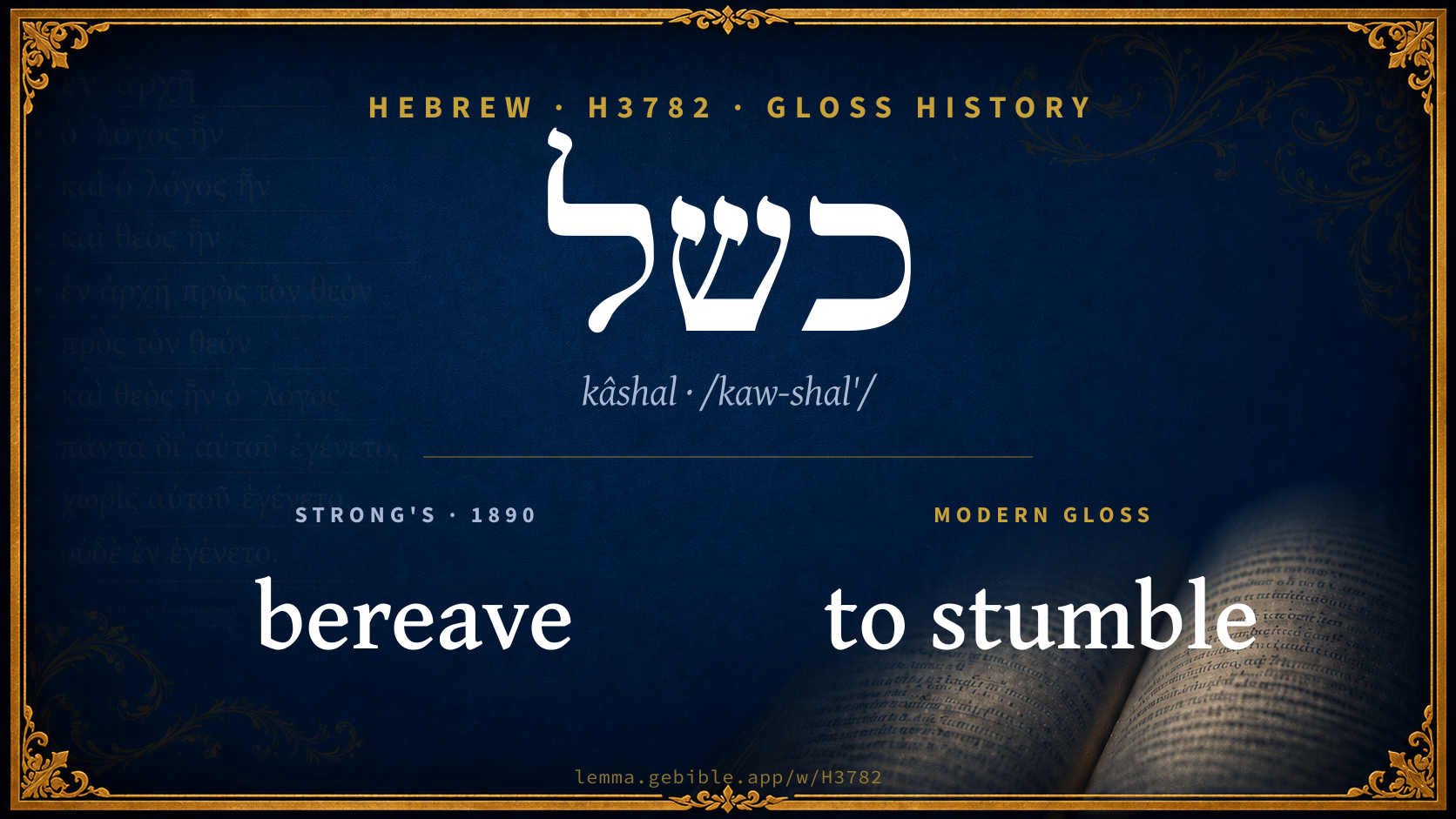
Gloss history
Strong's 1890 vs modern scholarship
About this word
Strong's H3782 catalogs a Hebrew word from the Hebrew Old Testament.
These counts are not copied from any lexicon or concordance. They are computed here, from the morphology-tagged Hebrew Old Testament. What Lemma adds →
- 59
- distinct verses
- The word appears in 59 distinct verses.
- 16 / 39
- OT books
- The word appears in 16 of 39 Old Testament books.
- #597
- by frequency
- Top 1000 most frequent Hebrew words (rank 597 of 8,640 Hebrew words by occurrence).
View all 59 occurrences in the concordance →
By section of the Old Testament
By traditional corpus
Conventional, traditional groupings — biblical authorship is debated, so this is a traditional corpus grouping, not an authorship claim. Each share is this word’s portion of its verses in that division of the Hebrew canon. Each figure is a share of the word’s 59 distinct verses.
- Prophets (Nevi'im) 33 verses · 56%
- Writings (Ketuvim) 25 verses · 42%
- Torah (Pentateuch) 1 verse · 2%
How translations render this word
Counts come from each version’s own published word-to-Strong’s tagging or interlinear alignment — an approximate guide to how each version renders this word, not a word-level alignment the data otherwise carries. Because each total is that version’s own tagged count, the per-version totals vary from one another and need not match the appearance or distinct-verse counts above. These counts may also differ from a printed concordance because Lemma counts each distinctly tagged rendering and does not collapse phrase taggings into a single head-word total. This is a fixed set of word-tagged versions (KJV, ASV, BSB, ULT) and does not change with the reading translation you choose elsewhere. Each version’s license is shown beside its name below (and on Sources).
- King James Version: Fall 7×, Shall fall 7×, They shall fall 4×
- American Standard Version: Shall stumble 5×, They stumble 4×, Stumble 3×
- Berean Standard Bible: Stumble 10×, Will stumble 5×, They stumble 4×
- unfoldingWord Literal Text: Stumble 7×, Will stumble 7×, They will stumble 6×
King James Version Public Domain
Renders H3782 across 62 tagged occurrences — most commonly:
Plus 34 renderings that appear only once — usually multi-word phrases or single function words the recovered tagging swept in, not distinct renderings. Not rendered by a distinct English word in 3 further occurrences.
American Standard Version Public Domain
Renders H3782 across 62 tagged occurrences — most commonly:
Plus 44 renderings that appear only once — usually multi-word phrases or single function words the recovered tagging swept in, not distinct renderings.
Berean Standard Bible Public Domain
Renders H3782 across 63 tagged occurrences — most commonly:
Plus 29 renderings that appear only once — usually multi-word phrases or single function words the recovered tagging swept in, not distinct renderings.
unfoldingWord Literal Text CC BY-SA 4.0
Renders H3782 across 64 tagged occurrences — most commonly:
Plus 30 renderings that appear only once — usually multi-word phrases or single function words the recovered tagging swept in, not distinct renderings.
16 senses and sub-senses in the full BDB
Hebrew verbs can shift meaning by stem (binyan): Qal is the basic action, Niphal is often passive or reflexive, Piel often intensifies or makes it factitive, and Hiphil is typically causative. The senses below are grouped under the stem BDB assigns to each. This entry also uses Hophal (the passive of Hiphil).
What do BDB’s symbols mean?
BDB uses these scholarly abbreviations:
| Symbol | Meaning |
|---|---|
| 𝔊 | the Septuagint (the ancient Greek translation, LXX) |
| 𝔙 | the Vulgate (the Latin translation) |
| 𝔖 | the Syriac version (the Peshitta) |
| 𝔗 | the Targum (the Aramaic translation) |
| ψ | the Psalms |
| √ | root (the underlying root or stem) |
| ‖ | parallel passage (a synonymous or contrasted parallel) |
| † | the dagger: every passage where the word occurs is cited |
The 16 senses and sub-senses the full Brown-Driver-Briggs lexicon distinguishes for this word, in lexicon order (not ranked by frequency), with BDB’s own verbatim wording and sub-sense lettering. Shown in Hebrew script with BDB’s own scholarly abbreviations. The condensed entry is in the Lexicon Entry tab. See also the Forms in the corpus table below.
Qal
- Pf. כ׳ Ne 4:4 +, (Ho 5:5b read יִכָּשֵׁל, cf. We), כָּֽשְׁלָה Is 3:8; 59:14; כָּֽשְׁלוּ Je 46:6 +, כָּשַׁלְנוּ Is 59:10, etc.; Impf. 3 mpl. יכשׁ֑ולו Pr 4:16 Kt (but read Hiph., q.v., so Qr); יכשׁלו Na 3:3 Kt (but read Pf. וְכָֽשְׁלוּ, so Qr); Inf. abs. כָּשׁוֹל Is 40:30 (c. Niph. Impf.); Pt. act. כּוֹשֵׁל Is 5:27 + 2 times, כֹּשֵׁל 2 Ch 28:15 ψ 105:37; fpl. כֹּשְׁלוֹת Is 35:3;— e.g. Nehemiah 4:4
- 1. stumble at, over, something, c. ב (lit. by means of), Na 3:3, גִּבּוֹר בְּגִבּוֹר כ׳ Je 46:12 (+ נָפַל), cf. Lv 26:37; וּנְעָרִים בָּעֵץ כ׳ La 5:13 i.e. stagger (of toil in captivity); abs. Is 5:27 (‖ עָיֵף), כָּֽשְׁלוּ וְנָפָ֑לוּ Je 46:6, cf. הִרְבָּה כּוֹשֵׁ֑ל גַּס־נָפַל אישׁ וגו׳ v 16 (strange; Gie, foll. in part 𝔊 𝔖, עֶרְבְּךָ כָּשַׁל וְנָפַל thy mixed people—cf. 25:20, etc.—hath stumbled and hath fallen); often fig. of overthrow, through divine judgment, c. בְּ at, (v. supr.) Je 6:21, so Is 8:15 (+ נָפַל etc.) according to Ges Hi Buhl Che Di; בָּם = among them,—Isr. and Judah,—as ב in v 16, so Ew De Du E.V; Ho 4:5(×2); 5:5; 14:2 (בַּעֲוֹנֶֽךָ, בְּ prob. instr.); abs. of Babylon, under fig. of זָדוֹן, כ׳ ונפל Je 50:32; כ׳ ונפל ψ 27:2 Is 3:8; 31:3 (both ‖ נפל); of אֱמֶת Is 59:14; Is 28:13 (+ אָחוֹר); of distress Is 59:10, ψ 107:12. e.g. Nahum 3:3
- 2. totter, of knees, lit. בִּרְכַּי כ׳ מִצּוֹם ψ 109:24 my knees totter from fasting; fig. Is 35:3 (‖ יָדַיִם רָפוֹת); כּוֹשֵׁל tottering one, lit. Jb 4:4 2 Ch 28:15 ψ 105:37; hence fig., fail, of strength (כֹּחַ), Ne 4:4 ψ 31:11;—Inf. abs. כָּשׁוֹל, v. sub Niph. e.g. Psalms 109:24
Niphal
- Pf. consec. וְנִכְשַׁל Dn 11:19, וְנִכְשְׁלוּ v 33, וְנִכְשָׁ֑לוּ v 14; Impf. יִכָּשֵׁל Ez 33:12 + Ho 5:5b (𝔊 as v a, so We; MT כָּשַׁל), 2 ms. תִּכָּשֵׁל Pr 4:12, יִכָּשְׁלוּ Ho 5:5a + 9 times; יִכָּשֵׁ֑לוּ Is 40:30 + 3 times; Inf. cstr. sf. בִּכָּֽשְׁלוֹ Pr 24:17 (yet v. Ges§ 51, R. 1), בְּהִכָּֽשְׁלָם Dn 11:34; Pt. נִכְשָׁל Zc 12:8; pl. נִכְשָׁלִים 1 S 2:4;— e.g. Daniel 11:19
- 1. stumble (= Qal) Na 2:6; Is 63:13; Je 31:9; usually fig.: e.g. Nahum 2:6
- a. of misfortune Pr 24:17 (‖ נפל), neg. 4:12. e.g. Proverbs 24:17
- b. of divine judgment (c. בְּ at) Pr 4:19; 24:16, neg. Ez 33:12; see also Ho 14:10 (בְ loc.), Je 20:11 Dn 11:14, 35, יִכָּֽשְׁלוּ וְיֹאבְדוּ מִפָּנֶיךָ ψ 9:4; be thrown to the ground, of nations, armies, etc., Ho 5:5 (c. בַּעֲוֹנָם, cf. 14:2 Qal), Je 6:15 (‖ נפל), cf. 8:12 (‖ id.), Dn 11:19 (+ נפל), v 33 (בְ instr.), v 34, 41. e.g. Proverbs 4:19
- 2. be tottering, feeble, כָּשׁוֹל יִכָּשֵׁ֑לוּ Is 40:30 (opp. יַחֲלִיפוּ כֹחַ v 31); so pt. 1 S 2:4 Zc 12:8. e.g. Isaiah 40:30
Piel
- only apparent, תְּכַשְּׁלִי Ez 36:14, read תְּשַׁכְּלִי with Qr Vrss E.V. Sm Co Da (v. alo Hiph. ad fin.). e.g. Ezekiel 36:14
Hiphil
- Pf. הִכְשִׁיל La 1:14, הִכְשַׁלְתֶּם Mal 2:8; Impf. 3 ms. sf. יַכְשִׁילְךָ 2 Ch 25:8; 2 fs. תַּכְשִׁלִי Ez 36:15 (but del. 𝔊 Co; read תשׁכלי, as v 14 other Vrss Sm Da); 3 mpl. יַכְשִׁילוּ Pr 4:16 Qr (Kt v. sub Qal), וַיַּכְשִׁילֻהוּ ψ 64:9, וַיַּכְשִׁלוּם Je 18:15 (so 𝔗; Gie, after 𝔊 𝔖, וַיִּכְשְׁלוּ, [וַיִּכָּֽשְׁלוּ]); Inf. cstr. הַכְשִׁיל 2 Ch 25:8, sf. הַכְשִׁילוֹ 2 Ch 28:23;— e.g. Lamentations 1:14
- 1. cause to stumble, fig.:
- a. = bring injury or ruin to, abs. Pr 4:16; of punishment ψ 64:9 (indef. subj.; si vera l.; text prob. corrupt, v. Che Bae). e.g. Proverbs 4:16
- b. = overthrow, of nation, army, etc., 2 Ch 25:8 (sq. לִפְנֵי אוֹיֵב), cf. v 8 (opp. עזר); cause overthrow 2 Ch 28:23.—On Ez 36:15 v. supr. e.g. 2 Chronicles 25:8
- c. morally, Je 18:15 (בְּ loc.), Mal 2:8 (בְּ instr.) e.g. Jeremiah 18:15
- 2. make feeble, weak, הִכְשִׁיל כֹּחִי La 1:14 (of God’s dealing with Jerus.) e.g. Lamentations 1:14
Hophal
- only Pt. והיו מֻכְשָׁלִים לְפָנֶיךָ Je 18:23 either and let them be ones who have stumbled before thee, i.e. regard them as such (Hi Gf VB), or and let them be ones overthrown before thee (Gie; so Qr according to Gf). So also in Ez 21:20 according to Co, cf. Sm Da (MT מִכְשֹׁלִים, v. מִכְשׁוֹל). e.g. Jeremiah 18:23
Senses from the full Brown-Driver-Briggs lexicon (Brown, Driver, Briggs; Oxford 1906 — public domain), digitized via Sefaria, supplemented by the OpenScriptures HebrewLexicon (CC BY 4.0). Full attribution on Sources.
Word origin
vb. stumble, stagger, totter (NH id.; Syriac [ܟܫܰܠ] give offence (occasion for stumbling), σκανδαλίζω, (chiefly Ethpe. Aph.), v. PS Brock Schwally; Arabic كَسِلَ is be heavy, sluggish);—
— Brown-Driver-Briggs (Oxford 1906, public domain), digitized via Sefaria, supplemented by the OpenScriptures HebrewLexicon (CC BY 4.0). See Sources.
Origin: a primitive root
Jastrow Dictionary
A second Hebrew/Aramaic lexicon for comparison, covering Aramaic and post-biblical (Talmudic, Targumic, Midrashic) usage that the biblical-Hebrew BDB does not. Matched by lemma rather than by Strong’s number, so a lemma may carry more than one Jastrow headword (shown separately below), and the entries cover usage well beyond the Bible.
כָּשַׁל
- to strike against, stumble. Lev. R. s. 19 (ref. to Is. XXXV, 3) שהן נראות כאילו כּוֹשְׁלוֹת knees which have the appearance of stumbling (threaten to stumble). Ib. שכְּשַׁלְתֶּם וכ׳ for you have really stumbled (sinned) through your evil deeds. Num. R. s. 16 כְּשַׁלְתֶּם you have stumbled (were discouraged; Tanḥ. Shlaḥ 2 נתרשלתם); a. e.—כּוֹשֵׁל (law) weak, under legal disadvantages (in adapt. of Is. l. c. a. Job IV, 4). Keth. IX, 2 ינתנו לַכּ׳ שבהן let it be given him who is under the greatest disadvantage of all (the claimants being the deceased man’s widow, his creditor and his heirs); expl. ib. 84ᵃ לכ׳ שבראיה to him who is under disadvantage for evidence (whose document is of the latest date); [oth. opin.] לכתובת אשה to the widow, v. חִינָּא; Y. ib. IX, 33ᵃ top לכ׳ שבראיותיו וכ׳ to him who is the weakest as to evidence, e.g. he who loaned without witnesses as against him who has witnesses. Ib. לכ׳ בגופו to him who is in feeble health (and poor). e.g. Isaiah 35:3
- 1. to be struck, meet with an accident. Mekh. B’shall. s. 2 לא נ׳ אחד וכ׳ not one of them (the Egyptians) met with an accident (was detained) on the road. Y. Sabb. VI, 8ᶜ bot. נ׳ באצבעו got a sore finger; ib. XVI, 15ᶜ top; Lam. R. to IV, 20; a. e.
- 2. to stumble, fall; to be led to sin. Pesik. Shub., p. 165ᵃ והיו … נִכְשָׁלִין בו and people stumbled over it (the rock); Yalk. Hos. 533. Ib. אדם נ׳ בעכירה if man becomes a victim of sin. Gitt. 43ᵃ אין אדם … אא"כ נ׳ בהן one never gets at the true sense of the words of the Law, except after mistakes; Ḥag. 14ᵃ; Sabb. 120ᵃ.—Ber. 28ᵇ ולא אֶכָּשֵׁל בדבר הלכה and that I may not err against a hălakhah; ולא יִכָּשְׁלוּ וכ׳ nor may my colleagues &c. Midr. Till. to Ps. XXII בשביל … איני נִכְשֶׁלֶת because I am a queen, I shall not come to grief; a. fr.
- to cause to stumble, to be an obstruction; to weaken; to cause sin. Y. Shebi. III, end, 34ᵈ a breach in the fence מַכְשֶׁלֶת את הרבים annoying the public (an obstruction to traffic). R. Hash. I, 6 נמצאת מַכְשִׁילָן לע"ל thou wilt make them sin in future cases (by their refraining from going to court); Yoma 77ᵇ שלא תהא מַכְשִׁילָן וכ׳ that thou mayest not cause them to sin (by staying away from college); Kidd. 33ᵃ; Ḥull. 54ᵇ מְכַשְּׁלָן (Pi.).—Ab. Zar. 11ᵇ פיהם הִכְשִׁילָן לרשעים Ms. M. (ed. ה׳ פיהם) their own (ominous) words brought these wicked men to fall; Num. R. s. 18. B. Kam. 16ᵇ; B. Bath. 9ᵇ (ref. to מכשלים, Jer. XVIII, 23) הַכְשִׁילֵם וכ׳ make them stumble by sending them unworthy subjects of charity. Midr. Till. to Ps. XC לעצמי הייתי מַכְשִׁיל I should have injured myself. e.g. Jeremiah 18:23
- 1. same, v. supra.—2)
- to weaken, break the force of. Y. Ber. IX, 13ᶜ bot. מְכַשְּׁלוֹ בגבעות (Gen. R. s. 24 מרשלו), v. חָשַׁל.
כְּשַׁל
- , Af. אַכְשַׁל to bring to fall. Gitt. 57ᵃ אַכְשְׁלֵיה פומיה לבר וכ׳ his own mouth (his presumptuous prayer) caused Bar-Daroma’s downfall.
שַׁל
- v. שַׁלְוָה) carelessness, negligence. Sot. 35ᵃ (expl. II Sam. VII, 7) על עיסקי שַׁלּוֹ for his careless handling (of the Ark); Num. R. s. 420; Yalk. Sam. 142; Num. R. s. 2112 על השל מפני ששגגת וכ׳ ‘for the carelessness’, because an involuntary act of a scholar counts as a wilful act. e.g. 2 Samuel 7:7
שַׁל ²
- , v. שַׁלְצִיּוֹן
שֶׁל
- , v. שֶׁ־) belonging to, of. Ab. II, 2 בנו של ר׳ וכ׳ the son of &c. Ib. 12 יהי ממון … כשֶׁלְּךָ let thy neighbor’s property be as dear to thee as thine own. Ib. V, 10 האומר שֶׁלִּי שלי ושֶׁלְּךָ שֶׁלָּךְ he who says, what is mine is mine, and what is thine is thine. B. Mets. I, 1 זה אומר כולה שלי וכ׳ one says, it belongs entirely to me &c. Ib. 30ᵃ שהיתה מלאכה שֶׁלּוֹ … משל חבירו when his own work is more valuable than that required for his neighbor, i.e. when by helping his neighbor he would lose more than he could save for his neighbor. Gen. R. s. 49 אמרו לו מה נאמר … שאכלנו מִשֶּׁלּוֹ they (the strangers entertained by Araham) said to him, what shall we say? Said he, say, blessed be the God of the world of whose belongings we have partaken; a. v. fr.—Kidd. 57ᵇ שחוט שלי בשלי וכ׳ (not לי) slaughter what is owing to me (the sacrifice) on what belongs to me (on Temple grounds), and what is for thee, on thy own ground.
A Dictionary of the Targumim, the Talmud Babli and Yerushalmi, and the Midrashic Literature (Marcus Jastrow; London, Luzac, 1903) — Public Domain. Digitized via Sefaria. Digitized via Sefaria. Full attribution on Sources.
Forms in the corpus
The 57 distinct written forms H3782 takes in the Hebrew Bible, most frequent first — each parse links to that stem’s occurrences in the concordance. Hebrew forms include their vowel points and cantillation, so a single lemma takes many written forms.
Same root — word family
Other BDB entries built from the same root as H3782, grouped by Strong’s listed origin. These share a root / origin per the lexicon — not necessarily a shared meaning. Each links to that word’s own entry.
Derived from this word
- כשיל kashshîyl H3781 axe
- כשלון kishshâlôwn H3783 stumbling
- מכשול mikshôwl H4383 stumbling block
- מכשלה makshêlâh H4384 ruin
Compare all same-root words → Showing 4 of 5 — not the complete family. They share a root, not necessarily a meaning.
Septuagint verse parallels
This word appears in 53 verses that also exist in the Greek Old Testament (Septuagint), out of the 59 Hebrew verses it occurs in. You can read those verses in Greek by switching the Old Testament edition to the Septuagint.
Read these verses in the Septuagint
- Leviticus 26:37
- 1 Samuel 2:4
- 2 Chronicles 25:8
- Job 4:4
- Psalms 9:3
- Proverbs 4:12
- Isaiah 3:8
- Jeremiah 6:15
- Lamentations 1:14
- Ezekiel 33:12
- Daniel 11:14
- Hosea 4:5
This is a verse-level parallel only — the same verses exist in both the Hebrew and Greek Old Testaments. No word-level Hebrew↔Greek correspondence is claimed: the data carries no such alignment, so no Greek word is shown as this Hebrew word’s translation. Coverage is not total — the Septuagint omits the deuterocanon and renumbers the Psalms, so some Hebrew verses have no direct Greek parallel.