
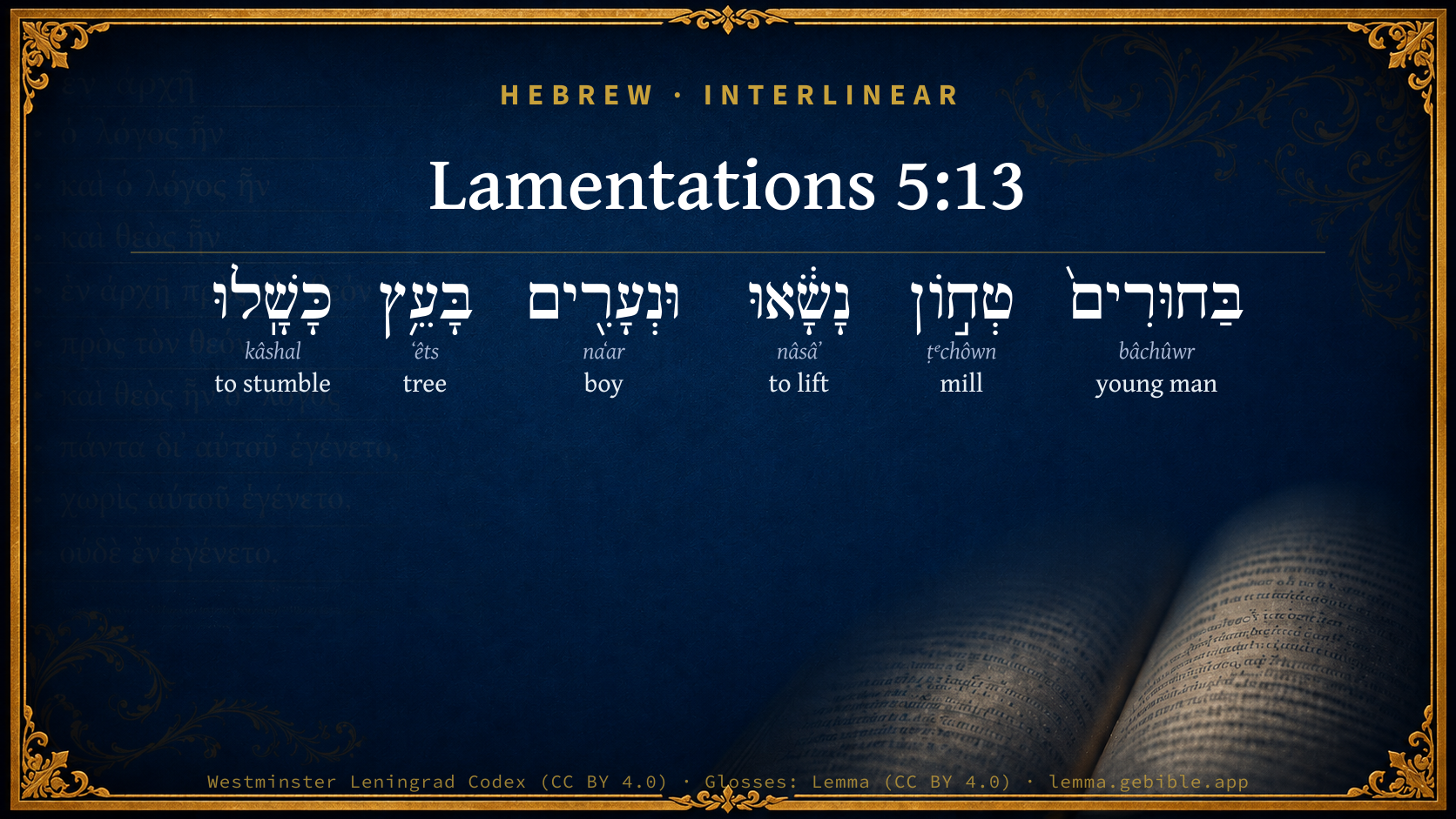
Lamentations 5:13

Hebrew (Westminster Leningrad Codex) Lamentations 5:13 appears in the Hebrew Old Testament. The text above is from the Westminster Leningrad Codex. Each word links to its Strong’s number, a concise gloss, and parsing drawn from the Open Scriptures Hebrew Bible morphology. Click any word for its full Brown-Driver-Briggs (BDB) entry.
Download image
Cite this verse

Lamentations 5:13 (World English Bible). Public Domain. Lemma interlinear Bible study tool, https://lemma.gebible.app/v/lamentations/5/13.

Show BibTeX & RIS
BibTeX
RIS
English Translation
The young men bare the mill; The children stumbled under the wood.
World English Bible · Public Domain
Highlights
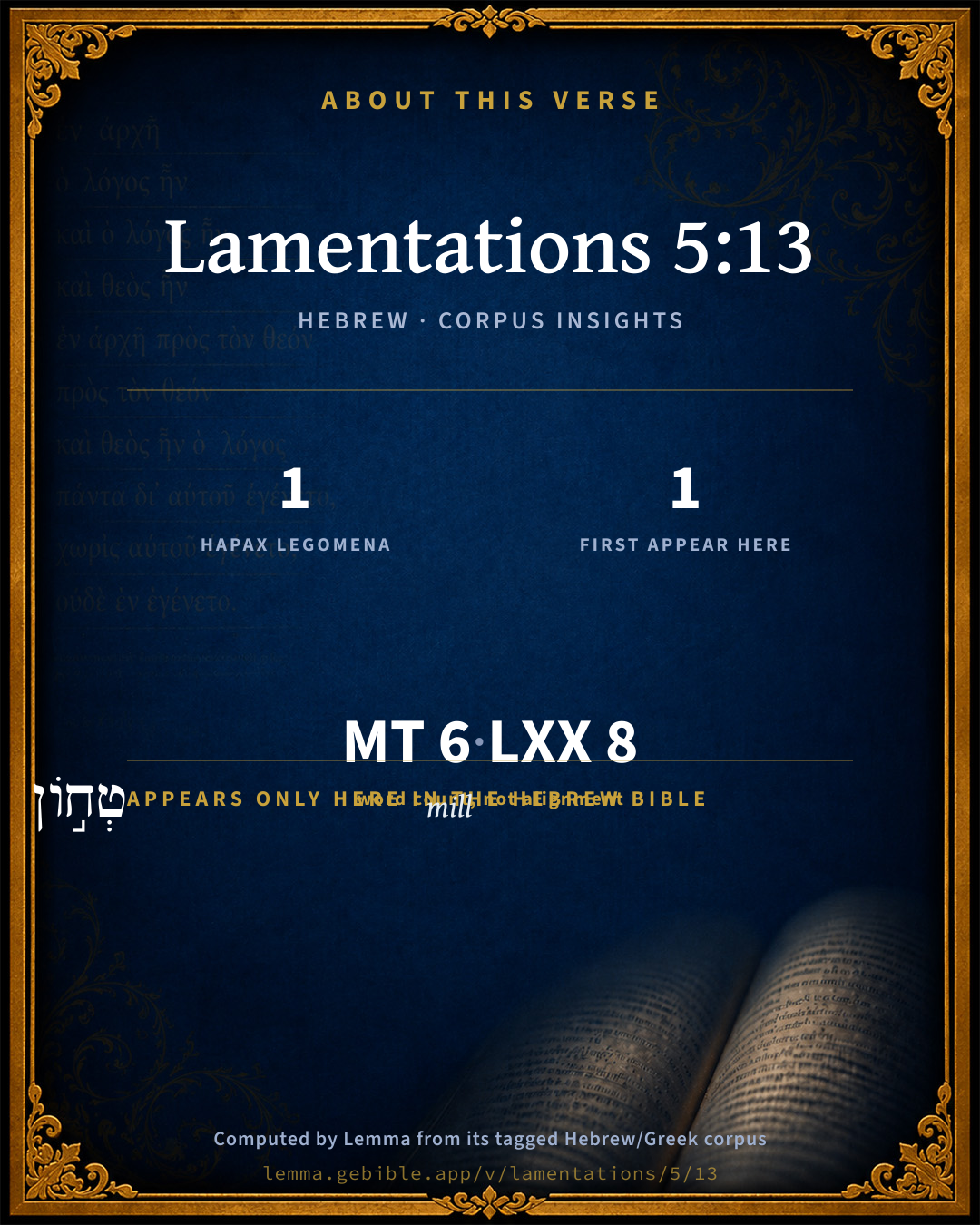
  • 1 hapax legomenon — only here in the Hebrew Bible
  • 1 first appearance in the Hebrew Bible
Full analysis ↓
Download a study sheet

One document with this verse’s original text, its word-by-word gloss line, the meaning frame, cross-references with their text, attributed commentary, and full source and license credits — printable, and it pastes into notes with its structure intact.

This verse Autodidact and up

Study sheet (.html) Plain text (.txt)

A passage Seminary Student

Up to 50 verses in one chapter. A passage sheet keeps up to 6 commentary sources and 12 cross-references per verse, in the order this page ranks them, and says so on the sheet whenever that leaves anything out. Ask for a single verse and you get the Autodidact verse sheet above.

Everything on this page stays free to read, with no account — the sheet is a download of what is already on screen, not access to it.

Want to remove ads? Support Godless Engineer
Compare translations 3

The same verse in 3 English versions, stacked beneath the original-language interlinear above. Click any original word for its lexicon entry.

Each is an independent rendering of the whole verse — the interlinear is not word-aligned to these translations.

Highlighted words mark where these versions differ — a whole-verse word diff, not a word-by-word alignment.

  • World English Bible Public Domain
    The young men bare the mill; The children stumbled under the wood.
  • King James Version Public Domain
    They took the young men to grind, and the children fell under the wood.
  • unfoldingWord Literal Text CC BY-SA 4.0
    Young men carry a grinding stone, and boys stumble under wood.

unfoldingWord Literal Text — © unfoldingWord, licensed CC BY-SA 4.0. Word-aligned USFM3 via Door43 (git.door43.org/unfoldingWord/en_ult).

Versions to compare (up to 4)

3 of 4 selected

Show all 18 translations

Every available English version of this verse, each an independent rendering of the whole verse.

  • World English Bible Public Domain
    The young men bare the mill; The children stumbled under the wood.
  • Berean Standard Bible Public Domain
    Young men toil at millstones; boys stagger under loads of wood.
  • Majority Standard Bible Public Domain
    Young men toil at millstones; boys stagger under loads of wood.
  • King James Version Public Domain
    They took the young men to grind, and the children fell under the wood.
  • American Standard Version (1901) Public Domain
    The young men bare the mill; And the children stumbled under the wood.
  • Revised Version (1885) Public Domain
    The young men bare the mill, and the children stumbled under the wood.
  • Geneva Bible (1599) Public Domain
    They tooke the yong men to grinde, and the children fell vnder the wood.
  • Douay-Rheims (1899) Public Domain
    They abused the young men indecently: and the children fell under the wood.
  • Young's Literal Translation Public Domain
    Young men to grind they have taken, And youths with wood have stumbled.
  • Literal Standard Version CC BY-SA 4.0
    They have taken young men to grind, || And youths have stumbled with wood.
  • Unlocked Literal Bible CC BY-SA 4.0
    Young men are forced to grind grain with a millstone, and boys stagger under heavy loads of wood.
  • unfoldingWord Literal Text CC BY-SA 4.0
    Young men carry a grinding stone, and boys stumble under wood.
  • Darby Bible Public Domain
    The young men have borne the mill, and the youths have stumbled under the wood.
  • World Messianic Bible Public Domain
    The young men carry millstones. The children stumbled under loads of wood.
  • Webster's Bible Public Domain
    They took the young men to grind, and the children fell under the wood.
  • Free Bible Version CC BY-SA 4.0
    Young men are forced to work at hand-mills; boys stagger under bundles of wood.
  • Bible in Basic English Public Domain
    The young men were crushing the grain, and the boys were falling under the wood.
  • JPS Tanakh (1917) Public Domain
    The young men have borne the mill, and the children have stumbled under the wood.

Literal Standard Version (2020), Covenant Press — licensed CC BY-SA 4.0. Text via the HelloAO Bible API (eBible.org). Unlocked Literal Bible (unfoldingWord) — licensed CC BY-SA 4.0. Text via the HelloAO Bible API (eBible.org). unfoldingWord Literal Text — © unfoldingWord, licensed CC BY-SA 4.0. Word-aligned USFM3 via Door43 (git.door43.org/unfoldingWord/en_ult). Free Bible Version, Dr. Jonathan Gallagher — licensed CC BY-SA 4.0. Text via the HelloAO Bible API (eBible.org).

Word by word

More ways to search: Search by grammar → Find every occurrence → Compare this word →

Practice this passage: Drill this verse → Learn its vocabulary →

About this verse

These counts appear in no published source. They are computed here, from the morphology-tagged text and Lemma’s own curated glosses. What Lemma adds →

6
words
6
distinct lemmas
Prophets
section

Notable vocabulary

1 hapax legomenon — a word that appears only here in the entire Hebrew Bible:

  • טְח֣וֹן mill H2911

First appearance in Scripture

This word makes its first canonical appearance in the Hebrew Bible here:

  • טְח֣וֹן mill H2911

Shared distinctive vocabulary

בַּחוּרִים֙ young man H970 occurs in 45 verses of the Hebrew Bible. Also found in:

Grammatical profile

  • 2 verbs
  • 4 nouns

Verb forms

  • נָשָׂ֔אוּ Qal · Perfect
  • כָּשָֽׁלוּ Qal · Perfect

Hebrew & Septuagint length

In English translation the verse runs 12 words from the Hebrew and 16 from the Septuagint (LXX English) — closely comparable.

A rough comparison of the two English renderings, which tokenize alike — not a word-level alignment.

Word counts can differ between the Hebrew and the Greek without any difference in meaning — e.g. the Hebrew direct-object marker אֵת has no separate Greek word, and Greek often adds the article ὁ.

In the original languages it is 6 Hebrew tokens and 8 Greek tokens — but the two are counted differently (Hebrew bundles its prefixes and suffixes into one token; the Greek is in lemma form), so that isn’t a like-for-like length.

Cross-references

10

Topical passages linked to Lamentations 5:13 in the Treasury of Scripture Knowledge — connected by theme and wording, ordered by reader-vote popularity; previews shown in the World English Bible.

  • Judges 16:21 The Philistines laid hold on him, and put out his eyes; and they brought him down to Gaza, and bound him with fetters of brass; and he did grind in the prison-house.
  • Matthew 23:4 For they bind heavy burdens that are grievous to be borne, and lay them on men's shoulders; but they themselves will not lift a finger to help them.
  • Exodus 1:11 Therefore they set taskmasters over them to afflict them with their burdens. They built storage cities for Pharaoh: Pithom and Raamses.
  • Exodus 2:11 It happened in those days, when Moses had grown up, that he went out to his brothers, and looked at their burdens. He saw an Egyptian striking a Hebrew, one of his brothers.
  • Exodus 11:5 and all the firstborn in the land of Egypt shall die, from the firstborn of Pharaoh who sits on his throne, even to the firstborn of the maid-servant who is behind the mill; and all the firstborn of cattle.
  • Exodus 23:5 If you see the donkey of him who hates you fallen down under his burden, don't leave him, you shall surely help him with it.
  • Nehemiah 5:1–5 Then there arose a great cry of the people and of their wives against their brothers the Jews.
  • Job 31:10 Then let my wife grind for another, And let others sleep with her.
  • Isaiah 47:2 Take the millstones, and grind meal; remove your veil, strip off the train, uncover the leg, pass through the rivers.
  • Isaiah 58:6 Isn't this the fast that I have chosen: to loose the bonds of wickedness, to undo the bands of the yoke, and to let the oppressed go free, and that you break every yoke?

Cross-references courtesy of OpenBible.info (CC BY 4.0).

Hebrew and Greek witnesses Masoretic Hebrew ↔ Greek Septuagint

The same verse in the two great witnesses to the Old Testament, shown verse-for-verse.

These are two independent witnesses, not word-aligned to each other, and the Septuagint is shown in lemma (dictionary) form.

Hebrew Lamentations 5:13 Masoretic · Westminster Leningrad Codex

בַּחוּרִים֙ טְח֣וֹן נָשָׂ֔אוּ וּנְעָרִ֖ים בָּעֵ֥ץ כָּשָֽׁלוּ

The young men bare the mill; The children stumbled under the wood.

World English Bible · Public Domain

Greek LXX Lamentations 5:13 Septuagint · lemma form

ἐκλεκτός κλαυθμός ἀναλαμβάνω καί νεανίσκος ἐν ξύλον ἀσθενέω

The chosen men lifted up the voice in weeping, and the youths fainted under the wood.

LXX2012 (modern English Septuagint) · Public Domain

On this verse, Haydock's Catholic Bible Commentary discusses the Septuagint’s reading. Read the note in Commentary ↓

Hebrew: Westminster Leningrad Codex (CC BY 4.0). Greek: Septuagint (public domain); English from LXX2012 (modern English Septuagint) (Public Domain). How the Septuagint differs from the Hebrew →

Commentary

Notes on Lamentations 5:13 from classic Christian and Jewish commentators (each source and its license shown beneath its notes). The classic Christian expositions comment on the surrounding passage and are grouped to its opening verse, so a note may address several verses; the Jewish commentaries on the Tanakh (Rashi and others) are per-verse, so they appear only where the commentator wrote on this verse.

Lemma curates 59 commentaries, every one of them public domain or Creative Commons licensed, each selected and text-cleaned for this edition rather than reprinted as found. About our sources →

Trapp's Complete Commentary

John Trapp

Lam 5:13 They took the young men to grind, and the children fell under the wood.

Ver. 13. They took the young men to grind,] i.e., To do any base and abject business. {Exo 11:5; Exo 12:29} Frustra enim hic Hieronymus et alii Sodomiticum quid cogitant.

And the children fell under the wood.] Being not able to stand under such unreasonable burdens as were laid upon their backs.

John Trapp, A Commentary or Exposition upon All the Books of the Old and New Testament (1647–1656) — public domain. Text from a community e-Sword module.

Geneva Bible (1599)

Geneva Bible translators

Their slavery was so great, that they were not able to abide it.

Geneva Bible (1599) marginal notes — public domain. Text via Bolls.life.

Jamieson, Fausset & Brown

Robert Jamieson, A. R. Fausset & David Brown

young men . . . grind--The work of the lowest female slave was laid on young men (Jdg 16:21; Job 31:10).

children fell under . . . wood--Mere children had to bear burdens of wood so heavy that they sank beneath them.

Jamieson, Fausset & Brown — Commentary Critical and Explanatory on the Whole Bible (1871) — public domain (CC PDM 1.0). Text via the HelloAO Bible API.

Adam Clarke's Commentary

Verse 13. They took the young men to grind] This was the work of female slaves. See Clarke on Isa 47:2.

Adam Clarke's Commentary on the Bible (1810–1826) — public domain. Text from a community e-Sword/MySword module.

John Calvin's Commentaries

I cannot proceed farther now.

John Calvin's Commentaries (1540-1563) — public domain. Text from the Calvin Translation Society English edition (1840s-50s) via the Christian Classics Ethereal Library (ccel.org). Calvin's coverage is partial (roughly two-thirds of the Bible); uncommented books and verses are honest gaps, never fabricated. The 19th-century editor's footnotes and remarks are omitted so the notes are faithfully Calvin's own voice.

Ellicott's Commentary for English Readers

(13) They took . . .—Better, Young men bear the mill: i.e., were not only set to grind the handmill, which was itself the work of a menial slave, commonly of women, but were made to carry the mill itself, probably as they marched along with the Chaldæan armies on their way to Babylon. (Comp. Isa_47:2.) So in like manner the next clause describes the sufferings of the striplings, who were made to carry the wood which was used as fuel or other purposes, and who literally “fell” (or staggered) under their burdens.

A Bible Commentary for English Readers, edited by Charles John Ellicott (1878–1897) — public domain. Text from a community e-Sword module.

The Cambridge Bible for Schools and Colleges

gen. ed. J. J. S. Perowne

13. Tenderness of age did not secure against the most oppressive and menial of labours.

The Cambridge Bible for Schools and Colleges (gen. ed. J. J. S. Perowne; Cambridge University Press, 1878–1918) — public domain. Text from a community e-Sword module.

John Gill's Exposition

They took the young men to grind,.... In the mill, which was laborious service; and which persons were sometimes put to, by way of punishment; and was the punishment of servants; see Jdg 16:21. Some render it, "the young men bore the grist" (x); carried the corn, the meal ground, from place to place. The Targum is,

"the young men carried the millstones;''

and so Jarchi, they put millstones upon their shoulders, and burdens so as to weary them. Ben Melech, from their Rabbins, relates, that there were no millstones in Babylon; wherefore the Chaldeans put them upon the young men of Israel, to carry them thither. The Vulgate Latin version is,

"they abused the young men in an unchaste manner;''

suggesting something obscene intended by grinding; see Job 31:10; but the context will not admit of such a sense:

and the children fell under the wood; such loads of wood were laid upon them, that they could not bear them, but fell under them. Aben Ezra understands it of moving the wood of the mill, of turning the wooden handle of it; or the wooden post, the rider or runner, by which the upper millstone was turned: this their strength was not equal to, and so failed. The Targum interprets it of a wooden gibbet, or gallows; some wooden engine seems to be had in view, used as a punishment, which was put upon their necks, something like a pillory; which they were not able to stand up under, but fell.

(x) "juvenes farinam portaverunt"; so some in Gataker; "juvenes molam tulerunt", Cocceius; "juvenes ad molendum portant", Junius & Tremellius.

John Gill's Exposition of the Whole Bible (1746–1763) — public domain (CC PDM 1.0). Text via the HelloAO Bible API.

Albert Barnes' Notes on the Bible

They took the young men to grind - Or, “The young men” have borne the mill, a menial and laborious task usually performed by slaves (compare Isa 47:2).

The children fell under the wood - Or, lads have stumbled under burdens of wood. By lads are meant youths up to the age of military service; another form of menial labor.

Albert Barnes' Notes on the Bible (1834–1885) — public domain. Text from a community e-Sword/MySword module.

Haydock's Catholic Bible Commentary

Indecently, like the Sodomites. Hebrew, "they made the young men grind" at the mill, in their prison, (Haydock) as Samson (Judges xvi. 21.) and Sedecias (according to the Septuagint, chap. lii. 11.) were forced to do. To grind is often used in a bad sense; but it is not necessary to adopt it here. (Calmet) (Amama) --- The Chaldeans treated their captives without pity or shame. (Haydock) --- Wood; burdens, or stumbling-blocks, unless they were crucified; or, "roasted," if we admit a small alteration in the Hebrew, chap. iv. 10. (Calmet) --- They were forced to grind naked, and were beaten with staves. (Worthington)

George Leo Haydock (1774–1849), Haydock's Catholic Family Bible and Commentary, 1859 edition — public domain. Excludes Psalms (Douay-Rheims chapter numbering differs from Protestant) and Deuterocanonical books (Catholic canon only).

Matthew Poole's English Annotations

Their base, servile condition is expressed by the labour they were put to, which was either grinding in the mill, (an ordinary employment of slaves in those countries,) or carrying millstones; and the younger children in carrying great burdens of wood, under which they fell, as being not able to stand under the burdens laid upon them.

Matthew Poole's English Annotations on the Holy Bible (1683–1685) — public domain. Text from a community e-Sword/MySword module.

The Pulpit Commentary

They took the young men to grind; rather, the young men have borne the mill. The lower millstone seems to have been specially hard, and therefore heavy, (see Job_41:24) and to carry it about must have required a more severe exertion even than the constant turning of the mill handle. Dr. Thomson "cannot recall an instance in which men were grinding at the mill" ("The Land and the Book," edit. 1881, p. 108), and Exo_11:5 and Mat_24:41 presuppose that it was women"s work. The conquered Jewish youths, however, share the fate of Samson"Eyeless, in Gaza, at the mill with slaves. ("Samson Agonistes," 41.) "Eyeless," indeed, they may some of them have been, as putting out the eyes was a common Oriental punishment. (comp. Jer_39:7) The children. This is, perhaps, too strong. The Hebrew na"ar is applicable, not only to children, but to youths at the age for marriage (Gen_34:19) or war. (1Ki_20:15) The wood; not the wooden handle of the mill, but the wood required for fuel.

The Pulpit Commentary (1880–1919), ed. H.D.M. Spence-Jones & Joseph S. Exell — public domain. Text from a community e-Sword module.

John Wesley's Explanatory Notes

Fell - Not being able to stand under the burdens laid upon them.

John Wesley, Explanatory Notes Upon the Whole Bible (1754–1765) — public domain. Text via the GEBible commentary corpus.

unfoldingWord translationNotes

Door43 World Missions Community

Young men are forced

This can be stated in active form. AT: "They force young men" (See: Active or Passive)

boys stagger under heavy loads of wood

The boys are forced to carry the loads of wood. AT: "boys stagger because they are forced to carry heavy loads of wood" or "they force the boys to carry heavy loads of wood which make them stagger" (See: Assumed Knowledge and Implicit Information)

the city gate

This is where the elders would give legal advice, but also where people would meet socially.

the young men have left their music

Playing music was part of the social life at the city gate. This speaks of the men no longer playing their music as if the act of playing music were a place that they left. AT: "the young men have stopped playing their music" (See: Metaphor)

translationWords

elder

gate

unfoldingWord translationNotes — © Distant Shores Media and the Door43 World Missions Community, licensed CC BY-SA 4.0. Source: git.door43.org/Door43/en_tn.

Rashi

Rabbi Shlomo Yitzchaki (Rashi)

Young men carried the millstones When the enemies led them away in neck irons, they would place millstones and burdens on their shoulders in order to tire them. Similarly: and youths fail under [loads of] wood, meaning that their strength failed. The expression of failing applies to the weakening of the strength, as is stated in Ezra (Neh. 4:4), “And Judea said: The porter’s strength has failed (כָּשַּׁל).” Similarly, (above 1:14) “and caused my strength to fail (הִכְשִּׁיל).”

Rashi on the Tanakh — English translations: “The Judaica Press complete Tanach with Rashi, translated by A. J. Rosenberg” (CC BY 4.0); “Pentateuch with Rashi's commentary by M. Rosenbaum and A.M. Silbermann, 1929-1934” (public domain); “The Metsudah Tanach series, Lakewood, N.J” (CC BY 4.0); and “The Book of Joshua, Metsudah Publications, 1997” (CC BY 4.0). Text via Sefaria.

Lesson kit

Teaching starters — assembled from the data on this page, not authored interpretation. Every prompt links to the verse data it draws on. Edit before teaching.

Lamentations, in the Prophets, opens this verse with 6 words (6 distinct Hebrew lemmas). Its most distinctive word is ṭᵉchôwn (“mill”). A historical commentator’s framing appears above. Read the whole chapter for the surrounding context.

Discussion questions

  1. How does “mill” (ṭᵉchôwn) shape what this verse is saying?
  2. This verse holds 1 word here found nowhere else in the Hebrew Bible. What might the rare word draw attention to?
  3. The word “mill” first appears here in Scripture. What is being introduced at this debut?
  4. Deuteronomy 32:25 shares the word «young man» with this verse. How do the two illuminate each other?
  5. The translations on this page render this verse differently — a whole-verse word diff, not a word-by-word alignment. What might account for the different wordings?
  6. The verb «נָשָׂ֔אוּ» is Qal Perfect. How does its form color the action?
  7. Reading how Trapp's Complete Commentary and Geneva Bible (1599) read this verse, where do the two commentators agree and where do they part?

Things to notice

Reading settings

Reading text

Shown beneath each verse's original-language words.

Old Testament
Old Testament edition

Read the OT as the Masoretic Hebrew (MT) or the Greek Septuagint (LXX).

English shown for the Greek Septuagint (in the Hebrew ↔ Greek comparison).

Comparing translations? Open the Compare panel on any verse page to stack up to four side by side.