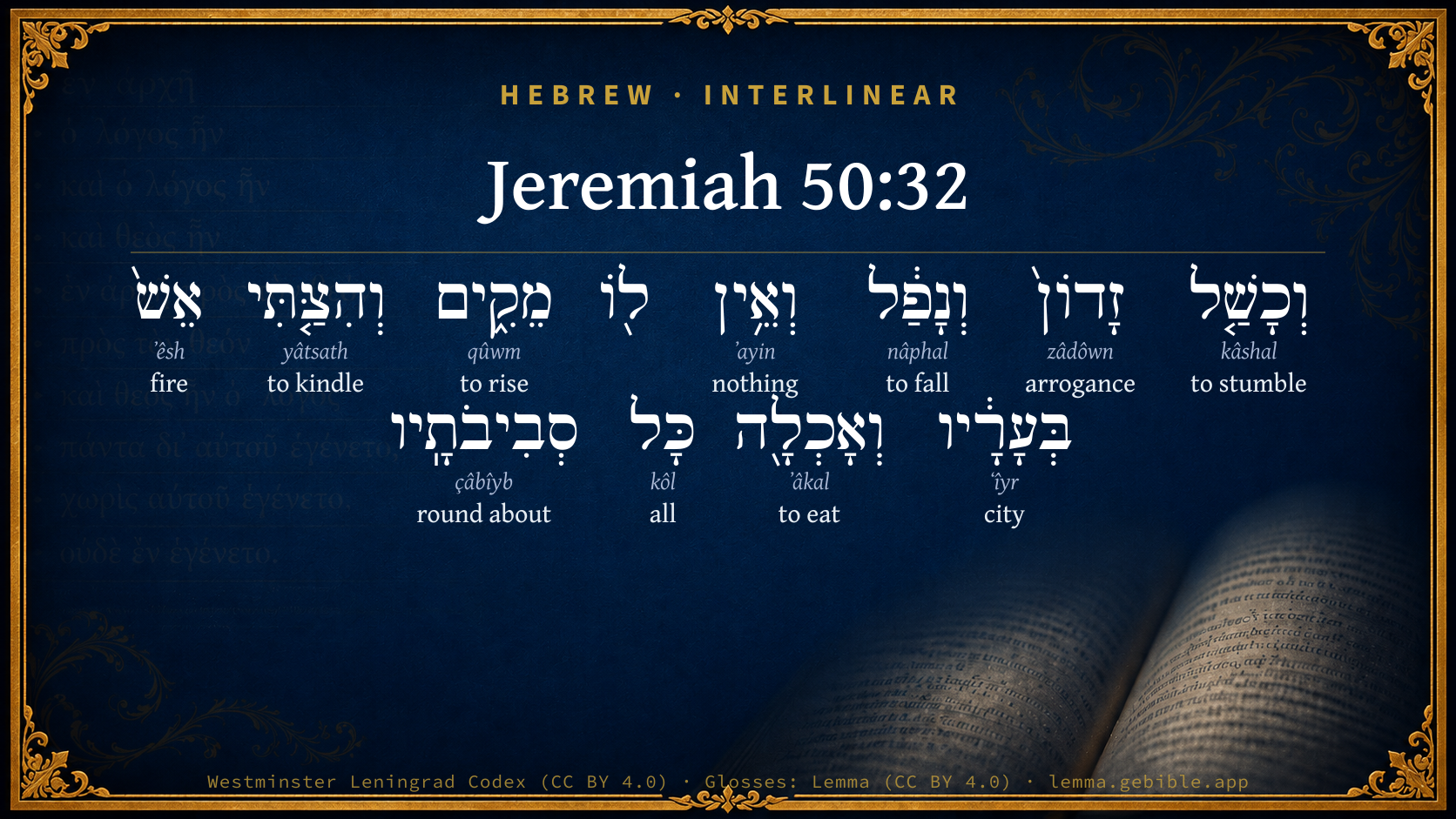
Jeremiah 50:32

Hebrew (Westminster Leningrad Codex) Jeremiah 50:32 appears in the Hebrew Old Testament. The text above is from the Westminster Leningrad Codex. Each word links to its Strong’s number, a concise gloss, and parsing drawn from the Open Scriptures Hebrew Bible morphology. Click any word for its full Brown-Driver-Briggs (BDB) entry.
Download image
Cite this verse

Jeremiah 50:32 (World English Bible). Public Domain. Lemma interlinear Bible study tool, https://lemma.gebible.app/v/jeremiah/50/32.

Show BibTeX & RIS
BibTeX
RIS
English Translation
The proud one shall stumble and fall, and none shall raise him up; and I will kindle a fire in his cities, and it shall devour all who are round about him.
World English Bible · Public Domain
Download a study sheet

One document with this verse’s original text, its word-by-word gloss line, the meaning frame, cross-references with their text, attributed commentary, and full source and license credits — printable, and it pastes into notes with its structure intact.

This verse Autodidact and up

Study sheet (.html) Plain text (.txt)

A passage Seminary Student

Up to 50 verses in one chapter. A passage sheet keeps up to 6 commentary sources and 12 cross-references per verse, in the order this page ranks them, and says so on the sheet whenever that leaves anything out. Ask for a single verse and you get the Autodidact verse sheet above.

Everything on this page stays free to read, with no account — the sheet is a download of what is already on screen, not access to it.

Want to remove ads? Support Godless Engineer
Compare translations 3

The same verse in 3 English versions, stacked beneath the original-language interlinear above. Click any original word for its lexicon entry.

Each is an independent rendering of the whole verse — the interlinear is not word-aligned to these translations.

Highlighted words mark where these versions differ — a whole-verse word diff, not a word-by-word alignment.

  • World English Bible Public Domain
    The proud one shall stumble and fall, and none shall raise him up; and I will kindle a fire in his cities, and it shall devour all who are round about him.
  • King James Version Public Domain
    And the most proud shall stumble and fall, and none shall raise him up: and I will kindle a fire in his cities, and it shall devour all round about him.
  • unfoldingWord Literal Text CC BY-SA 4.0
    So the proud ones will stumble and fall. No one will raise them up. I will light a fire in their cities; it will devour everything around him.

unfoldingWord Literal Text — © unfoldingWord, licensed CC BY-SA 4.0. Word-aligned USFM3 via Door43 (git.door43.org/unfoldingWord/en_ult).

Versions to compare (up to 4)

3 of 4 selected

Show all 18 translations

Every available English version of this verse, each an independent rendering of the whole verse.

  • World English Bible Public Domain
    The proud one shall stumble and fall, and none shall raise him up; and I will kindle a fire in his cities, and it shall devour all who are round about him.
  • Berean Standard Bible Public Domain
    The arrogant one will stumble and fall with no one to pick him up. And I will kindle a fire in his cities to consume all those around him.”
  • Majority Standard Bible Public Domain
    The arrogant one will stumble and fall with no one to pick him up. And I will kindle a fire in his cities to consume all those around him.”
  • King James Version Public Domain
    And the most proud shall stumble and fall, and none shall raise him up: and I will kindle a fire in his cities, and it shall devour all round about him.
  • American Standard Version (1901) Public Domain
    And the proud one shall stumble and fall, and none shall raise him up; and I will kindle a fire in his cities, and it shall devour all that are round about him.
  • Revised Version (1885) Public Domain
    And the proud one shall stumble and fall, and none shall raise him up: and I will kindle a fire in his cities, and it shall devour all that are round about him.
  • Geneva Bible (1599) Public Domain
    And the proude shall stumble and fall, and none shall raise him vp: and I will kindle a fire in his cities, and it shall deuoure all round about him.
  • Douay-Rheims (1899) Public Domain
    And the proud one shall fall, he shall fall down, and there shall be none to lift him up: and I will kindle a fire in his cities, and it shall devour all round about him.
  • Young's Literal Translation Public Domain
    And stumbled hath pride, And he hath fallen, and hath no raiser up, And I have kindled a fire in his cities, And it hath devoured all round about him.
  • Literal Standard Version CC BY-SA 4.0
    And pride has stumbled, || And he has fallen, and has none raising up, || And I have kindled a fire in his cities, || And it has devoured all around him.
  • Unlocked Literal Bible CC BY-SA 4.0
    So the proud ones will stumble and fall. No one will raise them up. I will light a fire in their cities; it will devour everything around him.
  • unfoldingWord Literal Text CC BY-SA 4.0
    So the proud ones will stumble and fall. No one will raise them up. I will light a fire in their cities; it will devour everything around him.
  • Darby Bible Public Domain
    and the proud one shall stumble and fall, and none shall raise him up; yea, I will kindle a fire in his cities, and it shall devour all that are round about him.
  • World Messianic Bible Public Domain
    The proud one will stumble and fall, and no one will raise him up. I will kindle a fire in his cities, and it will devour all who are around him.”
  • Webster's Bible Public Domain
    And the most proud shall stumble and fall, and none shall raise him up: and I will kindle a fire in his cities, and it shall devour all around him.
  • Free Bible Version CC BY-SA 4.0
    You arrogant people will trip and fall. Nobody will be there to pick you up. I'm going to set fire to your towns and burn up everything around you.
  • Bible in Basic English Public Domain
    And pride will go with uncertain steps and have a fall, and there will be no one to come to his help: and I will put a fire in his towns, burning up everything round about him.
  • JPS Tanakh (1917) Public Domain
    And the most arrogant shall stumble and fall, and none shall raise him up; and I will kindle a fire in his cities, and it shall devour all that are round about him.

Literal Standard Version (2020), Covenant Press — licensed CC BY-SA 4.0. Text via the HelloAO Bible API (eBible.org). Unlocked Literal Bible (unfoldingWord) — licensed CC BY-SA 4.0. Text via the HelloAO Bible API (eBible.org). unfoldingWord Literal Text — © unfoldingWord, licensed CC BY-SA 4.0. Word-aligned USFM3 via Door43 (git.door43.org/unfoldingWord/en_ult). Free Bible Version, Dr. Jonathan Gallagher — licensed CC BY-SA 4.0. Text via the HelloAO Bible API (eBible.org).

Word by word

More ways to search: Search by grammar → Find every occurrence → Compare this word →

Practice this passage: Drill this verse → Learn its vocabulary →

זָדוֹן֙
zâdôwn
H2087
“arrogance”
Noun, Common, Masculine, Singular, Absolute
Part of Speech
Noun
Type
Common
Gender
Masculine
Number
Singular
State
Absolute
Full BDB Definition

Origin: from H2102

TWOT: 547b

pride, insolence, presumptuousness, arrogance
  1. וְכָשַׁ֤ל kâshal H3782 “and · to stumble” Conjunction + Verb, Qal, Sequential Perfect, 3rd Person, Masculine, Singular
  2. וְנָפַ֔ל nâphal H5307 “and · to fall” Conjunction + Verb, Qal, Sequential Perfect, 3rd Person, Masculine, Singular
  3. וְאֵ֥ין ʼayin H369 “and · nothing” Conjunction + Particle, Negative
  4. מֵקִ֑ים qûwm H6965 “rising” Verb, Hiphil, Participle Active, Masculine, Singular, Absolute
  5. וְהִצַּ֤תִּי yâtsath H3341 “and · to kindle” Conjunction + Verb, Hiphil, Sequential Perfect, 1st Person, Common, Singular
  6. אֵשׁ֙ ʼêsh H784 “fire” Noun, Common, Both, Singular, Absolute
  7. בְּעָרָ֔יו ʻîyr H5892 “in/at · cities · his” Preposition + Noun, Common, Feminine, Plural, Construct + Suffix, Personal, 3rd Person, Masculine, Singular
  8. וְאָכְלָ֖ה ʼâkal H398 “and · to eat” Conjunction + Verb, Qal, Sequential Perfect, 3rd Person, Feminine, Singular
  9. כָּל kôl H3605 “all of” Noun, Common, Masculine, Singular, Construct
  10. סְבִיבֹתָֽיו çâbîyb H5439 “surroundings · his” Noun, Common, Both, Plural, Construct + Suffix, Personal, 3rd Person, Masculine, Singular

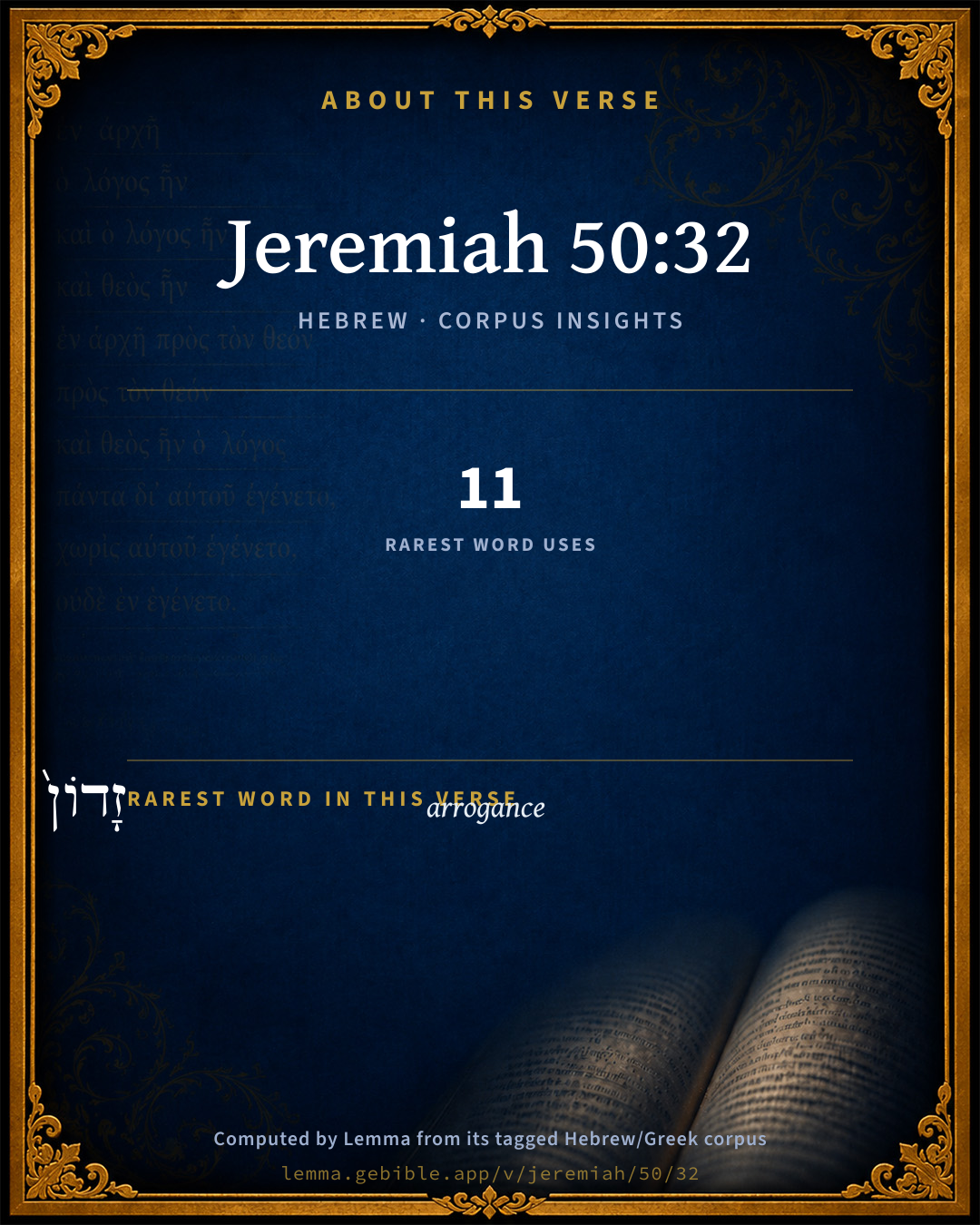
About this verse

These counts appear in no published source. They are computed here, from the morphology-tagged text and Lemma’s own curated glosses. What Lemma adds →

12
words
11
distinct lemmas
Prophets
section

Notable vocabulary

The rarest word here is זָדוֹן֙ arrogance H2087 — appearing just 11 times in the whole Hebrew Bible.

Shared distinctive vocabulary

זָדוֹן֙ arrogance H2087 occurs in 11 verses of the Hebrew Bible. Also found in:

Grammatical profile

  • 5 verbs
  • 5 nouns
  • 1 preposition
  • 1 particle

Verb forms

  • וְכָשַׁ֤ל Qal · Sequential Perfect
  • וְנָפַ֔ל Qal · Sequential Perfect
  • מֵקִ֑ים Hiphil · Participle Active
  • וְהִצַּ֤תִּי Hiphil · Sequential Perfect
  • וְאָכְלָ֖ה Qal · Sequential Perfect

Cross-references

20

Topical passages linked to Jeremiah 50:32 in the Treasury of Scripture Knowledge — connected by theme and wording, ordered by reader-vote popularity; previews shown in the World English Bible.

  • Jeremiah 21:14 I will punish you according to the fruit of your doings, says Yahweh; and I will kindle a fire in her forest, and it shall devour all that is round about her.
  • Jeremiah 49:27 I will kindle a fire in the wall of Damascus, and it shall devour the palaces of Ben Hadad.
  • Isaiah 10:12–15 Therefore it shall happen that, when the Lord has performed his whole work on Mount Zion and on Jerusalem, I will punish the fruit of the stout heart of the king of Assyria, and the glory of his high looks.
  • Amos 2:5 But I will send a fire on Judah, And it will devour the palaces of Jerusalem."
  • Revelation 18:8 Therefore in one day her plagues will come: death, mourning, and famine; and she will be utterly burned with fire; for the Lord God who has judged her is strong.
  • Deuteronomy 32:22 For a fire is kindled in my anger, Burns to the lowest Sheol, Devours the earth with its increase, Sets on fire the foundations of the mountains.
  • Proverbs 16:18 Pride goes before destruction, And a haughty spirit before a fall.
  • Proverbs 18:12 Before destruction the heart of man is proud, But before honor is humility.
  • Isaiah 14:13–15 You said in your heart, I will ascend into heaven, I will exalt my throne above the stars of God; and I will sit on the mountain of congregation, in the uttermost parts of the north;
  • Jeremiah 51:26 They shall not take of you a stone for a corner, nor a stone for foundations; but you shall be desolate for ever, says Yahweh.
  • Jeremiah 51:64 and you shall say, Thus shall Babylon sink, and shall not rise again because of the evil that I will bring on her; and they shall be weary. Thus far are the words of Jeremiah.
  • Ezekiel 28:2–9 Son of man, tell the prince of Tyre, Thus says the Lord Yahweh: Because your heart is lifted up, and you have said, I am a god, I sit in the seat of God, in the midst of the seas; yet you are man, and not God, though you did set your heart as the heart of God;-
  • Daniel 5:20 But when his heart was lifted up, and his spirit was hardened so that he dealt proudly, he was deposed from his kingly throne, and they took his glory from him:
  • Daniel 5:23–30 but have lifted up yourself against the Lord of heaven; and they have brought the vessels of his house before you, and you and your lords, your wives and your concubines, have drunk wine from them; and you have praised the gods of silver and gold, of brass, iron, wood, and stone, which don't see, nor hear, nor know; and the God in whose hand your breath is, and whose are all your ways, you have not glorified.
  • Amos 1:4 But I will send a fire into the house of Hazael, And it will devour the palaces of Ben Hadad.
  • Amos 1:7 But I will send a fire on the wall of Gaza, And it will devour its palaces.
  • Amos 1:10 But I will send a fire on the wall of Tyre, And it will devour its palaces."
  • Amos 1:12 But I will send a fire on Teman, And it will devour the palaces of Bozrah."
  • Amos 1:14 But I will kindle a fire in the wall of Rabbah, And it will devour its palaces, With shouting in the day of battle, With a tempest in the day of the whirlwind;
  • Amos 2:2 But I will send a fire on Moab, And it will devour the palaces of Kerioth; And Moab will die with tumult, with shouting, and with the sound of the trumpet;

Cross-references courtesy of OpenBible.info (CC BY 4.0).

Hebrew and Greek witnesses Masoretic Hebrew ↔ Greek Septuagint

The same verse in the two great witnesses to the Old Testament, shown verse-for-verse.

These are two independent witnesses, not word-aligned to each other, and the Septuagint is shown in lemma (dictionary) form.

Hebrew Jeremiah 50:32 Masoretic · Westminster Leningrad Codex

וְכָשַׁ֤ל זָדוֹן֙ וְנָפַ֔ל וְאֵ֥ין ל֖וֹ מֵקִ֑ים וְהִצַּ֤תִּי אֵשׁ֙ בְּעָרָ֔יו וְאָכְלָ֖ה כָּל סְבִיבֹתָֽיו

The proud one shall stumble and fall, and none shall raise him up; and I will kindle a fire in his cities, and it shall devour all who are round about him.

World English Bible · Public Domain

Greek LXX Structure differs

In the Septuagint, Jeremiah is about an eighth shorter than the Hebrew and arranges its material differently — the Oracles Against the Nations (Hebrew chapters 46–51) appear in the middle of the Greek book, after 25:13. Because the chapter and verse boundaries do not line up, a verse-for-verse comparison with the Hebrew is not shown.

A verse-for-verse comparison isn’t shown here because the chapters and verses don’t line up. Switch to the LXX edition with the MT / LXX toggle above to read the Greek directly.

Hebrew: Westminster Leningrad Codex (CC BY 4.0). Greek: Septuagint (public domain); English from a public-domain English Septuagint. How the Septuagint differs from the Hebrew →

Targum (Aramaic paraphrase)

1

The Targum is the ancient Jewish Aramaic paraphrase of the Hebrew Scriptures — an interpretive translation, not the Hebrew text itself. Onkelos (literal) and Pseudo-Jonathan (expansive) render the Torah, and Jonathan the Prophets. Coverage is partial: where no permissively-licensed English translation exists for a verse, only the Aramaic is shown. This is verse-level text, not a word-by-word alignment to the Hebrew.

  1. Targum Jonathan Prophets (Joshua–Malachi)
    וְיִתְקֵיל מַלְכָּא רַשִׁיעַיָא וְיִפּוֹל וְלֵית לֵיהּ מֵקִים וְאַדְלֵיק אֶשְׁתָּא בְּקִרְווֹהִי וּתְשֵׁיצֵי כָּל סַחֲרָנֵיהוֹן:

    (no public-domain English translation for this verse)

    Targum Jonathan — Aramaic: “Mikraot Gedolot” (public domain). English: “Sefaria Community Translation” (CC0 1.0 (public-domain dedication)); “London "Chaldee Paraphrase," 1871” (public domain). Text via Sefaria.

Commentary

Notes on Jeremiah 50:32 from classic Christian and Jewish commentators (each source and its license shown beneath its notes). The classic Christian expositions comment on the surrounding passage and are grouped to its opening verse, so a note may address several verses; the Jewish commentaries on the Tanakh (Rashi and others) are per-verse, so they appear only where the commentator wrote on this verse.

Lemma curates 59 commentaries, every one of them public domain or Creative Commons licensed, each selected and text-cleaned for this edition rather than reprinted as found. About our sources →

Trapp's Complete Commentary

John Trapp

Jer 50:32 And the most proud shall stumble and fall, and none shall raise him up: and I will kindle a fire in his cities, and it shall devour all round about him.

Ver. 32. And the most proud shall stumble.] Heb., Pride, or that man of pride. Praefractarius ille, so Oecolampadius rendereth it, that stubborn man, who will do wickedly against conviction of conscience.

John Trapp, A Commentary or Exposition upon All the Books of the Old and New Testament (1647–1656) — public domain. Text from a community e-Sword module.

Adam Clarke's Commentary

Verse 32. And the most proud] זדון zadon, as before. Here pride is personified and addressed, as if possessing a being and rational powers.

Adam Clarke's Commentary on the Bible (1810–1826) — public domain. Text from a community e-Sword/MySword module.

John Calvin's Commentaries

The Prophet continues the same subject: as then he had announced in God’s name that the time of visitation would come when God would rise up against the Chaldeans, he now adds, stumble shall the proud, and fall The verb כשל, cashel, means also to fall; but as it is added, ונפל, vanuphel, and fall, it ought to be rendered stumble here. Stumble, then, shall the proud, and fall — for the Prophet denotes a gradation. Some render the words, “Fall shall the proud and tumble down:” but more suitable is the rendering I have given, that the proud would stumble, and then that he would fall. And no one, he says, shall raise him up By these words, God intimates, that though Babylon had many nations under its authority, yet there would be no help given to it, when the time of visitation came. It indeed often happens that many busy themselves, and make every effort to assist the wicked, but without any success. When, therefore, God declares that there would be no one to raise up Babylon when fallen, the meaning is not, that courage would be wanting to all, but that the efforts of all would be of no avail, even because God, when Babylon fell, would be against her, so that were the whole world to unite for her relief, all their attempts would be useless.

And for the same purpose, he adds, I will kindle a fire which will consume or devour all his cities God calls slaughter, by a metaphor, fire; for slaughter, like fire, raged so as to consume the whole monarchy — not only the city, but also all the neighboring nations — for the war reached even to Asia. Cyrus, as it is well known, passed over the sea and depopulated Phrygia. In short, though victory might have been mild, yet it was no doubt like fire, as it devoured all the neighboring nations. It follows,—

John Calvin's Commentaries (1540-1563) — public domain. Text from the Calvin Translation Society English edition (1840s-50s) via the Christian Classics Ethereal Library (ccel.org). Calvin's coverage is partial (roughly two-thirds of the Bible); uncommented books and verses are honest gaps, never fabricated. The 19th-century editor's footnotes and remarks are omitted so the notes are faithfully Calvin's own voice.

Ellicott's Commentary for English Readers

(32) And the most proud shall stumble . . .—As before, Pride. The gender of the pronoun in “none shall raise him up” is determined by that of the Hebrew noun. The words furnish a striking illustration of the teaching of Pro_16:18.

A Bible Commentary for English Readers, edited by Charles John Ellicott (1878–1897) — public domain. Text from a community e-Sword module.

John Gill's Exposition

And the most proud shall stumble and fall,.... Or "pride", as before; "the man of pride", who is so proud that he may be called pride itself. The Targum, as before, interprets it a wicked king; and Abarbinel understands it of Belshazzar particularly, who was slain the night that Babylon was taken. It may be understood of the whole kingdom and monarchy of Babylon, which was a superb state; but all its grandeur and glory were brought down and laid in the dust at once, as mystical Babylon will; when it will be said, "Babylon the great", the proud and the haughty, is fallen, Rev 18:2;

and none shall raise him up; the kingdom of Babylon shall not be restored train, nor the king of it have any successor, nor the city be rebuilt; compare with this Rev 18:21;

and I will kindle a fire in his cities, and it shall devour all round about him; in Babylon, the metropolis of the kingdom, and in all others round about it: it denotes the utter destruction of the whole monarchy. It may be applied to the burning of Rome with fire, and the ruin of its whole jurisdiction; for, when that is destroyed, the cities of the nations all around shall fall, which belong unto it; see Rev 18:8.

John Gill's Exposition of the Whole Bible (1746–1763) — public domain (CC PDM 1.0). Text via the HelloAO Bible API.

Albert Barnes' Notes on the Bible

Him ... his ... him - Or, her.

Albert Barnes' Notes on the Bible (1834–1885) — public domain. Text from a community e-Sword/MySword module.

Matthew Poole's English Annotations

Babylon, before called the most proud, here

pride in the abstract, (which speaketh this people excessively faulty in this thing,) shall fall, and so full as never more to be recovered and raised up.

Matthew Poole's English Annotations on the Holy Bible (1683–1685) — public domain. Text from a community e-Sword/MySword module.

Whedon's Commentary on the Bible

Daniel D. Whedon

32. The most proud shall stumble — The marginal reading should be preferred, so as to read: And pride shall stumble and fall, and none shall raise him up; and I will kindle a fire in his cities, and it shall devour all round about him.

Daniel D. Whedon (gen. ed.), Commentary on the Old and New Testaments (1874–1909) — public domain. Text from a community e-Sword module.

The Pulpit Commentary

The most proud; rather, Pride. Raise him up. For the sake of uniformity, "her" would be better; for it is Babylon who is spoken of. There is an inconsistency in the use of the persons in the original. Elsewhere in this description Babylon is feminine; here it is masculine, to agree with "Pride."

The Pulpit Commentary (1880–1919), ed. H.D.M. Spence-Jones & Joseph S. Exell — public domain. Text from a community e-Sword module.

Lesson kit

Teaching starters — assembled from the data on this page, not authored interpretation. Every prompt links to the verse data it draws on. Edit before teaching.

Jeremiah, in the Prophets, opens this verse with 12 words (11 distinct Hebrew lemmas). Its most distinctive word is zâdôwn (“arrogance”). A historical commentator’s framing appears above. Read the whole chapter for the surrounding context.

Discussion questions

  1. How does “arrogance” (zâdôwn) shape what this verse is saying?
  2. How does Deuteronomy 17:12, which shares the word «arrogance», read alongside this verse?
  3. These translations render this verse differently; the difference is in the English rendering, not the original. What questions does that raise?
  4. «וְכָשַׁ֤ל» is a Qal Sequential Perfect verb. How does that grammatical form shape the action described?
  5. Compare how Trapp's Complete Commentary and Adam Clarke's Commentary read this verse. Where do they agree or differ?

Things to notice

Reading settings

Reading text

Shown beneath each verse's original-language words.

Old Testament
Old Testament edition

Read the OT as the Masoretic Hebrew (MT) or the Greek Septuagint (LXX).

English shown for the Greek Septuagint (in the Hebrew ↔ Greek comparison).

Comparing translations? Open the Compare panel on any verse page to stack up to four side by side.