
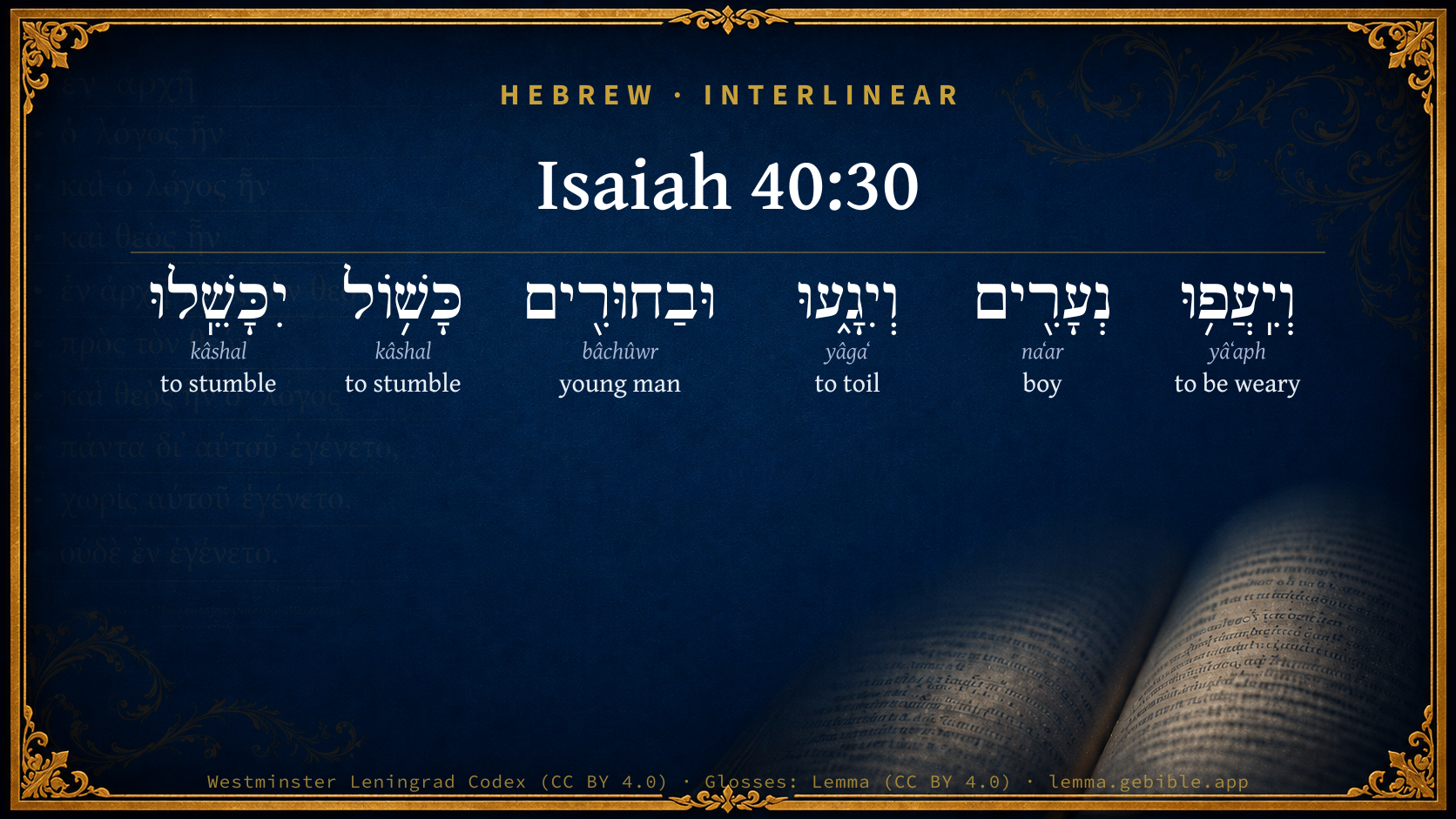
Isaiah 40:30

Hebrew (Westminster Leningrad Codex) Isaiah 40:30 appears in the Hebrew Old Testament. The text above is from the Westminster Leningrad Codex. Each word links to its Strong’s number, a concise gloss, and parsing drawn from the Open Scriptures Hebrew Bible morphology. Click any word for its full Brown-Driver-Briggs (BDB) entry.
Download image
Cite this verse

Isaiah 40:30 (World English Bible). Public Domain. Lemma interlinear Bible study tool, https://lemma.gebible.app/v/isaiah/40/30.

Show BibTeX & RIS
BibTeX
RIS
English Translation
Even the youths shall faint and be weary, and the young men shall utterly fall:
World English Bible · Public Domain
Download a study sheet

One document with this verse’s original text, its word-by-word gloss line, the meaning frame, cross-references with their text, attributed commentary, and full source and license credits — printable, and it pastes into notes with its structure intact.

This verse Autodidact and up

Study sheet (.html) Plain text (.txt)

A passage Seminary Student

Up to 50 verses in one chapter. A passage sheet keeps up to 6 commentary sources and 12 cross-references per verse, in the order this page ranks them, and says so on the sheet whenever that leaves anything out. Ask for a single verse and you get the Autodidact verse sheet above.

Everything on this page stays free to read, with no account — the sheet is a download of what is already on screen, not access to it.

Want to remove ads? Support Godless Engineer
Compare translations 3

The same verse in 3 English versions, stacked beneath the original-language interlinear above. Click any original word for its lexicon entry.

Each is an independent rendering of the whole verse — the interlinear is not word-aligned to these translations.

Highlighted words mark where these versions differ — a whole-verse word diff, not a word-by-word alignment.

  • World English Bible Public Domain
    Even the youths shall faint and be weary, and the young men shall utterly fall:
  • King James Version Public Domain
    Even the youths shall faint and be weary, and the young men shall utterly fall:
  • unfoldingWord Literal Text CC BY-SA 4.0
    Even youths tire and become weary, and young men, stumbling, they stumble.

unfoldingWord Literal Text — © unfoldingWord, licensed CC BY-SA 4.0. Word-aligned USFM3 via Door43 (git.door43.org/unfoldingWord/en_ult).

Versions to compare (up to 4)

3 of 4 selected

Show all 18 translations

Every available English version of this verse, each an independent rendering of the whole verse.

  • World English Bible Public Domain
    Even the youths shall faint and be weary, and the young men shall utterly fall:
  • Berean Standard Bible Public Domain
    Even youths grow tired and weary, and young men stumble and fall.
  • Majority Standard Bible Public Domain
    Even youths grow tired and weary, and young men stumble and fall.
  • King James Version Public Domain
    Even the youths shall faint and be weary, and the young men shall utterly fall:
  • American Standard Version (1901) Public Domain
    Even the youths shall faint and be weary, and the young men shall utterly fall:
  • Revised Version (1885) Public Domain
    Even the youths shall faint and be weary, and the young men shall utterly fall:
  • Geneva Bible (1599) Public Domain
    Euen the yong men shall faint, and be wearie, and the yong men shall stumble and fall.
  • Douay-Rheims (1899) Public Domain
    Youths shall faint, and labour, and young men shall fall by infirmity.
  • Young's Literal Translation Public Domain
    Even youths are wearied and fatigued, And young men utterly stumble,
  • Literal Standard Version CC BY-SA 4.0
    Even youths are wearied and fatigued, || And young men utterly stumble,
  • Unlocked Literal Bible CC BY-SA 4.0
    Even young people become tired and weary, and young men stumble and fall:
  • unfoldingWord Literal Text CC BY-SA 4.0
    Even youths tire and become weary, and young men, stumbling, they stumble.
  • Darby Bible Public Domain
    Even the youths shall faint and shall tire, and the young men shall stumble and fall;
  • World Messianic Bible Public Domain
    Even the youths faint and get weary, and the young men utterly fall;
  • Webster's Bible Public Domain
    Even the youths shall faint and be weary, and the young men shall utterly fall:
  • Free Bible Version CC BY-SA 4.0
    Even young people grow weak and tired—they fall down when they're exhausted.
  • Bible in Basic English Public Domain
    Even the young men will become feeble and tired, and the best of them will come to the end of his strength;
  • JPS Tanakh (1917) Public Domain
    Even the youths shall faint and be weary, and the young men shall utterly fall;

Literal Standard Version (2020), Covenant Press — licensed CC BY-SA 4.0. Text via the HelloAO Bible API (eBible.org). Unlocked Literal Bible (unfoldingWord) — licensed CC BY-SA 4.0. Text via the HelloAO Bible API (eBible.org). unfoldingWord Literal Text — © unfoldingWord, licensed CC BY-SA 4.0. Word-aligned USFM3 via Door43 (git.door43.org/unfoldingWord/en_ult). Free Bible Version, Dr. Jonathan Gallagher — licensed CC BY-SA 4.0. Text via the HelloAO Bible API (eBible.org).

Word by word

More ways to search: Search by grammar → Find every occurrence → Compare this word →

Practice this passage: Drill this verse → Learn its vocabulary →

About this verse

These counts appear in no published source. They are computed here, from the morphology-tagged text and Lemma’s own curated glosses. What Lemma adds →

6
words
5
distinct lemmas
Prophets
section

Notable vocabulary

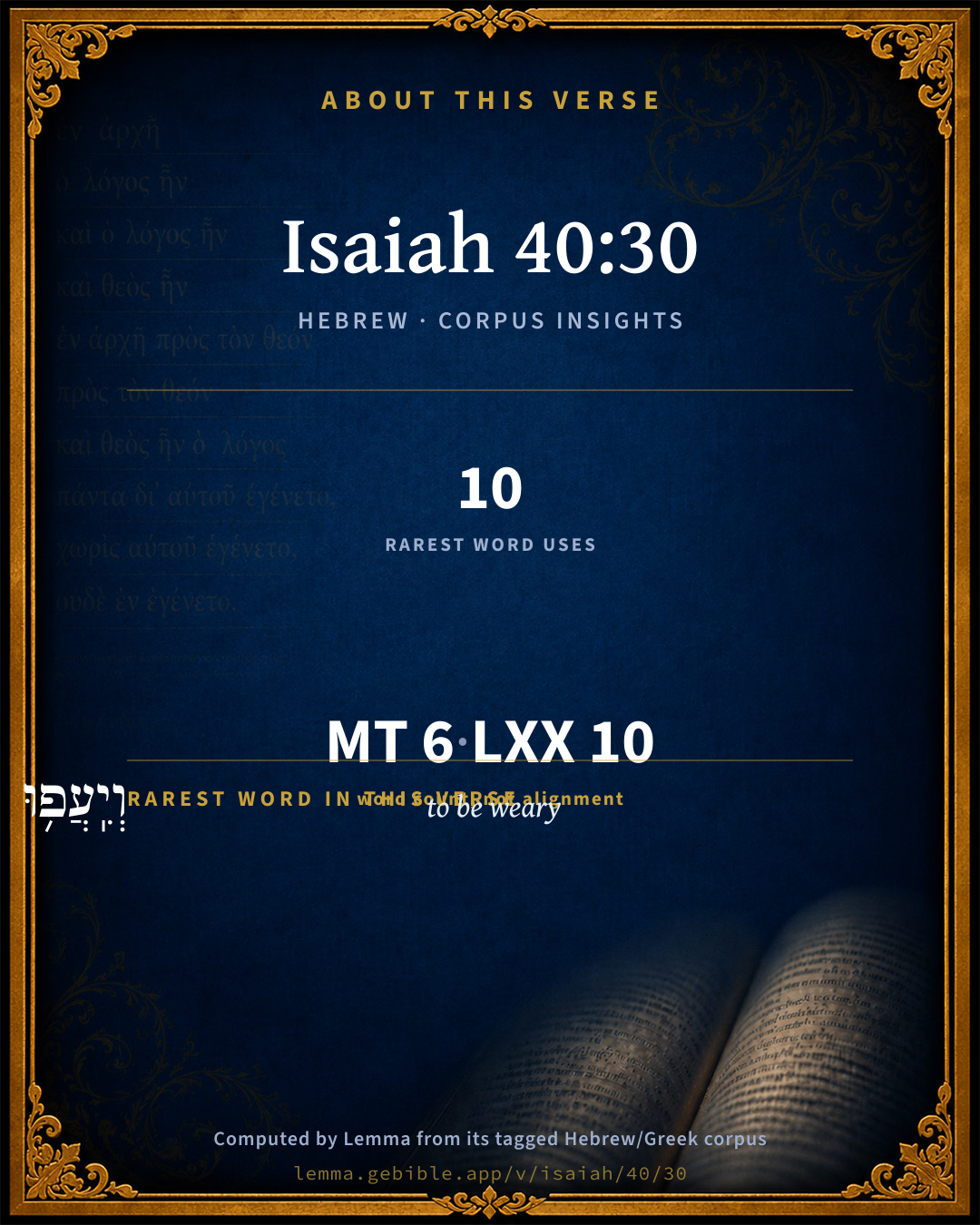
The rarest word here is וְיִֽעֲפ֥וּ to be weary H3286 — appearing just 10 times in the whole Hebrew Bible.

Shared distinctive vocabulary

וְיִֽעֲפ֥וּ to be weary H3286 occurs in 10 verses of the Hebrew Bible. Also found in:

Grammatical profile

  • 4 verbs
  • 2 nouns

Verb forms

  • וְיִֽעֲפ֥וּ Qal · Imperfect
  • וְיִגָ֑עוּ Qal · Imperfect
  • כָּשׁ֥וֹל Qal · Infinitive Absolute
  • יִכָּשֵֽׁלוּ Niphal · Imperfect

Repetition

A word recurs within this verse — often emphatic in Hebrew:

  • כָּשׁ֥וֹל to stumble H3782 ×2

Hebrew & Septuagint length

In English translation the verse runs 15 words from the Hebrew and 19 from the Septuagint (LXX English) — closely comparable.

A rough comparison of the two English renderings, which tokenize alike — not a word-level alignment.

Word counts can differ between the Hebrew and the Greek without any difference in meaning — e.g. the Hebrew direct-object marker אֵת has no separate Greek word, and Greek often adds the article ὁ.

In the original languages it is 6 Hebrew tokens and 10 Greek tokens — but the two are counted differently (Hebrew bundles its prefixes and suffixes into one token; the Greek is in lemma form), so that isn’t a like-for-like length.

Cross-references

6

Topical passages linked to Isaiah 40:30 in the Treasury of Scripture Knowledge — connected by theme and wording, ordered by reader-vote popularity; previews shown in the World English Bible.

  • Amos 2:14 Flight will perish from the swift; And the strong won't strengthen his force; Neither shall the mighty deliver himself;
  • Psalms 34:10 The young lions do lack, and suffer hunger, But those who seek Yahweh shall not lack any good thing.
  • Psalms 33:16 There is no king saved by the multitude of a host. A mighty man is not delivered by great strength.
  • Ecclesiastes 9:11 I returned, and saw under the sun, that the race is not to the swift, nor the battle to the strong, neither yet bread to the wise, nor yet riches to men of understanding, nor yet favor to men of skill; but time and chance happen to them all.
  • Isaiah 9:17 Therefore the Lord will not rejoice over their young men, neither will he have compassion on their fatherless and widows; for everyone is profane and an evil-doer, and every mouth speaks folly. For all this his anger is not turned away, but his hand is stretched out still.
  • Isaiah 13:18 [Their] bows shall dash the young men in pieces; and they shall have no pity on the fruit of the womb; their eye shall not spare children.

Cross-references courtesy of OpenBible.info (CC BY 4.0).

Hebrew and Greek witnesses Masoretic Hebrew ↔ Greek Septuagint

The same verse in the two great witnesses to the Old Testament, shown verse-for-verse.

These are two independent witnesses, not word-aligned to each other, and the Septuagint is shown in lemma (dictionary) form.

Hebrew Isaiah 40:30 Masoretic · Westminster Leningrad Codex

וְיִֽעֲפ֥וּ נְעָרִ֖ים וְיִגָ֑עוּ וּבַחוּרִ֖ים כָּשׁ֥וֹל יִכָּשֵֽׁלוּ

Even the youths shall faint and be weary, and the young men shall utterly fall:

World English Bible · Public Domain

Greek LXX Isaiah 40:30 Septuagint · lemma form

πεινάω γάρ νέος καί κοπιάω νεανίσκος καί ἐκλεκτός ἀναἰσχύω εἰμί

For the young men shall hunger, and the youths shall be weary, and the choice men shall be powerless:

LXX2012 (modern English Septuagint) · Public Domain

Hebrew: Westminster Leningrad Codex (CC BY 4.0). Greek: Septuagint (public domain); English from LXX2012 (modern English Septuagint) (Public Domain). How the Septuagint differs from the Hebrew →

Targum (Aramaic paraphrase)

1

The Targum is the ancient Jewish Aramaic paraphrase of the Hebrew Scriptures — an interpretive translation, not the Hebrew text itself. Onkelos (literal) and Pseudo-Jonathan (expansive) render the Torah, and Jonathan the Prophets. Coverage is partial: where no permissively-licensed English translation exists for a verse, only the Aramaic is shown. This is verse-level text, not a word-by-word alignment to the Hebrew.

  1. Targum Jonathan Prophets (Joshua–Malachi)
    וְיִשְׁתַּלְהוּן עוּלֵימִין חַיָבִין וְיִלְאוּן וּרְוָקֵי רַשִׁיעַיָא אִיתְּקָלָא יִתְקְלוּן:

    And the wicked youths shall be fatigued and shall be weary; and the impious young men shall utterly fall.

    Targum Jonathan — Aramaic: “Mikraot Gedolot” (public domain). English: “Sefaria Community Translation” (CC0 1.0 (public-domain dedication)); “London "Chaldee Paraphrase," 1871” (public domain). Text via Sefaria.

Commentary

Notes on Isaiah 40:30 from classic Christian and Jewish commentators (each source and its license shown beneath its notes). The classic Christian expositions comment on the surrounding passage and are grouped to its opening verse, so a note may address several verses; the Jewish commentaries on the Tanakh (Rashi and others) are per-verse, so they appear only where the commentator wrote on this verse.

Lemma curates 59 commentaries, every one of them public domain or Creative Commons licensed, each selected and text-cleaned for this edition rather than reprinted as found. About our sources →

Trapp's Complete Commentary

John Trapp

Isa 40:30 Even the youths shall faint and be weary, and the young men shall utterly fall:

Ver. 30. Even the youths shall faint.] All that trust to their own strength shall tire out. Like as the hare, that trusteth to the swiftness of her legs, is at length overtaken and torn in pieces; when the coney, that flieth to the holes in the rocks, doth easily avoid the dogs that pursue her.

John Trapp, A Commentary or Exposition upon All the Books of the Old and New Testament (1647–1656) — public domain. Text from a community e-Sword module.

The Biblical Illustrator

Joseph S. Exell

Isa_40:30-31

Even the youths shall faint

The unfainting spirit

The Hebrew tendency to lean upon the most muscular arm accessible, to buy up horses from Egypt in imitation of the warriors of the plains, to form alliances with neighbouring peoples in a neighbourly, instead of acting in the true Israelite spirit--was a tendency not confined to Hebrew blood.

It is in human nature to live by eyesight, and to go on doing so even although everything should go to wreck under our very eyes. The true Israelite spirit felt--wherever that spirit prevailed--that Gods assuring word had more muscle in it than an army ofPhilistines; that Egyptian cavalry was an encumbrance; that Assyrian spears might be turned into withered blades of grass in a nights time; and that the only solid ground that never quaked was the Rock that faith stood upon. For the unseen is harder, stronger--has more vitality and power of renewal in it--than the youngest, freshest, fairest, and most select powers that are seen. Our desire is to show wherein lies the power of renewed life and force in a soul and in a Church, so that the vigour shall be real and elastic, being the very strength of God.

I. THE PROPHET EXPECTS THE NATURAL FAINTING AND FALLING OF THE SELECT MEN. Young men reads literally the select men,--those picked out for an enterprise on account of their youthful vigour.

II. A SPIRITUAL EMPOWERING OF ALL MEN IS PROVIDED THROUGH WAITING ON GOD. Panic seized our Lords disciples on the arrest of their Master, and their flight revealed their lack of power. They were converted men, but they fainted and failed. They were young and select, but they fled. When about to part from them, Jesus bade them remain where they were, and not attempt the discipling of the world until they should receive power. The word renew in this place signifies change. The strength sufficient for one day, and its duty, may need to be exchanged for something larger, deeper, swifter for the next day and its severer trials. The same Spirit works, changing the force and form of His working. How is the Spirit of God working in the renewal of strength to-day? What are the best people feeling the need of, but a closer union among themselves through an intenser, completer fellowship with God?

III. ISAIAH DESCRIBES THE MANIFESTATIONS OF A NEW AND STRONG LIFE IN GOD. A cheering succession of Saxon sentences, precious powers, most desirable energies.

1. There is heavenly elevation. They shall mount up with wings as eagles. Theodore Monod says: If you want to do something, do not try to be somebody. Certainly, self-exaltation is not heavenly. It ensures your poor wings being clipped or broken very soon. We speak exclusively of the spiritual realm. Live looking unto Jesus, and He will ere long set you with Him upon His throne.

2. There is quickened activity. They shall run and not be weary.

3. There is the unfainting every-day walk. They shall walk and not faint. The unfainting walk, the steady march from hour to hour, is the sharpest, truest, final test of a strong life. It is in trifles that character is revealed. It is in small, monotonous duties that we oftenest break down. (G. H. Dick.)

The secret of immortal youth

I. THE DREARY CERTAINTY OF WEARINESS AND DECAY.

1. The words point to the plain fact that all created and physical life, by the very law of its being, in the act of living tends to death; and by the very operation of its strength tends to exhaustion. There are three stages in every creatures life--that of growth, that of equilibrium, that of decay. You are in the first. If you live you will come to the second and the third.

2. The text points also to another fact, that, long before your natural life shall have begun to tend towards decay, hard work and occasional sorrows and responsibilities and burdens of all sorts will very often make you wearied and ready to faint. In your early days you dream of life as a kind of enchanted garden. Ah! long before you have traversed the length of one of its walks you will often have been tired of the whole thing, and weary of what is laid upon you.

3. My text points to another fact, as certain as gravitation, that the faintness and weariness and decay of the bodily strength will be accompanied with a parallel change in your feelings. We are drawn onward by hopes, and when we get them fulfilled we find that they are disappointing. Do you not think that, if that is so, it would be as well to face it? Do you not think that a wise man would take account of all the elements in forecasting his life, and would shape his conduct accordingly?

II. THE BLESSED OPPOSITE POSSIBILITY OF INEXHAUSTIBLE AND IMMORTAL STRENGTH. They that wait upon the Lord shall renew their strength, etc. The life of nature tends inevitably downward, but there may be another life within the life of nature which shall have the opposite motion, and tend as certainly upwards. Look on this possibility a little more closely.

1. Note, how to get at it. They that wait upon the Lord is Old Testament dialect for what in New Testament phraseology is meant by Believe on the Lord Jesus Christ. For the motion expressed here by waiting is that of expectant dependence, and the New Testament faith is the very same in its attitude of expectant dependence. The condition of the inflow of this unwearied life into our poor, fainting humanity is simply the trust in Jesus Christ the Redeemer of our souls. True, the revelation has advanced, the contents of that which we grasp are more developed. No matter where we stand on the course of life, there may come into our hearts a Divine Indweller, who laughs at weariness and knows nothing of decay.

2. What is this strength that we thus get, if we will, by faith? It is the true entrance into our souls of a Divine life. We who have Christ in our hearts by faith shall share, in some fashion and degree, in His wondrous prerogative of unwearied strength. So here is the promise. God will give Himself to you, and in the very heart of your decaying nature will plant the seed of an immortal being which shall, like His own, shake off fatigue from the limbs, and never tend to dissolution. The life of nature dies by living; the life of grace, which may belong to us all, lives by living, and lives evermore thereby. The oldest angels are the youngest. The longer men live in fellowship with Christ the stronger do they grow. And though our lives, whether we be Christians or no, are necessarily subject to the common laws of mortality, we may carry all that is worth preserving of the earliest stages into the latest; and when grey hairs are upon us, and we are living next door to our graves, we may still have the enthusiasm, the energy, and above all, the boundless hopefulness that made the gladness and the spring of our long-buried youth. They shall still bring forth fruit in old age.

3. The manner in which this immortal strength is exercised. There is strength to soar. Old men generally shed their wings, and can only manage to crawl. They have done with romance. Enthusiasms are dead. For the most part they are content, unless they have got Christ in their hearts, to keep along the low levels, and their soaring days are done. But if you and I have Jesus Christ for the life of our spirits, as certainly as fire sends its shooting tongues upwards, so certainly shall we rise above the sorrows and sins and cares of this dim spot which men call earth, and find ampler field for buoyant motion high up in communion with God. Strength to soar means the gracious power of bringing all heaven into our grasp, and setting our affections on things above. Life on earth were too wretched unless it were possible to mount up with wings as eagles. Again, you may have strength to run--that is to say, there is power waiting for you for all the great crises of your lives which call for special, though it may be brief, exertion. Such crises will come to each of you, in sorrow, work, difficulty, hard conflicts. And there is only one way to be ready for such times as these, and that is to live waiting on the Lord, near Christ, with Him in your hearts, and then nothing will come that will be too big for you. Strength to walk may be yours, i.e., patient power for persistent pursuit of weary, monotonous duty. (A. Maclaren, D. D.)

How to grow strong

I. We have here UNAIDED NATURE AT ITS BEST PROVING A DISMAL FAILURE. Youths and young men are the personification of activity, agility, vigour, and go. Their eye is not dim, nor their natural force abated. Moreover, the word here employed signifies the pick of the people, the flower of the youth, the very first and foremost. These are the strongest of the strong, the bravest of the brave. But what happens to them? Even these shall faint and be weary; even these shall fail and fall. It is in spiritual things that this disappointment is most to be deplored.

1. This is a picture of those who, starting in their own strength, are presently disillusioned. Here, then, is a picture of ourselves in our unregenerate condition.

2. This is a picture, too, of how we were when, having been convicted of sin, we began to try to cleave our own way to heaven, and to pave it too; when from self-complacency we turned to self-righteousness.

3. I see here, also, an all too accurate picture of some true Christians. The boastful Christian is represented here, the man who fancies that his native courage will carry him through, who imagines that his wide experience will suffice in his extremity, who supposes his rigid orthodoxy is enough.

4. There are some well-nigh prayerless Christians, too, who seem to imagine that since they are already converted to God, and have had great experience of His dealings, they need no longer be as fervent and as frequent at the mercy-seat as in early days.

II. PRAYERFUL DEPENDENCE UPON GOD MEANS UNQUALIFIED SUCCESS. They that wait, etc.

1. What is this waiting upon God?

(1) It involves humiliation and lamentation, a consciousness of need, a confession of weakness, an acknowledgment of sin. Do not think to get to the other stages except by this route. It is most unwise to seek to build a castle in the air, of even on the sands. Deep digging must precede lofty building.

(2) Then comes supplication, an earnest pouring out of the inmost heart to God.

(3) Mingled with the supplication is expectation.

(4) Yet with supplication and expectation there is resignation.

(5) There is not necessarily inaction; indeed those that wait upon the Lord are the very ones who are most in earnest, and most active.

2. What is the result of waiting upon God?

(1) They shall renew their strength. This means that they shall change their strength. They shall put off their own threadbare, worn-out, poverty stricken strength, and they shall be clad with strength as with a garment, a garment that has been woven in celestial looms. It means among other things, that the strength they have, God-given, shall be adapted to special circumstances, and applied to peculiar conditions. I know how possible it is to have a goodly measure of strength, and yet not know how to use it. Those who wait on the Lord are taught spiritual economy. They make the most of the little they have, and by using it, it is increased. They are as those who, having a long journey to undertake, have made arrangements previously that at each stage there shall be a flesh horse awaiting them.

(2) They shall mount up with wings as eagles, that is, they shall fly. I have often wondered what the sensation of flying may be like. I have nothing to guide me except sundry dreams. It is a most delightful sensation, except when it ends, and then you wish you had not gone in for it at all. Alas! that so many of our fellow-men have set their minds on flying. They have invented flying-machines, so-called, with which they have almost invariably till now courted disaster. I know a flying machine worth all of these. I will not soar to heaven on wings of wax, which melt as they get near the sun, but on wings which God supplies, wings of hope, and faith, and prayer, and praise.

(3) They shall run, and however much they run, and however fast they run, they shall not be weary. What wonderful progress those make who trust God.

(4) They shall walk and not faint. Divine strength enables us for patient continuance in well-doing. What is the secret of all this? God is at the bottom of it. Compare Isa_40:6 with Isa_40:10; Isa_40:12, etc. There is nothing impossible to those who love God. (T. Spurgeon.)

The Biblical Illustrator, edited by Joseph S. Exell (c. 1880s–1900s) — public domain. Text from a community e-Sword module.

Keil & Delitzsch

C. F. Keil & F. Delitzsch

Faith is all that is needed to ensure a participation in the strength (עצמה after the form חכמה), which He so richly bestows and so powerfully enhances. "And youths grow faint and weary, and young men suffer a fall. But they who wait for Jehovah gain fresh strength; lift up their wings like eagles; run, and are not weary; go forward, and do not faint." Even youths, even young men in the early bloom of their morning of life (bachūrı̄m, youths, from בּחר, related to בּכר, בּגר), succumb to the effects of the loss of sustenance or over-exertion (both futures are defective, the first letter being dropped), and any outward obstacle is sufficient to cause them to fall (נכשׁל with inf. abs. kal, which retains what has been stated for contemplation, according to Ges. 131, 3, Anm. 2). In Isa 40:30 the verb stands first, Isa 40:30 being like a concessive clause in relation to Isa 40:31. "Even though this may happen, it is different with those who wait for Jehovah," i.e., those who believe in Him; for the Old Testament applies to faith a number of synonyms denoting trust, hope, and longing, and thus describes it according to its inmost nature, as fiducia and as hope, directed to the manifestation and completion of that which is hoped for. The Vav cop. introduces the antithesis, as in Isa 40:8. החליף, to cause one to pursue, or new to take the place of the old (Lat. recentare). The expression וגו יעלוּ is supposed by early translators, after the Sept., Targ. Jer., and Saad., to refer to the moulting of the eagle and the growth of the new feathers, which we meet with in Psa 103:5 (cf., Mic 1:16) as a figurative representation of the renewal of youth through grace. But Hitzig correctly observes that העלה is never met with as the causative of the kal used in Isa 5:6, and moreover that it would require נוצה instead of אבר. The proper rendering therefore is, "they cause their wings to rise, or lift their wings high, like the eagles" ('ēbher as in Psa 55:7). Their course of life, which has Jehovah for its object, is as it were possessed of wings. They draw from Him strength upon strength (see Psa 84:8); running does not tire them, nor do they become faint from going ever further and further.

The first address, consisting of three parts (Isa 40:1-11, Isa 40:12-26, Isa 40:27-31), is here brought to a close.

Keil & Delitzsch — Biblical Commentary on the Old Testament (1861–1891) — public domain (CC PDM 1.0). Text via the HelloAO Bible API. (Old Testament only.)

Geneva Bible (1599)

Geneva Bible translators

They that trust in their own virtue, and do not acknowledge that all cometh of God.

Geneva Bible (1599) marginal notes — public domain. Text via Bolls.life.

Jamieson, Fausset & Brown

Robert Jamieson, A. R. Fausset & David Brown

young men--literally, "those selected"; men picked out on account of their youthful vigor for an enterprise.

Jamieson, Fausset & Brown — Commentary Critical and Explanatory on the Whole Bible (1871) — public domain (CC PDM 1.0). Text via the HelloAO Bible API.

Ellicott's Commentary for English Readers

(30) Even the youths . . .—The second word implies a nearer approach to manhood than the first, the age when vigour is at its highest point.

A Bible Commentary for English Readers, edited by Charles John Ellicott (1878–1897) — public domain. Text from a community e-Sword module.

The Cambridge Bible for Schools and Colleges

gen. ed. J. J. S. Perowne

30. Even the youths shall faint …] Better: And though youths faint and are weary and choice young men stumble (the protasis to Isa_40:31). Natural strength at its best is exhausted, but—

The Cambridge Bible for Schools and Colleges (gen. ed. J. J. S. Perowne; Cambridge University Press, 1878–1918) — public domain. Text from a community e-Sword module.

John Gill's Exposition

But they that wait upon the Lord,.... As children on their parents, to do them honour, to obey their commands, and receive food and blessings from them; as servants on their masters, to know their pleasure, do their work, and have their wages; as clients on their patrons, to have advice of them, put their cause into their hands, and know how it goes; and as beggars at the door, who knock and wait, tell their case and wait, meet with repulses, yet keep their place, and continue waiting: such an act supposes a knowledge and reverence of God, confidence in him, attendance on him, not with the body only, in public and private, but with the soul also, and with some degree of constancy, and with patience and quietness: the Lord is to be waited upon for the manifestations of himself, who sometimes hides himself, but is to be waited for, since he has his set time to show himself again, and his presence is worth waiting for; also for the performance of his promises, which may be expected from his perfections, the nature of the promises, and their being in Christ; likewise for answers of prayer, and for the fresh discoveries of pardoning grace and mercy; and as Old Testament saints waited for the first coming of Christ, so New Testament saints for his second coming, and for eternal glory and happiness: and such "shall renew their strength"; which is to be understood of spiritual! strength in the heart, and of the graces of the Spirit there: it supposes strength received already, which natural men have not, but converted men have; and yet they want more, and more they shall have; to assist them in the performance of duty, to enable them to resist Satan and his temptations, and the corruptions of nature, and to cause them to endure afflictions and persecutions patiently, and to persevere unto the end:

they shall mount up with wings as eagles; swiftly and strongly; it is expressive of the motion of the affections heavenwards towards God and Christ, and things above; of the entrance of faith and hope within the veil, and of the exercise of these graces on Christ, who is now at the right hand of God; of the expectation of glory and happiness in heaven hereafter, and of present support under afflictions, the Lord bearing them as on eagles' wings; see Psa 103:5 (g):

they shall run, and not be weary; in the way of God's commandments; which shows great affection for them, haste to obey them, delight and pleasure, cheerfulness and alacrity, therein, so as to be without weariness:

and they shall, walk, and not faint: in the ways of God, in the name of the Lord, or in Christ, as they have received him; leaning on him, trusting in him, continuing to do so, till they receive the end of their faith, the salvation of their souls; and so shall not sink under their burdens, nor give out till they enjoy it; different persons, though all of them believers, may be here intended; particularly Christians under the Gospel dispensation, tried and exercised by many enemies; some shall soar aloft, and dwell on high; others, though they cannot rise and "fly" so swiftly and strongly, yet shall "run" without weariness; and others, though they can neither fly nor run, yet shall "walk" without fainting.

(g) The Jews have a notion, that for ten years the eagle ascends very high in the firmament of heaven, and approaching near to the heat of the sun, it falls into the sea, through the vehemence of the heat; and then it casts its feathers, and is renewed again, and its feathers grow, and it returns to the days of its youth; and so every ten years to a hundred; and in the hundredth year it ascends according to its custom, and falls into the sea, and dies. So Ben Melech from Saadiab Gaon.

Next: Isaiah Chapter 41

John Gill's Exposition of the Whole Bible (1746–1763) — public domain (CC PDM 1.0). Text via the HelloAO Bible API.

Albert Barnes' Notes on the Bible

Even the youths shall faint - The most vigorous young men, those in whom we expect manly strength, and who are best suited to endure hardy toil. They become weary by labor. Their powers are soon exhausted. The design here is, to contrast the most vigorous of the human race with God, and to show that while all their powers fail, the power of God is unexhausted and inexhaustible.

And the young men - The word used here denotes properly “those who are chosen or selected” (בחוּרים bachûriym, Greek ἐκλεκτοὶ eklektoi), and may be applied to those who were selected or chosen for any hazardous enterprise, or dangerous achievement in war; those who would be selected for vigor or activity. The meaning is, that the most chosen or select of the human family - the most vigorous and manly, must be worn down by fatigue, or paralyzed by sickness or death; but that the powers of God never grow weary, and that those who trust in him should never become faint.

Albert Barnes' Notes on the Bible (1834–1885) — public domain. Text from a community e-Sword/MySword module.

Matthew Poole's English Annotations

The youngest and strongest men, left to themselves, or without God’s help, or which do not wait upon God; which is easily understood from the opposition in the following verse.

Matthew Poole's English Annotations on the Holy Bible (1683–1685) — public domain. Text from a community e-Sword/MySword module.

Whedon's Commentary on the Bible

Daniel D. Whedon

30, 31. Youths shall faint — Young men chosen for war or other hard service, even, lose all their vigour. But they that wait upon (or for) the Lord, however weak physically.

Shall renew… strength — Become spiritually strong. Their waiting has the sense of expecting.

In general, the Old Testament gives not the full glory to come, but Isaiah has here caught the view. Starting from the exile condition and deliverance from it through trustful waiting, expecting, he sees spiritual victories under Messiah. Souls rise by faith, like eagles by their pinions. The imagery here is strikingly correspondent to Christian experiences.

Daniel D. Whedon (gen. ed.), Commentary on the Old and New Testaments (1874–1909) — public domain. Text from a community e-Sword module.

The Pulpit Commentary

Shall faint... shall fall; rather, should even the youths faint and be weary, and should the young men utterly fall, yet they that wait upon the Lord shall renew their strength, etc. The two clauses of ver. 30 are "concessive.

Spiritual faintness.

"Even the youths shall faint," ere. Then faintness is not a matter of age. Exhausted power may belong to youth. We are to learn that natural spirits are not enough for this great campaign. Health and energy will do much for the earthly soldier, and for the young mountaineer on the Swiss Alps. But it is otherwise here. From beginning to end of the Divine life we shall faint and fail unless God be with us to inspire and strengthen us.

I YOUNG EXPERIENCES. It is perhaps well that we should learn the great lesson early, so that we may never think of ourselves more highly than we ought to think. There are doubtless joyful experiences in our first love to Christ; but Bunyan was right when he placed the Slough of Despond so near the starting-place. We soon meet with disappointments and disheartenments. We are soon face to face with temptations which well-nigh overcome us. The Philistines make us afraid.

II FALLEN FORTUNES. Not in houses or estates, but in hearts and lives. We fall utterly tall. So that there may be no excuse, no palliation, no pretence that it was only a stumble; we cannot gaily pick ourselves up and go on our way as though nothing had happened. We are told of our utter failure. But to fall, even. is not to be lost. We may be maimed, bruised, broken, but God can lift us up. "Rejoice not over me, O mine enemy, for when I fall I shall arise." This is the victor-song of souls that trust not in themselves, but in him who is able to make all grace abound unto them. Never let the fallen, whether it be in faith, or creed, or character, be treated as lost. W.M.S.

The Pulpit Commentary (1880–1919), ed. H.D.M. Spence-Jones & Joseph S. Exell — public domain. Text from a community e-Sword module.

John Wesley's Explanatory Notes

The youths - The youngest and strongest men, left to themselves.

John Wesley, Explanatory Notes Upon the Whole Bible (1754–1765) — public domain. Text via the GEBible commentary corpus.

J. A. Alexander on Isaiah

Joseph Addison Alexander

“And (yet) weary shall youths be and faint, and chosen (youths) shall be weakened, be weakened.” There is here an obvious allusion to the terms of v. 28. What is there denied of God, is here affirmed, not only of men in general, but of the stoutest and most vigorous, aptly represented by the young men chosen for military service. That the prominent idea here conveyed is that of manly strength and vigor, is not questioned. The intensive repetition of the verb may either be expressed by the addition of an adverb, as in the English Version (utterly fall), or retained in the translation as above.

Joseph Addison Alexander, The Prophecies of Isaiah (1846–1847; New York: Scribner, 1870–1878) — public domain. Text from a community e-Sword module.

Rashi

Rabbi Shlomo Yitzchaki (Rashi)

Now youths shall become tired Heb. נְעָרִים. The might of your enemies who are devoid (מְנֹעָרִים) of commandments, shall become faint.

and young men shall stumble Those who are now mighty and strong, shall stumble, but you, who put your hope in the Lord shall gain new strength and power.

Rashi on the Tanakh — English translations: “The Judaica Press complete Tanach with Rashi, translated by A. J. Rosenberg” (CC BY 4.0); “Pentateuch with Rashi's commentary by M. Rosenbaum and A.M. Silbermann, 1929-1934” (public domain); “The Metsudah Tanach series, Lakewood, N.J” (CC BY 4.0); and “The Book of Joshua, Metsudah Publications, 1997” (CC BY 4.0). Text via Sefaria.

Ibn Ezra

Rabbi Abraham ibn Ezra

Even the youths who have strength, faint, etc.

Ibn Ezra on the Tanakh — English translations: “Sefaria Community Translation” (CC0 1.0 (public-domain dedication)); “Yalkut, Sifsei Chachomim Chumash, Metsudah Publications, 2009” (CC BY 4.0); and “Commentary of Ibn Ezra on Isaiah - trans. by M. Friedlander, 1873” (public domain). Text via Sefaria.

Lesson kit

Teaching starters — assembled from the data on this page, not authored interpretation. Every prompt links to the verse data it draws on. Edit before teaching.

Isaiah, in the Prophets, opens this verse with 6 words (5 distinct Hebrew lemmas). Its most distinctive word is yâʻaph (“to be weary”). A historical commentator’s framing appears above. Read the whole chapter for the surrounding context.

Discussion questions

  1. What does “to be weary” (yâʻaph) contribute to the verse as a whole?
  2. Judges 8:15 shares the word «to be weary» with this verse. How do the two illuminate each other?
  3. “to stumble” occurs 2× in this one verse. What is the effect of the repetition?
  4. These translations render this verse differently; the difference is in the English rendering, not the original. What questions does that raise?
  5. The verb «וְיִֽעֲפ֥וּ» is Qal Imperfect. How does its form color the action?
  6. Reading how Trapp's Complete Commentary and The Biblical Illustrator read this verse, where do the two commentators agree and where do they part?

Things to notice

Reading settings

Reading text

Shown beneath each verse's original-language words.

Old Testament
Old Testament edition

Read the OT as the Masoretic Hebrew (MT) or the Greek Septuagint (LXX).

English shown for the Greek Septuagint (in the Hebrew ↔ Greek comparison).

Comparing translations? Open the Compare panel on any verse page to stack up to four side by side.