Ezekiel 36:14

Hebrew (Westminster Leningrad Codex) Ezekiel 36:14 appears in the Hebrew Old Testament. The text above is from the Westminster Leningrad Codex. Each word links to its Strong’s number, a concise gloss, and parsing drawn from the Open Scriptures Hebrew Bible morphology. Click any word for its full Brown-Driver-Briggs (BDB) entry.
Download image
Cite this verse

Ezekiel 36:14 (World English Bible). Public Domain. Lemma interlinear Bible study tool, https://lemma.gebible.app/v/ezekiel/36/14.

Show BibTeX & RIS
BibTeX
RIS
English Translation
therefore you shall devour men no more, neither bereave your nation any more, says the Lord Yahweh;
World English Bible · Public Domain
Download a study sheet

One document with this verse’s original text, its word-by-word gloss line, the meaning frame, cross-references with their text, attributed commentary, and full source and license credits — printable, and it pastes into notes with its structure intact.

This verse Autodidact and up

Study sheet (.html) Plain text (.txt)

A passage Seminary Student

Up to 50 verses in one chapter. A passage sheet keeps up to 6 commentary sources and 12 cross-references per verse, in the order this page ranks them, and says so on the sheet whenever that leaves anything out. Ask for a single verse and you get the Autodidact verse sheet above.

Everything on this page stays free to read, with no account — the sheet is a download of what is already on screen, not access to it.

Want to remove ads? Support Godless Engineer
Compare translations 3

The same verse in 3 English versions, stacked beneath the original-language interlinear above. Click any original word for its lexicon entry.

Each is an independent rendering of the whole verse — the interlinear is not word-aligned to these translations.

Highlighted words mark where these versions differ — a whole-verse word diff, not a word-by-word alignment.

  • World English Bible Public Domain
    therefore you shall devour men no more, neither bereave your nation any more, says the Lord Yahweh;
  • King James Version Public Domain
    Therefore thou shalt devour men no more, neither bereave thy nations any more, saith the Lord GOD.
  • unfoldingWord Literal Text CC BY-SA 4.0
    therefore you will not consume people any longer, and you will no longer make your nation mourn their deaths. This is the Lord Yahweh’s declaration.

unfoldingWord Literal Text — © unfoldingWord, licensed CC BY-SA 4.0. Word-aligned USFM3 via Door43 (git.door43.org/unfoldingWord/en_ult).

Versions to compare (up to 4)

3 of 4 selected

Show all 18 translations

Every available English version of this verse, each an independent rendering of the whole verse.

  • World English Bible Public Domain
    therefore you shall devour men no more, neither bereave your nation any more, says the Lord Yahweh;
  • Berean Standard Bible Public Domain
    therefore you will no longer devour men or deprive your nation of its children, declares the Lord GOD.
  • Majority Standard Bible Public Domain
    therefore you will no longer devour men or deprive your nation of its children, declares the Lord GOD.
  • King James Version Public Domain
    Therefore thou shalt devour men no more, neither bereave thy nations any more, saith the Lord GOD.
  • American Standard Version (1901) Public Domain
    therefore thou shalt devour men no more, neither bereave thy nation any more, saith the Lord Jehovah;
  • Revised Version (1885) Public Domain
    therefore thou shalt devour men no more, neither bereave thy nation any more, saith the Lord GOD;
  • Geneva Bible (1599) Public Domain
    Therefore thou shalt deuoure men no more, neither waste thy people henceforth, sayth the Lord God,
  • Douay-Rheims (1899) Public Domain
    Therefore thou shalt devour men no more, nor destroy thy nation any more, saith the Lord God:
  • Young's Literal Translation Public Domain
    Therefore, man thou devourest no more, And thy nations thou causest not to stumble any more, An affirmation of the Lord Jehovah.
  • Literal Standard Version CC BY-SA 4.0
    Therefore, you no longer devour man, || And you do not cause your nations to stumble anymore, || A declaration of Lord YHWH.
  • Unlocked Literal Bible CC BY-SA 4.0
    therefore you will not consume people any longer, and you will no longer make your nation mourn their deaths. This is the Lord Yahweh's declaration.
  • unfoldingWord Literal Text CC BY-SA 4.0
    therefore you will not consume people any longer, and you will no longer make your nation mourn their deaths. This is the Lord Yahweh’s declaration.
  • Darby Bible Public Domain
    therefore thou shalt devour men no more, neither bereave thy nation any more, saith the Lord Jehovah;
  • World Messianic Bible Public Domain
    therefore you shall devour men no more, and not bereave your nation any more,” says the Lord GOD.
  • Webster's Bible Public Domain
    Therefore thou shalt devour men no more, neither bereave thy nations any more, saith the Lord GOD.
  • Free Bible Version CC BY-SA 4.0
    from now on you won't eat people or rob your nation of their children, declares the Lord God.
  • Bible in Basic English Public Domain
    For this reason you will no longer take the lives of men and will never again be the cause of loss of children to your nation, says the Lord.
  • JPS Tanakh (1917) Public Domain
    therefore thou shalt devour men no more, neither bereave thy nations any more, saith the Lord GOD;

Literal Standard Version (2020), Covenant Press — licensed CC BY-SA 4.0. Text via the HelloAO Bible API (eBible.org). Unlocked Literal Bible (unfoldingWord) — licensed CC BY-SA 4.0. Text via the HelloAO Bible API (eBible.org). unfoldingWord Literal Text — © unfoldingWord, licensed CC BY-SA 4.0. Word-aligned USFM3 via Door43 (git.door43.org/unfoldingWord/en_ult). Free Bible Version, Dr. Jonathan Gallagher — licensed CC BY-SA 4.0. Text via the HelloAO Bible API (eBible.org).

Word by word

More ways to search: Search by grammar → Find every occurrence → Compare this word →

Practice this passage: Drill this verse → Learn its vocabulary →

תְשַׁכְּלִי
shâkôl
H7921
“to be bereaved”
Verb, Piel, Imperfect, 2nd Person, Feminine, Singular
Part of Speech
Verb
Stem
Piel
Form
Imperfect
Person
2nd Person
Gender
Feminine
Number
Singular
Full BDB Definition

Origin: a primitive root

TWOT: 2385

to be bereaved, make childless, miscarry - (Qal) to be bereaved - (Piel) - to make childless - to cause barrenness, show barrenness or abortion - to miscarry - (Hiphil) miscarrying (participle)
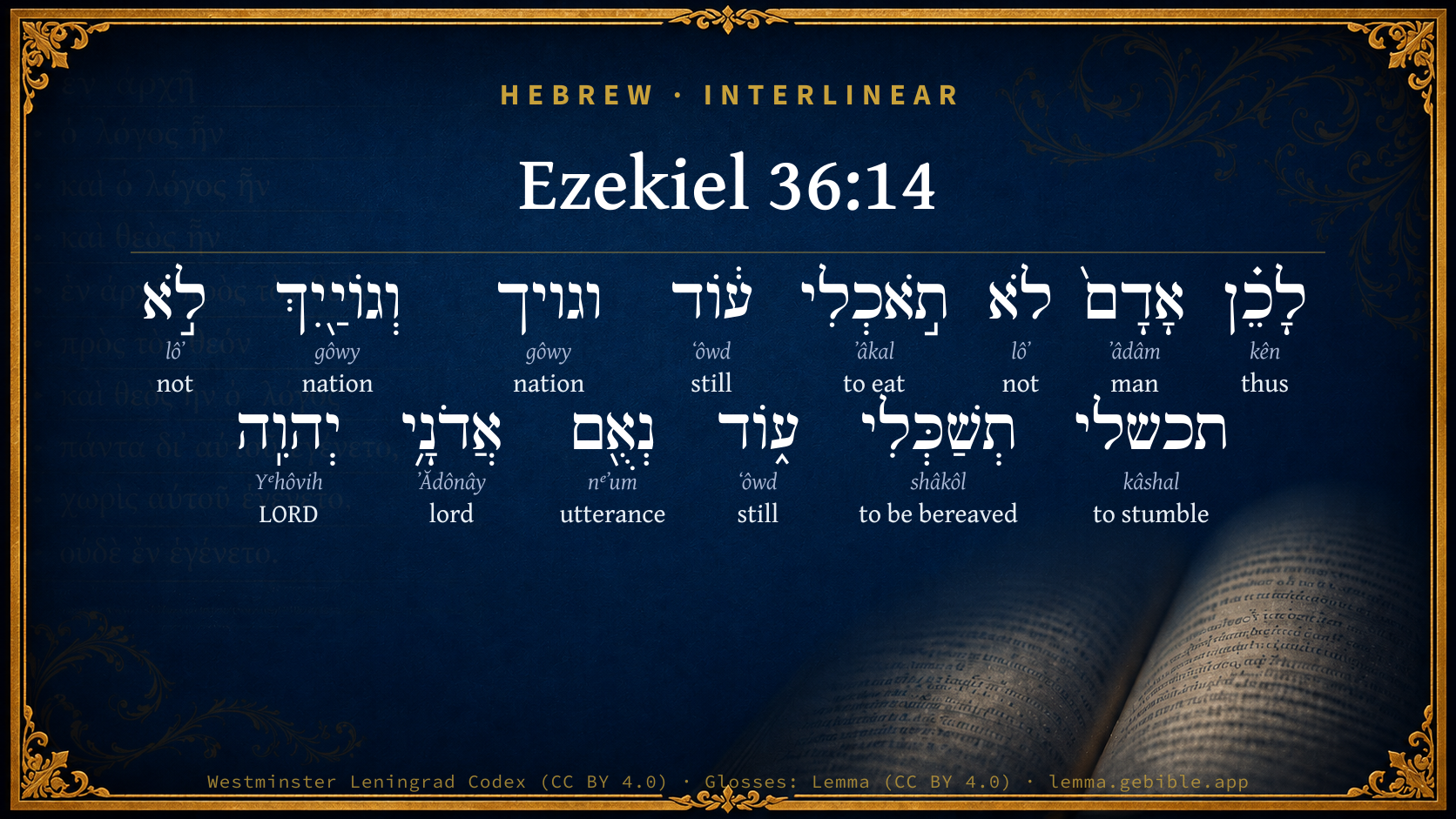
  1. לָכֵ֗ן kên H3651 “to/for · thus” Preposition + Adverb
  2. אָדָם֙ ʼâdâm H120 “man” Noun, Common, Masculine, Singular, Absolute
  3. לֹא lôʼ H3808 “not” Particle, Negative
  4. תֹ֣אכְלִי ʼâkal H398 “to eat” Verb, Qal, Imperfect, 2nd Person, Feminine, Singular
  5. ע֔וֹד ʻôwd H5750 “still” Adverb
  6. וגויך gôwy H1471 “and · nation · your” Conjunction + Noun, Common, Masculine, Singular, Construct + Suffix, Personal, 2nd Person, Feminine, Singular
  7. וְגוֹיַ֖יִךְ gôwy H1471 “and · nations · your” Conjunction + Noun, Common, Masculine, Plural, Construct + Suffix, Personal, 2nd Person, Feminine, Singular
  8. לֹ֣א lôʼ H3808 “not” Particle, Negative
  9. תכשלי kâshal H3782 “to stumble” Verb, Piel, Imperfect, 2nd Person, Feminine, Singular
  10. ע֑וֹד ʻôwd H5750 “still” Adverb
  11. נְאֻ֖ם nᵉʼum H5002 “utterance of” Noun, Common, Masculine, Singular, Construct
  12. אֲדֹנָ֥י ʼĂdônây H136 “Lord · my” Noun, Common, Masculine, Plural, Construct + Suffix, Personal, 1st Person, Common, Singular
  13. יְהוִֽה Yᵉhôvih H3069 “LORD” Noun, Proper

About this verse

These counts appear in no published source. They are computed here, from the morphology-tagged text and Lemma’s own curated glosses. What Lemma adds →

14
words
11
distinct lemmas
Prophets
section

Notable vocabulary

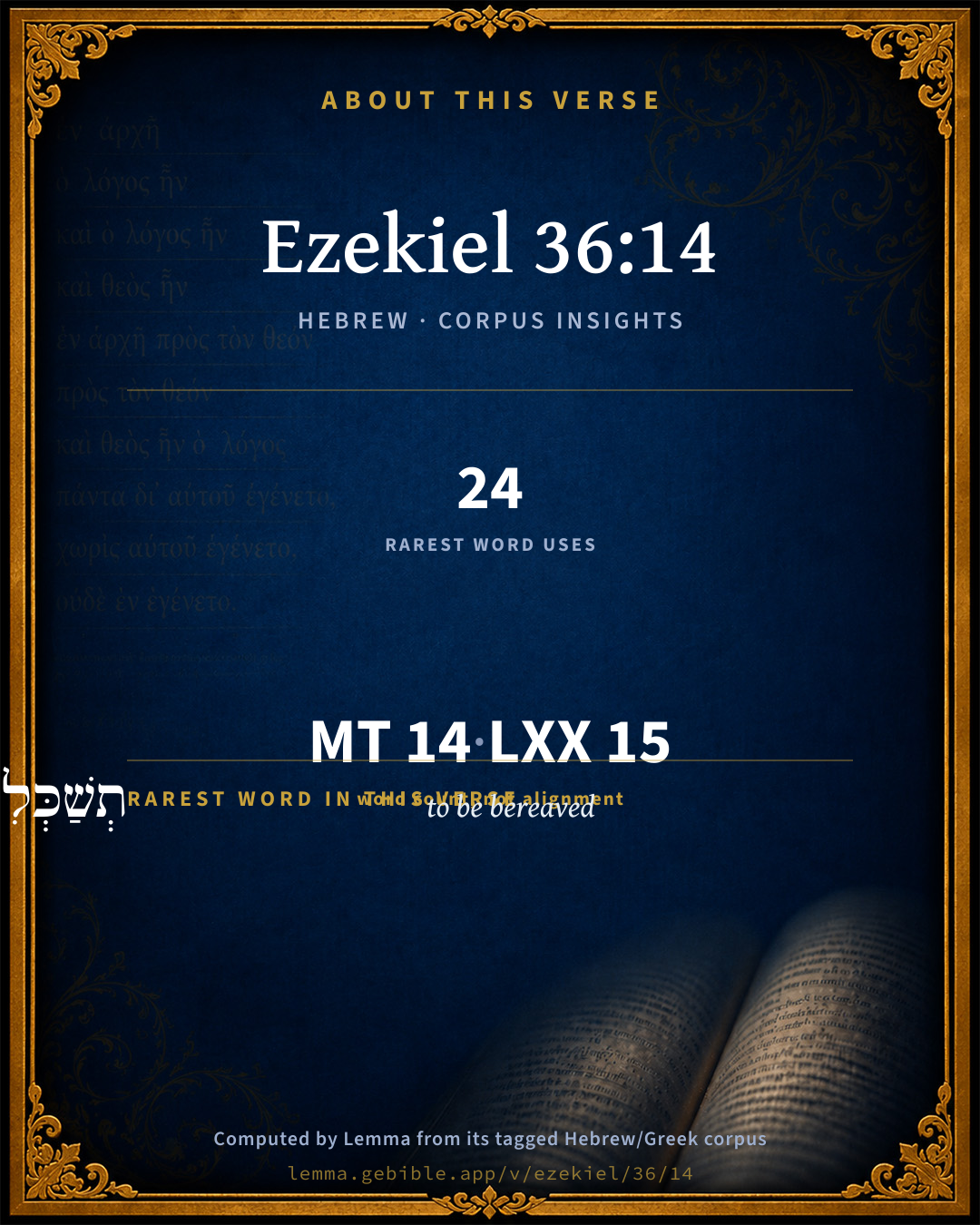
The rarest word here is תְשַׁכְּלִי to be bereaved H7921 — appearing just 24 times in the whole Hebrew Bible.

Shared distinctive vocabulary

תְשַׁכְּלִי to be bereaved H7921 occurs in 22 verses of the Hebrew Bible. Also found in:

Grammatical profile

  • 3 verbs
  • 6 nouns
  • 3 adverbs
  • 2 particles

Verb forms

  • תֹ֣אכְלִי Qal · Imperfect
  • תכשלי Piel · Imperfect
  • תְשַׁכְּלִי Piel · Imperfect

Repetition

Words recur within this verse — often emphatic in Hebrew:

  • ע֔וֹד still H5750 ×2
  • וגויך nation H1471 ×2
  • לֹא not H3808 ×2

Hebrew & Septuagint length

In English translation the verse runs 17 words from the Hebrew and 19 from the Septuagint (LXX English) — closely comparable.

A rough comparison of the two English renderings, which tokenize alike — not a word-level alignment.

Word counts can differ between the Hebrew and the Greek without any difference in meaning — e.g. the Hebrew direct-object marker אֵת has no separate Greek word, and Greek often adds the article ὁ.

In the original languages it is 14 Hebrew tokens and 15 Greek tokens — but the two are counted differently (Hebrew bundles its prefixes and suffixes into one token; the Greek is in lemma form), so that isn’t a like-for-like length.

Cross-references

3

Topical passages linked to Ezekiel 36:14 in the Treasury of Scripture Knowledge — connected by theme and wording, ordered by reader-vote popularity; previews shown in the World English Bible.

  • Isaiah 60:21 Your people also shall be all righteous; they shall inherit the land forever, the branch of my planting, the work of my hands, that I may be glorified.
  • Ezekiel 37:25–28 They shall dwell in the land that I have given to Jacob my servant, in which your fathers lived; and they shall dwell therein, they, and their children, and their children's children, forever: and David my servant shall be their prince for ever.
  • Amos 9:15 I will plant them on their land, And they will no more be plucked up out of their land which I have given them," says Yahweh your God.

Cross-references courtesy of OpenBible.info (CC BY 4.0).

Hebrew and Greek witnesses Masoretic Hebrew ↔ Greek Septuagint

The same verse in the two great witnesses to the Old Testament, shown verse-for-verse.

These are two independent witnesses, not word-aligned to each other, and the Septuagint is shown in lemma (dictionary) form.

Hebrew Ezekiel 36:14 Masoretic · Westminster Leningrad Codex

לָכֵ֗ן אָדָם֙ לֹא תֹ֣אכְלִי ע֔וֹד וגויך וְגוֹיַ֖יִךְ לֹ֣א תכשלי תְשַׁכְּלִי ע֑וֹד נְאֻ֖ם אֲדֹנָ֥י יְהוִֽה

therefore you shall devour men no more, neither bereave your nation any more, says the Lord Yahweh;

World English Bible · Public Domain

Greek LXX Ezekiel 36:14 Septuagint · lemma form

διά οὗτος ἄνθρωπος οὐκέτι ἐσθίω καί ὁ ἔθνος σύ οὐ ἀτεκνόω ἔτι λέγω κύριος κύριος

therefore you shall no more devour men, and you shall no more bereave your nation, says the Lord God.

LXX2012 (modern English Septuagint) · Public Domain

Hebrew: Westminster Leningrad Codex (CC BY 4.0). Greek: Septuagint (public domain); English from LXX2012 (modern English Septuagint) (Public Domain). How the Septuagint differs from the Hebrew →

Targum (Aramaic paraphrase)

1

The Targum is the ancient Jewish Aramaic paraphrase of the Hebrew Scriptures — an interpretive translation, not the Hebrew text itself. Onkelos (literal) and Pseudo-Jonathan (expansive) render the Torah, and Jonathan the Prophets. Coverage is partial: where no permissively-licensed English translation exists for a verse, only the Aramaic is shown. This is verse-level text, not a word-by-word alignment to the Hebrew.

  1. Targum Jonathan Prophets (Joshua–Malachi)
    בְּכֵן אֱנָשָׁא לָא תִתְקַטְלִין עוֹד וְעַמִיךְ לָא תִתְכְּלִין עוֹד אֲמַר יְיָ אֱלֹהִים:

    (no public-domain English translation for this verse)

    Targum Jonathan — Aramaic: “Mikraot Gedolot” (public domain). English: “Sefaria Community Translation” (CC0 1.0 (public-domain dedication)); “London "Chaldee Paraphrase," 1871” (public domain). Text via Sefaria.

Commentary

Notes on Ezekiel 36:14 from classic Christian and Jewish commentators (each source and its license shown beneath its notes). The classic Christian expositions comment on the surrounding passage and are grouped to its opening verse, so a note may address several verses; the Jewish commentaries on the Tanakh (Rashi and others) are per-verse, so they appear only where the commentator wrote on this verse.

Lemma curates 59 commentaries, every one of them public domain or Creative Commons licensed, each selected and text-cleaned for this edition rather than reprinted as found. About our sources →

Trapp's Complete Commentary

John Trapp

Eze 36:14 Therefore thou shalt devour men no more, neither bereave thy nations any more, saith the Lord GOD.

Ver. 14. Neither bereave thy nations any more.] Either by consuming them, or spuing them out. {as Lev 18:28; Lev 20:22; Lev 26:20; Lev 26:22} See what is said of heaven, Rev 22:3-5.

John Trapp, A Commentary or Exposition upon All the Books of the Old and New Testament (1647–1656) — public domain. Text from a community e-Sword module.

Jamieson, Fausset & Brown

Robert Jamieson, A. R. Fausset & David Brown

bereave--so the Keri, or Hebrew Margin reads, to correspond to "bereave" in Eze 36:13; but "cause to fall" or "stumble," in the Hebrew text or Chetib, being the more difficult reading, is the one least likely to come from a corrector; also, it forms a good transition to the next subject, namely, the moral cause of the people's calamities, namely, their falls, or stumblings through sin. The latter ceasing, the former also cease. So the same expression follows in Eze 36:15, "Neither shalt thou cause thy nations to fall any more."

Jamieson, Fausset & Brown — Commentary Critical and Explanatory on the Whole Bible (1871) — public domain (CC PDM 1.0). Text via the HelloAO Bible API.

John Gill's Exposition

Therefore thou shalt devour men no more,.... Or they shall be no more destroyed in thee by pestilence, famine, sword, or other means:

neither bereave that nations any more, saith the Lord; or, "thou shalt not cause them to fall any more" (k), for so it is written, as in Eze 36:15, though the marginal reading is, "thou shalt not bereave", which we follow; and both are to be received, since miscarriages often come by falls.

(k) "non impingere facies", Montanus, Vatablus; "non offendere facies", Starckius.

John Gill's Exposition of the Whole Bible (1746–1763) — public domain (CC PDM 1.0). Text via the HelloAO Bible API.

Albert Barnes' Notes on the Bible

Bereave - Or, as in the margin: i. e., the land shall not prove the ruin of its inhabitants by tempting them (as of old time) to the sin of idolatry.

Albert Barnes' Notes on the Bible (1834–1885) — public domain. Text from a community e-Sword/MySword module.

Matthew Poole's English Annotations

I will so bless thee, O land, that thou shalt bring forth and breed up many sons and daughters, thou shalt see thy children’s children increase, and this reproach shall cease for ever.

Matthew Poole's English Annotations on the Holy Bible (1683–1685) — public domain. Text from a community e-Sword/MySword module.

The Pulpit Commentary

Thou shalt devour men no more. From the middle of ver. 12 the form of address changes from the plural to the singular, the whole country, mountains, and valleys being regarded as one land, as in Deu_3:25. The charge preferred against the country by her enemies was that she had been a land that devoured men and "bereaved its nations" (or, "nation," Revised Version) literally, an eater-up of men and a bereaver of thy nations; i.e. of Israel and Judah, perhaps also of the Canaanites, their predecessors (Fausset), the image being that of a wild beast which ravages the population and makes them childless, as in Eze_5:17 and Eze_14:15 (Smend), rather than that of an unnatural mother, a Rabenmutter , as in 2Ki_6:29, who devours her offspring (Ewald) This charge, in which, perhaps, the prophet detected an allusion. Num_13:32, had certainly in times past been true; not, however, as Hengstenberg suggests, because the land had been "an apple of discord for the Asiatic and African powers," or, as Ewald explains, because "the tremendous restlessness, the excited push and hurry of such a mentally active city must in any case have used up its inhabitants more rapidly;" but, as Keil, Plumptre, and others interpret, because of the judgments of sword, famine, and pestilence sent upon the land by Jehovah for its sins. These judgments had so destroyed its inhabitants, first the Canaanites, and latterly the two peoples of Israel and Judah, that "those who looked upon it deemed it a fatal land, which brought destruction to all who should occupy it" (Currey) In the golden age to which the prophet looked forward, no such reproach should be possible. Not only should the laud not bereave its nations (according to the Keri, followed by the Authorized and Revised Versions, as well as by Ewald and Smend), but (according to the Chethib, preferred by Keil, Kliefoth, Havernick, Heugstenberg, Schroder, and Plumptre) it should not even cause them (or it) to stumble; i.e. should no more cause its inhabitants to lapse into those sins, amongst which idolatry stood prominent, which entailed on them ruin. Hengstenberg"s idea, that "moral stumbling is not to be thought of in this connection," is certainly to be rejected.

The Pulpit Commentary (1880–1919), ed. H.D.M. Spence-Jones & Joseph S. Exell — public domain. Text from a community e-Sword module.

John Wesley's Explanatory Notes

Therefore - I will so bless thee, O land, that thou shalt bring forth and breed up many sons and daughters, and this reproach shall cease forever. 17. By their doings - By their carriage, and whole conversation. As the uncleanness - Or as one cut off from the congregation, because of some great sin.

John Wesley, Explanatory Notes Upon the Whole Bible (1754–1765) — public domain. Text via the GEBible commentary corpus.

Lesson kit

Teaching starters — assembled from the data on this page, not authored interpretation. Every prompt links to the verse data it draws on. Edit before teaching.

Ezekiel, in the Prophets, opens this verse with 14 words (11 distinct Hebrew lemmas). Its most distinctive word is shâkôl (“to be bereaved”). A historical commentator’s framing appears above. Read the whole chapter for the surrounding context.

Discussion questions

  1. The word shâkôl carries the sense “to be bereaved.” How does it shape the verse?
  2. How does Genesis 27:45, which shares the word «to be bereaved», read alongside this verse?
  3. What does the repetition of “still” (2× in this one verse) do in this verse?
  4. The translations on this page render this verse differently — a whole-verse word diff, not a word-by-word alignment. What might account for the different wordings?
  5. «תֹ֣אכְלִי» is a Qal Imperfect verb. How does that grammatical form shape the action described?
  6. Compare how Trapp's Complete Commentary and Jamieson, Fausset & Brown read this verse. Where do they agree or differ?

Things to notice

Reading settings

Reading text

Shown beneath each verse's original-language words.

Old Testament
Old Testament edition

Read the OT as the Masoretic Hebrew (MT) or the Greek Septuagint (LXX).

English shown for the Greek Septuagint (in the Hebrew ↔ Greek comparison).

Comparing translations? Open the Compare panel on any verse page to stack up to four side by side.