
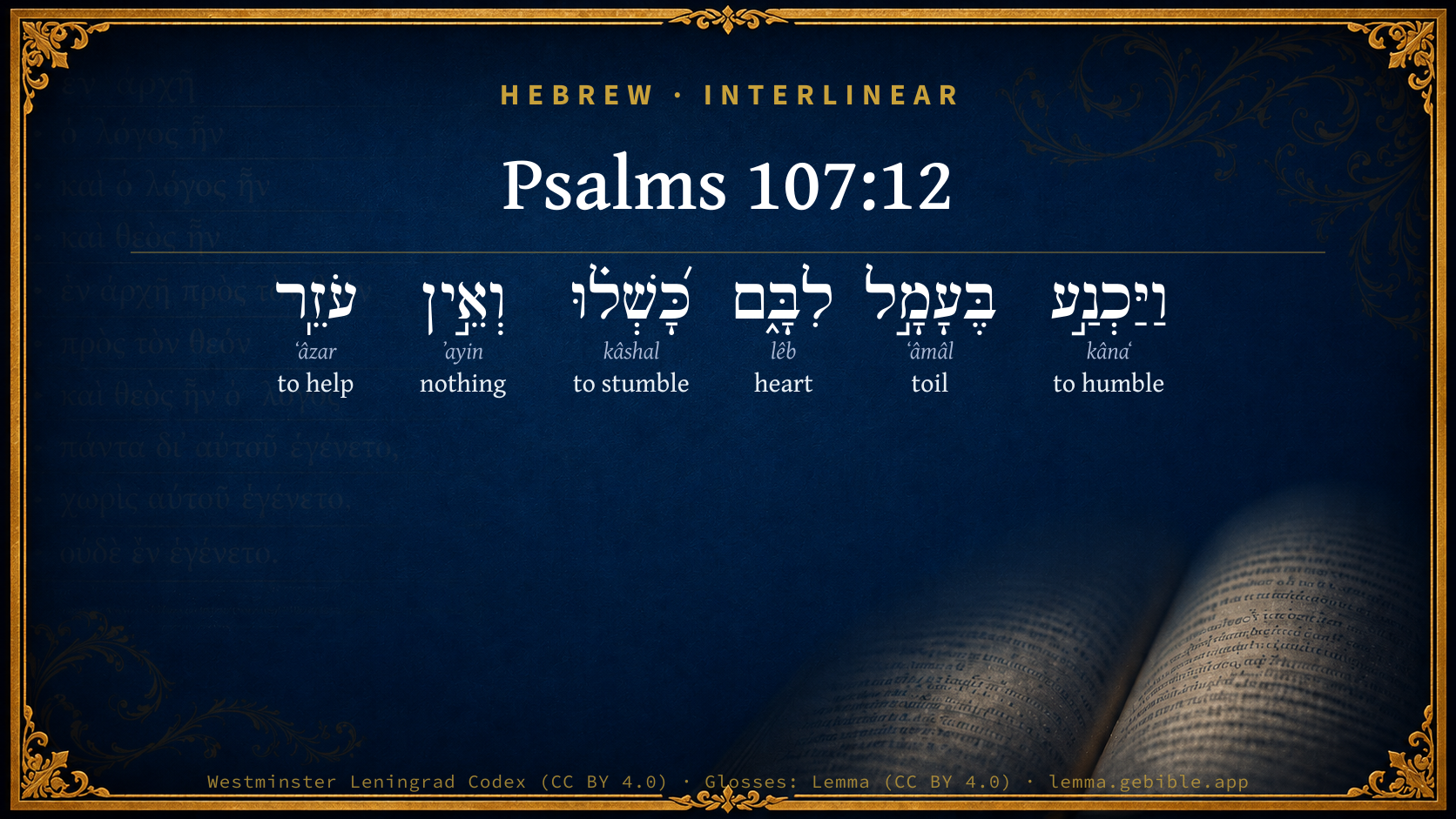
Psalms 107:12

Hebrew (Westminster Leningrad Codex) Psalms 107:12 appears in the Hebrew Old Testament. The text above is from the Westminster Leningrad Codex. Each word links to its Strong’s number, a concise gloss, and parsing drawn from the Open Scriptures Hebrew Bible morphology. Click any word for its full Brown-Driver-Briggs (BDB) entry.
Download image
Cite this verse

Psalms 107:12 (World English Bible). Public Domain. Lemma interlinear Bible study tool, https://lemma.gebible.app/v/psalms/107/12.

Show BibTeX & RIS
BibTeX
RIS
English Translation
Therefore he brought down their heart with labor. They fell down, and there was none to help.
World English Bible · Public Domain
Download a study sheet

One document with this verse’s original text, its word-by-word gloss line, the meaning frame, cross-references with their text, attributed commentary, and full source and license credits — printable, and it pastes into notes with its structure intact.

This verse Autodidact and up

Study sheet (.html) Plain text (.txt)

A passage Seminary Student

Up to 50 verses in one chapter. A passage sheet keeps up to 6 commentary sources and 12 cross-references per verse, in the order this page ranks them, and says so on the sheet whenever that leaves anything out. Ask for a single verse and you get the Autodidact verse sheet above.

Everything on this page stays free to read, with no account — the sheet is a download of what is already on screen, not access to it.

Want to remove ads? Support Godless Engineer
Compare translations 3

The same verse in 3 English versions, stacked beneath the original-language interlinear above. Click any original word for its lexicon entry.

Each is an independent rendering of the whole verse — the interlinear is not word-aligned to these translations.

Highlighted words mark where these versions differ — a whole-verse word diff, not a word-by-word alignment.

  • World English Bible Public Domain
    Therefore he brought down their heart with labor. They fell down, and there was none to help.
  • King James Version Public Domain
    Therefore he brought down their heart with labour; they fell down, and there was none to help.
  • unfoldingWord Literal Text CC BY-SA 4.0
    he humbled their hearts through hardship; they stumbled and there was no helper.

unfoldingWord Literal Text — © unfoldingWord, licensed CC BY-SA 4.0. Word-aligned USFM3 via Door43 (git.door43.org/unfoldingWord/en_ult).

Versions to compare (up to 4)

3 of 4 selected

Show all 18 translations

Every available English version of this verse, each an independent rendering of the whole verse.

  • World English Bible Public Domain
    Therefore he brought down their heart with labor. They fell down, and there was none to help.
  • Berean Standard Bible Public Domain
    He humbled their hearts with hard labor; they stumbled, and there was no one to help.
  • Majority Standard Bible Public Domain
    He humbled their hearts with hard labor; they stumbled, and there was no one to help.
  • King James Version Public Domain
    Therefore he brought down their heart with labour; they fell down, and there was none to help.
  • American Standard Version (1901) Public Domain
    Therefore he brought down their heart with labor; They fell down, and there was none to help.
  • Revised Version (1885) Public Domain
    Therefore he brought down their heart with labour; they fell down, and there was none to help.
  • Geneva Bible (1599) Public Domain
    When he humbled their heart with heauines, then they fell downe and there was no helper.
  • Douay-Rheims (1899) Public Domain
    And their heart was humbled with labours: they were weakened, and their was none to help them.
  • Young's Literal Translation Public Domain
    And He humbleth with labour their heart, They have been feeble, and there is no helper.
  • Literal Standard Version CC BY-SA 4.0
    And He humbles their heart with labor, || They have been feeble, and there is no helper.
  • Unlocked Literal Bible CC BY-SA 4.0
    He humbled their hearts through hardship; they stumbled and there was no one to help them up.
  • unfoldingWord Literal Text CC BY-SA 4.0
    he humbled their hearts through hardship; they stumbled and there was no helper.
  • Darby Bible Public Domain
    And he bowed down their heart with labour; they stumbled, and there was none to help:
  • World Messianic Bible Public Domain
    Therefore he brought down their heart with labor. They fell down, and there was no one to help.
  • Webster's Bible Public Domain
    Therefore he brought down their heart with labor; they fell down, and there was none to help.
  • Free Bible Version CC BY-SA 4.0
    So he humbled their pride with the troubles of life; they tripped over and no one was there to stop them falling.
  • Bible in Basic English Public Domain
    So that he made their hearts weighted down with grief; they were falling, and had no helper.
  • JPS Tanakh (1917) Public Domain
    Therefore He humbled their heart with travail, they stumbled, and there was none to help —

Literal Standard Version (2020), Covenant Press — licensed CC BY-SA 4.0. Text via the HelloAO Bible API (eBible.org). Unlocked Literal Bible (unfoldingWord) — licensed CC BY-SA 4.0. Text via the HelloAO Bible API (eBible.org). unfoldingWord Literal Text — © unfoldingWord, licensed CC BY-SA 4.0. Word-aligned USFM3 via Door43 (git.door43.org/unfoldingWord/en_ult). Free Bible Version, Dr. Jonathan Gallagher — licensed CC BY-SA 4.0. Text via the HelloAO Bible API (eBible.org).

Word by word

More ways to search: Search by grammar → Find every occurrence → Compare this word →

Practice this passage: Drill this verse → Learn its vocabulary →

About this verse

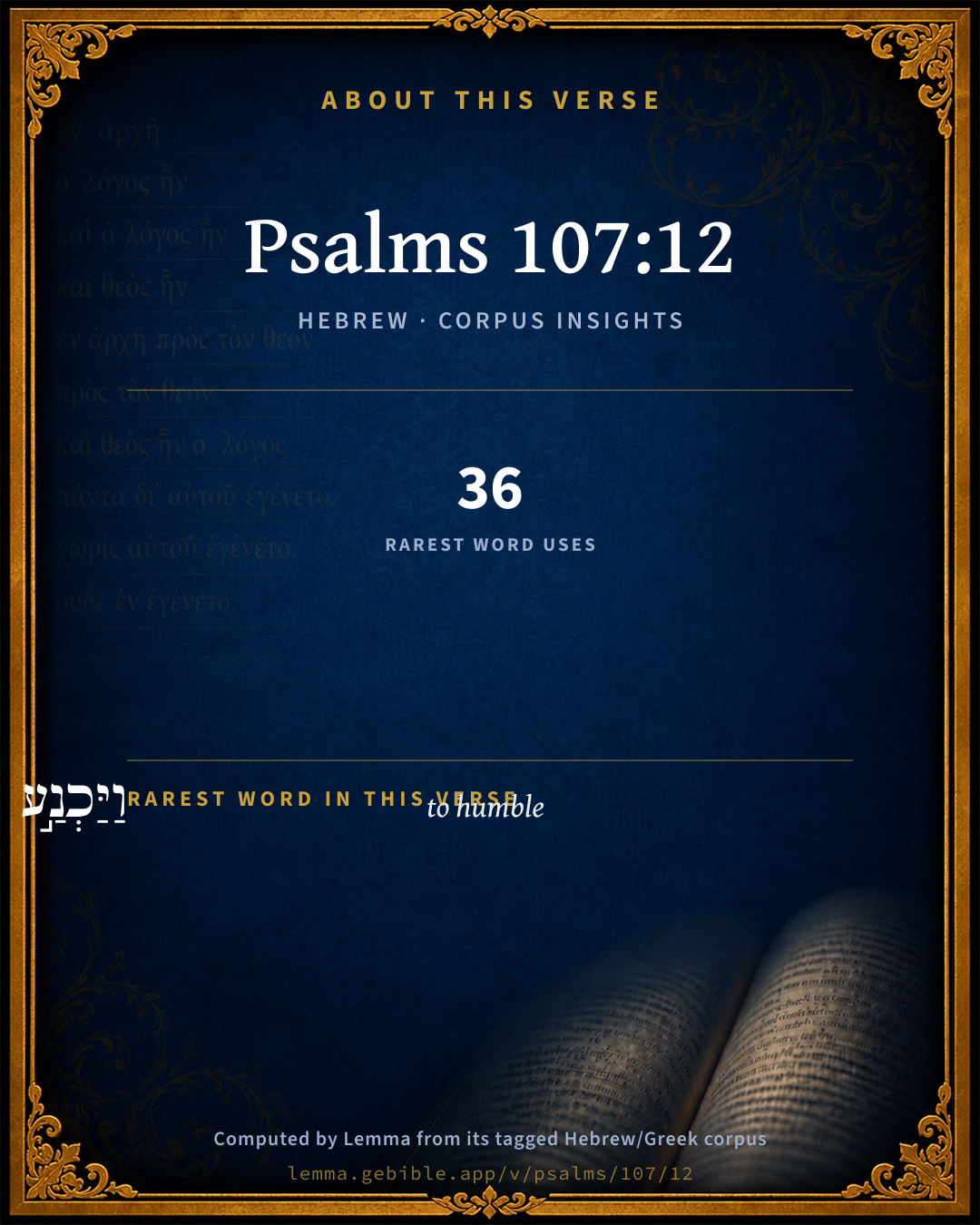
These counts appear in no published source. They are computed here, from the morphology-tagged text and Lemma’s own curated glosses. What Lemma adds →

6
words
6
distinct lemmas
Wisdom
section

Shared distinctive vocabulary

וַיַּכְנַ֣ע to humble H3665 occurs in 32 verses of the Hebrew Bible. Also found in:

Grammatical profile

  • 3 verbs
  • 2 nouns
  • 1 particle

Verb forms

  • וַיַּכְנַ֣ע Hiphil · Sequential Imperfect
  • כָּ֝שְׁל֗וּ Qal · Perfect
  • עֹזֵֽר Qal · Participle Active

Hebrew & Septuagint length

In English translation the verse runs 17 words from the Hebrew and 16 from the Septuagint (LXX English) — closely comparable.

A rough comparison of the two English renderings, which tokenize alike — not a word-level alignment.

Word counts can differ between the Hebrew and the Greek without any difference in meaning — e.g. the Hebrew direct-object marker אֵת has no separate Greek word, and Greek often adds the article ὁ.

Cross-references

18

Topical passages linked to Psalms 107:12 in the Treasury of Scripture Knowledge — connected by theme and wording, ordered by reader-vote popularity; previews shown in the World English Bible.

  • Psalms 22:11 Don't be far from me, for trouble is near. For there is none to help.
  • Exodus 5:18–19 Go therefore now, and work, for no straw shall be given to you, yet shall you deliver the same number of bricks!"
  • Exodus 2:23 It happened in the course of those many days, that the king of Egypt died, and the children of Israel sighed because of the bondage, and they cried, and their cry came up to God because of the bondage.
  • Luke 15:14–17 When he had spent all of it, there arose a severe famine in that country, and he began to be in need.
  • Isaiah 51:23 and I will put it into the hand of those who afflict you, who have said to your soul, Bow down, that we may go over; and you have laid your back as the ground, and as the street, to those who go over.
  • Judges 10:16–18 They put away the foreign gods from among them, and served Yahweh; and his soul was grieved for the misery of Israel.
  • Judges 16:30 Samson said, Let me die with the Philistines. He bowed himself with all his might; and the house fell on the lords, and on all the people who were therein. So the dead that he killed at his death were more than those who he killed in his life.
  • 2 Kings 6:26–27 As the king of Israel was passing by on the wall, there cried a woman to him, saying, Help, my lord, O king.
  • 2 Kings 6:33 While he was yet talking with them, behold, the messenger came down to him: and he said, Behold, this evil is of Yahweh; why should I wait for Yahweh any longer?
  • Nehemiah 9:37 It yields much increase to the kings whom you have set over us because of our sins: also they have power over our bodies, and over our cattle, at their pleasure, and we are in great distress.
  • Job 9:13 "God will not withdraw his anger; The helpers of Rahab stoop under him.
  • Isaiah 51:19–20 These two things have happened to you. Who will bemoan you? Desolation and destruction, and the famine and the sword; how shall I comfort you?
  • Isaiah 52:5 Now therefore, what do I here, says Yahweh, seeing that my people is taken away for nothing? those who rule over them do howl, says Yahweh, and my name continually all the day is blasphemed.
  • Isaiah 63:5 I looked, and there was none to help; and I wondered that there was none to uphold: therefore my own arm brought salvation to me; and my wrath, it upheld me.
  • Lamentations 5:5–6 Our pursuers are on our necks: We are weary, and have no rest.
  • Judges 16:21 The Philistines laid hold on him, and put out his eyes; and they brought him down to Gaza, and bound him with fetters of brass; and he did grind in the prison-house.
  • Psalms 18:40–41 You have also made my enemies turn their backs to me, That I might cut off those who hate me.
  • Psalms 142:4 Look on my right, and see; For there is no one who is concerned for me. Refuge has fled from me. No one cares for my soul.

Cross-references courtesy of OpenBible.info (CC BY 4.0).

Hebrew and Greek witnesses Masoretic Hebrew ↔ Greek Septuagint

The same verse in the two great witnesses to the Old Testament, shown verse-for-verse.

You’re reading Greek Psalm 106 (Hebrew Psalm 107). The Septuagint counts the superscription, so verse numbers can differ from the Hebrew — chapter-level alignment, not verse-by-verse. Numbering follows Rahlfs.

These are two independent witnesses, not word-aligned to each other, and the Septuagint is shown in lemma (dictionary) form.

Hebrew Psalms 107:12 Masoretic · Westminster Leningrad Codex

וַיַּכְנַ֣ע בֶּעָמָ֣ל לִבָּ֑ם כָּ֝שְׁל֗וּ וְאֵ֣ין עֹזֵֽר

Therefore he brought down their heart with labor. They fell down, and there was none to help.

World English Bible · Public Domain

Greek LXX Greek Psalm 106:12 Septuagint · lemma form

καί ταπεινόω ἐν κόπος ὁ καρδία αὐτός ἀσθενέω καί οὐ εἰμί ὁ βοηθέω

So their heart was brought low with troubles; they were weak, and there was no helper.

LXX2012 (modern English Septuagint) · Public Domain

Hebrew: Westminster Leningrad Codex (CC BY 4.0). Greek: Septuagint (public domain); English from LXX2012 (modern English Septuagint) (Public Domain). How the Septuagint differs from the Hebrew →

Commentary

Notes on Psalms 107:12 from classic Christian and Jewish commentators (each source and its license shown beneath its notes). The classic Christian expositions comment on the surrounding passage and are grouped to its opening verse, so a note may address several verses; the Jewish commentaries on the Tanakh (Rashi and others) are per-verse, so they appear only where the commentator wrote on this verse.

Lemma curates 59 commentaries, every one of them public domain or Creative Commons licensed, each selected and text-cleaned for this edition rather than reprinted as found. About our sources →

Trapp's Complete Commentary

John Trapp

Psa 107:12 Therefore he brought down their heart with labour; they fell down, and [there was] none to help.

Ver. 12. Therefore he brought down their heart] That proud piece of flesh, Quod erat elatum et verba Dei contempsit, saith Kimchi, which had stouted it out with God, and thought to have carried it away with a strong hand; as Manasseh, that sturdy rebel, till God had hampered him, and laid him in cold irons.

John Trapp, A Commentary or Exposition upon All the Books of the Old and New Testament (1647–1656) — public domain. Text from a community e-Sword module.

J. A. Alexander on Psalms

Joseph Addison Alexander

12. (Psa 107:12) And he brought down, with trouble, their heart; they stumbled and there was no helper. The remedial design and effect of their punishment are beautifully set forth in the first clause. The word translated trouble means originally work or labour, then the pain attending it or flowing from it. Stumbled may here be put for fell, or have the milder sense of tottering or stumbling, as distinguished from a total fall. No helper, or none helping, except God, as intimated in the next verse; or against God, when he chose to punish them.

Joseph Addison Alexander, The Psalms Translated and Explained (1850) — public domain. Text from a community e-Sword module.

Tyndale Open Study Notes

Tyndale Open Resources

107:12 Exhausted by their hard labor (Lam 5:13), the people fell. While this might be expected of the wicked (Pss 9:3; 27:2), it was unlike the Israelites’ flight from Egypt (105:37).

Tyndale Open Study Notes — © Tyndale Open Resources, licensed CC BY-SA 4.0. Text via the HelloAO Bible API.

Adam Clarke's Commentary

Verse 12. He brought down their heart with labour] He delivered them into the hands of their enemies. and, as they would not be under subjection to GOD, he delivered them into slavery to wicked men: "So they fell down, and there was none to help ;" God had forsaken them because they had forsaken him.

Adam Clarke's Commentary on the Bible (1810–1826) — public domain. Text from a community e-Sword/MySword module.

Ellicott's Commentary for English Readers

(12) Brought down.—Literally, made them bend.

Fell down.—Better, stumbled.

The whole verse presents a picture of men staggering under the forced labour which was the usual fate of captives under the great Oriental monarchies.

A Bible Commentary for English Readers, edited by Charles John Ellicott (1878–1897) — public domain. Text from a community e-Sword module.

The Cambridge Bible for Schools and Colleges

gen. ed. J. J. S. Perowne

12. So that he subdued their heart with travail. Cp. Psa_106:42.

they fell down] Lit. they stumbled; figuratively as in Psa_105:37 (note); Isa_3:8 (A.V. is ruined).

The Cambridge Bible for Schools and Colleges (gen. ed. J. J. S. Perowne; Cambridge University Press, 1878–1918) — public domain. Text from a community e-Sword module.

John Gill's Exposition

He brought them out of darkness,.... In which they were by nature, into marvellous light; to see their interest in Christ, and his salvation; and to have the light of joy and comfort in him.

And the shadow of death; quickening them by his Spirit and grace; causing them to live by faith upon him; entitling them to eternal life, and securing them from eternal death.

And brake their bands in sunder; their cords and fetters of affliction; or their bands of sin, and the power of it; and loosed them whom Satan had bound and kept so for many years, and brought them into the glorious liberty of the children of God.

John Gill's Exposition of the Whole Bible (1746–1763) — public domain (CC PDM 1.0). Text via the HelloAO Bible API.

Albert Barnes' Notes on the Bible

Therefore he brought down their heart - Their pride; their self-sufficiency; their self-complacency. They thought that they could do without God; they relied on their own resources, and were self-satisfied; but God showed them that all this was vain, and humbled them, as he often does the proud, in the dust.

With labour - With trouble; with affliction; with disappointment; with reverses; with sorrow. The Hebrew word - עמל ‛âmâl - would include all this. Compare Gen 41:51; Deu 26:7; Job 3:10; Job 16:2.

They fell down - They, as it were, “stumbled” - for so the Hebrew word means. They were walking along with a haughty air, and a high look, and suddenly they stumbled and fell.

And there was none to help - No God to interpose; no nation to befriend them; no human arm to be stretched out for their deliverance. God gave them up, helpless, to the just consequences of their folly and wickedness.

Albert Barnes' Notes on the Bible (1834–1885) — public domain. Text from a community e-Sword/MySword module.

Matthew Poole's English Annotations

Their heart; the pride, and rebellion, and obstinacy of their hearts.

With labour; or, with trouble or troubles. They fell into their enemy’s hands, and into hopeless and remediless miseries.

Matthew Poole's English Annotations on the Holy Bible (1683–1685) — public domain. Text from a community e-Sword/MySword module.

The Treasury of David

Charles H. Spurgeon

Ver. 12. Therefore he brought down their heart with labour. In eastern prisons men are frequently made to labour like beasts of the field. As they have no liberty, so they have no rest. This soon subdues the stoutest heart, and makes the proud boaster sing another tune. Trouble and hard toil are enough to tame a lion. God has methods of abating the loftiness of rebellious looks; the cell and the mill make even giants tremble.

They fell down, and there was none to help. Stumbling on in the dark beneath their weary task, they at last fell prone upon the ground, but no one came to pity them or to lift them up. Their fall might be fatal for aught that any man cared about them; their misery was unseen, or, if observed, no one could interfere between them and their tyrant masters. In such a wretched plight the rebellious Israelite became more lowly in mind, and thought more tenderly of his God and of his offences against him. When a soul finds all its efforts at self salvation prove abortive, and feels that it is now utterly without strength, then the Lord is at work hiding pride from man and preparing the afflicted one to receive his mercy. The spiritual case which is here figuratively described is desperate, and therefore affords the finer field for the divine interposition; some of us remember well how brightly mercy shone in our prison, and what music the fetters made when they fell off from our hands. Nothing but the Lord's love could have delivered us; without it we must have utterly perished.

Ver. 12. He brought down their heart. O believer, God may see you have many and strong lusts to be subdued, and that you need many and sore afflictions to bring them down. Your pride and obstinacy of heart may be strong, your distempers deeply rooted, and therefore the physic must be proportioned to them. John Willison.

Ver. 12. He brought down their heart with labour. Those towering passions by which they vainly vaunted themselves above the law and the worship of God, he weakened and curbed, so that they began to submit themselves to God. The root enk taken from the Arabic, describes a process of weakening by compressing the wings or shrinking the fingers, and is properly applied to birds, which when their wings are compressed are obliged to fall to the ground, or to men, who by the shrivelling up of their fingers lose the power of working; whence it is transferred to oppressions or depressions of any kind. Venema.

Ver. 12. They fell down, and there was none to help. Affliction is then come to the height and its complete measure, when the sinner is made sensible of his own weakness, and doth see there is no help for him, save in God alone. David Dickson.

Ver. 12. They fell down. They threw themselves prostrate at his feet for mercy; their heart and strength failed them, as the word signifies, and is used in Ps 31:10; terrified with a sense of divine wrath, they could not stand before the Lord, nor brave it out against him. And there was none to help. They could not help themselves, nor was there any creature that could. There is salvation in no other than in Christ; when he saw there was none to help him in that work, his own arm brought salvation to him; and when sinners see there is help in no other, they apply to him. John Gill.

Ver. 12-13.

1. The convicted soul's abject conditionhumbled, exhausted, prostrate, deserted.

2. His speedy deliverance. Cried, cried while in trouble, unto the Lord, he saved, out of their distresses.

Psalms 107:13*

Charles H. Spurgeon's The Treasury of David (1869–1885) — public domain. Psalms only. Text from a community e-Sword/MySword module.

Whedon's Commentary on the Bible

Daniel D. Whedon

12. Brought down their heart with labour—He bowed down their heart, as one bends low to a heavy, servile task. The bowing down the “heart,” shows that the seat of their greatest suffering and labour was inward. Sin is a hard service. See Isa_4:2; Rom_6:23.

They fell down— They fainted under their oppressive labour.

None to help—None but God, whom they had rejected, and whose service of freedom and delight they had despised.

Daniel D. Whedon (gen. ed.), Commentary on the Old and New Testaments (1874–1909) — public domain. Text from a community e-Sword module.

The Pulpit Commentary

Therefore he brought down their heart with labor; rather, with misery, or with sorrow. They fell down; i.e. collapsed sank to the earth. And there was none to help. They were like Job; no one gave them any help in their affliction.

The Pulpit Commentary (1880–1919), ed. H.D.M. Spence-Jones & Joseph S. Exell — public domain. Text from a community e-Sword module.

John Wesley's Explanatory Notes

Heart - The pride and obstinacy of their hearts. Fell - They fell into hopeless miseries.

John Wesley, Explanatory Notes Upon the Whole Bible (1754–1765) — public domain. Text via the GEBible commentary corpus.

Lesson kit

Teaching starters — assembled from the data on this page, not authored interpretation. Every prompt links to the verse data it draws on. Edit before teaching.

Psalms, in the Wisdom, opens this verse with 6 words (6 distinct Hebrew lemmas). Its most distinctive word is kânaʻ (“to humble”). A historical commentator’s framing appears above. Read the whole chapter for the surrounding context.

Discussion questions

  1. How does “to humble” (kânaʻ) shape what this verse is saying?
  2. How does Leviticus 26:41, which shares the word «to humble», read alongside this verse?
  3. These translations render this verse differently; the difference is in the English rendering, not the original. What questions does that raise?
  4. «וַיַּכְנַ֣ע» is a Hiphil Sequential Imperfect verb. How does that grammatical form shape the action described?
  5. Compare how Trapp's Complete Commentary and J. A. Alexander on Psalms read this verse. Where do they agree or differ?

Things to notice

Reading settings

Reading text

Shown beneath each verse's original-language words.

Old Testament
Old Testament edition

Read the OT as the Masoretic Hebrew (MT) or the Greek Septuagint (LXX).

English shown for the Greek Septuagint (in the Hebrew ↔ Greek comparison).

Comparing translations? Open the Compare panel on any verse page to stack up to four side by side.