
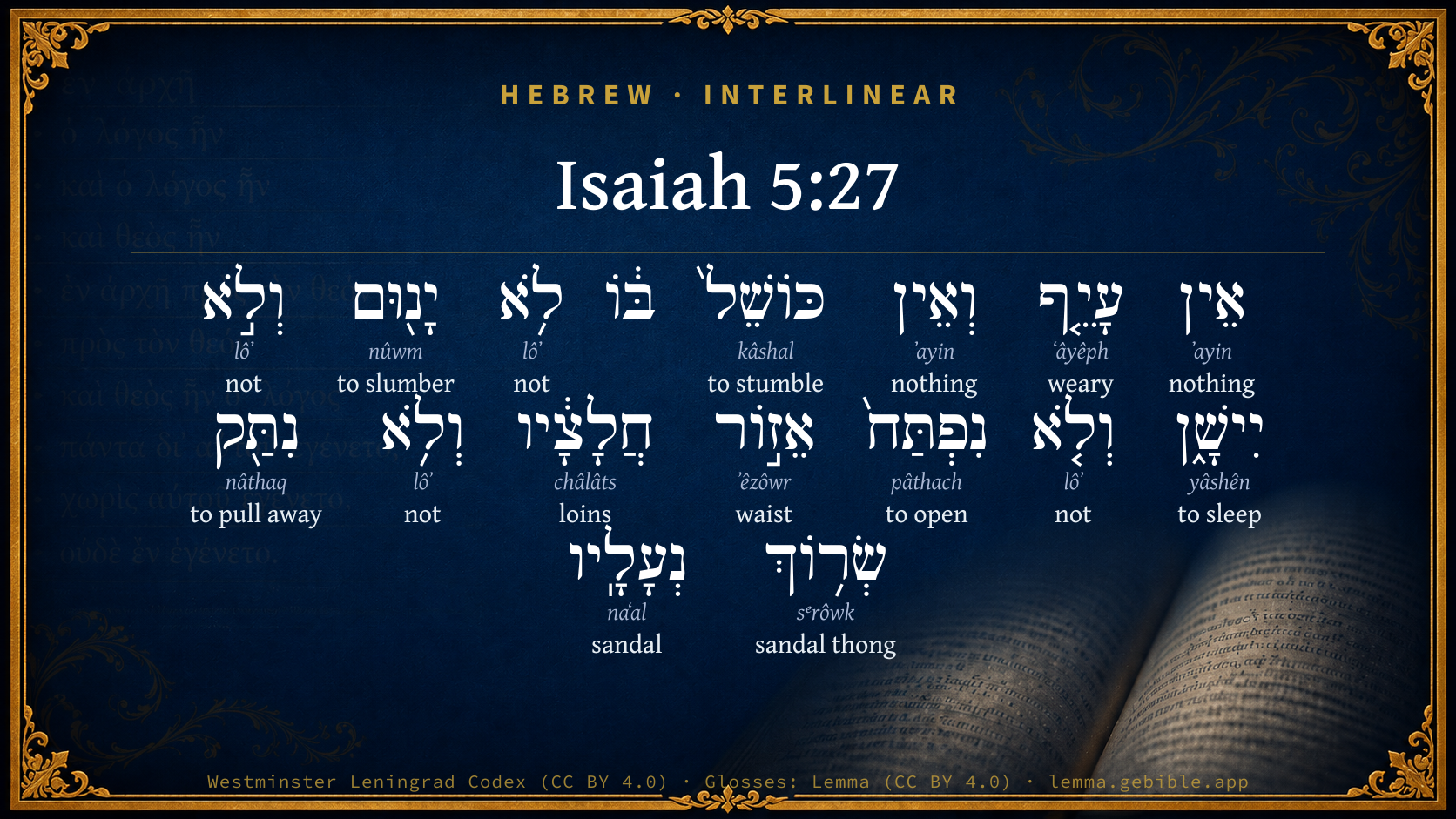
Isaiah 5:27

Hebrew (Westminster Leningrad Codex) Isaiah 5:27 appears in the Hebrew Old Testament. The text above is from the Westminster Leningrad Codex. Each word links to its Strong’s number, a concise gloss, and parsing drawn from the Open Scriptures Hebrew Bible morphology. Click any word for its full Brown-Driver-Briggs (BDB) entry.
Download image
Cite this verse

Isaiah 5:27 (World English Bible). Public Domain. Lemma interlinear Bible study tool, https://lemma.gebible.app/v/isaiah/5/27.

Show BibTeX & RIS
BibTeX
RIS
English Translation
None shall be weary nor stumble among them; None shall slumber nor sleep; Neither shall the belt of their loins be untied, Nor the latchet of their shoes be broken:
World English Bible · Public Domain
Download a study sheet

One document with this verse’s original text, its word-by-word gloss line, the meaning frame, cross-references with their text, attributed commentary, and full source and license credits — printable, and it pastes into notes with its structure intact.

This verse Autodidact and up

Study sheet (.html) Plain text (.txt)

A passage Seminary Student

Up to 50 verses in one chapter. A passage sheet keeps up to 6 commentary sources and 12 cross-references per verse, in the order this page ranks them, and says so on the sheet whenever that leaves anything out. Ask for a single verse and you get the Autodidact verse sheet above.

Everything on this page stays free to read, with no account — the sheet is a download of what is already on screen, not access to it.

Want to remove ads? Support Godless Engineer
Compare translations 3

The same verse in 3 English versions, stacked beneath the original-language interlinear above. Click any original word for its lexicon entry.

Each is an independent rendering of the whole verse — the interlinear is not word-aligned to these translations.

Highlighted words mark where these versions differ — a whole-verse word diff, not a word-by-word alignment.

  • World English Bible Public Domain
    None shall be weary nor stumble among them; None shall slumber nor sleep; Neither shall the belt of their loins be untied, Nor the latchet of their shoes be broken:
  • King James Version Public Domain
    None shall be weary nor stumble among them; none shall slumber nor sleep; neither shall the girdle of their loins be loosed, nor the latchet of their shoes be broken:
  • unfoldingWord Literal Text CC BY-SA 4.0
    None weary and none stumbling among it; he does not slumber and he does not sleep. And the belt of his loins is not opened, and the strap of his sandals is not broken,

unfoldingWord Literal Text — © unfoldingWord, licensed CC BY-SA 4.0. Word-aligned USFM3 via Door43 (git.door43.org/unfoldingWord/en_ult).

Versions to compare (up to 4)

3 of 4 selected

Show all 18 translations

Every available English version of this verse, each an independent rendering of the whole verse.

  • World English Bible Public Domain
    None shall be weary nor stumble among them; None shall slumber nor sleep; Neither shall the belt of their loins be untied, Nor the latchet of their shoes be broken:
  • Berean Standard Bible Public Domain
    None of them grows weary or stumbles; no one slumbers or sleeps. No belt is loose and no sandal strap is broken.
  • Majority Standard Bible Public Domain
    None of them grows weary or stumbles; no one slumbers or sleeps. No belt is loose and no sandal strap is broken.
  • King James Version Public Domain
    None shall be weary nor stumble among them; none shall slumber nor sleep; neither shall the girdle of their loins be loosed, nor the latchet of their shoes be broken:
  • American Standard Version (1901) Public Domain
    None shall be weary nor stumble among them; none shall slumber nor sleep; neither shall the girdle of their loins be loosed, nor the latchet of their shoes be broken:
  • Revised Version (1885) Public Domain
    None shall be weary nor stumble among them; none shall slumber nor sleep; neither shall the girdle of their loins be loosed, nor the latchet of their shoes be broken:
  • Geneva Bible (1599) Public Domain
    None shall faint nor fall among them: none shall slumber nor sleepe, neither shall the girdle of his loynes be loosed, nor the latchet of his shooes be broken:
  • Douay-Rheims (1899) Public Domain
    There is none that shall faint, nor labour among them: they shall not slumber nor sleep, neither shall the girdle of their loins be loosed, nor the latchet of their shoes be broken.
  • Young's Literal Translation Public Domain
    There is none weary, nor stumbling in it, It doth not slumber, nor sleep, Nor opened hath been the girdle of its loins, Nor drawn away the latchet of its sandals.
  • Literal Standard Version CC BY-SA 4.0
    There is none weary, nor stumbling in it, || It does not slumber, nor sleep, || Nor has the girdle of its loins been opened, || Nor the strap of its sandals drawn away.
  • Unlocked Literal Bible CC BY-SA 4.0
    None tire or stumble among them; none slumbers or sleeps. Nor are their belts loose, or the thongs of their sandals broken.
  • unfoldingWord Literal Text CC BY-SA 4.0
    None weary and none stumbling among it; he does not slumber and he does not sleep. And the belt of his loins is not opened, and the strap of his sandals is not broken,
  • Darby Bible Public Domain
    None among them is weary, none stumbleth; they slumber not, nor sleep; none hath the girdle of his loins loosed, nor the thong of his sandals broken;
  • World Messianic Bible Public Domain
    No one shall be weary nor stumble among them; no one shall slumber nor sleep, neither shall the belt of their waist be untied, nor the strap of their sandals be broken,
  • Webster's Bible Public Domain
    None shall be weary nor stumble among them; none shall slumber nor sleep; neither shall the girdle of their loins be loosed, nor the latchet of their shoes be broken:
  • Free Bible Version CC BY-SA 4.0
    None of them gets tired or stumbles; none of them rests or sleeps. No belt comes loose, and no sandal strap breaks.
  • Bible in Basic English Public Domain
    There is no weariness among them, and no man is feeble-footed: they come without resting or sleeping, and the cord of their shoes is not broken.
  • JPS Tanakh (1917) Public Domain
    None shall be weary nor stumble among them; none shall slumber nor sleep; neither shall the girdle of their loins be loosed, nor the latchet of their shoes be broken;

Literal Standard Version (2020), Covenant Press — licensed CC BY-SA 4.0. Text via the HelloAO Bible API (eBible.org). Unlocked Literal Bible (unfoldingWord) — licensed CC BY-SA 4.0. Text via the HelloAO Bible API (eBible.org). unfoldingWord Literal Text — © unfoldingWord, licensed CC BY-SA 4.0. Word-aligned USFM3 via Door43 (git.door43.org/unfoldingWord/en_ult). Free Bible Version, Dr. Jonathan Gallagher — licensed CC BY-SA 4.0. Text via the HelloAO Bible API (eBible.org).

Word by word

More ways to search: Search by grammar → Find every occurrence → Compare this word →

Practice this passage: Drill this verse → Learn its vocabulary →

שְׂר֥וֹךְ
sᵉrôwk
H8288
“sandal thong of”
Noun, Common, Masculine, Singular, Construct
Part of Speech
Noun
Type
Common
Gender
Masculine
Number
Singular
State
Construct
Full BDB Definition

Origin: from H8308

TWOT: 2290a

sandal thong
  1. אֵין ʼayin H369 “nothing” Particle, Negative
  2. עָיֵ֤ף ʻâyêph H5889 “weary” Adjective, Adjective, Masculine, Singular, Absolute
  3. וְאֵין ʼayin H369 “and · nothing” Conjunction + Particle, Negative
  4. כּוֹשֵׁל֙ kâshal H3782 “stumbling” Verb, Qal, Participle Active, Masculine, Singular, Absolute
  5. לֹ֥א lôʼ H3808 “not” Particle, Negative
  6. יָנ֖וּם nûwm H5123 “to slumber” Verb, Qal, Imperfect, 3rd Person, Masculine, Singular
  7. וְלֹ֣א lôʼ H3808 “and · not” Conjunction + Particle, Negative
  8. יִישָׁ֑ן yâshên H3462 “to sleep” Verb, Qal, Imperfect, 3rd Person, Masculine, Singular
  9. וְלֹ֤א lôʼ H3808 “and · not” Conjunction + Particle, Negative
  10. נִפְתַּח֙ pâthach H6605 “to open” Verb, Niphal, Perfect, 3rd Person, Masculine, Singular
  11. אֵז֣וֹר ʼêzôwr H232 “waist of” Noun, Common, Masculine, Singular, Construct
  12. חֲלָצָ֔יו châlâts H2504 “loins · his” Noun, Common, Both, Dual, Construct + Suffix, Personal, 3rd Person, Masculine, Singular
  13. וְלֹ֥א lôʼ H3808 “and · not” Conjunction + Particle, Negative
  14. נִתַּ֖ק nâthaq H5423 “to pull away” Verb, Niphal, Perfect, 3rd Person, Masculine, Singular
  15. נְעָלָֽיו naʻal H5275 “sandals · his” Noun, Common, Feminine, Plural, Construct + Suffix, Personal, 3rd Person, Masculine, Singular

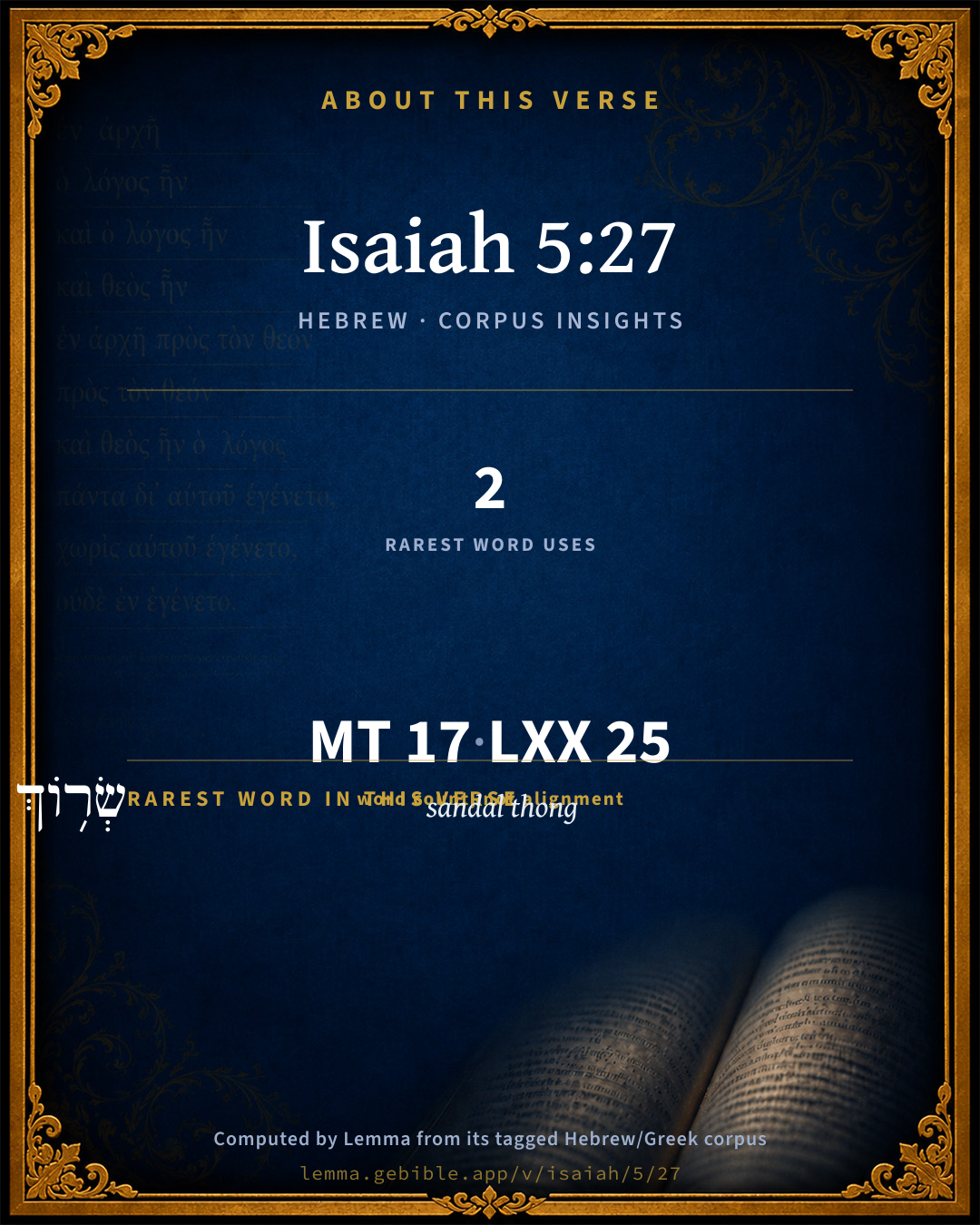
About this verse

These counts appear in no published source. They are computed here, from the morphology-tagged text and Lemma’s own curated glosses. What Lemma adds →

17
words
12
distinct lemmas
Prophets
section

Notable vocabulary

The rarest word here is שְׂר֥וֹךְ sandal thong H8288 — appearing just 2 times in the whole Hebrew Bible.

Shared distinctive vocabulary

שְׂר֥וֹךְ sandal thong H8288 occurs in 2 verses of the Hebrew Bible. Also found in:

Grammatical profile

  • 5 verbs
  • 4 nouns
  • 1 adjective
  • 1 preposition
  • 6 particles

Verb forms

  • כּוֹשֵׁל֙ Qal · Participle Active
  • יָנ֖וּם Qal · Imperfect
  • יִישָׁ֑ן Qal · Imperfect
  • נִפְתַּח֙ Niphal · Perfect
  • נִתַּ֖ק Niphal · Perfect

Repetition

Words recur within this verse — often emphatic in Hebrew:

  • אֵין nothing H369 ×2
  • לֹ֥א not H3808 ×4

Hebrew & Septuagint length

In English translation the verse runs 30 words from the Hebrew and 28 from the Septuagint (LXX English) — closely comparable.

A rough comparison of the two English renderings, which tokenize alike — not a word-level alignment.

Word counts can differ between the Hebrew and the Greek without any difference in meaning — e.g. the Hebrew direct-object marker אֵת has no separate Greek word, and Greek often adds the article ὁ.

In the original languages it is 17 Hebrew tokens and 25 Greek tokens — but the two are counted differently (Hebrew bundles its prefixes and suffixes into one token; the Greek is in lemma form), so that isn’t a like-for-like length.

Cross-references

12

Topical passages linked to Isaiah 5:27 in the Treasury of Scripture Knowledge — connected by theme and wording, ordered by reader-vote popularity; previews shown in the World English Bible.

  • Job 12:18 He loosens the bond of kings, He binds their loins with a belt.
  • Joel 2:7–8 They run like mighty men. They climb the wall like warriors. They each march in his line, and they don't swerve off course.
  • Job 12:21 He pours contempt on princes, And loosens the belt of the strong.
  • Deuteronomy 32:25 Outside shall the sword bereave, In the chambers terror; [It shall destroy] both young man and virgin, The suckling with the man of gray hairs.
  • 1 Kings 2:5 Moreover you know also what Joab the son of Zeruiah did to me, even what he did to the two captains of the hosts of Israel, to Abner the son of Ner, and to Amasa the son of Jether, whom he killed, and shed the blood of war in peace, and put the blood of war on his sash that was about his loins, and in his shoes that were on his feet.
  • Psalms 18:32 The God who arms me with strength, and makes my way perfect?
  • Psalms 93:1 Yahweh reigns! He is clothed with majesty! Yahweh is armed with strength. The world also is established. It can't be moved.
  • Isaiah 11:5 Righteousness shall be the belt of his waist, and faithfulness the belt of his loins.
  • Isaiah 45:1 Thus says Yahweh to his anointed, to Cyrus, whose right hand I have held, to subdue nations before him, and I will loose the loins of kings; to open the doors before him, and the gates shall not be shut:
  • Isaiah 45:5 I am Yahweh, and there is none else; besides me there is no God. I will gird you, though you have not known me;
  • Daniel 5:6 Then the king's face was changed in him, and his thoughts troubled him; and the joints of his loins were loosened, and his knees struck one against another.
  • Ephesians 6:13–14 Therefore, put on the whole armor of God, that you may be able to withstand in the evil day, and, having done all, to stand.

Cross-references courtesy of OpenBible.info (CC BY 4.0).

Hebrew and Greek witnesses Masoretic Hebrew ↔ Greek Septuagint

The same verse in the two great witnesses to the Old Testament, shown verse-for-verse.

These are two independent witnesses, not word-aligned to each other, and the Septuagint is shown in lemma (dictionary) form.

Hebrew Isaiah 5:27 Masoretic · Westminster Leningrad Codex

אֵין עָיֵ֤ף וְאֵין כּוֹשֵׁל֙ בּ֔וֹ לֹ֥א יָנ֖וּם וְלֹ֣א יִישָׁ֑ן וְלֹ֤א נִפְתַּח֙ אֵז֣וֹר חֲלָצָ֔יו וְלֹ֥א נִתַּ֖ק שְׂר֥וֹךְ נְעָלָֽיו

None shall be weary nor stumble among them; None shall slumber nor sleep; Neither shall the belt of their loins be untied, Nor the latchet of their shoes be broken:

World English Bible · Public Domain

Greek LXX Isaiah 5:27 Septuagint · lemma form

οὐ πεινάω οὐδέ κοπιάω οὐδέ νυστάζω οὐδέ κοιμάω οὐδέ λύω ὁ ζωνή αὐτός ἀπό ὁ ὀσφύς αὐτός οὐδέ μή ῥήγνυμι ὁ ἱμάς ὁ ὑπόδημα αὐτός

They shall not hunger nor be weary, neither shall they slumber nor sleep; neither shall they loose their girdles from their loins, neither shall their shoe-latchets be broken.

LXX2012 (modern English Septuagint) · Public Domain

Hebrew: Westminster Leningrad Codex (CC BY 4.0). Greek: Septuagint (public domain); English from LXX2012 (modern English Septuagint) (Public Domain). How the Septuagint differs from the Hebrew →

Targum (Aramaic paraphrase)

1

The Targum is the ancient Jewish Aramaic paraphrase of the Hebrew Scriptures — an interpretive translation, not the Hebrew text itself. Onkelos (literal) and Pseudo-Jonathan (expansive) render the Torah, and Jonathan the Prophets. Coverage is partial: where no permissively-licensed English translation exists for a verse, only the Aramaic is shown. This is verse-level text, not a word-by-word alignment to the Hebrew.

  1. Targum Jonathan Prophets (Joshua–Malachi)
    לֵית דִמְשַׁלְהֵי וְלֵית דְמִתְקֵיל בֵּיהּ לָא יְנוּם וְלָא יִדְמוּךְ וְלָא יִשְׁתְּרֵי זְרִיז חַרְצֵיהּ וְלָא תִתְפְּסֵיק עַרְקַת מְסָנֵיהּ:

    None shall be weary nor stumble among them; none shall slumber nor sleep; neither shall the girdle of their loins be loosed, nor the latchet of their sandals be broken.

    Targum Jonathan — Aramaic: “Mikraot Gedolot” (public domain). English: “Sefaria Community Translation” (CC0 1.0 (public-domain dedication)); “London "Chaldee Paraphrase," 1871” (public domain). Text via Sefaria.

Commentary

Notes on Isaiah 5:27 from classic Christian and Jewish commentators (each source and its license shown beneath its notes). The classic Christian expositions comment on the surrounding passage and are grouped to its opening verse, so a note may address several verses; the Jewish commentaries on the Tanakh (Rashi and others) are per-verse, so they appear only where the commentator wrote on this verse.

Lemma curates 59 commentaries, every one of them public domain or Creative Commons licensed, each selected and text-cleaned for this edition rather than reprinted as found. About our sources →

Trapp's Complete Commentary

John Trapp

Isa 5:27 None shall be weary nor stumble among them; none shall slumber nor sleep; neither shall the girdle of their loins be loosed, nor the latchet of their shoes be broken:

Ver. 27. None shall be weary nor stumble.] Though they come speedily, yet they shall none of them tire or turn out of the way, but come on with expedition, robusti, alacres, felices, probe armati, saevi {Isa 5:27-29} being lively, lusty, happy, well appointed, fierce.

None shall slumber or sleep.] More than the necessity of nature requireth; they shall be no less vigilant than diligent.

Neither shall the girdle of their loins be loosed.] They may put up their swords sometimes, but not put them off at all, as it is said of Julius Caesar.

Nor the latchet,] i.e., So as to hinder their march.

John Trapp, A Commentary or Exposition upon All the Books of the Old and New Testament (1647–1656) — public domain. Text from a community e-Sword module.

Joseph Benson's Commentary

Isa 5:27-29. None, &c. — In these verses the prophet describes the quality of the forces which should come against Jerusalem; their vigour, activity, and diligence, Isa 5:27; their military expedition, readiness, skilfulness, and apparatus, Isa 5:28; their fortitude and undaunted courage, Isa 5:29; for all which particulars the Romans were remarkably eminent. — Dodd. None shall be weary — Though their march be long and tedious. As I have called them to this work, so I will assist them in it. None shall slumber nor sleep — They shall all be watchful and diligent to take all opportunities of executing my judgments. Nor the latchet, &c., be broken — I will take all impediments out of their way. Whose arrows are sharp — Who are every way furnished and ready for my work, waiting only for my command. Their horses’ hoofs like flint — Because they shall not be broken or battered by the length or stoniness and ruggedness of the way. And their wheels like a whirlwind — For the swiftness of their march, and for the force and violence of their chariots in battle. They shall roar like young lions — Which signifies both their cruelty, and their eagerness to catch and devour the prey. They shall lay hold on the prey, &c. — These words do not agree to the Assyrians, for they were forced to retreat with great shame and loss, and the Jews were delivered from them: but they agree perfectly both to the Chaldeans and the Romans, both of whom carried the prey away safe, and none delivered it — That is, neither the Jews themselves, nor any of their confederates, to whose help they trusted.

Joseph Benson's Commentary on the Old and New Testaments (1811–1818) — public domain. Text from a community e-Sword module.

Geneva Bible (1599)

Geneva Bible translators

They shall be prompt and lusty to execute God’s vengeance.

The enemy shall have none impediment.

Geneva Bible (1599) marginal notes — public domain. Text via Bolls.life.

Jamieson, Fausset & Brown

Robert Jamieson, A. R. Fausset & David Brown

weary--with long marches (Deu 25:18).

none . . . slumber--requiring no rest.

girdle--with which the ancient loose robes used to be girded for action. Ever ready for march or battle.

nor the latchet . . . broken--The soles were attached to the feet, not by upper leather as with us, but by straps. So securely clad that not even a strap of their sandals gives way, so as to impede their march.

Jamieson, Fausset & Brown — Commentary Critical and Explanatory on the Whole Bible (1871) — public domain (CC PDM 1.0). Text via the HelloAO Bible API.

Adam Clarke's Commentary

Verse 27. None - among them] Kimchi has well illustrated this continued exaggeration or hyperbole, as he rightly calls it, to the following effect: "Through the greatness of their courage they shall not be fatigued with their march; nor shall they stumble though they march with the utmost speed: they shall not slumber by day, nor sleep by night; neither shall they ungird their armour, or put off their sandals to take their rest. Their arms shall be always in readiness, their arrows sharpened, and their bows bent. The hoofs of their horses are hard as a rock. They shall not fail, or need to be shod with iron: the wheels of their carriages shall move as rapidly as a whirlwind."

Neither shall the girdle] The Eastern people, wearing long and loose garments, were unfit for action or business of any kind, without girding their clothes about them. When their business was finished they took off their girdles. A girdle therefore denotes strength and activity; and to unloose the girdle is to deprive of strength, to render unfit for action. God promises to unloose the loins of kings before Cyrus, Isa 45:1. The girdle is so essential a part of a soldier's accoutrement, being the last that he puts on to make himself ready for action, that to be girded, ζωννυσθαι, with the Greeks means to be completely armed and ready for battle: -

Ατρειδης δ εβοησεν, ιδε ζωννυσθαι ανωγεν

Αργειους.

Iliad, xi. 15.

Το δε ενδυναι τα ὁπλα εκαλουν οἱ παλαιοι ζωννυσθαι.

Pausan. Boeot.

It is used in the same manner by the Hebrews: "Let not him that girdeth himself boast as he that unlooseth his girdle," 1Kg 20:11; that is, triumph not before the war is finished.

Adam Clarke's Commentary on the Bible (1810–1826) — public domain. Text from a community e-Sword/MySword module.

Ellicott's Commentary for English Readers

(27-29) None shall be weary . . .—The three verses paint the progress of the invading army. Unresting, unhasting, in perfect order, they march onward. They do not loosen their girdle for repose. The latchet or thong which fastens their sandals is not “broken” or untied. The light-armed troops are there, probably the Medes and Elamites in the Assyrian army (Isa_13:18). The chariots of the Assyrians themselves are there, sweeping onward like a tempest. Their unshod hoofs (the practice of shoeing horses was unknown in the ancient East) are hard as flint. Comp. Homer’s epithet of “brazen-footed” (Il. v. 329); and Amo_6:12. The battle-cry is heard far off like the roaring of lions.

A Bible Commentary for English Readers, edited by Charles John Ellicott (1878–1897) — public domain. Text from a community e-Sword module.

The Cambridge Bible for Schools and Colleges

gen. ed. J. J. S. Perowne

27. Their accoutrement is perfect down to the smallest detail.

The Cambridge Bible for Schools and Colleges (gen. ed. J. J. S. Perowne; Cambridge University Press, 1878–1918) — public domain. Text from a community e-Sword module.

John Gill's Exposition

None shall be weary nor stumble among them,.... Though they should come from far, and make long marches, yet none should be weary by the way, but go on with great cheerfulness and strength; and though they should make such haste, they should not stumble at any thing by the way, nor rush one against another, but proceed with great order in their several ranks:

none shall slumber nor sleep; day nor night, in any fixed stated times, as men usually do:

neither shall the girdle of their loins be loosed; with which they should be girded both for strength and greater expedition; this they should not unloose, in order to lie down and take sleep:

nor the latchet of their shoes be broken, which might hinder their journey; they never plucked off their shoes: all the expressions show their indefatigableness, diligence, intenseness, and resolution, and the good order observed by them; see Joe 2:7.

John Gill's Exposition of the Whole Bible (1746–1763) — public domain (CC PDM 1.0). Text via the HelloAO Bible API.

Albert Barnes' Notes on the Bible

None shall be weary - In this verse and the following, the prophet describes the condition of the army that would be summoned to the destruction of Judea. It would be composed of bold, vigorous, courageous men; they would be unwearied by long and painful journies; they would be fierce and violent; they would come fully prepared for conquest. None would be “weary,” that is, fatigued with long marches, or with hard service; Deu 25:18; 2Sa 16:14.

Nor stumble - They shall be chosen, select men; not those who are defective, or who shall easily fall by any impediments in the way of their march.

None shall slumber - They shall be unwearied, and indefatigable, pursuing their purpose with ever watchfull vigilance - so much as not to be off their guard. They cannot be taken by surprise.

Neither shall the girdle of their loins be loosed - The ancients wore a loose, large, flowing robe, or upper garment. When they labored, or ran, it was necessary to “gird” this up round the body, or to lay it aside altogether. The form of expression here may mean, that they will not relax their efforts; they will not unloose their girdle; they will not unfit themselves for vigorous action, and for battle. “In” that girdle, with which they bound up their robes, the orientals usually carried their dirks and swords; see Neh 4:18; Eze 22:15. It means that they should be fully, and at all times, prepared for action.

Nor the latchet of their shoes be broken - They will be constantly prepared for marches. The shoes, sandals, or “soles” were attached to the feet, not by upper leather, but were girded on by thongs or strings; see the notes at Mat 3:2.

Albert Barnes' Notes on the Bible (1834–1885) — public domain. Text from a community e-Sword/MySword module.

Haydock's Catholic Bible Commentary

Broken. They shall march incessantly, Ezechiel xxvi. 7., and xxx. 11.

George Leo Haydock (1774–1849), Haydock's Catholic Family Bible and Commentary, 1859 edition — public domain. Excludes Psalms (Douay-Rheims chapter numbering differs from Protestant) and Deuterocanonical books (Catholic canon only).

Matthew Poole's English Annotations

None shall be weary, though their march be long and tedious. As I have called them to this work, so I will strengthen and assist them in it. None shall slumber nor sleep; they shall all be watchful and diligent to take all opportunities and advantages of executing my judgments upon my people.

Neither shall the girdle of their loins be loosed, nor the latchet of their shoes be broken; which otherwise would hinder, or at least slacken, them in their march. I will take all impediments out of their way.

Matthew Poole's English Annotations on the Holy Bible (1683–1685) — public domain. Text from a community e-Sword/MySword module.

The Pulpit Commentary

None shall be weary nor stumble. None shall lag behind on the march, none fall and be disabled. None shall slumber. They shall scarcely give themselves time for necessary repose.

The Pulpit Commentary (1880–1919), ed. H.D.M. Spence-Jones & Joseph S. Exell — public domain. Text from a community e-Sword module.

John Wesley's Explanatory Notes

Nor sleep - They shall all be watchful and diligent to take all opportunities of executing my judgments. Nor latchet - I will take all impediments out of their way.

John Wesley, Explanatory Notes Upon the Whole Bible (1754–1765) — public domain. Text via the GEBible commentary corpus.

Keil & Delitzsch

C. F. Keil & F. Delitzsch

"There is none exhausted, and none stumbling among them: it gives itself no slumber, and no sleep; and to none is the girdle of his hips loosed; and to none is the lace of his shoes broken." Notwithstanding the long march, there is no exhausted one, obliged to separate himself and remain behind (Deu 25:18; Isa 14:31); no stumbling one (Cōshēl), for they march on, pressing incessantly forwards, as if along a well-made road (Jer 31:9). They do not slumber (nūm), to say nothing of sleeping (yâshēn), so great is their eagerness for battle: i.e., they do not slumber to refresh themselves, and do not even allow themselves their ordinary night's rest. No one has the girdle of his armour-shirt or coat of mail, in which he stuck his sword (Neh 4:18), at all loosened; nor has a single one even the shoe-string, with which his sandals were fastened, broken (nittak, disrumpitur). The statement as to their want of rest forms a climax descendens; the other, as to the tightness and durability of their equipment, a climax ascendens: the two statements follow one another after the nature of a chiasmus.

Keil & Delitzsch — Biblical Commentary on the Old Testament (1861–1891) — public domain (CC PDM 1.0). Text via the HelloAO Bible API. (Old Testament only.)

J. A. Alexander on Isaiah

Joseph Addison Alexander

The enemy whose approach was just foretold, is now described as not only prompt and rapid, but complete in his equipments, firm and vigorous, ever wakeful, impeded neither by the accidents of the way nor by defective preparation. “There is no one faint (or exhausted) and there is no one stumbling (or faltering) among them (literally in him) he (the enemy, considered as an individual) sleeps not, and he slumbers not, and the girdle of his loins is not opened (or loosed), and the latchet (string or band) of his shoes (or sandals) is not broken.” It is most probable that this last clause relates to accidental interruptions of the march.

Joseph Addison Alexander, The Prophecies of Isaiah (1846–1847; New York: Scribner, 1870–1878) — public domain. Text from a community e-Sword module.

unfoldingWord translationNotes

Door43 World Missions Community

General Information:

Isaiah continues to describe the army that will attack Judah. He describes it as if it were already existing. (See: Isaiah 5:26)

tire ... stumble ... slumbers ... sleeps

These four words progress from being tired from work to being unable to walk well, to being unable to stay awake, to full sleep, so all four should appear in the translation.

Nor are their belts loose

The soldiers kept their clothes tight so it would easier to move and fight.

the thongs of their sandals

"the straps of their sandals"

their horses' hooves are like flint

"their hooves are like hard stone." Isaiah compares the hard part of a horse's foot to flint, which is a hard stone that can cause sparks when struck. Possible meanings are 1) Isaiah compares their hooves to flint so to describe the frightening image of their feet causing sparks as they run or 2) Isaiah compares their hooves to flint to emphasize how strong their hooves are which enables the horse to do whatever their master want them to do. (See: Simile)

their chariot wheels like storms

Isaiah compares the chariot wheels to storms in order to imply that they will destroy everything in their path. AT: "the wheels of the chariots will spin like a windstorm" (See: Simile)

chariot wheels

These wheels often had sharp blades attached to them that would cut to pieces anyone the chariot passed close to.

translationWords

stumble

bow and arrow

horse

chariot

unfoldingWord translationNotes — © Distant Shores Media and the Door43 World Missions Community, licensed CC BY-SA 4.0. Source: git.door43.org/Door43/en_tn.

Rashi

Rabbi Shlomo Yitzchaki (Rashi)

None is weary or stumbles among them No one will be weary and no one will stumble in his running, to fulfill (supra v. 19), “Let Him hurry, let Him hasten,” that they say before Him.

open up Heb. נִפְתַּח, an expression of untying, as (Genesis 24:32): “And he untied (וַיְפַתַּח) the camels.”

nor will...be torn And they will not see any omen of defeat, because of which to fear to come.

Rashi on the Tanakh — English translations: “The Judaica Press complete Tanach with Rashi, translated by A. J. Rosenberg” (CC BY 4.0); “Pentateuch with Rashi's commentary by M. Rosenbaum and A.M. Silbermann, 1929-1934” (public domain); “The Metsudah Tanach series, Lakewood, N.J” (CC BY 4.0); and “The Book of Joshua, Metsudah Publications, 1997” (CC BY 4.0). Text via Sefaria.

Ibn Ezra

Rabbi Abraham ibn Ezra

ינום He will slumber; נום signifies a sleep of a less profound kind than ישן. He will not slumber, much less will he sleep.

נתק It is broken. Niphal.

Ibn Ezra on the Tanakh — English translations: “Sefaria Community Translation” (CC0 1.0 (public-domain dedication)); “Yalkut, Sifsei Chachomim Chumash, Metsudah Publications, 2009” (CC BY 4.0); and “Commentary of Ibn Ezra on Isaiah - trans. by M. Friedlander, 1873” (public domain). Text via Sefaria.

Lesson kit

Teaching starters — assembled from the data on this page, not authored interpretation. Every prompt links to the verse data it draws on. Edit before teaching.

Isaiah, in the Prophets, opens this verse with 17 words (12 distinct Hebrew lemmas). Its most distinctive word is sᵉrôwk (“sandal thong”). A historical commentator’s framing appears above. Read the whole chapter for the surrounding context.

Discussion questions

  1. How does “sandal thong” (sᵉrôwk) shape what this verse is saying?
  2. How does Genesis 14:23, which shares the word «sandal thong», read alongside this verse?
  3. What does the repetition of “nothing” (2× in this one verse) do in this verse?
  4. The translations on this page render this verse differently — a whole-verse word diff, not a word-by-word alignment. What might account for the different wordings?
  5. «כּוֹשֵׁל֙» is a Qal Participle Active verb. How does that grammatical form shape the action described?
  6. Compare how Trapp's Complete Commentary and Joseph Benson's Commentary read this verse. Where do they agree or differ?

Things to notice

Reading settings

Reading text

Shown beneath each verse's original-language words.

Old Testament
Old Testament edition

Read the OT as the Masoretic Hebrew (MT) or the Greek Septuagint (LXX).

English shown for the Greek Septuagint (in the Hebrew ↔ Greek comparison).

Comparing translations? Open the Compare panel on any verse page to stack up to four side by side.