
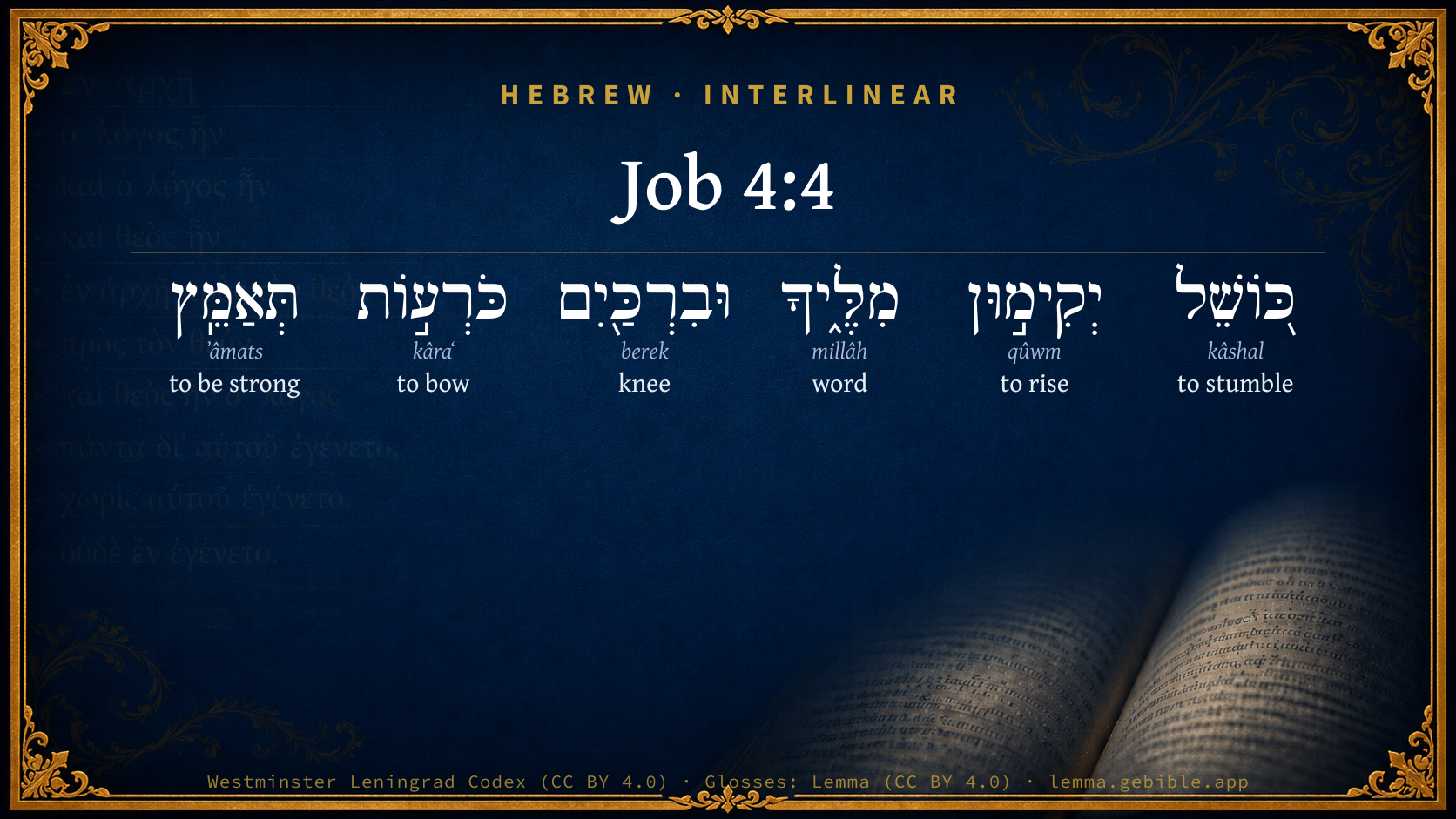
Job 4:4

Hebrew (Westminster Leningrad Codex) Job 4:4 appears in the Hebrew Old Testament. The text above is from the Westminster Leningrad Codex. Each word links to its Strong’s number, a concise gloss, and parsing drawn from the Open Scriptures Hebrew Bible morphology. Click any word for its full Brown-Driver-Briggs (BDB) entry.
Download image
Cite this verse

Job 4:4 (World English Bible). Public Domain. Lemma interlinear Bible study tool, https://lemma.gebible.app/v/job/4/4.

Show BibTeX & RIS
BibTeX
RIS
English Translation
Your words have supported him who was falling, You have made firm the feeble knees.
World English Bible · Public Domain
Download a study sheet

One document with this verse’s original text, its word-by-word gloss line, the meaning frame, cross-references with their text, attributed commentary, and full source and license credits — printable, and it pastes into notes with its structure intact.

This verse Autodidact and up

Study sheet (.html) Plain text (.txt)

A passage Seminary Student

Up to 50 verses in one chapter. A passage sheet keeps up to 6 commentary sources and 12 cross-references per verse, in the order this page ranks them, and says so on the sheet whenever that leaves anything out. Ask for a single verse and you get the Autodidact verse sheet above.

Everything on this page stays free to read, with no account — the sheet is a download of what is already on screen, not access to it.

Want to remove ads? Support Godless Engineer
Compare translations 3

The same verse in 3 English versions, stacked beneath the original-language interlinear above. Click any original word for its lexicon entry.

Each is an independent rendering of the whole verse — the interlinear is not word-aligned to these translations.

Highlighted words mark where these versions differ — a whole-verse word diff, not a word-by-word alignment.

  • World English Bible Public Domain
    Your words have supported him who was falling, You have made firm the feeble knees.
  • King James Version Public Domain
    Thy words have upholden him that was falling, and thou hast strengthened the feeble knees.
  • unfoldingWord Literal Text CC BY-SA 4.0
    Your words have upheld the one stumbling, and buckling knees you have strengthened.

unfoldingWord Literal Text — © unfoldingWord, licensed CC BY-SA 4.0. Word-aligned USFM3 via Door43 (git.door43.org/unfoldingWord/en_ult).

Versions to compare (up to 4)

3 of 4 selected

Show all 18 translations

Every available English version of this verse, each an independent rendering of the whole verse.

  • World English Bible Public Domain
    Your words have supported him who was falling, You have made firm the feeble knees.
  • Berean Standard Bible Public Domain
    Your words have steadied those who stumbled; you have braced the knees that were buckling.
  • Majority Standard Bible Public Domain
    Your words have steadied those who stumbled; you have braced the knees that were buckling.
  • King James Version Public Domain
    Thy words have upholden him that was falling, and thou hast strengthened the feeble knees.
  • American Standard Version (1901) Public Domain
    Thy words have upholden him that was falling, And thou hast made firm the feeble knees.
  • Revised Version (1885) Public Domain
    Thy words have upholden him that was falling, and thou hast confirmed the feeble knees.
  • Geneva Bible (1599) Public Domain
    Thy wordes haue confirmed him that was falling, and thou hast strengthened the weake knees.
  • Douay-Rheims (1899) Public Domain
    Thy words have confirmed them that were staggering, and thou hast strengthened the trembling knees:
  • Young's Literal Translation Public Domain
    The stumbling one do thy words raise up, And bowing knees thou dost strengthen.
  • Literal Standard Version CC BY-SA 4.0
    Your words raise up the stumbling one, || And you strengthen bowing knees.
  • Unlocked Literal Bible CC BY-SA 4.0
    Your words have supported him who was falling; you have made feeble knees firm.
  • unfoldingWord Literal Text CC BY-SA 4.0
    Your words have upheld the one stumbling, and buckling knees you have strengthened.
  • Darby Bible Public Domain
    Thy words have upholden him that was stumbling, and thou hast braced up the bending knees:
  • World Messianic Bible Public Domain
    Your words have supported him who was falling, you have made the feeble knees firm.
  • Webster's Bible Public Domain
    Thy words have upheld him that was falling, and thou hast strengthened the feeble knees.
  • Free Bible Version CC BY-SA 4.0
    Your advice has helped those who are stumbling not to fall, and you have strengthened those whose knees are weak.
  • Bible in Basic English Public Domain
    He who was near to falling has been lifted up by your words, and you have given strength to bent knees.
  • JPS Tanakh (1917) Public Domain
    Thy words have upholden him that was falling, and thou hast strengthened the feeble knees.

Literal Standard Version (2020), Covenant Press — licensed CC BY-SA 4.0. Text via the HelloAO Bible API (eBible.org). Unlocked Literal Bible (unfoldingWord) — licensed CC BY-SA 4.0. Text via the HelloAO Bible API (eBible.org). unfoldingWord Literal Text — © unfoldingWord, licensed CC BY-SA 4.0. Word-aligned USFM3 via Door43 (git.door43.org/unfoldingWord/en_ult). Free Bible Version, Dr. Jonathan Gallagher — licensed CC BY-SA 4.0. Text via the HelloAO Bible API (eBible.org).

Word by word

More ways to search: Search by grammar → Find every occurrence → Compare this word →

Practice this passage: Drill this verse → Learn its vocabulary →

About this verse

These counts appear in no published source. They are computed here, from the morphology-tagged text and Lemma’s own curated glosses. What Lemma adds →

6
words
6
distinct lemmas
Wisdom
section

Shared distinctive vocabulary

וּבִרְכַּ֖יִם knee H1290 occurs in 25 verses of the Hebrew Bible. Also found in:

Grammatical profile

  • 4 verbs
  • 2 nouns

Verb forms

  • כּ֭וֹשֵׁל Qal · Participle Active
  • יְקִימ֣וּן Hiphil · Imperfect
  • כֹּרְע֣וֹת Qal · Participle Active
  • תְּאַמֵּֽץ Piel · Imperfect

Hebrew & Septuagint length

In English translation the verse runs 15 words from the Hebrew and 14 from the Septuagint (LXX English) — closely comparable.

A rough comparison of the two English renderings, which tokenize alike — not a word-level alignment.

Word counts can differ between the Hebrew and the Greek without any difference in meaning — e.g. the Hebrew direct-object marker אֵת has no separate Greek word, and Greek often adds the article ὁ.

In the original languages it is 6 Hebrew tokens and 10 Greek tokens — but the two are counted differently (Hebrew bundles its prefixes and suffixes into one token; the Greek is in lemma form), so that isn’t a like-for-like length.

Cross-references

9

Topical passages linked to Job 4:4 in the Treasury of Scripture Knowledge — connected by theme and wording, ordered by reader-vote popularity; previews shown in the World English Bible.

  • Psalms 145:14 Yahweh upholds all who fall, And raises up all those who are bowed down.
  • Proverbs 12:18 There is one who speaks rashly like the piercing of a sword, But the tongue of the wise heals.
  • 1 Thessalonians 5:14 We exhort you, brothers, admonish the disorderly, encourage the fainthearted, support the weak, be patient toward all.
  • Hebrews 12:12 Therefore, lift up the hands that hang down and the feeble knees,
  • Proverbs 16:23–24 The heart of the wise instructs his mouth, And adds learning to his lips.
  • Isaiah 35:3–4 Strengthen you the weak hands, and confirm the feeble knees.
  • Daniel 5:6 Then the king's face was changed in him, and his thoughts troubled him; and the joints of his loins were loosened, and his knees struck one against another.
  • 2 Corinthians 2:7 so that on the contrary you should rather forgive him and comfort him, lest by any means such a one should be swallowed up with his excessive sorrow.
  • 2 Corinthians 7:6 Nevertheless, he who comforts the lowly, God, comforted us by the coming of Titus;

Cross-references courtesy of OpenBible.info (CC BY 4.0).

Hebrew and Greek witnesses Masoretic Hebrew ↔ Greek Septuagint

The same verse in the two great witnesses to the Old Testament, shown verse-for-verse.

These are two independent witnesses, not word-aligned to each other, and the Septuagint is shown in lemma (dictionary) form.

Hebrew Job 4:4 Masoretic · Westminster Leningrad Codex

כּ֭וֹשֵׁל יְקִימ֣וּן מִלֶּ֑יךָ וּבִרְכַּ֖יִם כֹּרְע֣וֹת תְּאַמֵּֽץ

Your words have supported him who was falling, You have made firm the feeble knees.

World English Bible · Public Domain

Greek LXX Job 4:4 Septuagint · lemma form

ἀσθενέω τε ἐκ ἀναἵστημι ῥῆμα γόνυ τε ἀδυνατέω θάρσος περιτίθημι

and have supported the failing with words, and have imparted courage to feeble knees.

LXX2012 (modern English Septuagint) · Public Domain

Hebrew: Westminster Leningrad Codex (CC BY 4.0). Greek: Septuagint (public domain); English from LXX2012 (modern English Septuagint) (Public Domain). How the Septuagint differs from the Hebrew →

Commentary

Notes on Job 4:4 from classic Christian and Jewish commentators (each source and its license shown beneath its notes). The classic Christian expositions comment on the surrounding passage and are grouped to its opening verse, so a note may address several verses; the Jewish commentaries on the Tanakh (Rashi and others) are per-verse, so they appear only where the commentator wrote on this verse.

Lemma curates 59 commentaries, every one of them public domain or Creative Commons licensed, each selected and text-cleaned for this edition rather than reprinted as found. About our sources →

Trapp's Complete Commentary

John Trapp

Job 4:4 Thy words have upholden him that was falling, and thou hast strengthened the feeble knees.

Ver. 4. Thy words have upholden him that was falling] So forcible are right words, well timed and fitted to the present necessity, they shore up the tottering, they catch him before be comes to ground, and prevent his fall. This made Latimer bless God that ever he came acquainted with that fellow prisoner of his, that angel of God (as he called him), John Bradford he and Ridley, so long as they lived, upheld Cranmer by their words and letters; who soon after fell, to the grief of the godly party, but rose again by repentance (Mr Clark in his Life). The story is told of Urbanus Regius, a famous Dutch divine, that meeting with Luther at Goburg, be spent a whole day in conference with him about matters of great moment, of which himself writeth, that he never had a more comfortable day in all his life. The earl of Derby’s accusation in the parliament house against Mr Bradford was, that he did more harm (so he called good, evil) by letters and conferences in prison than ever he did when he was abroad by preaching (Acts and Mon.).

Thou hast strengthened the feeble knees] That bend and buckle under a back burden of afflictions: this was to be like unto God, who doth not crush, but cherish the worm Jacob; he doth not break the bruised reed, nor quench the smoking flax; he despiseth not the day of small things, nor slighteth the well meant weaknesses of his upright hearted people. Now Job, as a partaker of the Divine nature, resembled God herein, and made it his work to comfort the abject, to strengthen and straighten those that were bowed down with pains and pressures, to be eyes to the blind and feet to the lame, Job 29:15; to distribute spiritual alms, which is far the best in many respects, as were easy to instance.

John Trapp, A Commentary or Exposition upon All the Books of the Old and New Testament (1647–1656) — public domain. Text from a community e-Sword module.

Joseph Benson's Commentary

Job 4:4. Thy words have upholden him that was falling — That was ready to sink under his pressures, or to fall into sin, or from God, through despondency and distrust of his providence and promise, or through impatience. And thou hast strengthened the feeble knees — Such as were weak-hearted, and fainting under their trials.

Joseph Benson's Commentary on the Old and New Testaments (1811–1818) — public domain. Text from a community e-Sword module.

The Cambridge Bible for Schools and Colleges

gen. ed. J. J. S. Perowne

4. the feeble knees] lit. as margin, the bowing, or tottering, knees; the figure being that of one tottering under a heavy load, which he is ready to sink beneath. See Isa_35:3-4; Heb_12:12.

The Cambridge Bible for Schools and Colleges (gen. ed. J. J. S. Perowne; Cambridge University Press, 1878–1918) — public domain. Text from a community e-Sword module.

John Gill's Exposition

But now it is come upon thee, and thou faintest,.... The affliction and evil that he feared, Job 3:25; or rather the same trials and afflictions were come upon him as had been on those whom he had instructed and reproved, and whose hands and hearts he had strengthened and comforted; and yet now thou thyself "faintest", or "art weary" (z), or art bore down and sinkest under the burden, and bearest it very impatiently (a), quite contrary to the advice given to others; and therefore it was concluded he could not be a virtuous, honest, and upright man at heart, only in show and appearance. Bolducius renders the words, "God cometh unto thee", or "thy God cometh"; very wrongly, though the sense may be the same; God cometh and visits thee by laying his afflicting hand upon thee:

it toucheth thee, and thou art troubled; suggesting that it was but a touch, a slight one, a light affliction; thereby lessening Job's calamity and distress, or making little and light of it, and aggravating his impatience under it, that for such a trial as this he should be so excessively troubled, his passions should be so violently moved, and he be thrown into so much disorder and confusion, and be impatient beyond measure; no bounds being set to his grief, and the expressions of it; yea, even to be in the utmost consternation and amazement, as the word (b) signifies.

(z) Defatigaris, Cocceius. (a) aegre tulisti, Pagninus, Montanus, Mercerus; "impatienter fers", Schmidt, Michaelis, Piscator. (b) "consternaris", Mercerus, Cocceius, Schmidt, Michaelis, Schultens.

John Gill's Exposition of the Whole Bible (1746–1763) — public domain (CC PDM 1.0). Text via the HelloAO Bible API.

Albert Barnes' Notes on the Bible

Thy words have upholden him that was falling - That is, either falling into sin, or sinking under calamity and trial. The Hebrew will bear either interpretation, but the connection seems to require us to understand it of one who was sinking under the weight of affliction.

The feeble knees - Margin, “bowing.” The knees support the frame. If they fail, we are feeble and helpless. Hence, their being weak, is so often used in the Bible to denote imbecility. The sense is, that Job, in the days of his own prosperity, had exhorted others to submit to God; had counselled them in such a manner as actually to give them support, and that the same views should now have sustained him which he had so successfully employed in comforting others.

Albert Barnes' Notes on the Bible (1834–1885) — public domain. Text from a community e-Sword/MySword module.

Haydock's Catholic Bible Commentary

Knees. It is just that thou shouldst apply thy instructions to thyself. (Menochius)

George Leo Haydock (1774–1849), Haydock's Catholic Family Bible and Commentary, 1859 edition — public domain. Excludes Psalms (Douay-Rheims chapter numbering differs from Protestant) and Deuterocanonical books (Catholic canon only).

Matthew Poole's English Annotations

Him that was falling; ready to sink under their pressures, or to fall from God, or into sin, (as that word is used, 1Co 10:12; Gal 6:2, and elsewhere,) through despondency and distrust of God’s providence and promise, or through impatience.

The feeble knees; such as were weak-hearted, and fainting under their trials. See Isa 35:3; Dan 5:6; Heb 12:12.

Matthew Poole's English Annotations on the Holy Bible (1683–1685) — public domain. Text from a community e-Sword/MySword module.

Whedon's Commentary on the Bible

Daniel D. Whedon

4. Feeble knees — Literally, sinking knees. Schultens sees in these verses a beautiful image drawn from the palestra, and the contests of wrestlers. The duty was devolved upon one to prepare for, and assist others in, such contests. A like office Job has filled as a moral instructor and helper. This sense, however, is forced. Similar figures are used elsewhere to describe moral traits. 2Sa_4:1; Isa_35:3; Eze_7:17.

Daniel D. Whedon (gen. ed.), Commentary on the Old and New Testaments (1874–1909) — public domain. Text from a community e-Sword module.

The Pulpit Commentary

Thy words have upholden him that was falling. Many a man, just on the point of falling, has been stopped in time by thy wise words and good advice to him. This is a strong testimony to Job"s kindliness of heart, and active sympathy with sufferers during the period of his prosperity. And thou hast strengthened the feeble knees; literally, the bowing knees those that were just on the point of collapsing and giving way through exhaustion or feebleness. (comp. Isa_35:3)

The Pulpit Commentary (1880–1919), ed. H.D.M. Spence-Jones & Joseph S. Exell — public domain. Text from a community e-Sword module.

John Wesley's Explanatory Notes

Feeble knees - Such as were weak hearted, and fainting under their trials.

John Wesley, Explanatory Notes Upon the Whole Bible (1754–1765) — public domain. Text via the GEBible commentary corpus.

unfoldingWord translationNotes

Door43 World Missions Community

General Information:

The writer uses parallelism in each of these verses to make one idea using two different statements to emphasize 1) the support that Job has given others in the past, 2) the effect on him of his present troubles, and 3) his piety before God. (See: Parallelism)

supported

Someone who has been encouraged is spoken of as if he were kept from falling down. (See: Metaphor)

falling

Here becoming discouraged is spoken of as if it were falling down. (See: Metaphor)

you have made feeble knees firm

Here discouragement is spoken of as if it were a person whose weak knees could not keep him upright. (See: Metaphor)

But now trouble has come to you

Here trouble is spoken of as if it were an object that could come to a person. AT: "But now you suffer from disasters" (See: Metaphor)

you are weary

"you are discouraged"

your fear

"the fact that you honor God"

Is not your fear your confidence, and the integrity of your ways your hope?

Eliphaz asks these questions in order to tell Job that it is because of his sin that he is suffering. AT: "Everyone thinks that you honor God; everyone thinks that you are an honest man. But these things must not be true, because you do not trust God any longer." (See: Rhetorical Question)

your fear

Eliphaz means Job's fear of God. AT: "your fear of God" (See: Assumed Knowledge and Implicit Information)

your ways

Here "your ways" represents "your conduct," "how you behave." (See: Metaphor)

translationWords

word

trouble

fear

God

confidence

integrity

hope

unfoldingWord translationNotes — © Distant Shores Media and the Door43 World Missions Community, licensed CC BY-SA 4.0. Source: git.door43.org/Door43/en_tn.

Rashi

Rabbi Shlomo Yitzchaki (Rashi)

would pick up Your words were wont to pick up the stumbler.

Rashi on the Tanakh — English translations: “The Judaica Press complete Tanach with Rashi, translated by A. J. Rosenberg” (CC BY 4.0); “Pentateuch with Rashi's commentary by M. Rosenbaum and A.M. Silbermann, 1929-1934” (public domain); “The Metsudah Tanach series, Lakewood, N.J” (CC BY 4.0); and “The Book of Joshua, Metsudah Publications, 1997” (CC BY 4.0). Text via Sefaria.

Lesson kit

Teaching starters — assembled from the data on this page, not authored interpretation. Every prompt links to the verse data it draws on. Edit before teaching.

Job, in the Wisdom, opens this verse with 6 words (6 distinct Hebrew lemmas). Its most distinctive word is berek (“knee”). A historical commentator’s framing appears above. Read the whole chapter for the surrounding context.

Discussion questions

  1. How does “knee” (berek) shape what this verse is saying?
  2. How does Genesis 30:3, which shares the word «knee», read alongside this verse?
  3. These translations render this verse differently; the difference is in the English rendering, not the original. What questions does that raise?
  4. «כּ֭וֹשֵׁל» is a Qal Participle Active verb. How does that grammatical form shape the action described?
  5. Compare how Trapp's Complete Commentary and Joseph Benson's Commentary read this verse. Where do they agree or differ?

Things to notice

Reading settings

Reading text

Shown beneath each verse's original-language words.

Old Testament
Old Testament edition

Read the OT as the Masoretic Hebrew (MT) or the Greek Septuagint (LXX).

English shown for the Greek Septuagint (in the Hebrew ↔ Greek comparison).

Comparing translations? Open the Compare panel on any verse page to stack up to four side by side.