
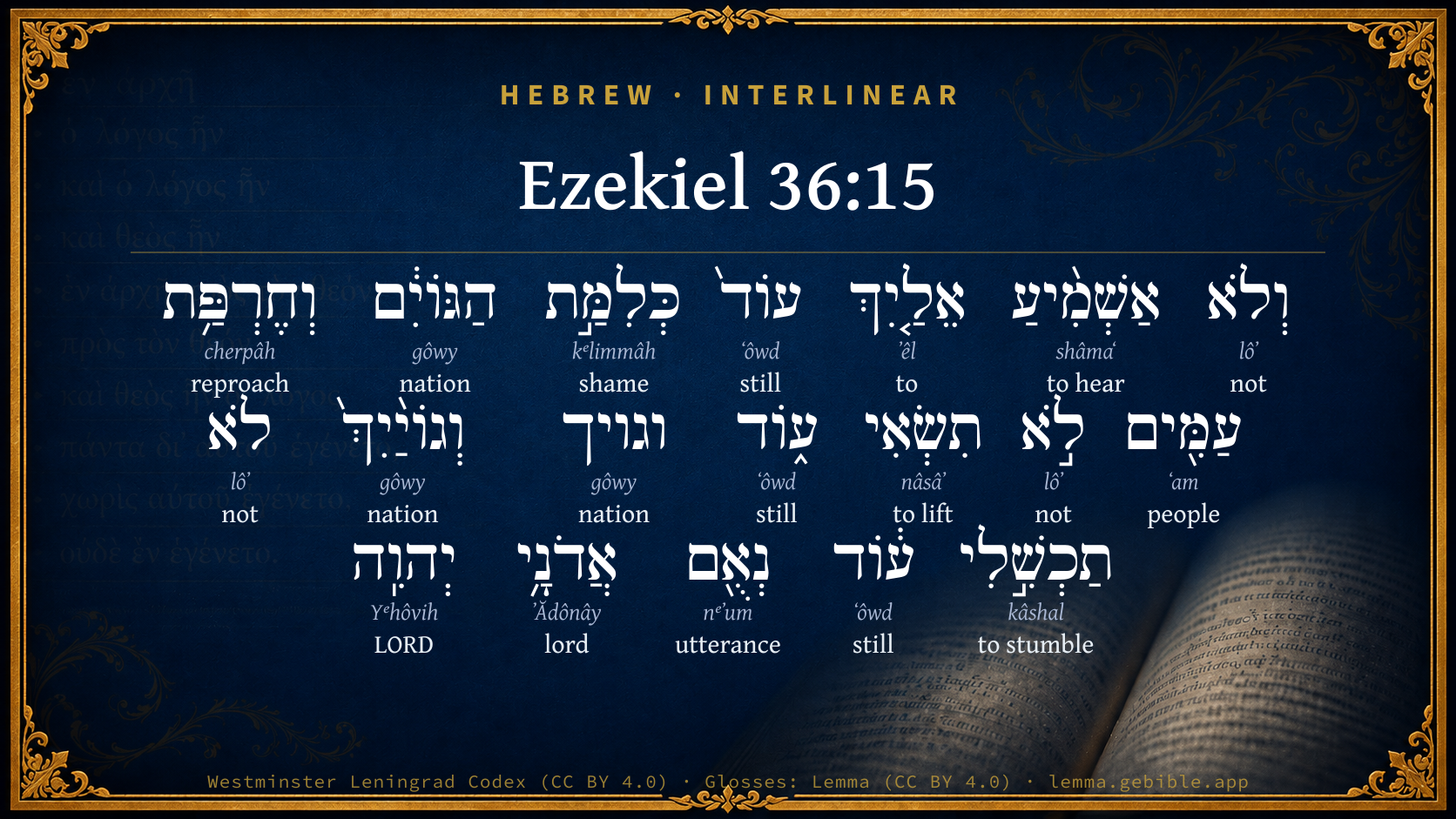
Ezekiel 36:15

Hebrew (Westminster Leningrad Codex) Ezekiel 36:15 appears in the Hebrew Old Testament. The text above is from the Westminster Leningrad Codex. Each word links to its Strong’s number, a concise gloss, and parsing drawn from the Open Scriptures Hebrew Bible morphology. Click any word for its full Brown-Driver-Briggs (BDB) entry.
Download image
Cite this verse

Ezekiel 36:15 (World English Bible). Public Domain. Lemma interlinear Bible study tool, https://lemma.gebible.app/v/ezekiel/36/15.

Show BibTeX & RIS
BibTeX
RIS
English Translation
neither will I let you hear any more the shame of the nations, neither shall you bear the reproach of the peoples any more, neither shall you cause your nation to stumble any more, says the Lord Yahweh.
World English Bible · Public Domain
Download a study sheet

One document with this verse’s original text, its word-by-word gloss line, the meaning frame, cross-references with their text, attributed commentary, and full source and license credits — printable, and it pastes into notes with its structure intact.

This verse Autodidact and up

Study sheet (.html) Plain text (.txt)

A passage Seminary Student

Up to 50 verses in one chapter. A passage sheet keeps up to 6 commentary sources and 12 cross-references per verse, in the order this page ranks them, and says so on the sheet whenever that leaves anything out. Ask for a single verse and you get the Autodidact verse sheet above.

Everything on this page stays free to read, with no account — the sheet is a download of what is already on screen, not access to it.

Want to remove ads? Support Godless Engineer
Compare translations 3

The same verse in 3 English versions, stacked beneath the original-language interlinear above. Click any original word for its lexicon entry.

Each is an independent rendering of the whole verse — the interlinear is not word-aligned to these translations.

Highlighted words mark where these versions differ — a whole-verse word diff, not a word-by-word alignment.

  • World English Bible Public Domain
    neither will I let you hear any more the shame of the nations, neither shall you bear the reproach of the peoples any more, neither shall you cause your nation to stumble any more, says the Lord Yahweh.
  • King James Version Public Domain
    Neither will I cause men to hear in thee the shame of the heathen any more, neither shalt thou bear the reproach of the people any more, neither shalt thou cause thy nations to fall any more, saith the Lord GOD.
  • unfoldingWord Literal Text CC BY-SA 4.0
    Nor will I allow you to hear the insults of the nations any longer; you will no longer have to bear the shame of the peoples or cause your nation to fall—this is the Lord Yahweh’s declaration.’”

unfoldingWord Literal Text — © unfoldingWord, licensed CC BY-SA 4.0. Word-aligned USFM3 via Door43 (git.door43.org/unfoldingWord/en_ult).

Versions to compare (up to 4)

3 of 4 selected

Show all 18 translations

Every available English version of this verse, each an independent rendering of the whole verse.

  • World English Bible Public Domain
    neither will I let you hear any more the shame of the nations, neither shall you bear the reproach of the peoples any more, neither shall you cause your nation to stumble any more, says the Lord Yahweh.
  • Berean Standard Bible Public Domain
    I will no longer allow the taunts of the nations to be heard against you, and you will no longer endure the reproach of the peoples or cause your nation to stumble, declares the Lord GOD.”
  • Majority Standard Bible Public Domain
    I will no longer allow the taunts of the nations to be heard against you, and you will no longer endure the reproach of the peoples or cause your nation to stumble, declares the Lord GOD.”
  • King James Version Public Domain
    Neither will I cause men to hear in thee the shame of the heathen any more, neither shalt thou bear the reproach of the people any more, neither shalt thou cause thy nations to fall any more, saith the Lord GOD.
  • American Standard Version (1901) Public Domain
    neither will I let thee hear any more the shame of the nations, neither shalt thou bear the reproach of the peoples any more, neither shalt thou cause thy nation to stumble any more, saith the Lord Jehovah.
  • Revised Version (1885) Public Domain
    neither will I let thee hear any more the shame of the heathen, neither shalt thou bear the reproach of the peoples any more, neither shalt thou cause thy nation to stumble any more, saith the Lord GOD.
  • Geneva Bible (1599) Public Domain
    Neither will I cause men to heare in thee the shame of the heathen any more, neither shalt thou beare the reproche of the people any more, neither shalt cause thy folke to fal any more, saith the Lord God.
  • Douay-Rheims (1899) Public Domain
    Neither will I cause men to hear in thee the shame of the nations any more, nor shalt thou bear the reproach of the people, nor lose thy nation any more, saith the Lord God.
  • Young's Literal Translation Public Domain
    And I proclaim not unto thee any more the shame of the nations, And the reproach of peoples thou bearest no more, And thy nations stumble not any more, An affirmation of the Lord Jehovah.'
  • Literal Standard Version CC BY-SA 4.0
    And I do not proclaim the shame of the nations to you anymore, || And you no longer bear the reproach of peoples, || And your nations do not stumble anymore, || A declaration of Lord YHWH.”
  • Unlocked Literal Bible CC BY-SA 4.0
    Nor will I allow you to hear the insults of the nations any longer; you will no longer have to bear the shame of the peoples or cause your nation to fall—this is the Lord Yahweh's declaration.'”
  • unfoldingWord Literal Text CC BY-SA 4.0
    Nor will I allow you to hear the insults of the nations any longer; you will no longer have to bear the shame of the peoples or cause your nation to fall—this is the Lord Yahweh’s declaration.’”
  • Darby Bible Public Domain
    neither will I cause thee to hear the ignominy of the nations any more, and thou shalt not bear the reproach of the peoples any more, neither shalt thou cause thy nation to fall any more, saith the Lord Jehovah.
  • World Messianic Bible Public Domain
    “I won’t let you hear the shame of the nations any more. You won’t bear the reproach of the peoples any more, and you won’t cause your nation to stumble any more,” says the Lord GOD.’”
  • Webster's Bible Public Domain
    Neither will I cause men to hear in thee the shame of the heathen any more, neither shalt thou bear the reproach of the people any more, neither shalt thou cause thy nations to fall any more, saith the Lord GOD.
  • Free Bible Version CC BY-SA 4.0
    I'm going to stop these nations insulting you, and you won't have to put up with their taunts any more, or make the nation fall, declares the Lord God.”
  • Bible in Basic English Public Domain
    And I will not let the shaming of the nations come to your ears, and no longer will you be looked down on by the peoples, says the Lord.
  • JPS Tanakh (1917) Public Domain
    neither will I suffer the shame of the nations any more to be heard against thee, neither shalt thou bear the reproach of the peoples any more, neither shalt thou cause thy nations to stumble any more, saith the Lord GOD.'

Literal Standard Version (2020), Covenant Press — licensed CC BY-SA 4.0. Text via the HelloAO Bible API (eBible.org). Unlocked Literal Bible (unfoldingWord) — licensed CC BY-SA 4.0. Text via the HelloAO Bible API (eBible.org). unfoldingWord Literal Text — © unfoldingWord, licensed CC BY-SA 4.0. Word-aligned USFM3 via Door43 (git.door43.org/unfoldingWord/en_ult). Free Bible Version, Dr. Jonathan Gallagher — licensed CC BY-SA 4.0. Text via the HelloAO Bible API (eBible.org).

Word by word

More ways to search: Search by grammar → Find every occurrence → Compare this word →

Practice this passage: Drill this verse → Learn its vocabulary →

כְּלִמַּ֣ת
kᵉlimmâh
H3639
“shame of”
Noun, Common, Feminine, Singular, Construct
Part of Speech
Noun
Type
Common
Gender
Feminine
Number
Singular
State
Construct
Full BDB Definition

Origin: from H3637

TWOT: 987a

disgrace, reproach, shame, confusion, dishonour, insult, ignominy - insult, reproach - reproach, ignominy
  1. וְלֹא lôʼ H3808 “and · not” Conjunction + Particle, Negative
  2. אַשְׁמִ֨יעַ shâmaʻ H8085 “to hear” Verb, Hiphil, Imperfect, 1st Person, Common, Singular
  3. אֵלַ֤יִךְ ʼêl H413 “to · you” Preposition + Suffix, Personal, 2nd Person, Feminine, Singular
  4. עוֹד֙ ʻôwd H5750 “still” Adverb
  5. הַגּוֹיִ֔ם gôwy H1471 “the · nations” Particle, Definite Article + Noun, Common, Masculine, Plural, Absolute
  6. וְחֶרְפַּ֥ת cherpâh H2781 “and · reproach of” Conjunction + Noun, Common, Feminine, Singular, Construct
  7. עַמִּ֖ים ʻam H5971 “peoples” Noun, Common, Masculine, Plural, Absolute
  8. לֹ֣א lôʼ H3808 “not” Particle, Negative
  9. תִשְׂאִי nâsâʼ H5375 “to lift” Verb, Qal, Imperfect, 2nd Person, Feminine, Singular
  10. ע֑וֹד ʻôwd H5750 “still” Adverb
  11. וגויך gôwy H1471 “and · nation · your” Conjunction + Noun, Common, Masculine, Singular, Construct + Suffix, Personal, 2nd Person, Feminine, Singular
  12. וְגוֹיַ֨יִךְ֙ gôwy H1471 “and · nations · your” Conjunction + Noun, Common, Masculine, Plural, Construct + Suffix, Personal, 2nd Person, Feminine, Singular
  13. לֹא lôʼ H3808 “not” Particle, Negative
  14. תַכְשִׁ֣לִי kâshal H3782 “to stumble” Verb, Hiphil, Imperfect, 2nd Person, Feminine, Singular
  15. ע֔וֹד ʻôwd H5750 “still” Adverb
  16. נְאֻ֖ם nᵉʼum H5002 “utterance of” Noun, Common, Masculine, Singular, Construct
  17. אֲדֹנָ֥י ʼĂdônây H136 “Lord · my” Noun, Common, Masculine, Plural, Construct + Suffix, Personal, 1st Person, Common, Singular
  18. יְהוִֽה Yᵉhôvih H3069 “LORD” Noun, Proper

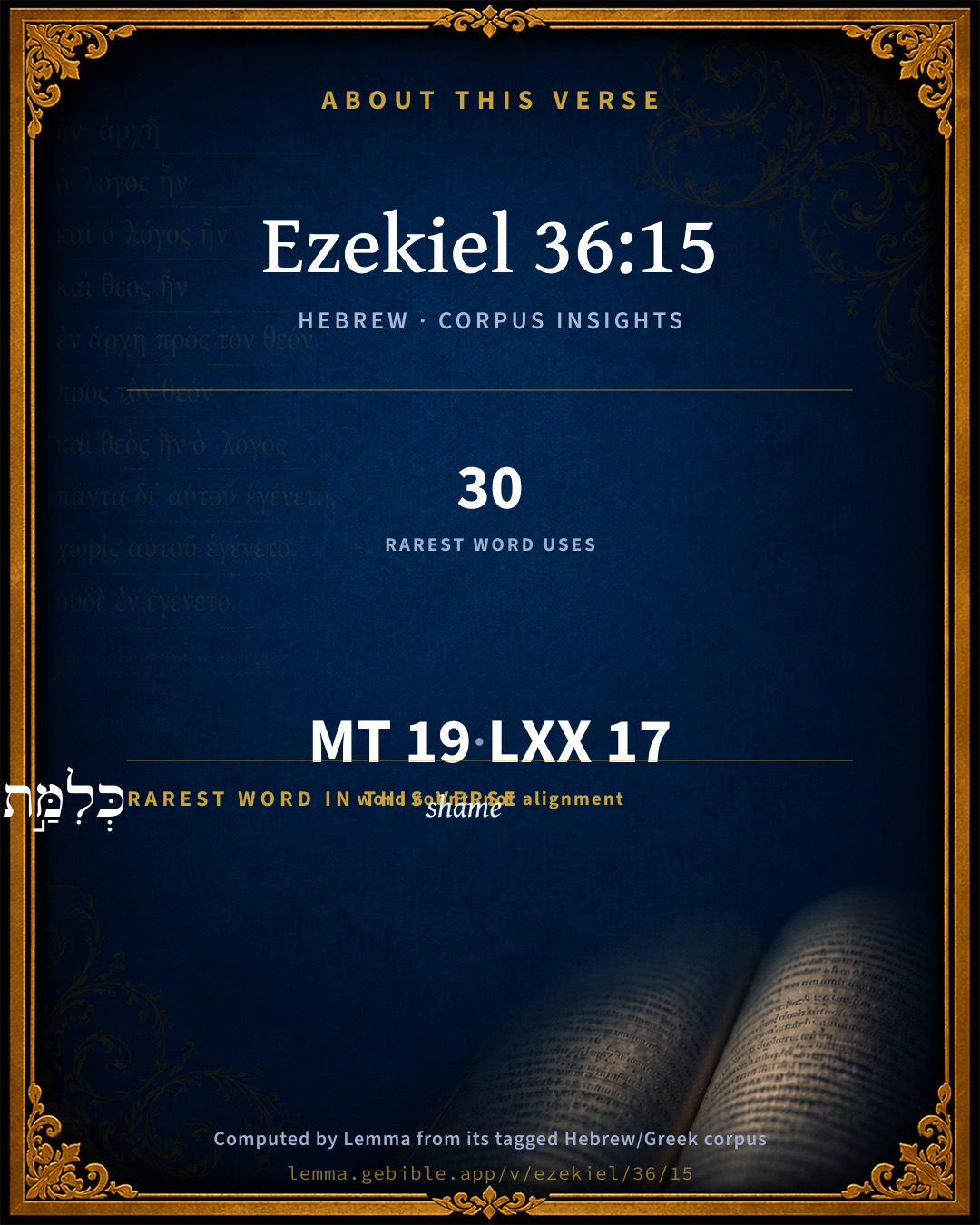
About this verse

These counts appear in no published source. They are computed here, from the morphology-tagged text and Lemma’s own curated glosses. What Lemma adds →

19
words
13
distinct lemmas
Prophets
section

Shared distinctive vocabulary

כְּלִמַּ֣ת shame H3639 occurs in 29 verses of the Hebrew Bible. Also found in:

Grammatical profile

  • 3 verbs
  • 9 nouns
  • 1 preposition
  • 3 adverbs
  • 3 particles

Verb forms

  • אַשְׁמִ֨יעַ Hiphil · Imperfect
  • תִשְׂאִי Qal · Imperfect
  • תַכְשִׁ֣לִי Hiphil · Imperfect

Repetition

Words recur within this verse — often emphatic in Hebrew:

  • עוֹד֙ still H5750 ×3
  • הַגּוֹיִ֔ם nation H1471 ×3
  • וְלֹא not H3808 ×3

Hebrew & Septuagint length

In English translation the verse runs 38 words from the Hebrew and 29 from the Septuagint (LXX English) — closely comparable.

A rough comparison of the two English renderings, which tokenize alike — not a word-level alignment.

Word counts can differ between the Hebrew and the Greek without any difference in meaning — e.g. the Hebrew direct-object marker אֵת has no separate Greek word, and Greek often adds the article ὁ.

In the original languages it is 19 Hebrew tokens and 17 Greek tokens — but the two are counted differently (Hebrew bundles its prefixes and suffixes into one token; the Greek is in lemma form), so that isn’t a like-for-like length.

Cross-references

8

Topical passages linked to Ezekiel 36:15 in the Treasury of Scripture Knowledge — connected by theme and wording, ordered by reader-vote popularity; previews shown in the World English Bible.

  • Psalms 89:50 Remember, Lord, the reproach of your servants, How I bear in my heart the taunts of all the mighty peoples,
  • Ezekiel 34:29 I will raise up to them a plantation for renown, and they shall be no more consumed with famine in the land, neither bear the shame of the nations any more.
  • Isaiah 54:4 Don't be afraid; for you shall not be ashamed: neither be confounded; for you shall not be disappointed: for you shall forget the shame of your youth; and the reproach of your widowhood shall you remember no more.
  • Isaiah 60:14 The sons of those who afflicted you shall come bending to you; and all those who despised you shall bow themselves down at the soles of your feet; and they shall call you The city of Yahweh, The Zion of the Holy One of Israel.
  • Ezekiel 36:6 Therefore prophesy concerning the land of Israel, and tell the mountains and to the hills, to the watercourses and to the valleys, Thus says the Lord Yahweh: Behold, I have spoken in my jealousy and in my wrath, because you have borne the shame of the nations:
  • Micah 7:8–10 Don't rejoice against me, my enemy. When I fall, I will arise. When I sit in darkness, Yahweh will be a light to me.
  • Zephaniah 2:8 I have heard the reproach of Moab, and the insults of the children of Ammon, with which they have reproached my people, and magnified themselves against their border.
  • Zephaniah 3:19–20 Behold, at that time I will deal with all those who afflict you, and I will save those who are lame, and gather those who were driven away. I will give them praise and honor, whose shame has been in all the earth.

Cross-references courtesy of OpenBible.info (CC BY 4.0).

Hebrew and Greek witnesses Masoretic Hebrew ↔ Greek Septuagint

The same verse in the two great witnesses to the Old Testament, shown verse-for-verse.

These are two independent witnesses, not word-aligned to each other, and the Septuagint is shown in lemma (dictionary) form.

Hebrew Ezekiel 36:15 Masoretic · Westminster Leningrad Codex

וְלֹא אַשְׁמִ֨יעַ אֵלַ֤יִךְ עוֹד֙ כְּלִמַּ֣ת הַגּוֹיִ֔ם וְחֶרְפַּ֥ת עַמִּ֖ים לֹ֣א תִשְׂאִי ע֑וֹד וגויך וְגוֹיַ֨יִךְ֙ לֹא תַכְשִׁ֣לִי ע֔וֹד נְאֻ֖ם אֲדֹנָ֥י יְהוִֽה

neither will I let you hear any more the shame of the nations, neither shall you bear the reproach of the peoples any more, neither shall you cause your nation to stumble any more, says the Lord Yahweh.

World English Bible · Public Domain

Greek LXX Ezekiel 36:15 Septuagint · lemma form

καί οὐ ἀκούω οὐκέτι ἐπί σύ ἀτιμία ἔθνος καί ὀνειδισμός λαός οὐ μή ἀναφέρω λέγω κύριος κύριος

And there shall no more be heard against you the reproach of the nations, and you⌃ shall no more bear the revilings of the peoples, says the Lord God.

LXX2012 (modern English Septuagint) · Public Domain

On this verse, The Cambridge Bible for Schools and Colleges discusses the Septuagint’s reading. Read the note in Commentary ↓

Hebrew: Westminster Leningrad Codex (CC BY 4.0). Greek: Septuagint (public domain); English from LXX2012 (modern English Septuagint) (Public Domain). How the Septuagint differs from the Hebrew →

Targum (Aramaic paraphrase)

1

The Targum is the ancient Jewish Aramaic paraphrase of the Hebrew Scriptures — an interpretive translation, not the Hebrew text itself. Onkelos (literal) and Pseudo-Jonathan (expansive) render the Torah, and Jonathan the Prophets. Coverage is partial: where no permissively-licensed English translation exists for a verse, only the Aramaic is shown. This is verse-level text, not a word-by-word alignment to the Hebrew.

  1. Targum Jonathan Prophets (Joshua–Malachi)
    וְלָא אֶשְׁמַע לִיךְ עוֹד אִתְכְּנָעוּת עַמְמַיָא וְחִסוּדֵי עַמְמַיָא לָא תְקַבְּלִין עוֹד וְעַמֵיךְ לָא תִתְכְּלִין עוֹד אֲמַר יְיָ אֱלֹהִים:

    (no public-domain English translation for this verse)

    Targum Jonathan — Aramaic: “Mikraot Gedolot” (public domain). English: “Sefaria Community Translation” (CC0 1.0 (public-domain dedication)); “London "Chaldee Paraphrase," 1871” (public domain). Text via Sefaria.

Commentary

Notes on Ezekiel 36:15 from classic Christian and Jewish commentators (each source and its license shown beneath its notes). The classic Christian expositions comment on the surrounding passage and are grouped to its opening verse, so a note may address several verses; the Jewish commentaries on the Tanakh (Rashi and others) are per-verse, so they appear only where the commentator wrote on this verse.

Lemma curates 59 commentaries, every one of them public domain or Creative Commons licensed, each selected and text-cleaned for this edition rather than reprinted as found. About our sources →

Ellicott's Commentary for English Readers

(15) Cause . . . to fall.—In the last four verses there is a delicate play upon words which cannot well be expressed in English. Two verbs are used, each of them twice (“bereave” in Eze_36:14 should be cause to fall, as in margin), one of them meaning to bereave, the other to cause to fall; and these verbs have the same radical letters, but with the first two of them transposed.

In reviewing this whole prophecy (Eze_35:1 to Eze_36:15), it is evident that the time had in view by the prophet was one in which Edom still existed as a nation, and was rejoicing in the fall of Israel. It cannot, therefore, look forward to any literal, but still future, accomplishment, since Edom, as a nation, has long since disappeared; and no future people, occupying the same territory or bearing the same name, could possibly sustain the same historic relations to Israel as are here attributed to Edom. Whatever, therefore, is to be literally understood in the prophecy must have been long ago fulfilled. And this was much. Israel was restored to its land, and there greatly multiplied, so that the country became for ages one of the most fertile and prosperous in Asia. At the same time, the sinfulness of the people, as of old, hindered the fulness of blessing that was within their reach. But a small part of them availed themselves of the opportunity to return to their land; and they who did so suffered themselves so to live that when the crowning blessing of the ages was fulfilled in the coming of the Messiah, the mass of the nation rejected and crucified Him. The blessings promised were fulfilled literally as far as the sinfulness of the people allowed; but inasmuch as these prevented anything like the full realisation of the terms of the prophecy, and as no future realisation of these is possible, on account of the total change of conditions and circumstances, it is plain that under these earthly terms the prophet, like his predecessors, Isaiah and the others, sets forth the glories of the spiritual future, and uses earthly blessings as the types of those better ones which are heavenly.

Eze_36:16-38 constitute a separate prophecy, but one closely connected with that which has gone before. It is here declared that Israel has been scattered among the heathen because they had defiled the land by their sin (Eze_36:16-19); then, that although they had yet further profaned God’s name among the heathen, He yet had pity for that name’s sake (Eze_36:20-23); and, accordingly, that He will gather and restore Israel, cleansing them from their sins, and giving them a heart to keep His commandments (Eze_36:24-32); and in consequence of this change that He will greatly bless them (Eze_36:35-38). The great point of the prophecy is the moral change foretold in Eze_36:25-27; Eze_36:31.

A Bible Commentary for English Readers, edited by Charles John Ellicott (1878–1897) — public domain. Text from a community e-Sword module.

Trapp's Complete Commentary

John Trapp

Eze 36:15 Neither will I cause [men] to hear in thee the shame of the heathen any more, neither shalt thou bear the reproach of the people any more, neither shalt thou cause thy nations to fall any more, saith the Lord GOD.

Ver. 15. Neither will I cause men to hear.] I will cut off all occasions, and remove all such stumblingblocks as whereat the nations dash and split themselves.

John Trapp, A Commentary or Exposition upon All the Books of the Old and New Testament (1647–1656) — public domain. Text from a community e-Sword module.

The Cambridge Bible for Schools and Colleges

gen. ed. J. J. S. Perowne

15. Read peoples for people, as usual.

cause thy nations to fall] Rather: bereave thy nation any more. The same word is read Eze_36:14, but corrected in Heb. marg., and the same correction should be made here (shakal = bereave, kashal = fall). The clause is wanting in LXX.

The Cambridge Bible for Schools and Colleges (gen. ed. J. J. S. Perowne; Cambridge University Press, 1878–1918) — public domain. Text from a community e-Sword module.

John Gill's Exposition

Neither will I cause men to hear in thee the shame of the Heathen any more,.... Their calumnies and revilings, their scoffs and jeers:

neither shalt thou bear the reproach of the people any more; or be any more a taunt and a curse, a proverb and a byword of the people; or be their laughing stock, and the object of their derision:

neither shalt thou cause thy nations to fall any more, saith the Lord God; by famine, sword, or pestilence, or any other judgment caused by sin: or, "thou shalt not bereave" (l), as the marginal reading is; and which the Targum and many versions follow: now what is here promised, in this and the preceding verse, had not its full accomplishment upon the Jews' return from the Babylonish captivity; for since that time their men have been devoured, and their tribes have been bereaved of them by famine, sword, and pestilence; and they have heard and bore the shame and reproach of the nations where they have been dispersed, and do to this day; wherefore these prophecies must refer to a future restoration of that people.

(l) "Non orbabis", Starckius.

John Gill's Exposition of the Whole Bible (1746–1763) — public domain (CC PDM 1.0). Text via the HelloAO Bible API.

Albert Barnes' Notes on the Bible

Hear in thee the shame of the pagan - Hear the pagan putting thee to shame by their contemptuous words.

The reproach of the people - “Thy people” (thy rightful possessors) shall have no cause to reproach thee for want of fertility. Were the blessings promised here merely temporal they could not be said to be fulfilled. The land is still subject to pagan masters. The words must point to blessings yet future, spiritual blessings.

In the following chapters to the end of Ezek. 39 the conflict between the world mid God is described in its most general form, and the absolute triumph of the kingdom of God fully depicted. The honor of God is asserted in the gathering together, and the purification of, His people. As the dispersion of the children of Israel was far wider and more lasting than the sojourn in Chaldaea, so the reunion here predicted is far more extensive and complete. The dispersion yet continues, the reunion will be in those days when Israel shall be gathered into the Church of God.

Albert Barnes' Notes on the Bible (1834–1885) — public domain. Text from a community e-Sword/MySword module.

Haydock's Catholic Bible Commentary

CHAPTER XXXVI.

More. This whole promise principally relates to the Church of Christ, and God’s perpetual protection of her; for to the carnal Jews, they have been removed out of their land these sixteen hundred years. (Challoner)

George Leo Haydock (1774–1849), Haydock's Catholic Family Bible and Commentary, 1859 edition — public domain. Excludes Psalms (Douay-Rheims chapter numbering differs from Protestant) and Deuterocanonical books (Catholic canon only).

Matthew Poole's English Annotations

This verse is a confirmation of what was promised in Eze 36:12-14, all which is doubled for more assurance, and each part already explicated. See Eze 36:6.

Matthew Poole's English Annotations on the Holy Bible (1683–1685) — public domain. Text from a community e-Sword/MySword module.

Whedon's Commentary on the Bible

Daniel D. Whedon

15. Neither shalt thou cause thy nations to fall — R.V., “neither shalt thou cause thy nation to stumble;” but by slight change of text read, “neither shalt thou bereave thy nation any more,” or, “thou shalt no more bereave thy nation of children.”

Daniel D. Whedon (gen. ed.), Commentary on the Old and New Testaments (1874–1909) — public domain. Text from a community e-Sword module.

The Pulpit Commentary

Neither will I cause men to hear in theelet thee hear, proclaim against thee (Revised Version); or literally, cause to be heard against thee the shame of the heathen any more; i.e. the contemptuous speech uttered against thee by the heathen, equivalent to the reproach of the people; or, peoples; i.e. the reproach cast upon thee by the nations. (see Eze_16:57 Eze_22:4; and comp. Jos_5:9; Mic_6:16) rather than, as Curtsy suggests, the reproach cast upon thee by thy rightful possessors for want of fertility. This prophecy clearly looked beyond the return from exile under Zerubbabel and Joshua, Ezra and Neherajah, since under these leaders only a portion of the whole house of Israel re established themselves in Canaan, while the land was often afterwards subjected to reproach and oppression under heathen powers. At the same time, the homecoming from Babylon and the prosperity that ensued thereupon were partial fulfillments of the blessings here promised.

The Pulpit Commentary (1880–1919), ed. H.D.M. Spence-Jones & Joseph S. Exell — public domain. Text from a community e-Sword module.

Lesson kit

Teaching starters — assembled from the data on this page, not authored interpretation. Every prompt links to the verse data it draws on. Edit before teaching.

Ezekiel, in the Prophets, opens this verse with 19 words (13 distinct Hebrew lemmas). Its most distinctive word is kᵉlimmâh (“shame”). A historical commentator’s framing appears above. Read the whole chapter for the surrounding context.

Discussion questions

  1. How does “shame” (kᵉlimmâh) shape what this verse is saying?
  2. Job 20:3 shares the word «shame» with this verse. How do the two illuminate each other?
  3. “still” occurs 3× in this one verse. What is the effect of the repetition?
  4. These translations render this verse differently. What is at stake in choosing one wording over another?
  5. The verb «אַשְׁמִ֨יעַ» is Hiphil Imperfect. How does its form color the action?
  6. Reading how Ellicott's Commentary for English Readers and Trapp's Complete Commentary read this verse, where do the two commentators agree and where do they part?

Things to notice

Reading settings

Reading text

Shown beneath each verse's original-language words.

Old Testament
Old Testament edition

Read the OT as the Masoretic Hebrew (MT) or the Greek Septuagint (LXX).

English shown for the Greek Septuagint (in the Hebrew ↔ Greek comparison).

Comparing translations? Open the Compare panel on any verse page to stack up to four side by side.