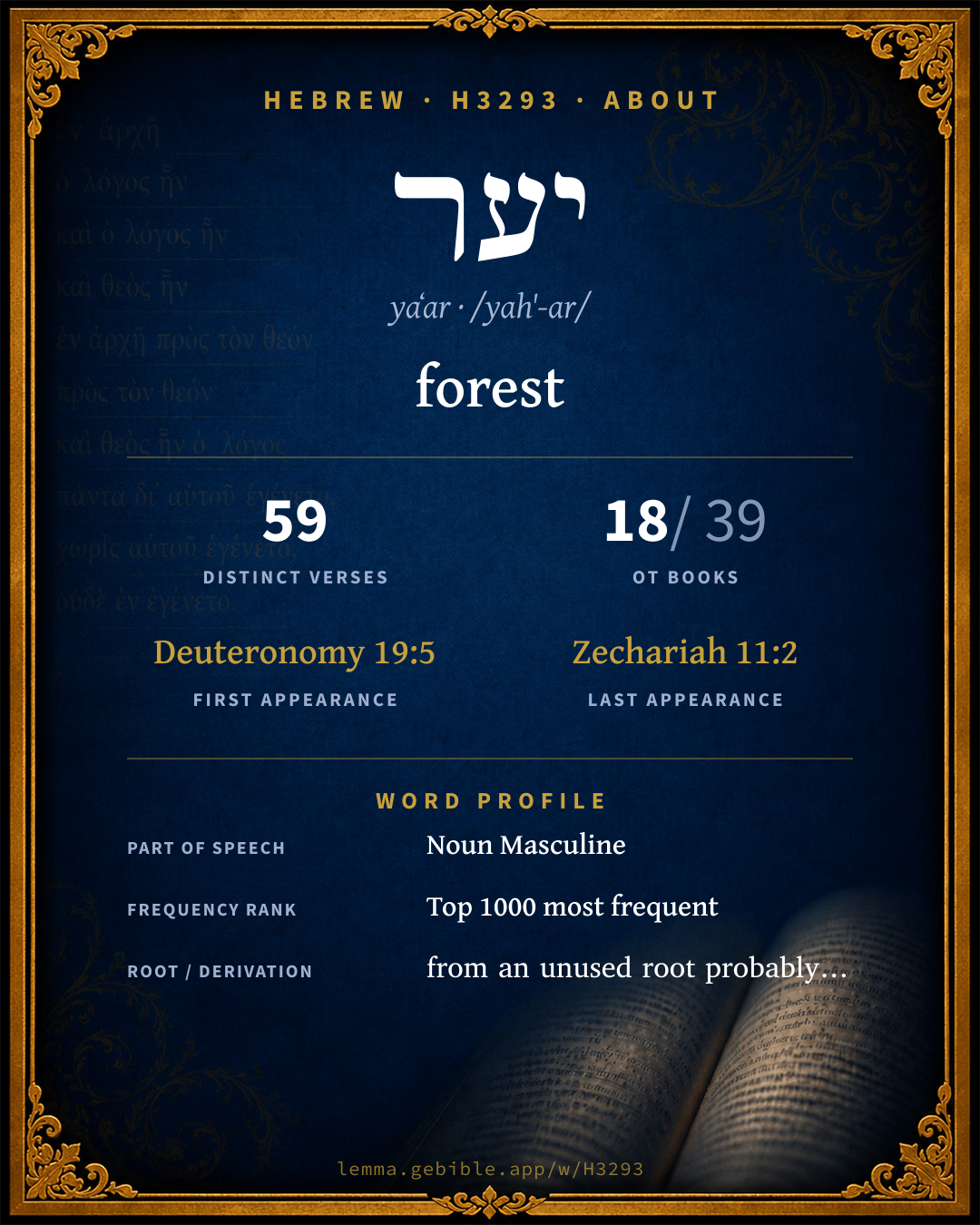
יַ֫עַר
forest
Full lexicon entry — Brown-Driver-Briggs (BDB)
From Brown-Driver-Briggs (BDB)
Where this word appears
See every Absolute-state word in the Hebrew Bible →
Grammar key — what these labels mean
Part of speech
- Noun
- A naming word — a person, place, thing, or idea.
Noun type
- Common
- A common noun — a general class of person, place, or thing (“king,” “city,” “water”), not a specific name.
- Proper
- A name of a specific person, place, or people (e.g. Abraham, Zion, Israel).
State
- Absolute
- The independent form of a noun, not bound to a following word.
- Construct
- A noun bound to a following noun in a possessive / “of” relationship (the construct chain).
Gender
- Masculine
- Grammatically masculine.
Number
- Singular
- One.
- Plural
- More than one (in Hebrew, generally three or more).
Grammatical forms
- Noun, Common, Masculine, Singular, Absolute 37 times (63%)
- Noun, Common, Masculine, Singular, Construct 18 times (31%)
- Noun, Common, Masculine, Plural, Absolute 3 times (5%)
- Noun, Proper 1 time (2%)
Parsed forms decoded from the imported morphology (morphhb / Westminster Leningrad Codex — WLC text public domain, morphhb tagging CC BY 4.0), counted across 59 parsed occurrences — not distinct verses.
Every verse where H3293 appears — 59 distinct verses across 18 books. Click any verse to open its interlinear word-by-word view. Verse text shown in the World English Bible for context — . Each verse’s Hebrew form is shown with its reference; the English is not keyword-highlighted, since the data carries no word-level English alignment. Use “Compare translations” on any verse to read it across multiple English versions. This concordance covers the Hebrew Bible; Septuagint (Greek Old Testament) occurrences are not indexed here.
Deuteronomy 1 verse
Joshua 2 verses
- Joshua 17:15 הַ/יַּ֔עְרָ/ה ptcl def.art + n c ms + sfx dem Joshua said to them, If you are a great people, go up to the forest, and cut down for yourself there in the land of the Perizzites and of the Rephaim; since the hill-country of Ephraim is too narrow for you.
- Joshua 17:18 יַ֣עַר n c ms but the hill-country shall be yours; for though it is a forest, you shall cut it down, and the goings out of it shall be yours; for you shall drive out the Canaanites, though they have chariots of iron, and though they are strong.
1 Samuel 3 verses
- 1 Samuel 14:25 בַ/יָּ֑עַר prep det + n c ms All the people came into the forest; and there was honey on the ground.
- 1 Samuel 14:26 הַ/יַּ֔עַר ptcl def.art + n c ms When the people were come to the forest, behold, the honey dropped: but no man put his hand to his mouth; for the people feared the oath.
- 1 Samuel 22:5 יַ֥עַר n c ms cs The prophet Gad said to David, Don't stay in the stronghold; depart, and get you into the land of Judah. Then David departed, and came into the forest of Hereth.
2 Samuel 3 verses
- 2 Samuel 18:6 בְּ/יַ֥עַר prep + n c ms cs So the people went out into the field against Israel: and the battle was in the forest of Ephraim.
- 2 Samuel 18:8 הַ/יַּ֨עַר֙ ptcl def.art + n c ms For the battle was there spread over the surface of all the country; and the forest devoured more people that day than the sword devoured.
- 2 Samuel 18:17 בַ/יַּ֨עַר֙ prep det + n c ms They took Absalom, and cast him into the great pit in the forest, and raised over him a very great heap of stones: and all Israel fled everyone to his tent.
1 Kings 3 verses
- 1 Kings 7:2 יַ֣עַר n c ms cs For he built the house of the forest of Lebanon; the length of it was one hundred cubits, and the breadth of it fifty cubits, and the height of it thirty cubits, on four rows of cedar pillars, with cedar beams on the pillars.
- 1 Kings 10:17 יַ֥עַר n c ms cs [he made] three hundred shields of beaten gold; three minas of gold went to one shield: and the king put them in the house of the forest of Lebanon.
- 1 Kings 10:21 יַ֥עַר n c ms cs All king Solomon's drinking vessels were of gold, and all the vessels of the house of the forest of Lebanon were of pure gold: none were of silver; it was nothing accounted of in the days of Solomon.
2 Kings 2 verses
- 2 Kings 2:24 הַ/יַּ֔עַר ptcl def.art + n c ms He looked behind him and saw them, and cursed them in the name of Yahweh. There came forth two she-bears out of the wood, and mauled forty-two lads of them.
- 2 Kings 19:23 יַ֖עַר n c ms cs By your messengers you have defied the Lord, and have said, With the multitude of my chariots am I come up to the height of the mountains, to the innermost parts of Lebanon; and I will cut down the tall cedars of it, and the choice fir trees of it; and I will enter into his farthest lodging-place, the forest of his fruitful field.
1 Chronicles 1 verse
2 Chronicles 2 verses
- 2 Chronicles 9:16 יַ֥עַר n c ms cs [he made] three hundred shields of beaten gold; three hundred [shekels] of gold went to one shield: and the king put them in the house of the forest of Lebanon.
- 2 Chronicles 9:20 יַ֥עַר n c ms cs All king Solomon's drinking vessels were of gold, and all the vessels of the house of the forest of Lebanon were of pure gold: silver was nothing accounted of in the days of Solomon.
Psalms 7 verses
- Psalms 29:9 יְעָ֫ר֥וֹת n c mp Yahweh's voice makes the deer calve, And strips the forests bare. In his temple everything says, "Glory!"
- Psalms 50:10 יָ֑עַר n c ms For every animal of the forest is mine, And the cattle on a thousand hills.
- Psalms 80:13 מִ/יָּ֑עַר prep + n c ms The boar out of the wood ravages it. The wild animals of the field feed on it.
- Psalms 83:14 יָ֑עַר n c ms As the fire that burns the forest, As the flame that sets the mountains on fire,
- Psalms 96:12 יָֽעַר n c ms Let the field and all that is in it exult! Then all the trees of the woods shall sing for joy
- Psalms 104:20 יָֽעַר n c ms You make darkness, and it is night, In which all the animals of the forest prowl.
- Psalms 132:6 יָֽעַר n Proper Behold, we heard of it in Ephrathah. We found it in the field of Jaar:
Ecclesiastes 1 verse
Song of Solomon 2 verses
- Song of Solomon 2:3 הַ/יַּ֔עַר ptcl def.art + n c ms As the apple tree among the trees of the wood, So is my beloved among the sons. I sat down under his shadow with great delight, His fruit was sweet to my taste.
- Song of Solomon 5:1 יַעְרִ/י֙ n c ms cs + sfx pers 1cs I have come into my garden, my sister, my bride. I have gathered my myrrh with my spice; I have eaten my honeycomb with my honey; I have drunk my wine with my milk. Friends Eat, friends! Drink, yes, drink abundantly, beloved. Beloved
Isaiah 14 verses
- Isaiah 7:2 יַ֖עַר n c ms It was told the house of David, saying, "Syria is allied with Ephraim." His heart trembled, and the heart of his people, as the trees of the forest tremble with the wind.
- Isaiah 9:18 הַ/יַּ֔עַר ptcl def.art + n c ms For wickedness burns as the fire; it devours the briers and thorns; yes, it kindles in the thickets of the forest, and they roll upward in a column of smoke.
- Isaiah 10:18 יַעְר/וֹ֙ n c ms cs + sfx pers 3ms He will consume the glory of his forest, and of his fruitful field, both soul and body: and it shall be as when a standard-bearer faints.
- Isaiah 10:19 יַעְר֖/וֹ n c ms cs + sfx pers 3ms The remnant of the trees of his forest shall be few, so that a child may write them.
- Isaiah 10:34 הַ/יַּ֖עַר ptcl def.art + n c ms He will cut down the thickets of the forest with iron, and Lebanon shall fall by a mighty one.
- Isaiah 21:13 בַּ/יַּ֤עַר prep det + n c ms The burden on Arabia. In the forest in Arabia shall you lodge, you caravans of Dedanites.
- Isaiah 22:8 הַ/יָּֽעַר ptcl def.art + n c ms He took away the covering of Judah; and you did look in that day to the armor in the house of the forest.
- Isaiah 29:17 לַ/יַּ֥עַר prep det + n c ms Is it not yet a very little while, and Lebanon shall be turned into a fruitful field, and the fruitful field shall be esteemed as a forest?
- Isaiah 32:15 לַ/יַּ֥עַר prep det + n c ms until the Spirit be poured on us from on high, and the wilderness become a fruitful field, and the fruitful field be esteemed as a forest.
- Isaiah 32:19 הַ/יָּ֑עַר ptcl def.art + n c ms But it shall hail in the downfall of the forest; and the city shall be utterly laid low.
- Isaiah 37:24 יַ֖עַר n c ms cs By your servants have you defied the Lord, and have said, With the multitude of my chariots am I come up to the height of the mountains, to the innermost parts of Lebanon; and I will cut down the tall cedars of it, and the choice fir trees of it; and I will enter into its farthest height, the forest of its fruitful field;
- Isaiah 44:14 יָ֑עַר n c ms He cuts down cedars for himself, and takes the cypress and the oak, and strengthens for himself one among the trees of the forest: he plants a fir tree, and the rain nourishes it.
- Isaiah 44:23 יַ֖עַר n c ms Sing, you heavens, for Yahweh has done it; shout, you lower parts of the earth; break forth into singing, you mountains, O forest, and every tree therein: for Yahweh has redeemed Jacob, and will glorify himself in Israel.
- Isaiah 56:9 בַּ/יָּֽעַר prep det + n c ms All you animals of the field, come to devour, [yes], all you animals in the forest.
Jeremiah 6 verses
- Jeremiah 5:6 מִ/יַּ֗עַר prep + n c ms Therefore a lion out of the forest shall kill them, a wolf of the evenings shall destroy them, a leopard shall watch against their cities; everyone who goes out there shall be torn in pieces; because their transgressions are many, [and] their backsliding is increased.
- Jeremiah 10:3 מִ/יַּ֣עַר prep + n c ms For the customs of the peoples are vanity; for one cuts a tree out of the forest, the work of the hands of the workman with the axe.
- Jeremiah 12:8 בַ/יָּ֑עַר prep det + n c ms My heritage is become to me as a lion in the forest: she has uttered her voice against me; therefore I have hated her.
- Jeremiah 21:14 בְּ/יַעְרָ֔/הּ prep + n c ms cs + sfx pers 3fs I will punish you according to the fruit of your doings, says Yahweh; and I will kindle a fire in her forest, and it shall devour all that is round about her.
- Jeremiah 26:18 יָֽעַר n c ms Micah the Morashtite prophesied in the days of Hezekiah king of Judah; and he spoke to all the people of Judah, saying, Thus says Yahweh of Hosts: Zion shall be plowed as a field, and Jerusalem shall become heaps, and the mountain of the house as the high places of a forest.
- Jeremiah 46:23 יַעְרָ/הּ֙ n c ms cs + sfx pers 3fs They shall cut down her forest, says Yahweh, though it can't be searched; because they are more than the locusts, and are innumerable.
Ezekiel 6 verses
- Ezekiel 15:2 הַ/יָּֽעַר ptcl def.art + n c ms Son of man, what is the vine tree more than any tree, the vine-branch which is among the trees of the forest?
- Ezekiel 15:6 הַ/יַּ֔עַר ptcl def.art + n c ms Therefore thus says the Lord Yahweh: As the vine tree among the trees of the forest, which I have given to the fire for fuel, so will I give the inhabitants of Jerusalem.
- Ezekiel 20:46 יַ֥עַר n c ms cs Son of man, set your face toward the south, and drop [your word] toward the south, and prophesy against the forest of the field in the South;
- Ezekiel 20:47 לְ/יַ֣עַר prep + n c ms cs and tell the forest of the South, Hear the word of Yahweh: Thus says the Lord Yahweh, Behold, I will kindle a fire in you, and it shall devour every green tree in you, and every dry tree: the flaming flame shall not be quenched, and all faces from the south to the north shall be burnt thereby.
- Ezekiel 34:25 בַּ/יְּעָרִֽים prep det + n c mp I will make with them a covenant of peace, and will cause evil animals to cease out of the land; and they shall dwell securely in the wilderness, and sleep in the woods.
- Ezekiel 39:10 הַ/יְּעָרִ֔ים ptcl def.art + n c mp so that they shall take no wood out of the field, neither cut down any out of the forests; for they shall make fires of the weapons; and they shall plunder those who plundered them, and rob those who robbed them, says the Lord Yahweh.
Hosea 1 verse
Amos 1 verse
Micah 3 verses
- Micah 3:12 יָֽעַר n c ms Therefore Zion for your sake will be plowed like a field, And Jerusalem will become heaps of rubble, And the mountain of the temple like the high places of a forest.
- Micah 5:8 יַ֔עַר n c ms The remnant of Jacob will be among the nations, In the midst of many peoples, Like a lion among the animals of the forest, Like a young lion among the flocks of sheep; Who, if he goes through, treads down and tears in pieces, And there is no one to deliver.
- Micah 7:14 יַ֖עַר n c ms Shepherd your people with your staff, The flock of your heritage, Who dwell by themselves in a forest, In the midst of fertile pasture land, let them feed; In Bashan and Gilead, as in the days of old.
Zechariah 1 verse
About this entry
At a glance — auto-summarized from this page’s data, not written by a person. Every figure links to its source below. This summary describes the numbers; it doesn’t interpret them.
At its core, יער (yaʻar) means “forest.” The King James Version’s older “wood” has given way to “forest” in modern versions, as the renderings breakdown shows. With 59 verses in 18 books, it is a moderately common word in the Hebrew Bible. Scripture first uses it in Deuteronomy 19:5. Sharing its root, it stands alongside יערה, יעור and יערי ארגים. Each statement above links to its evidence; the full detail follows below.
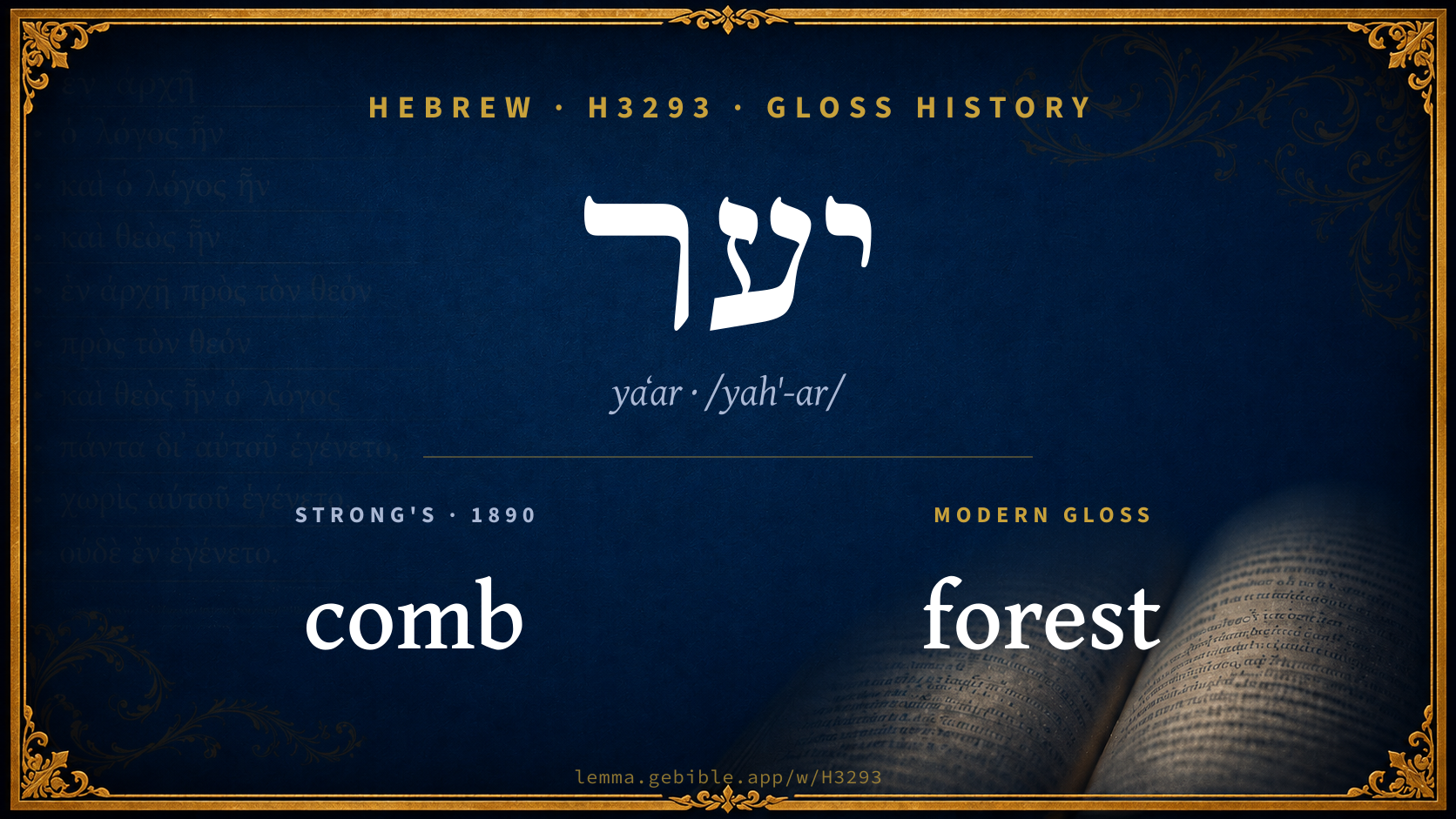
Gloss history
Strong's 1890 vs modern scholarship
About this word
Strong's H3293 catalogs a Hebrew word from the Hebrew Old Testament.
These counts are not copied from any lexicon or concordance. They are computed here, from the morphology-tagged Hebrew Old Testament. What Lemma adds →
- 59
- distinct verses
- The word appears in 59 distinct verses.
- 18 / 39
- OT books
- The word appears in 18 of 39 Old Testament books.
- #647
- by frequency
- Top 1000 most frequent Hebrew words (rank 647 of 8,640 Hebrew words by occurrence).
View all 59 occurrences in the concordance →
By section of the Old Testament
By traditional corpus
Conventional, traditional groupings — biblical authorship is debated, so this is a traditional corpus grouping, not an authorship claim. Each share is this word’s portion of its verses in that division of the Hebrew canon. Each figure is a share of the word’s 59 distinct verses.
- Prophets (Nevi'im) 45 verses · 76%
- Writings (Ketuvim) 13 verses · 22%
- Torah (Pentateuch) 1 verse · 2%
How translations render this word
Counts come from each version’s own published word-to-Strong’s tagging or interlinear alignment — an approximate guide to how each version renders this word, not a word-level alignment the data otherwise carries. Because each total is that version’s own tagged count, the per-version totals vary from one another and need not match the appearance or distinct-verse counts above. These counts may also differ from a printed concordance because Lemma counts each distinctly tagged rendering and does not collapse phrase taggings into a single head-word total. This is a fixed set of word-tagged versions (KJV, ASV, BSB, ULT) and does not change with the reading translation you choose elsewhere. Each version’s license is shown beside its name below (and on Sources).
BDB lists this Strong’s number as 4 distinct words (homographs). Each count above pools all of them and is not split by sense — see the Senses section below. A low-frequency rendering may belong to a different one of those words, not the primary meaning.
- King James Version†: Forest 36×, Wood 15×
- American Standard Version†: Forest 43×, Wood 4×
- Berean Standard Bible†: Forest 40×, Forests 4×, Like a forest 2×
- unfoldingWord Literal Text†: Forest 39×, Forest of 10×, Forests 4×
King James Version Public Domain
Renders H3293 across 58† tagged occurrences — most commonly:
Plus 7 renderings that appear only once — usually multi-word phrases or single function words the recovered tagging swept in, not distinct renderings.
American Standard Version Public Domain
Renders H3293 across 58† tagged occurrences — most commonly:
Plus 11 renderings that appear only once — usually multi-word phrases or single function words the recovered tagging swept in, not distinct renderings.
Berean Standard Bible Public Domain
Renders H3293 across 59† tagged occurrences — most commonly:
Plus 11 renderings that appear only once — usually multi-word phrases or single function words the recovered tagging swept in, not distinct renderings.
unfoldingWord Literal Text CC BY-SA 4.0
Renders H3293 across 60† tagged occurrences — most commonly:
Plus 5 renderings that appear only once — usually multi-word phrases or single function words the recovered tagging swept in, not distinct renderings.
7 senses and sub-senses in the full BDB
What do BDB’s symbols mean?
BDB uses these scholarly abbreviations:
| Symbol | Meaning |
|---|---|
| 𝔊 | the Septuagint (the ancient Greek translation, LXX) |
| 𝔙 | the Vulgate (the Latin translation) |
| 𝔖 | the Syriac version (the Peshitta) |
| 𝔗 | the Targum (the Aramaic translation) |
| ψ | the Psalms |
| √ | root (the underlying root or stem) |
| ‖ | parallel passage (a synonymous or contrasted parallel) |
| † | the dagger: every passage where the word occurs is cited |
The 7 senses and sub-senses the full Brown-Driver-Briggs lexicon distinguishes for this word, in lexicon order (not ranked by frequency), with BDB’s own verbatim wording and sub-sense lettering. Shown in Hebrew script with BDB’s own scholarly abbreviations. The condensed entry is in the Lexicon Entry tab. See also the Forms in the corpus table below.
יער I (√ of foll.
יער II
- a. wood, forest, wooded height, with trees to be felled Jos 17:15 (c. עלה go up to), v 18 (J), Dt 19:5 (not elsewhere Hex); עֵץ מִיַּעַר כִּרָתוֹ Je 10:3 as wood out of a forest he hath cut it; יחטבו מן־היערים Ez 39:10 (עצים מן־השׂדה in ‖ cl.); as producing trees יער צוֹמֵחַ עֵצִים Ec 2:6; in designation of Solomon’s palace בֵּית יַעַר הַלְּבָנוֹן 1 K 7:2 (on structure of this house v. StaSalomos Bauten, ZAW 1883, 150), 10:17, 21 = 2 Ch 9:16, 20; cf. בֵּית הַיָּ֑עַר Is 22:8; fig. of foes to be cut down and destroyed נִקַּף סִבְכֵי היער Is 10:34; כָּֽרְתוּ יַעְרָהּ Je 46:23; so Is 32:19 and יער הַבָּצִו֯ר Zc 11:2 (read Kt הַבָּצוּר inaccessible forest). e.g. Joshua 17:15
- b. as hiding-place for fugitive 1 S 22:5; lurking-place of wild beasts Am 3:4 Mi 5:7 2 K 2:24 Je 5:6; 12:8 Is 56:9 ψ 50:10; 80:14; 104:20, cf. Ez 34:25 (read Qr, v. supr.) e.g. 1 Samuel 22:5
- c. stripped by voice of י׳ ψ 29:9; devoured by fire Is 9:17 (סִבְכֵי הַיּ׳; fig. of the people); so in metaph. or sim. of י׳’s judgements Is 10:18 (כְּבוֹד יַעְרוֹ, fig. of Assyrian), Je 21:14 Ez 21:2, 3 (v. infr.) ψ 83:15. e.g. Psalms 29:9
- d. opp. כַּרְמֶל (garden-land) Is 29:17; 32:15; but also יַעַר כַּרְמִלּוֹ his garden woodland 2 K 19:23 = Is 37:24, and יַעַר בְּתוֹךְ כַּרְמֶל Mi 7:14 (secluded and fertile abode for flock, fig. of people, v. Che; Hi-St thinks of sacred grove). e.g. Isaiah 29:17
- e. = thicket, especially as symbol of desolation Ho 2:14; בָּמוֹת יער thicket-covered heights (overgrown with bushes and trees) Mi 3:12 = Je 26:18; also בַּיַּעַר בִּעְרַב Is 21:13 in the thicket (or bushes, so VB) in Arabia must ye lodge, caravans of Dedanites. e.g. Hosea 2:14
- f. עֲצֵי (ה)יער trees of the forest Is 7:2 (in sim.), 10:19 (שְׁאָר עֵץ יַעְרוֹ, fig.), 44:14 Ez 15:2, also v 6 (עֵץ היער), Ct 2:3 (in sim.); fig., as singing before י׳ ψ 96:12 = 1 Ch 16:33, Is 44:23 (יער וְכָל־עֵץ בּוֹ). e.g. Isaiah 7:2
- g. particular forests are: יער אפרים 2 S 18:6, see אֶפְרַיִם p. 68 supr.; cf. v 8, 17 (v. also Jos 17:15, 18); יַעַר חָ֑רֶת 1 S 22:5 (v. supr.); יַעַר לְבָנוֹן (v. supr.); יַעַר הַשָּׂדֶה נֶגֶב and יַעַר הַנָּגֶב Ez 21:2, 3 (v. supr.) fig. of Judah (land and people); v. also יְעָרִים infr.—שְׂדֵי־יָ֑עַר ψ 132:6 is a n.pr.loc. (but Bae thinks appellat. ‘auf waldigem Gefilde’), v. קִרְיַת יְעָרִים. On 1 S 14:25, 26, v. ii. יער.—יעורים Ez 34:25 Kt, read יְעָרִים Qr, v. supr. e.g. 2 Samuel 18:6
יער III (√ of following
יער IV [m.] honeycomb,
Senses from the full Brown-Driver-Briggs lexicon (Brown, Driver, Briggs; Oxford 1906 — public domain), digitized via Sefaria, supplemented by the OpenScriptures HebrewLexicon (CC BY 4.0). Full attribution on Sources.
Word origin
I. (√ of foll.; Arabic وَعُرَ is be rugged, of mountain, etc., be difficult; وَعْرٌ rough or difficult place, mountain).
I. n.m. 2 S 18:8 wood, forest, thicket (MI21 pl. היערן (= n.pr.loc.?); Ph. יער and יר, cf. DHM in MV(10) 983; Aramaic יַעֲרָא, ܝܰܥܪܳܐ wood, thicket; Assyrian âru DlHWB 230, cf. JägerBAS i, 476)—abs. יַ֫עַר Is 7:2 +; יָ֑עַר Mi 3:12 +; c. ה loc. יַעֲרָה Jos 17:15; cstr. יַ֫עַר 2 S 18:6; יַעְרָהּ Je 46:23, etc.; pl. יְעָרִים Ezr 2:25 + 4 times (incl. Ez 34:25 Qr, so Co); יְעָרוֹת ψ 29:9;—
II. (√ of following; meaning dubious; MV identif. with I, from roughness and porousness (?) of honeycomb, cf. Buhl)
II. n.[m.] honeycomb,—abs. יַעַר 1 S 14:25, 26; sf. יַעְרִי Ct 5:1;—honeycomb, containing honey 1 S 14:25 (where read וְיַעַר הָיָה עַל־פְּנֵי הַשָּׁדֶה with 𝔊 We Dr Kit in KauAT, instead of v. as in MT); וַיָּבוֹא העם אֶל־הַיַּעַר 1 S 14:26 (‖ דבשׁ v 25) and when the people came to the honeycomb behold its bees had departed (v. 𝔊 We Dr Kit VB); אָכַלְתִּי יַעְרִי עִם־דִּבְשִׁי Ct 5:1; v. also i. יַעֲרָה.
— Brown-Driver-Briggs (Oxford 1906, public domain), digitized via Sefaria, supplemented by the OpenScriptures HebrewLexicon (CC BY 4.0). See Sources.
Origin: from an unused root probably meaning to thicken with verdure
Jastrow Dictionary
A second Hebrew/Aramaic lexicon for comparison, covering Aramaic and post-biblical (Talmudic, Targumic, Midrashic) usage that the biblical-Hebrew BDB does not. Matched by lemma rather than by Strong’s number, so a lemma may carry more than one Jastrow headword (shown separately below), and the entries cover usage well beyond the Bible.
יַעַר
- (b. h.) forest. B. Kam. 32ᵇ (ref. to Deut. XIX, 5) ומה י׳ וכ׳ when in the case of unintentional homicide in the forest where each entered of his own accord &c.; Sifré Deut. 182 מה י׳ רשות וכ׳ as in the case … in the forest, both had a right to enter. Cant. R. to III, 4, v. יְאוֹר; a. fr.—[יער, יאר = עור, אור, to break forth, applied to vegetation, water-course and light (cmp. נָהָר a. נְהוֹרָא); cmp. יְאוֹר a. Sam. יאר Gen. I, 11 for h. דשא.] e.g. Deuteronomy 19:5
A Dictionary of the Targumim, the Talmud Babli and Yerushalmi, and the Midrashic Literature (Marcus Jastrow; London, Luzac, 1903) — Public Domain. Digitized via Sefaria. Digitized via Sefaria. Full attribution on Sources.
Forms in the corpus
The 33 distinct written forms H3293 takes in the Hebrew Bible, most frequent first — each parse links to that state’s occurrences in the concordance. Hebrew forms include their vowel points and cantillation, so a single lemma takes many written forms.
Same root — word family
Other BDB entries built from the same root as H3293, grouped by Strong’s listed origin. These share a root / origin per the lexicon — not necessarily a shared meaning. Each links to that word’s own entry.
Derived from this word
Proper names from this root
People and places named from this root — a name, not an additional meaning of the word.
Compare all same-root words → Showing 4 of 5 — not the complete family. 3 of the same-root words are proper names (people or places). They share a root, not necessarily a meaning.
Septuagint verse parallels
This word appears in 54 verses that also exist in the Greek Old Testament (Septuagint), out of the 59 Hebrew verses it occurs in. You can read those verses in Greek by switching the Old Testament edition to the Septuagint.
Read these verses in the Septuagint
- Deuteronomy 19:5
- Joshua 17:15
- 1 Samuel 14:25
- 2 Samuel 18:6
- 1 Kings 7:2
- 2 Kings 2:24
- 1 Chronicles 16:33
- 2 Chronicles 9:16
- Psalms 29:9
- Ecclesiastes 2:6
- Song of Solomon 2:3
- Isaiah 7:2
This is a verse-level parallel only — the same verses exist in both the Hebrew and Greek Old Testaments. No word-level Hebrew↔Greek correspondence is claimed: the data carries no such alignment, so no Greek word is shown as this Hebrew word’s translation. Coverage is not total — the Septuagint omits the deuterocanon and renumbers the Psalms, so some Hebrew verses have no direct Greek parallel.