
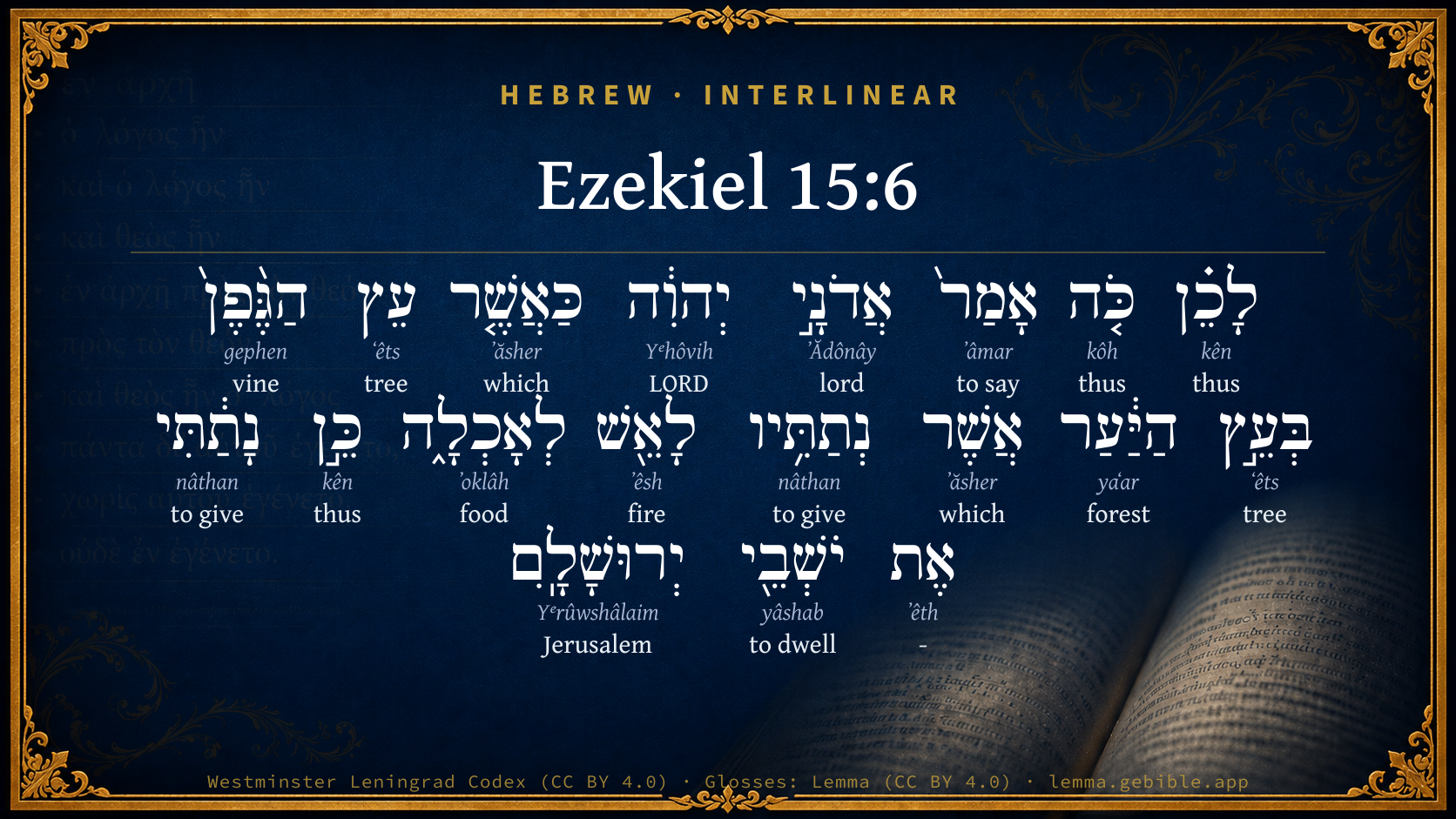
Ezekiel 15:6

Hebrew (Westminster Leningrad Codex) Ezekiel 15:6 appears in the Hebrew Old Testament. The text above is from the Westminster Leningrad Codex. Each word links to its Strong’s number, a concise gloss, and parsing drawn from the Open Scriptures Hebrew Bible morphology. Click any word for its full Brown-Driver-Briggs (BDB) entry.
Download image
Cite this verse

Ezekiel 15:6 (World English Bible). Public Domain. Lemma interlinear Bible study tool, https://lemma.gebible.app/v/ezekiel/15/6.

Show BibTeX & RIS
BibTeX
RIS
English Translation
Therefore thus says the Lord Yahweh: As the vine tree among the trees of the forest, which I have given to the fire for fuel, so will I give the inhabitants of Jerusalem.
World English Bible · Public Domain
Download a study sheet

One document with this verse’s original text, its word-by-word gloss line, the meaning frame, cross-references with their text, attributed commentary, and full source and license credits — printable, and it pastes into notes with its structure intact.

This verse Autodidact and up

Study sheet (.html) Plain text (.txt)

A passage Seminary Student

Up to 50 verses in one chapter. A passage sheet keeps up to 6 commentary sources and 12 cross-references per verse, in the order this page ranks them, and says so on the sheet whenever that leaves anything out. Ask for a single verse and you get the Autodidact verse sheet above.

Everything on this page stays free to read, with no account — the sheet is a download of what is already on screen, not access to it.

Want to remove ads? Support Godless Engineer
Compare translations 3

The same verse in 3 English versions, stacked beneath the original-language interlinear above. Click any original word for its lexicon entry.

Each is an independent rendering of the whole verse — the interlinear is not word-aligned to these translations.

Highlighted words mark where these versions differ — a whole-verse word diff, not a word-by-word alignment.

  • World English Bible Public Domain
    Therefore thus says the Lord Yahweh: As the vine tree among the trees of the forest, which I have given to the fire for fuel, so will I give the inhabitants of Jerusalem.
  • King James Version Public Domain
    Therefore thus saith the Lord GOD; As the vine tree among the trees of the forest, which I have given to the fire for fuel, so will I give the inhabitants of Jerusalem.
  • unfoldingWord Literal Text CC BY-SA 4.0
    Therefore the Lord Yahweh says this: Unlike the trees in the forests, I have given the vine as fuel for fires; I will act in the same way toward the inhabitants of Jerusalem.

unfoldingWord Literal Text — © unfoldingWord, licensed CC BY-SA 4.0. Word-aligned USFM3 via Door43 (git.door43.org/unfoldingWord/en_ult).

Versions to compare (up to 4)

3 of 4 selected

Show all 18 translations

Every available English version of this verse, each an independent rendering of the whole verse.

  • World English Bible Public Domain
    Therefore thus says the Lord Yahweh: As the vine tree among the trees of the forest, which I have given to the fire for fuel, so will I give the inhabitants of Jerusalem.
  • Berean Standard Bible Public Domain
    Therefore this is what the Lord GOD says: ‘Like the wood of the vine among the trees of the forest, which I have given to the fire for fuel, so I will give up the people of Jerusalem.
  • Majority Standard Bible Public Domain
    Therefore this is what the Lord GOD says: ‘Like the wood of the vine among the trees of the forest, which I have given to the fire for fuel, so I will give up the people of Jerusalem.
  • King James Version Public Domain
    Therefore thus saith the Lord GOD; As the vine tree among the trees of the forest, which I have given to the fire for fuel, so will I give the inhabitants of Jerusalem.
  • American Standard Version (1901) Public Domain
    Therefore thus saith the Lord Jehovah: As the vine-tree among the trees of the forest, which I have given to the fire for fuel, so will I give the inhabitants of Jerusalem.
  • Revised Version (1885) Public Domain
    Therefore thus saith the Lord GOD: As the vine tree among the trees of the forest, which I have given to the fire for fuel, so will I give the inhabitants of Jerusalem.
  • Geneva Bible (1599) Public Domain
    Therefore thus sayth the Lord God, As the vine tree, that is among the trees of the forest, which I haue giuen to the fire to be consumed, so will I giue the inhabitants of Ierusalem.
  • Douay-Rheims (1899) Public Domain
    Therefore thus saith the Lord God: As the vine tree among the trees of the forests which I have given to the fire to be consumed, so will I deliver up the inhabitants of Jerusalem.
  • Young's Literal Translation Public Domain
    Therefore, thus said the Lord Jehovah: As the vine-tree among trees of the forest, That I have given to the fire for fuel, So I have given the inhabitants of Jerusalem.
  • Literal Standard Version CC BY-SA 4.0
    Therefore, thus said Lord YHWH: “As the vine-tree among trees of the forest, || That I have given to the fire for fuel, || So I have given the inhabitants of Jerusalem.
  • Unlocked Literal Bible CC BY-SA 4.0
    Therefore the Lord Yahweh says this: Unlike the trees in the forests, I have given the vine as fuel for fires; I will act in the same way toward the inhabitants of Jerusalem.
  • unfoldingWord Literal Text CC BY-SA 4.0
    Therefore the Lord Yahweh says this: Unlike the trees in the forests, I have given the vine as fuel for fires; I will act in the same way toward the inhabitants of Jerusalem.
  • Darby Bible Public Domain
    Therefore thus saith the Lord Jehovah: As the wood of the vine among the trees of the forest, which I have given to the fire for fuel, so will I give the inhabitants of Jerusalem.
  • World Messianic Bible Public Domain
    Therefore the Lord GOD says: “As the vine wood among the trees of the forest, which I have given to the fire for fuel, so I will give the inhabitants of Jerusalem.
  • Webster's Bible Public Domain
    Therefore thus saith the Lord GOD; As the vine-tree among the trees of the forest, which I have given to the fire for fuel, so will I give the inhabitants of Jerusalem.
  • Free Bible Version CC BY-SA 4.0
    So this is what the Lord God says: In the same way that I have taken the wood of a vine from the forest and thrown it on the fire to be burned, so I'm going to throw away the people of Jerusalem.
  • Bible in Basic English Public Domain
    For this cause the Lord has said: Like the vine-tree among the trees of the woods which I have given to the fire for burning, so will I give the people of Jerusalem.
  • JPS Tanakh (1917) Public Domain
    Therefore thus saith the Lord GOD: As the vine-tree among the trees of the forest, which I have given to the fire for fuel, so do I give the inhabitants of Jerusalem.

Literal Standard Version (2020), Covenant Press — licensed CC BY-SA 4.0. Text via the HelloAO Bible API (eBible.org). Unlocked Literal Bible (unfoldingWord) — licensed CC BY-SA 4.0. Text via the HelloAO Bible API (eBible.org). unfoldingWord Literal Text — © unfoldingWord, licensed CC BY-SA 4.0. Word-aligned USFM3 via Door43 (git.door43.org/unfoldingWord/en_ult). Free Bible Version, Dr. Jonathan Gallagher — licensed CC BY-SA 4.0. Text via the HelloAO Bible API (eBible.org).

Word by word

More ways to search: Search by grammar → Find every occurrence → Compare this word →

Practice this passage: Drill this verse → Learn its vocabulary →

לְאָכְלָ֑ה
ʼoklâh
H402
“to/for · food”
Preposition + Noun, Common, Feminine, Singular, Absolute
Part of Speech
Preposition + Noun
Type
Common
Gender
Feminine
Number
Singular
State
Absolute
Full BDB Definition

Origin: from H401

TWOT: 85b

food - food, eating - object of devouring, consuming - by wild beasts (figurative) - in fire - of judgment (figurative)
  1. לָכֵ֗ן kên H3651 “to/for · thus” Preposition + Adverb
  2. כֹּ֤ה kôh H3541 “thus” Adverb
  3. אָמַר֙ ʼâmar H559 “to say” Verb, Qal, Perfect, 3rd Person, Masculine, Singular
  4. אֲדֹנָ֣י ʼĂdônây H136 “Lord · my” Noun, Common, Masculine, Plural, Construct + Suffix, Personal, 1st Person, Common, Singular
  5. יְהוִ֔ה Yᵉhôvih H3069 “LORD” Noun, Proper
  6. כַּאֲשֶׁ֤ר ʼăsher H834 “like/as · which” Preposition + Particle, Relative
  7. עֵץ ʻêts H6086 “tree of” Noun, Common, Masculine, Singular, Construct
  8. הַגֶּ֨פֶן֙ gephen H1612 “the · vine” Particle, Definite Article + Noun, Common, Both, Singular, Absolute
  9. בְּעֵ֣ץ ʻêts H6086 “in/at · tree of” Preposition + Noun, Common, Masculine, Singular, Construct
  10. הַיַּ֔עַר yaʻar H3293 “the · forest” Particle, Definite Article + Noun, Common, Masculine, Singular, Absolute
  11. אֲשֶׁר ʼăsher H834 “which” Particle, Relative
  12. נְתַתִּ֥יו nâthan H5414 “to give · him” Verb, Qal, Perfect, 1st Person, Common, Singular + Suffix, Personal, 3rd Person, Masculine, Singular
  13. לָאֵ֖שׁ ʼêsh H784 “to/for the · fire” Preposition, Determined + Noun, Common, Both, Singular, Absolute
  14. כֵּ֣ן kên H3651 “thus” Particle, Demonstrative
  15. נָתַ֔תִּי nâthan H5414 “to give” Verb, Qal, Perfect, 1st Person, Common, Singular
  16. אֶת ʼêth H853 “-” Particle, Direct Object
  17. יֹשְׁבֵ֖י yâshab H3427 “dwelling” Verb, Qal, Participle Active, Masculine, Plural, Construct
  18. יְרוּשָׁלִָֽם Yᵉrûwshâlaim H3389 “Jerusalem” Noun, Proper

About this verse

These counts appear in no published source. They are computed here, from the morphology-tagged text and Lemma’s own curated glosses. What Lemma adds →

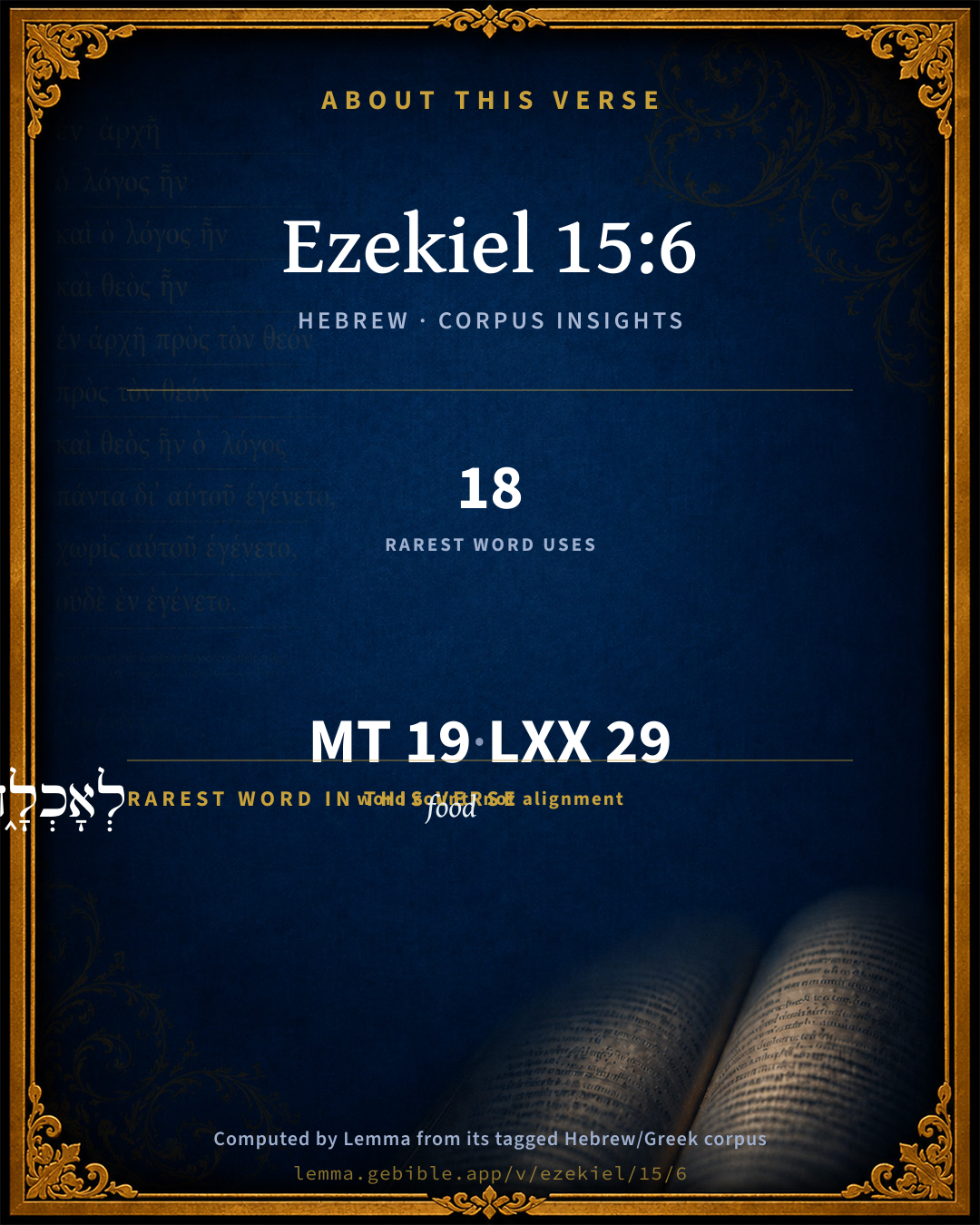
19
words
15
distinct lemmas
Prophets
section

Notable vocabulary

The rarest word here is לְאָכְלָ֑ה food H402 — appearing just 18 times in the whole Hebrew Bible.

Shared distinctive vocabulary

לְאָכְלָ֑ה food H402 occurs in 18 verses of the Hebrew Bible. Also found in:

Grammatical profile

  • 4 verbs
  • 9 nouns
  • 2 adverbs
  • 4 particles

Verb forms

  • אָמַר֙ Qal · Perfect
  • נְתַתִּ֥יו Qal · Perfect
  • נָתַ֔תִּי Qal · Perfect
  • יֹשְׁבֵ֖י Qal · Participle Active

Repetition

Words recur within this verse — often emphatic in Hebrew:

  • לָכֵ֗ן thus H3651 ×2
  • עֵץ tree H6086 ×2
  • נְתַתִּ֥יו to give H5414 ×2
  • כַּאֲשֶׁ֤ר which H834 ×2

Hebrew & Septuagint length

In English translation the verse runs 33 words from the Hebrew and 36 from the Septuagint (LXX English) — closely comparable.

A rough comparison of the two English renderings, which tokenize alike — not a word-level alignment.

Word counts can differ between the Hebrew and the Greek without any difference in meaning — e.g. the Hebrew direct-object marker אֵת has no separate Greek word, and Greek often adds the article ὁ.

In the original languages it is 19 Hebrew tokens and 29 Greek tokens — but the two are counted differently (Hebrew bundles its prefixes and suffixes into one token; the Greek is in lemma form), so that isn’t a like-for-like length.

Cross-references

13

Topical passages linked to Ezekiel 15:6 in the Treasury of Scripture Knowledge — connected by theme and wording, ordered by reader-vote popularity; previews shown in the World English Bible.

  • Isaiah 5:1–6 Let me sing for my well beloved a song of my beloved about his vineyard. My beloved had a vineyard on a very fruitful hill.
  • Isaiah 5:24–25 Therefore as the tongue of fire devours the stubble, And as the dry grass sinks down in the flame, So their root shall be as rottenness, And their blossom shall go up as dust; Because they have rejected the law of Yahweh of Hosts, And despised the word of the Holy One of Israel.
  • Jeremiah 4:7 A lion is gone up from his thicket, and a destroyer of nations; he is on his way, he is gone forth from his place, to make your land desolate, that your cities be laid waste, without inhabitant.
  • Jeremiah 7:20 Therefore thus says the Lord Yahweh: Behold, my anger and my wrath shall be poured out on this place, on man, and on animal, and on the trees of the field, and on the fruit of the ground; and it shall burn, and shall not be quenched.
  • Jeremiah 21:7 Afterward, says Yahweh, I will deliver Zedekiah king of Judah, and his servants, and the people, even such as are left in this city from the pestilence, from the sword, and from the famine, into the hand of Nebuchadrezzar king of Babylon, and into the hand of their enemies, and into the hand of those who seek their life: and he shall strike them with the edge of the sword; he shall not spare them, neither have pity, nor have mercy.
  • Jeremiah 24:8–10 As the bad figs, which can't be eaten, they are so bad, surely thus says Yahweh, So will I give up Zedekiah the king of Judah, and his princes, and the residue of Jerusalem, who remain in this land, and those who dwell in the land of Egypt,
  • Jeremiah 25:9–11 behold, I will send and take all the families of the north, says Yahweh, and [I will send] to Nebuchadrezzar the king of Babylon, my servant, and will bring them against this land, and against the inhabitants of it, and against all these nations round about; and I will utterly destroy them, and make them an astonishment, and a hissing, and perpetual desolations.
  • Jeremiah 25:18 [to wit], Jerusalem, and the cities of Judah, and the kings of it, and the princes of it, to make them a desolation, an astonishment, a hissing, and a curse, as it is this day;
  • Jeremiah 44:21–27 The incense that you burned in the cities of Judah, and in the streets of Jerusalem, you and your fathers, your kings and your princes, and the people of the land, didn't Yahweh remember them, and didn't it come into his mind?
  • Ezekiel 15:2 Son of man, what is the vine tree more than any tree, the vine-branch which is among the trees of the forest?
  • Ezekiel 17:3–10 and say, Thus says the Lord Yahweh: A great eagle with great wings and long feathers, full of feathers, which had various colors, came to Lebanon, and took the top of the cedar:
  • Zechariah 1:6 But my words and my decrees, which I commanded my servants the prophets, didn't they overtake your fathers? "Then they repented and said, 'Just as Yahweh of Hosts determined to do to us, according to our ways, and according to our practices, so he has dealt with us.'"
  • Ezekiel 20:47–48 and tell the forest of the South, Hear the word of Yahweh: Thus says the Lord Yahweh, Behold, I will kindle a fire in you, and it shall devour every green tree in you, and every dry tree: the flaming flame shall not be quenched, and all faces from the south to the north shall be burnt thereby.

Cross-references courtesy of OpenBible.info (CC BY 4.0).

Hebrew and Greek witnesses Masoretic Hebrew ↔ Greek Septuagint

The same verse in the two great witnesses to the Old Testament, shown verse-for-verse.

These are two independent witnesses, not word-aligned to each other, and the Septuagint is shown in lemma (dictionary) form.

Hebrew Ezekiel 15:6 Masoretic · Westminster Leningrad Codex

לָכֵ֗ן כֹּ֤ה אָמַר֙ אֲדֹנָ֣י יְהוִ֔ה כַּאֲשֶׁ֤ר עֵץ הַגֶּ֨פֶן֙ בְּעֵ֣ץ הַיַּ֔עַר אֲשֶׁר נְתַתִּ֥יו לָאֵ֖שׁ לְאָכְלָ֑ה כֵּ֣ן נָתַ֔תִּי אֶת יֹשְׁבֵ֖י יְרוּשָׁלִָֽם

Therefore thus says the Lord Yahweh: As the vine tree among the trees of the forest, which I have given to the fire for fuel, so will I give the inhabitants of Jerusalem.

World English Bible · Public Domain

Greek LXX Ezekiel 15:6 Septuagint · lemma form

διά οὗτος εἶπον ὅδε λέγω κύριος ὅς τρόπος ὁ ξύλον ὁ ἄμπελος ἐν ὁ ξύλον ὁ δρυμός ὅς δίδωμι αὐτός ὁ πῦρ εἰς ἀνάλωσις οὕτως δίδωμι ὁ καταοἰκέω ἰερουσαλήμ

Therefore say, Thus says the Lord, As the vine tree among the trees of the forest, which I have given up to the fire to be consumed, so have I given up the inhabitants of Jerusalem.

LXX2012 (modern English Septuagint) · Public Domain

Hebrew: Westminster Leningrad Codex (CC BY 4.0). Greek: Septuagint (public domain); English from LXX2012 (modern English Septuagint) (Public Domain). How the Septuagint differs from the Hebrew →

Targum (Aramaic paraphrase)

1

The Targum is the ancient Jewish Aramaic paraphrase of the Hebrew Scriptures — an interpretive translation, not the Hebrew text itself. Onkelos (literal) and Pseudo-Jonathan (expansive) render the Torah, and Jonathan the Prophets. Coverage is partial: where no permissively-licensed English translation exists for a verse, only the Aramaic is shown. This is verse-level text, not a word-by-word alignment to the Hebrew.

  1. Targum Jonathan Prophets (Joshua–Malachi)
    בְּכֵן כִּדְנַן אֲמַר יְיָ אֱלֹהִים כְּמָא דְאִילָן גוּפְנָא בַּאֲעֵי חוּרְשָׁא דִמְסַרְתֵּיהּ לְאֶשְׁתָּא לְאִשְׁתֵּיצָאָהּ כֵּן מְסָרֵית יַת יַתְבֵי יְרוּשְׁלֵם:

    (no public-domain English translation for this verse)

    Targum Jonathan — Aramaic: “Mikraot Gedolot” (public domain). English: “Sefaria Community Translation” (CC0 1.0 (public-domain dedication)); “London "Chaldee Paraphrase," 1871” (public domain). Text via Sefaria.

Commentary

Notes on Ezekiel 15:6 from classic Christian and Jewish commentators (each source and its license shown beneath its notes). The classic Christian expositions comment on the surrounding passage and are grouped to its opening verse, so a note may address several verses; the Jewish commentaries on the Tanakh (Rashi and others) are per-verse, so they appear only where the commentator wrote on this verse.

Lemma curates 59 commentaries, every one of them public domain or Creative Commons licensed, each selected and text-cleaned for this edition rather than reprinted as found. About our sources →

Trapp's Complete Commentary

John Trapp

Eze 15:6 Therefore thus saith the Lord GOD; As the vine tree among the trees of the forest, which I have given to the fire for fuel, so will I give the inhabitants of Jerusalem.

Ver. 6. As the vine tree.] Adaptat parabolam. Here beginneth the apodosis or application of the parable. That which is not for fruit is for the fire. Salt which hath lost the savour is thrown out.

So will I give the inhabitants of Jerusalem.] Those sinners in Zion; {Isa 33:14} those sacrificing Sodomites; {Isa 1:10} I will make them a fiery oven in the time of mine anger; I will swallow them up in my wrath; {Psa 21:9} besides that, hell gapeth for them.

John Trapp, A Commentary or Exposition upon All the Books of the Old and New Testament (1647–1656) — public domain. Text from a community e-Sword module.

Joseph Benson's Commentary

Eze 15:6-8. As the vine-tree among the trees of the forest, which I have given for fuel — That is, as the vine-tree, when barren and fruitless, like the wild trees of the forest, is given for fuel, being fit for nothing else; or as a vine, when barren and cut up, is thrown among other wood which is intended to be fuel for the fire; so will I give the inhabitants of Jerusalem — So will I destroy them by the Chaldeans, among other nations which are destroyed by them. For they are so degenerated, and grown so corrupt and wicked, that they are of no use any longer in the world; but are rather injurious to civil society, and therefore are only fit to be consumed. And I will set my face against them — To thwart all their counsels and confound their schemes, as they have set their faces against me to contradict my word and defeat my designs: or, I will look upon them with indignation. They shall go out from one fire, and another fire shall devour them — The end of one judgment shall be the beginning of another; and their escape from one only a reprieve till another come. They shall go from misery in their own country to misery in Babylon. They that kept themselves out of the way of the sword, perished by famine or pestilence: when one descent of the Chaldean forces upon them was over, and they thought, Surely the bitterness of death is past; yet soon after these enemies returned again with double violence till they had made a full end. And ye shall know that I am the Lord, when I have set my face against them — You that are in Chaldea, when you shall hear what mischiefs, one after another, are heaped on Jerusalem, shall know that I am Jehovah, a God of almighty power, that it is my wrath and vengeance that is poured upon them. Observe, reader, God shows himself to be the Lord by the destruction of his implacable enemies, as well as by the deliverance of his obedient people. And, observe also those against whom he sets his face, though they may come out of one trouble little hurt, will fall into another; though they come out of the pit, will be taken in the snare, Isa 24:8; though they escape the sword of Hazael, will fall by that of Jehu, 1Ki 19:17 : for evil pursues sinners. Nay, though they go out from the fire of temporal judgments, and seem to die in peace, yet there is an everlasting fire that will devour them; for when God judgeth, first or last, he will overcome, and will be known by the judgments which he executeth.

Joseph Benson's Commentary on the Old and New Testaments (1811–1818) — public domain. Text from a community e-Sword module.

Tyndale Open Study Notes

Tyndale Open Resources

15:6 The people of Jerusalem are like grapevines: Cp. Ps 80:8-9; Isa 5:1-7; Jer 2:21; John 15:1-6. • If grapevines grow among the trees of the forest, they do not bear fruit because they lack sufficient sunlight.

Tyndale Open Study Notes — © Tyndale Open Resources, licensed CC BY-SA 4.0. Text via the HelloAO Bible API.

Jamieson, Fausset & Brown

Robert Jamieson, A. R. Fausset & David Brown

So will I give the inhabitants of Jerusalem, as being utterly unprofitable (Mat 21:33-41; Mat 25:30; Mar 11:12-14; Luk 13:6-9) in answering God's design that they should be witnesses for Jehovah before the heathen (Mat 3:10; Mat 5:13).

Jamieson, Fausset & Brown — Commentary Critical and Explanatory on the Whole Bible (1871) — public domain (CC PDM 1.0). Text via the HelloAO Bible API.

Adam Clarke's Commentary

Verse 6. Therefore thus saith the Lord] As surely as I have allotted such a vine branch, or vine branches, for fuel; so surely have I appointed the inhabitants of Jerusalem to be consumed.

The design of this parable is to abate the pride of the Jews; to show them that, in their best estate, they had nothing but what they had received, and therefore deserved nothing; and now, having fallen from all righteousness, they can have no expectation of any thing but judgment unmixed with mercy.

Adam Clarke's Commentary on the Bible (1810–1826) — public domain. Text from a community e-Sword/MySword module.

John Calvin's Commentaries

Here the Prophet shows that the citizens of Jerusalem were cast into a fire, by which they suffered various kinds of death: for although they were not immediately and entirely consumed, yet the extremities were burnt off. For the whole region was laid waste all around, and the kingdom of Israel was entirely cut off: Jerusalem remained like the middle portion of the bundle. But the inhabitants of Jerusalem were so worn down by adversity, that they were like a stick burnt at both ends. Since this was so, we here perceive their great stupidity in persisting in contumacy, although God had humbled them so in various ways. Now, therefore, we understand the meaning of this point. But the words of the Prophet must be explained, what shall be, or what is the wood of the vine compared with other wood? Some translate, with the palm branch; others, with the wild vine; but both of these are foreign to the mind of the Prophet: especially the wild vine cannot have any place here. As far as the palm is concerned, what reference is there to the palm branch in the midst of a wood? for palms are not planted in woods amidst lofty trees. But since the wood, זמורה, zemoreh, signifies boughs as well as palms, it agrees best with the sense to speak of every tree as branching. What, therefore, is the vine in comparison with every branching tree which is among the trees of the forest? Here the Prophet brings before us fruitless trees, but yet those which attract our notice by their beauty: and so he implies, if the Jews wish to compare themselves with the profane nations, they are not superior in any worthiness or elegance which they have naturally and of themselves. This must be diligently noticed; although God sometimes adopts those who excel in ability and learning, in warlike prowess, in riches, and in power, yet he gathers his Church as much as possible from lowly-born men, in whom no great splendor is refulgent, that they may be objects of wonder to the world. For what end, then, does God do this? for he could fashion his own elect, that they may be completely perfect in every way. But since we are too inclined to pride, it is necessary that our infirmity should always be set before our eyes to teach us modesty. For if nothing in us reminded us of our weakness, our worthiness would blind us, or turn away our eyes from ourselves, or intoxicate us with false glory. Hence God wishes us to be inferior to the profane, that we may learn always to acknowledge as received from him whatever he has gratuitously conferred upon us, and not to arrogate anything to ourselves when our humility is so plainly set before our eyes. But as far as concerns the Jews, they were, as we have said, like a vine, because their excellence was not natural, but external. God had fashioned them, as it were, from nothing; and although they were adorned with many remarkable gifts, yet they could claim nothing from themselves.

Shall there be taken, says he, any wood from it to fashion it for any work? God here shows that the Jews were deservedly preferred to others, because he had planted them with his hand; for if they had been pulled out of the earth, he shows that the wood would be useless, since it could not be used for any purpose. And Christ uses the same simile (John 15:1-7), when he shows that we have no root in us by nature, nor yet sap or moisture or rigor, since we are a vine planted by our heavenly Father. But if he roots us up, nothing remains for us but to be cast into the fire and utterly burnt. Lastly, God shows that the Jews should be viler than the nations, if he took away from them whatever he gave them; and he admonishes them that their state has no firmness unless through his goodwill towards them. For if the Prophet had only said, that whatever the Jews had they owed to God, and for this reason were bound to his liberality, yet they might still exalt themselves. But it is added in the second place, that they remained safe day by day, as far as God spares them, cherishes, defends, and sustains them. Therefore the Prophet means this when he says, Shall it be taken to form any work from it, or will they take it for a peg to hang any vessels upon it. Behold, says he, it was given for consumption, and its two ends were burnt up. Here, as I said, he points out various calamities by which the Jews were almost struck down, though not subdued. For they were hardened in their obstinacy; and although they were like burnt and rotten wood, yet they boasted themselves to be perfect through their adoption, and through the covenant which God had made with Abraham: they boasted themselves to be a holy race, and a royal priesthood. Yet God reproves their sloth when he says theirs was like burnt wood, when a bundle of twigs has been cast into the fire, and there is some remnant so injured by the smoke as to be deprived of its strength.

Behold, says he, when it was whole could it be formed into any work! How much less after the fire has consumed it. Here we pursues the same sentiment. If any one should take any part of the bundle after the fire had dried it, could he fit it for any work? If he should take the twig when whole, it would not be fit to receive any shaping: how much less could the burnt wood be used for a peg or anything else. If, then, not even a peg can be found in the entire bundle, when the stem is like an ember through being parched by fire, how can it be turned to any use? Now follows the application: as I have given the wood of the vine among woods, says he: verbally, in the wood of the forest. Hence gather we what I formerly said about the branch, that it agrees with trees and is not put for the wild vine or the palm branch: for he now says, simply, amidst all the wood of the forest. But he says that the wood of the vine was among the wood of the forest — not because vines are merely planted there, but this comparison is used: that is, among woods, or even among all the woods of the forest, because these trees are felled, and destined for buildings, or vessels are made from them, and all kinds of wooden furniture, as well as the materials of houses, are taken from trees. He says, therefore, that the wood of the vine is given among the wood, of the forest, that is, among the woods of the forest, since the twigs are burnt, as they cannot be rendered useful to men: so have I given, says he, the citizens of Jerusalem

Now after we understand the Prophet’s meaning, let us learn that the Holy Spirit so addressed the Jews formerly, that this discourse might profit us in these days. We must perceive, in the first place, that we are superior to the whole world, through God’s gratuitous pity: but naturally we have nothing of our own in which to boast. But if we carry ourselves haughtily, through reliance on God’s gifts, this arrogance would be sacrilege: for we snatch away from God his own praise, and clothe ourselves, as it were, in his spoils. But Paul, when he speaks of the Jews, shortly, but clearly, defines both sides: Do we excel? says he — (for he there makes himself one with the people) — Do we excel the Gentiles? says he, (Romans 3:1); by no means: for Scripture denounces us all to be sinners — all to be, accursed. Since, therefore, we are children of wrath, he says, there is nothing which we can claim to ourselves over the profane Gentiles. After he has so prostrated all the pride of his own nation, he repeats again — What? Are we not superior to others? Yea, we excel in every way. For the adoption, and the worship, and the law of God, and the covenant, confer upon us remarkable superiority, and such as we find nothing like it in the whole world. How do those things agree? That the Jews excel, and are to be preferred to others, and yet that they excel in nothing! namely, since they have nothing in themselves to cause them to despise the Gentiles, or boast themselves superior; hence their excellence is not in themselves but in God. And so, Paul here does not commend their virtues, but says that they excel by gratuitous adoption, because God made his covenant with Abraham, and they were to arise from the holy nations, because he instituted a fixed line of piety among them, in promising himself to be a Father to them; nay, he determined that Christ should spring from them, who is the life and light of the world. We see, then, the former privileges of the Jews: ours is the same in these days. As often as we are favored with God’s gifts, by which we approach near him and overcome the world, we ought also to remember what we were before God took us up. Then our origin will prostrate all arrogance, and prevent us from being ungrateful to God. But that is not yet sufficient; but we must come to the second clause, that not only has God’s free grace raised us to such a height, but also sustains us; so that our standing is not founded in ourselves, but depends only on his will. Hence not only the remembrance of our origin ought to humble us, but the sense of our infirmity. Whence we gather that we have no perseverance in ourselves unless God daily, nay, momentarily strengthen us, and follow us up with his favor. This is the second point: the third is, if God afflicts or chastises us with his rods, we should know that the foolish confidence by which we deceive ourselves is by this means beaten out of us. Here we ought diligently to weigh the meaning of the phrase — the wood of the vine is useless when it is torn up, and especially when dry. For although the profane nations perish, yet it is not surprising if God’s judgments are more severe towards the reprobate, who had obtained a place in his Church, and who had been enriched with his spiritual gifts. This ingratitude requires us to become an example to others, so that the whole world may be astonished at beholding in us such dreadful signs of God’s anger. Hence the Jews were for a hissing and an abhorrence, an astonishment and a curse to the profane nations. Why so? They had more grievously exasperated God who had acted so liberally towards them, and were not only ungrateful and perfidious, but had purposely provoked him. Thus also it happens to other reprobates. So this clause is to be diligently noticed, when the Prophet says that the wood of the vine is cast into the fire, although trees, when cut down, are still useful either for building or for furniture. Now it follows —

John Calvin's Commentaries (1540-1563) — public domain. Text from the Calvin Translation Society English edition (1840s-50s) via the Christian Classics Ethereal Library (ccel.org). Calvin's coverage is partial (roughly two-thirds of the Bible); uncommented books and verses are honest gaps, never fabricated. The 19th-century editor's footnotes and remarks are omitted so the notes are faithfully Calvin's own voice.

The Cambridge Bible for Schools and Colleges

gen. ed. J. J. S. Perowne

6–8. Application of the figure to Jerusalem

6. which I have given] The reference is to the supposition in Eze_15:4. It is nowhere said in the passage that the vinewood is fit only fur fuel, nor that it has been appointed (when created by God) to be burnt; Eze_15:4 is a supposition that in a particular case it has been flung into the fire for fuel, and its ends burnt, and the inference is drawn that, good for little when whole, much less will it be good for anything in that condition. The use of the first person “I have given” is peculiar. Cornill suggests “it has been given,” considering “I have given” which follows immediately to have been the source of the error.

so will I give] Lit., so have I given. The comparison is not between Jerusalem and a vine when whole, but between Jerusalem and a vine with its two ends burnt. Naturally the supposition is made that the vinewood flung into the fire has been plucked out after having been burnt and charred, and the question is asked, Is it good for anything now? This is the condition of Jerusalem: it has been given into the fire for fuel, plucked out of it, as it were, half-burnt; is it good for anything?

The Cambridge Bible for Schools and Colleges (gen. ed. J. J. S. Perowne; Cambridge University Press, 1878–1918) — public domain. Text from a community e-Sword module.

John Gill's Exposition

And I will set my face against them,.... In wrath to destroy them; see Eze 14:8; and

they shall go out from one fire, and another fire shall devour them: from one calamity to another; those that escaped the famine and pestilence in the city fell by the sword; and those that escaped famine, sword, and pestilence, were carried into captivity, and there passed from one hardship and affliction to another. The Targum is,

"I will execute my vengeance on them, because of the words of the law, which were given out of the midst of fire; they have transgressed, and people who are strong as fire shall consume them.''

Some, as Abendana observes, interpret the fire, out of which they went, of Sennacherib, out of whose hand the Lord delivered them; and the fire which devoured them, of Nebuchadnezzar king of Babylon; and it may be rendered, "they have gone out" (e), &c.

and ye shall know that I am the Lord, when I set my face against them; he is known by his judgments to be the Lord God omnipotent, holy, just, and true.

(e) "exiverunt", Cocceius, Starckius.

John Gill's Exposition of the Whole Bible (1746–1763) — public domain (CC PDM 1.0). Text via the HelloAO Bible API.

Matthew Poole's English Annotations

Either thus, When the vine is, as the wild trees of the forest, barren and fruitless, it is less worth than the forest tree; so are you, O house of Israel, in my account: or else, As trees of the forest are for the fire in all the less valuable parts of them, so are all the branches and body of the barren vine, which you are, O Jerusalemites.

I have given; designed and doomed for food to the fire.

So will I give the inhabitants of Jerusalem; for by their sins they have kindled a fire, which shall burn every barren branch in the degenerate and fruitless vine.

Matthew Poole's English Annotations on the Holy Bible (1683–1685) — public domain. Text from a community e-Sword/MySword module.

John Wesley's Explanatory Notes

Given - Doomed for food to the fire.

John Wesley, Explanatory Notes Upon the Whole Bible (1754–1765) — public domain. Text via the GEBible commentary corpus.

Rashi

Rabbi Shlomo Yitzchaki (Rashi)

have I placed Jerusalem. Its two ends were consumed by the fire, [i.e.,] the two exiles: When Jehoiakim was exiled, some of the royal seed and of the nobles were exile with him, as it is said in Daniel (1:3). After him were exiled his son Jeconiah and the craftsmen and the gate sentries. “And its inside was charred” [based on above, verse 4] Concerning Zedekiah, the one who remained therein, I have already decreed (10:2): “and fill your hands with fiery coals...and cast [them] onto the city.”

Rashi on the Tanakh — English translations: “The Judaica Press complete Tanach with Rashi, translated by A. J. Rosenberg” (CC BY 4.0); “Pentateuch with Rashi's commentary by M. Rosenbaum and A.M. Silbermann, 1929-1934” (public domain); “The Metsudah Tanach series, Lakewood, N.J” (CC BY 4.0); and “The Book of Joshua, Metsudah Publications, 1997” (CC BY 4.0). Text via Sefaria.

Lesson kit

Teaching starters — assembled from the data on this page, not authored interpretation. Every prompt links to the verse data it draws on. Edit before teaching.

Ezekiel, in the Prophets, opens this verse with 19 words (15 distinct Hebrew lemmas). Its most distinctive word is ʼoklâh (“food”). A historical commentator’s framing appears above. Read the whole chapter for the surrounding context.

Discussion questions

  1. What does “food” (ʼoklâh) contribute to the verse as a whole?
  2. How does Genesis 1:29, which shares the word «food», read alongside this verse?
  3. What does the repetition of “thus” (2× in this one verse) do in this verse?
  4. These translations render this verse differently. What is at stake in choosing one wording over another?
  5. «אָמַר֙» is a Qal Perfect verb. How does that grammatical form shape the action described?
  6. Compare how Trapp's Complete Commentary and Joseph Benson's Commentary read this verse. Where do they agree or differ?

Things to notice

Reading settings

Reading text

Shown beneath each verse's original-language words.

Old Testament
Old Testament edition

Read the OT as the Masoretic Hebrew (MT) or the Greek Septuagint (LXX).

English shown for the Greek Septuagint (in the Hebrew ↔ Greek comparison).

Comparing translations? Open the Compare panel on any verse page to stack up to four side by side.