
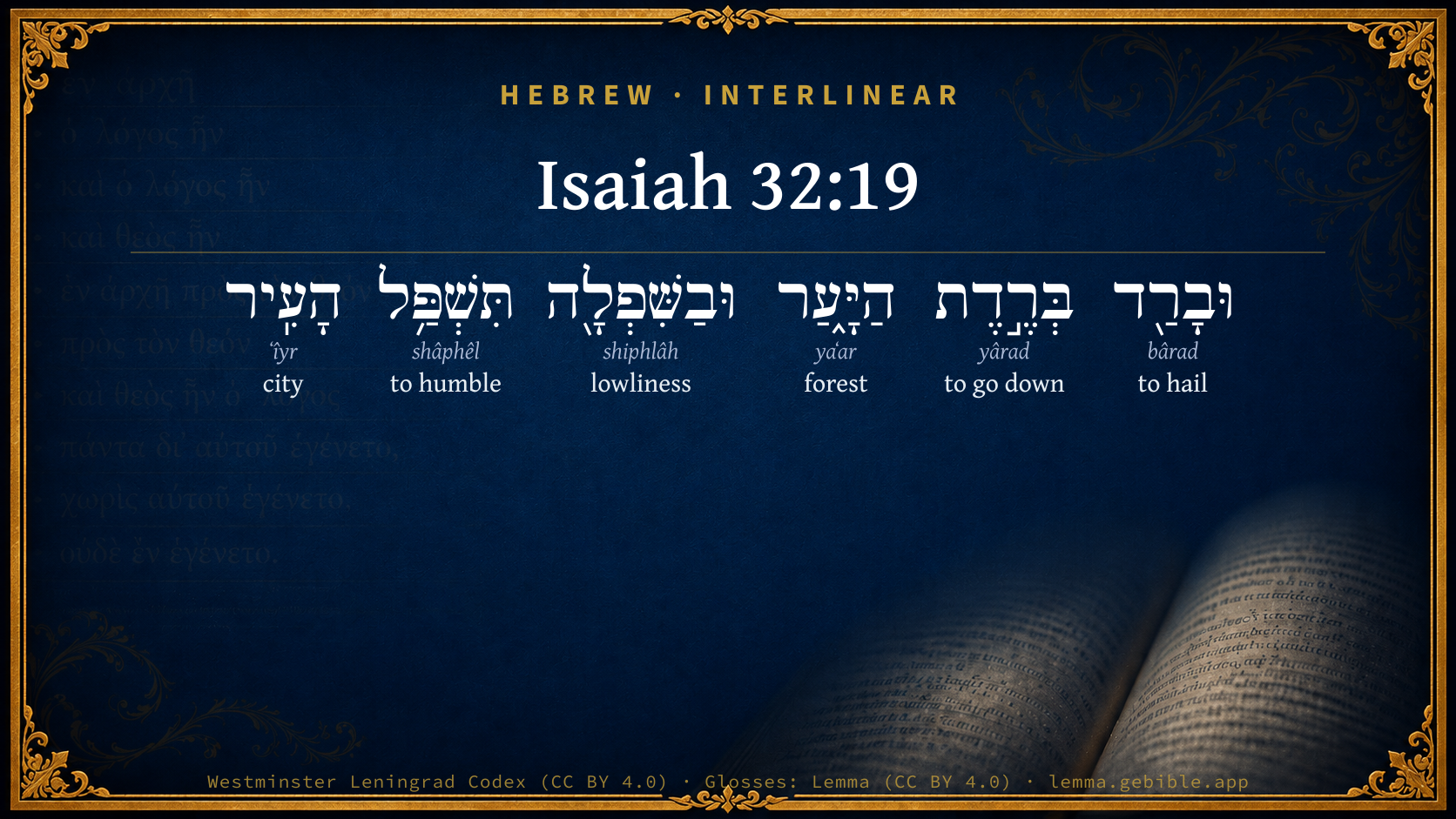
Isaiah 32:19

Hebrew (Westminster Leningrad Codex) Isaiah 32:19 appears in the Hebrew Old Testament. The text above is from the Westminster Leningrad Codex. Each word links to its Strong’s number, a concise gloss, and parsing drawn from the Open Scriptures Hebrew Bible morphology. Click any word for its full Brown-Driver-Briggs (BDB) entry.
Download image
Cite this verse

Isaiah 32:19 (World English Bible). Public Domain. Lemma interlinear Bible study tool, https://lemma.gebible.app/v/isaiah/32/19.

Show BibTeX & RIS
BibTeX
RIS
English Translation
But it shall hail in the downfall of the forest; and the city shall be utterly laid low.
World English Bible · Public Domain
Highlights Full analysis ↓
Download a study sheet

One document with this verse’s original text, its word-by-word gloss line, the meaning frame, cross-references with their text, attributed commentary, and full source and license credits — printable, and it pastes into notes with its structure intact.

This verse Autodidact and up

Study sheet (.html) Plain text (.txt)

A passage Seminary Student

Up to 50 verses in one chapter. A passage sheet keeps up to 6 commentary sources and 12 cross-references per verse, in the order this page ranks them, and says so on the sheet whenever that leaves anything out. Ask for a single verse and you get the Autodidact verse sheet above.

Everything on this page stays free to read, with no account — the sheet is a download of what is already on screen, not access to it.

Want to remove ads? Support Godless Engineer
Compare translations 3

The same verse in 3 English versions, stacked beneath the original-language interlinear above. Click any original word for its lexicon entry.

Each is an independent rendering of the whole verse — the interlinear is not word-aligned to these translations.

Highlighted words mark where these versions differ — a whole-verse word diff, not a word-by-word alignment.

  • World English Bible Public Domain
    But it shall hail in the downfall of the forest; and the city shall be utterly laid low.
  • King James Version Public Domain
    When it shall hail, coming down on the forest; and the city shall be low in a low place.
  • unfoldingWord Literal Text CC BY-SA 4.0
    And it will hail when the forest comes down, and in lowness the city will become low.

unfoldingWord Literal Text — © unfoldingWord, licensed CC BY-SA 4.0. Word-aligned USFM3 via Door43 (git.door43.org/unfoldingWord/en_ult).

Versions to compare (up to 4)

3 of 4 selected

Show all 18 translations

Every available English version of this verse, each an independent rendering of the whole verse.

  • World English Bible Public Domain
    But it shall hail in the downfall of the forest; and the city shall be utterly laid low.
  • Berean Standard Bible Public Domain
    But hail will level the forest, and the city will sink to the depths.
  • Majority Standard Bible Public Domain
    But hail will level the forest, and the city will sink to the depths.
  • King James Version Public Domain
    When it shall hail, coming down on the forest; and the city shall be low in a low place.
  • American Standard Version (1901) Public Domain
    But it shall hail in the downfall of the forest; and the city shall be utterly laid low.
  • Revised Version (1885) Public Domain
    But it shall hail, in the downfall of the forest; and the city shall be utterly laid low.
  • Geneva Bible (1599) Public Domain
    When it haileth, it shall fall on the forest, and the citie shall be set in the lowe place.
  • Douay-Rheims (1899) Public Domain
    But hail shall be in the descent of the forest, and the city shall be made very low.
  • Young's Literal Translation Public Domain
    And it hath hailed in the going down of the forest, And in the valley is the city low.
  • Literal Standard Version CC BY-SA 4.0
    And it has hailed in the going down of the forest, || And the city is low in the valley.
  • Unlocked Literal Bible CC BY-SA 4.0
    But even if it hails and the forest is destroyed, and the city is completely annihilated,
  • unfoldingWord Literal Text CC BY-SA 4.0
    And it will hail when the forest comes down, and in lowness the city will become low.
  • Darby Bible Public Domain
    And it shall hail, coming down on the forest; and the city shall be low in a low place.
  • World Messianic Bible Public Domain
    though hail flattens the forest, and the city is leveled completely.
  • Webster's Bible Public Domain
    When it shall hail, coming down on the forest; and the city shall be low in a low place.
  • Free Bible Version CC BY-SA 4.0
    Even though hail can destroy a forest, and a town can be demolished,
  • Bible in Basic English Public Domain
    But the tall trees will come down with a great fall, and the town will be low in a low place.
  • JPS Tanakh (1917) Public Domain
    And it shall hail, in the downfall of the forest; but the city shall descend into the valley.

Literal Standard Version (2020), Covenant Press — licensed CC BY-SA 4.0. Text via the HelloAO Bible API (eBible.org). Unlocked Literal Bible (unfoldingWord) — licensed CC BY-SA 4.0. Text via the HelloAO Bible API (eBible.org). unfoldingWord Literal Text — © unfoldingWord, licensed CC BY-SA 4.0. Word-aligned USFM3 via Door43 (git.door43.org/unfoldingWord/en_ult). Free Bible Version, Dr. Jonathan Gallagher — licensed CC BY-SA 4.0. Text via the HelloAO Bible API (eBible.org).

Word by word

More ways to search: Search by grammar → Find every occurrence → Compare this word →

Practice this passage: Drill this verse → Learn its vocabulary →

About this verse

These counts appear in no published source. They are computed here, from the morphology-tagged text and Lemma’s own curated glosses. What Lemma adds →

6
words
6
distinct lemmas
Prophets
section

Notable vocabulary

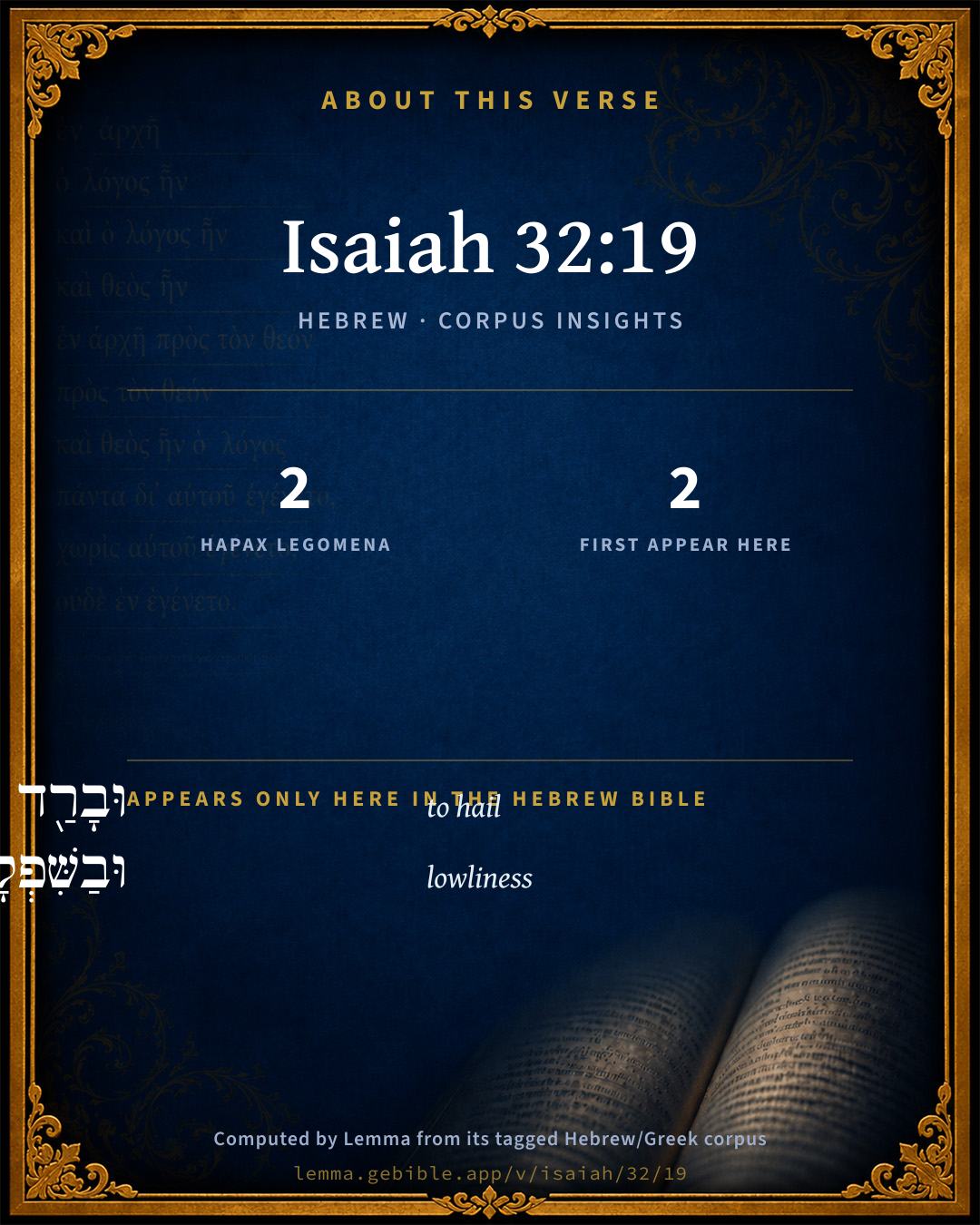
2 hapax legomena — words that appear only here in the entire Hebrew Bible:

  • וּבָרַ֖ד to hail H1258
  • וּבַשִּׁפְלָ֖ה lowliness H8218

First appearance in Scripture

These words make their first canonical appearance in the Hebrew Bible here:

  • וּבָרַ֖ד to hail H1258
  • וּבַשִּׁפְלָ֖ה lowliness H8218

Shared distinctive vocabulary

תִּשְׁפַּ֥ל to humble H8213 occurs in 27 verses of the Hebrew Bible. Also found in:

Grammatical profile

  • 3 verbs
  • 3 nouns

Verb forms

  • וּבָרַ֖ד Qal · Sequential Perfect
  • בְּרֶ֣דֶת Qal · Infinitive Construct
  • תִּשְׁפַּ֥ל Qal · Imperfect

Hebrew & Septuagint length

In English translation the verse runs 18 words from the Hebrew and 30 from the Septuagint (LXX English) — the Septuagint runs noticeably longer here. See the side-by-side →

A rough comparison of the two English renderings, which tokenize alike — not a word-level alignment.

Word counts can differ between the Hebrew and the Greek without any difference in meaning — e.g. the Hebrew direct-object marker אֵת has no separate Greek word, and Greek often adds the article ὁ.

Cross-references

19

Topical passages linked to Isaiah 32:19 in the Treasury of Scripture Knowledge — connected by theme and wording, ordered by reader-vote popularity; previews shown in the World English Bible.

  • Isaiah 28:17 I will make justice the line, and righteousness the plummet; and the hail shall sweep away the refuge of lies, and the waters shall overflow the hiding-place.
  • Isaiah 26:5 For he has brought down those who dwell on high, the lofty city: he lays it low, he lays it low even to the ground; he brings it even to the dust.
  • Isaiah 28:2 Behold, the Lord has a mighty and strong one; as a tempest of hail, a destroying storm, as a tempest of mighty waters overflowing, will he cast down to the earth with the hand.
  • Isaiah 30:30 Yahweh will cause his glorious voice to be heard, and will show the lighting down of his arm, with the indignation of [his] anger, and the flame of a devouring fire, with a blast, and tempest, and hailstones.
  • Zechariah 11:2 Wail, fir tree, for the cedar has fallen, Because the stately ones are destroyed. Wail, you oaks of Bashan, For the strong forest has come down.
  • Exodus 9:18–26 Behold, tomorrow about this time I will cause it to rain a very grievous hail, such as has not been in Egypt since the day it was founded even until now.
  • Isaiah 10:19 The remnant of the trees of his forest shall be few, so that a child may write them.
  • Isaiah 14:22–23 I will rise up against them, says Yahweh of Hosts, and cut off from Babylon name and remnant, and son and son's son, says Yahweh.
  • Isaiah 24:10 The waste city is broken down; every house is shut up, that no man may come in.
  • Isaiah 25:4 For you have been a stronghold to the poor, a stronghold to the needy in his distress, a refuge from the storm, a shade from the heat, when the blast of the awesome ones is as a storm against the wall.
  • Isaiah 27:10 For the fortified city is solitary, a habitation deserted and forsaken, like the wilderness: there shall the calf feed, and there shall he lie down, and consume the branches of it.
  • Isaiah 37:24 By your servants have you defied the Lord, and have said, With the multitude of my chariots am I come up to the height of the mountains, to the innermost parts of Lebanon; and I will cut down the tall cedars of it, and the choice fir trees of it; and I will enter into its farthest height, the forest of its fruitful field;
  • Ezekiel 13:11–13 tell those who daub it with whitewash, that it shall fall: there shall be an overflowing shower; and you, great hailstones, shall fall; and a stormy wind shall tear it.
  • Nahum 1:1 An oracle about Nineveh. The book of the vision of Nahum the Elkoshite.
  • Nahum 1:8 But with an overflowing flood, he will make a full end of her place, and will pursue his enemies into darkness.
  • Nahum 2:10–13 She is empty, void, and waste. The heart melts, the knees knock together, their bodies and faces have grown pale.
  • Matthew 7:25 The rain came down, the floods came, and the winds blew, and beat on that house; and it didn't fall, for it was founded on the rock.
  • Revelation 8:7 The first sounded, and there followed hail and fire, mixed with blood, and they were thrown to the earth. One third of the earth was burnt up, and one third of the trees were burnt up, and all green grass was burnt up.
  • Revelation 18:21 A mighty angel took up a stone like a great millstone and cast it into the sea, saying, "Thus with violence will Babylon, the great city, be thrown down, and will be found no more at all.

Cross-references courtesy of OpenBible.info (CC BY 4.0).

Hebrew and Greek witnesses Masoretic Hebrew ↔ Greek Septuagint

The same verse in the two great witnesses to the Old Testament, shown verse-for-verse.

Here the Septuagint runs noticeably longer than the Hebrew — LXX2012 (modern English Septuagint) 30 words vs World English Bible 18. A rough length comparison of the two English translations, not a word-level alignment — read both below.

These are two independent witnesses, not word-aligned to each other, and the Septuagint is shown in lemma (dictionary) form.

Hebrew Isaiah 32:19 Masoretic · Westminster Leningrad Codex

וּבָרַ֖ד בְּרֶ֣דֶת הַיָּ֑עַר וּבַשִּׁפְלָ֖ה תִּשְׁפַּ֥ל הָעִֽיר

But it shall hail in the downfall of the forest; and the city shall be utterly laid low.

World English Bible · Public Domain

Greek LXX Isaiah 32:19 Septuagint · lemma form

ὁ δέ χάλαζα ἐάν καταβαίνω οὐ ἐπί σύ ἥκω καί εἰμί ὁ ἐνοἰκέω ἐν ὁ δρυμός πείθω ὡς ὁ ἐν ὁ πεδεινός

And if the hail should come down, it shall not come upon you; and they that dwell in the forests shall be in confidence, as those in the plain country.

LXX2012 (modern English Septuagint) · Public Domain

Hebrew: Westminster Leningrad Codex (CC BY 4.0). Greek: Septuagint (public domain); English from LXX2012 (modern English Septuagint) (Public Domain). How the Septuagint differs from the Hebrew →

Targum (Aramaic paraphrase)

1

The Targum is the ancient Jewish Aramaic paraphrase of the Hebrew Scriptures — an interpretive translation, not the Hebrew text itself. Onkelos (literal) and Pseudo-Jonathan (expansive) render the Torah, and Jonathan the Prophets. Coverage is partial: where no permissively-licensed English translation exists for a verse, only the Aramaic is shown. This is verse-level text, not a word-by-word alignment to the Hebrew.

  1. Targum Jonathan Prophets (Joshua–Malachi)
    וְיֵחוֹת בַּרְדָא וְיִקְטֵיל מַשִׁרְיַת עַמְמַיָא פַּלְחֵי טַעֲוָתָא וְיִצְדוּן וִיסוּפוּן דָיְרֵיהוֹן:

    And hail shall descend and shall slay the armies of the nations, and their encampments shall be laid desolate, and come to an end.

    Targum Jonathan — Aramaic: “Mikraot Gedolot” (public domain). English: “Sefaria Community Translation” (CC0 1.0 (public-domain dedication)); “London "Chaldee Paraphrase," 1871” (public domain). Text via Sefaria.

Commentary

Notes on Isaiah 32:19 from classic Christian and Jewish commentators (each source and its license shown beneath its notes). The classic Christian expositions comment on the surrounding passage and are grouped to its opening verse, so a note may address several verses; the Jewish commentaries on the Tanakh (Rashi and others) are per-verse, so they appear only where the commentator wrote on this verse.

Lemma curates 59 commentaries, every one of them public domain or Creative Commons licensed, each selected and text-cleaned for this edition rather than reprinted as found. About our sources →

Trapp's Complete Commentary

John Trapp

Isa 32:19 When it shall hail, coming down on the forest; and the city shall be low in a low place.

Ver. 19. When it shall hail, coming down on the forest.] When reprobates - here compared to a forest or tall wood - shall be hail beaten, that is, grievously plagued, as those Egyptians once were, {Exo 9:22; Exo 9:26} it shall be hale, or well, with the elect. The Church, as a city that standeth in a low bottom, is secure and safe, her afflictions also working together for her good. In humbling her, God remembereth her, for his mercy endureth for ever. {Psa 136:23}

John Trapp, A Commentary or Exposition upon All the Books of the Old and New Testament (1647–1656) — public domain. Text from a community e-Sword module.

Joseph Benson's Commentary

Isa 32:19. When — Or, rather, And it shall hail — As my blessings shall be poured down upon my people, who, from a wilderness, are turned into a fruitful field, so my judgments (which are signified by hail, Isa 28:2; Isa 28:17, and elsewhere) shall fall upon them who were a fruitful field, but are turned into a forest, as was said Isa 32:15; that is, upon the unbelieving and rebellious Jews. And the city — Jerusalem, which, though now it was the seat of God’s worship and people, yet he foresaw would be the great enemy of the Messiah; shall be low in a low place — Hebrew, תשׁפל בשׁפלה, shall be humbled with humiliation; that is, shall be greatly humbled, or brought very low.

Joseph Benson's Commentary on the Old and New Testaments (1811–1818) — public domain. Text from a community e-Sword module.

Tyndale Open Study Notes

Tyndale Open Resources

32:19 the forest . . . the city: The godly would remain secure even with evidence of God’s judgment all around them.

Tyndale Open Study Notes — © Tyndale Open Resources, licensed CC BY-SA 4.0. Text via the HelloAO Bible API.

Geneva Bible (1599)

Geneva Bible translators

They shall not need to build it in high places for fear of the enemy: for God will defend it, and turn away the storms from hurting of their commodities.

Geneva Bible (1599) marginal notes — public domain. Text via Bolls.life.

Jamieson, Fausset & Brown

Robert Jamieson, A. R. Fausset & David Brown

Literally, "But it shall hail with coming down of the forest, and in lowness shall the city (Nineveh) be brought low; that is, humbled." The "hail" is Jehovah's wrathful visitation (Isa 30:30; Isa 28:2, Isa 28:17). The "forest" is the Assyrian host, dense as the trees of a forest (Isa 10:18-19, Isa 10:33-34; Zac 11:2).

Jamieson, Fausset & Brown — Commentary Critical and Explanatory on the Whole Bible (1871) — public domain (CC PDM 1.0). Text via the HelloAO Bible API.

Adam Clarke's Commentary

Verse 19. The city shall be low in a low place. - "The city shall be laid level with the plain."] For ובשפלה ubashephelah, the Syriac reads וכשפלה ukeshephelah. The city - probably Nineveh or Babylon: but this verse is very obscure. Saltus; Assyriorum regnum: civitas; magnifica Assyriorum castra. Ephrem Syr. in loc. For וברד ubarad, a MS. has וירד vaiyered; and so conjectured Abp. Secker, referring to Zec 11:2.

Adam Clarke's Commentary on the Bible (1810–1826) — public domain. Text from a community e-Sword/MySword module.

Ellicott's Commentary for English Readers

(19) When it shall hail, coming down on the forest.—Better, But it shall hail. A time of sharp judgment, “hailstones and coals of fire,” is to precede that of blessedness and peace. Of such a judgment “hail” was the natural symbol. (Comp. Isa_30:30; Eze_13:13.) The “forest” stands in the symbolism of prophecy for the rulers and princes of any kingdom, as in Isa_10:34 for those of Assyria, and here probably of Judah. Not a few commentators refer the words here also to Assyria, but the city that follows is clearly Jerusalem, and the interpretation given above harmonises accordingly better with the context. Of that city Isaiah says that it shall be “brought down to a low estate,” its pride humbled even to the ground, in order that it may afterwards be exalted.

A Bible Commentary for English Readers, edited by Charles John Ellicott (1878–1897) — public domain. Text from a community e-Sword module.

The Cambridge Bible for Schools and Colleges

gen. ed. J. J. S. Perowne

19. The verse reads: And it shall hail at the falling of the forest, and in lowliness shall the city be laid low. According to most commentators the “forest” is a symbol for Assyria, as in ch. Isa_10:18 f., 33 f. But this is suggested by nothing in the context, and the “city” in the next line cannot be Nineveh, which is never referred to by Isaiah, and is far from his thoughts here. The verse as a whole must (if genuine) be taken as an announcement of judgment on Jerusalem; but it comes in so awkwardly between Isa_32:18; Isa_32:20, that it may not unreasonably be regarded as an interpolation. On the “hail” as a synonym for Divine judgment see ch. Isa_28:2; Isa_28:17, Isa_30:30.

The Cambridge Bible for Schools and Colleges (gen. ed. J. J. S. Perowne; Cambridge University Press, 1878–1918) — public domain. Text from a community e-Sword module.

John Gill's Exposition

When it shall hail, coming down on the forest,.... The people of God will be peaceable and quiet, safe and secure, when the judgments of God, signified by a "hail" storm, shall come upon antichrist, and the antichristian states, intended by the "forest", both for their numbers, and for their barrenness and unfruitfulness; see Rev 16:21 and as so it sometimes is, by the disposition of divine Providence, that a storm of hail falls not upon fields and gardens, and the fruits of the earth, but upon forests and desert lands; and as the plague of hail fell upon the Egyptians, and not upon the Israelites in Goshen, to which some think the allusion is here; so will it be when God comes to take vengeance on the enemies of his people:

and the city shall be low in a low place: meaning not the city of Jerusalem, surrounded with mountains, built under hills, and so under the wind, and not exposed to the fury of a storm; but rather Babylon, built in a plain, in a low plain, and yet should be brought lower still; mystical Babylon is here meant, the city of Rome, that should "in humiliation be humbled", as the words may be rendered, that is, brought very low, exceeding low; see Isa 26:5 and which, at the time of the great hail, will be divided into three parts, and the cities of the nations shall fall, and Babylon be had in remembrance by the Lord to destroy it, Rev 16:19.

John Gill's Exposition of the Whole Bible (1746–1763) — public domain (CC PDM 1.0). Text via the HelloAO Bible API.

Albert Barnes' Notes on the Bible

When it shall hail - Hebrew, ברדת ברד bârad beredeth - ‘And it shall hail in coming down. There is a paranomasia in the original here, which cannot be expressed in a translation - a figure of speech, which, as we have seen, is common in Isaiah. ‘Hail’ is an image of divine vengeance or punishment; and the reference here is, doubtless, to the storms of indignation that would come on the enemies of the Jews, particularly on the Assyrians (see the notes at Isa 30:30).

Coming down on the forest - Coming down on the army of the Assyrian, which is here called ‘a forest.’ The same term ‘forest’ is given to the army of the Assyrians in Isa 10:18-19, Isa 10:33-34. The sense is, that the divine judgment would come down on that army with as much severity as a storm of hail descends on a forest - stripping the leaves from the trees, destroying its beauty, and laying it waste.

And the city - According to Gesenius, this is Nineveh, the capital of the Assyrian empire. According to Rosenmuller, Grotius, and others, it is Babylon. Hensler supposes that it is Jerusalem, and that the sense is, that as a city that is situated in a valley is safe when the storm and tempest sweep over the hills, so would it be to Jerusalem when the storm of wrath should sweep away the army of the Assyrian. But the connection evidently requires us to understand it of the capital of the enemy; though whether it be Nineveh or Babylon perhaps cannot be determined.

Shall be low in a low place - Margin, ‘Utterly abased.’ Hebrew, ‘In humility shall be humbled.’ The sense is, shall be completely prostrate. Those who refer this to Jerusalem suppose it refers to the time when God should humble it by bringing the enemy so near, and exciting so much consternation and alarm. Those who refer it to Babylon suppose it relates to its destruction. If referred to Nineveh, it must mean when the pride of the capital of the Assyrian empire should be iratabled by the complete overthrow of their army, and the annihilation of their hopes. The connection seems to require us to adopt this latter interpretation. The whole verse is very obscure; but perhaps the above will express its general sense.

Albert Barnes' Notes on the Bible (1834–1885) — public domain. Text from a community e-Sword/MySword module.

Haydock's Catholic Bible Commentary

Hail. God’s judgment shall overtake Babylon, or rather Ninive.

George Leo Haydock (1774–1849), Haydock's Catholic Family Bible and Commentary, 1859 edition — public domain. Excludes Psalms (Douay-Rheims chapter numbering differs from Protestant) and Deuterocanonical books (Catholic canon only).

Matthew Poole's English Annotations

When it shall hail, coming down on the forest, Heb. And it shall hail, &c. As my blessings shall be poured down upon my people, who from a wilderness are turned into a fruitful field, as it is said, Isa 32:15; so my wrath and judgments (which are signified by hail, Isa 28:2,17, and elsewhere) shall fall upon them, who were a fruitful field, but are turned into a forest, as was said, Isa 32:15, i.e. upon the unbelieving and rebellious Jews, who seem there to be designed under that notion.

The city; either,

1. Babylon, the great enemy and oppressor of God’s people. Or,

2. Jerusalem, which, though now it was the seat of God’s worship and people, yet he foresaw by the Spirit of prophecy that it would be the great enemy of the Messiah, and of God’s people.

Shall be low in a low place, Heb. shall be humbled with humiliation; which by an ordinary Hebraism signifies, shall be greatly humbled, or brought very low.

Matthew Poole's English Annotations on the Holy Bible (1683–1685) — public domain. Text from a community e-Sword/MySword module.

Whedon's Commentary on the Bible

Daniel D. Whedon

19. It shall hail, coming down on the forest — That is, the fierce storm shall overthrow it. Hail storms in Palestine are fearful agencies of destruction. Note the scenes under Joshua at Beth-horon, and at Megiddo under Barak. Jos_10:11; Jdg_5:20. And the city, etc. — If this verse is in its right place, it is another case of a sudden mental association, in the mind of the prophet, with the destroying power, Assyria. Assyria is to destroy Judah as an event ordered to precede this beginning of spiritual renovation of redeemed Israel. “The forest,” then, denotes the degenerated children of Judah, and “the city,” is destroyed Jerusalem. In the same mental association, Assyria, as a destroying power, covers the seat of that power throughout the Euphrates valley; it ideally includes the same power transferred to Babylon. The verse would seem to be a parenthetic interruption to the course of thought in this place.

Daniel D. Whedon (gen. ed.), Commentary on the Old and New Testaments (1874–1909) — public domain. Text from a community e-Sword module.

The Pulpit Commentary

When it shall hail, coming down on the forest; rather, but it shall hail in the coming down (i.e. the destruction) of the forest. "The forest" has commonly been regarded as Assyria, on the strength of Isa_10:18, Isa_10:19, Isa_10:33, Isa_10:34. Mr. Cheyne, however, suggests Judah, or the high and haughty ones of Judah, whose destruction was a necessary preliminary to the establishment of Christ"s kingdom. May not God"s enemies generally be meant? The city. Nineveh (Lowth, Gesenius, Rosenm Jerusalem (Delitzsch, Knobel, Cheyne, Kay); "the city in which the hostility of the world to Jehovah will, in the latter days, be centralized" (Drechsler, Nagel) the "world-power," in fact. The last view seems to give the best sense.

The Pulpit Commentary (1880–1919), ed. H.D.M. Spence-Jones & Joseph S. Exell — public domain. Text from a community e-Sword module.

John Wesley's Explanatory Notes

It shall hail - As my blessings shall be poured down upon my people, who, from a wilderness, are turned into a fruitful field, so my judgments (which are signified by hail, chap. xxviii, 2, 17, and elsewhere) shall fall upon them, who were a fruitful field, but are turned into a forest, upon the unbelieving and rebellious Jews. The city - Jerusalem, which, though now it was the seat of God's worship and people, yet he foresaw, would be the great enemy of the Messiah. Low - Hebrew. shall be humbled with humiliation: shall be greatly humbled, or brought very low.

John Wesley, Explanatory Notes Upon the Whole Bible (1754–1765) — public domain. Text via the GEBible commentary corpus.

J. A. Alexander on Isaiah

Joseph Addison Alexander

“And it shall hail in the downfall of the forest (i.e., so as to overthrow it), and the city shall be low in a low place” (or humble with humiliation) (i.e., utterly brought down). If this be read as a direct continuation of the promise in v. 18, it must be explained as a description of the downfall of some hostile power, and accordingly it has been referred by most interpreters to Nineveh. Others, thinking it more natural to assume one subject here and in v. 13, regard this as another instance of prophetic recurrence from remoter promises to nearer threats; as if he had said, before these things can come to pass, the city must be brought low. This construction is entirely in keeping with the Prophet’s manner, as exemplified already in this very chapter. (See the note on v. 9 above.) However natural and probable certain applications of the passage may appear, the only sense which can with certainty be put upon it, is that some existing power must be humbled, either as a means or as a consequence of the moral revolution which had been predicted.

Joseph Addison Alexander, The Prophecies of Isaiah (1846–1847; New York: Scribner, 1870–1878) — public domain. Text from a community e-Sword module.

unfoldingWord translationNotes

Door43 World Missions Community

hails

See how you translated this in Isaiah 28:2.

the forest is destroyed, and the city is completely annihilated

This can be stated in active form. AT: "it destroys the forest and completely destroys the city" (See: Active or Passive)

you who sow beside all the streams will be blessed, you who send out your ox and donkey to graze

This can be stated in active form. This refers to Yahweh blessing all of his people and speaks of the things that are normal for his people to do. AT: "Yahweh will bless you, as you plant your crops in fields alongside the streams and as you send out your ox and donkey to graze in the pasture" (See: Active or Passive and Assumed Knowledge and Implicit Information)

translationWords

plant

bless

cow

donkey

unfoldingWord translationNotes — © Distant Shores Media and the Door43 World Missions Community, licensed CC BY-SA 4.0. Source: git.door43.org/Door43/en_tn.

Rashi

Rabbi Shlomo Yitzchaki (Rashi)

And He shall hail down the hailing of the forest (וּבָרַד בְּרֶדֶתהַיָּעַר) Perforce, this word וּבָרָד is not a noun, since half of it is vowelized with a ‘kamatz’ and half of it with a ‘pattah’ in an expression of פָּעַל. (Rashi distinguishes בָּרַד from בָּרָד, the noun denoting hail.) And so is its interpretation, an expression of an action, like ‘and he shall wash’ (וְרָחַץ), ‘and he shall sit’ (וְיָשַׁב), ‘and he shall stand’ (וְעָמַד). Here too, וּבָרַד ‘and He shall hail down the hailing of the forest.’ Then the ‘beth’ of בְּרֶדֶת is a radical, like עֲטֶרֶת, ‘a crown,’ עֲקֶרֶת ‘a barren woman.’ That is to say that the Holy One, blessed be He, shall rain down the rain of the coals of the wicked, those who are now built up and full of cities like a forest.

and into the low state Into which Israel has been humbled until now,

shall the metropolis of Persia (Seir, Edom, [according to various mss.]) be humbled. In a similar manner did Jonathan render it: And hail will come down and kill the camps of the nations.

Rashi on the Tanakh — English translations: “The Judaica Press complete Tanach with Rashi, translated by A. J. Rosenberg” (CC BY 4.0); “Pentateuch with Rashi's commentary by M. Rosenbaum and A.M. Silbermann, 1929-1934” (public domain); “The Metsudah Tanach series, Lakewood, N.J” (CC BY 4.0); and “The Book of Joshua, Metsudah Publications, 1997” (CC BY 4.0). Text via Sefaria.

Ibn Ezra

Rabbi Abraham ibn Ezra

וברד When it shall hail. The Pathah under ר proves that the word is a verb; comp. עשן it smoked (Ex. 19:18). When it shall hail, coming down on the forest. When the hailstones will come down, they will come down on the forest, not on the fields.

The city shall be low, shall be like a wide plain without walls

Ibn Ezra on the Tanakh — English translations: “Sefaria Community Translation” (CC0 1.0 (public-domain dedication)); “Yalkut, Sifsei Chachomim Chumash, Metsudah Publications, 2009” (CC BY 4.0); and “Commentary of Ibn Ezra on Isaiah - trans. by M. Friedlander, 1873” (public domain). Text via Sefaria.

Lesson kit

Teaching starters — assembled from the data on this page, not authored interpretation. Every prompt links to the verse data it draws on. Edit before teaching.

Isaiah, in the Prophets, opens this verse with 6 words (6 distinct Hebrew lemmas). Its most distinctive word is bârad (“to hail”). The Greek Septuagint runs longer here. A historical commentator’s framing appears above. Read the whole chapter for the surrounding context.

Discussion questions

  1. How does “to hail” (bârad) shape what this verse is saying?
  2. This verse holds 2 words here found nowhere else in the Hebrew Bible. What might the rare words draw attention to?
  3. 2 words here appear for the first time in Scripture. What is being introduced at this debut?
  4. 1 Samuel 2:7 shares the word «to humble» with this verse. How do the two illuminate each other?
  5. Compared with the Hebrew, the Septuagint runs longer here. What questions does that raise?
  6. The translations on this page render this verse differently — a whole-verse word diff, not a word-by-word alignment. What might account for the different wordings?
  7. The verb «וּבָרַ֖ד» is Qal Sequential Perfect. How does its form color the action?
  8. Reading how Trapp's Complete Commentary and Joseph Benson's Commentary read this verse, where do the two commentators agree and where do they part?

Things to notice

  • 2 words in this verse appear nowhere else in the Hebrew Bible.
  • 2 words make their first canonical appearance in Scripture here.
  • These translations choose different wording for 12 words in this verse.
  • 6 distinct Hebrew lemmas span 6 words in this verse.

Reading settings

Reading text

Shown beneath each verse's original-language words.

Old Testament
Old Testament edition

Read the OT as the Masoretic Hebrew (MT) or the Greek Septuagint (LXX).

English shown for the Greek Septuagint (in the Hebrew ↔ Greek comparison).

Comparing translations? Open the Compare panel on any verse page to stack up to four side by side.