Jeremiah 10:3

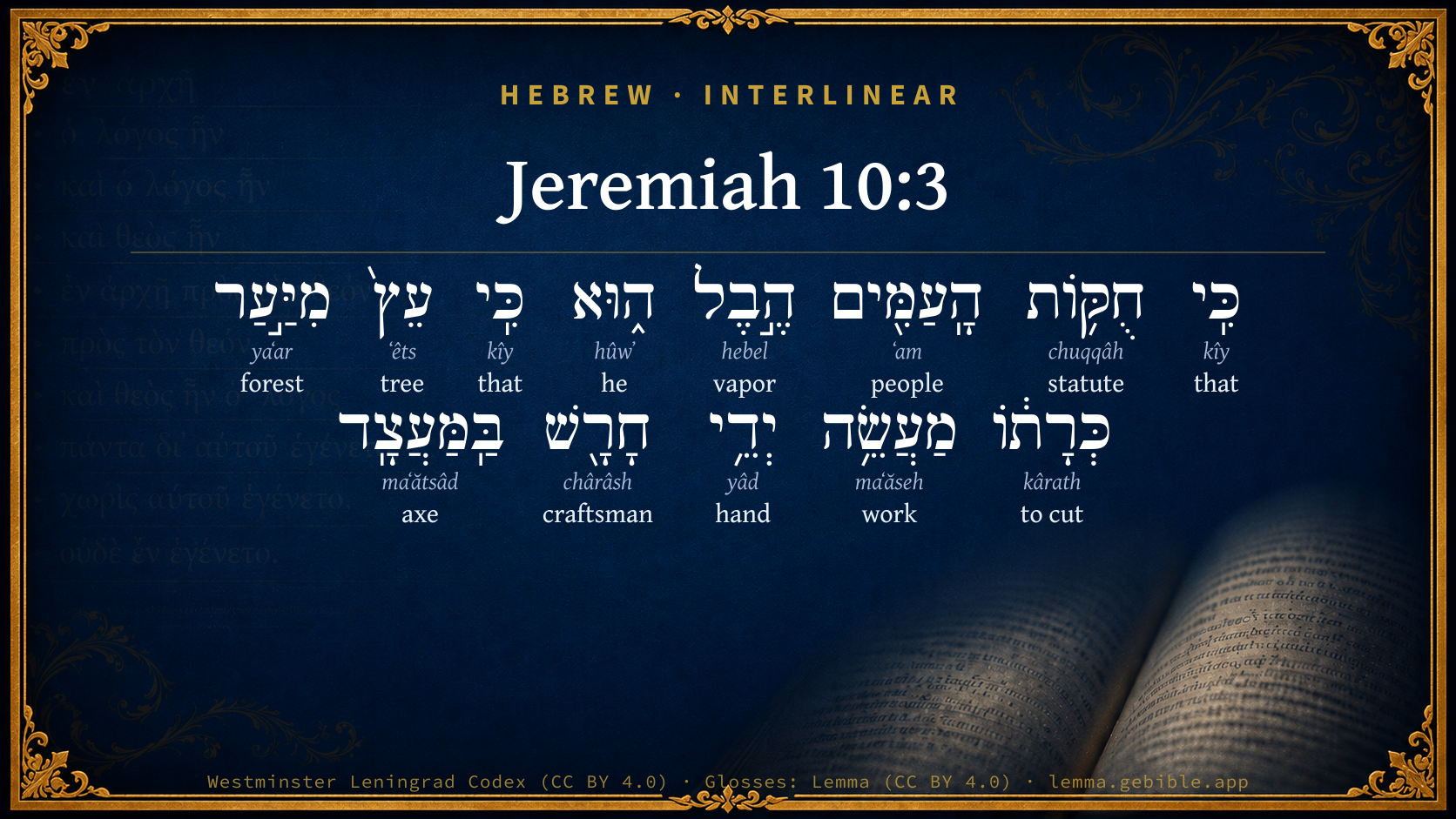
Hebrew (Westminster Leningrad Codex) Jeremiah 10:3 appears in the Hebrew Old Testament. The text above is from the Westminster Leningrad Codex. Each word links to its Strong’s number, a concise gloss, and parsing drawn from the Open Scriptures Hebrew Bible morphology. Click any word for its full Brown-Driver-Briggs (BDB) entry.
Download image
Cite this verse

Jeremiah 10:3 (World English Bible). Public Domain. Lemma interlinear Bible study tool, https://lemma.gebible.app/v/jeremiah/10/3.

Show BibTeX & RIS
BibTeX
RIS
English Translation
For the customs of the peoples are vanity; for one cuts a tree out of the forest, the work of the hands of the workman with the axe.
World English Bible · Public Domain
Download a study sheet

One document with this verse’s original text, its word-by-word gloss line, the meaning frame, cross-references with their text, attributed commentary, and full source and license credits — printable, and it pastes into notes with its structure intact.

This verse Autodidact and up

Study sheet (.html) Plain text (.txt)

A passage Seminary Student

Up to 50 verses in one chapter. A passage sheet keeps up to 6 commentary sources and 12 cross-references per verse, in the order this page ranks them, and says so on the sheet whenever that leaves anything out. Ask for a single verse and you get the Autodidact verse sheet above.

Everything on this page stays free to read, with no account — the sheet is a download of what is already on screen, not access to it.

Want to remove ads? Support Godless Engineer
Compare translations 3

The same verse in 3 English versions, stacked beneath the original-language interlinear above. Click any original word for its lexicon entry.

Each is an independent rendering of the whole verse — the interlinear is not word-aligned to these translations.

Highlighted words mark where these versions differ — a whole-verse word diff, not a word-by-word alignment.

  • World English Bible Public Domain
    For the customs of the peoples are vanity; for one cuts a tree out of the forest, the work of the hands of the workman with the axe.
  • King James Version Public Domain
    For the customs of the people are vain: for one cutteth a tree out of the forest, the work of the hands of the workman, with the axe.
  • unfoldingWord Literal Text CC BY-SA 4.0
    For the customs of the peoples are breath, for a tree from the forest he cuts it down, the work of the hands of a craftsman with the tool.

unfoldingWord Literal Text — © unfoldingWord, licensed CC BY-SA 4.0. Word-aligned USFM3 via Door43 (git.door43.org/unfoldingWord/en_ult).

Versions to compare (up to 4)

3 of 4 selected

Show all 18 translations

Every available English version of this verse, each an independent rendering of the whole verse.

  • World English Bible Public Domain
    For the customs of the peoples are vanity; for one cuts a tree out of the forest, the work of the hands of the workman with the axe.
  • Berean Standard Bible Public Domain
    For the customs of the peoples are worthless; they cut down a tree from the forest; it is shaped with a chisel by the hands of a craftsman.
  • Majority Standard Bible Public Domain
    For the customs of the peoples are worthless; they cut down a tree from the forest; it is shaped with a chisel by the hands of a craftsman.
  • King James Version Public Domain
    For the customs of the people are vain: for one cutteth a tree out of the forest, the work of the hands of the workman, with the axe.
  • American Standard Version (1901) Public Domain
    For the customs of the peoples are vanity; for one cutteth a tree out of the forest, the work of the hands of the workman with the axe.
  • Revised Version (1885) Public Domain
    For the customs of the peoples are vanity: for one cutteth a tree out of the forest, the work of the hands of the workman with the axe.
  • Geneva Bible (1599) Public Domain
    For the customes of the people are vaine: for one cutteth a tree out of the forest (which is the worke of the handes of the carpenter) with the axe,
  • Douay-Rheims (1899) Public Domain
    For the laws of the people are vain: for the works of the hand of the workman hath cut a tree out of the forest with an axe.
  • Young's Literal Translation Public Domain
    For the statutes of the peoples are vanity, For a tree from a forest hath one cut, Work of the hands of an artificer, with an axe,
  • Literal Standard Version CC BY-SA 4.0
    For the statutes of the peoples are vanity, || For one has cut a tree from a forest, || Work of the hands of a craftsman, with an axe,
  • Unlocked Literal Bible CC BY-SA 4.0
    For the religious customs of these people are worthless. They cut down a tree in the forest, and the craftsman carves the wood.
  • unfoldingWord Literal Text CC BY-SA 4.0
    For the customs of the peoples are breath, for a tree from the forest he cuts it down, the work of the hands of a craftsman with the tool.
  • Darby Bible Public Domain
    For the statutes of the peoples are vanity; for [it is] a tree cut out of the forest, worked with a chisel by the hands of the artizan;
  • World Messianic Bible Public Domain
    For the customs of the peoples are vanity; for one cuts a tree out of the forest, the work of the hands of the workman with the ax.
  • Webster's Bible Public Domain
    For the customs of the people are vain: for one cutteth a tree out of the forest, the work of the hands of the workman, with the ax.
  • Free Bible Version CC BY-SA 4.0
    The religious beliefs of the peoples are pointless. They chop down a tree in the forest and a craftsman carves the wood with a tool to make an idol.
  • Bible in Basic English Public Domain
    For that which is feared by the people is foolish: it is the work of the hands of the workman; for a tree is cut down by him out of the woods with his axe.
  • JPS Tanakh (1917) Public Domain
    For the customs of the peoples are vanity; for it is but a tree which one cutteth out of the forest, the work of the hands of the workman with the axe.

Literal Standard Version (2020), Covenant Press — licensed CC BY-SA 4.0. Text via the HelloAO Bible API (eBible.org). Unlocked Literal Bible (unfoldingWord) — licensed CC BY-SA 4.0. Text via the HelloAO Bible API (eBible.org). unfoldingWord Literal Text — © unfoldingWord, licensed CC BY-SA 4.0. Word-aligned USFM3 via Door43 (git.door43.org/unfoldingWord/en_ult). Free Bible Version, Dr. Jonathan Gallagher — licensed CC BY-SA 4.0. Text via the HelloAO Bible API (eBible.org).

Word by word

More ways to search: Search by grammar → Find every occurrence → Compare this word →

Practice this passage: Drill this verse → Learn its vocabulary →

בַּֽמַּעֲצָֽד
maʻătsâd
H4621
“in/at the · axe”
Preposition, Determined + Noun, Common, Masculine, Singular, Absolute
Part of Speech
Preposition + Noun
Type
Common
Gender
Masculine
Number
Singular
State
Absolute
Full BDB Definition

Origin: from an unused root meaning to hew

TWOT: 1668a

axe
  1. כִּֽי kîy H3588 “that” Conjunction
  2. חֻקּ֥וֹת chuqqâh H2708 “statutes of” Noun, Common, Both, Plural, Construct
  3. הָֽעַמִּ֖ים ʻam H5971 “the · peoples” Particle, Definite Article + Noun, Common, Masculine, Plural, Absolute
  4. הֶ֣בֶל hebel H1892 “vapor” Noun, Common, Masculine, Singular, Absolute
  5. ה֑וּא hûwʼ H1931 “he” Pronoun, Personal, 3rd Person, Masculine, Singular
  6. כִּֽי kîy H3588 “that” Conjunction
  7. עֵץ֙ ʻêts H6086 “tree” Noun, Common, Masculine, Singular, Absolute
  8. מִיַּ֣עַר yaʻar H3293 “from · forest” Preposition + Noun, Common, Masculine, Singular, Absolute
  9. כְּרָת֔וֹ kârath H3772 “to cut · him” Verb, Qal, Perfect, 3rd Person, Masculine, Singular + Suffix, Personal, 3rd Person, Masculine, Singular
  10. מַעֲשֵׂ֥ה maʻăseh H4639 “work of” Noun, Common, Masculine, Singular, Construct
  11. יְדֵ֥י yâd H3027 “hands of” Noun, Common, Both, Dual, Construct
  12. חָרָ֖שׁ chârâsh H2796 “craftsman” Noun, Common, Masculine, Singular, Absolute

About this verse

These counts appear in no published source. They are computed here, from the morphology-tagged text and Lemma’s own curated glosses. What Lemma adds →

13
words
12
distinct lemmas
Prophets
section

Notable vocabulary

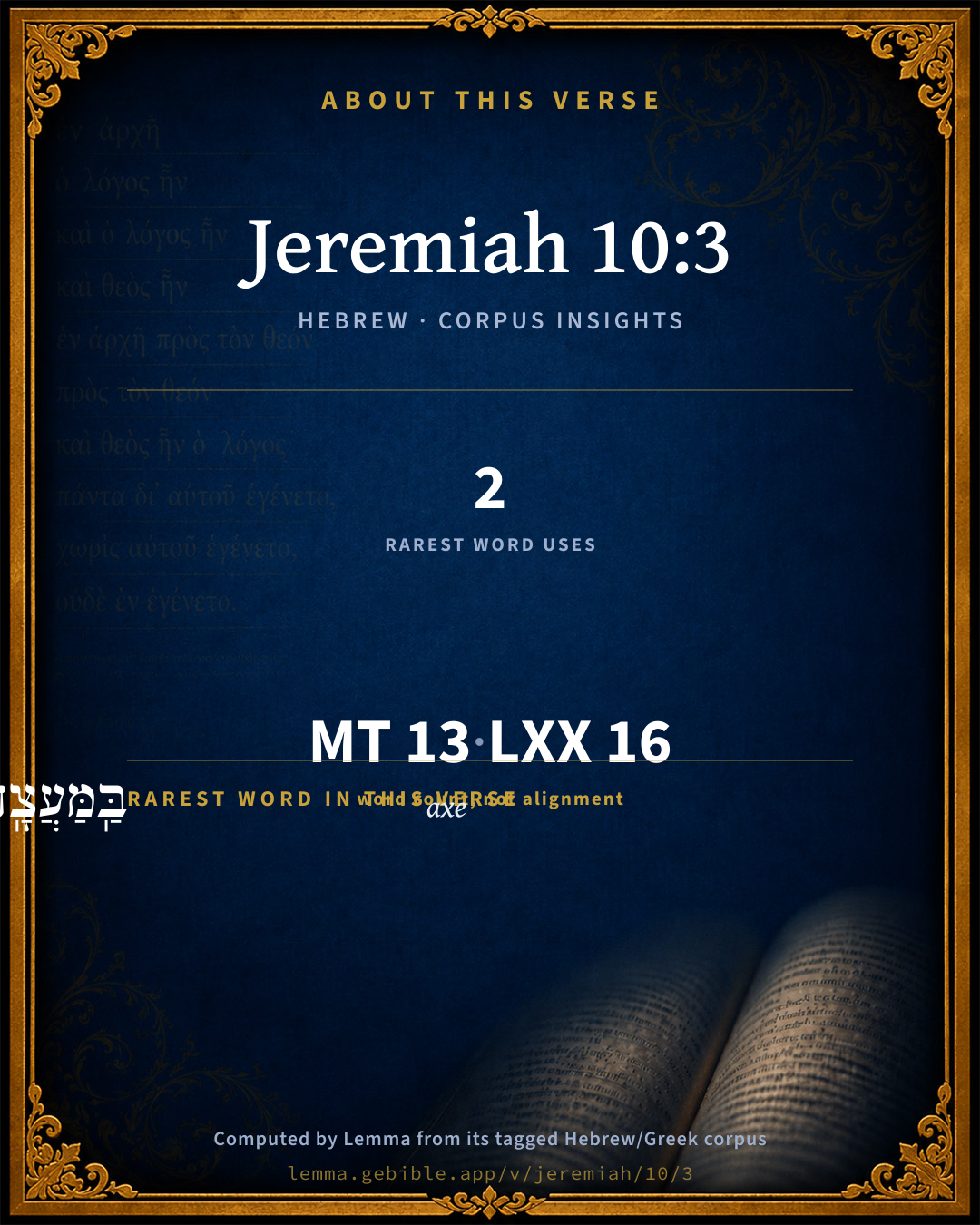
The rarest word here is בַּֽמַּעֲצָֽד axe H4621 — appearing just 2 times in the whole Hebrew Bible.

Shared distinctive vocabulary

בַּֽמַּעֲצָֽד axe H4621 occurs in 2 verses of the Hebrew Bible. Also found in:

Grammatical profile

  • 1 verb
  • 9 nouns
  • 1 pronoun
  • 2 conjunctions

Verb forms

  • כְּרָת֔וֹ Qal · Perfect

Repetition

A word recurs within this verse — often emphatic in Hebrew:

  • כִּֽי that H3588 ×2

Hebrew & Septuagint length

In the original languages it is 13 Hebrew tokens and 16 Greek tokens — but the two are counted differently (Hebrew bundles its prefixes and suffixes into one token; the Greek is in lemma form), so that isn’t a like-for-like length.

Cross-references

12

Topical passages linked to Jeremiah 10:3 in the Treasury of Scripture Knowledge — connected by theme and wording, ordered by reader-vote popularity; previews shown in the World English Bible.

  • Isaiah 44:9–20 Those who fashion an engraved image are all of them vanity; and the things that they delight in shall not profit; and their own witnesses don't see, nor know: that they may be disappointed.
  • 1 Peter 1:18 knowing that you were redeemed, not with corruptible things, with silver or gold, from the useless way of life handed down from your fathers,
  • Leviticus 18:30 Therefore you shall keep my charge, that you do not practice any of these abominable customs, which were practiced before you, and that you do not defile yourselves with them: I am Yahweh your God.'"
  • Jeremiah 10:8 But they are together brutish and foolish: the instruction of idols! it is but a stock.
  • Romans 1:21 Because, knowing God, they didn't glorify him as God, neither gave thanks, but became vain in their reasoning, and their senseless heart was darkened.
  • Isaiah 45:20 Assemble yourselves and come; draw near together, you who have escaped from the nations: they have no knowledge who carry the wood of their engraved image, and pray to a god that can't save.
  • Matthew 6:7 In praying, don't use vain repetitions, as the Gentiles do; for they think that they will be heard for their much speaking.
  • 1 Kings 18:26–28 They took the bull which was given them, and they dressed it, and called on the name of Baal from morning even until noon, saying, Baal, hear us. But there was no voice, nor any who answered. They leaped about the altar which was made.
  • Hosea 8:4–6 They have set up kings, but not by me. They have made princes, and I didn't approve. Of their silver and their gold they have made themselves idols, That they may be cut off.
  • Jeremiah 2:5 thus says Yahweh, What unrighteousness have your fathers found in me, that they have gone far from me, and have walked after vanity, and are become vain?
  • Habakkuk 2:18–19 "What value does the engraved image have, that its maker has engraved it; the molten image, even the teacher of lies, that he who fashions its form trusts in it, to make mute idols?
  • Isaiah 40:19–31 The image, a workman has cast [it], and the goldsmith overlays it with gold, and casts [for it] silver chains.

Cross-references courtesy of OpenBible.info (CC BY 4.0).

Hebrew and Greek witnesses Masoretic Hebrew ↔ Greek Septuagint

The same verse in the two great witnesses to the Old Testament, shown verse-for-verse.

These are two independent witnesses, not word-aligned to each other, and the Septuagint is shown in lemma (dictionary) form.

Hebrew Jeremiah 10:3 Masoretic · Westminster Leningrad Codex

כִּֽי חֻקּ֥וֹת הָֽעַמִּ֖ים הֶ֣בֶל ה֑וּא כִּֽי עֵץ֙ מִיַּ֣עַר כְּרָת֔וֹ מַעֲשֵׂ֥ה יְדֵ֥י חָרָ֖שׁ בַּֽמַּעֲצָֽד

For the customs of the peoples are vanity; for one cuts a tree out of the forest, the work of the hands of the workman with the axe.

World English Bible · Public Domain

Greek LXX Structure differs

In the Septuagint, Jeremiah is about an eighth shorter than the Hebrew and arranges its material differently — the Oracles Against the Nations (Hebrew chapters 46–51) appear in the middle of the Greek book, after 25:13. Because the chapter and verse boundaries do not line up, a verse-for-verse comparison with the Hebrew is not shown.

A verse-for-verse comparison isn’t shown here because the chapters and verses don’t line up. Switch to the LXX edition with the MT / LXX toggle above to read the Greek directly.

On this verse, Ellicott's Commentary for English Readers discusses the Septuagint’s reading. Read the note in Commentary ↓

Hebrew: Westminster Leningrad Codex (CC BY 4.0). Greek: Septuagint (public domain); English from a public-domain English Septuagint. How the Septuagint differs from the Hebrew →

Targum (Aramaic paraphrase)

1

The Targum is the ancient Jewish Aramaic paraphrase of the Hebrew Scriptures — an interpretive translation, not the Hebrew text itself. Onkelos (literal) and Pseudo-Jonathan (expansive) render the Torah, and Jonathan the Prophets. Coverage is partial: where no permissively-licensed English translation exists for a verse, only the Aramaic is shown. This is verse-level text, not a word-by-word alignment to the Hebrew.

  1. Targum Jonathan Prophets (Joshua–Malachi)
    אֲרֵי גְזֵירַת עַמְמַיָא לְמָא אִינוּן אֲרֵי אָעָא מֵחוּרְשָׁא קָיִץ לֵיהּ עוֹבַד יְדֵי נַגָר בַּחֲצִינָא:

    (no public-domain English translation for this verse)

    Targum Jonathan — Aramaic: “Mikraot Gedolot” (public domain). English: “Sefaria Community Translation” (CC0 1.0 (public-domain dedication)); “London "Chaldee Paraphrase," 1871” (public domain). Text via Sefaria.

Commentary

Notes on Jeremiah 10:3 from classic Christian and Jewish commentators (each source and its license shown beneath its notes). The classic Christian expositions comment on the surrounding passage and are grouped to its opening verse, so a note may address several verses; the Jewish commentaries on the Tanakh (Rashi and others) are per-verse, so they appear only where the commentator wrote on this verse.

Lemma curates 59 commentaries, every one of them public domain or Creative Commons licensed, each selected and text-cleaned for this edition rather than reprinted as found. About our sources →

Trapp's Complete Commentary

John Trapp

Jer 10:3 For the customs of the people [are] vain: for [one] cutteth a tree out of the forest, the work of the hands of the workman, with the axe.

Ver. 3. For the customs of the people {a} are vain.] Their rites confirmed by custom; their imagery, for instance, a very magnum nihil, whether ye look to the efficient matter, form, or end of those idols.

For one cutteth a tree out of the forest.] See Isa 40:2; Isa 44:12-17, which last place Jeremiah here seemeth to have imitated.

{a} Caeremoniae populorum,

John Trapp, A Commentary or Exposition upon All the Books of the Old and New Testament (1647–1656) — public domain. Text from a community e-Sword module.

Joseph Benson's Commentary

Jer 10:3-5. One cutteth down a tree, &c. — The prophet here exposes the folly of men’s worshipping the work of their own hands, by arguments similar to those which are used by Isa 44:10-20; where see the notes. They are upright,&c. — They are like the trunk of the palm-tree — Houb. “They are inflexible, immoveable, fixed, without action or motion, like the trunk of a tree: a comparison which admirably suits the ancient statues seen in Egypt and elsewhere, before the art of sculpture attained the perfection which it afterward did in Greece.” — Calmet. Dr. Waterland’s translation of this verse is, They are of just proportion, as a pillar, but they speak not; carried they must be, for go they cannot. Be not afraid of them — They can do you no more harm than the signs of heaven could do. The heathen worshipped some idols in order that they might do them good, and others, that they might do them no harm: but God tells them here, that as they cannot do evil, so neither is it in them to do good. See note on Isa 41:23. They can neither punish nor reward; they can neither hurt their enemies nor help their friends. By this the true God will be distinguished from idols, in that he alone can foretel things to come, and he alone can reward or punish.

Joseph Benson's Commentary on the Old and New Testaments (1811–1818) — public domain. Text from a community e-Sword module.

Tyndale Open Study Notes

Tyndale Open Resources

10:3 The stars are unable to predict anything—only the Lord knows the future. • A wooden idol was carved from a tree; a craftsman carved the wood until it looked something like a creature that lives on earth (Isa 40:18-20; 44:9-20).

Tyndale Open Study Notes — © Tyndale Open Resources, licensed CC BY-SA 4.0. Text via the HelloAO Bible API.

Geneva Bible (1599)

Geneva Bible translators

Meaning, not only in the observation of the stars, but their laws and ceremonies whereby they confirm their idolatry, which is forbidden, Deut. 12:30.

Geneva Bible (1599) marginal notes — public domain. Text via Bolls.life.

Adam Clarke's Commentary

Verse 3. The customs of the people are vain] חקות chukkoth; the statutes and principles of the science are vain, empty, and illusory. They are founded in nonsense, ignorance, idolatry, and folly.

One cutteth a tree out of the forest] See Clarke on Isa 40:19, and "Isa 44:9", &c., which are all parallel places and where this conduct is strongly ridiculed.

Adam Clarke's Commentary on the Bible (1810–1826) — public domain. Text from a community e-Sword/MySword module.

John Calvin's Commentaries

The Prophet seems to break off his subject, and even to reason inconclusively; for he had said in the last verse, “Learn not the rites of the Gentiles, and fear not the celestial signs;” and he now adds, Because the rites of the Gentiles are vanity; for wood they cut down from the forest. He seems then, as though forgetting himself, to have passed off to idols. But we must observe, that the Jews were influenced by that ancient opinion, that the Chaldeans and the Egyptians were alone wise, and that they had acquired a fame of this kind among all nations. We find also that heathen writers, when speaking of the origin of the sciences, trace them up to the Chaldeans and the Egyptians; for with them, it is said, have originated astrology and all the liberal sciences. The Jews then, no doubt, allowed so much authority to the Chaldeans and the Egyptians, that their minds, being possessed by that prejudice, could discern nothing aright. The Prophet then shakes off from them this stupidity, and shews how foolish they were, who yet would have themselves to be alone deemed wise, and regarded others, compared with themselves, as barbarous and ignorant. We now then see why the Prophet connects idolatry with that false and spurious astrology which he had mentioned.

He says, Laws: the word, חקות, chekut, means strictly, statutes. The word, חק chek, signifies to decree, or to write; and hence decrees are called חקות, chekut. The word Law is general; and one of those which are special and often occurs in Scripture, is the statute. Some render it “Edict;” and the verb means to publish by edict. But this word is often applied to ceremonies and rites. He then says, that the rites of the nations were vanity.

He then proves this, Because they cut for themselves trees from the forest; and after having polished them by art, they think them to be gods. How detestable was this madness, to think that a tree, cut from the forest, was a god, as soon as it assumed a certain form or shape! As then a madness, so great and so monstrous, prevailed among the Chaldeans and the Egyptians, what right knowledge or judgment could have been in them? The Jews then were very foolish in thinking that they were very clear — sighted. “They are,” he says, “brute animals; for it is wholly contrary to reason to suppose that a god can be made from a dead piece of wood. When, therefore, the Chaldeans and the Egyptians amaze and astonish you through the influence of a false opinion, derived from nothing, that they are alone wise, do ye not see that ye are doubly and trebly mad? for where is their wisdom, when they thus make gods from trunks of trees?”

We now then perceive the design of the Prophet: but as these circumstances have not been considered by interpreters, they have only elicited a frigid doctrine and gathered some general thoughts. But when any one rightly and carefully examines the design of the Prophet, he will find how important is what he teaches; and no one can otherwise rightly understand what Jeremiah means.

A tree then does one cut, etc.: he uses the singular number. He then adds, the work of the hands of the artificer by the ax He shews that nature itself is changed through the false imagination of men; for as soon as it takes a new form, it seems to be no longer a tree. The tree, while it grows, when it produces fruit, is not worshipped as God; but when it is cut down, the dead and dry trunk is substituted in the place of God: for what reason? even because the ax has been applied. Some render it “hatchet,” hache, ou doloire, which is the same; for there is no ambiguity in the meaning: they cut down trees from the forests; and then after the tree was formed by the ax and worked by the hands of the artificer, what follows was done to it —

John Calvin's Commentaries (1540-1563) — public domain. Text from the Calvin Translation Society English edition (1840s-50s) via the Christian Classics Ethereal Library (ccel.org). Calvin's coverage is partial (roughly two-thirds of the Bible); uncommented books and verses are honest gaps, never fabricated. The 19th-century editor's footnotes and remarks are omitted so the notes are faithfully Calvin's own voice.

Ellicott's Commentary for English Readers

(3) The customs of the people.—Better, ordinances of the peoples. The prophet is speaking, not of common customs, but of religious institutions, and of these as belonging, not to “the people,” i.e., Israel, but to the nations round them. The verses that follow are so closely parallel to Isa_41:7; Isa_44:9-17; Isa_46:5-7 (where see Notes), that the natural conclusion is that one writer had seen the work of the other. The grandeur and fulness of Isaiah’s language, and the unlikeness of what we find here to Jeremiah’s usual style, makes it more probable that he was the copyist, and so far adds to the argument for the authorship of the chapter ascribed to Isaiah. It is, however, possible, as some critics have thought, that these verses are an interpolation, and in that case they supply no evidence either way. The fact that they are found in the LXX. as well as in the Hebrew is, however, in favour of their genuineness. It may be noted that the substance of what follows has a parallel in the Epistle ascribed to Jeremiah in the apocryphal book of Baruch.

A Bible Commentary for English Readers, edited by Charles John Ellicott (1878–1897) — public domain. Text from a community e-Sword module.

The Cambridge Bible for Schools and Colleges

gen. ed. J. J. S. Perowne

3. customs] lit. as mg. statutes. The expression is strange in this connexion. Probably the word in MT. has suffered corruption, but no substitute commanding general acceptance has been found. It is clear, at any rate, that the reference is to idols.

one cutteth a tree] the mg. is to be preferred.

workman] better, craftsman, as Deu_27:15.

The Cambridge Bible for Schools and Colleges (gen. ed. J. J. S. Perowne; Cambridge University Press, 1878–1918) — public domain. Text from a community e-Sword module.

John Gill's Exposition

For the customs of the people are vain,.... Or, "their decrees", or "statutes" (o), their determinations and conclusions, founded upon the observation of the stars; or, their "rites and ceremonies" (p) in religion, in the worship of the sun and moon, and the hosts of heaven. The Syriac version is, "the idols of the people are nothing"; and which appears by what follows:

for one cutteth a tree out of the forest (the work of the hands of the workman) with the axe; not for building, or for burning, but to make a god of; the vanity, stupidity, and folly of which are manifest, when it is considered that the original of it is a tree that grew in the forest; the matter and substance of it the body and trunk of a tree cut down with an axe, and then hewed with the same, and planed with a plane, and formed into the image of a man, or of some creature; and now, to fall down and worship this must be vanity and madness to the last degree; see Isa 44:13.

(o) "decreta", Targ.; "statua", Junius & Tremellius, Piscator, Cocceius, Schmidt. (p) Ritus, Vatablus; "ceremoniae", Tigurine version.

John Gill's Exposition of the Whole Bible (1746–1763) — public domain (CC PDM 1.0). Text via the HelloAO Bible API.

Albert Barnes' Notes on the Bible

The customs - Better, as the marg, “the ordinances,” established institutions, “of the peoples, i. e.” pagan nations.

Albert Barnes' Notes on the Bible (1834–1885) — public domain. Text from a community e-Sword/MySword module.

Matthew Poole's English Annotations

The customs of the people are vain, i.e. such courses, institutions, idolatrous customs, and ceremonies as these, that many people follow, they are vain, and it is a foolish and wicked thing that any that profess the true God should give heed to such lying vanities.

One cutteth a tree out of the forest: here he annexeth their idolatry to their astrology: q.d. They cut down timber to make the images and representations of these stars and planets that they fear and worship as gods, either in memorial of them, when they could not see them, or else upon a superstitious conceit that the stars which they worshipped did by some magic art convey some virtue or spirit into these statues or images; or rather, he doth set forth the folly of the heathen, that whereas for the matter of them, they are but a piece of wood, a tree out of the forest; and as to the form of them, no other than the carver, a sorry man, is pleased to put them into by his axe, which I suppose is here put for any cutting tool of the artist whereby he shapes it; yet they are afraid of these, as if they were gods, Isa 40:20. See Poole "Jer 8:2".

Matthew Poole's English Annotations on the Holy Bible (1683–1685) — public domain. Text from a community e-Sword/MySword module.

Whedon's Commentary on the Bible

Daniel D. Whedon

3. Customs — Rather, ordinances, that is, their religious observances. These are as vain as the things on which they are based, namely, idols. The prophet now proceeds to show the vanity of idols in a passage which does, indeed, closely follow the thought of Isaiah, but is especially terse and graphic, and, when we consider that it was spoken when the popular current was setting toward idolatry, we shall feel it to be bold and effective. In the whole there is almost a vein of humour, which contrasts agreeably with Jeremiah’s accustomed pathos and sadness.

Daniel D. Whedon (gen. ed.), Commentary on the Old and New Testaments (1874–1909) — public domain. Text from a community e-Sword module.

The Pulpit Commentary

The customs of the people. "People" should, as usual, be corrected into peoples the heathen nations are referred to. The Hebrew has "the statutes;" but the Authorized Version is substantially right, customs having a force as of iron in Eastern countries. It seems to be implied that the "customs" are of religious origin 2Ki_17:8, where "the statutes of the heathen" are obviously the rites and customs of polytheism. For one cutteth a tree, etc. This is intended to prove the foregoing statement of the "vanity," or groundlessness, of idolatry. The order of the Hebrew, however, is more forcible, for as wood out of the forest one cutteth it, viz. the idol.

The Pulpit Commentary (1880–1919), ed. H.D.M. Spence-Jones & Joseph S. Exell — public domain. Text from a community e-Sword module.

unfoldingWord translationNotes

Door43 World Missions Community

General Information:

Yahweh has just reminded them not to learn the ways of the nations nor be worried by things that happen in the sky.

craftsman

a man skilled in his work

What they make with their hands is like scarecrows

A scarecrow is a man-like figure made to scare birds and prevent them from eating the crops. Here Yahweh compares the idols to scarecrows because they are not capable of doing anything. (See: Simile)

cucumber

a vegetable that is usually long, with green skin and white flesh that contains much water

they have to be carried

This can be stated in active form. AT: "people have to carry them" (See: Active or Passive)

translationWords

people group

worthy

ax

gold

false god

fear

evil

good

unfoldingWord translationNotes — © Distant Shores Media and the Door43 World Missions Community, licensed CC BY-SA 4.0. Source: git.door43.org/Door43/en_tn.

Rashi

Rabbi Shlomo Yitzchaki (Rashi)

a carpenter Heb. חרש, a craftsman.

a small axe Dolodojjre in O.F.

Rashi on the Tanakh — English translations: “The Judaica Press complete Tanach with Rashi, translated by A. J. Rosenberg” (CC BY 4.0); “Pentateuch with Rashi's commentary by M. Rosenbaum and A.M. Silbermann, 1929-1934” (public domain); “The Metsudah Tanach series, Lakewood, N.J” (CC BY 4.0); and “The Book of Joshua, Metsudah Publications, 1997” (CC BY 4.0). Text via Sefaria.

Lesson kit

Teaching starters — assembled from the data on this page, not authored interpretation. Every prompt links to the verse data it draws on. Edit before teaching.

Jeremiah, in the Prophets, opens this verse with 13 words (12 distinct Hebrew lemmas). Its most distinctive word is maʻătsâd (“axe”). A historical commentator’s framing appears above. Read the whole chapter for the surrounding context.

Discussion questions

  1. How does “axe” (maʻătsâd) shape what this verse is saying?
  2. How does Isaiah 44:12, which shares the word «axe», read alongside this verse?
  3. What does the repetition of “that” (2× in this one verse) do in this verse?
  4. These translations render this verse differently; the difference is in the English rendering, not the original. What questions does that raise?
  5. «כְּרָת֔וֹ» is a Qal Perfect verb. How does that grammatical form shape the action described?
  6. Compare how Trapp's Complete Commentary and Joseph Benson's Commentary read this verse. Where do they agree or differ?

Things to notice

Reading settings

Reading text

Shown beneath each verse's original-language words.

Old Testament
Old Testament edition

Read the OT as the Masoretic Hebrew (MT) or the Greek Septuagint (LXX).

English shown for the Greek Septuagint (in the Hebrew ↔ Greek comparison).

Comparing translations? Open the Compare panel on any verse page to stack up to four side by side.