Jeremiah 46:23

Hebrew (Westminster Leningrad Codex) Jeremiah 46:23 appears in the Hebrew Old Testament. The text above is from the Westminster Leningrad Codex. Each word links to its Strong’s number, a concise gloss, and parsing drawn from the Open Scriptures Hebrew Bible morphology. Click any word for its full Brown-Driver-Briggs (BDB) entry.
Download image
Cite this verse

Jeremiah 46:23 (World English Bible). Public Domain. Lemma interlinear Bible study tool, https://lemma.gebible.app/v/jeremiah/46/23.

Show BibTeX & RIS
BibTeX
RIS
English Translation
They shall cut down her forest, says Yahweh, though it can't be searched; because they are more than the locusts, and are innumerable.
World English Bible · Public Domain
Download a study sheet

One document with this verse’s original text, its word-by-word gloss line, the meaning frame, cross-references with their text, attributed commentary, and full source and license credits — printable, and it pastes into notes with its structure intact.

This verse Autodidact and up

Study sheet (.html) Plain text (.txt)

A passage Seminary Student

Up to 50 verses in one chapter. A passage sheet keeps up to 6 commentary sources and 12 cross-references per verse, in the order this page ranks them, and says so on the sheet whenever that leaves anything out. Ask for a single verse and you get the Autodidact verse sheet above.

Everything on this page stays free to read, with no account — the sheet is a download of what is already on screen, not access to it.

Want to remove ads? Support Godless Engineer
Compare translations 3

The same verse in 3 English versions, stacked beneath the original-language interlinear above. Click any original word for its lexicon entry.

Each is an independent rendering of the whole verse — the interlinear is not word-aligned to these translations.

Highlighted words mark where these versions differ — a whole-verse word diff, not a word-by-word alignment.

  • World English Bible Public Domain
    They shall cut down her forest, says Yahweh, though it can't be searched; because they are more than the locusts, and are innumerable.
  • King James Version Public Domain
    They shall cut down her forest, saith the LORD, though it cannot be searched; because they are more than the grasshoppers, and are innumerable.
  • unfoldingWord Literal Text CC BY-SA 4.0
    They will cut down the forests—this is Yahweh’s declaration—although it is very dense. For the enemies will be more numerous than locusts, unable to be counted.

unfoldingWord Literal Text — © unfoldingWord, licensed CC BY-SA 4.0. Word-aligned USFM3 via Door43 (git.door43.org/unfoldingWord/en_ult).

Versions to compare (up to 4)

3 of 4 selected

Show all 18 translations

Every available English version of this verse, each an independent rendering of the whole verse.

  • World English Bible Public Domain
    They shall cut down her forest, says Yahweh, though it can't be searched; because they are more than the locusts, and are innumerable.
  • Berean Standard Bible Public Domain
    They will chop down her forest, declares the LORD, dense though it may be, for they are more numerous than locusts; they cannot be counted.
  • Majority Standard Bible Public Domain
    They will chop down her forest, declares the LORD, dense though it may be, for they are more numerous than locusts; they cannot be counted.
  • King James Version Public Domain
    They shall cut down her forest, saith the LORD, though it cannot be searched; because they are more than the grasshoppers, and are innumerable.
  • American Standard Version (1901) Public Domain
    They shall cut down her forest, saith Jehovah, though it cannot be searched; because they are more than the locusts, and are innumerable.
  • Revised Version (1885) Public Domain
    They shall cut down her forest, saith the LORD, though it cannot be searched; because they are more than the locusts, and are innumerable.
  • Geneva Bible (1599) Public Domain
    They shall cut downe her forest, saith the Lord: for they cannot be counted, because they are moe then ye grashoppers, and are innumerable.
  • Douay-Rheims (1899) Public Domain
    They have cut down her forest, saith the Lord, which cannot be counted: they are multiplied above locusts, and are without number.
  • Young's Literal Translation Public Domain
    They have cut down her forest, An affirmation of Jehovah -- for it is not searched, For they have been more than the grasshopper, And they have no numbering.
  • Literal Standard Version CC BY-SA 4.0
    They have cut down her forest, || A declaration of YHWH, || For it is not searched, || For they have been more than the grasshopper, || And they have no numbering.
  • Unlocked Literal Bible CC BY-SA 4.0
    They will cut down the forests—this is Yahweh's declaration—although it is very dense. For the enemies will be more numerous than locusts, unable to be counted.
  • unfoldingWord Literal Text CC BY-SA 4.0
    They will cut down the forests—this is Yahweh’s declaration—although it is very dense. For the enemies will be more numerous than locusts, unable to be counted.
  • Darby Bible Public Domain
    They shall cut down her forest, saith Jehovah, though it be impenetrable; for they are more than the locusts, and are innumerable.
  • World Messianic Bible Public Domain
    They will cut down her forest,” says the LORD, “though it can’t be searched; because they are more than the locusts, and are innumerable.
  • Webster's Bible Public Domain
    They shall cut down her forest, saith the LORD, though it cannot be searched; because they are more than the grasshoppers, and are innumerable.
  • Free Bible Version CC BY-SA 4.0
    They will cut them down like a thick forest, declares the Lord, because the invaders are like a swarm of locusts—there are so many of them that they can't be counted.
  • Bible in Basic English Public Domain
    They will be cutting down her woods, for they may not be searched out; because they are like locusts, more than may be numbered.
  • JPS Tanakh (1917) Public Domain
    They cut down her forest, saith the LORD, though it cannot be searched; because they are more than the locusts, and are innumerable.

Literal Standard Version (2020), Covenant Press — licensed CC BY-SA 4.0. Text via the HelloAO Bible API (eBible.org). Unlocked Literal Bible (unfoldingWord) — licensed CC BY-SA 4.0. Text via the HelloAO Bible API (eBible.org). unfoldingWord Literal Text — © unfoldingWord, licensed CC BY-SA 4.0. Word-aligned USFM3 via Door43 (git.door43.org/unfoldingWord/en_ult). Free Bible Version, Dr. Jonathan Gallagher — licensed CC BY-SA 4.0. Text via the HelloAO Bible API (eBible.org).

Word by word

More ways to search: Search by grammar → Find every occurrence → Compare this word →

Practice this passage: Drill this verse → Learn its vocabulary →

רַבּוּ֙
râbab
H7231
“to become many”
Verb, Qal, Perfect, 3rd Person, Common, Plural
Part of Speech
Verb
Stem
Qal
Form
Perfect
Person
3rd Person
Gender
Common
Number
Plural
Full BDB Definition

Origin: a primitive root

TWOT: 2099

to be or become many, be or become much, be or become great - (Qal) - to be or become many - to be or become great - to be long (of journey) - (Pual) ten thousands
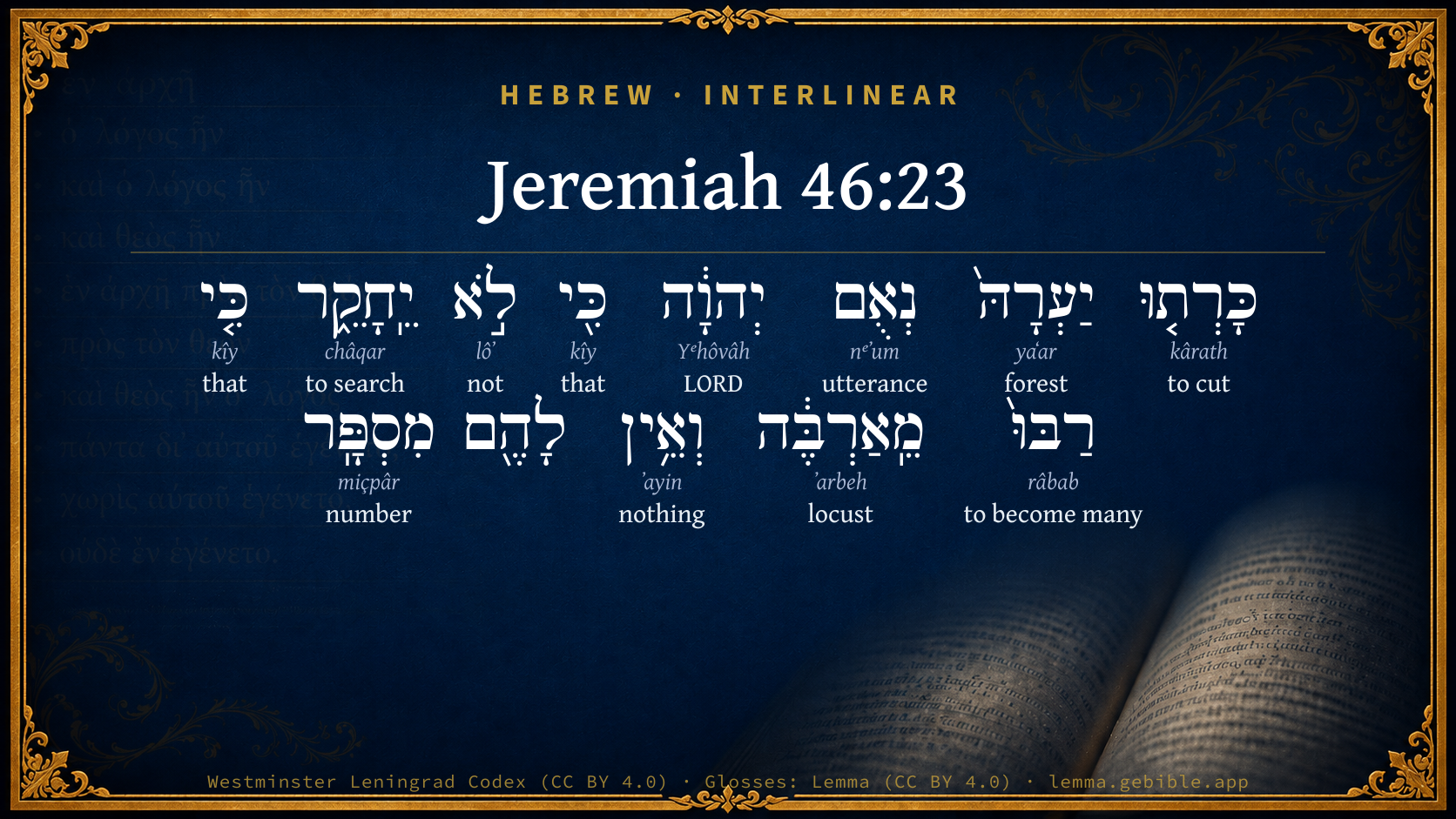
  1. כָּרְת֤וּ kârath H3772 “to cut” Verb, Qal, Perfect, 3rd Person, Common, Plural
  2. יַעְרָהּ֙ yaʻar H3293 “forest · her” Noun, Common, Masculine, Singular, Construct + Suffix, Personal, 3rd Person, Feminine, Singular
  3. נְאֻם nᵉʼum H5002 “utterance of” Noun, Common, Masculine, Singular, Construct
  4. יְהוָ֔ה Yᵉhôvâh H3068 “LORD” Noun, Proper
  5. כִּ֖י kîy H3588 “that” Conjunction
  6. לֹ֣א lôʼ H3808 “not” Particle, Negative
  7. יֵֽחָקֵ֑ר châqar H2713 “to search” Verb, Niphal, Imperfect, 3rd Person, Masculine, Singular
  8. כִּ֤י kîy H3588 “that” Conjunction
  9. מֵֽאַרְבֶּ֔ה ʼarbeh H697 “from · locust” Preposition + Noun, Common, Masculine, Singular, Absolute
  10. וְאֵ֥ין ʼayin H369 “and · nothing” Conjunction + Particle, Negative
  11. מִסְפָּֽר miçpâr H4557 “number” Noun, Common, Masculine, Singular, Absolute

About this verse

These counts appear in no published source. They are computed here, from the morphology-tagged text and Lemma’s own curated glosses. What Lemma adds →

13
words
11
distinct lemmas
Prophets
section

Notable vocabulary

The rarest word here is רַבּוּ֙ to become many H7231 — appearing just 13 times in the whole Hebrew Bible.

Shared distinctive vocabulary

רַבּוּ֙ to become many H7231 occurs in 13 verses of the Hebrew Bible. Also found in:

Grammatical profile

  • 3 verbs
  • 5 nouns
  • 1 preposition
  • 2 conjunctions
  • 2 particles

Verb forms

  • כָּרְת֤וּ Qal · Perfect
  • יֵֽחָקֵ֑ר Niphal · Imperfect
  • רַבּוּ֙ Qal · Perfect

Repetition

A word recurs within this verse — often emphatic in Hebrew:

  • כִּ֖י that H3588 ×2

Cross-references

6

Topical passages linked to Jeremiah 46:23 in the Treasury of Scripture Knowledge — connected by theme and wording, ordered by reader-vote popularity; previews shown in the World English Bible.

  • Judges 7:12 The Midianites and the Amalekites and all the children of the east lay along in the valley like locusts for multitude; and their camels were without number, as the sand which is on the sea-shore for multitude.
  • Judges 6:5 For they came up with their cattle and their tents; they came in as locusts for multitude; both they and their camels were without number: and they came into the land to destroy it.
  • Joel 2:25 I will restore to you the years that the swarming locust has eaten, The great locust, the grasshopper, and the caterpillar, My great army, which I sent among you.
  • Isaiah 10:18 He will consume the glory of his forest, and of his fruitful field, both soul and body: and it shall be as when a standard-bearer faints.
  • Ezekiel 20:46 Son of man, set your face toward the south, and drop [your word] toward the south, and prophesy against the forest of the field in the South;
  • Revelation 9:2–10 He opened the pit of the abyss, and smoke went up out of the pit, like the smoke from a burning furnace. The sun and the air were darkened because of the smoke from the pit.

Cross-references courtesy of OpenBible.info (CC BY 4.0).

Hebrew and Greek witnesses Masoretic Hebrew ↔ Greek Septuagint

The same verse in the two great witnesses to the Old Testament, shown verse-for-verse.

These are two independent witnesses, not word-aligned to each other, and the Septuagint is shown in lemma (dictionary) form.

Hebrew Jeremiah 46:23 Masoretic · Westminster Leningrad Codex

כָּרְת֤וּ יַעְרָהּ֙ נְאֻם יְהוָ֔ה כִּ֖י לֹ֣א יֵֽחָקֵ֑ר כִּ֤י רַבּוּ֙ מֵֽאַרְבֶּ֔ה וְאֵ֥ין לָהֶ֖ם מִסְפָּֽר

They shall cut down her forest, says Yahweh, though it can't be searched; because they are more than the locusts, and are innumerable.

World English Bible · Public Domain

Greek LXX Structure differs

In the Septuagint, Jeremiah is about an eighth shorter than the Hebrew and arranges its material differently — the Oracles Against the Nations (Hebrew chapters 46–51) appear in the middle of the Greek book, after 25:13. Because the chapter and verse boundaries do not line up, a verse-for-verse comparison with the Hebrew is not shown.

A verse-for-verse comparison isn’t shown here because the chapters and verses don’t line up. Switch to the LXX edition with the MT / LXX toggle above to read the Greek directly.

Hebrew: Westminster Leningrad Codex (CC BY 4.0). Greek: Septuagint (public domain); English from a public-domain English Septuagint. How the Septuagint differs from the Hebrew →

Targum (Aramaic paraphrase)

1

The Targum is the ancient Jewish Aramaic paraphrase of the Hebrew Scriptures — an interpretive translation, not the Hebrew text itself. Onkelos (literal) and Pseudo-Jonathan (expansive) render the Torah, and Jonathan the Prophets. Coverage is partial: where no permissively-licensed English translation exists for a verse, only the Aramaic is shown. This is verse-level text, not a word-by-word alignment to the Hebrew.

  1. Targum Jonathan Prophets (Joshua–Malachi)
    שֵׁיצוּ רַבְרְבָהָא אֲמַר יְיָ אֲרֵי לֵית לְהוֹן סוֹף אֲרֵי סָגִיאִין מִזַחֲלָא וְלֵית לְהוֹן מִנְיָן:

    (no public-domain English translation for this verse)

    Targum Jonathan — Aramaic: “Mikraot Gedolot” (public domain). English: “Sefaria Community Translation” (CC0 1.0 (public-domain dedication)); “London "Chaldee Paraphrase," 1871” (public domain). Text via Sefaria.

Commentary

Notes on Jeremiah 46:23 from classic Christian and Jewish commentators (each source and its license shown beneath its notes). The classic Christian expositions comment on the surrounding passage and are grouped to its opening verse, so a note may address several verses; the Jewish commentaries on the Tanakh (Rashi and others) are per-verse, so they appear only where the commentator wrote on this verse.

Lemma curates 59 commentaries, every one of them public domain or Creative Commons licensed, each selected and text-cleaned for this edition rather than reprinted as found. About our sources →

Trapp's Complete Commentary

John Trapp

Jer 46:23 They shall cut down her forest, saith the LORD, though it cannot be searched; because they are more than the grasshoppers, and [are] innumerable.

Ver. 23. They shall cut down her forest,] i.e., Her many cities. Herodotus telleth of one thousand and twenty cities that were in the land of Egypt in the days of King Amasis.

Because they are more than the grasshoppers.] The Babylonian sellers are; and those many hands will make light work. {a}

{a} Lib. ii.; Diodor., lib. i. cap. 31.

John Trapp, A Commentary or Exposition upon All the Books of the Old and New Testament (1647–1656) — public domain. Text from a community e-Sword module.

Geneva Bible (1599)

Geneva Bible translators

That is, they shall slay the great and mighty men of power.

To wit, Nebuchadnezzar’s army.

Geneva Bible (1599) marginal notes — public domain. Text via Bolls.life.

Jamieson, Fausset & Brown

Robert Jamieson, A. R. Fausset & David Brown

her forest-- (Isa 10:34).

though it cannot be searched--They cut down her forest, dense and unsearchable (Job 5:9; Job 9:10; Job 36:26) as it may seem: referring to the thickly set cities of Egypt, which were at that time a thousand and twenty. The Hebrew particle is properly, "for," "because."

because--the reason why the Chaldeans shall be able to cut down so dense a forest of cities as Egypt: they themselves are countless in numbers.

grasshoppers--locusts (Jdg 6:5).

Jamieson, Fausset & Brown — Commentary Critical and Explanatory on the Whole Bible (1871) — public domain (CC PDM 1.0). Text via the HelloAO Bible API.

Adam Clarke's Commentary

Verse 23. They shall cut down her forest] Supposed to mean her cities, of which Egypt had no fewer than one thousand and twenty.

Adam Clarke's Commentary on the Bible (1810–1826) — public domain. Text from a community e-Sword/MySword module.

John Calvin's Commentaries

He goes on here with the same subject. He indeed uses the past tense, but we know that this was commonly done by the Prophets. He compares the people of Egypt to a forest, as he had said that individual men would be like trees: They have then cut down, that is, they shall cut down its forest, saith Jehovah For the sake of confirmation he ascribes the words to God; as though he had said, that he predicted nothing but what God had determined to do. His object then was to remove every doubt; because the Jews might on the one hand have refused to believe this prophecy on considering the power of Egypt; and the Egyptians on the other might have disregarded these threatenings, confiding in their own strength. Hence the Prophet introduces God as the speaker, as though he had said, “This decree cannot be revoked, because God hath spoken.”

And he says, that they had multiplied more than locusts, so there could be no number I have omitted one previous sentence, It shall not be searched. As the particle כי, ki, is read twice, some think that both clauses refer to the Chal-deans. Others read, “It shall not be numbered;” but the verb חקר, chekor, properly means to inquire, to investigate; and the sentence may be thus suitably rendered, “That the forest may not be investigated.” Yet another meaning has been more approved, that the Chaldeans shall not be numbered. If this view be received, there is a Change of number, for it immediately follows, “They shall multiply,” רבו, rebu; and then, there shall not be a number to them, להם, laem. But what I stated in the first place, as it appears to me, does not ill suit the passage, that is, that there would be no investigation of the forest of Egypt, that is, of the people; for when a forest is cut down, it appears a naked plain, nor can the place of any tree be pointed out. As to the general meaning, there is not much difference. The Prophet, in short, means, that the slaughter, of which he prophecies, would be so great, that Egypt would be reduced to a waste, because the Chaldeans would come with a numerous army: and he sets up this number in opposition to the Egyptian forces, that they might know that their enemies would be far superior to them. It follows —

John Calvin's Commentaries (1540-1563) — public domain. Text from the Calvin Translation Society English edition (1840s-50s) via the Christian Classics Ethereal Library (ccel.org). Calvin's coverage is partial (roughly two-thirds of the Bible); uncommented books and verses are honest gaps, never fabricated. The 19th-century editor's footnotes and remarks are omitted so the notes are faithfully Calvin's own voice.

The Cambridge Bible for Schools and Colleges

gen. ed. J. J. S. Perowne

23. though] better, as mg. for.

they are more] i.e. the enemy.

the locusts] See on Joe_1:4, C.B. (Driver).

The Cambridge Bible for Schools and Colleges (gen. ed. J. J. S. Perowne; Cambridge University Press, 1878–1918) — public domain. Text from a community e-Sword module.

John Gill's Exposition

They shall cut down her forest, saith the Lord,.... The land of Egypt, compared to a forest, for the multitude of its cities and towns, and the inhabitants of them; which should be destroyed by the Chaldeans, as a forest is cut down by hewers of wood; the metaphor is here continued. The Targum interprets this of the princes of Egypt, and the destruction of them;

though it cannot be searched; either the forest of Egypt, which was so thick of trees; that is, the land was so full of towns and cities, that they could not be searched and numbered; and though the way through it seemed impassable, yet was made passable by the hewers of wood: or its destruction would be so general, "that it cannot be searched" (o); or found out, where this forest was, where those trees grew, not one of them standing: or else this is to be understood of the Chaldean army, which was so great, that it could not be numbered:

because they are more than the grasshoppers, and are innumerable; which creatures come in large numbers, and eat up every green tree and herb; and so the Chaldean army, being alike numerous, would easily cut down the trees of this forest, though they were so many.

(o) "ut non investigetur", Calvin.

John Gill's Exposition of the Whole Bible (1746–1763) — public domain (CC PDM 1.0). Text via the HelloAO Bible API.

Albert Barnes' Notes on the Bible

Or, “They have cut down her forest, saith Yahweh, for it is impenetrable,” i. e., just as a pathless forest must be cleared to assist agriculture and the passage to and fro of men, so must the false worship and the material prosperity of Egypt be overthrown.

Grasshoppers - The invading host advances as multitudinous as the locusts which consume the whole vegetation of the land on which they alight.

Albert Barnes' Notes on the Bible (1834–1885) — public domain. Text from a community e-Sword/MySword module.

Haydock's Catholic Bible Commentary

Above, or "more than locusts," (Haydock) which destroy all herbs where they light.

George Leo Haydock (1774–1849), Haydock's Catholic Family Bible and Commentary, 1859 edition — public domain. Excludes Psalms (Douay-Rheims chapter numbering differs from Protestant) and Deuterocanonical books (Catholic canon only).

Matthew Poole's English Annotations

Egypt is compared to a forest, either for the multitude of cities or of people in that country; and to a thick forest, because as it is a hard thing to make one’s way through a forest, so it was judged as hard for an enemy to make his way into that country: in human probability Egypt could not be searched, yet (saith God) the Chaldeans shall cut down this forest, and it shall be no more to them than for hewers of wood, with tools fitted for the purpose, to make their way through a forest. For the army of the Chaldeans shall be as numerous as the inhabitants of Egypt, more than the grasshoppers, which come in such troops as in a short time they devour every green herb in a place.

Matthew Poole's English Annotations on the Holy Bible (1683–1685) — public domain. Text from a community e-Sword/MySword module.

Whedon's Commentary on the Bible

Daniel D. Whedon

23. Cut down her forest — These Chaldean wood choppers will do this, though it be most dense, (referring to this land thickly set with cities and filled with the products of material prosperity,) for they, like the grasshoppers, are innumerable.

Daniel D. Whedon (gen. ed.), Commentary on the Old and New Testaments (1874–1909) — public domain. Text from a community e-Sword module.

The Pulpit Commentary

They shall cut down; better, they cut down. The prophet is describing a picture which passes before his inner eye. Though it cannot be searched; rather, for it cannot be searched out. The subject of the verb is uncertain. De Dieu"s explanation is, "Because the forest is so dense, so intricate, it is necessary to clear a path by cutting down the trees." But this does not seem to suit the context. Surely no other reason was required for the destruction of the "forest" than the will of the wood cutters. "Searching out" occurs in Job (Job_5:9 Job_9:10 Job_36:26; comp. also 1Ki_7:47) in connection with numbering, and the second half of the verse expressly describes the foe as innumerable. The singular alternates with the plural, as Isa_5:28, a host being regarded sometimes as a whole, and sometimes as an aggregate of individuals. Than the grasshoppers; rather, the locust. The name is one of nine which we find given to the various species of locusts in the Old Testament, and means "multitudinous."

The Pulpit Commentary (1880–1919), ed. H.D.M. Spence-Jones & Joseph S. Exell — public domain. Text from a community e-Sword module.

John Wesley's Explanatory Notes

Tho' - Tho' it seem impenetrable.

John Wesley, Explanatory Notes Upon the Whole Bible (1754–1765) — public domain. Text via the GEBible commentary corpus.

unfoldingWord translationNotes

Door43 World Missions Community

They will cut down the forests ... although it is very dense

This continues speaking of the enemy army attacking the Egyptians as if the army were woodcutters cutting down trees. AT: "The enemy army will kill many Egyptians like woodcutters cutting down a forest ... even though there are very many trees" (See: Metaphor)

this is Yahweh's declaration

Yahweh speaks of himself by name to express the certainty of what he is declaring. See how you translated this in Jeremiah 1:8. AT: "this is what Yahweh has declared" or "this is what I, Yahweh, have declared" (See: First, Second, or Third Person)

locusts

This is a type of insect that travels in very large groups and can cause great destruction by eating crops.

unable to be counted

This can be stated in active form. AT: "no one will be able to count them" (See: Active or Passive)

The daughter of Egypt will be made ashamed

The people of Egypt are spoken of as if they were the daughter of Egypt. This can be stated in active form. AT: "The enemy army will humiliate the people of Egypt" (See: Metaphor and Active or Passive)

She will be given into the hand of people from the north

Here "hand" represents power or control. This can be stated in active form. AT: "I, Yahweh, will allow the people from the north to defeat the Egyptians" (See: Metonymy and Active or Passive)

translationWords

Yahweh

declare

Egypt

shame

hand

people group

unfoldingWord translationNotes — © Distant Shores Media and the Door43 World Missions Community, licensed CC BY-SA 4.0. Source: git.door43.org/Door43/en_tn.

Rashi

Rabbi Shlomo Yitzchaki (Rashi)

They will cut down her forest They have power to cut down her forest.

for they are innumerable [lit. it shall not be fathomed, i.e.,] the number of their host.

Rashi on the Tanakh — English translations: “The Judaica Press complete Tanach with Rashi, translated by A. J. Rosenberg” (CC BY 4.0); “Pentateuch with Rashi's commentary by M. Rosenbaum and A.M. Silbermann, 1929-1934” (public domain); “The Metsudah Tanach series, Lakewood, N.J” (CC BY 4.0); and “The Book of Joshua, Metsudah Publications, 1997” (CC BY 4.0). Text via Sefaria.

Lesson kit

Teaching starters — assembled from the data on this page, not authored interpretation. Every prompt links to the verse data it draws on. Edit before teaching.

Jeremiah, in the Prophets, opens this verse with 13 words (11 distinct Hebrew lemmas). Its most distinctive word is râbab (“to become many”). A historical commentator’s framing appears above. Read the whole chapter for the surrounding context.

Discussion questions

  1. How does “to become many” (râbab) shape what this verse is saying?
  2. Genesis 6:1 shares the word «to become many» with this verse. How do the two illuminate each other?
  3. “that” occurs 2× in this one verse. What is the effect of the repetition?
  4. These translations render this verse differently; the difference is in the English rendering, not the original. What questions does that raise?
  5. The verb «כָּרְת֤וּ» is Qal Perfect. How does its form color the action?
  6. Reading how Trapp's Complete Commentary and Geneva Bible (1599) read this verse, where do the two commentators agree and where do they part?

Things to notice

Reading settings

Reading text

Shown beneath each verse's original-language words.

Old Testament
Old Testament edition

Read the OT as the Masoretic Hebrew (MT) or the Greek Septuagint (LXX).

English shown for the Greek Septuagint (in the Hebrew ↔ Greek comparison).

Comparing translations? Open the Compare panel on any verse page to stack up to four side by side.