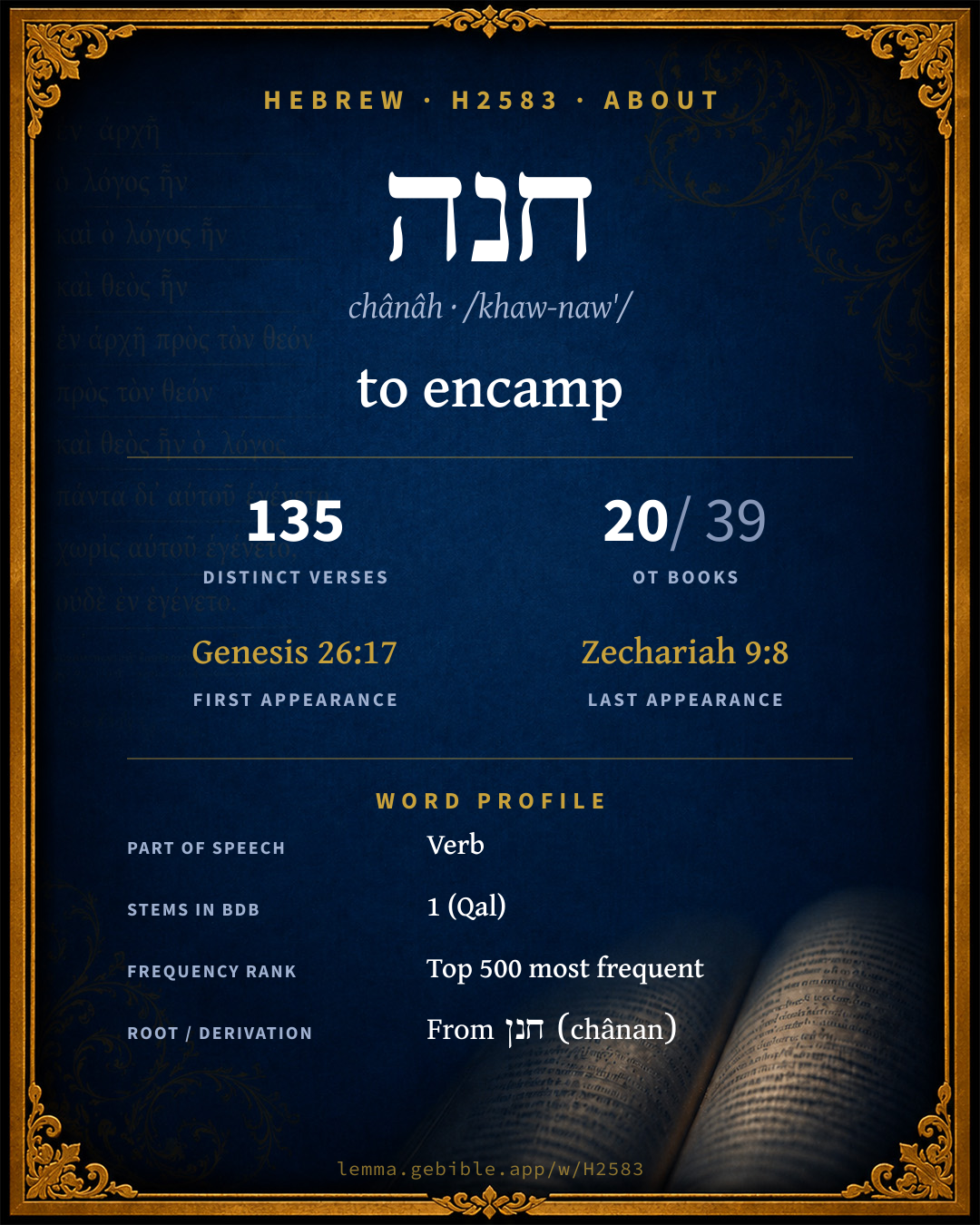
חָנָה
to encamp
‘to encamp’ is one of 3 main senses fuller range ↓
Full lexicon entry — Brown-Driver-Briggs (BDB)
From Brown-Driver-Briggs (BDB)
Where this word appears
Grammar key — what these labels mean
Part of speech
- Verb
- An action or state-of-being word.
Stem
- Qal
- The basic, simple active stem — the plain form of the verb (“he wrote”). Here: ‘decline’
Form
- Sequential Imperfect
- An imperfect with prefixed waw — the standard past-narrative form (waw-consecutive imperfect).
- Imperfect
- An incomplete, ongoing, or future action (“he will / would write”).
- Participle Active
- A verbal adjective expressing ongoing or characteristic action (“writing / one who writes”).
- Perfect
- A completed action or state — Hebrew marks aspect (completeness) more than strict tense (“he wrote”).
- Imperative
- A direct command (“write!”).
- Infinitive Construct
- A bound verbal noun, frequently with prepositions (“to write / in writing”).
- Jussive
- A third- or second-person volitional form expressing wish or command (“let him write”).
- Sequential Perfect
- A perfect with prefixed waw continuing a preceding imperfect or command (waw-consecutive perfect).
State
- Absolute
- The independent form of a noun, not bound to a following word.
- Construct
- A noun bound to a following noun in a possessive / “of” relationship (the construct chain).
Person
- 3rd Person
- The one spoken about (“he / she / it / they”).
- 2nd Person
- The one addressed (“you”).
- 1st Person
- The speaker (“I / we”).
Gender
- Masculine
- Grammatically masculine.
- Common
- Either gender — not distinguished for this form.
- Feminine
- Grammatically feminine.
Number
- Plural
- More than one (in Hebrew, generally three or more).
- Singular
- One.
Every verse where H2583 appears in the Book of 1 Kings — 4 distinct verses. Click any verse to open its interlinear word-by-word view. Verse text shown in the World English Bible for context — . Each verse’s Hebrew form is shown with its reference; the English is not keyword-highlighted, since the data carries no word-level English alignment. Use “Compare translations” on any verse to read it across multiple English versions. This concordance covers the Hebrew Bible; Septuagint (Greek Old Testament) occurrences are not indexed here.
1 Kings
- 1 Kings 16:15 חֹנִ֔ים Qal ptcp.act mp In the twenty-seventh year of Asa king of Judah did Zimri reign seven days in Tirzah. Now the people were encamped against Gibbethon, which belonged to the Philistines.
- 1 Kings 16:16 הַ/חֹנִ֣ים ptcl def.art + Qal ptcp.act mp The people who were encamped heard say, Zimri has conspired, and has also struck the king: therefore all Israel made Omri, the captain of the host, king over Israel that day in the camp.
- 1 Kings 20:27 וַ/יַּחֲנ֨וּ conj + Qal wimpf 3mp The children of Israel were mustered, and were provisioned, and went against them: and the children of Israel encamped before them like two little flocks of kids; but the Syrians filled the country.
- 1 Kings 20:29 וַֽ/יַּחֲנ֧וּ conj + Qal wimpf 3mp They encamped one over against the other seven days. So it was, that in the seventh day the battle was joined; and the children of Israel killed of the Syrians one hundred thousand footmen in one day.
About this entry
At a glance — auto-summarized from this page’s data, not written by a person. Every figure links to its source below. This summary describes the numbers; it doesn’t interpret them.
The Hebrew verb חנה centers on the idea of “to encamp.” Numbers dominates its distribution — 72 of 135 verses. The Hebrew Bible uses it across 135 verses — common. The lexicon spreads it across several senses; see its full sense range. Its English rendering has broadened — “pitched” classically, “camped” (Berean Standard Bible) in modern versions; see the renderings breakdown. Dig into 135-verse concordance and the renderings breakdown below.
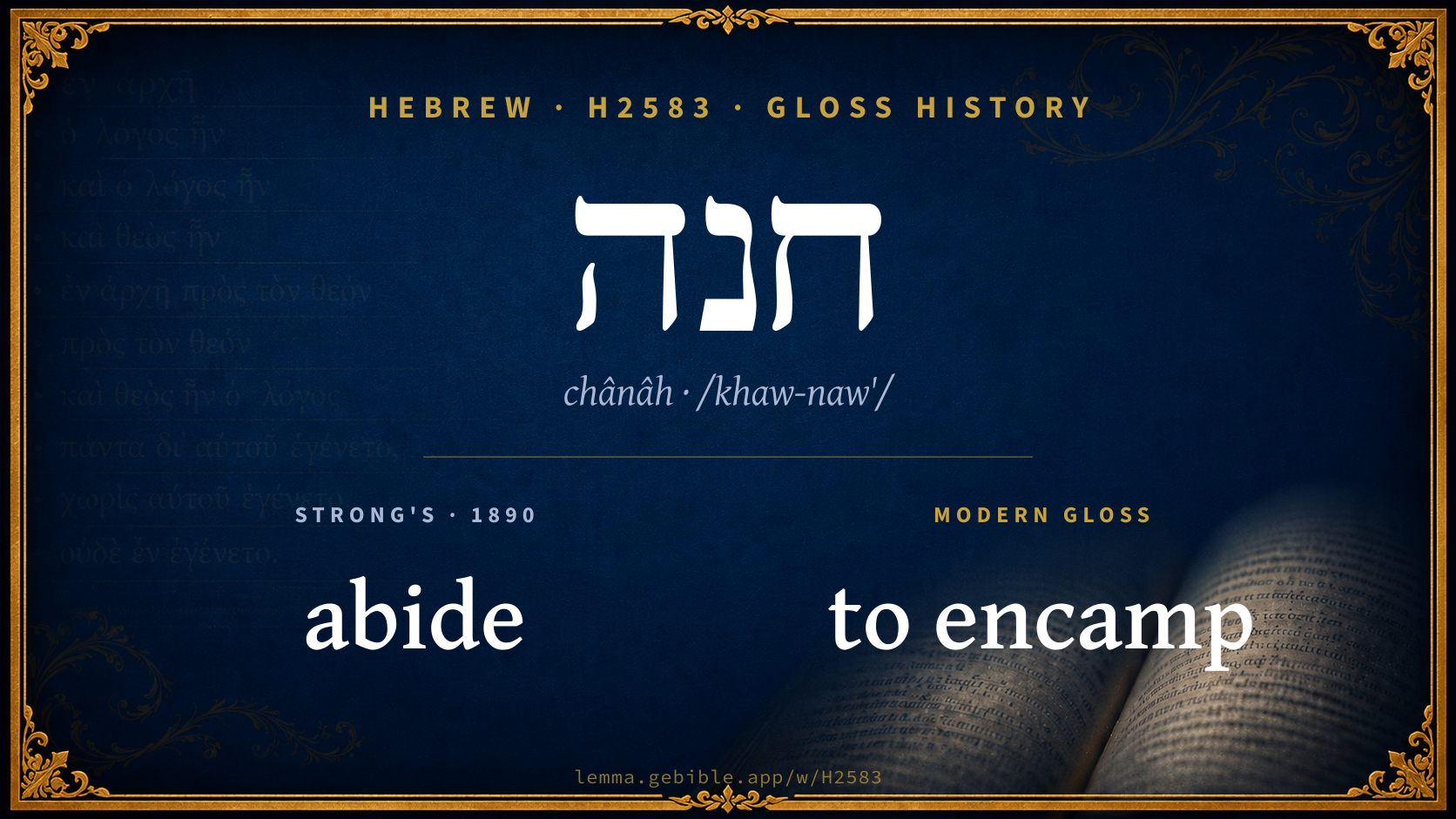
Gloss history
Strong's 1890 vs modern scholarship
About this word
Strong's H2583 catalogs a Hebrew word from the Hebrew Old Testament.
These counts are not copied from any lexicon or concordance. They are computed here, from the morphology-tagged Hebrew Old Testament. What Lemma adds →
- 135
- distinct verses
- The word appears in 135 distinct verses.
- 20 / 39
- OT books
- The word appears in 20 of 39 Old Testament books.
- #314
- by frequency
- Top 500 most frequent Hebrew words (rank 314 of 8,640 Hebrew words by occurrence).
View all 135 occurrences in the concordance →
By section of the Old Testament
By traditional corpus
Conventional, traditional groupings — biblical authorship is debated, so this is a traditional corpus grouping, not an authorship claim. Each share is this word’s portion of its verses in that division of the Hebrew canon. Each figure is a share of the word’s 135 distinct verses.
- Torah (Pentateuch) 82 verses · 61%
- Prophets (Nevi'im) 44 verses · 33%
- Writings (Ketuvim) 9 verses · 7%
How translations render this word
Counts come from each version’s own published word-to-Strong’s tagging or interlinear alignment — an approximate guide to how each version renders this word, not a word-level alignment the data otherwise carries. Because each total is that version’s own tagged count, the per-version totals vary from one another and need not match the appearance or distinct-verse counts above. These counts may also differ from a printed concordance because Lemma counts each distinctly tagged rendering and does not collapse phrase taggings into a single head-word total. This is a fixed set of word-tagged versions (KJV, ASV, BSB, ULT) and does not change with the reading translation you choose elsewhere. Each version’s license is shown beside its name below (and on Sources).
- King James Version: Pitched 57×, Encamped 26×, They pitched 7×
- American Standard Version: Encamped 81×, They encamped 11×, Encamp 9×
- Berean Standard Bible: Camped 74×, They camped 11×, Are to camp 4×
- unfoldingWord Literal Text: Camped 56×, They camped 20×, They encamped 9×
King James Version Public Domain
Renders H2583 across 143 tagged occurrences — most commonly:
Plus other, less common renderings. Plus 27 renderings that appear only once — usually multi-word phrases or single function words the recovered tagging swept in, not distinct renderings.
American Standard Version Public Domain
Renders H2583 across 143 tagged occurrences — most commonly:
Plus 27 renderings that appear only once — usually multi-word phrases or single function words the recovered tagging swept in, not distinct renderings.
Berean Standard Bible Public Domain
Renders H2583 across 141 tagged occurrences — most commonly:
Plus other, less common renderings. Plus 25 renderings that appear only once — usually multi-word phrases or single function words the recovered tagging swept in, not distinct renderings. Not rendered by a distinct English word in 2 further occurrences.
unfoldingWord Literal Text CC BY-SA 4.0
Renders H2583 across 149 tagged occurrences — most commonly:
Plus other, less common renderings. Plus 21 renderings that appear only once — usually multi-word phrases or single function words the recovered tagging swept in, not distinct renderings.
Senses in the full BDB
What do BDB’s symbols mean?
BDB uses these scholarly abbreviations:
| Symbol | Meaning |
|---|---|
| 𝔊 | the Septuagint (the ancient Greek translation, LXX) |
| 𝔙 | the Vulgate (the Latin translation) |
| 𝔖 | the Syriac version (the Peshitta) |
| 𝔗 | the Targum (the Aramaic translation) |
| ψ | the Psalms |
| √ | root (the underlying root or stem) |
| ‖ | parallel passage (a synonymous or contrasted parallel) |
| † | the dagger: every passage where the word occurs is cited |
The 6 senses and sub-senses the full Brown-Driver-Briggs lexicon distinguishes for this word, in lexicon order (not ranked by frequency), with BDB’s own verbatim wording and sub-sense lettering. Shown in Hebrew script with BDB’s own scholarly abbreviations. The condensed entry is in the Lexicon Entry tab. See also the Forms in the corpus table below.
Qal
- Pf. חָנָה 1 S 26:5 Is 29:1; וְחָנִ֫יתִי consec. Is 29:3 Zc 9:8; חָנוּ Nu 2:34 + 2 times; וְחָנוּ consec. Nu 1:52; Impf. וַיִּחַן Gn 26:17 + 9 times; 3 fs. תַּחֲנֶה ψ 27:3; יַחֲנוּ Nu 1:50 + 13 times Nu + Ex 14:2: וַיַּחֲנוּ Ex 13:20 + 79 times (of which 42 in Nu 33); וַיַּחֲנוּן Ju 11:18; 2 mpl. תַּחֲנוּ Ex 14:2; 1 pl. וַנַּחֲנֶה Ezr 8:15; Imv. חֲנֵה 2 S 12:28; חֲנוּ Nu 31:19; Je 50:29; Inf. חֲנוֹת Ju 19:9; חֲנֹת Nu 1:51; sf. חֲנֹתֵנוּ Nu 10:31; חֲנֹתְכֶם Dt 1:33; Pt. חֹנֶה Ex 18:5 ψ 34:8; f. חֹנָה 2 S 23:13; 1 Ch 11:15; הֹנָ֑ךְ ψ 53:6; pl. חֹנִים Ex 14:9 + 11 times; חוֹנִים Nu 2:2; Na 3:17;— e.g. 1 Samuel 26:5
- 1. decline, of day drawing to its close חֲנוֹת הַיּוֹם Ju 19:9 (‖ רָפָה הַיּ׳ לַעֲרוֹב; also נְטוֹת הַיּ׳ v 8; הַיּוֹם רַד מְאֹד v 11). e.g. Judges 19:9
- 2. encamp (proposes verge toward, incline to, settle at, of goal of day’s march):—
- a. of single nomad Gn 26:17 (J; sq. ב), 33:18 (E; sq. אֶת־פני). e.g. Genesis 26:17
- b. of Israel at Exod. and in wilderness Ex 13:20 (ב) 14:2 (לִפְנֵי), v 2 (עַל), + c. 80 times (Hex chiefly P); also (abs.) Nu 9:18, 20, 22, 23 cf. Ezr 8:15; Ne 11:30 so they encamped (i.e. settled, or were settled) from Beersheba to the valley of Hinnom (‖ ישׁבו v 25). e.g. Exodus 13:20
- c. of armies: (1) Israel (conquering Cannan, etc.) Jos 4:19; 5:10 + often; (2) Philistines 1 S 4:1; 13:16; 2 S 23:23 +; usually sq. ב loc. Nu 10:31; 1 S 4:1; 13:16 Jos 4:19; 1 S 13:5 + 63 times (וַיַּחֲנוּ בְ 2 S 24:5 read וַיָּחֵלּוּ מִן 𝔊L We Dr v. חלל); so of locusts in hedges (in sim.) Na 3:17; also sq. עַל = by, near Ex 14:2, 9; 15:27; Nu 1:52; 2:2, 5, 12, 27; 3:29; 35 (על ירך), 33:10; Ju 7:1; 1 S 4:1; על־פני השׂדה (על in diff. sense) 2 S 11:11; sq. עַל also = against, encamp with hostile purpose Jos 10:5, 31, 34 Ju 6:4; 20:19 1 S 11:1; 2 S 12:28; 1 K 16:15; 2 K 25:1; 2 Ch 32:1; Je 50:29; 52:4 ψ 27:3; sq. אֶל־ in same sense Jos 11:5; metaph. of God’s hostility to apostate Jerusalem (על) Is 29:3; sq. also לְ = at, by Nu 2:34; Zc 9:8; אשׁר … שָׁם Ex 18:5; 1 S 26:5; sq. סביב לְ for protection Nu 1:50, 53, cf. metaph. ψ 34:8, but also hostility Jb 19:12; also sq. other prep. and prep. phrases, e.g. מֵעֵבֶר Nu 21:13; מחוץ Nu 31:19; בין 1 S 17:1; נגד 1 K 20:27 etc.; sq. acc. loc. 2 S 17:26; sq. sf. acc. with hostile sense הֹנָ֑ךְ ψ 53:6; without prep. or noun foll., in sense of encamp, be or abide in encampment Nu 9:18, 20, 22, 23; Ezr 8:15; 2 S 11:11 +; poet. of David in Jerusalem, Is 29:1 city in which David fixed his camp. e.g. Joshua 4:19
Senses from the full Brown-Driver-Briggs lexicon (Brown, Driver, Briggs; Oxford 1906 — public domain), digitized via Sefaria, supplemented by the OpenScriptures HebrewLexicon (CC BY 4.0). Full attribution on Sources.
Word origin
vb. decline, bend down, encamp (Aramaic ܚܢܳܐ to aim at, incline towards, reach; Zinj. מחנת cstr. camp, Inscr. Panammu13, 16, 17; Arabic حَنَا bend, curve, bend down; Assyrian mûnu, mênu and tênû couch, mânîtu, house, ZimBP 44, 45 Dl in Zim117)—
— Brown-Driver-Briggs (Oxford 1906, public domain), digitized via Sefaria, supplemented by the OpenScriptures HebrewLexicon (CC BY 4.0). See Sources.
Derived from חנן (chânan) (H2603) — to be gracious.
Jastrow Dictionary
A second Hebrew/Aramaic lexicon for comparison, covering Aramaic and post-biblical (Talmudic, Targumic, Midrashic) usage that the biblical-Hebrew BDB does not. Matched by lemma rather than by Strong’s number, so a lemma may carry more than one Jastrow headword (shown separately below), and the entries cover usage well beyond the Bible.
חָנָה
- , v. חני
חני
- [to be covered, surrounded,] to encamp, rest. Num. R. s. 11 (ref. to ויחנך, Num. VI, 25) יַחֲנֶה ד׳ אצלך the Lord have His tent with thee. Lam. R. introd. (R. Naḥm.) (ref. to Is. XXIX, 1) שח׳ בה וכ׳ where David (lawfully) resided, v. חַנְיָיא. Ib. (R. Alex. 1) נוסעים … וחוֹנִים וכ׳ they moved in discord and encamped in discord; Mekh. Yithro, Baḥod., s. 1; Lev. R. s. 9; a. fr.—Apocop. form: חָן (as if from חון). Midr. Till. to Ps. LXXVIII, 47 (play on ב̇ח̇נ̇מ̇ל ib.) ב̇א ח̇ן̇ מ̇ל̇ he (the locust) came, encamped, cut; (Tanḥ. Vaëra 14 בא נ"ח מ"ל; Ex. R. s. 12 interpol. from Midr. Till. l. c.: נח). e.g. Numbers 6:25
- to cause to rest. Fut. apocop. יַחַן. Y. Taan. III, 66ᶜ (play on י̇ח̇נ̇יף̇, Num. XXXV, 33) הדם י̇ח̇ן אף̇ וכ׳ bloodshed causes the anger (of the Lord) to rest upon the ground (rain being withheld); Sifré Num. 161, Yalk. ib. 788 יחון (corr. acc.). e.g. Numbers 35:33
A Dictionary of the Targumim, the Talmud Babli and Yerushalmi, and the Midrashic Literature (Marcus Jastrow; London, Luzac, 1903) — Public Domain. Digitized via Sefaria. Digitized via Sefaria. Full attribution on Sources.
Forms in the corpus
The 60 distinct written forms H2583 takes in the Hebrew Bible, most frequent first — each parse links to that stem’s occurrences in the concordance. Hebrew forms include their vowel points and cantillation, so a single lemma takes many written forms.
| Form | Parsing | Example | Uses |
|---|---|---|---|
| וַֽ/יַּחֲנ֖וּ | Verb, Qal, Sequential Imperfect, 3rd Person, Masculine, Plural | Exodus 19:2 | 47 |
| וַֽ/יַּחֲנוּ֙ | Verb, Qal, Sequential Imperfect, 3rd Person, Masculine, Plural | Exodus 17:1 | 9 |
| וַ/יַּחֲנ֣וּ | Verb, Qal, Sequential Imperfect, 3rd Person, Masculine, Plural | Exodus 13:20 | 7 |
| וַֽ/יַּחֲנ֛וּ | Verb, Qal, Sequential Imperfect, 3rd Person, Masculine, Plural | 1 Samuel 17:1 | 4 |
| יַחֲנ֖וּ | Verb, Qal, Imperfect, 3rd Person, Masculine, Plural | Numbers 2:2 | 4 |
| וַ/יַּחֲנ֥וּ | Verb, Qal, Sequential Imperfect, 3rd Person, Masculine, Plural | Joshua 5:10 | 3 |
| חֹנִ֔ים | Verb, Qal, Participle Active, Masculine, Plural, Absolute | 1 Kings 16:15 | 3 |
| יַחֲנֽוּ | Verb, Qal, Imperfect, 3rd Person, Masculine, Plural | Numbers 1:50 | 3 |
| הַ/חֹנִ֖ים | Verb, Qal, Participle Active, Masculine, Plural, Absolute | Numbers 10:5 | 2 |
| וְ/הַ/חֹנִ֥ים | Verb, Qal, Participle Active, Masculine, Plural, Absolute | Numbers 2:5 | 2 |
| וַ/יִּ֖חַן | Verb, Qal, Sequential Imperfect, 3rd Person, Masculine, Singular | Genesis 33:18 | 2 |
| וַ/יִּ֣חַן | Verb, Qal, Sequential Imperfect, 3rd Person, Masculine, Singular | 2 Kings 25:1 | 2 |
| וַ/יִּ֥חַן | Verb, Qal, Sequential Imperfect, 3rd Person, Masculine, Singular | Genesis 26:17 | 2 |
| וַ/יַּחֲנ֤וּ | Verb, Qal, Sequential Imperfect, 3rd Person, Masculine, Plural | Joshua 11:5 | 2 |
| וַ/יַּחֲנוּ | Verb, Qal, Sequential Imperfect, 3rd Person, Masculine, Plural | Exodus 15:27 | 2 |
| חָנ֥וּ | Verb, Qal, Perfect, 3rd Person, Common, Plural | 1 Samuel 4:1 | 2 |
| חֹנָ֖ה | Verb, Qal, Participle Active, Feminine, Singular, Absolute | 1 Chronicles 11:15 | 2 |
| יַחֲנ֑וּ | Verb, Qal, Imperfect, 3rd Person, Masculine, Plural | Numbers 3:29 | 2 |
| יַחֲנ֔וּ | Verb, Qal, Imperfect, 3rd Person, Masculine, Plural | Numbers 9:20 | 2 |
| הַ/חֹנִ֣ים | Verb, Qal, Participle Active, Masculine, Plural, Absolute | 1 Kings 16:16 | 1 |
| הַֽ/חוֹנִ֤ים | Verb, Qal, Participle Active, Masculine, Plural, Absolute | Nahum 3:17 | 1 |
| וְ/הַ/חֹנִ֣ים | Verb, Qal, Participle Active, Masculine, Plural, Absolute | Numbers 3:38 | 1 |
| וְ/הַ/חֹנִים֙ | Verb, Qal, Participle Active, Masculine, Plural, Absolute | Numbers 2:3 | 1 |
| וְ/הַ/חוֹנִ֥ם | Verb, Qal, Participle Active, Masculine, Plural, Absolute | Numbers 2:12 | 1 |
| וְ/חָנ֖וּ | Verb, Qal, Sequential Perfect, 3rd Person, Common, Plural | Numbers 1:52 | 1 |
| וְ/חָנִ֥יתִי | Verb, Qal, Sequential Perfect, 1st Person, Common, Singular | Isaiah 29:3 | 1 |
| וְ/חָנִ֨יתִי | Verb, Qal, Perfect, 1st Person, Common, Singular | Zechariah 9:8 | 1 |
| וְ/יַחֲנוּ֙ | Verb, Qal, Jussive, 3rd Person, Masculine, Plural | Exodus 14:2 | 1 |
| וַ/חֲנֵ֥ה | Verb, Qal, Imperative, 2nd Person, Masculine, Singular | 2 Samuel 12:28 | 1 |
| וַ/יִּ֤חַן | Verb, Qal, Sequential Imperfect, 3rd Person, Masculine, Singular | 2 Samuel 17:26 | 1 |
| וַ/יִּ֨חַן | Verb, Qal, Sequential Imperfect, 3rd Person, Masculine, Singular | 1 Samuel 26:3 | 1 |
| וַ/יִּ֨חַן֙ | Verb, Qal, Sequential Imperfect, 3rd Person, Masculine, Singular | 2 Chronicles 32:1 | 1 |
| וַ/יִּֽחַן | Verb, Qal, Sequential Imperfect, 3rd Person, Masculine, Singular | Exodus 19:2 | 1 |
| וַ/יַּחֲנ֖וּ | Verb, Qal, Sequential Imperfect, 3rd Person, Masculine, Plural | Job 19:12 | 1 |
| וַ/יַּחֲנ֨וּ | Verb, Qal, Sequential Imperfect, 3rd Person, Masculine, Plural | 1 Kings 20:27 | 1 |
| וַ/יַּֽחֲנ֖וּ | Verb, Qal, Sequential Imperfect, 3rd Person, Masculine, Plural | Judges 20:19 | 1 |
| וַ/נַּחֲנֶ֥ה | Verb, Qal, Sequential Imperfect, 1st Person, Common, Plural | Ezra 8:15 | 1 |
| וַֽ/יַּחֲנ֖וּ/ן | Verb, Qal, Sequential Imperfect, 3rd Person, Masculine, Plural | Judges 11:18 | 1 |
| וַֽ/יַּחֲנ֗וּ | Verb, Qal, Sequential Imperfect, 3rd Person, Masculine, Plural | Numbers 21:13 | 1 |
| וַֽ/יַּחֲנ֞וּ | Verb, Qal, Sequential Imperfect, 3rd Person, Masculine, Plural | Numbers 21:11 | 1 |
| וַֽ/יַּחֲנ֧וּ | Verb, Qal, Sequential Imperfect, 3rd Person, Masculine, Plural | 1 Kings 20:29 | 1 |
| וּ/בַ/חֲנֹת֙ | Verb, Qal, Infinitive Construct | Numbers 1:51 | 1 |
| חֲנ֛וּ | Verb, Qal, Imperative, 2nd Person, Masculine, Plural | Numbers 31:19 | 1 |
| חֲנ֤וֹת | Verb, Qal, Infinitive Construct | Judges 19:9 | 1 |
| חֲנ֧וּ | Verb, Qal, Imperative, 2nd Person, Masculine, Plural | Jeremiah 50:29 | 1 |
| חֲנֹתֵ֨/נוּ֙ | Verb, Qal, Infinitive Construct | Numbers 10:31 | 1 |
| חָנ֤וּ | Verb, Qal, Perfect, 3rd Person, Common, Plural | Numbers 2:34 | 1 |
| חָנָ֣ה | Verb, Qal, Perfect, 3rd Person, Masculine, Singular | Isaiah 29:1 | 1 |
| חָנָה | Verb, Qal, Perfect, 3rd Person, Masculine, Singular | 1 Samuel 26:5 | 1 |
| חֹנִ֣ים | Verb, Qal, Participle Active, Masculine, Plural, Absolute | Exodus 14:9 | 1 |
| חֹנִ֥ים | Verb, Qal, Participle Active, Masculine, Plural, Absolute | 1 Samuel 26:5 | 1 |
| חֹנֶ֤ה | Verb, Qal, Participle Active, Masculine, Singular, Absolute | Psalms 34:7 | 1 |
| חֹנֶ֥ה | Verb, Qal, Participle Active, Masculine, Singular, Absolute | Exodus 18:5 | 1 |
| חֹנָ֑/ךְ | Verb, Qal, Participle Active, Masculine, Singular, Construct | Psalms 53:5 | 1 |
| יַחֲנ֤וּ | Verb, Qal, Imperfect, 3rd Person, Masculine, Plural | Numbers 1:53 | 1 |
| יַחֲנ֥וּ | Verb, Qal, Imperfect, 3rd Person, Masculine, Plural | Numbers 9:22 | 1 |
| יַחֲנוּ֙ | Verb, Qal, Imperfect, 3rd Person, Masculine, Plural | Numbers 2:17 | 1 |
| לַֽ/חֲנֹֽתְ/כֶ֑ם | Verb, Qal, Infinitive Construct | Deuteronomy 1:33 | 1 |
| תַחֲנ֖וּ | Verb, Qal, Imperfect, 2nd Person, Masculine, Plural | Exodus 14:2 | 1 |
| תַּחֲנֶ֬ה | Verb, Qal, Imperfect, 3rd Person, Feminine, Singular | Psalms 27:3 | 1 |
Same root — word family
Other BDB entries built from the same root as H2583, grouped by Strong’s listed origin. These share a root / origin per the lexicon — not necessarily a shared meaning. Each links to that word’s own entry.
Derives from
Shares the same root
- חן chên H2580 grace
- חנון channûwn H2587 gracious
- חנות channôwth H2589 to be gracious
- חנינה chănîynâh H2594 compassion
- חנן chănan H2604 to show favour
- תחנה tᵉchinnâh H8467 supplication
- תחנון tachănûwn H8469 supplication
Derived from this word
- חנות chânûwth H2588 cell
- חנית chănîyth H2595 spear
- חנן chânan H2603 to be gracious
- מחנה machăneh H4264 camp
- תחנה tachănâh H8466 encampment
Proper names from this root
People and places named from this root — a name, not an additional meaning of the word.
- חנה Channâh H2584 Hannah
- חנון Chânûwn H2586 Hanun
- חניאל Channîyʼêl H2592 Hanniel
- חנן Chânân H2605 Hanan
- חננאל Chănanʼêl H2606 Hananeel
- חנני Chănânîy H2607 Hanani
- חנניה Chănanyâh H2608 Hananiah
- חנתן Channâthôn H2615 Hannathon
- תחן Tachan H8465 Tahan
Compare all same-root words → Showing 4 of 22 — not the complete family. 9 of the same-root words are proper names (people or places). They share a root, not necessarily a meaning.
Septuagint verse parallels
This word appears in 133 verses that also exist in the Greek Old Testament (Septuagint), out of the 135 Hebrew verses it occurs in. You can read those verses in Greek by switching the Old Testament edition to the Septuagint.
Read these verses in the Septuagint
- Genesis 26:17
- Exodus 13:20
- Numbers 1:50
- Deuteronomy 1:33
- Joshua 4:19
- Judges 6:4
- 1 Samuel 4:1
- 2 Samuel 11:11
- 1 Kings 16:15
- 2 Kings 25:1
- 1 Chronicles 11:15
- 2 Chronicles 32:1
This is a verse-level parallel only — the same verses exist in both the Hebrew and Greek Old Testaments. No word-level Hebrew↔Greek correspondence is claimed: the data carries no such alignment, so no Greek word is shown as this Hebrew word’s translation. Coverage is not total — the Septuagint omits the deuterocanon and renumbers the Psalms, so some Hebrew verses have no direct Greek parallel.