
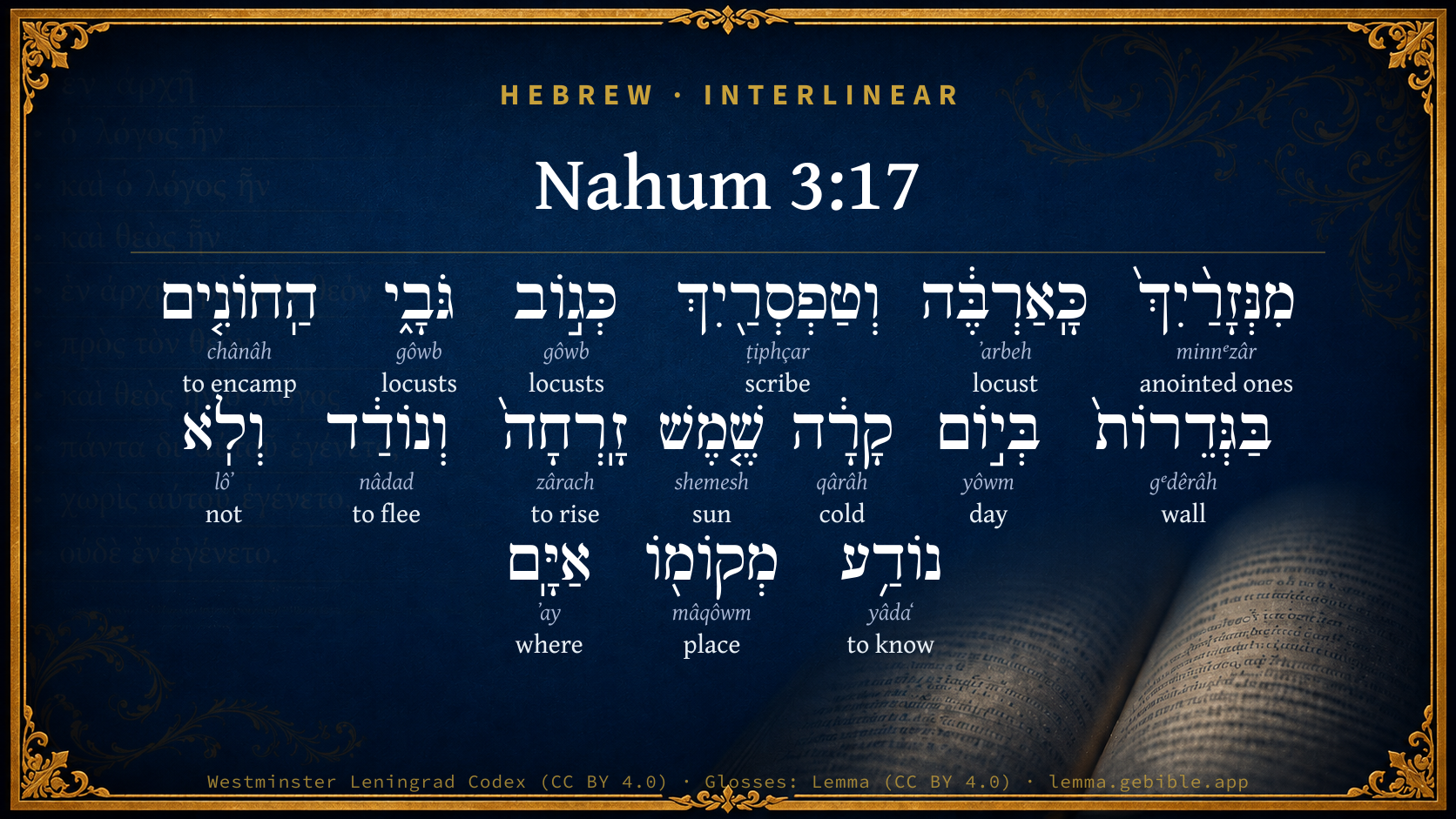
Nahum 3:17

Hebrew (Westminster Leningrad Codex) Nahum 3:17 appears in the Hebrew Old Testament. The text above is from the Westminster Leningrad Codex. Each word links to its Strong’s number, a concise gloss, and parsing drawn from the Open Scriptures Hebrew Bible morphology. Click any word for its full Brown-Driver-Briggs (BDB) entry.
Download image
Cite this verse

Nahum 3:17 (World English Bible). Public Domain. Lemma interlinear Bible study tool, https://lemma.gebible.app/v/nahum/3/17.

Show BibTeX & RIS
BibTeX
RIS
English Translation
Your guards are like the locusts, and your officials like the swarms of locusts, which settle on the walls on a cold day, but when the sun appears, they flee away, and their place is not known where they are.
World English Bible · Public Domain
Highlights
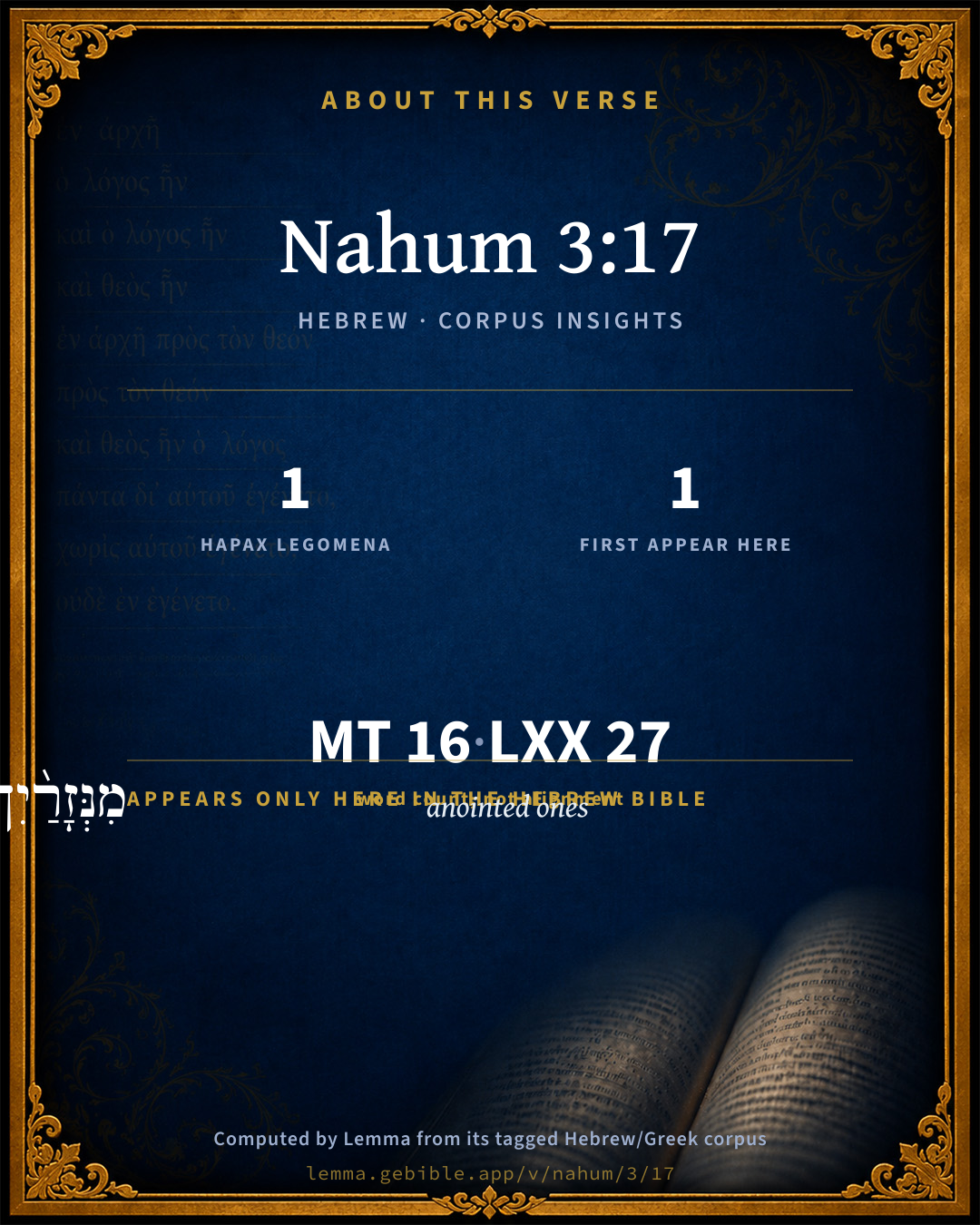
  • 1 hapax legomenon — only here in the Hebrew Bible
  • 1 first appearance in the Hebrew Bible
Full analysis ↓
Download a study sheet

One document with this verse’s original text, its word-by-word gloss line, the meaning frame, cross-references with their text, attributed commentary, and full source and license credits — printable, and it pastes into notes with its structure intact.

This verse Autodidact and up

Study sheet (.html) Plain text (.txt)

A passage Seminary Student

Up to 50 verses in one chapter. A passage sheet keeps up to 6 commentary sources and 12 cross-references per verse, in the order this page ranks them, and says so on the sheet whenever that leaves anything out. Ask for a single verse and you get the Autodidact verse sheet above.

Everything on this page stays free to read, with no account — the sheet is a download of what is already on screen, not access to it.

Want to remove ads? Support Godless Engineer
Compare translations 3

The same verse in 3 English versions, stacked beneath the original-language interlinear above. Click any original word for its lexicon entry.

Each is an independent rendering of the whole verse — the interlinear is not word-aligned to these translations.

Highlighted words mark where these versions differ — a whole-verse word diff, not a word-by-word alignment.

  • World English Bible Public Domain
    Your guards are like the locusts, and your officials like the swarms of locusts, which settle on the walls on a cold day, but when the sun appears, they flee away, and their place is not known where they are.
  • King James Version Public Domain
    Thy crowned are as the locusts, and thy captains as the great grasshoppers, which camp in the hedges in the cold day, but when the sun ariseth they flee away, and their place is not known where they are.
  • unfoldingWord Literal Text CC BY-SA 4.0
    Your guards like the locust, and your generals, like a swarm of locusts, the ones settling on the walls on a cold day. The sun shines and it flies away and its place is not known where they are.

unfoldingWord Literal Text — © unfoldingWord, licensed CC BY-SA 4.0. Word-aligned USFM3 via Door43 (git.door43.org/unfoldingWord/en_ult).

Versions to compare (up to 4)

3 of 4 selected

Show all 18 translations

Every available English version of this verse, each an independent rendering of the whole verse.

  • World English Bible Public Domain
    Your guards are like the locusts, and your officials like the swarms of locusts, which settle on the walls on a cold day, but when the sun appears, they flee away, and their place is not known where they are.
  • Berean Standard Bible Public Domain
    Your guards are like the swarming locust, and your scribes like clouds of locusts that settle on the walls on a cold day. When the sun rises, they fly away, and no one knows where.
  • Majority Standard Bible Public Domain
    Your guards are like the swarming locust, and your scribes like clouds of locusts that settle on the walls on a cold day. When the sun rises, they fly away, and no one knows where.
  • King James Version Public Domain
    Thy crowned are as the locusts, and thy captains as the great grasshoppers, which camp in the hedges in the cold day, but when the sun ariseth they flee away, and their place is not known where they are.
  • American Standard Version (1901) Public Domain
    Thy princes are as the locusts, and thy marshals as the swarms of grasshoppers, which encamp in the hedges in the cold day, but when the sun ariseth they flee away, and their place is not known where they are.
  • Revised Version (1885) Public Domain
    Thy crowned are as the locusts, and thy marshals as the swarms of grasshoppers, which camp in the hedges in the cold day, but when the sun ariseth they flee away, and their place is not known where they are.
  • Geneva Bible (1599) Public Domain
    Thy princes are as the grashoppers, and thy captaines as the great grashoppers which remaine in the hedges in the colde day: but when the sunne ariseth, they flee away and their place is not knowen where they are.
  • Douay-Rheims (1899) Public Domain
    Thy guards are like the locusts: and thy little ones like the locusts of locusts which swarm on the hedges in the day of cold: the sun arose, and they flew away, and their place was not known where they were.
  • Young's Literal Translation Public Domain
    Thy crowned ones `are' as a locust, And thy princes as great grasshoppers, That encamp in hedges in a day of cold, The sun hath risen, and it doth flee away, And not known is its place where they are.
  • Literal Standard Version CC BY-SA 4.0
    Your crowned ones [are] as a locust, || And your princes as great grasshoppers, || That encamp in hedges in a day of cold, || The sun has risen, and it flees away, || And its place where they are is not known.
  • Unlocked Literal Bible CC BY-SA 4.0
    Your princes are as many as the full-grown locusts, and your generals are like swarms of them that camp in the walls on a cold day. But when the sun rises they fly away to no one knows where.
  • unfoldingWord Literal Text CC BY-SA 4.0
    Your guards like the locust, and your generals, like a swarm of locusts, the ones settling on the walls on a cold day. The sun shines and it flies away and its place is not known where they are.
  • Darby Bible Public Domain
    Thy chosen men are as the locusts, and thy captains as swarms of grasshoppers, which camp in the hedges in the cold day: when the sun ariseth they flee away, and their place is not known where they are.
  • World Messianic Bible Public Domain
    Your guards are like the locusts, and your officials like the swarms of locusts, which settle on the walls on a cold day, but when the sun appears, they flee away, and their place is not known where they are.
  • Webster's Bible Public Domain
    Thy crowned are as the locusts, and thy captains as the great grasshoppers, which settle in the hedges in the cold day, but when the sun ariseth they flee away, and their place is not known where they are.
  • Free Bible Version CC BY-SA 4.0
    Your leaders are like locusts, your officials like a swarm of locusts. They rest on walls on a cold day, but when the sun rises they fly away, and no one knows where they've gone.
  • Bible in Basic English Public Domain
    Your crowned ones are like the locusts, and your scribes like the clouds of insects which take cover in the walls on a cold day, but when the sun comes up they go in flight, and are seen no longer in their place.
  • JPS Tanakh (1917) Public Domain
    Thy crowned are as the locusts, and thy marshals as the swarms of grasshoppers, which camp in the walls in the cold day, but when the sun ariseth they flee away, and their place is not known where they are.

Literal Standard Version (2020), Covenant Press — licensed CC BY-SA 4.0. Text via the HelloAO Bible API (eBible.org). Unlocked Literal Bible (unfoldingWord) — licensed CC BY-SA 4.0. Text via the HelloAO Bible API (eBible.org). unfoldingWord Literal Text — © unfoldingWord, licensed CC BY-SA 4.0. Word-aligned USFM3 via Door43 (git.door43.org/unfoldingWord/en_ult). Free Bible Version, Dr. Jonathan Gallagher — licensed CC BY-SA 4.0. Text via the HelloAO Bible API (eBible.org).

Word by word

More ways to search: Search by grammar → Find every occurrence → Compare this word →

Practice this passage: Drill this verse → Learn its vocabulary →

מִנְּזָרַ֨יִךְ֙
minnᵉzâr
H4502
“anointed ones · your”
Noun, Common, Masculine, Plural, Construct + Suffix, Personal, 2nd Person, Feminine, Singular
Part of Speech
Noun
Type
Common
Gender
Masculine
Number
Plural
State
Construct
Full BDB Definition

Origin: from H5144

TWOT: 1340d

princes, anointed ones, consecrated ones - meaning dubious
  1. כָּֽאַרְבֶּ֔ה ʼarbeh H697 “like/as the · locust” Preposition, Determined + Noun, Common, Masculine, Singular, Absolute
  2. וְטַפְסְרַ֖יִךְ ṭiphçar H2951 “and · scribes · your” Conjunction + Noun, Common, Masculine, Plural, Construct + Suffix, Personal, 2nd Person, Feminine, Singular
  3. כְּג֣וֹב gôwb H1462 “like/as · locusts of” Preposition + Noun, Common, Masculine, Singular, Construct
  4. גֹּבָ֑י gôwb H1462 “locusts” Noun, Common, Masculine, Plural, Absolute
  5. הַֽחוֹנִ֤ים chânâh H2583 “the · encamping” Particle, Definite Article + Verb, Qal, Participle Active, Masculine, Plural, Absolute
  6. בַּגְּדֵרוֹת֙ gᵉdêrâh H1448 “in/at the · walls” Preposition, Determined + Noun, Common, Feminine, Plural, Absolute
  7. בְּי֣וֹם yôwm H3117 “in/at · day of” Preposition + Noun, Common, Masculine, Singular, Construct
  8. קָרָ֔ה qârâh H7135 “cold” Noun, Common, Feminine, Singular, Absolute
  9. שֶׁ֤מֶשׁ shemesh H8121 “sun” Noun, Common, Both, Singular, Absolute
  10. זָֽרְחָה֙ zârach H2224 “to rise” Verb, Qal, Perfect, 3rd Person, Feminine, Singular
  11. וְנוֹדַ֔ד nâdad H5074 “and · to flee” Conjunction + Verb, Poal, Perfect, 3rd Person, Masculine, Singular
  12. וְלֹֽא lôʼ H3808 “and · not” Conjunction + Particle, Negative
  13. נוֹדַ֥ע yâdaʻ H3045 “to know” Verb, Niphal, Perfect, 3rd Person, Masculine, Singular
  14. מְקוֹמ֖וֹ mâqôwm H4725 “place · his” Noun, Common, Masculine, Singular, Construct + Suffix, Personal, 3rd Person, Masculine, Singular
  15. אַיָּֽם ʼay H335 “where · them” Particle, Interrogative + Suffix, Personal, 3rd Person, Masculine, Plural

About this verse

These counts appear in no published source. They are computed here, from the morphology-tagged text and Lemma’s own curated glosses. What Lemma adds →

16
words
15
distinct lemmas
Prophets
section

Notable vocabulary

1 hapax legomenon — a word that appears only here in the entire Hebrew Bible:

  • מִנְּזָרַ֨יִךְ֙ anointed ones H4502

First appearance in Scripture

This word makes its first canonical appearance in the Hebrew Bible here:

  • מִנְּזָרַ֨יִךְ֙ anointed ones H4502

Shared distinctive vocabulary

וְטַפְסְרַ֖יִךְ scribe H2951 occurs in 2 verses of the Hebrew Bible. Also found in:

Grammatical profile

  • 4 verbs
  • 10 nouns
  • 2 particles

Verb forms

  • הַֽחוֹנִ֤ים Qal · Participle Active
  • זָֽרְחָה֙ Qal · Perfect
  • וְנוֹדַ֔ד Poal · Perfect
  • נוֹדַ֥ע Niphal · Perfect

Repetition

A word recurs within this verse — often emphatic in Hebrew:

  • כְּג֣וֹב locusts H1462 ×2

Hebrew & Septuagint length

In English translation the verse runs 40 words from the Hebrew and 35 from the Septuagint (LXX English) — closely comparable.

A rough comparison of the two English renderings, which tokenize alike — not a word-level alignment.

Word counts can differ between the Hebrew and the Greek without any difference in meaning — e.g. the Hebrew direct-object marker אֵת has no separate Greek word, and Greek often adds the article ὁ.

In the original languages it is 16 Hebrew tokens and 27 Greek tokens — but the two are counted differently (Hebrew bundles its prefixes and suffixes into one token; the Greek is in lemma form), so that isn’t a like-for-like length.

Cross-references

2

Topical passages linked to Nahum 3:17 in the Treasury of Scripture Knowledge — connected by theme and wording, ordered by reader-vote popularity; previews shown in the World English Bible.

  • Jeremiah 51:27 Set up a standard in the land, blow the trumpet among the nations, prepare the nations against her, call together against her the kingdoms of Ararat, Minni, and Ashkenaz: appoint a marshal against her; cause the horses to come up as the rough canker-worm.
  • Revelation 9:7 The shapes of the locusts were like horses prepared for war. On their heads were something like golden crowns, and their faces were like people's faces.

Cross-references courtesy of OpenBible.info (CC BY 4.0).

Hebrew and Greek witnesses Masoretic Hebrew ↔ Greek Septuagint

The same verse in the two great witnesses to the Old Testament, shown verse-for-verse.

These are two independent witnesses, not word-aligned to each other, and the Septuagint is shown in lemma (dictionary) form.

Hebrew Nahum 3:17 Masoretic · Westminster Leningrad Codex

מִנְּזָרַ֨יִךְ֙ כָּֽאַרְבֶּ֔ה וְטַפְסְרַ֖יִךְ כְּג֣וֹב גֹּבָ֑י הַֽחוֹנִ֤ים בַּגְּדֵרוֹת֙ בְּי֣וֹם קָרָ֔ה שֶׁ֤מֶשׁ זָֽרְחָה֙ וְנוֹדַ֔ד וְלֹֽא נוֹדַ֥ע מְקוֹמ֖וֹ אַיָּֽם

Your guards are like the locusts, and your officials like the swarms of locusts, which settle on the walls on a cold day, but when the sun appears, they flee away, and their place is not known where they are.

World English Bible · Public Domain

Greek LXX Nahum 3:17 Septuagint · lemma form

ἐκἀλάομαι ὡς ἀττέλεβος ὁ σύμμικτός σύ ὡς ἀκρίς ἐπιβαίνω ἐπί φραγμός ἐν ἡμέρα πάγος ὁ ἥλιος ἀνατέλλω καί ἀποἅλλομαι καί οὐ γιγνώσκω ὁ τόπος αὐτός οὐαί αὐτός

Your mixed multitude has suddenly departed as the grasshopper, as the locust perched on a hedge in a frosty day; the sun arises, and it flies off, and knows not its place: woe to them!

LXX2012 (modern English Septuagint) · Public Domain

On this verse, Haydock's Catholic Bible Commentary discusses the Septuagint’s reading. Read the note in Commentary ↓

Hebrew: Westminster Leningrad Codex (CC BY 4.0). Greek: Septuagint (public domain); English from LXX2012 (modern English Septuagint) (Public Domain). How the Septuagint differs from the Hebrew →

Targum (Aramaic paraphrase)

1

The Targum is the ancient Jewish Aramaic paraphrase of the Hebrew Scriptures — an interpretive translation, not the Hebrew text itself. Onkelos (literal) and Pseudo-Jonathan (expansive) render the Torah, and Jonathan the Prophets. Coverage is partial: where no permissively-licensed English translation exists for a verse, only the Aramaic is shown. This is verse-level text, not a word-by-word alignment to the Hebrew.

  1. Targum Jonathan Prophets (Joshua–Malachi)
    הָא טַסַךְ מְצַלְהַבִין כְּגוֹבָא וְטַפְסְרַיִךְ כִּזְחִיל גוֹבָאֵי דִי שְׁרָן בְּכָתְלַיָא בְּיוֹם קָרֵיר דְכַד שִׁמְשָׁא דָנְחָא עֲלֵיהוֹן מִתְבַּדְרִין וְלָא אִתְיְדַע אָתְרֵיהוֹן לְאָן עַרְקִין:

    (no public-domain English translation for this verse)

    Targum Jonathan — Aramaic: “Mikraot Gedolot” (public domain). English: “Sefaria Community Translation” (CC0 1.0 (public-domain dedication)); “London "Chaldee Paraphrase," 1871” (public domain). Text via Sefaria.

Commentary

Notes on Nahum 3:17 from classic Christian and Jewish commentators (each source and its license shown beneath its notes). The classic Christian expositions comment on the surrounding passage and are grouped to its opening verse, so a note may address several verses; the Jewish commentaries on the Tanakh (Rashi and others) are per-verse, so they appear only where the commentator wrote on this verse.

Lemma curates 59 commentaries, every one of them public domain or Creative Commons licensed, each selected and text-cleaned for this edition rather than reprinted as found. About our sources →

Trapp's Complete Commentary

John Trapp

Nah 3:17 Thy crowned [are] as the locusts, and thy captains as the great grasshoppers, which camp in the hedges in the cold day, [but] when the sun ariseth they flee away, and their place is not known where they [are].

Ver. 17. Thy crowned are as the locusts] i.e. Thy barons (saith Diodati) and great lords, wearing diadems and wreaths, in token of dignity; such a Nazarite (that is the Hebrew word here) was Joseph, Gen 49:26, because separate and exempt from other men, as a chieftain. Calvin likewise rendereth it, thy princes; the Vulgate Latin, thy keepers; some others, thy Nazarites, or thy religious persons, set apart from the common sort to pray for the city’s safety. Such were those chemarims, or chimney chaplains, among the Jews, Hos 10:5 Zep 1:4; such are the mailers among the Turks, who call them the religious brothers of love; and the shaveling mendicants among the Papists. These locusts are, Rev 9:7, said to have on their heads as it were crowns like gold.

And thy captains as the great grasshoppers] Heb. as the grasshoppers of grasshoppers, by a Hebraism, like that King of kings, Song of songs, &c. The word rendered captains is foreign; R. David and others render it, Imperator, Dux, Princeps. It seemeth to be a name of dignity among the Assyrians, as Zaphnathpaaneah was among the Egyptians, Gen 41:45. These are called grasshoppers and locusts, for their uselessness and fearfulness.

Which camp in the hedges] sc. Of the gardens or vineyards, and they are said to camp, in regard of their multitudes, as if they were an army of them. See Joel ii. The prophet taxeth here Nineveh’s vain confidence in her confederates and such other hangers on, as might truly say,

“ Nos numeri sumus, fruges consumere nati. , ”

We are men of no great moment, such as Aristophanes in Plutarch prettily played upon, when he said, ταμιαι λαμιαι, i.e. quaestores bubones. treasurers of eagles.

But when the sun ariseth they flee away] So these trencher flies, when they have served their own turns upon thee, and now see the tempest of war growing on amain, they worship the rising sun, keep themselves on the warm side of the hedge, leave thee to shift as thou canst, and seek out for themselves a better fortune.

John Trapp, A Commentary or Exposition upon All the Books of the Old and New Testament (1647–1656) — public domain. Text from a community e-Sword module.

The Biblical Illustrator

Joseph S. Exell

Nah_3:17

Which camp in the hedges in the cold day.

Locusts affected by the cold

Paxton and others have remarked that there is much difficulty in this passage; but to anyone who has attentively watched the habits of the locusts it is not only plain, but very striking. In the evenings, as soon as the air became cool, at Aheih, they literally camped in the hedges and loose stone walls, covering them over like a swarm of bees settled on a bush. There they remained until the next days sun waxed warm, when they again commenced to march. One of the days on which they were passing was quite cool, and the locusts scarcely moved at all from their camps, and multitudes remained actually stationary until the next morning. Those that did march crept along very heavily, as if cramped and stiff; but in a hot day they hurried forward in a very earnest, lively manner. It is an aggravation of the calamity if the weather continues cool; for then they prolong their stay, and do far more damage. (Thomsons Land and Book.)

The Biblical Illustrator, edited by Joseph S. Exell (c. 1880s–1900s) — public domain. Text from a community e-Sword module.

Jamieson, Fausset & Brown

Robert Jamieson, A. R. Fausset & David Brown

Thy crowned--Thy princes (Rev 9:7). The king's nobles and officers wore the tiara, as well as the king; hence they are called here "thy crowned ones."

as the locusts--as many as the swarming locusts.

thy captains--Tiphsar, an Assyrian word; found also in Jer 51:27, meaning satraps [MICHAELIS]; or rather, "military leaders" [MAURER]. The last syllable, sar means a "prince," and is found in Belshaz-zar, Nabopolas-sar, Nebuchadnez-zar.

as the great grasshoppers--literally, "as the locust of locusts," that is, the largest locust. MAURER translates, "as many as locusts upon locusts," that is, swarms of locusts. Hebrew idiom favors English Version.

in the hedges in the cold--Cold deprives the locust of the power of flight; so they alight in cold weather and at night, but when warmed by the sun soon "flee away." So shall the Assyrian multitudes suddenly disappear, not leaving a trace behind (compare PLINY, Natural History, 11.29).

Jamieson, Fausset & Brown — Commentary Critical and Explanatory on the Whole Bible (1871) — public domain (CC PDM 1.0). Text via the HelloAO Bible API.

Adam Clarke's Commentary

Verse 17. Thy crowned are as the locusts] Thou hast numerous princes and numerous commanders.

Which camp in the hedges in the cold day] The locusts are said to lie in shelter about the hedges of fertile spots when the weather is cold, or during the night; but as soon as the sun shines out and is hot, they come out to their forage, or take to their wings.

Adam Clarke's Commentary on the Bible (1810–1826) — public domain. Text from a community e-Sword/MySword module.

John Calvin's Commentaries

And thy princes are as locusts: this refers to the wicked doings, by which they laid waste almost the whole earth. As then the locusts and chafers, wherever they come, consume every kind of food, devour all the fields, leave nothing, and the whole land becomes a waste; so also have been thy princes; they have been as locusts and thy leaders as the locusts of locusts, that is, as very great locusts; for this form, we know, expresses the superlative degree in Hebrew. Their leaders were then like the most voracious locusts for the whole land was made barren by them, as nothing was capable of satisfying their avarice and voracity.

The Prophet then adds, They are locusts, who dwell in the mounds during the time of cold; but when the sun rises, not known any more is their place He now shows, that it would not be perpetual, that the Ninevites would thus devour the whole earth, and that all countries would be exposed to their voracity; for as the locusts, he says, hide themselves in caverns, and afterwards fly away, so it shall happen to thy princes. But this passage may be taken to mean, — that the Ninevites concealed themselves in their hiding-places during the winter, and that when the suitable time for plundering came, they retook themselves in different directions, and took possession of various regions, and brought home plunder from the remotest parts. This meaning may be elicited from the words of the Prophet; and the different clauses would thus fitly coalesce together, that when the Ninevites left their nests, they dispersed and migrated in all directions. I do not at the same time disapprove of the former meaning: they are then like locusts, who lodge in mounds during the time of cold; but when the sun rises, — that is, when the season invites them, (for he speaks not of the winter sun,) but when the heat of the sun prevails and temperate the air, — then, he says, the locusts go forth and fly away, and known no more is their place He means, in short, that the Ninevites plundered, and that they did so after the manner of locusts; and that a similar end also was nigh them; for the Lord would destroy them, yea, suddenly consume them, so that no trace of them could be found. It follows —

John Calvin's Commentaries (1540-1563) — public domain. Text from the Calvin Translation Society English edition (1840s-50s) via the Christian Classics Ethereal Library (ccel.org). Calvin's coverage is partial (roughly two-thirds of the Bible); uncommented books and verses are honest gaps, never fabricated. The 19th-century editor's footnotes and remarks are omitted so the notes are faithfully Calvin's own voice.

Ellicott's Commentary for English Readers

(17) Thy crowned.—The subordinate kings who represent the Assyrian empire in her tributary provinces.

Captains.—Taphs’rîm, an Assyrian term denoting some high military office. The sudden disappearance of the Assyrian locust-pest is here enlarged upon. A sudden outburst of sunshine will sometimes induce a swarm of locusts to take flight; cold, on the other hand, makes these insects settle, and soon deprives them of the power of flying. Dr. Pusey well observes, “The heathen conqueror rehearsed his victory, ‘I came, I saw, conquered.’ The prophet goes further, as the issue of all human conquest, ‘I disappeared.’” The insect designations, rendered in Authorised Version, “cankerworm,” “locust,” “great grasshopper,” all represent varieties of the locust species.

A Bible Commentary for English Readers, edited by Charles John Ellicott (1878–1897) — public domain. Text from a community e-Sword module.

The Cambridge Bible for Schools and Colleges

gen. ed. J. J. S. Perowne

17. The idea at the end of Nah_3:16 is amplified.

Thy crowned] The word is unknown. It is probably an Assyrian term, and is conjectured to mean nobles, or something similar.

and thy captains] The word employed is taphsar (tiphsar, Jer_51:27), which appears to be the Assyr. dupsar, i.e. tablet writer, scribe, a term most likely used in a wider sense to denote high officials. Cf. Isa_47:13. See Schrader, i. 141, ii. 118, Del., Paradies, p. 142. The identification of the word with the Assyr. title is due to Lenormant.

the great grasshoppers]. The term means locusts, Amo_7:1. So in Arab. e.g. Carmina Hudhail. 139. 7. The word appears to be here written twice (possibly by mistake), which A.V. has sought to express by “great” and R.V. by “swarms.”

when the sun ariseth they flee away] Locusts become torpid with the cold; under the warmth of the sun they revive and take flight.

The Cambridge Bible for Schools and Colleges (gen. ed. J. J. S. Perowne; Cambridge University Press, 1878–1918) — public domain. Text from a community e-Sword module.

John Gill's Exposition

Thy crowned men are as the locusts,.... Tributary kings, and hired officers, as some think, who might be distinguished by what they wore on their heads; or their own princes and nobles, who wore coronets or diadems; unless their religious persons are meant, their Nazarites and devotees, their priests; these were like locusts for their number, fear, and flight in time of danger, and for their spoil of the poor; and some locusts have been seen with little crowns on their heads, as those in Rev 9:7 "which had on their heads as it were crowns like gold". In the year 1542 came locusts out of Turkish Satmatia into Austria, Silesia, Lusatia, and Misnia, which had on their heads little crowns (e). In the year 1572 a vehement wind brought large troops of locusts out of Turkey into Poland, which did great mischief, and were of a golden colour (f); and Aelianus (g) speaks of locusts in Arabia, marked with golden coloured figures; and mention is made in the Targum on Jer 51:27, of the shining locust, shining like gold:

and thy captains as the great grasshoppers; or "locusts of locusts" (h); those of the largest size. The Vulgate Latin renders the word for captains "thy little ones", junior princes, or officers of less dignity and authority; these were, as the Targum paraphrases it, as the worms of locusts; but rather as the locusts themselves, many and harmful:

which camp in the hedges in the cold day; in the cold part of the day, the night; when they get into the hedges of fields, gardens, and vineyards, in great numbers, like an army, and therefore said to encamp like one:

but when the sun ariseth they flee away, and their place is not known where they are; whither they are fled, as the Targum; so these captains, or half pay officers, swarmed in great numbers about the city, and in the provinces, while it was a time of peace, and they were indulged in sloth, and enjoyed much ease and prosperity; but when war broke out, and the heat of it began to be felt, these disappeared, and went into their own countries, from whence they came, with the auxiliaries and hired troops; nor could they be found where they were, or be called upon to do their duty: this is true of locusts in a literal sense, who flee away when the sun rises; hence the Arabs, as Bochart says (i) elegantly express this by the word "ascaara"; signifying, that when the sun comes to the locust it goes away, According to Macrobius (k), both Apollo and Hercules are names for the sun; and both these are surnamed from their power in driving away locusts: Hercules was called Cornopion by the Oeteans, because he delivered them from the locusts (l): and Apollo was called Parnopius by the Grecians, because, when the country was hurt by locusts, he drove them out of it, at Pausanias (m) relates; who observes, that they were drove out they knew, but in what manner they say not; for his own part, he says, he knew them thrice destroyed at Mount Sipylus, but not in the same way; one time a violent wind drove them out; another time a prodigious heat killed them; and a third time they perished by sudden cold; and so, according to the text here, the cold sends them to the hedges, and the heat of the sun obliges them to abandon their station.

(e) Vid. Frantzii Hist. Animal. Sacr. par. 5. c. 4. p. 799. (f) Ibid. p. 798. (g) Hist. Animal. l. 10. c. 13. (h) "ut locustae locustarum", Vatablus, Pagninus, Montanus; "sicut locusta locustarum", Burkius. (i) Hierozoic. par. 2. c. 2. col. 458. (k) Saturnal l. 1. c. 17. p. 335. & c. 20. p. 362. (l) Strabo. Geograph. l. 13. p. 422. (m) Attica, sive l. 1. p. 44.

John Gill's Exposition of the Whole Bible (1746–1763) — public domain (CC PDM 1.0). Text via the HelloAO Bible API.

Albert Barnes' Notes on the Bible

Thy crowned are as the locust, and thy captains as the great locusts - What he had said summarily under metaphor, the prophet expands in a likeness. “The crowned” are probably the subordinate princes, of whom Sennacherib said, “Are not my princes altogether kings?” Isa 10:8. It has been observed that the headdress of the Assyrian Vizier has the ornament which “throughout the whole series of sculptures is the distinctive mark of royal or quasi-royal authority.” : “All high officers of state, ‘the crowned captains,’ were adorned with diadems, closely resembling the lower band of the royal mitre, separated from the cap itself. Such was that of the vizier, which was broader in front than behind, was adorned with rosettes and compartments, and terminated in two ribbons with embroidered and fringed ends, which hung down his back.” “Captain” is apparently the title of some military ounce of princely rank.

One such Jeremiah Jer 51:27, in a prophecy in which he probably alludes to this, bids place over the armies of Ararat, Minni, and Ashchenaz, to marshall them against Babylon, against which he summons the cavalry like the rough locust. The “captains” are likened to the “great caterpillars,” either as chief in devastation, or as including under them the armies antler their command, who moved at their will. These and their armies now subsided into stillness for a time under the chill of calamity, like the locust “whose nature it is, that, torpid in the cold, they fly in the heat.” The stiffness of the locusts through the cold, when they lie motionless, heaps upon heaps, hidden out of sight, is a striking image of the helplessness of Nineveh’s mightiest in the day of her calamity; then, by a different part of their history, he pictures their entire disappearance. : “The locusts, are commonly taken in the morning when they are agglomerated one on another, in the places where they passed the night. As soon as the sun warms them, they fly away.” “When the sun ariseth, they flee away,” literally, “it is chased away.”

One and all; all as one. As at God’s command the plague of locusts, which He had sent on Egypt, was removed; “there remained not one locust in all the coasts of Egypt” Exo 10:19; so the mighty of Nineveh were driven north, with no trace where they had been, where they were. “The wind carried them away Isa 41:16; the wind passes over him and he is not, and his place knows him no more Psa 103:16. The triumphing of the wicked is short, and the joy of the ungodly for a moment: though his excellency mount up to the heavens, and his head reach unto the clouds, yet he shall perish for ever; they which have seen him shall say, where is he? He shall fly away, as a dream, and shall not be formal; neither shall his place any were bebold him Job 20:5-9.

Where they are - So Zechariah asks, “Your fathers, where are they?” Zech. 1. History, experience, human knowledge can answer nothing. They can only say, where they are not. God alone can answer that much-containing word, “Where-they.” They had disappeared from human sight, from their greatness, their visible being, their place on earth.

Albert Barnes' Notes on the Bible (1834–1885) — public domain. Text from a community e-Sword/MySword module.

Haydock's Catholic Bible Commentary

Guards. Hebrew, "crowned" princes. --- Little. Hebrew, "satraps are like great locusts, which," &c. St. Jerome has read (Calmet) toppic instead of taphseraic, (Haydock) which [the] Septuagint neglect. Thapsar denotes an officer, Jeremias li. 27. (Calmet) --- Of locusts. The young locusts. (Challoner)

George Leo Haydock (1774–1849), Haydock's Catholic Family Bible and Commentary, 1859 edition — public domain. Excludes Psalms (Douay-Rheims chapter numbering differs from Protestant) and Deuterocanonical books (Catholic canon only).

Matthew Poole's English Annotations

Thy crowned; thy rich and wealthy citizens, or thy confederate kings and princes, or thy tributary princes;

thy captains; hired, or homeborn, rather the former, commanders and officers; for number and briskness, are like locusts and great grasshoppers, but it is all for show, nothing for help to thee.

Which camp, as if they would guard the grounds about which they settle.

In the cold day; this lasts while the season suits them.

But when the sun ariseth, when trouble, war, and danger, like the parching sun, scalds them, they flee away; they shift from the hedge they eat up.

Their place is not known; thou shalt never know where to find them when thou needest, and they should help thee.

Matthew Poole's English Annotations on the Holy Bible (1683–1685) — public domain. Text from a community e-Sword/MySword module.

The Pulpit Commentary

Thy crowned. The word minnezar is found only here, and, as its derivation is uncertain, it has received various interpretations. The Anglican Version derives the word from nezer, "a diadem," and "the crowned" are the officials of upper rank. "High officers of state in Assyria were adorned with diadems, closely resembling the lower baud of the royal mitre, separated from the cap itself. Very commonly the head was encircled with a simple fillet or hoop, probably of gold, without any adornment" (Gosse, "Assyria," p.463, quoted by Strauss; see the figures in Bonomi, p. 319). Others derive it from nazar. "to separate," in the signification of "those separated or selected for war." Septuagint, o summiktov : i.e. the band of mixed mercenary troops a rendering in which Wordsworth acquiesces. Knabenbauer (referring to Strassmaier"s Assyrian vocabulary) considers the word to be a transliteration (ss being resolved into ne) of the Assyrian ma-as-sa-ru, which means "guardian," or some inferior officer. With this agrees the Vulgate Custodes. as the locusts; i.e. in multitude. That the number of captains and superior officers would be very great may be conjectured from the inscriptions which sometimes enumerate the captives carried off from conquered countries. Thus in the account of the capture of some insignificant nation, the then king boasts that he took away 13, 000 fighting men, 1121 captains, and 460 superior officers (Strauss, in loc.). The prophet"s meaning is that if the officers, etc., are so numerous, the multitude of soldiers and civilians must be truly immense. Thy captains. Taphsar is an Assyrian word, occurring only in Jer_51:27. It is probably the same as dupsarru or dipsarru of the inscriptions, and is taken to signify "a scribe" (see Sehrader, p. 424) Such officials are often represented on the monuments (see Layard, 2:184), and seem sometimes to have been of high or priestly rank. Jerome translates, parvuli tui, though in Jeremiah, loc. cit., he retains the Assyrian word. The Septuagint omits it. Great grasshoppers; swarms of locusts. (Amo_7:1) Which camp in the hedges in the cold day. Locusts become torpid in cold weather; so the captains and princes of Nineveh are paralyzed and useless in the day of calamity. They flee away. Thus the Assyrian army perishes and leaves no trace behind. The LXX adds, "Woe unto them!"

The Pulpit Commentary (1880–1919), ed. H.D.M. Spence-Jones & Joseph S. Exell — public domain. Text from a community e-Sword module.

John Wesley's Explanatory Notes

Thy crowned - Thy confederate kings and princes. Captains - Commanders and officers are for number, like locusts and grasshoppers; but 'tis all for shew, not for help. In the cool day - While the season suits them. The sun - When trouble, war, and danger, like the parching sun, scald them. Is not known - Thou shalt never know where to find them.

John Wesley, Explanatory Notes Upon the Whole Bible (1754–1765) — public domain. Text via the GEBible commentary corpus.

Rashi

Rabbi Shlomo Yitzchaki (Rashi)

Your princes Heb. מִנְּזָרַיִךְ, your princes. The “mem” is a radical and a root of the word, like the “mem” of מִשְׁמַרְתְּךָ, your watch (Num. 18:3); of מִשְׁמַעְתֶּךָ, your service (I Sam. 22:14); and of מִנְעָלֶךָ, your lock (Deut. 33:25). But sometimes the “mem” is defective; e.g., נְזִיר אֶחָיו, the prince of his brothers (Gen. 49:26); and, similarly, לִנְזָרִים, princes (Amos 2:11).

and your marshal Heb. וְטַפְסְרַיִךְ. Your appointees.

like armies of locust Heb. כְּגוֹב גּוֹבָי, like armies of locusts. גּוֹבָי is comme langouste in French, like locusts.

which alight on the walls on a cold day—So is the habit of the numerous locust, the fly, the finishing locust, and the nibbling locust; during the cold times they adhere to the walls, and when warmth comes they fly away from there and go away. So will all your people be exiled.

and it flies away Heb. וְנוֹדַד, and it moves.

and its place is not known where they are—Where they are and where they went.

Rashi on the Tanakh — English translations: “The Judaica Press complete Tanach with Rashi, translated by A. J. Rosenberg” (CC BY 4.0); “Pentateuch with Rashi's commentary by M. Rosenbaum and A.M. Silbermann, 1929-1934” (public domain); “The Metsudah Tanach series, Lakewood, N.J” (CC BY 4.0); and “The Book of Joshua, Metsudah Publications, 1997” (CC BY 4.0). Text via Sefaria.

Lesson kit

Teaching starters — assembled from the data on this page, not authored interpretation. Every prompt links to the verse data it draws on. Edit before teaching.

Nahum, in the Prophets, opens this verse with 16 words (15 distinct Hebrew lemmas). Its most distinctive word is minnᵉzâr (“anointed ones”). A historical commentator’s framing appears above. Read the whole chapter for the surrounding context.

Discussion questions

  1. How does “anointed ones” (minnᵉzâr) shape what this verse is saying?
  2. This verse holds 1 word here found nowhere else in the Hebrew Bible. What might the rare word draw attention to?
  3. The word “anointed ones” first appears here in Scripture. What is being introduced at this debut?
  4. Jeremiah 51:27 shares the word «scribe» with this verse. How do the two illuminate each other?
  5. “locusts” occurs 2× in this one verse. What is the effect of the repetition?
  6. These translations render this verse differently; the difference is in the English rendering, not the original. What questions does that raise?
  7. The verb «הַֽחוֹנִ֤ים» is Qal Participle Active. How does its form color the action?
  8. Reading how Trapp's Complete Commentary and The Biblical Illustrator read this verse, where do the two commentators agree and where do they part?

Things to notice

  • 1 word in this verse appears nowhere else in the Hebrew Bible.
  • 1 word makes its first canonical appearance in Scripture here.
  • This verse counts 16 Hebrew ↔ 27 Greek words.
  • These translations choose different wording for 24 words in this verse.
  • “locusts” occurs 2× in this single verse.

Reading settings

Reading text

Shown beneath each verse's original-language words.

Old Testament
Old Testament edition

Read the OT as the Masoretic Hebrew (MT) or the Greek Septuagint (LXX).

English shown for the Greek Septuagint (in the Hebrew ↔ Greek comparison).

Comparing translations? Open the Compare panel on any verse page to stack up to four side by side.