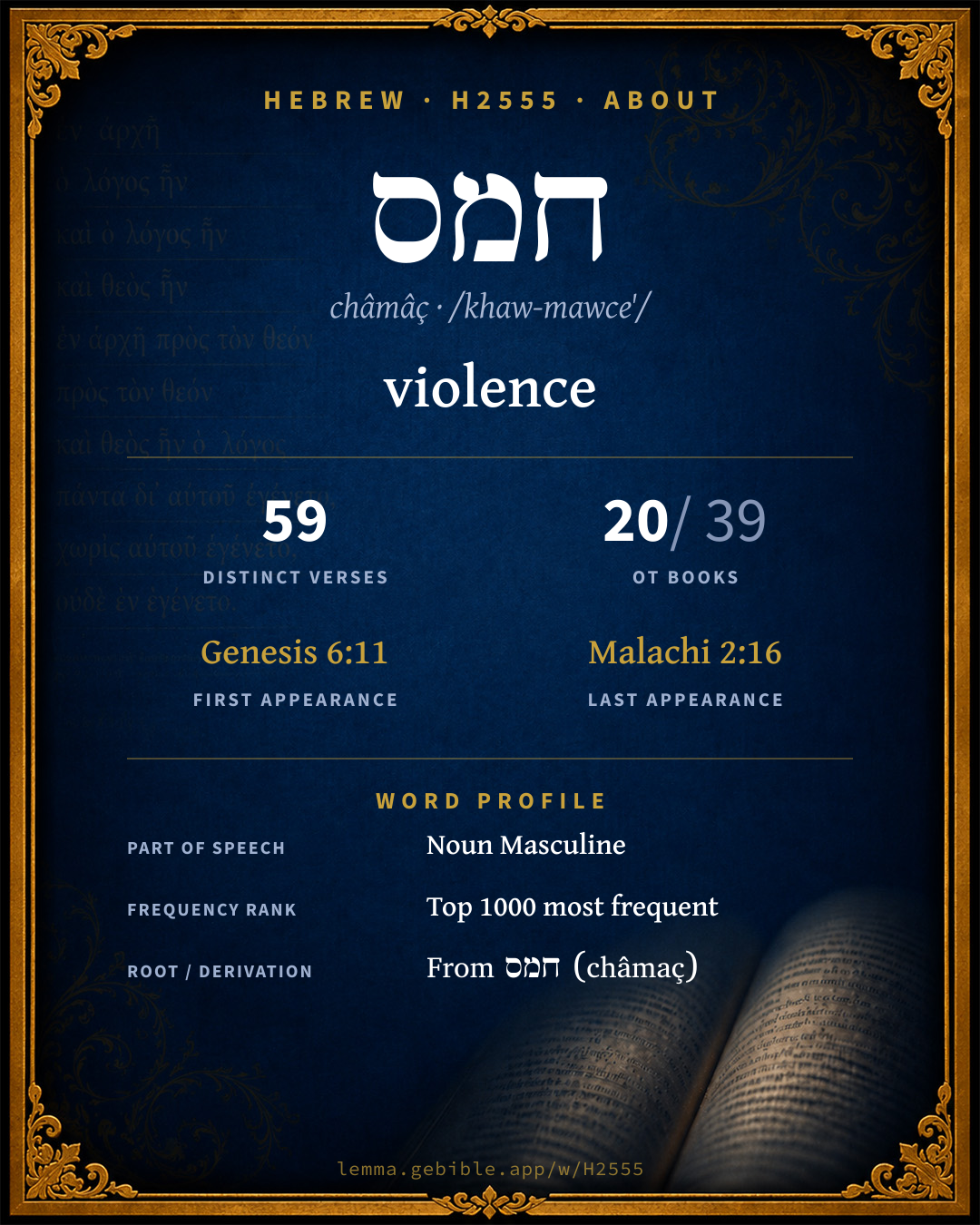
חָמָס
violence
Full lexicon entry — Brown-Driver-Briggs (BDB)
From Brown-Driver-Briggs (BDB)
Where this word appears
See every Absolute-state word in the Hebrew Bible →
Grammar key — what these labels mean
Part of speech
- Noun
- A naming word — a person, place, thing, or idea.
Noun type
- Common
- A common noun — a general class of person, place, or thing (“king,” “city,” “water”), not a specific name.
State
- Absolute
- The independent form of a noun, not bound to a following word.
- Construct
- A noun bound to a following noun in a possessive / “of” relationship (the construct chain).
Gender
- Masculine
- Grammatically masculine.
Number
- Singular
- One.
- Plural
- More than one (in Hebrew, generally three or more).
Grammatical forms
- Noun, Common, Masculine, Singular, Absolute 45 times (75%)
- Noun, Common, Masculine, Singular, Construct 11 times (18%)
- Noun, Common, Masculine, Plural, Absolute 4 times (7%)
Parsed forms decoded from the imported morphology (morphhb / Westminster Leningrad Codex — WLC text public domain, morphhb tagging CC BY 4.0), counted across 60 parsed occurrences — not distinct verses.
Every verse where H2555 appears — 59 distinct verses across 20 books. Click any verse to open its interlinear word-by-word view. Verse text shown in the World English Bible for context — . Each verse’s Hebrew form is shown with its reference; the English is not keyword-highlighted, since the data carries no word-level English alignment. Use “Compare translations” on any verse to read it across multiple English versions. This concordance covers the Hebrew Bible; Septuagint (Greek Old Testament) occurrences are not indexed here.
Genesis 4 verses
- Genesis 6:11 חָמָֽס n c ms The earth was corrupt before God, and the earth was filled with violence.
- Genesis 6:13 חָמָ֖ס n c ms God said to Noah, "The end of all flesh has come before me, for the earth is filled with violence through them. Behold, I will destroy them with the earth.
- Genesis 16:5 חֲמָסִ֣/י n c ms cs + sfx pers 1cs Sarai said to Abram, "This wrong is your fault. I gave my handmaid into your bosom, and when she saw that she had conceived, I was despised in her eyes. Yahweh judge between me and you."
- Genesis 49:5 חָמָ֖ס n c ms "Simeon and Levi are brothers; Weapons of violence are their swords.
Exodus 1 verse
Deuteronomy 1 verse
Judges 1 verse
2 Samuel 2 verses
- 2 Samuel 22:3 מֵ/חָמָ֖ס prep + n c ms God, my rock, in him will I take refuge; My shield, and the horn of my salvation, my high tower, and my refuge; My savior, you save me from violence.
- 2 Samuel 22:49 חֲמָסִ֖ים n c mp Who brings me forth from my enemies: Yes, you lift me up above those who rise up against me; You deliver me from the violent man.
1 Chronicles 1 verse
Job 2 verses
Psalms 14 verses
- Psalms 7:16 חֲמָס֥/וֹ n c ms cs + sfx pers 3ms The trouble he causes shall return to his own head. His violence shall come down on the crown of his own head.
- Psalms 11:5 חָמָ֑ס n c ms Yahweh examines the righteous, But the wicked and him who loves violence his soul hates.
- Psalms 18:48 חָ֝מָ֗ס n c ms He rescues me from my enemies. Yes, you lift me up above those who rise up against me. You deliver me from the violent man.
- Psalms 25:19 חָמָ֣ס n c ms Consider my enemies, for they are many. They hate me with cruel hatred.
- Psalms 27:12 חָמָֽס n c ms Don't deliver me over to the desire of my adversaries, For false witnesses have risen up against me, Such as breathe out cruelty.
- Psalms 35:11 חָמָ֑ס n c ms Unrighteous witnesses rise up. They ask me about things that I don't know about.
- Psalms 55:9 חָמָ֖ס n c ms Confuse them, Lord, and confound their language, For I have seen violence and strife in the city.
- Psalms 58:2 חֲמַ֥ס n c ms cs No, in your heart you plot injustice. You measure out the violence of your hands in the earth.
- Psalms 72:14 וּ֭/מֵ/חָמָס conj + prep + n c ms He will redeem their soul from oppression and violence. Their blood will be precious in his sight.
- Psalms 73:6 חָמָ֥ס n c ms Therefore pride is like a chain around their neck. Violence covers them like a garment.
- Psalms 74:20 חָמָֽס n c ms Honor your covenant, For haunts of violence fill the dark places of the earth.
- Psalms 140:1 חֲמָסִ֣ים n c mp Deliver me, Yahweh, from the evil man. Preserve me from the violent man;
- Psalms 140:4 חֲמָסִ֣ים n c mp Yahweh, keep me from the hands of the wicked. Preserve me from the violent men who have determined to trip my feet.
- Psalms 140:11 חָמָ֥ס n c ms An evil speaker won't be established in the earth. Evil will hunt the violent man to overthrow him.
Proverbs 7 verses
- Proverbs 3:31 חָמָ֑ס n c ms Don't envy the man of violence. Choose none of his ways.
- Proverbs 4:17 חֲמָסִ֣ים n c mp For they eat the bread of wickedness, And drink the wine of violence.
- Proverbs 10:6 חָמָֽס n c ms Blessings are on the head of the righteous, But violence covers the mouth of the wicked.
- Proverbs 10:11 חָמָֽס n c ms The mouth of the righteous is a spring of life, But violence covers the mouth of the wicked.
- Proverbs 13:2 חָמָֽס n c ms By the fruit of his lips, a man enjoys good things; But the unfaithful crave violence.
- Proverbs 16:29 חָ֭מָס n c ms A man of violence entices his neighbor, And leads him in a way that is not good.
- Proverbs 26:6 חָמָ֣ס n c ms One who sends a message by the hand of a fool Is cutting off feet and drinking violence.
Isaiah 3 verses
- Isaiah 53:9 חָמָ֣ס n c ms They made his grave with the wicked, and with a rich man in his death; although he had done no violence, neither was any deceit in his mouth.
- Isaiah 59:6 חָמָ֖ס n c ms Their webs shall not become garments, neither shall they cover themselves with their works: their works are works of iniquity, and the act of violence is in their hands.
- Isaiah 60:18 חָמָס֙ n c ms Violence shall no more be heard in your land, desolation nor destruction within your borders; but you shall call your walls Salvation, and your gates Praise.
Jeremiah 4 verses
- Jeremiah 6:7 חָמָ֣ס n c ms As a well casts forth its waters, so she casts forth her wickedness: violence and destruction is heard in her; before me continually is sickness and wounds.
- Jeremiah 20:8 חָמָ֥ס n c ms For as often as I speak, I cry out; I cry, Violence and destruction! because the word of Yahweh is made a reproach to me, and a derision, all the day.
- Jeremiah 51:35 חֲמָסִ֤/י n c ms cs + sfx pers 1cs The violence done to me and to my flesh be on Babylon, shall the inhabitant of Zion say; and, My blood be on the inhabitants of Chaldea, shall Jerusalem say.
- Jeremiah 51:46 וְ/חָמָ֣ס conj + n c ms Don't let your heart faint, neither fear for the news that shall be heard in the land; for news shall come one year, and after that in another year [shall come] news, and violence in the land, ruler against ruler.
Ezekiel 6 verses
- Ezekiel 7:11 הֶ/חָמָ֥ס ptcl def.art + n c ms Violence is risen up into a rod of wickedness; none of them [shall remain], nor of their multitude, nor of their wealth: neither shall there be eminency among them.
- Ezekiel 7:23 חָמָֽס n c ms Make the chain; for the land is full of bloody crimes, and the city is full of violence.
- Ezekiel 8:17 חָמָ֗ס n c ms Then he said to me, Have you seen [this], son of man? Is it a light thing to the house of Judah that they commit the abominations which they commit here? for they have filled the land with violence, and have turned again to provoke me to anger: and, behold, they put the branch to their nose.
- Ezekiel 12:19 מֵ/חֲמַ֖ס prep + n c ms cs and tell the people of the land, Thus says the Lord Yahweh concerning the inhabitants of Jerusalem, and the land of Israel: They shall eat their bread with fearfulness, and drink their water in dismay, that her land may be desolate, [and despoiled] of all that is therein, because of the violence of all those who dwell therein.
- Ezekiel 28:16 חָמָ֖ס n c ms By the abundance of your traffic they filled the midst of you with violence, and you have sinned: therefore I have cast you as profane out of the mountain of God; and I have destroyed you, covering cherub, from the midst of the stones of fire.
- Ezekiel 45:9 חָמָ֤ס n c ms Thus says the Lord Yahweh: Let it suffice you, princes of Israel: remove violence and spoil, and execute justice and righteousness; dispossessing my people, says the Lord Yahweh.
Joel 1 verse
Amos 2 verses
Obadiah 1 verse
Jonah 1 verse
Micah 1 verse
Habakkuk 5 verses
- Habakkuk 1:2 חָמָ֖ס n c ms Yahweh, how long will I cry, and you will not hear? I cry out to you "Violence!" and will you not save?
- Habakkuk 1:3 וְ/חָמָ֖ס conj + n c ms Why do you show me iniquity, and look at perversity? For destruction and violence are before me. There is strife, and contention rises up.
- Habakkuk 1:9 לְ/חָמָ֣ס prep + n c ms All of them come for violence. Their hordes face the desert. He gathers prisoners like sand.
- Habakkuk 2:8 וַ/חֲמַס conj + n c ms cs Because you have plundered many nations, all the remnant of the peoples will plunder you, because of men's blood, and for the violence done to the land, to the city and to all who dwell in it.
- Habakkuk 2:17 חֲמַ֤ס וַ/חֲמַס n c ms cs conj + n c ms cs For the violence done to Lebanon will overwhelm you, and the destruction of the animals, which made them afraid; because of men's blood, and for the violence done to the land, to every city and to those who dwell in them.
Zephaniah 1 verse
Malachi 1 verse
About this entry
At a glance — auto-summarized from this page’s data, not written by a person. Every figure links to its source below. This summary describes the numbers; it doesn’t interpret them.
The Hebrew noun חמס centers on the idea of “violence.” Debuting at Genesis 6:11, it then recurs through the corpus. Spanning 59 verses in 20 books, it ranks among the moderately common words of the Hebrew Bible. Sharing its root, it stands alongside חמס and תחמס. For the data behind this summary, explore the sense tree and the renderings breakdown below.
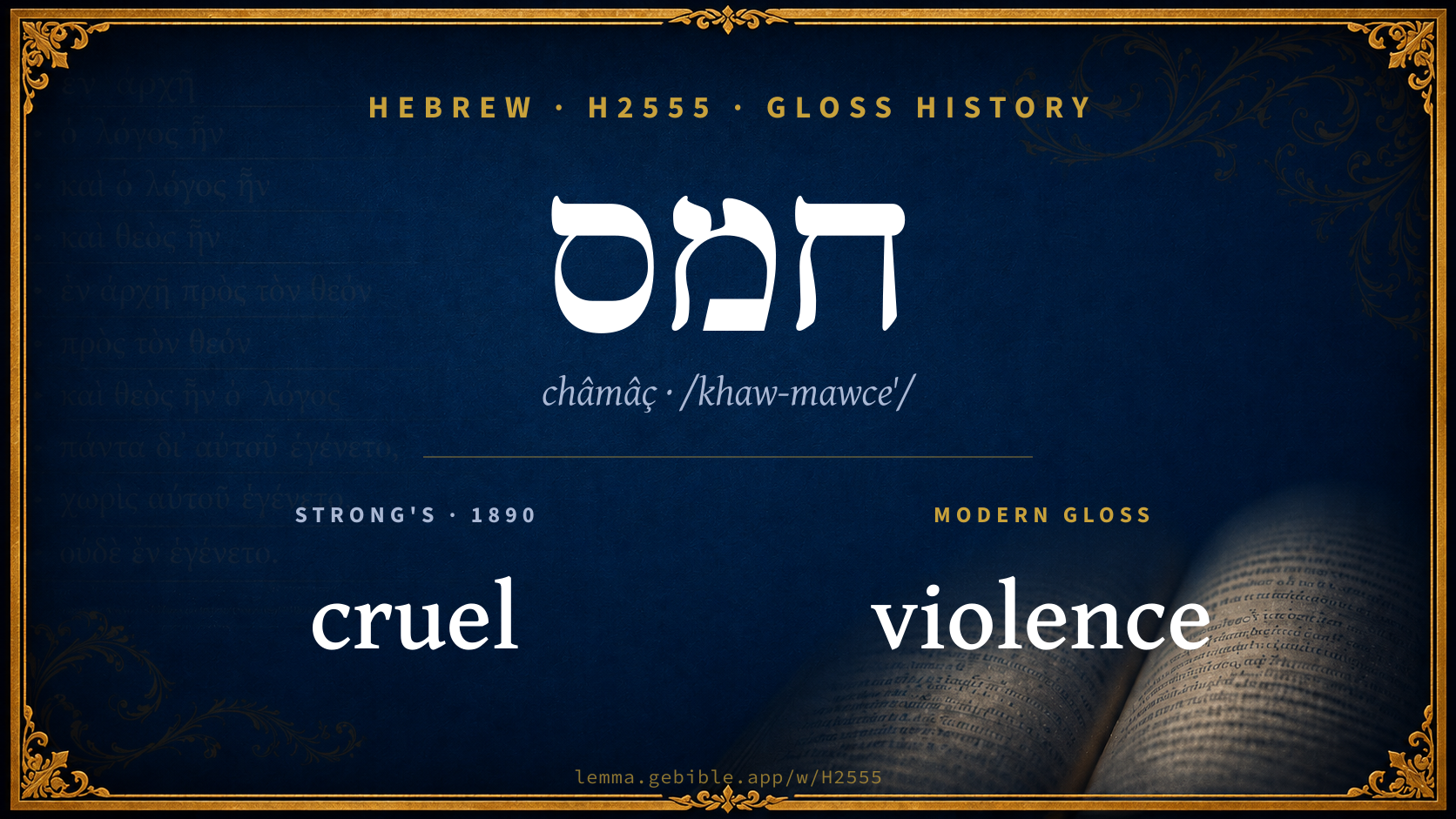
Gloss history
Strong's 1890 vs modern scholarship
About this word
Strong's H2555 catalogs a Hebrew word from the Hebrew Old Testament.
These counts are not copied from any lexicon or concordance. They are computed here, from the morphology-tagged Hebrew Old Testament. What Lemma adds →
- 59
- distinct verses
- The word appears in 59 distinct verses.
- 20 / 39
- OT books
- The word appears in 20 of 39 Old Testament books.
- #639
- by frequency
- Top 1000 most frequent Hebrew words (rank 639 of 8,640 Hebrew words by occurrence).
View all 59 occurrences in the concordance →
By section of the Old Testament
By traditional corpus
Conventional, traditional groupings — biblical authorship is debated, so this is a traditional corpus grouping, not an authorship claim. Each share is this word’s portion of its verses in that division of the Hebrew canon. Each figure is a share of the word’s 59 distinct verses.
- Prophets (Nevi'im) 29 verses · 49%
- Writings (Ketuvim) 24 verses · 41%
- Torah (Pentateuch) 6 verses · 10%
How translations render this word
Counts come from each version’s own published word-to-Strong’s tagging or interlinear alignment — an approximate guide to how each version renders this word, not a word-level alignment the data otherwise carries. Because each total is that version’s own tagged count, the per-version totals vary from one another and need not match the appearance or distinct-verse counts above. These counts may also differ from a printed concordance because Lemma counts each distinctly tagged rendering and does not collapse phrase taggings into a single head-word total. This is a fixed set of word-tagged versions (KJV, ASV, BSB, ULT) and does not change with the reading translation you choose elsewhere. Each version’s license is shown beside its name below (and on Sources).
- King James Version: Violence 34×, Violent 7×, Cruelty 4×
- American Standard Version: Violence 38×, Violent 3×, Thou deliverest me from the violent 2×
- Berean Standard Bible: Violence 47×, Violent 4×
- unfoldingWord Literal Text: Violence 47×, Violence of 5×
King James Version Public Domain
Renders H2555 across 59 tagged occurrences — most commonly:
Plus 9 renderings that appear only once — usually multi-word phrases or single function words the recovered tagging swept in, not distinct renderings. Not rendered by a distinct English word in 1 further occurrence.
American Standard Version Public Domain
Renders H2555 across 59 tagged occurrences — most commonly:
Plus 12 renderings that appear only once — usually multi-word phrases or single function words the recovered tagging swept in, not distinct renderings.
Berean Standard Bible Public Domain
Renders H2555 across 60 tagged occurrences — most commonly:
Plus 9 renderings that appear only once — usually multi-word phrases or single function words the recovered tagging swept in, not distinct renderings.
unfoldingWord Literal Text CC BY-SA 4.0
Renders H2555 across 61 tagged occurrences — most commonly:
Plus 9 renderings that appear only once — usually multi-word phrases or single function words the recovered tagging swept in, not distinct renderings.
Senses in BDB
The 1 sense BDB distinguishes for this word, in lexicon order (not ranked by frequency or importance). The full entry — with sub-senses — is in the Lexicon Entry tab.
- violence, wrong, cruelty, injustice
Word origin
n.m. ψ 7:17 violence, wrong—abs. ח׳ Gn 6:11 + 44 times; cstr. חֲמַס Ju 9:24 + 7 times; sf. חֲמָסִי Gn 16:5; Je 51:35 (in both = wrong done to me); חֲמָסוֹ ψ 7:17; pl. חֲמָסִים 2 S 22:49 + 3 times;—violence specif. of physical violence Ju 9:24; 2 S 22:3 (not ‖ ψ 18:3), Ob10, Hb 1:9; Je 51:35 (of Chaldeans), Hb 2:8, 17(×2) Jo 4:19 ψ 72:14; but also wrong, incl. injurious language, harsh treatment, etc. Gn 16:5 (J, of wrong done to Sarah by Hagar), Jb 19:7 Mal 2:16; in gen. of rude wickedness of men, their noisy, wild, ruthlessness Mi 6:12 Hb 1:2; Zp 1:9 Pr 10:6, 11; 13:2; 26:6 + Ez 7:11 (si vera l., v. Co), ‖ שֹׁד Am 3:10; Hb 1:3; Je 6:7; 20:8; Ez 45:9; Is 60:18, ‖ רִיב ψ 55:10, ‖ עָמָל 7:17, ‖ גַּאֲוָה 73:6, אֹהֵב ח׳ 11:5 (‖ רָשָׁע), denied, of servant of י׳ Is 53:9, ח׳ בארץ Je 51:46, cf. Gn 6:11, 13 (P), Ez 8:17; 12:19; מָֽלְאוּ מַחֲשַׁכֵּי־אֶרֶץ נְאוֹת ח׳ ψ 74:20, הָעִיר מָֽלְאָה ח׳ Ez 7:23; 28:16, שֶׁבֶת ח׳ Am 6:3 is (prob.) enthronement of violence; כְּלֵי ח׳ Gn 49:5 (poem) instruments, weapons, of violence;—other phrases are: ח׳ בְּיָדַיִם Jon 3:8; 1 Ch 12:17, cf. Jb 16:17, ח׳ יְדֵיכֶם ψ 58:3 and פֹּעַל ח׳ בְּכַפֵּיהֶם Is 59:6; עֵד ח׳ i.e. a witness that promotes violence and wrong Ex 23:1 (JE), Dt 19:16, עֵדֵי ח׳ ψ 35:11; עֵדֵי שֶׁקֶר וִיפֵחַ חָמָס ψ 27:12; שׂנאת ח׳ ψ 25:19 = hatred characterized by violence; אִישׁ חָמָס = violent man ψ 18:49 (2 S 22:49 has the later א׳ חמסים, cf. infr.) 140:12 Pr 3:31; 16:29; אישׁ חמסים (later) ψ 140:2, 5; 2 S 22:49; יֵין חֲמָסִים Pr 4:17 i.e. wine gained by violence (‖ לֶחֶם רֶשַׁע).
— Brown-Driver-Briggs (Oxford 1906, public domain), digitized via Sefaria, supplemented by the OpenScriptures HebrewLexicon (CC BY 4.0). See Sources.
Derived from חמס (châmaç) (H2554) — to wrong.
Jastrow Dictionary
A second Hebrew/Aramaic lexicon for comparison, covering Aramaic and post-biblical (Talmudic, Targumic, Midrashic) usage that the biblical-Hebrew BDB does not. Matched by lemma rather than by Strong’s number, so a lemma may carry more than one Jastrow headword (shown separately below), and the entries cover usage well beyond the Bible.
חמס
- , Ukts. III, 5, v. חֲמָם
חָמַס
- v. Ges. H. Dict.10 s. v.) [to be heated, passionate,] to insult, do violence, to rob. Y. Ab. Zar. II, 40ᵈ bot. לא סוף … אלא חֲמוֹס וכ׳ finally one does not say to another man, Kill that man, but, Attack &c. Gen. R. s. 45 (ref. to חמסי, ib. XVI, 5) חוֹמְסֵנִי את בדברים וכ׳ thou provokest me to speak harshly, because thou seest &c. Gen. R. s. 65, beg. מלכות … גוזלת וחוֹמֶסֶת the wicked government (Rome) robs and extorts; a. fr.—Lev. R. s. 26 דור ודור וחוֹמְסָיו each generation with its violent men.—Part. pass. חָמוּס. Ib. s. 30 גזול אני ח׳ אני I have been taken by force, by extortion.
- to be ruined (cmp. חָבַל). Lam. R. to II, 6 כגנה שנ׳ מעיינה וכ׳ like a garden the spring of which has been ruined, so that its vegetables fade.
- (of beasts of prey) to seize with fangs, scratch with nails. Gen. R. s. 45 (play on חמסי, v. supra) חִימְּסָה פניו Ar. (ed. בפניו, some ed. חימסא, incorr.) she scratched his face; Y’lamd. to Gen. l. c. (quot. in Ar.) חיטטה אותו וחימסה פניו כנמיה she scratched him and marked his face like a marten; Yalk. ib. 79 (not חומסה).
חֲמַס
- —Denom. חומָסָא.
- to do violence to one’s self, to restrain one’s self. Targ. II Esth. V, 10, v. חֲמַם. [Targ. Y. Gen. VII, 21 אתחמסי, read: אִתְמְסִי or אִתְהַמְסִי, v. מְסִי.]
חָמָס
- preced.) violence, extortion. Y. B. Mets. IV, 9ᶜ bot. (ref. to Gen. VI, 13) מה היה חֲמָסָן what was the nature of their violence? Gen. R. s. 31 (distinction between ח׳ a. גֶּזֶל); a. e.—Pl. חֲמָסִים. Gen. R. s. 65 … שלא גזילות ח׳ that thou wilt not give me to eat what has been obtained by robbery or extortion. Lev. R. s. 2. Koh. R. to III, 9; a. e. e.g. Genesis 6:13
A Dictionary of the Targumim, the Talmud Babli and Yerushalmi, and the Midrashic Literature (Marcus Jastrow; London, Luzac, 1903) — Public Domain. Digitized via Sefaria. Digitized via Sefaria. Full attribution on Sources.
Forms in the corpus
The 30 distinct written forms H2555 takes in the Hebrew Bible, most frequent first — each parse links to that state’s occurrences in the concordance. Hebrew forms include their vowel points and cantillation, so a single lemma takes many written forms.
Same root — word family
Other BDB entries built from the same root as H2555, grouped by Strong’s listed origin. These share a root / origin per the lexicon — not necessarily a shared meaning. Each links to that word’s own entry.
Derives from
Shares the same root
Compare all same-root words → They share a root, not necessarily a meaning.
Septuagint verse parallels
This word appears in 52 verses that also exist in the Greek Old Testament (Septuagint), out of the 59 Hebrew verses it occurs in. You can read those verses in Greek by switching the Old Testament edition to the Septuagint.
Read these verses in the Septuagint
- Genesis 6:11
- Exodus 23:1
- Deuteronomy 19:16
- Judges 9:24
- 2 Samuel 22:3
- 1 Chronicles 12:17
- Job 16:17
- Psalms 7:16
- Proverbs 3:31
- Isaiah 53:9
- Jeremiah 6:7
- Ezekiel 7:11
This is a verse-level parallel only — the same verses exist in both the Hebrew and Greek Old Testaments. No word-level Hebrew↔Greek correspondence is claimed: the data carries no such alignment, so no Greek word is shown as this Hebrew word’s translation. Coverage is not total — the Septuagint omits the deuterocanon and renumbers the Psalms, so some Hebrew verses have no direct Greek parallel.