Zephaniah 1:9

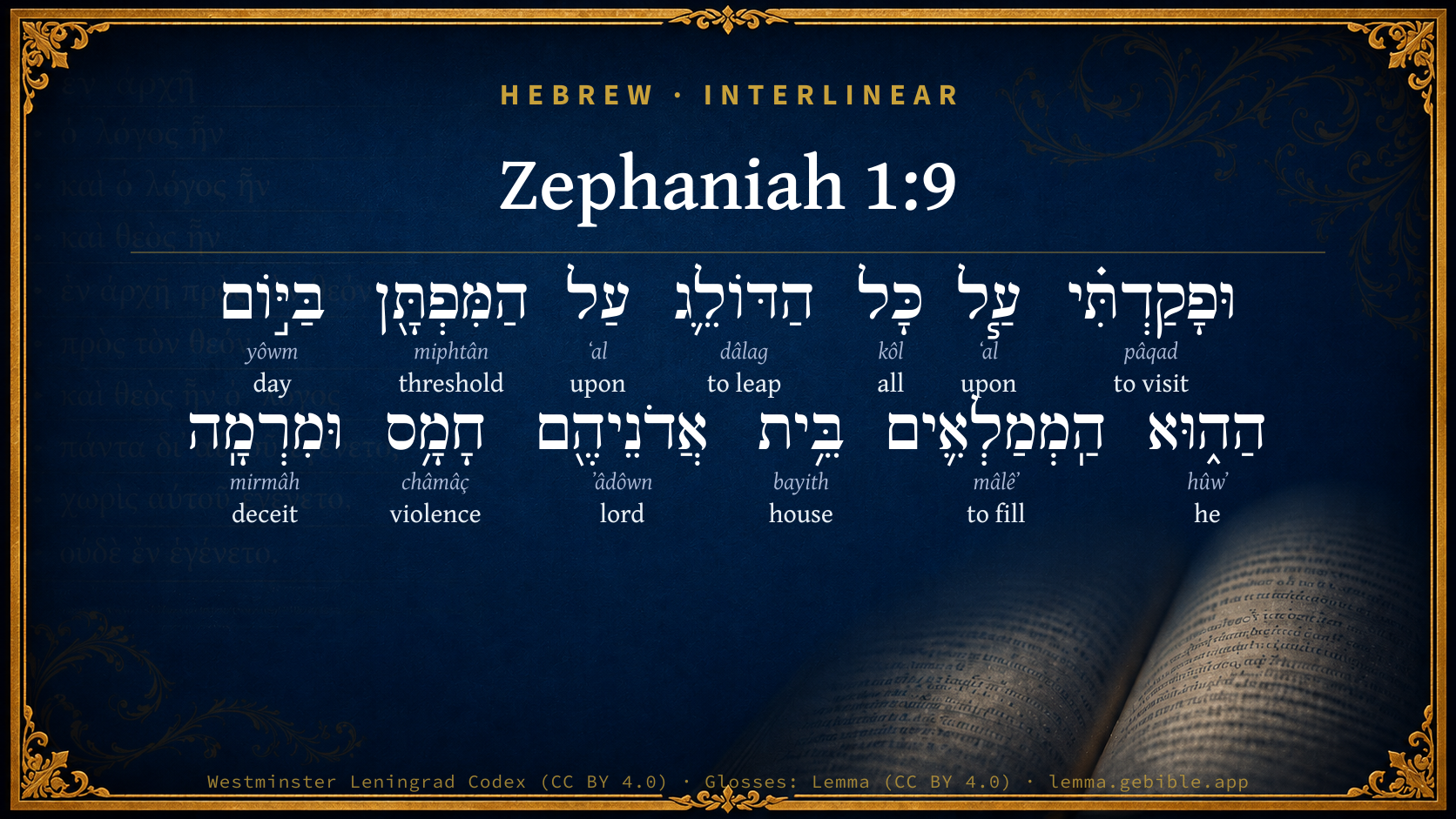
Hebrew (Westminster Leningrad Codex) Zephaniah 1:9 appears in the Hebrew Old Testament. The text above is from the Westminster Leningrad Codex. Each word links to its Strong’s number, a concise gloss, and parsing drawn from the Open Scriptures Hebrew Bible morphology. Click any word for its full Brown-Driver-Briggs (BDB) entry.
Download image
Cite this verse

Zephaniah 1:9 (World English Bible). Public Domain. Lemma interlinear Bible study tool, https://lemma.gebible.app/v/zephaniah/1/9.

Show BibTeX & RIS
BibTeX
RIS
English Translation
In that day, I will punish all those who leap over the threshold, who fill their master's house with violence and deceit.
World English Bible · Public Domain
Download a study sheet

One document with this verse’s original text, its word-by-word gloss line, the meaning frame, cross-references with their text, attributed commentary, and full source and license credits — printable, and it pastes into notes with its structure intact.

This verse Autodidact and up

Study sheet (.html) Plain text (.txt)

A passage Seminary Student

Up to 50 verses in one chapter. A passage sheet keeps up to 6 commentary sources and 12 cross-references per verse, in the order this page ranks them, and says so on the sheet whenever that leaves anything out. Ask for a single verse and you get the Autodidact verse sheet above.

Everything on this page stays free to read, with no account — the sheet is a download of what is already on screen, not access to it.

Want to remove ads? Support Godless Engineer
Compare translations 3

The same verse in 3 English versions, stacked beneath the original-language interlinear above. Click any original word for its lexicon entry.

Each is an independent rendering of the whole verse — the interlinear is not word-aligned to these translations.

Highlighted words mark where these versions differ — a whole-verse word diff, not a word-by-word alignment.

  • World English Bible Public Domain
    In that day, I will punish all those who leap over the threshold, who fill their master's house with violence and deceit.
  • King James Version Public Domain
    In the same day also will I punish all those that leap on the threshold, which fill their masters' houses with violence and deceit.
  • unfoldingWord Literal Text CC BY-SA 4.0
    and on that day I will visit upon all the ones leaping over the threshold, the ones filling the house of their lords violence and fraud.

unfoldingWord Literal Text — © unfoldingWord, licensed CC BY-SA 4.0. Word-aligned USFM3 via Door43 (git.door43.org/unfoldingWord/en_ult).

Versions to compare (up to 4)

3 of 4 selected

Show all 18 translations

Every available English version of this verse, each an independent rendering of the whole verse.

  • World English Bible Public Domain
    In that day, I will punish all those who leap over the threshold, who fill their master's house with violence and deceit.
  • Berean Standard Bible Public Domain
    On that day I will punish all who leap over the threshold, who fill the house of their master with violence and deceit.
  • Majority Standard Bible Public Domain
    On that day I will punish all who leap over the threshold, who fill the house of their master with violence and deceit.
  • King James Version Public Domain
    In the same day also will I punish all those that leap on the threshold, which fill their masters' houses with violence and deceit.
  • American Standard Version (1901) Public Domain
    And in that day I will punish all those that leap over the threshold, that fill their master's house with violence and deceit.
  • Revised Version (1885) Public Domain
    And in that day I will punish all those that leap over the threshold, which fill their master’s house with violence and deceit.
  • Geneva Bible (1599) Public Domain
    In the same day also will I visite all those that dance vpon the threshold so proudly, which fill their masters houses by crueltie and deceite.
  • Douay-Rheims (1899) Public Domain
    And I will visit in that day upon every one that entereth arrogantly over the threshold: them that fill the house of the Lord their God with iniquity and deceit.
  • Young's Literal Translation Public Domain
    And I have laid a charge on every one Who is leaping over the threshold in that day, Who are filling the house of their masters `With' violence and deceit.
  • Literal Standard Version CC BY-SA 4.0
    And I have laid a charge on everyone || Who is leaping over the threshold in that day, || Who are filling the house of their masters || [With] violence and deceit.
  • Unlocked Literal Bible CC BY-SA 4.0
    On that day I will punish all those who leap over the threshold, those who fill their master's house with violence and deceit.
  • unfoldingWord Literal Text CC BY-SA 4.0
    and on that day I will visit upon all the ones leaping over the threshold, the ones filling the house of their lords violence and fraud.
  • Darby Bible Public Domain
    And in that day will I punish all those that leap over the threshold, who fill their master's house with violence and deceit.
  • World Messianic Bible Public Domain
    In that day, I will punish all those who leap over the threshold, who fill their master’s house with violence and deceit.
  • Webster's Bible Public Domain
    In the same day also will I punish all those that leap on the threshhold, who fill their masters' houses with violence and deceit.
  • Free Bible Version CC BY-SA 4.0
    I will also punish those who jump over the threshold. On that day I will punish those who fill up their masters' houses using violence and deception.
  • Bible in Basic English Public Domain
    And in that day I will send punishment on all those who come jumping over the doorstep and make their master's house full of violent behaviour and deceit.
  • JPS Tanakh (1917) Public Domain
    In the same day also will I punish all those that leap over the threshold, that fill their master's house with violence and deceit.

Literal Standard Version (2020), Covenant Press — licensed CC BY-SA 4.0. Text via the HelloAO Bible API (eBible.org). Unlocked Literal Bible (unfoldingWord) — licensed CC BY-SA 4.0. Text via the HelloAO Bible API (eBible.org). unfoldingWord Literal Text — © unfoldingWord, licensed CC BY-SA 4.0. Word-aligned USFM3 via Door43 (git.door43.org/unfoldingWord/en_ult). Free Bible Version, Dr. Jonathan Gallagher — licensed CC BY-SA 4.0. Text via the HelloAO Bible API (eBible.org).

Word by word

More ways to search: Search by grammar → Find every occurrence → Compare this word →

Practice this passage: Drill this verse → Learn its vocabulary →

הַדּוֹלֵ֛ג
dâlag
H1801
“the · leaping”
Particle, Definite Article + Verb, Qal, Participle Active, Masculine, Singular, Absolute
Part of Speech
Particle + Verb
Stem
Qal
Form
Participle Active
Gender
Masculine
Number
Singular
State
Absolute
Full BDB Definition

Origin: a primitive root

TWOT: 430

to leap - (Qal) to leap - (Piel) to leap, leap over
  1. וּפָקַדְתִּ֗י pâqad H6485 “and · to visit” Conjunction + Verb, Qal, Sequential Perfect, 1st Person, Common, Singular
  2. עַ֧ל ʻal H5921 “upon” Preposition
  3. כָּל kôl H3605 “all of” Noun, Common, Masculine, Singular, Construct
  4. עַל ʻal H5921 “upon” Preposition
  5. הַמִּפְתָּ֖ן miphtân H4670 “the · threshold” Particle, Definite Article + Noun, Common, Masculine, Singular, Absolute
  6. בַּיּ֣וֹם yôwm H3117 “in/at the · day” Preposition, Determined + Noun, Common, Masculine, Singular, Absolute
  7. הַה֑וּא hûwʼ H1931 “the · he” Particle, Definite Article + Pronoun, Personal, 3rd Person, Masculine, Singular
  8. הַֽמְמַלְאִ֛ים mâlêʼ H4390 “the · filling” Particle, Definite Article + Verb, Piel, Participle Active, Masculine, Plural, Absolute
  9. בֵּ֥ית bayith H1004 “house of” Noun, Common, Masculine, Singular, Construct
  10. אֲדֹנֵיהֶ֖ם ʼâdôwn H113 “lords · their” Noun, Common, Masculine, Plural, Construct + Suffix, Personal, 3rd Person, Masculine, Plural
  11. חָמָ֥ס châmâç H2555 “violence” Noun, Common, Masculine, Singular, Absolute
  12. וּמִרְמָֽה mirmâh H4820 “and · deceit” Conjunction + Noun, Common, Feminine, Singular, Absolute

About this verse

These counts appear in no published source. They are computed here, from the morphology-tagged text and Lemma’s own curated glosses. What Lemma adds →

13
words
12
distinct lemmas
Prophets
section

Notable vocabulary

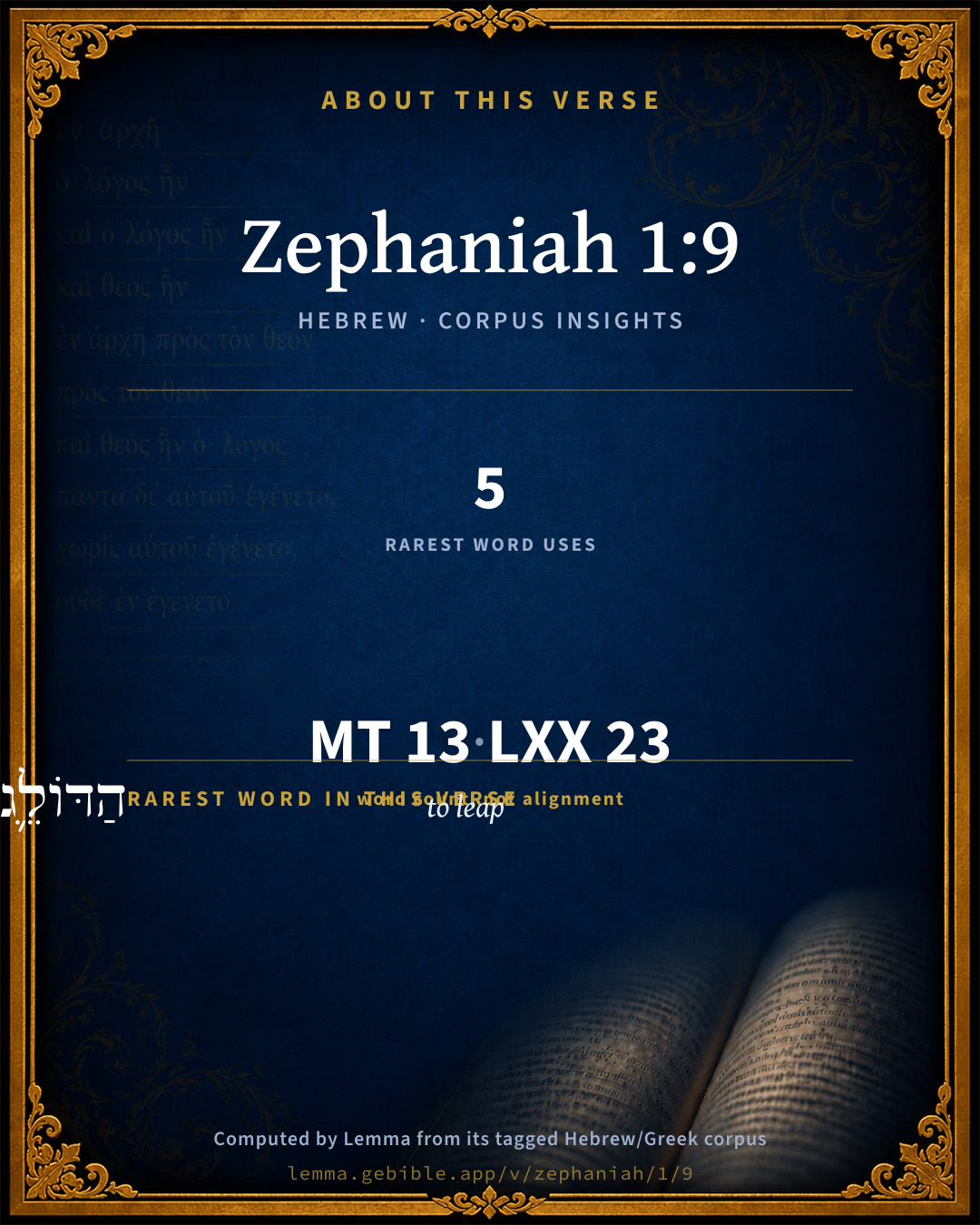
The rarest word here is הַדּוֹלֵ֛ג to leap H1801 — appearing just 5 times in the whole Hebrew Bible.

Shared distinctive vocabulary

הַדּוֹלֵ֛ג to leap H1801 occurs in 5 verses of the Hebrew Bible. Also found in:

Grammatical profile

  • 3 verbs
  • 7 nouns
  • 1 pronoun
  • 2 prepositions

Verb forms

  • וּפָקַדְתִּ֗י Qal · Sequential Perfect
  • הַדּוֹלֵ֛ג Qal · Participle Active
  • הַֽמְמַלְאִ֛ים Piel · Participle Active

Repetition

A word recurs within this verse — often emphatic in Hebrew:

  • עַ֧ל upon H5921 ×2

Hebrew & Septuagint length

In English translation the verse runs 22 words from the Hebrew and 28 from the Septuagint (LXX English) — closely comparable.

A rough comparison of the two English renderings, which tokenize alike — not a word-level alignment.

Word counts can differ between the Hebrew and the Greek without any difference in meaning — e.g. the Hebrew direct-object marker אֵת has no separate Greek word, and Greek often adds the article ὁ.

In the original languages it is 13 Hebrew tokens and 23 Greek tokens — but the two are counted differently (Hebrew bundles its prefixes and suffixes into one token; the Greek is in lemma form), so that isn’t a like-for-like length.

Cross-references

7

Topical passages linked to Zephaniah 1:9 in the Treasury of Scripture Knowledge — connected by theme and wording, ordered by reader-vote popularity; previews shown in the World English Bible.

  • 1 Samuel 5:5 Therefore neither the priests of Dagon, nor any who come into Dagon's house, tread on the threshold of Dagon in Ashdod, to this day.
  • Amos 3:10 "Indeed they don't know to do right," says Yahweh, "Who hoard plunder and loot in their palaces."
  • 1 Samuel 2:15–16 Yes, before they burnt the fat, the priest's servant came, and said to the man who sacrificed, Give flesh to roast for the priest; for he will not have boiled flesh of you, but raw.
  • 2 Kings 5:20–27 But Gehazi the servant of Elisha the man of God, said, Behold, my master has spared this Naaman the Syrian, in not receiving at his hands that which he brought: as Yahweh lives, I will run after him, and take somewhat of him.
  • Nehemiah 5:15 But the former governors who were before me were chargeable to the people, and took of them bread and wine, besides forty shekels of silver; yes, even their servants bore rule over the people: but I didn't do so, because of the fear of God.
  • Proverbs 29:12 If a ruler listens to lies, All of his officials are wicked.
  • Acts 16:19 But when her masters saw that the hope of their gain was gone, they seized Paul and Silas, and dragged them into the marketplace before the rulers.

Cross-references courtesy of OpenBible.info (CC BY 4.0).

Hebrew and Greek witnesses Masoretic Hebrew ↔ Greek Septuagint

The same verse in the two great witnesses to the Old Testament, shown verse-for-verse.

These are two independent witnesses, not word-aligned to each other, and the Septuagint is shown in lemma (dictionary) form.

Hebrew Zephaniah 1:9 Masoretic · Westminster Leningrad Codex

וּפָקַדְתִּ֗י עַ֧ל כָּל הַדּוֹלֵ֛ג עַל הַמִּפְתָּ֖ן בַּיּ֣וֹם הַה֑וּא הַֽמְמַלְאִ֛ים בֵּ֥ית אֲדֹנֵיהֶ֖ם חָמָ֥ס וּמִרְמָֽה

In that day, I will punish all those who leap over the threshold, who fill their master's house with violence and deceit.

World English Bible · Public Domain

Greek LXX Zephaniah 1:9 Septuagint · lemma form

καί ἐκδικέω ἐπί πᾶς ἐμφανῶς ἐπί ὁ πρόπυλον ἐν ἐκεῖνος ὁ ἡμέρα ὁ πληρόω ὁ οἶκος κύριος ὁ θεός αὐτός ἀσέβεια καί δόλος

And I will openly take vengeance on the porches in that day, on the men that fill the house of the Lord their God with ungodliness and deceit.

LXX2012 (modern English Septuagint) · Public Domain

On this verse, Haydock's Catholic Bible Commentary discusses the Septuagint’s reading. Read the note in Commentary ↓

Hebrew: Westminster Leningrad Codex (CC BY 4.0). Greek: Septuagint (public domain); English from LXX2012 (modern English Septuagint) (Public Domain). How the Septuagint differs from the Hebrew →

Targum (Aramaic paraphrase)

1

The Targum is the ancient Jewish Aramaic paraphrase of the Hebrew Scriptures — an interpretive translation, not the Hebrew text itself. Onkelos (literal) and Pseudo-Jonathan (expansive) render the Torah, and Jonathan the Prophets. Coverage is partial: where no permissively-licensed English translation exists for a verse, only the Aramaic is shown. This is verse-level text, not a word-by-word alignment to the Hebrew.

  1. Targum Jonathan Prophets (Joshua–Malachi)
    וְאַסְעַר עַל כָּל דִמְהַלְכִין בְּנִימוּסֵי פְלִשְׁתָּאֵי בְּעִדָנָא הַהִיא דְמָלַן בֵּית רִבּוֹנֵיהוֹן חֲטוֹף וְנִכְלִין:

    (no public-domain English translation for this verse)

    Targum Jonathan — Aramaic: “Mikraot Gedolot” (public domain). English: “Sefaria Community Translation” (CC0 1.0 (public-domain dedication)); “London "Chaldee Paraphrase," 1871” (public domain). Text via Sefaria.

Commentary

Notes on Zephaniah 1:9 from classic Christian and Jewish commentators (each source and its license shown beneath its notes). The classic Christian expositions comment on the surrounding passage and are grouped to its opening verse, so a note may address several verses; the Jewish commentaries on the Tanakh (Rashi and others) are per-verse, so they appear only where the commentator wrote on this verse.

Lemma curates 59 commentaries, every one of them public domain or Creative Commons licensed, each selected and text-cleaned for this edition rather than reprinted as found. About our sources →

Trapp's Complete Commentary

John Trapp

Zep 1:9 In the same day also will I punish all those that leap on the threshold, which fill their masters’ houses with violence and deceit.

Ver. 9. In the same day also will I punish all those that leap on the threshold] i.e. Great men’s officers, who by an absolute power went into other men’s houses, and to whom no doors were shut, saith Mr Diodati. These leap upon the threshold, that is, with great impudence and insolence, they invade and spoil other men’s houses, and do what they wish, like so many lurdaines, or lord danes: neither dare any question or control them. Lo, such things were done in good Josiah’s days without his consent or so much as knowledge; for none might be suffered to come to him with a complaint; always being shut up by those great ones about him, whose houses were by that means filled with violence and deceit, that is, with those ill-gotten goods, got by wrench and wile from the right but unrelieved possessors, through the might and sleight of those unconscionable subordinates.

John Trapp, A Commentary or Exposition upon All the Books of the Old and New Testament (1647–1656) — public domain. Text from a community e-Sword module.

Tyndale Open Study Notes

Tyndale Open Resources

1:9 those who participate in pagan worship ceremonies (literally those who leap over the threshold): The people of Judah perpetuated the pagan custom of leaping over the threshold of a temple to avoid contact with it, in deference to that pagan god (see 1 Sam 5:1-5).

Tyndale Open Study Notes — © Tyndale Open Resources, licensed CC BY-SA 4.0. Text via the HelloAO Bible API.

Geneva Bible (1599)

Geneva Bible translators

He meaneth the servants of the rulers which invade other men’s houses, and rejoice and leap for joy, when they can get any prey to please their master withall.

Geneva Bible (1599) marginal notes — public domain. Text via Bolls.life.

Jamieson, Fausset & Brown

Robert Jamieson, A. R. Fausset & David Brown

those that leap on the threshold--the servants of the princes, who, after having gotten prey (like hounds) for their masters, leap exultingly on their masters' thresholds; or, on the thresholds of the houses which they break into [CALVIN]. JEROME explains it of those who walk up the steps into the sanctuary with haughtiness. ROSENMULLER translates, "Leap over the threshold"; namely, in imitation of the Philistine custom of not treading on the threshold, which arose from the head and hands of Dragon being broken off on the threshold before the ark (Sa1 5:5). Compare Isa 2:6, "thy people . . . are soothsayers like the Philistines." CALVIN'S view agrees best with the latter clause of the verse.

fill . . . masters' houses with violence, &c.--that is, with goods obtained with violence, &c.

Jamieson, Fausset & Brown — Commentary Critical and Explanatory on the Whole Bible (1871) — public domain (CC PDM 1.0). Text via the HelloAO Bible API.

Adam Clarke's Commentary

Verse 9. That leap on the threshold] Or, that leap over the threshold. It is most probable that the Philistines are here meant. After the time that Dagon fell before the ark, and his hands were broken off on the threshold of his temple, his worshippers would no more set a foot upon the threshold, but stepped or leaped over it, when they entered into his temple. The Chaldee understands this of the Philistines, without giving this reason for it. Some understand it of haughtiness and pride: others think that leaping on the threshold refers to the customs of the Arabs, who used to ride into people's houses and take away whatever they could carry; and that this is the reason why, in several parts of the East, they have their doors made very low, to prevent those depredators from entering. In this manner, we learn the Persians have frequently oppressed the poor Armenians, going on horseback into their houses, and taking whatever they thought proper. Mr. Harmer understands it in this way.

Adam Clarke's Commentary on the Bible (1810–1826) — public domain. Text from a community e-Sword/MySword module.

Ellicott's Commentary for English Readers

(9) Their masters’ houses.—Better, their lord’s house, meaning the temple of their idol-deity. Probably the true interpretation of this obscure verse is that the idolaters had adopted a usage prevalent in the Philistine temples of Dagon—that of leaping over the threshold on entering the idol’s temple. (See 1Sa_5:5.) When they entered it they filled it with “violence and deceit” by bringing thither offerings acquired by fraud and oppression. Another interpretation makes the verse relate exclusively to plunder and unjust acquisition of goods. “Leaping the threshold” is then expounded as “a sudden rushing into houses to steal the property of strangers,” and the offenders are identified as “servants of the king, who thought they could best serve their master by extorting treasures from their dependants by violence and fraud” (Ewald). It does not seem likely that such malpractices would have been tolerated among the retainers of the pious Josiah; it is possible, however, to suppose that he had not yet acquired sufficient authority to check them.

A Bible Commentary for English Readers, edited by Charles John Ellicott (1878–1897) — public domain. Text from a community e-Sword module.

The Cambridge Bible for Schools and Colleges

gen. ed. J. J. S. Perowne

9. those that leap on the threshold] Rather: leap (or, spring) over the threshold. The priests of Dagon avoided treading on the threshold of his temple because the idol had fallen upon it (1Sa_5:5). The connexion here, however, implies that leaping over the threshold is rather an act of violence, suggesting forcible invasion of the house, for the next clause, “that fill their master’s house with violence,” is a further description of those that leap over the threshold.

fill their masters’ houses] More probably: their master’s house, reference being to the king. Zep_1:8-9 seem to have a common subject, the princes and king’s children, that is, the officers of the king and the members of the royal family. Probably persons belonging to the collateral branches of the royal house filled judicial and other offices in the government.

with violence and deceit] Or, wrong and fraud. The words do not mean that wrong and fraud are committed in the house of the king, but that his house is filled with the proceeds of such things, cf. Isa_3:14-15. What is alluded to is the perversion of justice practised by the princes and the royal family for purposes of gain. At a later time Ezek. makes a similar complaint against the princes and royal house (ch. Eze_22:25-29. In Eze_22:25 read princes).

The Cambridge Bible for Schools and Colleges (gen. ed. J. J. S. Perowne; Cambridge University Press, 1878–1918) — public domain. Text from a community e-Sword module.

John Gill's Exposition

In the same day also will I punish all those that leap on the threshold Not in a ludicrous way, who, by dancing and leaping, made sport for persons, and brought their masters much gain, as the damsel possessed with a spirit of divination did, ( Acts 16:16 ) rather, that entered rashly and irreverently into the house of God; or else in an idolatrous way, who, when they went into an idol's temple, did not tread upon the threshold, but leaped over it, as the priests of Dagon, after the fall of that idol on the threshold, ( 1 Samuel 5:4 1 Samuel 5:5 ) . So the Targum, ``and I will visit all those that walk in the laws (or according to the customs) of the Philistines;'' whose idol Dagon was: but it seems better to interpret it of such, who, seeing houses full of good things, in a rude, bold, insolent manner, thrust themselves, or jumped into them, and took away what they pleased; or when they returned to their masters' houses with their spoil, who set them on, and encouraged them in these practices, leaped over the threshold for joy of what they had got, as Aben Ezra observes; which agrees with what follows: which fill their masters' houses with violence and deceit; that is, with goods got by rapine and force, and by fraudulent ways and methods: this is to be understood of the servants of great men, who, to feed the ambition and avarice of their masters, used very oppressive methods with inferior persons to get their substance from them, and gratify their masters. Cocceius interprets these "three" verses of the day of Christ's coming in the flesh being at hand, when the true sacrifice should be offered up, and God would call his people to feed by faith upon it; when all civil power and authority in the sanhedrim and family of David should be removed from the Jews; and all friendship with the nations of the world, signified by likeness of garments; and the priestly dignity, the priests, according to him, being those that leaped over the threshold; that is, of the house of the Lord, the temple, and filled it with the spoil of widows' houses, unsupportable precepts, and false doctrines.

John Gill's Exposition of the Whole Bible (1746–1763) — public domain (CC PDM 1.0). Text via the HelloAO Bible API.

Albert Barnes' Notes on the Bible

I will punish all those that leap on the threshold - Neither language nor history nor context allow this to be understood of the idolatrous custom of Ashdod, not to tread on the threshold of the temple of Dagon. It had indeed been a strange infatuation of idolatry, that God’s people should adopt an act of superstitious reverence for an idol in the very instance in which its nothingness and the power of the true God had been shown. Nothing is indeed too brutish for one who chooses an idol for the true God, preferring Satan to the good God. Yet, the superstition belonged apparently to Ashdod alone; the worship of Dagon, although another form of untrue worship, does not appear, like that of Baal, to have fascinated the Jews; nor would Zephaniah, to express a rare superstition, have chosen an idiom, which might more readily express the contrary, that they “leapt “on” the threshold,” not over it.

They are also the same persons, who “leap on the threshold,” and who “fill their masters’ houses with violence and deceit.” Yet, this relates, not to superstition, but to plunder and goods unjustly gotten. As then, before, he had declared God’s judgments upon idolatry, so does he here upon sins against the second table, whether by open violence, or secret fraud, as do also Habakkuk Hab 1:2-3, and Jeremiah Jer 5:27. All, whether open or hidden from man, every wrongful dealing, (for every sin as to a neighbor’s goods falls under these two, violence or fraud) shall be avenged in that day. Here again all which remains is the sin. They enriched, as they thought, their masters by art or by force; they schemed, plotted, robbed; they succeeded to their heart’s wish; but, “ill-gotten, ill-spent!” They “filled their masters’ houses” quite full; but wherewith? with violence and deceit, which witnessed against them, and brought down the judgments of God upon them.

Albert Barnes' Notes on the Bible (1834–1885) — public domain. Text from a community e-Sword/MySword module.

Haydock's Catholic Bible Commentary

Entereth the temple, as if to shew themselves, Amos vi. 1. Hebrew, "jumpeth over," &c., denoting the Philistines. (Chaldean) (1 Kings v. 5.) (Calmet) --- Septuagint, "I will take vengeance on all openly before the gate in that day," (Haydock) on all who have cast themselves out of the Church. (St. Jerome) --- Lord. Hebrew, of their masters with," &c. This may relate to the Philistines, (Calmet) or to those who made the house of God a place of traffic, (Matthew xxi. 13.) and offered victims unjustly acquired. (Haydock)

George Leo Haydock (1774–1849), Haydock's Catholic Family Bible and Commentary, 1859 edition — public domain. Excludes Psalms (Douay-Rheims chapter numbering differs from Protestant) and Deuterocanonical books (Catholic canon only).

Matthew Poole's English Annotations

In the same day; not to be taken for a single day, but more largely for that time wherein God would visit and punish.

That leap on the threshold; insolently, and with rage, break open the doors of such whose goods they seize, upon pretence of forfeitures or fines; a sin that Ezekiel both taxed and threatened, Eze 8:17; 12:19; 45:9.

Their masters; either the oppressing kings, whose officers these were, or public officers and judges, whose servants thus did (to enrich their masters) spoil the poor and the oppressed.

With violence; goods taken away by force, and kept as much against right, as at first taken away without right;

and deceit, by false accusations, and by suborned evidence for proof, and by perjuries.

Matthew Poole's English Annotations on the Holy Bible (1683–1685) — public domain. Text from a community e-Sword/MySword module.

The Pulpit Commentary

Those that leap on (over) the threshold. These are the retainers of the princes, etc., named in ver. 8. There is no allusion to the circumstance of the priests of Dagon abstaining from treading on the threshold of their temple in consequence of what happened to the idol at Ashdod. (1Sa_5:5) It is inconceivable that this merely local custom, which demonstrated the impotence of the false god, should hare been imported into Judah. where, indeed, the worship of Dagon seems never to have made any way. The following clause explains the meaning which the Latin version intimates, Omnem qui arroganter ingreditur super limen all those who, carrying out their masters" wishes, violently invade the houses of others and pillage them of their contents. The expression, "to leap over the threshold," seems to have been a common term for burglary and stealing with violence. Which fill their masters" houses. These retainers plunder and steal in order that they may increase their masters" treasures. The king (though not Josiah) may be meant, the plural being the plural of majesty, or the idol temples. The LXX, followed by Jerome, renders, "who fill the house of the Lord their God." This is plainly erroneous, as there is no question here about the temple at Jerusalem. Violence and deceit; i.e. the fruits of, what they have extorted by, violence and fraud. (Jer_5:27)

The Pulpit Commentary (1880–1919), ed. H.D.M. Spence-Jones & Joseph S. Exell — public domain. Text from a community e-Sword module.

John Wesley's Explanatory Notes

In the same day - At the same time. Their masters houses - Either the oppressing kings, whose officers these were, or publick officers and Judges, whose servants thus spoiled the poor. Violence - Goods taken by force, by false accusations, or by suborned evidence.

John Wesley, Explanatory Notes Upon the Whole Bible (1754–1765) — public domain. Text via the GEBible commentary corpus.

Rashi

Rabbi Shlomo Yitzchaki (Rashi)

who leaps over the threshold Jonathan renders: who follows the customs of the Philistines, who would not step on the threshold of Dagon, as it is stated (I Sam. 5:5): “Therefore, the priests of Dagon... do not tread, etc.”

Rashi on the Tanakh — English translations: “The Judaica Press complete Tanach with Rashi, translated by A. J. Rosenberg” (CC BY 4.0); “Pentateuch with Rashi's commentary by M. Rosenbaum and A.M. Silbermann, 1929-1934” (public domain); “The Metsudah Tanach series, Lakewood, N.J” (CC BY 4.0); and “The Book of Joshua, Metsudah Publications, 1997” (CC BY 4.0). Text via Sefaria.

Lesson kit

Teaching starters — assembled from the data on this page, not authored interpretation. Every prompt links to the verse data it draws on. Edit before teaching.

Zephaniah, in the Prophets, opens this verse with 13 words (12 distinct Hebrew lemmas). Its most distinctive word is dâlag (“to leap”). A historical commentator’s framing appears above. Read the whole chapter for the surrounding context.

Discussion questions

  1. How does “to leap” (dâlag) shape what this verse is saying?
  2. 2 Samuel 22:30 shares the word «to leap» with this verse. How do the two illuminate each other?
  3. “upon” occurs 2× in this one verse. What is the effect of the repetition?
  4. These translations render this verse differently. What is at stake in choosing one wording over another?
  5. The verb «וּפָקַדְתִּ֗י» is Qal Sequential Perfect. How does its form color the action?
  6. Reading how Trapp's Complete Commentary and Tyndale Open Study Notes read this verse, where do the two commentators agree and where do they part?

Things to notice

Reading settings

Reading text

Shown beneath each verse's original-language words.

Old Testament
Old Testament edition

Read the OT as the Masoretic Hebrew (MT) or the Greek Septuagint (LXX).

English shown for the Greek Septuagint (in the Hebrew ↔ Greek comparison).

Comparing translations? Open the Compare panel on any verse page to stack up to four side by side.