
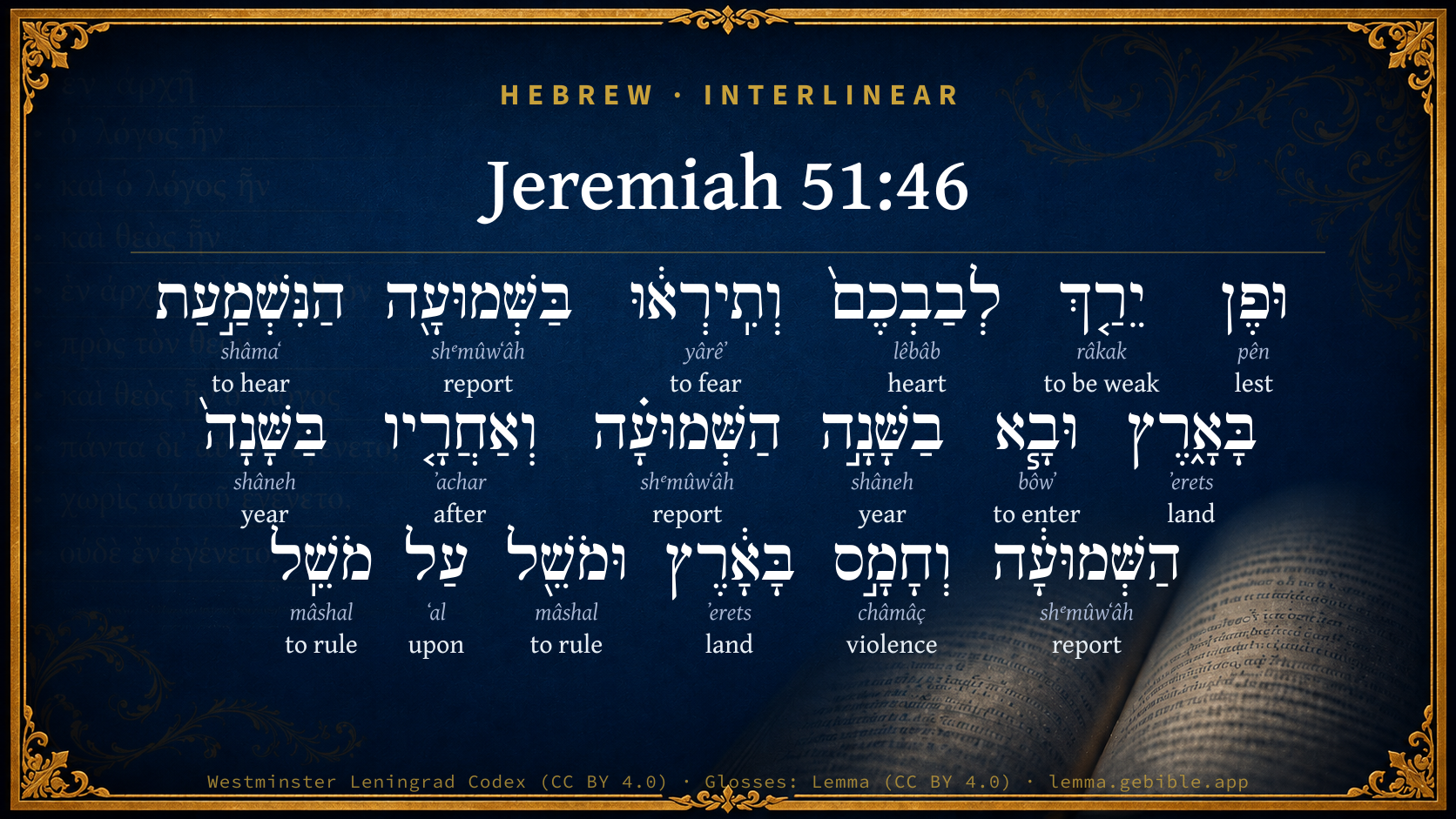
Jeremiah 51:46

Hebrew (Westminster Leningrad Codex) Jeremiah 51:46 appears in the Hebrew Old Testament. The text above is from the Westminster Leningrad Codex. Each word links to its Strong’s number, a concise gloss, and parsing drawn from the Open Scriptures Hebrew Bible morphology. Click any word for its full Brown-Driver-Briggs (BDB) entry.
Download image
Cite this verse

Jeremiah 51:46 (World English Bible). Public Domain. Lemma interlinear Bible study tool, https://lemma.gebible.app/v/jeremiah/51/46.

Show BibTeX & RIS
BibTeX
RIS
English Translation
Don't let your heart faint, neither fear for the news that shall be heard in the land; for news shall come one year, and after that in another year [shall come] news, and violence in the land, ruler against ruler.
World English Bible · Public Domain
Download a study sheet

One document with this verse’s original text, its word-by-word gloss line, the meaning frame, cross-references with their text, attributed commentary, and full source and license credits — printable, and it pastes into notes with its structure intact.

This verse Autodidact and up

Study sheet (.html) Plain text (.txt)

A passage Seminary Student

Up to 50 verses in one chapter. A passage sheet keeps up to 6 commentary sources and 12 cross-references per verse, in the order this page ranks them, and says so on the sheet whenever that leaves anything out. Ask for a single verse and you get the Autodidact verse sheet above.

Everything on this page stays free to read, with no account — the sheet is a download of what is already on screen, not access to it.

Want to remove ads? Support Godless Engineer
Compare translations 3

The same verse in 3 English versions, stacked beneath the original-language interlinear above. Click any original word for its lexicon entry.

Each is an independent rendering of the whole verse — the interlinear is not word-aligned to these translations.

Highlighted words mark where these versions differ — a whole-verse word diff, not a word-by-word alignment.

  • World English Bible Public Domain
    Don't let your heart faint, neither fear for the news that shall be heard in the land; for news shall come one year, and after that in another year [shall come] news, and violence in the land, ruler against ruler.
  • King James Version Public Domain
    And lest your heart faint, and ye fear for the rumour that shall be heard in the land; a rumour shall both come one year, and after that in another year shall come a rumour, and violence in the land, ruler against ruler.
  • unfoldingWord Literal Text CC BY-SA 4.0
    Do not let your hearts be timid or fear the news that is heard in the land, for the news will come one year. After it in the next year there will be news, and violence will be in the land. Ruler will be against ruler.

unfoldingWord Literal Text — © unfoldingWord, licensed CC BY-SA 4.0. Word-aligned USFM3 via Door43 (git.door43.org/unfoldingWord/en_ult).

Versions to compare (up to 4)

3 of 4 selected

Show all 18 translations

Every available English version of this verse, each an independent rendering of the whole verse.

  • World English Bible Public Domain
    Don't let your heart faint, neither fear for the news that shall be heard in the land; for news shall come one year, and after that in another year [shall come] news, and violence in the land, ruler against ruler.
  • Berean Standard Bible Public Domain
    Do not let your heart grow faint, and do not be afraid when the rumor is heard in the land; for a rumor will come one year—and then another the next year—of violence in the land and of ruler against ruler.
  • Majority Standard Bible Public Domain
    Do not let your heart grow faint, and do not be afraid when the rumor is heard in the land; for a rumor will come one year—and then another the next year—of violence in the land and of ruler against ruler.
  • King James Version Public Domain
    And lest your heart faint, and ye fear for the rumour that shall be heard in the land; a rumour shall both come one year, and after that in another year shall come a rumour, and violence in the land, ruler against ruler.
  • American Standard Version (1901) Public Domain
    And let not your heart faint, neither fear ye for the tidings that shall be heard in the land; for tidings shall come one year, and after that in another year `shall come' tidings, and violence in the land, ruler against ruler.
  • Revised Version (1885) Public Domain
    And let not your heart faint, neither fear ye for the rumour that shall be heard in the land; for a rumour shall come one year, and after that in another year shall come a rumour, and violence in the land, ruler against ruler.
  • Geneva Bible (1599) Public Domain
    Least your heart euen faynt, and ye feare the rumour, that shalbe heard in the land: the rumour shall come this yeere, and after that in the other yeere shall come a rumour, and crueltie in the land, and ruler against ruler.
  • Douay-Rheims (1899) Public Domain
    And lest your hearts faint, and ye fear for the rumour that shall be heard in the land: and a rumour shall come in one year, and after this year another rumour: and iniquity in the land, and ruler upon ruler.
  • Young's Literal Translation Public Domain
    And lest your heart be tender, And ye be afraid of the report that is heard in the land, And come in a year hath the report, And after it in a year the report, And violence `is' in the land, ruler against ruler;
  • Literal Standard Version CC BY-SA 4.0
    And lest your heart be tender, || And you are afraid of the report that is heard in the land, || And the report has come in [one] year, || And after it [another] report in [another] year, || And violence [is] in the land, ruler against ruler;
  • Unlocked Literal Bible CC BY-SA 4.0
    Do not let your hearts be timid or fear the news that is heard in the land, for the news will come one year. After it in the next year there will be news, and violence will be in the land. Ruler will be against ruler.
  • unfoldingWord Literal Text CC BY-SA 4.0
    Do not let your hearts be timid or fear the news that is heard in the land, for the news will come one year. After it in the next year there will be news, and violence will be in the land. Ruler will be against ruler.
  • Darby Bible Public Domain
    lest your heart faint, and ye fear for the rumour that shall be heard in the land; for a rumour shall come [one] year, and after that a rumour in [another] year, and violence in the earth, ruler against ruler.
  • World Messianic Bible Public Domain
    Don’t let your heart faint. Don’t fear for the news that will be heard in the land. For news will come one year, and after that in another year news will come, and violence in the land, ruler against ruler.
  • Webster's Bible Public Domain
    And lest your heart should faint, and ye should fear for the rumor that shall be heard in the land; a rumor shall both come one year, and after that in another year shall come a rumor, and violence in the land, ruler against ruler.
  • Free Bible Version CC BY-SA 4.0
    Don't lose courage, and don't be afraid when you hear different rumors going around the country. There'll be one rumor one year, and another one the next, talking about violent revolution, of one ruler fighting against another.
  • Bible in Basic English Public Domain
    So that your hearts may not become feeble and full of fear because of the news which will go about in the land; for a story will go about one year, and after that in another year another story, and violent acts in the land, ruler against ruler.
  • JPS Tanakh (1917) Public Domain
    And let not your heart faint, neither fear ye, for the rumour that shall be heard in the land; for a rumour shall come one year, and after that in another year a rumour, and violence in the land, ruler against ruler.

Literal Standard Version (2020), Covenant Press — licensed CC BY-SA 4.0. Text via the HelloAO Bible API (eBible.org). Unlocked Literal Bible (unfoldingWord) — licensed CC BY-SA 4.0. Text via the HelloAO Bible API (eBible.org). unfoldingWord Literal Text — © unfoldingWord, licensed CC BY-SA 4.0. Word-aligned USFM3 via Door43 (git.door43.org/unfoldingWord/en_ult). Free Bible Version, Dr. Jonathan Gallagher — licensed CC BY-SA 4.0. Text via the HelloAO Bible API (eBible.org).

Word by word

More ways to search: Search by grammar → Find every occurrence → Compare this word →

Practice this passage: Drill this verse → Learn its vocabulary →

יֵרַ֤ךְ
râkak
H7401
“to be weak”
Verb, Qal, Imperfect, 3rd Person, Masculine, Singular
Part of Speech
Verb
Stem
Qal
Form
Imperfect
Person
3rd Person
Gender
Masculine
Number
Singular
Full BDB Definition

Origin: a primitive root

TWOT: 2164

to be tender, be soft, be weak - (Qal) - to be tender, be weak (of heart) - to be timid, be fearful - to be softened, be penitent - to be soft (of treacherous words) - (Pual) to be softened - (Hiphil) to cause to be weak - (Niphal) tender
  1. וּפֶן pên H6435 “and · lest” Conjunction + Conjunction
  2. לְבַבְכֶם֙ lêbâb H3824 “heart · your” Noun, Common, Masculine, Singular, Construct + Suffix, Personal, 2nd Person, Masculine, Plural
  3. וְתִֽירְא֔וּ yârêʼ H3372 “and · to fear” Conjunction + Verb, Qal, Imperfect, 2nd Person, Masculine, Plural
  4. בַּשְּׁמוּעָ֖ה shᵉmûwʻâh H8052 “in/at the · report” Preposition, Determined + Noun, Common, Feminine, Singular, Absolute
  5. הַנִּשְׁמַ֣עַת shâmaʻ H8085 “the · hearing” Particle, Definite Article + Verb, Niphal, Participle Active, Feminine, Singular, Absolute
  6. בָּאָ֑רֶץ ʼerets H776 “in/at the · land” Preposition, Determined + Noun, Common, Both, Singular, Absolute
  7. וּבָ֧א bôwʼ H935 “and · to enter” Conjunction + Verb, Qal, Sequential Perfect, 3rd Person, Masculine, Singular
  8. בַשָּׁנָ֣ה shâneh H8141 “in/at the · year” Preposition, Determined + Noun, Common, Feminine, Singular, Absolute
  9. הַשְּׁמוּעָ֗ה shᵉmûwʻâh H8052 “the · report” Particle, Definite Article + Noun, Common, Feminine, Singular, Absolute
  10. וְאַחֲרָ֤יו ʼachar H310 “and · after · him” Conjunction + Preposition + Suffix, Personal, 3rd Person, Masculine, Singular
  11. בַּשָּׁנָה֙ shâneh H8141 “in/at the · year” Preposition, Determined + Noun, Common, Feminine, Singular, Absolute
  12. הַשְּׁמוּעָ֔ה shᵉmûwʻâh H8052 “the · report” Particle, Definite Article + Noun, Common, Feminine, Singular, Absolute
  13. וְחָמָ֣ס châmâç H2555 “and · violence” Conjunction + Noun, Common, Masculine, Singular, Absolute
  14. בָּאָ֔רֶץ ʼerets H776 “in/at the · land” Preposition, Determined + Noun, Common, Both, Singular, Absolute
  15. וּמֹשֵׁ֖ל mâshal H4910 “and · ruling” Conjunction + Verb, Qal, Participle Active, Masculine, Singular, Absolute
  16. עַל ʻal H5921 “upon” Preposition
  17. מֹשֵֽׁל mâshal H4910 “ruling” Verb, Qal, Participle Active, Masculine, Singular, Absolute

About this verse

These counts appear in no published source. They are computed here, from the morphology-tagged text and Lemma’s own curated glosses. What Lemma adds →

18
words
13
distinct lemmas
Prophets
section

Notable vocabulary

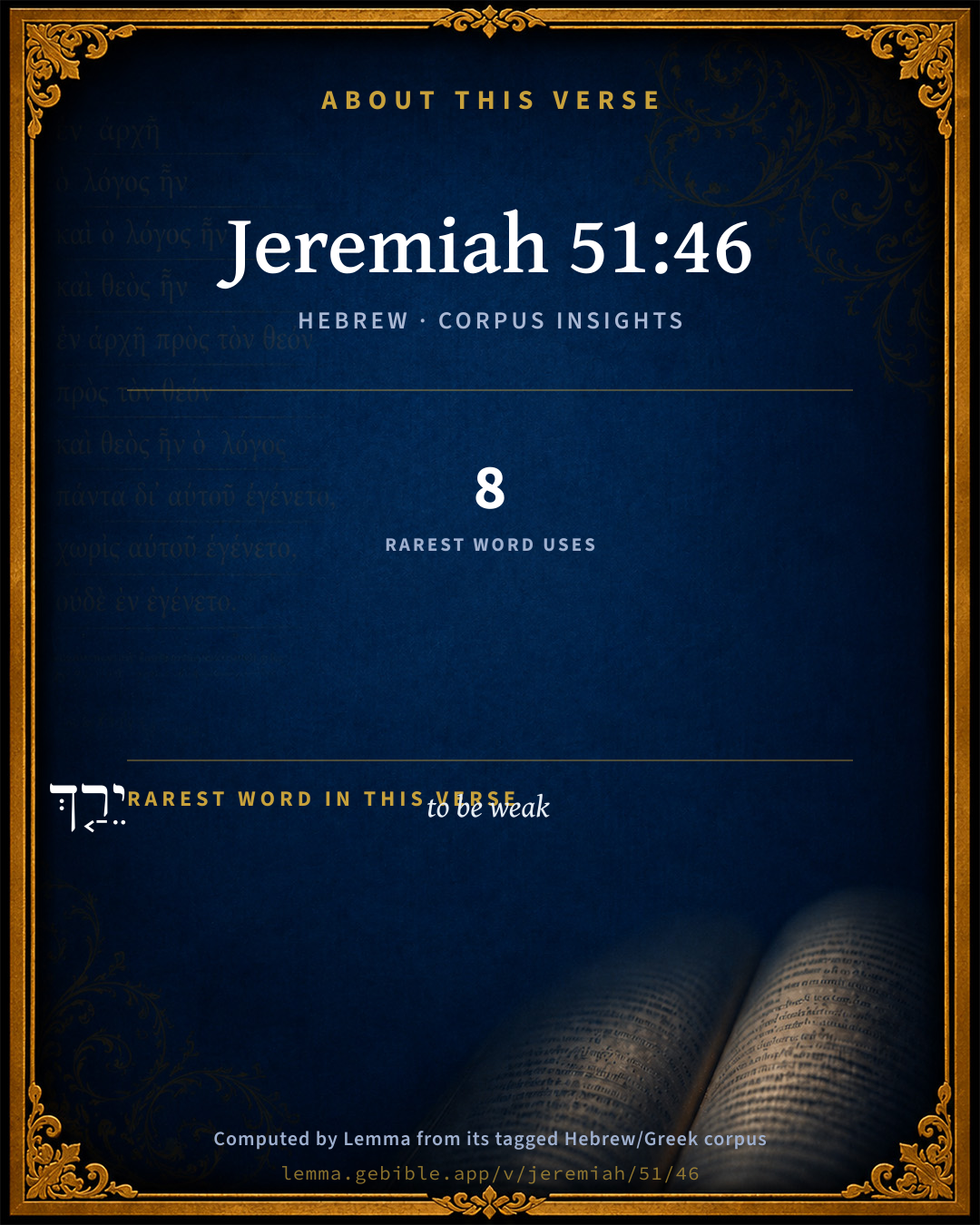
The rarest word here is יֵרַ֤ךְ to be weak H7401 — appearing just 8 times in the whole Hebrew Bible.

Shared distinctive vocabulary

יֵרַ֤ךְ to be weak H7401 occurs in 8 verses of the Hebrew Bible. Also found in:

Grammatical profile

  • 6 verbs
  • 9 nouns
  • 2 prepositions
  • 1 conjunction

Verb forms

  • יֵרַ֤ךְ Qal · Imperfect
  • וְתִֽירְא֔וּ Qal · Imperfect
  • הַנִּשְׁמַ֣עַת Niphal · Participle Active
  • וּבָ֧א Qal · Sequential Perfect
  • וּמֹשֵׁ֖ל Qal · Participle Active
  • מֹשֵֽׁל Qal · Participle Active

Repetition

Words recur within this verse — often emphatic in Hebrew:

  • בַּשְּׁמוּעָ֖ה report H8052 ×3
  • בָּאָ֑רֶץ land H776 ×2
  • בַשָּׁנָ֣ה year H8141 ×2
  • וּמֹשֵׁ֖ל to rule H4910 ×2

Cross-references

12

Topical passages linked to Jeremiah 51:46 in the Treasury of Scripture Knowledge — connected by theme and wording, ordered by reader-vote popularity; previews shown in the World English Bible.

  • 2 Kings 19:7 Behold, I will put a spirit in him, and he shall hear news, and shall return to his own land; and I will cause him to fall by the sword in his own land.
  • Isaiah 13:3–5 I have commanded my consecrated ones, yes, I have called my mighty men for my anger, even my proudly exulting ones.
  • Isaiah 19:2 I will stir up the Egyptians against the Egyptians: and they shall fight everyone against his brother, and everyone against his neighbor; city against city, [and] kingdom against kingdom.
  • Isaiah 21:2–3 A grievous vision is declared to me; the treacherous man deals treacherously, and the destroyer destroys. Go up, Elam; besiege, Media; all the sighing of it have I made to cease.
  • Judges 7:22 They blew the three hundred trumpets, and Yahweh set every man's sword against his fellow, and against all the host; and the host fled as far as Beth-shittah toward Zererah, as far as the border of Abel Meholah, by Tabbath.
  • 1 Samuel 14:16–20 The watchmen of Saul in Gibeah of Benjamin looked; and, behold, the multitude melted away, and they went [here] and there.
  • 2 Chronicles 20:23 For the children of Ammon and Moab stood up against the inhabitants of Mount Seir, utterly to kill and destroy them: and when they had made an end of the inhabitants of Seir, everyone helped to destroy another.
  • Mark 13:7–8 "When you hear of wars and rumors of wars, don't be troubled. For those must happen, but the end is not yet.
  • Luke 21:9–19 When you hear of wars and disturbances, don't be terrified, for these things must happen first, but the end won't come immediately."
  • Luke 21:28 But when these things begin to happen, look up, and lift up your heads, because your redemption is near."
  • Matthew 24:6–8 You will hear of wars and rumors of wars. See that you aren't troubled, for all this must happen, but the end is not yet.
  • Jeremiah 46:27 But don't be afraid you, Jacob my servant, neither be dismayed, Israel: for, behold, I will save you from afar, and your seed from the land of their captivity; and Jacob shall return, and shall be quiet and at ease, and none shall make him afraid.

Cross-references courtesy of OpenBible.info (CC BY 4.0).

Hebrew and Greek witnesses Masoretic Hebrew ↔ Greek Septuagint

The same verse in the two great witnesses to the Old Testament, shown verse-for-verse.

These are two independent witnesses, not word-aligned to each other, and the Septuagint is shown in lemma (dictionary) form.

Hebrew Jeremiah 51:46 Masoretic · Westminster Leningrad Codex

וּפֶן יֵרַ֤ךְ לְבַבְכֶם֙ וְתִֽירְא֔וּ בַּשְּׁמוּעָ֖ה הַנִּשְׁמַ֣עַת בָּאָ֑רֶץ וּבָ֧א בַשָּׁנָ֣ה הַשְּׁמוּעָ֗ה וְאַחֲרָ֤יו בַּשָּׁנָה֙ הַשְּׁמוּעָ֔ה וְחָמָ֣ס בָּאָ֔רֶץ וּמֹשֵׁ֖ל עַל מֹשֵֽׁל

Don't let your heart faint, neither fear for the news that shall be heard in the land; for news shall come one year, and after that in another year [shall come] news, and violence in the land, ruler against ruler.

World English Bible · Public Domain

Greek LXX Structure differs

In the Septuagint, Jeremiah is about an eighth shorter than the Hebrew and arranges its material differently — the Oracles Against the Nations (Hebrew chapters 46–51) appear in the middle of the Greek book, after 25:13. Because the chapter and verse boundaries do not line up, a verse-for-verse comparison with the Hebrew is not shown.

A verse-for-verse comparison isn’t shown here because the chapters and verses don’t line up. Switch to the LXX edition with the MT / LXX toggle above to read the Greek directly.

Hebrew: Westminster Leningrad Codex (CC BY 4.0). Greek: Septuagint (public domain); English from a public-domain English Septuagint. How the Septuagint differs from the Hebrew →

Targum (Aramaic paraphrase)

1

The Targum is the ancient Jewish Aramaic paraphrase of the Hebrew Scriptures — an interpretive translation, not the Hebrew text itself. Onkelos (literal) and Pseudo-Jonathan (expansive) render the Torah, and Jonathan the Prophets. Coverage is partial: where no permissively-licensed English translation exists for a verse, only the Aramaic is shown. This is verse-level text, not a word-by-word alignment to the Hebrew.

  1. Targum Jonathan Prophets (Joshua–Malachi)
    וְדִלְמָא יְזוּעַ לִבְּכוֹן וְתִדַחֲלוּן מִן קֳדָם בְּסוֹרָתָא דְתִשְׁתְּמַע בְּאַרְעָא וְתֵיתֵי בְשַׁתָּא בְסוֹרְתָא וּבַתְרוֹהִי בְּשַׁתָּא בְסוֹרְתָּא וְיִסְגוֹן חֲטוּפִין בְּאַרְעָא וִיקוּם שִׁלְטוֹן עַל שִׁלְטוֹן:

    (no public-domain English translation for this verse)

    Targum Jonathan — Aramaic: “Mikraot Gedolot” (public domain). English: “Sefaria Community Translation” (CC0 1.0 (public-domain dedication)); “London "Chaldee Paraphrase," 1871” (public domain). Text via Sefaria.

Commentary

Notes on Jeremiah 51:46 from classic Christian and Jewish commentators (each source and its license shown beneath its notes). The classic Christian expositions comment on the surrounding passage and are grouped to its opening verse, so a note may address several verses; the Jewish commentaries on the Tanakh (Rashi and others) are per-verse, so they appear only where the commentator wrote on this verse.

Lemma curates 59 commentaries, every one of them public domain or Creative Commons licensed, each selected and text-cleaned for this edition rather than reprinted as found. About our sources →

Trapp's Complete Commentary

John Trapp

Jer 51:46 And lest your heart faint, and ye fear for the rumour that shall be heard in the land; a rumour shall both come [one] year, and after that in [another] year [shall come] a rumour, and violence in the land, ruler against ruler.

Ver. 46. And lest your heart faint.] Or, And let not your hearts faint.

And ye fear for the rumour,] sc., Of Cyrus’s coming. Fear it not, all is for the best to you; your redemption draweth nigh.

A rumour shall both come one year,] sc., Of Cyrus’s preparation, and then another of his expedition toward Babylon.

Ruler against ruler,] i.e., Cyrus against Belshazzar; so Constantine against Maxentius, Maximinus, Lucinius, &c.; this was for the best to the poor Church of Christ.

John Trapp, A Commentary or Exposition upon All the Books of the Old and New Testament (1647–1656) — public domain. Text from a community e-Sword module.

Tyndale Open Study Notes

Tyndale Open Resources

51:46 Violence will erupt: As an enemy army headed toward Babylon, the leaders inside the city were blaming each other. Vicious in-fighting was tearing Babylon apart.

Tyndale Open Study Notes — © Tyndale Open Resources, licensed CC BY-SA 4.0. Text via the HelloAO Bible API.

Geneva Bible (1599)

Geneva Bible translators

Meaning, that Babylon should not be destroyed all at once, but little by little should be brought to nothing: for the first year came the tidings, the next year the siege, and in the third year it was taken: yet this is not that horrible destruction which the prophets threatened in many places: for that was after this when they rebelled and Darius overcame them by the policy of Zopyrus, and hanged three thousand gentlemen besides the common people.

Geneva Bible (1599) marginal notes — public domain. Text via Bolls.life.

Jamieson, Fausset & Brown

Robert Jamieson, A. R. Fausset & David Brown

And lest--Compare, for the same ellipsis, Gen 3:22; Exo 13:17; Deu 8:12. "And in order that your heart may not faint at the (first) rumor" (of war), I will give you some intimation of the time. In the first "year" there shall "come a rumor" that Cyrus is preparing for war against Babylon. "After that, in another year, shall come a rumor," namely, that Cyrus is approaching, and has already entered Assyria. Then is your time to "go out" (Jer 51:45). Babylon was taken the following or third year of Belshazzar's reign [GROTIUS].

violence in the land--of Babylon (Psa 7:16).

ruler against ruler--or, "ruler upon ruler," a continual change of rulers in a short space. Belshazzar and Nabonidus, supplanted by Darius or Cyaxares, who is succeeded by Cyrus.

Jamieson, Fausset & Brown — Commentary Critical and Explanatory on the Whole Bible (1871) — public domain (CC PDM 1.0). Text via the HelloAO Bible API.

Adam Clarke's Commentary

Verse 46. A rumour shall - come one year] A year before the capture of the city there shall be a rumour of war, - and in that year Belshazzar was defeated by Cyrus. In the following year the city was taken.

Adam Clarke's Commentary on the Bible (1810–1826) — public domain. Text from a community e-Sword/MySword module.

John Calvin's Commentaries

Here the Prophet in due time anticipates a danger, lest the Jews should be disturbed in their minds, when they saw those dreadful shakings which afterwards happened; for when their minds were raised to an expectation of a return, great commotions began to arise in Babylon. Babylon, as it is well known, was for a long time besieged, and, as is usual in wars, every day brings forth something new. As, then, God, in a manner, shook the whole land, it could not be, especially under increasing evils, but that the miserable exiles should become faint, being in constant fear; for they were exposed to the wantonness of their enemies. Then the Prophet seasonably meets them here, and shows that there was no cause for them to be disturbed, whatever might happen.

Come, he says, and rise shall various rumors; but stand firm in your minds. Interpreters confine these rumors to the first year of Belshazzar; but I know not whether such a view is correct. I consider the words simply intended to strengthen weak minds, lest they should be overwhelmed, or at least vacillate, through trials, when they heard of grievous commotions.

But there is a doctrine here especially useful; for when God designs to aid his Church, he suffers the world to be, in a manner, thrown into confusion, that the favor of redemption may appear more remarkable. Unless, then, the faithful were to have some knowledge of God’s mercy, they could never endure with courageous minds the trials by which God proves them, and while Satan, on the other hand, seeks to upset their faith. There is the prelude of this very thing to be seen in the ancient people: God had promised to be their redeemer; when the day drew nigh, war suddenly arose, and the Medes and the Persians, as locusts, covered the whole land. We know what various evils war brings with it. There is, then, no doubt but that the children of God sustained many and grievous troubles, especially as they were exiles there; they must have suffered want, they must have been harassed in various ways. Now, as the event of war was uncertain, they might have fainted a hundred times, had they not been supported by this prophecy. But, as I have said, so now also God deals with his Church; for when a deliverer appears, all things seem to threaten ruin rather than to promise a joyful and happy deliverance. It is then necessary, that these prophecies should come to our minds, and that we should apply, for our own benefit, what happened formerly to our fathers, for we are the same body. There is, therefore, no reason for us at this day to wonder, if all things seem to get worse and worse, when yet God has promised that the salvation of his Church will ever be precious to him, and that he will take care of her: how so? because it is said, Let not your heart be faint, fear ye not when rumors arise, one after another; when one year brings tumults, and then another year brings new tumults, yet let not all this disturb your minds.

And Christ seems to allude to these words of the Prophet, when he says,

“Wars shall arise, and rumors of wars: be ye not troubled.” (Matthew 24:6)

These words of Christ sufficiently warn us not to think it strange, if the Church at this day be exposed to violent waves, and be tossed as by continual storms: why so? because it is right and just that our condition should be like that of the fathers, or at least approach to it. We now, then, understand the design of the Prophet, and the perpetual use that ought to be made of what is here taught.

He afterwards adds, Violence in the land, and a ruler upon or after a ruler. This refers to Cyrus, who succeeded Darius, whom some call Cyaxares. They, indeed, as it is well known, both ruled; but Darius, who was older, had the honor of being the supreme king. Afterwards Cyrus, when Darius was dead, became the king of the whole monarchy. And Darius the Mede lived only one year after Babylon was taken. But I doubt not but that the Prophet here bids the Jews to be of good courage and of a cheerful mind, though the land should often change its masters; for that change, however often, could take away nothing from God’s authority and government. It afterwards follows, —

John Calvin's Commentaries (1540-1563) — public domain. Text from the Calvin Translation Society English edition (1840s-50s) via the Christian Classics Ethereal Library (ccel.org). Calvin's coverage is partial (roughly two-thirds of the Bible); uncommented books and verses are honest gaps, never fabricated. The 19th-century editor's footnotes and remarks are omitted so the notes are faithfully Calvin's own voice.

Ellicott's Commentary for English Readers

(46) And lest your heart faint . . .—Better, Let not your heart faint; fear ye not . . .

For the rumour that shall be heard in the land.—It lies in the nature of the case that the final catastrophe of the city would be preceded by a period of uncertainty and suspense. Men would hear of the union of the Medes and Persians under Cyrus, of the murder of Evil-Merodach by Neriglissar, of the death of Neriglissar in fighting against the enemy (B.C. 555). The child-king, whom Berosus calls Laborosoarchod, was dethroned by his nobles after a few months, and was succeeded by the father of the Belshazzar of Dan_5:1, the Labynetus of Herodotus, whose true name was Nabo-nahid. The whole empire was in the throes of dissolution. The words present a singular parallel to those which speak of “wars and rumours of wars” in Mat_24:6-7; Luk_21:9.

A Bible Commentary for English Readers, edited by Charles John Ellicott (1878–1897) — public domain. Text from a community e-Sword module.

The Cambridge Bible for Schools and Colleges

gen. ed. J. J. S. Perowne

46. a rumour … a rumour] Rumour shall succeed rumour, as the years go on, and disquieting revolts shall foreshadow the final break-up of the Babylonian empire.

The Cambridge Bible for Schools and Colleges (gen. ed. J. J. S. Perowne; Cambridge University Press, 1878–1918) — public domain. Text from a community e-Sword module.

John Gill's Exposition

Then the heaven and the earth, and all that is therein,

shall sing for Babylon,.... At the destruction of her, rejoicing at it; not at the ruin of fellow creatures, simply considered; but relatively, at the righteousness of God in it, and the glory of his justice, and the deliverance of many by it from tyranny and bondage. This seems to be a figurative expression often used, in which the heavens and the earth are brought in as witnesses, approvers, and applauders, of what is done by the Lord. Some indeed interpret it of the angels, the inhabitants of the heavens, and of the Jews, dwellers on earth; and others of the church of God, in heaven and in earth; which, of the two, seems best; the like will be done at the fall of mystical Babylon, Rev 18:20;

for the spoilers shall come unto her from the north, saith the Lord; the Medes and Persians that should and did spoil and plunder Babylon; and who came from countries that lay north to it.

John Gill's Exposition of the Whole Bible (1746–1763) — public domain (CC PDM 1.0). Text via the HelloAO Bible API.

Albert Barnes' Notes on the Bible

Literally, “And beware lest your heart faint, and ye be afraid because of the rumour that is heard in the land: for in one year shall one rumour come, and afterward in another year another rumour; and violence shall be in the land etc.” The fall of Babylon was to be preceded by a state of unquiet, men’s minds being unsettled partly by rumors of the warlike preparations of the Medes, and of actual invasions: partly by intestine feuds. So before the conquest of Jerusalem by the Romans the Church had similar warnings Mat 24:6-7.

Albert Barnes' Notes on the Bible (1834–1885) — public domain. Text from a community e-Sword/MySword module.

Haydock's Catholic Bible Commentary

Faint. You may apprehend that your miseries will increase in the midst of such confusion; but no, Baltassar, the last of your oppressor’s race, shall be assassinated by Neriglissor, who will be succeeded by Laborosoarchod and Nabonides. This last shall yield to Cyrus, who well grant you liberty. Baltassar reigned two years, Neriglissor four, his ill-tempered infant son nine months, when his followers murdered him, and gave the crown to a Babylonian called Nabonides, who kept it seventeen years, till Cyrus took him prisoner. This we learn from Berosus, quoted by Josephus, contra Apion i. On the other hand Daniel makes Darius, the Mede, succeed Baltassar, and after him Cyrus reigned. To these changes and continual alarms the prophet alludes.

George Leo Haydock (1774–1849), Haydock's Catholic Family Bible and Commentary, 1859 edition — public domain. Excludes Psalms (Douay-Rheims chapter numbering differs from Protestant) and Deuterocanonical books (Catholic canon only).

Matthew Poole's English Annotations

And lest your heart faint; and lest they should be affrighted by the succession of evils year after year that should come on Babylon. Some think it were better translated, And let not your heart faint. Though you should hear of Cyrus’s coming year after year, yet faint not; (for they say Cyrus was one year preparing, and that he spent the second year in passing through Assyria, so as he came not at Babylon till the third year;) no, not though you should see or hear of successive troubles, and a great deal of violence in the land by the opposition of great princes one to another, for none of them shall do you any harm; but this doth not so well suit to the former verse, where they are bidden to make haste out and to save their own lives. I do therefore prefer the sense of our interpreters, and their translation of it, as making another argument to persuade them to make haste out, because they would by reason of the successive evils year after year coming upon the Babylonians live there very troublesome and uneasy lives.

Matthew Poole's English Annotations on the Holy Bible (1683–1685) — public domain. Text from a community e-Sword/MySword module.

Whedon's Commentary on the Bible

Daniel D. Whedon

46. And lest your heart faint — In order that the sense here may come out into expression, some such word as beware should be employed. Beware lest your heart faint.

Daniel D. Whedon (gen. ed.), Commentary on the Old and New Testaments (1874–1909) — public domain. Text from a community e-Sword module.

The Pulpit Commentary

And lest your heart faint, etc.; rather, and (beware) lest, etc. A rumour shall both come; rather, for a rumour shall come. The war, then, will last some time, and all kinds of rumours will be in the air. Keil compares Mat_24:6.

The Pulpit Commentary (1880–1919), ed. H.D.M. Spence-Jones & Joseph S. Exell — public domain. Text from a community e-Sword module.

Keil & Delitzsch

C. F. Keil & F. Delitzsch

Yet they are not to despair when the catastrophe draws near, and all kinds of rumours of war and oppression are abroad. The repetition of השּׁמוּעה expresses the correlative relation, - this and that report; cf. Ewald, 360, c. The suffix in אחריו has a neuter sense; the word means "afterwards" (= אחרי זאת, Job 42:16). וחמס בּארץ is also to be taken as dependent, grammatically, on וּבא: "and when a deed of violence is committed in the land, one ruler (rises up) against the other." These words presuppose not merely a pretty long duration of the war, but also rebellion and revolution, through which Babylon is to go to ruin. In this sense they are employed by Christ for describing the wars and risings that are to precede His advent; Mat 24:6; Mar 13:7; Luk 21:9.

Keil & Delitzsch — Biblical Commentary on the Old Testament (1861–1891) — public domain (CC PDM 1.0). Text via the HelloAO Bible API. (Old Testament only.)

Rashi

Rabbi Shlomo Yitzchaki (Rashi)

because of the rumor that is heard in the land This rumor concerning Belshazzar that he was slain.

for a rumor shall come one year In that very year there will come a rumor that Babylon has been destroyed by itself from heaven as it is stated: “And Babylon, the beauty of the kingdoms the glory of the pride of the Chaldee, shall be like God’s overturning of Sodom and Gemorrah” (Isa. 13: 19).

and after it in a year [In] the second [year].

a rumor that is good for you [viz.] “So said Cyrus, the king of Persia..., Whoever among you of all His people...” (Ezra 1:2f).

and one ruler upon another ruler Darius the Mede reigned one year, and in the second year Cyrus the Persian.

Rashi on the Tanakh — English translations: “The Judaica Press complete Tanach with Rashi, translated by A. J. Rosenberg” (CC BY 4.0); “Pentateuch with Rashi's commentary by M. Rosenbaum and A.M. Silbermann, 1929-1934” (public domain); “The Metsudah Tanach series, Lakewood, N.J” (CC BY 4.0); and “The Book of Joshua, Metsudah Publications, 1997” (CC BY 4.0). Text via Sefaria.

Lesson kit

Teaching starters — assembled from the data on this page, not authored interpretation. Every prompt links to the verse data it draws on. Edit before teaching.

Jeremiah, in the Prophets, opens this verse with 18 words (13 distinct Hebrew lemmas). Its most distinctive word is râkak (“to be weak”). A historical commentator’s framing appears above. Read the whole chapter for the surrounding context.

Discussion questions

  1. How does “to be weak” (râkak) shape what this verse is saying?
  2. How does Deuteronomy 20:3, which shares the word «to be weak», read alongside this verse?
  3. What does the repetition of “report” (3× in this one verse) do in this verse?
  4. These translations render this verse differently; the difference is in the English rendering, not the original. What questions does that raise?
  5. «יֵרַ֤ךְ» is a Qal Imperfect verb. How does that grammatical form shape the action described?
  6. Compare how Trapp's Complete Commentary and Tyndale Open Study Notes read this verse. Where do they agree or differ?

Things to notice

Reading settings

Reading text

Shown beneath each verse's original-language words.

Old Testament
Old Testament edition

Read the OT as the Masoretic Hebrew (MT) or the Greek Septuagint (LXX).

English shown for the Greek Septuagint (in the Hebrew ↔ Greek comparison).

Comparing translations? Open the Compare panel on any verse page to stack up to four side by side.